

The DOI matches its Crossref record; 6 of the 6 references it cites were found in a registry or an index.
Neighbourhoods and potential access to health care: The role of spatial and aspatial factors
Overview
The claims and statistics of this paper haven’t been checked yet.
Run the check — free, no account needed. It reads the open-access text and checks the sources it cites.
Integrity signals
Registry
Cites
Statistics
Figures

Verification
Claims the paper makes
The claims and statistics of this paper haven’t been checked yet.
Run the check — free, no account needed. It reads the open-access text and checks the sources it cites.
Claims other papers make about this one
Each is checked against this paper’s own text: does it say what the citing paper says it does?
The check wasn’t confident either way, so it gives no verdict — never disputed.
In the citing paper
“However, sepsis data from a range of former British colonies that track sepsis incidence by race/ethnicity and class supports the notion that people with racialized/minoritized identities in colonized states also disproportionately experience sepsis for reasons other than income access to healthcare”
From On race, human variation, and who gets and dies of sepsis (2022) · cites this paper as Bissonnette et al., 2012
Experimental — accuracy not yet measuredIn the citing paper
“racialized identity negatively affects health and immunity both acutely and chronically, directly (e.g., experience of racist remarks can spur or worsen asthma attacks, raise blood pressure, alter infection course) and indirectly (decreased employment, lower income, healthcare, and food options)”
From On race, human variation, and who gets and dies of sepsis (2022) · cites this paper as Bissonnette et al., 2012
In the citing paper
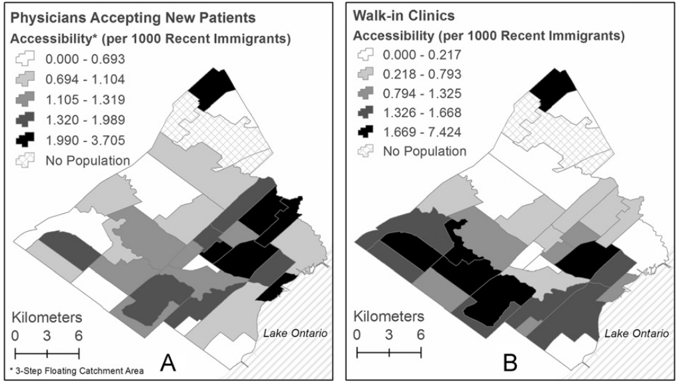
“Access to health care in the Toronto region is noted to be lowered for language minorities and recent immigrants, who tend to experience more difficulty accessing primary care physicians rather than walk‐in clinic care because fewer primary care physicians have offices in language minority and immigrant neighborhoods (Bissonnette et al., 2012).”
From On race, human variation, and who gets and dies of sepsis (2022) · cites this paper as Bissonnette et al., 2012
Self-check
Percentages, sums and reported differences re-computed from the paper’s own numbers.
The self-check needs the paper’s full text.
Citations
Cites
Morland, K., Wing, S., & Roux, A. D. (2002) · American Journal of Public Health · doi:10.2105/ajph.92.11.1761 · Cited by 1,289
Neighborhood Environments and Coronary Heart Disease: A Multilevel Analysis
Diez-Roux, A. V., Nieto, F. J., Muntaner, C., Tyroler, H. A., Comstock, G. W., Shahar, E., Cooper, L. S., Watson, R. L., & Szklo, M. (1997) · American Journal of Epidemiology · doi:10.1093/oxfordjournals.aje.a009191 · Cited by 744
Body mass index in elementary school children, metropolitan area food prices and food outlet density
Sturm, R., & Datar, A. (2005) · Public Health · doi:10.1016/j.puhe.2005.05.007 · Cited by 380
Neighbourhood effects on health: Does it matter where you draw the boundaries?
Flowerdew, R., Manley, D. J., & Sabel, C. E. (2008) · Social Science & Medicine · doi:10.1016/j.socscimed.2007.11.042 · Cited by 331
Auchincloss, A. H., Diez Roux, A. V., Brown, D. G., Erdmann, C. A., & Bertoni, A. G. (2008) · Epidemiology · doi:10.1097/ede.0b013e31815c480 · Cited by 167
The relationship between the neighbourhood environment and adverse birth outcomes
Farley, T. A., Mason, K., Rice, J., Habel, J. D., Scribner, R., & Cohen, D. A. (2006) · Paediatric and Perinatal Epidemiology · doi:10.1111/j.1365-3016.2006.00719.x · Cited by 149
Research works printed but not linked: 88
- Aday, 1974, A framework for the study of access to medical care, Health Services Research, 9, 208
- Andersen, 1983, Exploring dimensions of access to medical care, Health Services Research, 18, 49
- Apparicio, 2008, Comparing alternative approaches to measuring the geographical accessibility of urban health services: distance types and aggregation-error issues, International Journal of Health Geographics, 7, 7, 10.1186/1476-072X-7-7 · DOI
- Asanin, 2008, I spent nine years looking for a doctor: exploring access to health care among immigrants in Mississauga, ON, Canada, Social Science & Medicine, 66, 1271, 10.1016/j.socscimed.2007.11.043 · DOI
- Bell, S., Wilson, K., Bissonette, L., Shah, T.I., Access to primary health care: does neighbourhood of residence matter? Annal of the Association of American Geographers, in press. · DOI
- Boardman, 2001, Neighborhood disadvantage, stress, and drug use among adults, Journal of Health and Social Behavior, 42, 151, 10.2307/3090175 · DOI
- Brabyn, 2004, Population need and geographical access to general practitioners in rural New Zealand, Journal of the New Zealand Medical Association, 117, 1199
- Briggs, 2009, Uncertainty in epidemiology and health risk and impact assessment, Environmental Geochemistry and Health, 31, 189, 10.1007/s10653-008-9214-5 · DOI
- Brown, 2002, Walk-in clinics in Ontario: an atmosphere of tension, Canadian Family Physician, 48, 531
- Buka, 2003, Neighborhood support and the birth weight of urban infants, American Journal of Epidemiology, 157, 1, 10.1093/aje/kwf170 · DOI
- Campbell, 2001, Identifying predictors of high quality care in English general practice: observational study, British Medical Journal, 323, 784, 10.1136/bmj.323.7316.784 · DOI
- Charreire, 2009, Poor prenatal care in an urban area: a geographic analysis, Health & Place, 15, 412, 10.1016/j.healthplace.2008.07.005 · DOI
- Cordasco, 2011, English language proficiency and geographical proximity to a safety net clinic as a predictor of health care access, Journal of Immigrant and Minority Health, 13, 260, 10.1007/s10903-010-9425-6 · DOI
- De Marco, 2010, Conceptualization and measurement of the neighborhood in rural settings: a systematic review of the literature, Journal of Community Psychology, 38, 99, 10.1002/jcop.20354 · DOI
- Diez Roux, 2001, Investigating neighborhood and area effects on health, American Journal of Public Health, 91, 1783, 10.2105/AJPH.91.11.1783 · DOI
- Duncan, 1999, Smoking and deprivation: are there neighbourhood effects?, Social Science & Medicine, 48, 497, 10.1016/S0277-9536(98)00360-8 · DOI
- Duncan, 2002, A multilevel analysis of neighborhood context and youth alcohol and drug problems, Prevention Science, 3, 125, 10.1023/A:1015483317310 · DOI
- Ecob, 2000, Small area variations in health related behaviours; do these depend on the behaviour itself, its measurement, or on personal characteristics?, Health & Place, 6, 261, 10.1016/S1353-8292(00)00008-3 · DOI
- Finkelstein, 2003, Relation between income, air pollution and mortality: a cohort study, Canadian Medical Association Journal, 169, 397
- Fisher, 2004, Neighborhood-level influences on physical activity among older adults: a multilevel analysis, Journal of Aging and Physical Activity, 12, 45, 10.1123/japa.12.1.45 · DOI
- Frohlich, 2002, Youth smoking initiation: disentangling context from composition, Health & Place, 8, 155, 10.1016/S1353-8292(02)00003-5 · DOI
- Galster, 2001, On the nature of neighbourhood, Urban Studies, 38, 2111, 10.1080/00420980120087072 · DOI
- Garner, 1991, Neighborhood effects on educational attainment: a multilevel analysis, Sociology of Education, 64, 251, 10.2307/2112706 · DOI
- Gauvin, 2008, Association between neighborhood active living potential and walking, American Journal of Epidemiology, 167, 944, 10.1093/aje/kwm391 · DOI
- Giles-Corti, 2002, Socioeconomic status differences in recreational physical activity levels and real and perceived access to a supportive physical environment, Preventive Medicine, 35, 601, 10.1006/pmed.2002.1115 · DOI
- Goodman, 2003, Primary care service areas: a new tool for the evaluation of primary care services, Health Services Research, 38, 287, 10.1111/1475-6773.00116 · DOI
- Guagliardo, 2004, Physician accessibility: an urban case study of pediatric providers, Health & Place, 10, 273, 10.1016/j.healthplace.2003.01.001 · DOI
- Haggerty, 2008, Practice features associated with patient-reported accessibility, continuity, and coordination of primary health care, The Annals of Family Medicine, 6, 116, 10.1370/afm.802 · DOI
- Harrison, 2007, The population effect of crime and neighbourhood on physical activity: an analysis of 15,461 adults, Journal of Epidemiology and Community Health, 61, 34, 10.1136/jech.2006.048389 · DOI
- Haynes, 2007, Modifiable neighbourhood units, zone design and residents' perceptions, Health & Place, 13, 812, 10.1016/j.healthplace.2007.01.002 · DOI
- Haynes, 2003, Potential accessibility, travel time, and consumer choice: geographical variations in general medical practice registrations in Eastern England, Environment and Planning A, 35, 1733, 10.1068/a35165 · DOI
- Henderson, 2005, Neighbourhood characteristics, individual level socioeconomic factors, and depressive symptoms in young adults: the CARDIA study, Journal of Epidemiology and Community Health, 59, 322, 10.1136/jech.2003.018846 · DOI
- Herbert, 1976, The study of delinquency areas: a social geographical approach, Transactions of the Institute of British Geographers, 1, 472, 10.2307/621904 · DOI
- Hiscock, 2008, Is neighborhood access to health care provision associated with individual-level utilization and satisfaction?, Health Services Research, 43, 2183, 10.1111/j.1475-6773.2008.00877.x · DOI
- Hyman, 2000, Negative consequences of acculturation on health behaviour, social support and stress among pregnant Southeast Asian immigrant women in Montreal: an exploratory study, Canadian Journal of Public Health, 91, 357, 10.1007/BF03404807 · DOI
- Jaffee, 2003, An ecological analysis of racial differences in low birthweight: implications for maternal and child health social work, Health and Social Work, 28, 9, 10.1093/hsw/28.1.9 · DOI
- Kallus, 2000, What is a neighbourhood? The structure and function of an idea, Environment and Planning B, 27, 815, 10.1068/b2636 · DOI
- Kawachi, 1999, Social capital and self-rated health: a contextual analysis, American Journal of Public Health, 89, 1187, 10.2105/AJPH.89.8.1187 · DOI · Paper page
- Kendrick, 2005, Relationships between child, family and neighbourhood characteristics and childhood injury: a cohort study, Social Science & Medicine, 61, 1905, 10.1016/j.socscimed.2005.04.003 · DOI
- Khan, 1992, An integrated approach to measuring potential spatial access to health care services, Socio-Economic Planning Sciences, 26, 275, 10.1016/0038-0121(92)90004-O · DOI
- Kindig, 1989, The adequacy of physician supply in small rural counties, Health Affairs, 8, 63, 10.1377/hlthaff.8.2.63 · DOI
- Kirby, 2005, Neighborhood socioeconomic disadvantage and access to health care, Journal of Health and Social Behavior, 46, 15, 10.1177/002214650504600103 · DOI
- Kirby, 2006, Access to health care: does neighborhood residential instability matter?, Journal of Health and Social Behavior, 47, 142, 10.1177/002214650604700204 · DOI
- Kleinschmidt, 1995, Smoking behaviour can be predicted by neighbourhood deprivation measures, Journal of Epidemiology and Community Health, 49, S72, 10.1136/jech.49.Suppl_2.S72 · DOI
- Korda, 2007, Differential impacts of health care in Australia: trend analysis of socioeconomic inequalities in avoidable mortality, International Journal of Epidemiology, 36, 157, 10.1093/ije/dyl282 · DOI
- Kubzansky, 2005, Neighborhood contextual influences on depressive symptoms in the elderly, American Journal of Epidemiology, 162, 253, 10.1093/aje/kwi185 · DOI
- Lambrew, 1996, The effects of having a regular doctor on access to primary care, Medical Care, 34, 138, 10.1097/00005650-199602000-00006 · DOI · Paper page
- Lasser, 2006, Access to care, health status, and health disparities in the United States and Canada: results of a cross-national population-based survey, American Journal of Public Health, 96, 1300, 10.2105/AJPH.2004.059402 · DOI
- Law, 2005, Meeting health need, accessing health care: the role of neighbourhood, Health & Place, 11, 367, 10.1016/j.healthplace.2004.05.004 · DOI
- Lebel, 2007, A multi-perspective approach for defining neighbourhood units in the context of a study on health inequalities in the Quebec city region, International Journal of Health Geographics, 6, 27, 10.1186/1476-072X-6-27 · DOI
- Lee, 2002, Neighborhood context and youth cardiovascular health behaviors, American Journal of Public Health, 92, 428, 10.2105/AJPH.92.3.428 · DOI
- Li, 2005, Multilevel modelling of built environment characteristics related to neighbourhood walking activity in older adults, Journal of Epidemiology and Community Health, 59, 558, 10.1136/jech.2004.028399 · DOI
- Lopez, 2007, Neighborhood risk factors for obesity, Obesity, 15, 2111, 10.1038/oby.2007.251 · DOI · Paper page
- Lovett, 2002, Car travel time and accessibility by bus to general practitioner services: a study using patient registers and GIS, Social Science & Medicine, 55, 97, 10.1016/S0277-9536(01)00212-X · DOI
- Luo, 2004, Using a GIS-based floating catchment method to assess areas with shortage of physicians, Health & Place, 10, 1, 10.1016/S1353-8292(02)00067-9 · DOI
- Luo, 2009, An enhanced two-step floating catchment area (E2SFCA) method for measuring spatial accessibility to primary care physicians, Health & Place, 15, 1100, 10.1016/j.healthplace.2009.06.002 · DOI
- Luo, 2003, Measures of spatial accessibility to health care in a GIS environment: synthesis and a case study in the Chicago region, Environment and Planning B, 30, 865, 10.1068/b29120 · DOI
- Lurie, 1993, Preventive care for women — does the sex of the physician matter?, New England Journal of Medicine, 329, 478, 10.1056/NEJM199308123290707 · DOI
- Matheson, 2006, Urban neighborhoods, chronic stress, gender and depression, Social Science & Medicine, 63, 2604, 10.1016/j.socscimed.2006.07.001 · DOI
- Mcgrail, 2009, Measuring spatial accessibility to primary care in rural areas: improving the effectiveness of the two-step floating catchment area method, Applied Geography, 29, 533, 10.1016/j.apgeog.2008.12.003 · DOI
- Mississauga, 2009. 2008 growth forecasts — Mississauga Plan Review (Corporate Report). Retrieved January 30, 2012 from. 〈http://www5.mississauga.ca/agendas/planning/2009/01_12_09/Item04GrowthForecasts2008.pdf〉.
- Mobley, 2008, How sensitive are multilevel regression findings to defined area of context?, Medical Care Research and Review, 65, 315, 10.1177/1077558707312501 · DOI
- Moudon, 2005, Cycling and the built environment, a US perspective, Transportation Research Part D: Transport and Environment, 10, 245, 10.1016/j.trd.2005.04.001 · DOI
- Mullins, 1973, Neighbourhood perception and the effects of forced residential mobility, Journal of Sociology, 9, 45, 10.1177/144078337300900210 · DOI
- O'campo, 1997, Neighbourhood risk factors for low birthweight in Baltimore: a multi-level analysis, American Journal of Public Health, 87, 1113, 10.2105/AJPH.87.7.1113 · DOI
- Patel, 2003, Neighborhood context and self-rated health in older Mexican Americans, Annals of Epidemiology, 13, 620, 10.1016/S1047-2797(03)00060-7 · DOI
- Pearce, 2006, Neighbourhoods and health: a GIS approach to measuring community resource accessibility, Journal of Epidemiology and Community Health, 60, 389, 10.1136/jech.2005.043281 · DOI
- Penchansky, 1981, The concept of access: definition and relationship to consumer satisfaction, Medical Care, 19, 127, 10.1097/00005650-198102000-00001 · DOI
- Pollack, 2005, Neighbourhood deprivation and alcohol consumption: does the availability of alcohol play a role?, International Journal of Epidemiology, 34, 772, 10.1093/ije/dyi026 · DOI
- Britt, 2005, Neighborhood level spatial analysis of the relationship between alcohol outlet density and criminal violence, Environmental and Ecological Statistics, 12, 411, 10.1007/s10651-005-1518-3 · DOI
- Rodríguez, 2008, Relation of modifiable neighborhood attributes to walking, Preventive Medicine, 47, 260, 10.1016/j.ypmed.2008.02.028 · DOI
- Rosenthal, 2005, The geographic distribution of physicians revisited, Health Services Research, 40, 1931, 10.1111/j.1475-6773.2005.00440.x · DOI
- Ross, 2004, Neighbourhood influences on health in Montreal, Canada, Social Science Medicine, 59, 1485, 10.1016/j.socscimed.2004.01.016 · DOI
- Russ-Eft, 1979, Identifying components comprising neighborhood quality of life, Social Indicators Research, 6, 349, 10.1007/BF00300654 · DOI
- Sallis, 2009, Neighborhood built environment and income: examining multiple health outcomes, Social Science & Medicine, 68, 1285, 10.1016/j.socscimed.2009.01.017 · DOI
- Sanmartin, 2006, Comparing health and health care use in Canada and the United States, Health Affairs, 25, 1133, 10.1377/hlthaff.25.4.1133 · DOI
- Schempf, 2011, The neighborhood contribution to black-white perinatal disparities: an example from two North Carolina counties, 1999–2001, American Journal of Epidemiology, 174, 744, 10.1093/aje/kwr128 · DOI
- Schuurman, 2010, Measuring potential spatial access to primary health care physicians using a modified gravity model, Canadian Geographer, 54, 29, 10.1111/j.1541-0064.2009.00301.x · DOI
- Stockdale, 2007, The importance of social context: neighborhood stressors, stress-buffering mechanisms, and alcohol, drug, and mental health disorders, Social Science & Medicine, 65, 1867, 10.1016/j.socscimed.2007.05.045 · DOI
- Sundquist, 2004, Neighbourhood deprivation and incidence of coronary heart disease: a multilevel study of 2.6 million women and men in Sweden, Journal of Epidemiology and Community Health, 58, 71, 10.1136/jech.58.1.71 · DOI
- Szwarcwald, 2002, Income inequality, residential poverty clustering and infant mortality: a study in Rio de Janeiro, Brazil, Social Science & Medicine, 55, 2083, 10.1016/S0277-9536(01)00353-7 · DOI
- Wang, 2005, Assessing spatial and nonspatial factors for healthcare access: towards an integrated approach to defining health professional shortage areas, Health & Place, 11, 131, 10.1016/j.healthplace.2004.02.003 · DOI
- Wang, 2007, Immigration, ethnicity, and accessibility to culturally diverse family physicians, Health & Place, 13, 656, 10.1016/j.healthplace.2006.10.001 · DOI
- Wang, 2008, Ethnicity and utilization of family physicians: a case study of Mainland Chinese immigrants in Toronto, Canada, Social Science & Medicine, 67, 1410, 10.1016/j.socscimed.2008.06.012 · DOI
- Weiss, 2007, Defining neighborhood boundaries for urban health research, American Journal of Preventive Medicine, 32, S154, 10.1016/j.amepre.2007.02.034 · DOI
- Wen, 2006, Objective and perceived neighborhood environment, individual SES and psychosocial factors, and self-rated health: an analysis of older adults in Cook County, Illinois, Social Science & Medicine, 63, 2575, 10.1016/j.socscimed.2006.06.025 · DOI
- Witten, 2003, The quality of urban environments: mapping variation in access to community resources, Urban Studies, 40, 161, 10.1080/00420980220080221 · DOI
- Yip, 2002, Individual and neighbourhood determinants of health care utilization. Implications for health policy and resource allocation, Canadian Journal of Public Health, 93, 303, 10.1007/BF03405022 · DOI · Paper page
Cited by
Sorted by citations
Advancing health equity and access using telemedicine: A geospatial assessment
Khairat, S., Haithcoat, T., Liu, S., Zaman, T., Edson, B., Gianforcaro, R., & Shyu, C.-R. (2019) · Journal of the American Medical Informatics Association · doi:10.1093/jamia/ocz108 · Cited by 165
On race, human variation, and who gets and dies of sepsis
Brinkworth, J. F., & Shaw, J. G. (2022) · American Journal of Biological Anthropology · doi:10.1002/ajpa.24527 · Cited by 9
Metadata
- Authors
- Bissonnette, L., Wilson, K., Bell, S., & Shah, T. I.
- Venue
- Health & Place
- Publisher
- Elsevier BV
- Published
- 2012-07
- Volume
- 18
- Issue
- 4
- Pages
- 841-853
- ISSN
- 1353-8292
- Cited by
- 170
- References
- 6
- Language
- en
About these checks
Registry, retraction, Cites and statistics results are computed, not judged, with one exception: a printed reference that no index lists is read once by a model before it counts as a citation error. Claims are extracted by a model and kept only when their quote appears verbatim in the text; each cited source is then checked, with a model’s help, for whether it says what the claim relies on. Those verdicts can be wrong — read the claim’s quote and the cited source before relying on one.
Statistics and arithmetic are recomputed, not judged.
Confidence bands are shown only for fields calibrated on our annotated test set. None is calibrated yet, so no band is shown.
What counts as a claim ›How we measure confidence ›How we check this ›
Are you an author, or do you see a problem with this page? Request a review
