

The application of Herzberg's two-factor theory of motivation to job satisfaction in clinical laboratories in Omani hospitals
Open accessThe DOI matches its Crossref record; 45 of the 45 references it cites were found in a registry or an index; none of the 40 sources its claims cite is checked for support yet.
Abstract
BACKGROUND: Job satisfaction is an important condition for staff retention in most healthcare Organizations. As a concept, job satisfaction is linked to motivation theory. Herzberg's two factor theory of motivation is used in this study to explore what motivational elements are associated with job satisfaction among medical laboratory professionals (MLPs) in Oman. METHODS: A mixed-method approach was adopted, and focus group discussions (FGDs) were used for data collection. The FGDs were conducted in the main hospitals in Oman. Data were analyzed by directed content analysis, and frequencies of statements related to factors were calculated for a comparison with the Herzberg theory. RESULTS: The following job dissatisfaction factors (hygiene) were identified: health and safety, heavy workload, salary, promotion, recognition and organizational policies. The satisfaction (motivators) were: relationships with co-workers, relationship with leaders, and professional development. CONCLUSIONS: The job dissatisfaction reported was resulted from the absence of hygiene factors and some of the motivators in accordance with Hertzberg's theory. Hospital managers need to address these factors, defined by Hertzberg, in order to improve motivation and job satisfaction.
Overview
CoChat Summary
TL;DR
In focus groups with 101 medical laboratory professionals at three Omani hospitals, lack of health and safety, heavy workload, salary, promotion, recognition, and organizational policies emerged as dissatisfiers, while relationships with co-workers/leaders and professional development were satisfiers. Findings largely aligned with Herzberg’s two-factor theory, though recognition appeared as a hygiene factor rather than a motivator.
Key findings
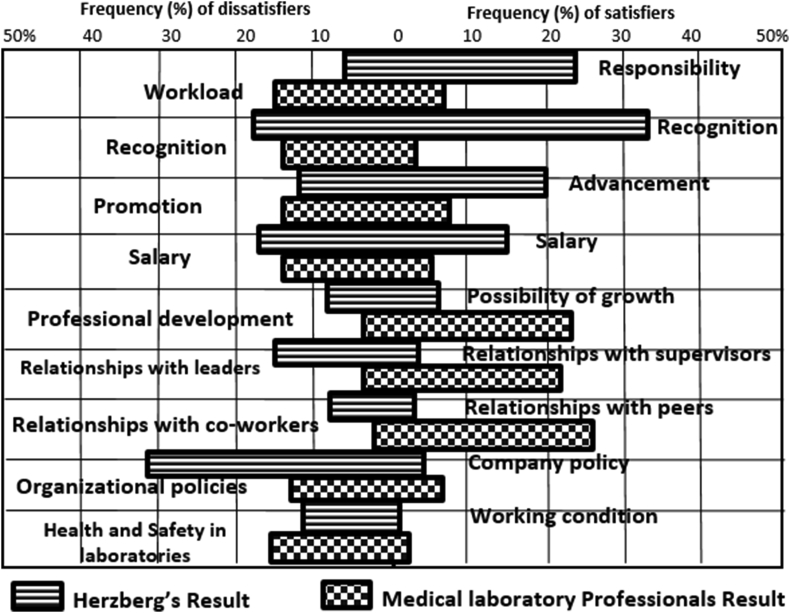
- Job dissatisfaction factors included health and safety (16% dissatisfying vs 2% satisfying), workload (15% vs 7%), salary (14% vs 5%), promotion (14% vs 8%), organizational policies (12% vs 6%), and recognition (12% vs 3%).
- Job satisfaction factors included relationships with co-workers (26% satisfying vs 2% dissatisfying), professional development (22% vs 4%), and relationships with leaders (21% vs 3%).
- The most frequently mentioned source of dissatisfaction was lack of laboratory health and safety, with poor ventilation, exposure to toxic chemicals, samples without biohazard labels, lack of safety officers, and lack of health and safety training.
- Salary and promotion dissatisfaction was linked to the 2014 Medical and Allied Health Personnel Executive Bylaw, perceived unfairness, lack of risk allowance, unclear or delayed promotions, and no differentiation between hard workers and others. Recognition contradicted Herzberg’s theory by acting as a hygiene/dissatisfier rather than a motivator.
Methods
- Mixed-method study using focus group discussions conducted February–June 2017 at Royal, Al Nahdha, and Khoula Hospitals in Oman; 18 groups (nine Royal, five Khoula, four Al Nahdha), each with six to eight participants, totaling 101 medical laboratory professionals from hematology, biochemistry, pathology, and microbiology.
- Discussions followed an interview guide derived from Herzberg’s two-factor theory, lasted 60–90 minutes, and included member checking at the end of each session.
- Data were transcribed and analyzed by directed content analysis; meaning units were condensed into categories and themes, and frequencies of statements were calculated for comparison with Herzberg’s original distribution of motivating and hygiene factors.
Limitations
- The authors state that this was a qualitative study using focus groups, so findings cannot be generalized to the whole population of MLPs, although participants were representative of laboratory staff in the three hospitals.
- The authors acknowledge possible FGD disadvantages: participants may be more or less vocal, sensitive topics may be harder to discuss in a group, and group pressure may silence participants, potentially distorting results; they also note that comparing FGD-based frequencies with Herzberg’s critical incident technique and individual interviews requires scrutiny.
- Evident from the text: recruitment relied on volunteers through laboratory supervisors, the study covered only three MOH hospitals, and the semi-quantitative comparison was based on statements generated in group discussions rather than individual critical incident interviews.
Model-written summary. Check it against the paper before relying on it.
Integrity signals
Registry
Cites
Statistics
Figures
Verification
Claims the paper makes
0 Valid · 3 Not valid · 38 Not checked · 65 Own results and interpretations
A result the paper reports from its own data — it cites no other source for it, so there is none to check. The quote shows it is in the paper.
In the paper
“The Royal hospital MLPs also reported dissatisfaction with their salaries, believing that they deserved higher salaries and bonuses since they had to work more night shifts than MLPs in other hospitals in the country.”
§ The application of Herzberg's two-factor theory of motivation to job satisfaction in clinical laboratories in Omani hospitals > Results > Salary and promotion
plain- Asserted: passes — The authors put it forward as true.
- Checkable: passes — It can be checked against evidence.
- Load-bearing: unclear — It is unclear whether the paper’s conclusions depend on it.
- Based: passes — The paper gives a reason why it holds.
A result the paper reports from its own data — it cites no other source for it, so there is none to check. The quote shows it is in the paper.
In the paper
“The MLPs in all three main hospitals (the Royal, Al Nahdha, and Khoula Hospitals) also noted that they were unhappy with the new Medical and Allied Health Personnel Executive Bylaw, introduced in 2014 for paramedical staff, which defined the rules for the employment, promotion, retention development and termination of medical and allied health personnel.”
§ The application of Herzberg's two-factor theory of motivation to job satisfaction in clinical laboratories in Omani hospitals > Results > Salary and promotion
plain- Asserted: passes — The authors put it forward as true.
- Checkable: passes — It can be checked against evidence.
- Load-bearing: unclear — It is unclear whether the paper’s conclusions depend on it.
- Based: passes — The paper gives a reason why it holds.
A result the paper reports from its own data — it cites no other source for it, so there is none to check. The quote shows it is in the paper.
In the paper
“Relations with co-workers, relation with leaders and professional development are three factors seen as important motivating factors, high on the positive end of the continuum (satisfied 26 per cent, 21 per cent, and 22 per cent respectively.”
§ The application of Herzberg's two-factor theory of motivation to job satisfaction in clinical laboratories in Omani hospitals > Discussion
plain- Asserted: passes — The authors put it forward as true.
- Checkable: passes — It can be checked against evidence.
- Load-bearing: passes — The paper’s conclusions depend on it.
- Based: passes — The paper gives a reason why it holds.
A result the paper reports from its own data — it cites no other source for it, so there is none to check. The quote shows it is in the paper.
In the paper
“FGDs participants identified workload as another dissatisfier, especially when colleagues took unplanned leave, which lead to the accumulation of samples for processing and for others to handle.”
§ The application of Herzberg's two-factor theory of motivation to job satisfaction in clinical laboratories in Omani hospitals > Results > Heavy workload
plainstates a cause- Asserted: passes — The authors put it forward as true.
- Checkable: passes — It can be checked against evidence.
- Load-bearing: unclear — It is unclear whether the paper’s conclusions depend on it.
- Based: passes — The paper gives a reason why it holds.
A result the paper reports from its own data — it cites no other source for it, so there is none to check. The quote shows it is in the paper.
In the paper
“Professional development emerged as a satisfaction factor for participants from all three hospitals.”
§ The application of Herzberg's two-factor theory of motivation to job satisfaction in clinical laboratories in Omani hospitals > Results > Professional development and training
plain- Asserted: passes — The authors put it forward as true.
- Checkable: passes — It can be checked against evidence.
- Load-bearing: unclear — It is unclear whether the paper’s conclusions depend on it.
- Based: passes — The paper gives a reason why it holds.
34 more claims
Create a free account to see all 106 claims and to verify the 27 references still open.
- It may state two separate claims as one. 21
- The quote only partly states this claim. 2
- Probably not a substantial claim. 52
Self-check
Percentages, sums and reported differences re-computed from the paper’s own numbers.
Each contradiction between two passages listed here was confirmed by an independent check.
Rated minor: it would not touch a result — a value no result rests on, a p-value that stays on the same side of the significance level, or a conflict that is clerical, resolved elsewhere in the paper, or outside its own findings.
In the paper
§ The application of Herzberg's two-factor theory of motivation to job satisfaction in clinical laboratories in Omani hospitals > Introduction > Herzberg's two-factor theory of motivation
“dissatisfiers (hygiene factors), which are the main causes of job dissatisfaction (Herzberg, 1966) and include factors such as working conditions, salaries, relationships with colleagues, administrative policies, and supervision.”
§ The application of Herzberg's two-factor theory of motivation to job satisfaction in clinical laboratories in Omani hospitals > Discussion
“Herzberg's two-factor theory suggests that salary is a motivator, but that after some time, it tends to become a dissatisfier (hygiene factor) for employees.”
Rated minor: it would not touch a result — a value no result rests on, a p-value that stays on the same side of the significance level, or a conflict that is clerical, resolved elsewhere in the paper, or outside its own findings.
In the paper
§ The application of Herzberg's two-factor theory of motivation to job satisfaction in clinical laboratories in Omani hospitals > Introduction > Herzberg's two-factor theory of motivation
“satisfiers (motivators), which are the main drivers of job satisfaction and include achievements, recognition, responsibility, and work advancement”
§ The application of Herzberg's two-factor theory of motivation to job satisfaction in clinical laboratories in Omani hospitals > Results > Relationships with coworkers
“The heavy workload in this study represent the “responsibility” in Herzberg's study as a hygiene factor.”
Rated minor: it would not touch a result — a value no result rests on, a p-value that stays on the same side of the significance level, or a conflict that is clerical, resolved elsewhere in the paper, or outside its own findings.
In the paper
§ The application of Herzberg's two-factor theory of motivation to job satisfaction in clinical laboratories in Omani hospitals > Methods > Setting and participants
“nine groups from the Royal Hospital, five groups from Khoula Hospital, and four groups from Al Nahdha Hospital. Each group had between six and eight participants (Krueger and Casey, 2015).”
§ The application of Herzberg's two-factor theory of motivation to job satisfaction in clinical laboratories in Omani hospitals > Methods > Setting and participants
“A total of 101 medical laboratory professionals participated in the FGDs.”
Citations
Cites
(1997) · Naming the Mind: How Psychology Found its Language · doi:10.4135/9781446221815.n7 · Cited by 15,148
Kline, P. (1993) · Personality and Individual Differences · doi:10.1016/0191-8869(93)90054-7 · Cited by 8,744
A Protection Motivation Theory of Fear Appeals and Attitude Change1
Rogers, R. W. (1975) · The Journal of Psychology · doi:10.1080/00223980.1975.9915803 · Cited by 6,805
Herzberg, F., Mausner, B., & Snyderman, B. B. (2017) · Routledge eBooks · doi:10.4324/9781315124827 · Cited by 5,559
Member Checking: A Tool to Enhance Trustworthiness or Merely a Nod to Validation?
Birt, L., Scott, S., Cavers, D., Campbell, C., & Walter, F. (2016) · Qualitative Health Research · doi:10.1177/1049732316654870 · Cited by 3,970
Dunnette, M. D., & Herzberg, F. (1967) · Administrative Science Quarterly · doi:10.2307/2391218 · Cited by 3,170
The World Health report 2006 1 : Working together for health 2
Guilbert, J.-J. (2006) · Education for Health: Change in Learning & Practice · doi:10.1080/13576280600937911 · Cited by 2,654
One More Time: How Do You Motivate Employees?
Herzberg, F. (1976) · Job Satisfaction — A Reader · doi:10.1007/978-1-349-02701-9_2 · Cited by 2,180
Health and Well-Being in the Workplace: A Review and Synthesis of the Literature
Danna, K., & Griffin, R. W. (1999) · Journal of Management · doi:10.1016/s0149-2063(99)00006-9 · Cited by 1,743
Understanding and Managing Organizational Behavior
George, J. M., & Jones, G. R. (1995) · Cited by 1,159
(2017) · The SAGE Encyclopedia of Industrial and Organizational Psychology, 2nd edition · doi:10.4135/9781483386874.n93 · Cited by 574
Identifying factors for job motivation of rural health workers in North Viet Nam
Dieleman, M., Cuong, P. V., Anh, L. V., & Martineau, T. (2003) · Human Resources for Health · doi:10.1186/1478-4491-1-10 · Cited by 422
The Instinctoid Nature of Basic Needs1
MASLOW, A. H. (1954) · Journal of Personality · doi:10.1111/j.1467-6494.1954.tb01136.x · Cited by 421 · cited 1×
“…the lower needs on the proposed pyramid must be met before the higher needs; this idea can be considered parallel to that of motivational and hygiene factors because hygiene factors must be present to allow motivational factors to emerge and thereby prevent job dissatisfaction (Maslow, 1954).”
BackgroundDoes Herzberg's motivation theory have staying power?
Bassett‐Jones, N., & Lloyd, G. C. (2005) · Journal of Management Development · doi:10.1108/02621710510627064 · Cited by 378
Tausch, A. P., & Menold, N. (2016) · Global Qualitative Nursing Research · doi:10.1177/2333393616630466 · Cited by 287
Lundberg, C., Gudmundson, A., & Andersson, T. D. (2009) · Tourism Management · doi:10.1016/j.tourman.2008.12.003 · Cited by 280
Testing Herzberg’s two‐factor theory in the Thai construction industry
Ruthankoon, R., & Ogunlana, S. O. (2003) · Engineering Construction & Architectural Management · doi:10.1108/09699980310502946 · Cited by 273
Pillay, R. (2009) · Human Resources for Health · doi:10.1186/1478-4491-7-15 · Cited by 271
Blaauw, D., Ditlopo, P., Maseko, F., Chirwa, M., Mwisongo, A., Bidwell, P., Thomas, S., & Normand, C. (2013) · Global Health Action · doi:10.3402/gha.v6i0.19287 · Cited by 213
The Oxford Handbook of Counseling Psychology
(2011) · Oxford University Press eBooks · doi:10.1093/oxfordhb/9780195342314.001.0001 · Cited by 188
Job Satisfaction and Promotions: Job Satisfaction and Promotions
KOSTEAS, V. D. (2011) · Industrial Relations: A Journal of Economy and Society · doi:10.1111/j.1468-232x.2010.00630.x · Cited by 175
Lu, Y., Hu, X.-M., Huang, X.-L., Zhuang, X.-D., Guo, P., Feng, L.-F., Hu, W., Chen, L., & Hao, Y.-T. (2016) · BMJ Open · doi:10.1136/bmjopen-2016-011388 · Cited by 160
Understanding Post-adoption Usage of Mobile Data Services: The Role of Supplier-side Variables
Korea Institute of Procurement, Lee, S., Shin, B., San Diego State University, Lee, H., & Yonsei University (2009) · Journal of the Association for Information Systems · doi:10.17705/1jais.00217 · Cited by 152
Rahman, K. U., Akhter, W., & Khan, S. U. (2017) · Cogent Business & Management · doi:10.1080/23311975.2016.1273082 · Cited by 113
The critical role of supervision in retaining staff in obstetric services: a three country study
McAuliffe, E., Daly, M., Kamwendo, F., Masanja, H., Sidat, M., & de Pinho, H. (2013) · PLoS ONE · doi:10.1371/journal.pone.0058415 · Cited by 78
Deriba, B. K., Sinke, S. O., Ereso, B. M., & Badacho, A. S. (2017) · Human Resources for Health · doi:10.1186/s12960-017-0206-3 · Cited by 71
Munyewende, P. O., Rispel, L. C., & Chirwa, T. (2014) · Human Resources for Health · doi:10.1186/1478-4491-12-27 · Cited by 62
Job satisfaction and motivation among public sector health workers: evidence from Ethiopia
Hotchkiss, D. R., Banteyerga, H., & Tharaney, M. (2015) · Human Resources for Health · doi:10.1186/s12960-015-0083-6 · Cited by 55
Verma, M., Singh, T., Kaur, M., & Kumar, R. (2019) · Journal of Family Medicine and Primary Care · doi:10.4103/jfmpc.jfmpc_600_19 · Cited by 51
Temesgen, K., Aycheh, M. W., & Leshargie, C. T. (2018) · Health and Quality of Life Outcomes · doi:10.1186/s12955-018-0898-7 · Cited by 48
Geleto, A., Baraki, N., Atomsa, G. E., & Dessie, Y. (2015) · BMC Research Notes · doi:10.1186/s13104-015-1368-5 · Cited by 43
Johnston, R. B. (2015) · Wiley eBooks · doi:10.1002/9781118785317.weom100214 · Cited by 38
Marinucci, F., Majigo, M., Wattleworth, M., Paterniti, A. D., Hossain, M. B., & Redfield, R. (2013) · Human Resources for Health · doi:10.1186/1478-4491-11-38 · Cited by 35
Job satisfaction of nurses with multicultural backgrounds: a questionnaire survey in Kuwait
Al-Enezi, N., Chowdhury, R. I., Shah, M. A., & Al-Otabi, M. (2009) · Applied Nursing Research · doi:10.1016/j.apnr.2007.05.005 · Cited by 33
Model of wealth and goods dynamics in a closed market
Ausloos, M., & Pe¸kalski, A. (2006) · Physica A Statistical Mechanics and its Applications · doi:10.1016/j.physa.2006.04.112 · Cited by 30
Managing motivation and developing job satisfaction in the health care work environment
Timmreck, T. C. (2001) · The Health Care Manager · doi:10.1097/00126450-200120010-00007 · Cited by 26
Hsiao, A., Ma, E., & Auld, C. J. (2016) · Journal of Hospitality Marketing & Management · doi:10.1080/19368623.2016.1181020 · Cited by 26
Wang, H., Tang, C., Zhao, S., Meng, Q., & Liu, X. (2017) · International Journal of Environmental Research and Public Health · doi:10.3390/ijerph14101101 · Cited by 26
Job Satisfaction of Nurses in a Regional Hospital in Oman: A Cross-Sectional Survey
Al Maqbali, M. A. (2015) · Journal of Nursing Research · doi:10.1097/jnr.0000000000000081 · Cited by 21
Factors contributing to the retention of clinical laboratory personnel.
Doig, K., & Beck, S. (2005) · PubMed · Cited by 16
Job satisfaction of health service providers working in a public tertiary care hospital of Pakistan
Tasneem, S., Cagatan, A. S., Avci, M. Z., & Basustaoglu, A. C. (2018) · The Open Public Health Journal · doi:10.2174/1874944501811010017 · Cited by 16
The implications of Herzberg's "Motivation-Hygiene" theory for management in the Irish health sector
Byrne, M. (2006) · The Health Care Manager · doi:10.1097/00126450-200601000-00002 · Cited by 15
Alrawahi, S., Sellgren, S. F., Alwahaibi, N., Altouby, S., & Brommels, M. (2019) · The International Journal of Health Planning and Management · doi:10.1002/hpm.2689 · Cited by 14
Self-citationAl-Akeel, N., & Jahangir, S. F. (2020) · International Journal of Psychosocial Rehabilitation · doi:10.37200/ijpr/v24sp1/pr201145
(1968) · Harvard business review
Research works printed but not linked: 4
- Kian T. Wan W. Rajah S. European journal of business and social sciences Eur. J. Bus. Soc. Sci. 3 2 2014 94 102
- Krueger R. 2d edition Krueger Richard A. Focus Groups: A Practical Guide for Applied Research 13 1996 Sage Publications, Inc. Thousand Oaks, CA 273 274 1994. 255 + xiv pages. $21.50. Journal Of Product Innovation Management
- Krueger R. Casey M. Focus Groups 2015 SAGE Los Angeles
- WHO The world health report 2006 - working together for health Retrieved from https://www.who.int/whr/2006/en/ 2006 17178522
Cited by
Analyzing Determinants of Job Satisfaction Based on Two-Factor Theory
Lee, B., Lee, C., Choi, I., & Kim, J. (2022) · Sustainability · doi:10.3390/su141912557 · Cited by 211
Amin, M. S. (2022) · Golden Ratio of Human Resource Management · doi:10.52970/grhrm.v2i1.156 · Cited by 116
Nurlina, N. (2022) · Golden Ratio of Human Resource Management · doi:10.52970/grhrm.v2i2.182 · Cited by 146
Latifah, I. N., Suhendra, A. A., & Mufidah, I. (2023) · International Journal of Productivity and Performance Management · doi:10.1108/ijppm-03-2021-0132 · Cited by 120
Yean, T. F., Johari, J., Yahya, K. K., & Chin, T. L. (2022) · SAGE Open · doi:10.1177/21582440221123289 · Cited by 99
Metadata
- Authors
- Alrawahi, S., Sellgren, S. F., Altouby, S., Alwahaibi, N., & Brommels, M.
- Affiliations
- Karolinska Institutet (SE)
- Karolinska University Hospital (SE)
- Sultan Qaboos University (OM)
- Corresponding author
- Alrawahi, Samira
- Venue
- Heliyon
- Publisher
- Elsevier BV
- Published
- 2020-09
- Volume
- 6
- Issue
- 9
- Pages
- e04829
- ISSN
- 2405-8440 (ISSN-L)
- PMC
- PMC7486437
- OpenAlex
- W3083379900
- Semantic Scholar
- 366aa04c4a6e0f6e1c1f5cef8bf83c9eb2082a7d
- Cited by
- 428
- References
- 45
- Citations by year
- 2026: 100 · 2025: 97 · 2024: 113 · 2023: 68 · 2022: 28 · 2021: 19 · 2020: 2
- FWCI
- 31.61
- Type
- journal article
- Language
- en
- Open access
- gold
- doi.org
- Licence
- cc-by-nc-nd
- www.elsevier.com/tdm/userlicense/1.0/ (tdm)
- www.elsevier.com/legal/tdmrep-license (tdm)
- creativecommons.org/licenses/by-nc-nd/4.0/ (vor)
- Locations
- Heliyon (publishedVersion, cc-by-nc-nd)
- PubMed (publishedVersion)
- PubMed Central (publishedVersion, cc-by-nc-nd)
- DOAJ (DOAJ: Directory of Open Access Journals) (submittedVersion, cc-by-sa)
- Topics
- Social Sciences › Business, Management and Accounting › Organizational Behavior and Human Resource Management › Employee Performance and Management
- Health Sciences › Nursing › Research and Theory › Nursing education and management
- Social Sciences › Business, Management and Accounting › Organizational Behavior and Human Resource Management › Job Satisfaction and Organizational Behavior
- Keywords
- Herzberg's two-factor theory, job satisfaction, motivation, hygiene factors, motivators, medical laboratory professionals, clinical laboratory staff, hospital staff retention, workload, pay and promotion, professional development, workplace relationships, Oman
About these checks
Registry, retraction, Cites and statistics results are computed, not judged, with one exception: a printed reference that no index lists is read once by a model before it counts as a citation error. Claims are extracted by a model and kept only when their quote appears verbatim in the text; each cited source is then checked, with a model’s help, for whether it says what the claim relies on. Those verdicts can be wrong — read the claim’s quote and the cited source before relying on one.
A language model drew the claims from the paper on 2026-11-16, under version 3 of the claim definition (model deepseek-v4.1-flash, prompt extract-v3).
A second model labelled each claim on 2026-11-16 (model jev-1.13-20260917, definition revision gold-guideline-v0.2).
Statistics and arithmetic are recomputed, not judged.
Confidence bands are shown only for fields calibrated on our annotated test set. None is calibrated yet, so no band is shown.
What counts as a claim ›How we measure confidence ›How we check this ›
Are you an author, or do you see a problem with this page? Request a review
Data sources
Bibliographic data: Semantic Scholar, OpenAlex, Crossref.
Contains information from the Semantic Scholar Academic Graph Datasets, made available under the ODC Attribution License (ODC-BY 1.0).
Semantic Scholar’s data is described in: Kinney, R., et al. (2023). The Semantic Scholar Open Data Platform. arXiv:2301.10140.
