

The DOI matches its Crossref record; 59 of the 62 references it cites were found in a registry or an index, and 2 are not checked yet.
RETRACTED: Factors influencing pre-service special education teachers’ intention toward AI in education: Digital literacy, teacher self-efficacy, perceived ease of use, and perceived usefulness
Open accessAbstract
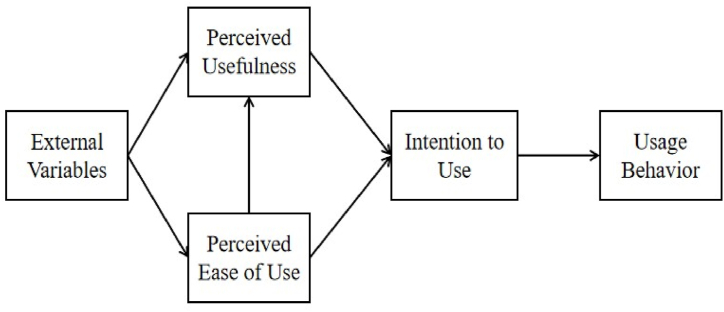
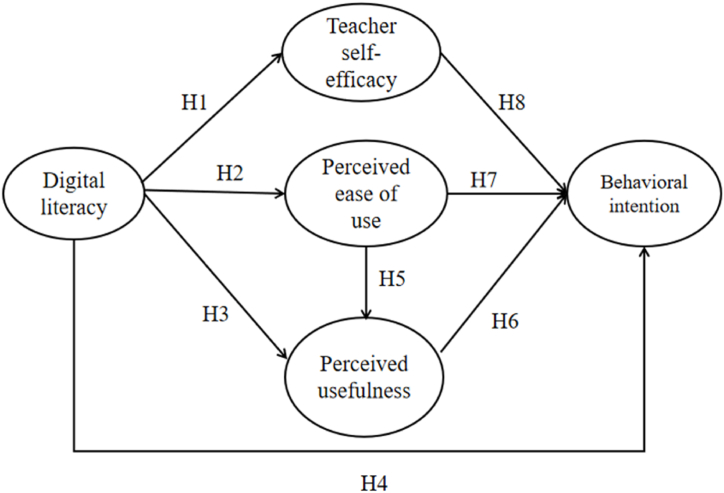
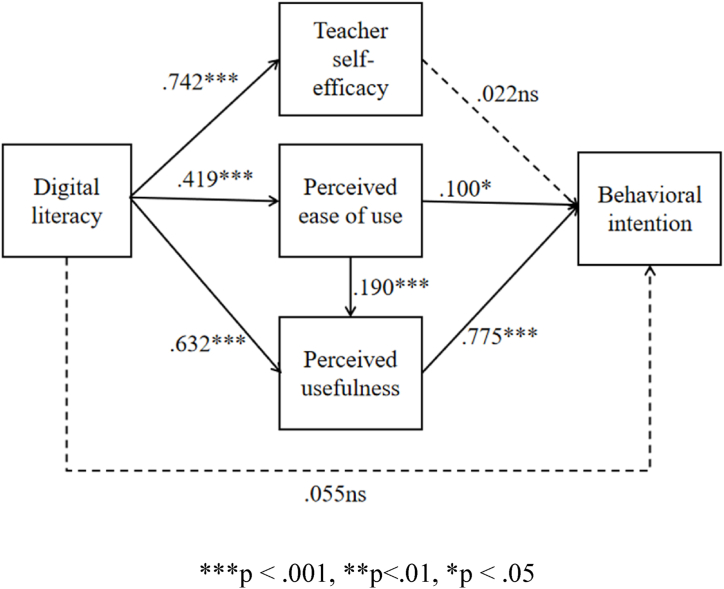
The use of artificial intelligence in education (AIEd) has become increasingly significant globally. In China, there is a lack of research examining the behavioral intention toward AIEd among pre-service special education (SPED) teachers in terms of digital literacy and teacher self-efficacy. Building on the technology acceptance model, our study evaluated the aspects influencing pre-service special education teachers' intention toward AI in education. Data was gathered from 274 pre-service SPED teachers studying at a Chinese public normal university of special education and analyzed using structural equation modeling (SEM). The results show that digital literacy is associated with the perceived usefulness and ease of use of AIEd, which influences SPED teachers' intention to use AIEd. Additionally, digital literacy significantly impacts the self-efficacy of SPED teachers. Given these results, AI designers in special education should comprehend the effectiveness and usability of AIEd for fostering behavioral intention formation. Simultaneously, special educational programs that identify key content and activities for digital literacy training should be developed, and educators should attempt to execute the relevant pre-service training to enhance the intention of pre-service SPED teachers toward AIEd.
Overview
The claims and statistics of this paper haven’t been checked yet.
Run the check — free, no account needed. It reads the open-access text and checks the sources it cites.
Integrity signals
Registry
Cites
Statistics
Figures
Verification
Claims the paper makes
The claims and statistics of this paper haven’t been checked yet.
Run the check — free, no account needed. It reads the open-access text and checks the sources it cites.
Claims other papers make about this one
Each is checked against this paper’s own text: does it say what the citing paper says it does?
The source backs part of the claim, not all of it — or backs it for a different population, condition or comparison.
In the citing paper
“Studies also indicate that digitally literate teachers are more inclined to participate in AI-related training (Yao & Wang, 2020)”
From Integrating artificial intelligence into preservice teacher education: enhancing AI literacy and digital material design competency (2026) · cites this paper as Yao & Wang, 2020
Experimental — accuracy not yet measured
Self-check
Percentages, sums and reported differences re-computed from the paper’s own numbers.
The self-check needs the paper’s full text.
Citations
Cites
Evaluating structural equation models with unobservable variables and measurement error
Fornell, C., & Larcker, D. F. (1981) · Journal of Marketing Research · doi:10.1177/002224378101800104 · Cited by 109,190
Perceived usefulness, perceived ease of use, and user acceptance of information technology
Davis, F. D. (1989) · MIS Quarterly · doi:10.2307/249008 · Cited by 68,483
User Acceptance of Information Technology: Toward A Unified View1
Venkatesh, V., Morris, M. G., Davis, G. B., & Davis, F. D. (2003) · MIS Quarterly · doi:10.2307/30036540 · Cited by 45,035
A Theoretical Extension of the Technology Acceptance Model: Four Longitudinal Field Studies
Venkatesh, V., & Davis, F. D. (2000) · Management Science · doi:10.1287/mnsc.46.2.186.11926 · Cited by 23,066
Bandura, A. (1977) · Zenodo (CERN European Organization for Nuclear Research) · doi:10.5281/zenodo.15521699 · Cited by 7,585
Zawacki-Richter, O., Marín, V. I., Bond, M., & Gouverneur, F. (2019) · International Journal of Educational Technology in Higher Education · doi:10.1186/s41239-019-0171-0 · Cited by 7,242 · cited 1×
“The application of AI technology in educational settings, known as AI in education (AIEd), has been widely regarded as one of the most significant advancements in this century [2,3].”
BackgroundTeacher efficacy: capturing an elusive construct
Tschannen-Moran, M., & Hoy, A. W. (2001) · Teaching and Teacher Education · doi:10.1016/s0742-051x(01)00036-1 · Cited by 6,839 · cited 1×
“Tschannen-Moran and Woolfolk Hoy [53] specifically defined teacher self-efficacy as belief concerning one ’ s ability to teach, to establish and enforce classroom regulations, as well as to inspire students ’ learning motivation.”
BackgroundA Beginner's Guide to Structural Equation Modeling
Finkelstein, D. (2005) · Technometrics · doi:10.1198/tech.2005.s328 · Cited by 6,087
Duan, Y., Edwards, J. S., & Dwivedi, Y. K. (2019) · International Journal of Information Management · doi:10.1016/j.ijinfomgt.2019.01.021 · Cited by 2,628 · cited 1×
“Similarly, the rapid progress of information processing technology and computer technology (e. g., advanced algorithms, Big Data) has significantly expedited the advancement and implementation of AI, which has increased in contemporary times [38].”
BackgroundVision, challenges, roles and research issues of Artificial Intelligence in Education
Hwang, G.-J., Xie, H., Wah, B. W., & Gašević, D. (2020) · Computers and Education: Artificial Intelligence · doi:10.1016/j.caeai.2020.100001 · Cited by 1,435
Research works printed but not linked: 4
- Exploring the Relationships between Reading Behavior Patterns and Learning Outcomes Based on Log Data from E-Books: A Human Factor Approach: Int. J. Hum. Comput. Interact.: Vol 35, No 4–5 - Get Access’. Accessed: July. 1, 2024. [Online]. Available: https://www.tandfonline.com/doi/full/10.1080/10447318.2018.1543077. · DOI
- Quaicoe, 2020, Teachers' digital literacy and digital activity as digital divide components among basic schools in Ghana, Educ. Inf. Technol., 25, 4077, 10.1007/s10639-020-10158-8 · DOI · Paper page
- Riina, 2022, DigComp 2.2: The Digital Competence Framework for Citizens - With new examples of knowledge, skills and attitudes, JRC Research Reports, 1
- Quaicoe, 2020, Teachers' digital literacy and digital activity as digital divide components among basic schools in Ghana, Educ. Inf. Technol., 25, 4077, 10.1007/s10639-020-10158-8 · DOI · Paper page
Cited by
Sorted by citations
Items 101–151 of 151
Hutabarat, I. R., & Nusraningrum, D. (2025) · Journal of Sustainable Economic and Business · doi:10.70550/joseb.v2i1.36
The Success of Teachers in Implementing the Curriculum in Statistics Subjects
Ramatni, A. (2025) · Journal of Education Research and Evaluation · doi:10.23887/jere.v9i1.83766
Al‐Mahdy, Y. F. H., & Elwakil, F. R. (2025) · International Conference for Artificial Intelligence, Applications, Innovation and Ethics (AI2E) · doi:10.1109/ai2e64943.2025.10983145
Alrefaei, M. M. (2025) · International Journal of Instruction · doi:10.29333/iji.2025.18319a
Sudibyo, Z. A., Hudayah, S., & Indriastuti, H. (2025) · Priviet Social Sciences Journal · doi:10.55942/pssj.v5i7.440
(2025) · Journal of Logistics Informatics and Service Science · doi:10.33168/jliss.2025.0313 · Cited by 1
Yun, S.-U., & Kim, C. (2025) · Journal of Digital Contents Society · doi:10.9728/dcs.2025.26.8.2271
Dewi, F. K., Hidayat, H., Ernawati, E., & Effendi, H. (2025) · Salud Ciencia y Tecnología · doi:10.56294/saludcyt20251943
Javed, T., Azhar, J., Shabbir, M. F., & Nasir, A. (2025) · Discover Sustainability · doi:10.1007/s43621-025-01737-1
User Experience and Scale Development of Mobility Aids Based on Factor and Entropy Weight Analysis
Wang, Z., Deng, R., & Napper, R. (2025) · SAGE Open · doi:10.1177/21582440251388121
Suchánek, O., Havlásková, T., Tran, D., Javorčík, T., Kancner, M., Mrázová, M., & Ulrichova, H. (2025) · International Conference on Emerging eLearning Technologies and Applications (ICETA) · doi:10.1109/iceta67772.2025.11280144
Nurcholifah, M., & Harsono (2025) · Didaktika Jurnal Kependidikan · doi:10.58230/27454312.2283
Du, Y., Tang, M., Jia, K., Wang, C., & Zou, B. (2025) · Apollo (University of Cambridge)
Lestari, L., Teresa, A., Kho, F. A., & Syahchari, D. H. (2025) · International Conference on Information Technology and Digital Applications (ICITDA) · doi:10.1109/icitda68167.2025.11332513
Purwita, A. W., Elfaiz, E. A., & Rahmaningrum, A. (2025) · International Conference on Information Technology, Information Systems and Electrical Engineering (ICITISEE) · doi:10.1109/icitisee68184.2025.11355052 · Cited by 1
Cordero-Franco, H. F., Carrillo-García, J. M., Romero-Garcia, M., & la Garza, F. G. L. (2026) · Nigerian Postgraduate Medical Journal · doi:10.4103/npmj.npmj_389_25
Pamungkas, B. A., Japutra, J. P., Noventina, A., & Sanny, L. (2025) · International Conference on Computer System, Information Technology, and Electrical Engineering (COSITE) · doi:10.1109/cosite68330.2025.11414405
Huang, Y., Zeng, L., Huang, Z., & Gao, B. (2026) · Journal of Hospitality and Tourism Technology · doi:10.1108/jhtt-04-2025-0340
MSMEs Sales Products Marketing Performance Increasement Based on The Use of QRIS
Ismail, H. A., Pranaditya, A., & Andini, R. (2026) · Jurnal Manajemen · doi:10.24912/jm.v30i1.3622
Digital Fluency and Metacognitive Scaffolds for Ethically Grounded AI-Ready General Education
Alam, A. (2026) · IGI Global eBooks · doi:10.4018/979-8-2600-1133-1.ch007
Pre-service Teachers’ Experiences in Instructional Design with Artificial Intelligence Tools
Ayaz, E., & Ekinci, V. (2026) · Springer eBooks · doi:10.1007/978-3-032-18030-8_8
Online Experiential Learning with AI Support: A TAM-Based Study of Student Attitudes and Usage
Duy, M. H. V., & Nguyen, L. T. (2025) · International Conference on Information Education and Artificial Intelligence (ICIEAI) · doi:10.1145/3799457.3799533
Gonzales, G. G., Hallarte, D. K., Milano, M. L., Pasaje, S. J., Villaflor, M. G., & Gonzales, R. R. (2026) · Social Sciences & Humanities Open · doi:10.1016/j.ssaho.2026.102921
Zhang, Y., & Lin, Y. (2026) · European Journal of Education · doi:10.1111/ejed.70687 · Cited by 1
Choudhury, S., Kar, A., Shukla, P., & Khatun, R. (2026) · Asian Journal of Interdisciplinary Research · doi:10.54392/ajir26211 · Cited by 1
Exploring the Needs and Perspectives of Chinese Special Education Teachers on Digital Learning
Zhang, Y., & Paracha, S. (2026) · International Conference on Educational and Information Technology · doi:10.1109/iceit68991.2026.11521097
KANDEMİR, M. A. (2026) · Sinop Üniversitesi Sosyal Bilimler Dergisi · doi:10.30561/sinopusd.1835438
Minglie, H. E., & Song, Y. (2026) · European Journal of Education · doi:10.1111/ejed.70708
Dou, T. (2026) · Perceptual and Motor Skills · doi:10.1177/00315125261459732
Dikmen, Ş., & Kirişçi, N. (2026) · Bayburt Eğitim Fakültesi Dergisi · doi:10.35675/befdergi.1785903
Sharma, S., & Rautela, S. (2026) · Learning Futures and Emerging Technologies · doi:10.1108/lfet-03-2026-0037
Filipović, R., Filipović, I., & Dumančić, M. (2026) · International Convention on Information and Communication Technology, Electronics and Microelectronics · doi:10.1109/mipro70003.2026.11591597
Chen, X., Cai, S., & Yao, H. (2026) · Education and Information Technologies · doi:10.1007/s10639-026-14064-3
Sujannah, W. D., Suwarso, P. N., & Unsiah, F. (2026) · Cogent Education · doi:10.1080/2331186x.2026.2699474
Adoption of AI-powered E-commerce applications: insights from the Technology Acceptance Model
Carvache‐Franco, M., Martin-Moreno, O., Carvache-Franco, O., Moran-Cedeño, V., & Carvache‐Franco, W. (2026) · Cogent Social Sciences · doi:10.1080/23311886.2026.2692162 · Cited by 2
Cui, S., & He, G. (2026) · Innovation in Language Learning and Teaching · doi:10.1080/17501229.2026.2700604
Teaching with Technology, Leading with Values: ELT Teachers and the Future of AI in Education
Zaimoğlu, S. (2026) · English Teaching & Learning · doi:10.1007/s42321-026-00244-4
Joseph, C. H., Osiesi, M. P., Madikizela-Madiya, N., Adaramoye, T. O., Akinola, O. T., & Abiodun, A. A. (2026) · SN Social Sciences · doi:10.1007/s43545-026-01604-4
Qiao, S., Nie, Y., Niu, F., He, Z., & Chen, L. (2026) · Frontiers in Psychology · doi:10.3389/fpsyg.2026.1902647 · Cited by 1
Tsinaridis, V. D. (2026) · IGI Global eBooks · doi:10.4018/979-8-3373-9509-8.ch009
Alan, F. A. O., Flores, G. T., Tagupa, E. R., Lagura, G. L., Montederamos, H. H., Cubillas, A. U., Lanes, J. R., Genovia, J. A., Aying, H. B., & Cubillan, M. T. (2026) · International Conference on e-Education, e-Business, e-Management and e-Learning · doi:10.1109/ic4e69618.2026.11631319
Lin, S., Hu, Y., Duan, J., Wang, X., Ma, W., & Xu, J. (2026) · International Conference on Computer Science and Technologies in Education (CSTE) · doi:10.1109/cste69562.2026.11649734
Xiao, Y., & Pan, L. (2026) · European Journal of Education · doi:10.1111/ejed.70872
Wang, J., Pan, L., & Juan, L. (2026) · European Journal of Education · doi:10.1111/ejed.70877
Supartinah, S., Firdaus, F. M., Sugiarsih, S., Sayekti, O. M., & Fauzi, W. N. A. (2026) · Social Sciences & Humanities Open · doi:10.1016/j.ssaho.2026.103627
Yu, H., Cho, M., Lim, S., Park, E., & Kang, S. (2026) · Computers in the Schools · doi:10.1080/07380569.2026.2740438
Xing, X., & Liang, X. (2026) · European Journal of Education · doi:10.1111/ejed.70893
Arafat, Y., Stefanus, T. K., & Kodrat, D. (2026) · Social Sciences & Humanities Open · doi:10.1016/j.ssaho.2026.103911
Zhang, H., Yu, H., Deng, H., Wang, H., & Dong, Y. (2026) · European Journal of Education · doi:10.1111/ejed.70900
Abror, A., Patrisia, D., Gaffar, V., Hamid, R. S., & Faridah, A. (2026) · Cogent Business & Management · doi:10.1080/23311975.2026.2748119
Metadata
- Authors
- Yao, N., & Wang, Q.
- Affiliations
- Nanjing Normal University of Special Education (CN)
- Corresponding author
- Yao, Ni
- ORCID
- Yao, Ni
- Venue
- Heliyon
- Publisher
- Elsevier BV
- Published
- 2024-07
- Volume
- 10
- Issue
- 14
- Pages
- e34894
- ISSN
- 2405-8440 (ISSN-L)
- PMC
- PMC11325385
- OpenAlex
- W4400768008
- Cited by
- 150
- References
- 62
- Citations by year
- 2026: 62 · 2025: 84 · 2024: 4
- FWCI
- 56.40
- Type
- journal article
- Language
- en
- Status
- Retracted
- Update notices
- Open access
- gold
- doi.org
- Licence
- Locations
- Heliyon (publishedVersion, cc-by-nc)
- PubMed Central (publishedVersion, cc-by-nc)
- PubMed (publishedVersion)
- DOAJ (DOAJ: Directory of Open Access Journals) (submittedVersion)
- Funders
- Government of Jiangsu Province
- Nanjing Normal University
- Topics
- Social Sciences › Education › Artificial Intelligence in Education
- Social Sciences › Decision Sciences › Information Systems and Management › Technology Adoption and User Behaviour
- Social Sciences › Education › Digital literacy in education
- Keywords
- artificial intelligence in education, pre-service special education teachers, digital literacy, teacher self-efficacy, perceived ease of use, perceived usefulness, technology acceptance model, special education teacher training, retracted article
About these checks
Registry, retraction, Cites and statistics results are computed, not judged, with one exception: a printed reference that no index lists is read once by a model before it counts as a citation error. Claims are extracted by a model and kept only when their quote appears verbatim in the text; each cited source is then checked, with a model’s help, for whether it says what the claim relies on. Those verdicts can be wrong — read the claim’s quote and the cited source before relying on one.
Statistics and arithmetic are recomputed, not judged.
Confidence bands are shown only for fields calibrated on our annotated test set. None is calibrated yet, so no band is shown.
What counts as a claim ›How we measure confidence ›How we check this ›
Are you an author, or do you see a problem with this page? Request a review
