

The DOI matches its Crossref record; 59 of the 62 references it cites were found in a registry or an index, and 2 are not checked yet.
RETRACTED: Factors influencing pre-service special education teachers’ intention toward AI in education: Digital literacy, teacher self-efficacy, perceived ease of use, and perceived usefulness
Open accessAbstract
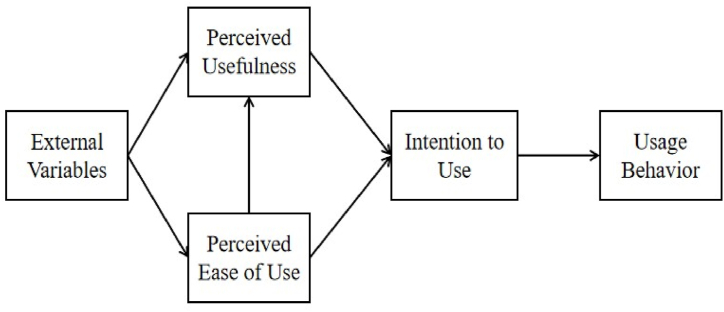
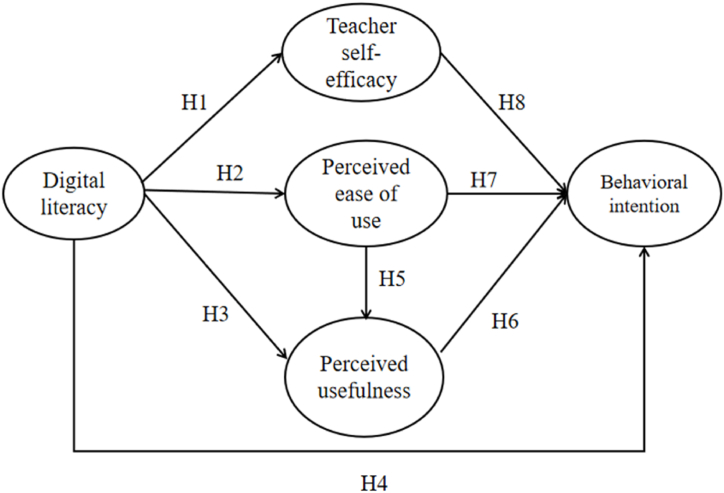
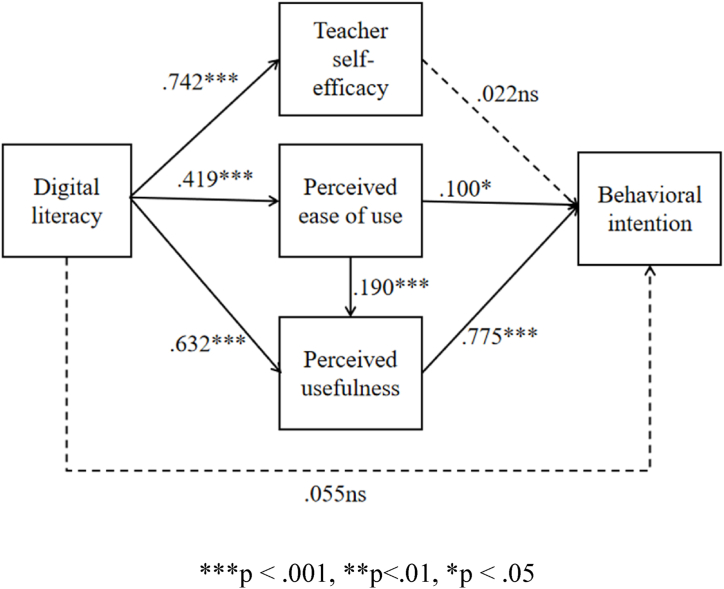
The use of artificial intelligence in education (AIEd) has become increasingly significant globally. In China, there is a lack of research examining the behavioral intention toward AIEd among pre-service special education (SPED) teachers in terms of digital literacy and teacher self-efficacy. Building on the technology acceptance model, our study evaluated the aspects influencing pre-service special education teachers' intention toward AI in education. Data was gathered from 274 pre-service SPED teachers studying at a Chinese public normal university of special education and analyzed using structural equation modeling (SEM). The results show that digital literacy is associated with the perceived usefulness and ease of use of AIEd, which influences SPED teachers' intention to use AIEd. Additionally, digital literacy significantly impacts the self-efficacy of SPED teachers. Given these results, AI designers in special education should comprehend the effectiveness and usability of AIEd for fostering behavioral intention formation. Simultaneously, special educational programs that identify key content and activities for digital literacy training should be developed, and educators should attempt to execute the relevant pre-service training to enhance the intention of pre-service SPED teachers toward AIEd.
Overview
The claims and statistics of this paper haven’t been checked yet.
Run the check — free, no account needed. It reads the open-access text and checks the sources it cites.
Integrity signals
Registry
Cites
Statistics
Figures
Verification
Claims the paper makes
The claims and statistics of this paper haven’t been checked yet.
Run the check — free, no account needed. It reads the open-access text and checks the sources it cites.
Claims other papers make about this one
Each is checked against this paper’s own text: does it say what the citing paper says it does?
The source backs part of the claim, not all of it — or backs it for a different population, condition or comparison.
In the citing paper
“Studies also indicate that digitally literate teachers are more inclined to participate in AI-related training (Yao & Wang, 2020)”
From Integrating artificial intelligence into preservice teacher education: enhancing AI literacy and digital material design competency (2026) · cites this paper as Yao & Wang, 2020
Experimental — accuracy not yet measured
Self-check
Percentages, sums and reported differences re-computed from the paper’s own numbers.
The self-check needs the paper’s full text.
Citations
Cites
Evaluating structural equation models with unobservable variables and measurement error
Fornell, C., & Larcker, D. F. (1981) · Journal of Marketing Research · doi:10.1177/002224378101800104 · Cited by 109,190
Perceived usefulness, perceived ease of use, and user acceptance of information technology
Davis, F. D. (1989) · MIS Quarterly · doi:10.2307/249008 · Cited by 68,483
User Acceptance of Information Technology: Toward A Unified View1
Venkatesh, V., Morris, M. G., Davis, G. B., & Davis, F. D. (2003) · MIS Quarterly · doi:10.2307/30036540 · Cited by 45,035
A Theoretical Extension of the Technology Acceptance Model: Four Longitudinal Field Studies
Venkatesh, V., & Davis, F. D. (2000) · Management Science · doi:10.1287/mnsc.46.2.186.11926 · Cited by 23,066
Bandura, A. (1977) · Zenodo (CERN European Organization for Nuclear Research) · doi:10.5281/zenodo.15521699 · Cited by 7,585
Zawacki-Richter, O., Marín, V. I., Bond, M., & Gouverneur, F. (2019) · International Journal of Educational Technology in Higher Education · doi:10.1186/s41239-019-0171-0 · Cited by 7,242 · cited 1×
“The application of AI technology in educational settings, known as AI in education (AIEd), has been widely regarded as one of the most significant advancements in this century [2,3].”
BackgroundTeacher efficacy: capturing an elusive construct
Tschannen-Moran, M., & Hoy, A. W. (2001) · Teaching and Teacher Education · doi:10.1016/s0742-051x(01)00036-1 · Cited by 6,839 · cited 1×
“Tschannen-Moran and Woolfolk Hoy [53] specifically defined teacher self-efficacy as belief concerning one ’ s ability to teach, to establish and enforce classroom regulations, as well as to inspire students ’ learning motivation.”
BackgroundA Beginner's Guide to Structural Equation Modeling
Finkelstein, D. (2005) · Technometrics · doi:10.1198/tech.2005.s328 · Cited by 6,087
Duan, Y., Edwards, J. S., & Dwivedi, Y. K. (2019) · International Journal of Information Management · doi:10.1016/j.ijinfomgt.2019.01.021 · Cited by 2,628 · cited 1×
“Similarly, the rapid progress of information processing technology and computer technology (e. g., advanced algorithms, Big Data) has significantly expedited the advancement and implementation of AI, which has increased in contemporary times [38].”
BackgroundVision, challenges, roles and research issues of Artificial Intelligence in Education
Hwang, G.-J., Xie, H., Wah, B. W., & Gašević, D. (2020) · Computers and Education: Artificial Intelligence · doi:10.1016/j.caeai.2020.100001 · Cited by 1,435
Research works printed but not linked: 4
- Exploring the Relationships between Reading Behavior Patterns and Learning Outcomes Based on Log Data from E-Books: A Human Factor Approach: Int. J. Hum. Comput. Interact.: Vol 35, No 4–5 - Get Access’. Accessed: July. 1, 2024. [Online]. Available: https://www.tandfonline.com/doi/full/10.1080/10447318.2018.1543077. · DOI
- Quaicoe, 2020, Teachers' digital literacy and digital activity as digital divide components among basic schools in Ghana, Educ. Inf. Technol., 25, 4077, 10.1007/s10639-020-10158-8 · DOI · Paper page
- Riina, 2022, DigComp 2.2: The Digital Competence Framework for Citizens - With new examples of knowledge, skills and attitudes, JRC Research Reports, 1
- Quaicoe, 2020, Teachers' digital literacy and digital activity as digital divide components among basic schools in Ghana, Educ. Inf. Technol., 25, 4077, 10.1007/s10639-020-10158-8 · DOI · Paper page
Cited by
Sorted by citations
Zhang, Q., Nie, H., Fan, J., & Liu, H. (2025) · Behavioral Sciences · doi:10.3390/bs15040523 · Cited by 154
Pan, Z., & Wang, Y. (2025) · European Journal of Education · doi:10.1111/ejed.70020 · Cited by 143
Schmidt, D. A., Alboloushi, B., Thomas, A., & Magalhães, R. (2025) · Computers and Education Open · doi:10.1016/j.caeo.2025.100274 · Cited by 171
Runge, I., Hebibi, F., & Lazarides, R. (2025) · Education Sciences · doi:10.3390/educsci15020167 · Cited by 85
Ocen, S., Elasu, J., Aarakit, S. M., & Olupot, C. (2025) · Frontiers in Education · doi:10.3389/feduc.2025.1530247 · Cited by 157
Liu, N. (2025) · BMC Psychology · doi:10.1186/s40359-025-02620-4 · Cited by 99
Pei, B., Lu, J., & Jing, X. (2025) · Computers and Education Artificial Intelligence · doi:10.1016/j.caeai.2025.100406 · Cited by 78
Zhao, Z., An, Q., & Liu, J. (2025) · Frontiers in Psychology · doi:10.3389/fpsyg.2025.1619391 · Cited by 77
Adopting AI in education: optimizing human resource management considering teacher perceptions
Gârdan, I. P., Manu, M. B., Gârdan, D. A., Negoiţă, L., Paștiu, C. A., Ghiță, E., & Zaharia, A. (2025) · Frontiers in Education · doi:10.3389/feduc.2025.1488147 · Cited by 60
Ning, Y., Zheng, H., Wu, H., Jin, Z. M., Chang, H., & Wijaya, T. T. (2025) · Education and Information Technologies · doi:10.1007/s10639-025-13477-w · Cited by 43
Liu, Y., Wang, Q., & Lei, J. (2025) · Behavioral Sciences · doi:10.3390/bs15081040 · Cited by 34
Self-citationHao, L., Yusoff, S. M., & Marzaini, A. F. M. (2024) · Education and Information Technologies · doi:10.1007/s10639-024-13150-8 · Cited by 50
Du, Y., Tang, M., Jia, K., Wang, C., & Zou, B. (2025) · Journal of Computer Assisted Learning · doi:10.1002/jcal.70174 · Cited by 35
Fostering AI literacy in pre-service physics teachers: inputs from training and co-variables
Abdulayeva, A., Жанатбекова, Н., Andasbayev, Y. S., & Boribekova, F. (2025) · Frontiers in Education · doi:10.3389/feduc.2025.1505420 · Cited by 45
Artificial intelligence as a teaching tool in university education
Marín, Y. R., Caro, O. C., Rubio, Y. D. C. M., Tuesta, J. N. A., Bardales, E. S., Rituay, A. M. C., & Santos, R. C. (2025) · Frontiers in Education · doi:10.3389/feduc.2025.1578451 · Cited by 53
El‐Sayed, A. A. I., Alsenany, S. A., Almalki, R. S. E., & Asal, M. G. R. (2025) · Nurse Education Today · doi:10.1016/j.nedt.2025.106734 · Cited by 32
Alqurni, J. S. (2026) · Frontiers in Artificial Intelligence · doi:10.3389/frai.2026.1738774 · Cited by 41
Zhang, G., & Yu, T. (2025) · Acta Psychologica · doi:10.1016/j.actpsy.2025.105791 · Cited by 34
Fteiha, M. A., Al-Rashaida, M. A. H., & Ghazal, M. A. (2025) · PLoS ONE · doi:10.1371/journal.pone.0331941 · Cited by 56
Beyond hype: Is ChatGPT-generated content effective in class preparation among academic instructors?
Bin-Nashwan, S. A., Bouteraa, M., Benlahcene, A., & Sadallah, M. (2025) · The Internet and Higher Education · doi:10.1016/j.iheduc.2025.101016 · Cited by 21
Ahmad, W., Shokeen, R., & Raj, R. (2024) · Advances in educational technologies and instructional design book series · doi:10.4018/979-8-3693-5538-1.ch017 · Cited by 22
Liao, C.-H. (2025) · Systems · doi:10.3390/systems13030144 · Cited by 18
The perceived impact of artificial intelligence on academic learning
Dogaru, M., Pisică, O., Popa, C.-Ș., Răgman, A.-A., & Tololoi, I.-R. (2025) · Frontiers in Artificial Intelligence · doi:10.3389/frai.2025.1611183 · Cited by 37
Barbieri, W., & Nguyen, N. N. (2025) · Australasian Journal of Educational Technology · doi:10.14742/ajet.10035 · Cited by 26
Zhu, Y., & Siquan, X. (2025) · European Journal of Education · doi:10.1111/ejed.70160 · Cited by 23
Tek, T., & ÖZSARI, A. (2025) · Frontiers in Psychiatry · doi:10.3389/fpsyt.2025.1638959 · Cited by 18
Jin, H., & Rui, Y. (2025) · European Journal of Education · doi:10.1111/ejed.70364 · Cited by 18
Yang, H., Xu, N., Lin, X., & Zhang, W. (2025) · Computers in Human Behavior Reports · doi:10.1016/j.chbr.2025.100833 · Cited by 22
Yu, H. M., Lee, H., & Kim, S. H. (2025) · Journal of Research in Childhood Education · doi:10.1080/02568543.2025.2579668 · Cited by 13
A visual analysis of the research literature on teachers’ digital literacy (2015–2024)
Liu, C., & Yun, X. (2025) · Frontiers in Education · doi:10.3389/feduc.2025.1597121 · Cited by 26
Integrating Digital Literacy into Curriculum Design a Framework for 21st Century Learning
Jordan, A., Julianto, A., & Firmansyah, M. A. (2025) · JOURNAL OF TECHNOLOGY EDUCATION & TEACHING (J-TECH) · doi:10.62734/jtech.v1i2.418 · Cited by 10
Analyzing factors influencing students’ decisions to adopt smart classrooms in higher education
Kim, L., Jitpakdee, R., Praditsilp, W., & Yeo, S. F. (2025) · Education and Information Technologies · doi:10.1007/s10639-025-13381-3 · Cited by 11
Xu, F., Wang, L., & Xu, J. (2025) · Acta Psychologica · doi:10.1016/j.actpsy.2025.105105 · Cited by 37
Bircan, M. A., Şeref, İ., & Nacaroğlu, O. (2025) · Education and Information Technologies · doi:10.1007/s10639-025-13625-2 · Cited by 15
Xiong, X. B., Cao, S., Gao, T., Feng, X., & Li, H. (2025) · IEEE Transactions on Learning Technologies · doi:10.1109/tlt.2025.3596125 · Cited by 9
Ke, Q., & Gong, Y. (2025) · Journal of Research on Technology in Education · doi:10.1080/15391523.2025.2568514 · Cited by 8
Baimukhambetova, K., Ыбыраимжанов, К., Moldabek, K., Borashkyzy, A. U., Zhetkizgenova, A., & Uaidullakyzy, E. (2025) · Education Sciences · doi:10.3390/educsci16010043 · Cited by 8
Derakhshan, A., Corral-Robles, S., Ortega-Martín, J. L., & Ortega‐Rodríguez, P. (2026) · European Journal of Education · doi:10.1111/ejed.70639 · Cited by 9
Lan, Y., Liu, S., & Xia, L. (2025) · Frontiers in Psychology · doi:10.3389/fpsyg.2025.1652934 · Cited by 10
Chen, Y., & Gao, H. (2025) · SAGE Open · doi:10.1177/21582440251378790 · Cited by 7
Xiao, W., Wang, M., & Li, X. (2025) · Teaching and Teacher Education · doi:10.1016/j.tate.2025.105301 · Cited by 7
Feng, X., Guan, W., & Xu, E. (2025) · Acta Psychologica · doi:10.1016/j.actpsy.2025.105141 · Cited by 14
Du, Y. (2025) · Interactive Learning Environments · doi:10.1080/10494820.2025.2538746 · Cited by 7
Predictors of Pre-Service EFL Teachers’ Predisposition Towards AI Adoption in Language Teaching
Harakchiyska, T. (2025) · Education Sciences · doi:10.3390/educsci15091112 · Cited by 18
Karaman, K., & KÖSE, M. (2025) · Eğitimde Yeni Yaklaşımlar Dergisi · doi:10.70325/eyyad.1782927 · Cited by 9
Zhu, G., Pan, F., Fu, M., & Ni, J. (2025) · Innovations in Education and Teaching International · doi:10.1080/14703297.2025.2475857 · Cited by 7
Tan, C. C., Saghier, E. G., & Selem, K. M. (2025) · Journal of Quality Assurance in Hospitality & Tourism · doi:10.1080/1528008x.2025.2493144 · Cited by 5
Factors affecting Indonesian pre-service EFL teachers’ AI acceptance and use
Firdaus, R., Habibi, A., Hendra, R., Fauzee, M. S. O., Oktaria, S. D., Sofwan, M., & Alqahtani, T. M. (2025) · Texto Livre Linguagem e Tecnologia · doi:10.1590/1983-3652.2025.57135 · Cited by 7
Koukaras, C., Stavrinides, S. G., Hatzikraniotis, E., Mitsiaki, M., Koukaras, P., & Tjortjis, C. (2026) · Telecom · doi:10.3390/telecom7010002 · Cited by 10
Luo, T., & Cao, S. (2026) · SAGE Open · doi:10.1177/21582440251409860 · Cited by 6
Jaiswal, R., Prakhar, P., Chen, P.-J., & Gupta, S. (2026) · Journal of Hospitality & Tourism Education · doi:10.1080/10963758.2025.2602583 · Cited by 5
Zhang, Y., & Kang, B. (2026) · BMC Psychology · doi:10.1186/s40359-026-04047-x · Cited by 9
Örnek, G. T. (2026) · BMC Psychology · doi:10.1186/s40359-026-04184-3 · Cited by 6
Kong, P. (2025) · European Journal of Education · doi:10.1111/ejed.70275 · Cited by 6
Büyükeke, A. (2025) · Üniversite Araştırmaları Dergisi · doi:10.32329/uad.1728785 · Cited by 4
Bilal, M., Uzzaman, M. S., Hassan, H., & Adnan, M. (2026) · Total Quality Management & Business Excellence · doi:10.1080/14783363.2026.2613218 · Cited by 4
How ready are gifted education teachers for AI integration? Evidence from BILSEM in Türkiye
Önal, N., İlhan, A. O., & ÖNAL, N. T. (2026) · Education and Information Technologies · doi:10.1007/s10639-026-13932-2 · Cited by 4
UDL-Driven Digital Pedagogy and Equity-Focused Assessment for Inclusive Higher Education
Alam, A. (2026) · IGI Global eBooks · doi:10.4018/979-8-2600-0976-5.ch005 · Cited by 4
Cui, Y., & Li, M. (2025) · Interactive Learning Environments · doi:10.1080/10494820.2025.2583194 · Cited by 4
Kim, B., Oh, H.-J., Kim, M., & Lee, D. (2024) · Behavioral Sciences · doi:10.3390/bs14100937 · Cited by 7
Kılıç, E., Almasri, F., & Çelik, H. E. (2025) · Computers and Education Artificial Intelligence · doi:10.1016/j.caeai.2025.100486 · Cited by 5
Exploring Pre-service EFL Teachers’ Readiness to Integrate AI: A UTAUT2 Model Analysis
Tootkaboni, A. A., & Maghsoudi, M. (2025) · Journal of Education · doi:10.1177/00220574251379029 · Cited by 4
Zahrani, A. A. (2025) · IEEE Access · doi:10.1109/access.2025.3647788 · Cited by 3
Awal, M. R. (2026) · Sustainable Futures · doi:10.1016/j.sftr.2026.101666 · Cited by 3
Yang, Q., Zhao, M., Yang, L., Wang, X., & Yang, C. (2026) · Frontiers in Medicine · doi:10.3389/fmed.2026.1753024 · Cited by 6
Sumandya, I. W., Widana, I. W., Dharmadewi, A. A. I. M., Setiawan, G. I., Habibi, A., & Hendra, R. (2026) · Open Education Studies · doi:10.1515/edu-2025-0126 · Cited by 6
Kurdal, C., & Kaplan, A. (2026) · Kastamonu Eğitim Dergisi · doi:10.24106/kefdergi.1877948 · Cited by 6
Benlaria, H., & Alanazi, A. S. (2026) · Frontiers in Psychology · doi:10.3389/fpsyg.2026.1686149 · Cited by 3
Lin, Y., Wang, W., & Chen, C. (2026) · The International Journal of Management Education · doi:10.1016/j.ijme.2026.101411 · Cited by 3
Faculty perceptions of generative AI in Azerbaijani higher education
Ismayil, Z., Jafarov, A., Adil, G., Soltanova, A. E., Mansimova, K. G., Alishanova, A., Gundogdu, S., Hasanova, N., Aliyev, S. T., Ahmadov, H., et al. (2026) · European Journal of STEM Education · doi:10.20897/ejsteme/18310 · Cited by 11
Transforming curriculum design with generative AI: a model for assessing teacher digital competence
Guillén‐Gámez, F. D., Tomczyk, Ł., Habibi, A., & Vargas, B. L. D. (2026) · Educational Technology Research and Development · doi:10.1007/s11423-026-10647-6 · Cited by 5
Su, F., Beh, W. F., & Lee, K. C. S. (2026) · Acta Psychologica · doi:10.1016/j.actpsy.2026.107353 · Cited by 7
Integrating AI in Special Education and Instructional Design
Jowallah, R. J., & Kaletski-Maisel, G. (2025) · Advances in educational technologies and instructional design book series · doi:10.4018/979-8-3693-6527-4.ch007 · Cited by 3
Daniilidou, A., Nerantzaki, K., Antoniadou, N., & Kyriakidou-Rasidaki, M. (2025) · Behaviour and Information Technology · doi:10.1080/0144929x.2025.2590101 · Cited by 4
Kılıç, E., & Çelik, H. E. (2025) · Computers and Education Artificial Intelligence · doi:10.1016/j.caeai.2025.100452 · Cited by 9
Gulen, H. N., & Kucuk, S. (2026) · Education and Information Technologies · doi:10.1007/s10639-026-14020-1 · Cited by 3
Arimbawa, G. P. A., Wikanta, I. M. I. A., Sumarno, I. W., Dantes, G. R., Indrawan, G., & Gunawan, I. (2024) · Jurnal Edutech Undiksha · doi:10.23887/jeu.v12i2.86129 · Cited by 4
Liu, L., Liu, W., Luo, Z., & Yue, L. (2025) · Acta Psychologica · doi:10.1016/j.actpsy.2025.105889 · Cited by 6
Ubanan, G., & Libradilla, D. (2026) · Psychology and Education A Multidisciplinary Journal · doi:10.70838/pemj.510910 · Cited by 2
Li, H., Luo, Y., Wang, J., Ye, Y., & Xu, J. H. (2026) · Journal of Professional Capital and Community · doi:10.1108/jpcc-12-2025-0145 · Cited by 2
Liang, X., Diankun, J., Tadesse, E., & Hu, P. (2026) · European Journal of Education · doi:10.1111/ejed.70727 · Cited by 2
Sıngh, A. (2025) · Human Systems Management · doi:10.1177/01672533251374535 · Cited by 2
Teacher Emotion and AI: Current Status, Theories, and Prospects
Ci, F., & Jiang, L. G. (2025) · Springer eBooks · doi:10.1007/978-981-13-2262-4_329-1 · Cited by 3
Cho, N., Liao, W., & Lalitphasan, U. (2025) · Research Square · doi:10.21203/rs.3.rs-8267583/v1 · Cited by 3
杨, 茜. (2025) · Statistics and Applications · doi:10.12677/sa.2025.143060 · Cited by 1
Akefe, I. O., Adegoke, V. A., Akefe, E., Schweitzer, D. R., & Bolaji, S. (2025) · Trends in Higher Education · doi:10.3390/higheredu4030036 · Cited by 2
Perceived Impact of Integrating Artificial Intelligence in Teaching-Learning
Ablin, N. L., & Mediodia, H. B. (2025) · Psychology and Education A Multidisciplinary Journal · doi:10.70838/pemj.431006 · Cited by 5
Huynh-Thanh, T., Dinh, T. H. N., Teow, J., Stibe, A., & Nguyen, K. M. (2025) · Lecture notes in computer science · doi:10.1007/978-3-032-02060-4_14 · Cited by 1
Myths and magic of adopting marketing technologies: a customer-centric framework
Vishnoi, S. K., Mathur, S., Rawal, P., Sharma, V. K., Jain, A., & Agarwal, V. (2025) · Asia-Pacific Journal of Business Administration · doi:10.1108/apjba-09-2024-0545 · Cited by 1
Teacher’s use of generative AI: Comparing personal use and classroom integration
Meishar‐Tal, H., Gedge, M., & Levin, E. (2025) · Journal of Digital Learning in Teacher Education · doi:10.1080/21532974.2025.2583515 · Cited by 4
Truong, V. L., & Nguyen, T. H. T. (2025) · Computer Applications in Engineering Education · doi:10.1002/cae.70106 · Cited by 1
Ravi, R. K., Kaur, D., Kavumpurath, J., Jacob, J., Sharma, S., Baby, P., & Ahmed, S. K. (2026) · Nursing Forum · doi:10.1155/nuf/5278157 · Cited by 1
Wu, Q., Yusof, N. M., & Zhang, Z. (2026) · International Journal of Interactive Mobile Technologies (iJIM) · doi:10.3991/ijim.v20i04.58587 · Cited by 1
Ding, N., Hu, L., & Chen, M. (2026) · Humanities and Social Sciences Communications · doi:10.1057/s41599-026-07075-5 · Cited by 1
Dong, Z., & Bao, M. (2026) · Frontiers in Psychology · doi:10.3389/fpsyg.2026.1823038 · Cited by 1
Bhatti, M. A., & Absamatov, A. (2025) · Reports in Mechanical Engineering · doi:10.31181/rme505 · Cited by 1
Sumandya, I. W., Widana, I. W., Dharmadewi, A. A. I. M., Setiawan, G. I., & Nugraha, I. N. B. S. (2026) · Discover Education · doi:10.1007/s44217-026-01836-9 · Cited by 2
Cao, S., Liu, X., & Yu, X. (2026) · Frontiers in Psychology · doi:10.3389/fpsyg.2026.1797047 · Cited by 1
Análisis factorial exploratorio del estudio de autorregulación de docentes escolares ecuatorianos
Rumbaut-Rangel, D., Asencio, V. J. R., & Chévez, E. Y. S. (2025) · European Public & Social Innovation Review · doi:10.31637/epsir-2025-2082 · Cited by 1
Analysis of Pre-Service Early Childhood Teachers’ Acceptance Intentions of AI-Driven Education
Lee, E.-K. (2025) · Journal of Digital Contents Society · doi:10.9728/dcs.2025.26.2.499
Metadata
- Authors
- Yao, N., & Wang, Q.
- Affiliations
- Nanjing Normal University of Special Education (CN)
- Corresponding author
- Yao, Ni
- ORCID
- Yao, Ni
- Venue
- Heliyon
- Publisher
- Elsevier BV
- Published
- 2024-07
- Volume
- 10
- Issue
- 14
- Pages
- e34894
- ISSN
- 2405-8440 (ISSN-L)
- PMC
- PMC11325385
- OpenAlex
- W4400768008
- Cited by
- 150
- References
- 62
- Citations by year
- 2026: 62 · 2025: 84 · 2024: 4
- FWCI
- 56.40
- Type
- journal article
- Language
- en
- Status
- Retracted
- Update notices
- Open access
- gold
- doi.org
- Licence
- Locations
- Heliyon (publishedVersion, cc-by-nc)
- PubMed Central (publishedVersion, cc-by-nc)
- PubMed (publishedVersion)
- DOAJ (DOAJ: Directory of Open Access Journals) (submittedVersion)
- Funders
- Government of Jiangsu Province
- Nanjing Normal University
- Topics
- Social Sciences › Education › Artificial Intelligence in Education
- Social Sciences › Decision Sciences › Information Systems and Management › Technology Adoption and User Behaviour
- Social Sciences › Education › Digital literacy in education
- Keywords
- artificial intelligence in education, pre-service special education teachers, digital literacy, teacher self-efficacy, perceived ease of use, perceived usefulness, technology acceptance model, special education teacher training, retracted article
About these checks
Registry, retraction, Cites and statistics results are computed, not judged, with one exception: a printed reference that no index lists is read once by a model before it counts as a citation error. Claims are extracted by a model and kept only when their quote appears verbatim in the text; each cited source is then checked, with a model’s help, for whether it says what the claim relies on. Those verdicts can be wrong — read the claim’s quote and the cited source before relying on one.
Statistics and arithmetic are recomputed, not judged.
Confidence bands are shown only for fields calibrated on our annotated test set. None is calibrated yet, so no band is shown.
What counts as a claim ›How we measure confidence ›How we check this ›
Are you an author, or do you see a problem with this page? Request a review
