

The DOI matches its Crossref record; 72 of the 73 references it cites were found in a registry or an index.
Cytotoxic CD4+ T cells in cancer: Expanding the immune effector toolbox
Open accessAbstract
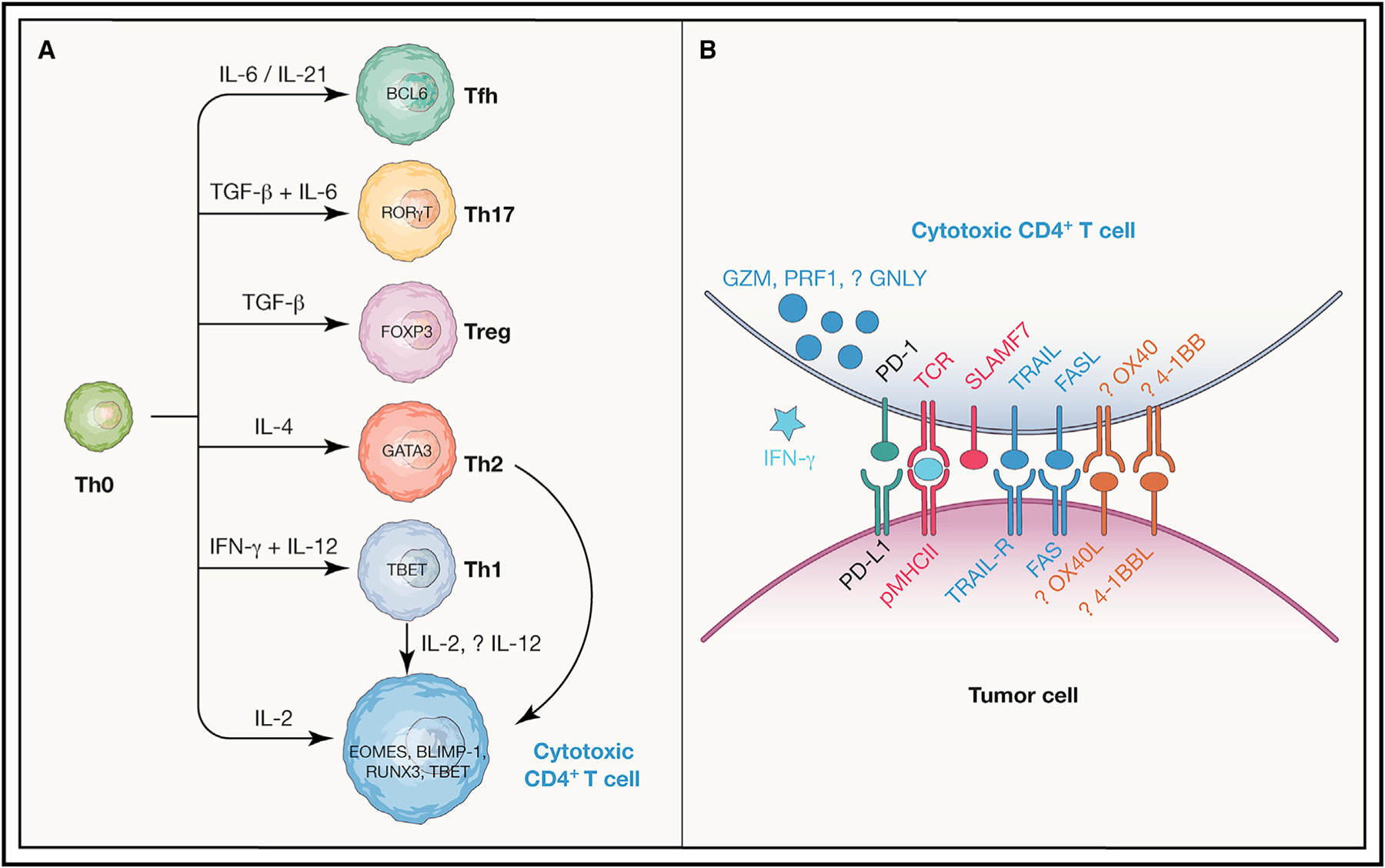
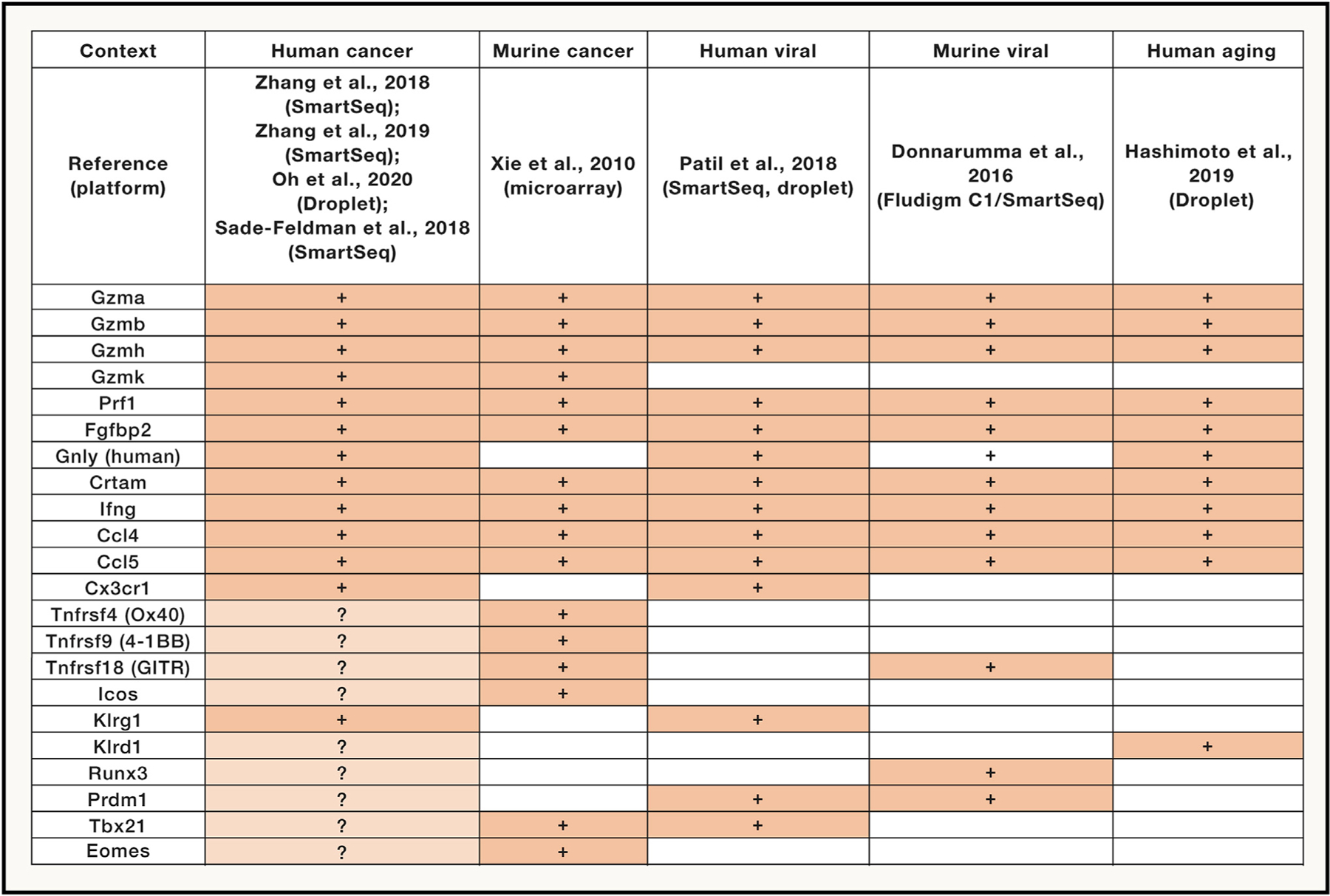
Cytotoxic T cells are important effectors of anti-tumor immunity. While tumor killing is ascribed to CD8 + T cell function, pre-clinical and clinical studies have identified intra-tumoral CD4 + T cells that possess cytotoxic programs and can directly kill cancer cells. Cytotoxic CD4 + T cells are found in other disease settings including infection and autoimmunity. Here, we review the phenotypic and functional characteristics of cytotoxic CD4 + T cells in non-cancer and cancer contexts. We conduct a comparative examination of cytolytic mechanisms of cytotoxic CD4 + T cells across disease states and synthesize features that define these cells independent of context. We discuss regulatory mechanisms driving ontogeny and effector function and evidence for the clinical relevance of cytotoxic CD4 + T cells in cancer. In this context, we highlight important gaps in understanding in the biology of cytotoxic CD4 + T cells as well as the potential use of these cells in immunotherapies for specific cancers.
Overview
The claims and statistics of this paper haven’t been checked yet.
Run the check — free, no account needed. It reads the open-access text and checks the sources it cites.
Integrity signals
Registry
Cites
Statistics
Figures
Verification
Claims the paper makes
The claims and statistics of this paper haven’t been checked yet.
Run the check — free, no account needed. It reads the open-access text and checks the sources it cites.
Claims other papers make about this one
Each is checked against this paper’s own text: does it say what the citing paper says it does?
The source backs part of the claim, not all of it — or backs it for a different population, condition or comparison.
In the citing paper
“we observed a significant increase in the total CD4+ T cells expressing IFN-γ (figure 4H) and granzyme B (GZMB; figure 4J),60–65 NK cells (figure 4N), and the amount of GZMB expression in CD8+ T cells (figure 4L) in the post-cryoablated RMS 76-9STINGwt TME as compared with RMS 76-9STING-/- TME in wild-type mice, as was Foxp3+ CD4+ cells (figure 4M).”
From Functional tumor cell-intrinsic STING, not host STING, drives local and systemic antitumor immunity and therapy efficacy following cryoablation (2023) · cites this paper as [64]
Experimental — accuracy not yet measured
Self-check
Percentages, sums and reported differences re-computed from the paper’s own numbers.
The self-check needs the paper’s full text.
Citations
Cites
An immunogenic personal neoantigen vaccine for patients with melanoma
Ott, P. A., Hu, Z., Keskin, D. B., Shukla, S. A., Sun, J., Bozym, D. J., Zhang, W., Luoma, A., Giobbie-Hurder, A., Peter, L., et al. (2017) · Nature · doi:10.1038/nature22991 · Cited by 2,936 · cited 1×
“Interestingly, in a complementary approach where high-risk resected stage III or stage IV melanoma patients were immunized with pools of long peptides containing predicted neoantigens prioritized based solely on HLA-A or HLA-B predicted binding affinity, neoantigen-specific CD4+ T cell responses were seen in addition…”
Puram, S. V., Tirosh, I., Parikh, A. S., Patel, A. P., Yizhak, K., Gillespie, S., Rodman, C., Luo, C. L., Mroz, E. A., Emerick, K. S., et al. (2017) · Cell · doi:10.1016/j.cell.2017.10.044 · Cited by 2,557
Personalized RNA mutanome vaccines mobilize poly-specific therapeutic immunity against cancer
Sahin, U., Derhovanessian, E., Miller, M., Kloke, B.-P., Simon, P., Löwer, M., Bukur, V., Tadmor, A. D., Luxemburger, U., Schrörs, B., et al. (2017) · Nature · doi:10.1038/nature23003 · Cited by 2,488
Defining T Cell States Associated with Response to Checkpoint Immunotherapy in Melanoma
Sade-Feldman, M., Yizhak, K., Bjorgaard, S. L., Ray, J. P., de Boer, C. G., Jenkins, R. W., Lieb, D. J., Chen, J. H., Frederick, D. T., Barzily-Rokni, M., et al. (2018) · Cell · doi:10.1016/j.cell.2018.10.038 · Cited by 2,053
Single-Cell Map of Diverse Immune Phenotypes in the Breast Tumor Microenvironment
Azizi, E., Carr, A. J., Plitas, G., Cornish, A. E., Konopacki, C., Prabhakaran, S., Nainys, J., Wu, K., Kiseliovas, V., Setty, M., et al. (2018) · Cell · doi:10.1016/j.cell.2018.05.060 · Cited by 1,976
Cancer Immunotherapy Based on Mutation-Specific CD4+ T Cells in a Patient with Epithelial Cancer
Tran, E., Turcotte, S., Gros, A., Robbins, P. F., Lu, Y., Dudley, M. E., Wunderlich, J. R., Somerville, R. P. T., Hogan, K., Hinrichs, C. S., et al. (2014) · Science · doi:10.1126/science.1251102 · Cited by 1,737
Global characterization of T cells in non-small-cell lung cancer by single-cell sequencing
Guo, X., Zhang, Y., Zheng, L., Zheng, C., Song, J., Zhang, Q., Kang, B., Liu, Z., Jin, L., Xing, R., et al. (2018) · Nature Medicine · doi:10.1038/s41591-018-0045-3 · Cited by 1,651
Landscape and Dynamics of Single Immune Cells in Hepatocellular Carcinoma
Zhang, Q., He, Y., Luo, N., Patel, S. J., Han, Y., Gao, R., Modak, M., Carotta, S., Haslinger, C., Kind, D., et al. (2019) · Cell · doi:10.1016/j.cell.2019.10.003 · Cited by 1,624
Lineage tracking reveals dynamic relationships of T cells in colorectal cancer
Zhang, L., Yu, X., Zheng, L., Zhang, Y., Li, Y., Fang, Q., Gao, R., Kang, B., Zhang, Q., Huang, J. Y., et al. (2018) · Nature · doi:10.1038/s41586-018-0694-x · Cited by 1,505
Treatment of Metastatic Melanoma with Autologous CD4+ T Cells against NY-ESO-1
Hunder, N. N. H., Wallen, H. D., Cao, J., Hendricks, D. W., Reilly, J. Z., Rodmyre, R. M., Jungbluth, A. A., Gnjatic, S., Thompson, J. A., & Yee, C. (2008) · New England Journal of Medicine · doi:10.1056/nejmoa0800251 · Cited by 904
Cited by
Sorted by citations
The cancer-immunity cycle: Indication, genotype, and immunotype
Mellman, I., Chen, D. S., Powles, T. B., & Turley, S. J. (2023) · Immunity · doi:10.1016/j.immuni.2023.09.011 · Cited by 1,018
Dynamics and specificities of T cells in cancer immunotherapy
Oliveira, G., & Wu, C. J. (2023) · Nature reviews. Cancer · doi:10.1038/s41568-023-00560-y · Cited by 574
Speiser, D. E., Chijioke, O., Schaeuble, K., & Münz, C. (2023) · Nature Cancer · doi:10.1038/s43018-023-00521-2 · Cited by 511
Xu, Z., Chen, Y., Ma, L., Chen, Y., Liu, J., Guo, Y., Yu, T., Zhang, L., Zhu, L., & Shu, Y. (2022) · Molecular Therapy · doi:10.1016/j.ymthe.2022.01.046 · Cited by 337
“Th cells can be further divided into Th1, Th17, and Tregs.(177)”
Nanomaterials for bone metastasis
Hao, X., Jiang, B., Wu, J., Xiang, D., Xiong, Z., Li, C., Li, Z., He, S., Tu, C., & Li, Z. (2024) · Journal of Controlled Release · doi:10.1016/j.jconrel.2024.07.067 · Cited by 240
Metadata
- Authors
- Oh, D. Y., & Fong, L.
- Affiliations
- University of California, San Francisco (US)
- Corresponding author
- Fong, Lawrence
- Venue
- Immunity
- Publisher
- Elsevier BV
- Published
- 2021-12
- Volume
- 54
- Issue
- 12
- Pages
- 2701-2711
- ISSN
- 1074-7613 (ISSN-L)
- PMC
- PMC8809482
- OpenAlex
- W4200244347
- Cited by
- 467
- References
- 73
- Citations by year
- 2026: 81 · 2025: 127 · 2024: 116 · 2023: 101 · 2022: 41 · 2021: 1
- FWCI
- 6.86
- Type
- journal article
- Language
- en
- Open access
- hybrid
- doi.org
- Licence
- Locations
- Immunity (publishedVersion, cc-by)
- PubMed (publishedVersion)
- PubMed Central (acceptedVersion, cc-by)
- eScholarship (California Digital Library) (submittedVersion, cc-by)
- Funders
- NCI
- National Institutes of Health (K08AI139375)
- Prostate Cancer Foundation (R35CA253175)
- Bavarian Nordic
- Genentech
- Parker Institute for Cancer Immunotherapy
- AbbVie
- Amgen
- Merck
- Merck KGaA
- Topics
- Life Sciences › Immunology and Microbiology › Immunology › T-cell and B-cell Immunology
- Health Sciences › Medicine › Oncology › Cancer Immunotherapy and Biomarkers
- Life Sciences › Immunology and Microbiology › Immunology › Immunotherapy and Immune Responses
- Keywords
- cytotoxic CD4+ T cells, antitumor immunity, cytotoxicity mechanism, cancer immunotherapy, infection, autoimmunity
- MeSH terms
- Animals, Cytotoxicity, Immunologic, Humans, Neoplasms, T-Lymphocytes, Cytotoxic, CD4-Positive T-Lymphocytes, Immunotherapy, Adoptive
About these checks
Registry, retraction, Cites and statistics results are computed, not judged, with one exception: a printed reference that no index lists is read once by a model before it counts as a citation error. Claims are extracted by a model and kept only when their quote appears verbatim in the text; each cited source is then checked, with a model’s help, for whether it says what the claim relies on. Those verdicts can be wrong — read the claim’s quote and the cited source before relying on one.
Statistics and arithmetic are recomputed, not judged.
Confidence bands are shown only for fields calibrated on our annotated test set. None is calibrated yet, so no band is shown.
What counts as a claim ›How we measure confidence ›How we check this ›
Are you an author, or do you see a problem with this page? Request a review
