

The DOI matches its Crossref record; 46 of the 46 references it cites were found in a registry or an index.
Cholesteryl Ester Transfer Protein Inhibition for Preventing Cardiovascular Events
Open accessAbstract
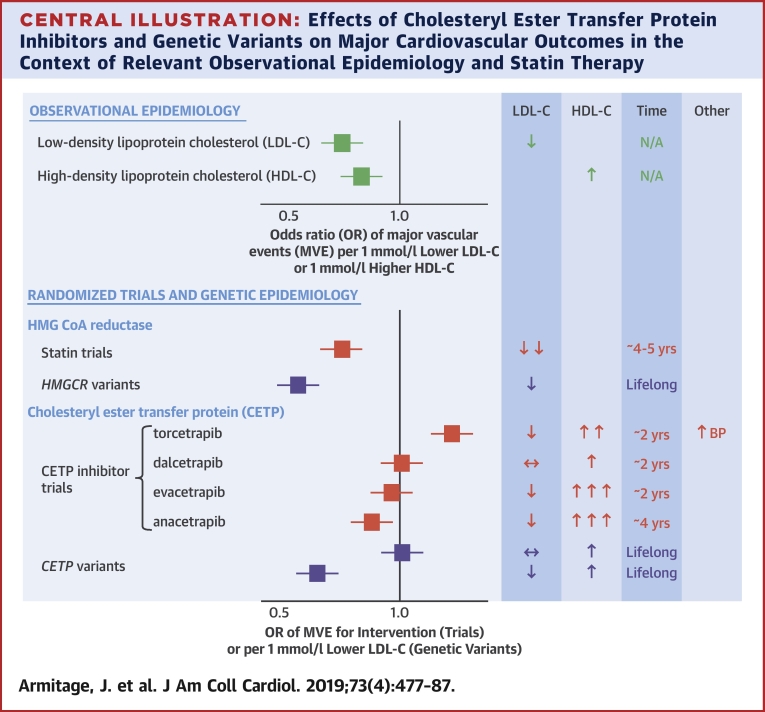
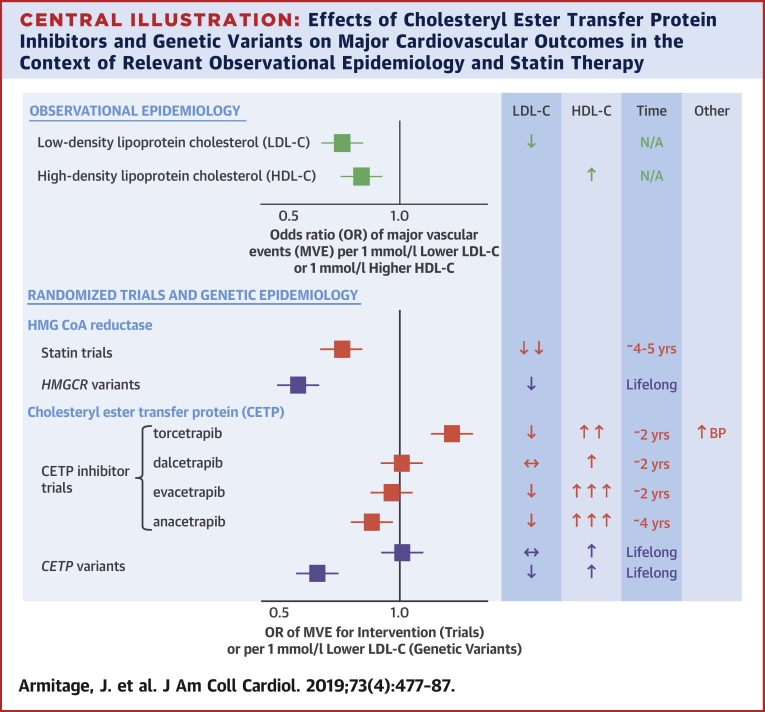
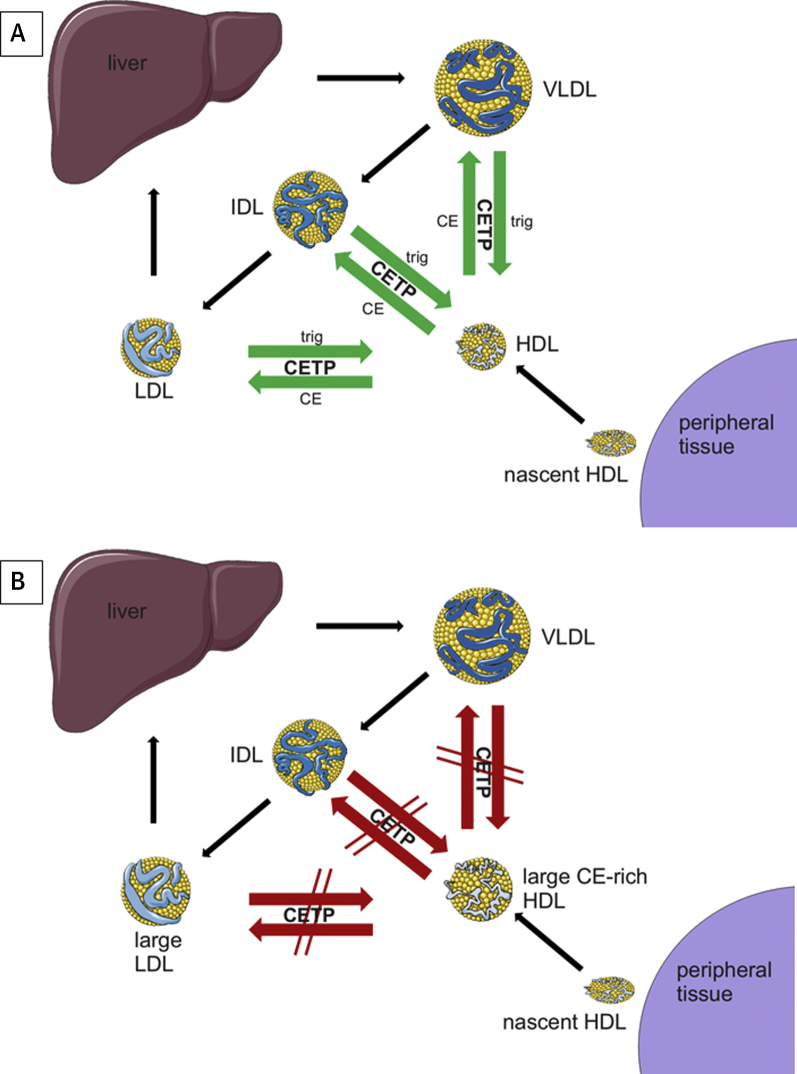
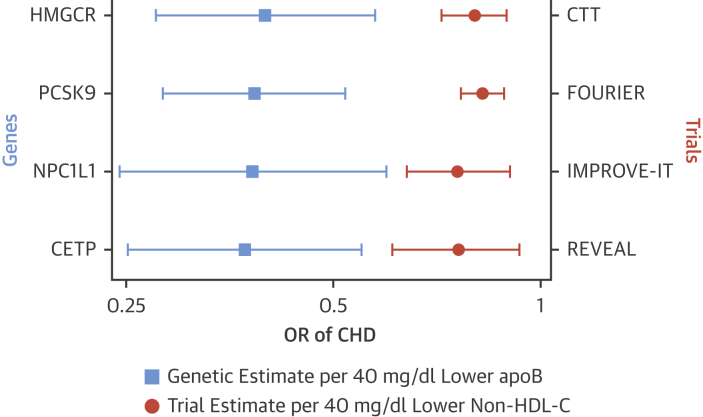
Cholesteryl ester transfer protein (CETP) facilitates exchange of triglycerides and cholesteryl ester between high-density lipoprotein (HDL) and apolipoprotein B100-containing lipoproteins. Evidence from genetic studies that variants in the CETP gene were associated with higher blood HDL cholesterol, lower low-density lipoprotein cholesterol, and lower risk of coronary heart disease suggested that pharmacological inhibition of CETP may be beneficial. To date, 4 CETP inhibitors have entered phase 3 cardiovascular outcome trials. Torcetrapib was withdrawn due to unanticipated off-target effects that increased risk of death, and major trials of dalcetrapib and evacetrapib were terminated early for futility. In the 30,000-patient REVEAL (Randomized Evaluation of the Effects of Anacetrapib through Lipid Modification) trial, anacetrapib doubled HDL cholesterol, reduced non-HDL cholesterol by 17 mg/dl (0.44 mmol/l), and reduced major vascular events by 9% over 4 years, but anaceptrapib was found to accumulate in adipose tissue, and regulatory approval is not being sought. Therefore, despite considerable initial promise, CETP inhibition provides insufficient cardiovascular benefit for routine use.
Overview
The claims and statistics of this paper haven’t been checked yet.
Run the check — free, no account needed. It reads the open-access text and checks the sources it cites.
Integrity signals
Registry
Cites
Statistics
Figures
Verification
Claims the paper makes
The claims and statistics of this paper haven’t been checked yet.
Run the check — free, no account needed. It reads the open-access text and checks the sources it cites.
Claims other papers make about this one
Each is checked against this paper’s own text: does it say what the citing paper says it does?
In the citing paper
“Colocalization, which is a statistical approach that quantifies the extent to which two traits share the same underlying causal variant, and thus can be used to infer vertical pleiotropy 83-85 , can be used to test for such bias 86 , but can suffer from issues of lack of power and/or availability of suitable data from relevant tissues.”
From Integrating genomics with biomarkers and therapeutic targets to invigorate cardiovascular drug development (2021) · cites this paper as [83]
Self-check
Percentages, sums and reported differences re-computed from the paper’s own numbers.
The self-check needs the paper’s full text.
Citations
Cites
Cholesterol Treatment Trialists' (CTT) Collaboration (2010) · The Lancet · doi:10.1016/s0140-6736(10)61350-5 · Cited by 6,550
Evolocumab and Clinical Outcomes in Patients with Cardiovascular Disease
Sabatine, M. S., Giugliano, R. P., Keech, A. C., Honarpour, N., Wiviott, S. D., Murphy, S. A., Kuder, J. F., Wang, H., Liu, T., Wasserman, S. M., et al. (2017) · New England Journal of Medicine · doi:10.1056/nejmoa1615664 · Cited by 6,138 · cited 2×
“PCSK9 inhibitor Evolocumab (44) Subcutaneous in every 2–4”
BackgroundEzetimibe Added to Statin Therapy after Acute Coronary Syndromes
Cannon, C. P., Blazing, M. A., Giugliano, R. P., McCagg, A., White, J. A., Theroux, P., Darius, H., Lewis, B. S., Ophuis, T. O., Jukema, J. W., et al. (2015) · New England Journal of Medicine · doi:10.1056/nejmoa1410489 · Cited by 4,487
Biological, clinical and population relevance of 95 loci for blood lipids
Teslovich, T. M., Musunuru, K., Smith, A. V., Edmondson, A. C., Stylianou, I. M., Koseki, M., Pirruccello, J. P., Ripatti, S., Chasman, D. I., Willer, C. J., et al. (2010) · Nature · doi:10.1038/nature09270 · Cited by 3,487
Effects of torcetrapib in patients at high risk for coronary events
Barter, P. J., Caulfield, M., Eriksson, M., Grundy, S. M., Kastelein, J. J. P., Komajda, M., Lopez-Sendon, J., Mosca, L., Tardif, J.-C., Waters, D. D., et al. (2007) · New England Journal of Medicine · doi:10.1056/nejmoa0706628 · Cited by 3,139
Major lipids, apolipoproteins, and risk of vascular disease
The Emerging Risk Factors Collaboration* (2009) · JAMA · doi:10.1001/jama.2009.1619 · Cited by 2,731
Efficacy and Safety of Alirocumab in Reducing Lipids and Cardiovascular Events
Robinson, J. G., Farnier, M., Krempf, M., Bergeron, J., Luc, G., Averna, M., Stroes, E. S., Langslet, G., Raal, F. J., El Shahawy, M., et al. (2015) · New England Journal of Medicine · doi:10.1056/nejmoa1501031 · Cited by 2,296
Effects of dalcetrapib in patients with a recent acute coronary syndrome
Schwartz, G. G., Olsson, A. G., Abt, M., Ballantyne, C. M., Barter, P. J., Brumm, J., Chaitman, B. R., Holme, I. M., Kallend, D., Leiter, L. A., et al. (2012) · New England Journal of Medicine · doi:10.1056/nejmoa1206797 · Cited by 2,022
Cited by
Sorted by citations
HDL and Reverse Cholesterol Transport
Ouimet, M. I., Barrett, T. J., & Fisher, E. A. A. (2019) · Circulation Research · doi:10.1161/circresaha.119.312617 · Cited by 816
Saturated Fats and Health: A Reassessment and Proposal for Food-Based Recommendations
Astrup, A. V., Magkos, F., Bier, D. M., Brenna, J. T., Otto, M. C. D. O., Hill, J. O., King, J. C., Mente, A., Ordovás, J. M., Volek, J. S., et al. (2020) · Journal of the American College of Cardiology · doi:10.1016/j.jacc.2020.05.077 · Cited by 581
Apolipoprotein C1: Its Pleiotropic Effects in Lipid Metabolism and Beyond
Fuior, E. V., & Gafencu, A. V. (2019) · International Journal of Molecular Sciences · doi:10.3390/ijms20235939 · Cited by 186
Holmes, M. V., Richardson, T. G., Ference, B. A., Davies, N. M., & Davey Smith, G. (2021) · Nature Reviews Cardiology · doi:10.1038/s41569-020-00493-1 · Cited by 184
Self-citationAdvances in HDL: Much More than Lipid Transporters
Ben‐Aicha, S., Badimón, L., & Vilahur, G. (2020) · International Journal of Molecular Sciences · doi:10.3390/ijms21030732 · Cited by 158
Metadata
- Authors
- Armitage, J., Holmes, M. V., & Preiss, D.
- Affiliations
- University of Oxford (GB)
- Corresponding author
- Armitage, Jane
- Venue
- Journal of the American College of Cardiology
- Publisher
- Elsevier BV
- Published
- 2019-02
- Volume
- 73
- Issue
- 4
- Pages
- 477-487
- ISSN
- 0735-1097 (ISSN-L)
- PMC
- PMC6354546
- OpenAlex
- W2911625798
- Cited by
- 140
- References
- 46
- Citations by year
- 2026: 9 · 2025: 10 · 2024: 19 · 2023: 11 · 2022: 15 · 2021: 30 · 2020: 28 · 2019: 17
- FWCI
- 4.64
- Type
- journal article
- Language
- en
- Open access
- hybrid
- doi.org
- Licence
- Locations
- Journal of the American College of Cardiology (publishedVersion, cc-by)
- Europe PMC (PubMed Central) (publishedVersion, cc-by)
- PubMed Central (publishedVersion, cc-by)
- PubMed (publishedVersion)
- Funders
- National Institute for Health and Care Research
- British Heart Foundation (18/23/33512, RE/13/1/30181, FS/18/23/33512)
- University of Oxford (RE/13/1/30181)
- Merck Sharp and Dohme
- Medical Research Council (13/1/30181, RE/13/1/30181)
- Topics
- Health Sciences › Medicine › Cardiology and Cardiovascular Medicine › Lipoproteins and Cardiovascular Health
- Life Sciences › Biochemistry, Genetics and Molecular Biology › Biochemistry › Cholesterol and Lipid Metabolism
- Life Sciences › Biochemistry, Genetics and Molecular Biology › Clinical Biochemistry › Paraoxonase enzyme and polymorphisms
- Keywords
- cholesteryl ester transfer protein, CETP inhibitors, cardiovascular events, HDL cholesterol, anacetrapib, torcetrapib, dalcetrapib, evacetrapib, coronary artery disease, non-HDL cholesterol, cardiovascular outcome trials, drug safety, adipose tissue accumulation
- MeSH terms
- Animals, Anticholesteremic Agents, Cardiovascular Diseases, Humans, Cholesterol, LDL, Clinical Trials, Phase III as Topic, Cholesterol Ester Transfer Proteins
About these checks
Registry, retraction, Cites and statistics results are computed, not judged, with one exception: a printed reference that no index lists is read once by a model before it counts as a citation error. Claims are extracted by a model and kept only when their quote appears verbatim in the text; each cited source is then checked, with a model’s help, for whether it says what the claim relies on. Those verdicts can be wrong — read the claim’s quote and the cited source before relying on one.
Statistics and arithmetic are recomputed, not judged.
Confidence bands are shown only for fields calibrated on our annotated test set. None is calibrated yet, so no band is shown.
What counts as a claim ›How we measure confidence ›How we check this ›
Are you an author, or do you see a problem with this page? Request a review
