

The DOI matches its Crossref record; 99 of the 102 references it cites were found in a registry or an index.
Resolving the Paradox of Hepatic Insulin Resistance
Open accessAbstract
Insulin resistance is associated with numerous metabolic disorders, such as obesity and type II diabetes, that currently plague our society. Although insulin normally promotes anabolic metabolism in the liver by increasing glucose consumption and lipid synthesis, insulin-resistant individuals fail to inhibit hepatic glucose production and paradoxically have increased liver lipid synthesis, leading to hyperglycemia and hypertriglyceridemia. Here, we detail the intrahepatic and extrahepatic pathways mediating insulin's control of glucose and lipid metabolism. We propose that the interplay between both of these pathways controls insulin signaling and that mis-regulation between the 2 results in the paradoxic effects seen in the insulin-resistant liver instead of the commonly proposed deficiencies in particular branches of only the direct hepatic pathway.
Overview
The claims and statistics of this paper haven’t been checked yet.
Run the check — free, no account needed. It reads the open-access text and checks the sources it cites.
Integrity signals
Registry
Cites
Statistics
Figures
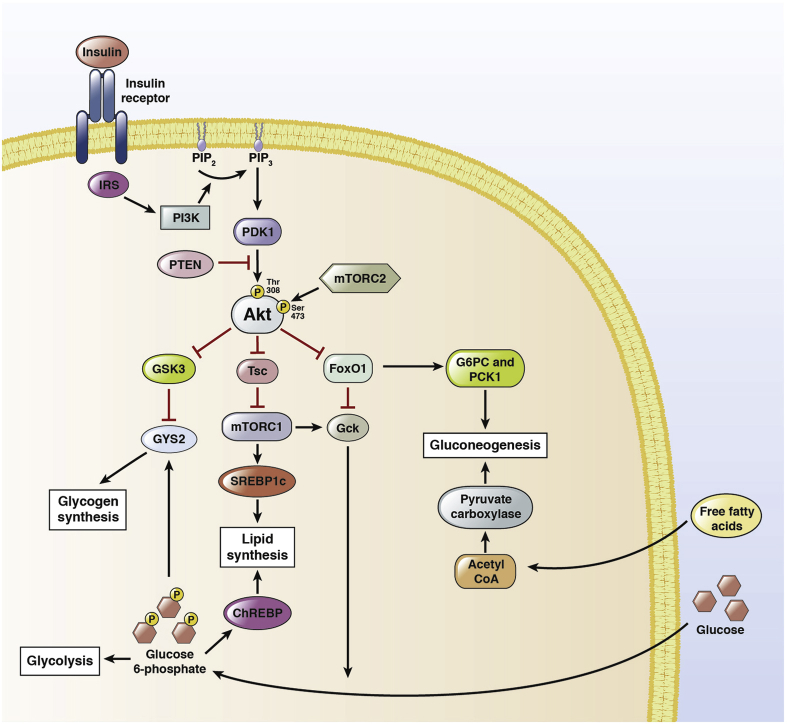
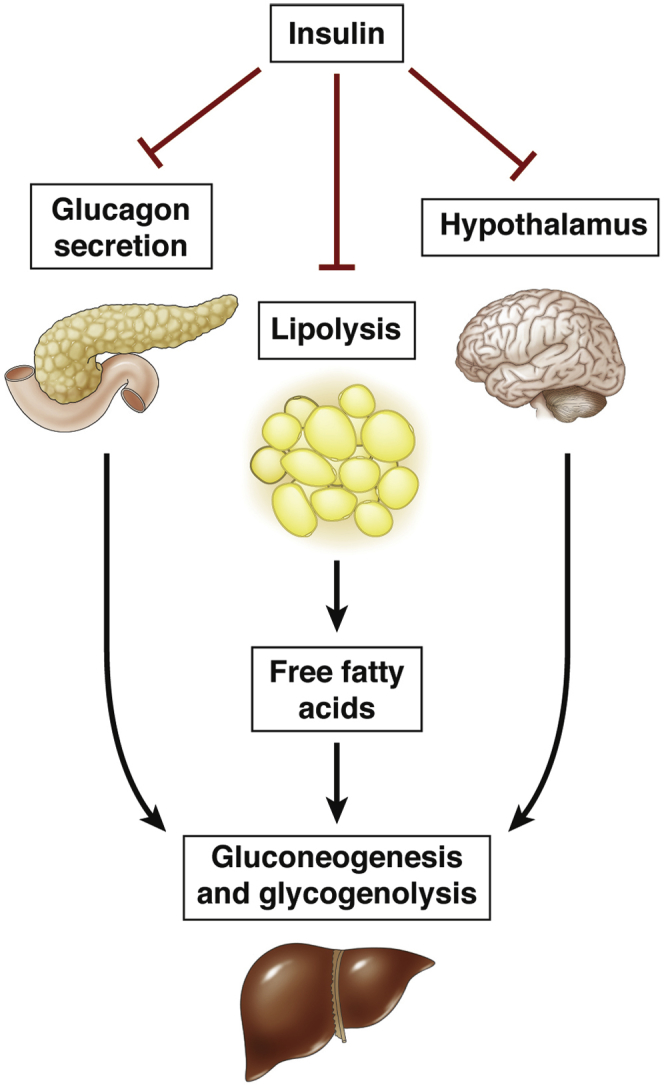
Verification
Claims the paper makes
The claims and statistics of this paper haven’t been checked yet.
Run the check — free, no account needed. It reads the open-access text and checks the sources it cites.
Claims other papers make about this one
Each is checked against this paper’s own text: does it say what the citing paper says it does?
The source backs part of the claim, not all of it — or backs it for a different population, condition or comparison.
In the citing paper
“Reduced phosphorylation of the PI3K/Akt pathway is a hallmark of IR in PCOS patients10–12.”
From Efficacy and safety of GLP-1 receptor agonists on weight management and metabolic parameters in PCOS women: a meta-analysis of randomized controlled trials (2025) · cites this paper as [11]
Experimental — accuracy not yet measuredThe source backs part of the claim, not all of it — or backs it for a different population, condition or comparison.
In the citing paper
“hepatic insulin resistance, among other effects, has proved to result in increased gluconeogenesis, lipogenesis, and synthesis of very-low-density lipoproteins (VLDL) [22]”
From The Role of Exercise in the Interplay between Myokines, Hepatokines, Osteokines, Adipokines, and Modulation of Inflammation for Energy Substrate Redistribution and Fat Mass Loss: A Review (2020) · cites this paper as [22]
Experimental — accuracy not yet measured
Self-check
Percentages, sums and reported differences re-computed from the paper’s own numbers.
The self-check needs the paper’s full text.
Citations
Cites
1 retracted
Mora, A., Lipina, C., Tronche, F., Sutherland, C. D., & Alessi, D. R. (2005) · Biochemical Journal · doi:10.1042/bj20041782 · Cited by 92 · cited 1×
“In addition, deficiency in 3phosphoinositide-dependent protein kinase 1 in mouse liver causes glucose intolerance and results in liver failure.(24)”
BackgroundRetractedPhosphorylation and regulation of Akt/PKB by the rictor-mTOR complex
Sarbassov, D. D., Guertin, D. A., Ali, S. M., & Sabatini, D. M. (2005) · Science · doi:10.1126/science.1106148 · Cited by 6,216
Global and societal implications of the diabetes epidemic
Zimmet, P., Alberti, K. G. M. M., & Shaw, J. (2001) · Nature · doi:10.1038/414782a · Cited by 5,883 · cited 1×
“016 Mdiabetes mellitus (T2DM) have reached epidemic proportions and continue to be a leading cause of death worldwide.(1) The liver plays a central role in the systemic regulation of glucose and lipid metabolism and aberrant hepatic insulin action is thought to be a primary driver of insulin resistance, in which highe…”
BackgroundInhibition of glycogen synthase kinase-3 by insulin mediated by protein kinase B
Cross, D. A. E., Alessi, D. R., Cohen, P., Andjelkovich, M., & Hemmings, B. A. (1995) · Nature · doi:10.1038/378785a0 · Cited by 5,244
SREBPs: activators of the complete program of cholesterol and fatty acid synthesis in the liver
Horton, J. D., Goldstein, J. L., & Brown, M. S. (2002) · Journal of Clinical Investigation · doi:10.1172/jci15593 · Cited by 4,794 · cited 1×
“Sterol regulatory element binding protein 1c (SREBP1c) is a member of the SREBP class of transcription factors that are key players in controlling cellular expression of genes required for lipid and cholesterol metabolism.(39) Insulin regulates SREBP1c by both enhancing its gene expression and post-translational proce…”
BackgroundSREBPs: activators of the complete program of cholesterol and fatty acid synthesis in the liver
Horton, J. D., Goldstein, J. L., & Brown, M. S. (2002) · Journal of Clinical Investigation · doi:10.1172/jci0215593 · Cited by 4,092
Brown, M. S., & Goldstein, J. L. (1997) · Cell · doi:10.1016/s0092-8674(00)80213-5 · Cited by 3,834 · cited 1×
“SREBP proteins from the endoplasmic reticulum to the Golgi where it is cleaved, releasing the active part of SREBP to the nucleus where it regulates transcription.(44) SCAP is required for activation of all isoforms of SREBP and its deletion significantly reduces cholesterol and fatty acid synthesis in the liver.”
BackgroundCritical nodes in signalling pathways: insights into insulin action
Taniguchi, C. M., Emanuelli, B., & Kahn, C. R. (2006) · Nature Reviews Molecular Cell Biology · doi:10.1038/nrm1837 · Cited by 2,760 · cited 1×
“3-phosphate kinase (PI3K)/Akt pathway is the key signaling pathway that mediates the effects of insulin on anabolic metabolism in all organisms.(17) When insulin binds to the insulin receptor (IR), it recruits and activates PI3K through insulin-receptor substrates (IRS), generating phosphatidylinositol (3,4,5)-trispho…”
BackgroundNonalcoholic steatohepatitis: association of insulin resistance and mitochondrial abnormalities
Sanyal, A. J., Campbell–Sargent, C., Mirshahi, F., Rizzo, W. B., Contos, M. J., Sterling, R. K., Luketic, V. A., Shiffman, M. L., & Clore, J. N. (2001) · Gastroenterology · doi:10.1053/gast.2001.23256 · Cited by 2,078 · cited 1×
“Patients with NAFLD almost universally show hyperinsulinemia.(6) In addition, both obese and diabetic human beings show a higher prevalence of NAFLD than lean ones.”
BackgroundActivation of a metabolic gene regulatory network downstream of mTOR complex 1
Düvel, K., Yecies, J. L., Menon, S., Raman, P., Lipovsky, A. I., Souza, A. L., Triantafellow, E., Ma, Q., Gorski, R., Cleaver, S., et al. (2010) · Molecular Cell · doi:10.1016/j.molcel.2010.06.022 · Cited by 2,020
Research works printed but not linked: 1
- Roden, 2000, Effects of free fatty acid elevation on and gluconeogenesis in humans, Endocrinol Metab, 49, 701
Cited by
Sorted by citations
Mechanisms of Fibrosis Development in Nonalcoholic Steatohepatitis
Schwabe, R. F., Tabas, I., & Pajvani, U. B. (2020) · Gastroenterology · doi:10.1053/j.gastro.2019.11.311 · Cited by 671
Role of Insulin in Health and Disease: An Update
Rahman, M. S., Hossain, K. S., Das, S., Kundu, S., Adegoke, E. O., Rahman, M. A., Hannan, M. A., Uddin, M. J., & Pang, M. (2021) · International Journal of Molecular Sciences · doi:10.3390/ijms22126403 · Cited by 574
The Role of Estrogen in Insulin Resistance
Paoli, M. D., Zakharia, A., & Werstuck, G. H. (2021) · American Journal Of Pathology · doi:10.1016/j.ajpath.2021.05.011 · Cited by 322
“However, insulin-resistant individuals do not respond to this signaling process, and paradoxically show an increase in both hepatic glucose production and insulin secretion, which can induce or aggravate hyperglycemia.(15) The factors that promote the emergence of insulin resistance include altered insulin signaling,…”
BackgroundGonzalez-Gil, A. M., & Elizondo-Montemayor, L. (2020) · Nutrients · doi:10.3390/nu12061899 · Cited by 278
“In humans, high pre-training levels of SeP were predictive of decreased aerobic exercise capacity, measured as VO2 max [50], suggesting that FFAs released by VAT lipolysis during and after exercise are less efficiently utilized by SkM and are instead preferentially reincorporated into VAT via VLDL.”
BackgroundInfluentialAcetyl-CoA Carboxylases and Diseases
Wang, Y., Yu, W., Li, S., Guo, D., He, J., & Wang, Y. (2022) · Frontiers in Oncology · doi:10.3389/fonc.2022.836058 · Cited by 238
“In mammals, the accumulation of lipid in tissues, such as muscle and liver, is closely related to insulin resistance that associates with a myriad of metabolic disorders (84, 85).”
Background
Metadata
- Authors
- Santoleri, D., & Titchenell, P. M.
- Affiliations
- University of Pennsylvania (US)
- Corresponding author
- Titchenell, Paul M.
- Venue
- Cellular and Molecular Gastroenterology and Hepatology
- Publisher
- Elsevier BV
- Published
- 2019
- Volume
- 7
- Issue
- 2
- Pages
- 447-456
- ISSN
- 2352-345X (ISSN-L)
- PMC
- PMC6369222
- OpenAlex
- W2899043265
- Cited by
- 336
- References
- 102
- Citations by year
- 2026: 35 · 2025: 57 · 2024: 61 · 2023: 63 · 2022: 51 · 2021: 40 · 2020: 24 · 2019: 5
- FWCI
- 2.57
- Type
- journal article
- Language
- en
- Open access
- gold
- doi.org
- Licence
- Locations
- Cellular and Molecular Gastroenterology and Hepatology (publishedVersion, cc-by-nc-nd)
- Europe PMC (PubMed Central) (publishedVersion, cc-by-nc-nd)
- PubMed Central (publishedVersion, cc-by-nc-nd)
- PubMed (publishedVersion)
- DOAJ (DOAJ: Directory of Open Access Journals) (submittedVersion, cc-by-sa)
- Funders
- National Institutes of Health (K01 DK111715, P30 DK19525)
- Topics
- Health Sciences › Medicine › Hepatology › Liver Disease Diagnosis and Treatment
- Life Sciences › Biochemistry, Genetics and Molecular Biology › Molecular Biology › Metabolism, Diabetes, and Cancer
- Health Sciences › Medicine › Endocrinology, Diabetes and Metabolism › Diabetes, Cardiovascular Risks, and Lipoproteins
- Keywords
- hepatic insulin resistance, insulin signaling, hepatic glucose production, hepatic lipid synthesis, hypertriglyceridemia, hyperglycemia, type 2 diabetes, obesity, glucose metabolism, lipid metabolism
- MeSH terms
- Animals, Humans, Insulin, Insulin Resistance, Liver, Models, Biological, Signal Transduction, Lipid Metabolism
About these checks
Registry, retraction, Cites and statistics results are computed, not judged, with one exception: a printed reference that no index lists is read once by a model before it counts as a citation error. Claims are extracted by a model and kept only when their quote appears verbatim in the text; each cited source is then checked, with a model’s help, for whether it says what the claim relies on. Those verdicts can be wrong — read the claim’s quote and the cited source before relying on one.
Statistics and arithmetic are recomputed, not judged.
Confidence bands are shown only for fields calibrated on our annotated test set. None is calibrated yet, so no band is shown.
What counts as a claim ›How we measure confidence ›How we check this ›
Are you an author, or do you see a problem with this page? Request a review
