

The DOI matches its Crossref record; 63 of the 64 references it cites were found in a registry or an index.
Novelty, conditioning and attentional bias to sexual rewards
Open accessAbstract
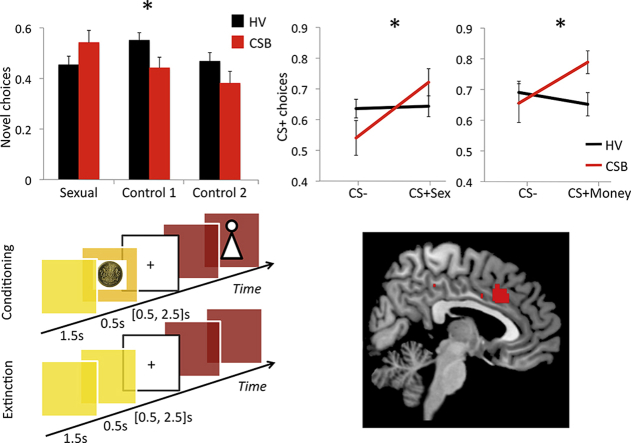
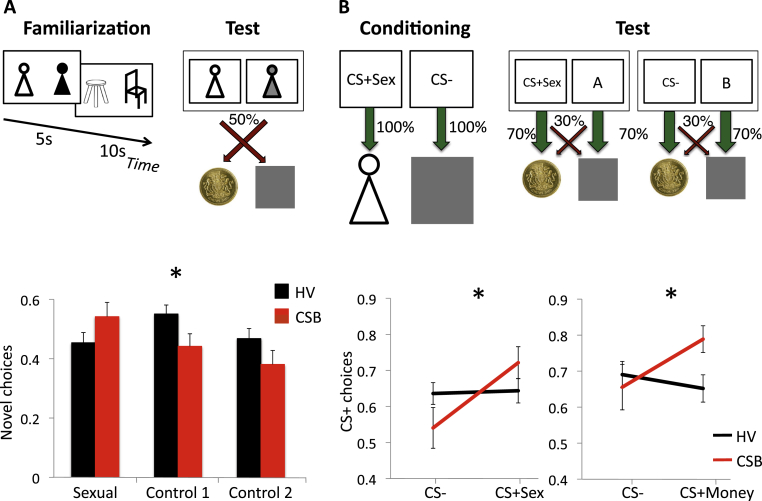
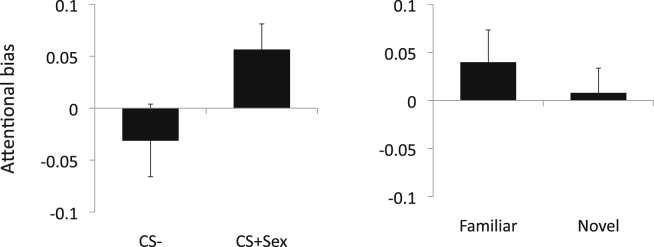
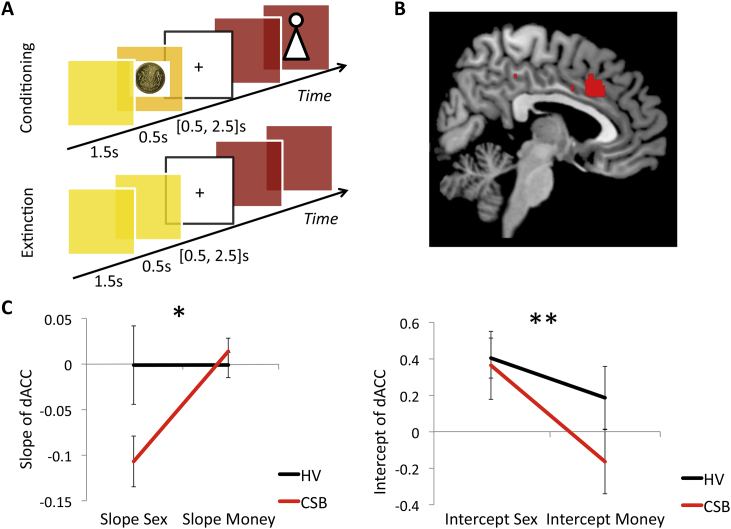
The Internet provides a large source of novel and rewarding stimuli, particularly with respect to sexually explicit materials. Novelty-seeking and cue-conditioning are fundamental processes underlying preference and approach behaviors implicated in disorders of addiction. Here we examine these processes in individuals with compulsive sexual behaviors (CSB), hypothesizing a greater preference for sexual novelty and stimuli conditioned to sexual rewards relative to healthy volunteers. Twenty-two CSB males and forty age-matched male volunteers were tested in two separate behavioral tasks focusing on preferences for novelty and conditioned stimuli. Twenty subjects from each group were also assessed in a third conditioning and extinction task using functional magnetic resonance imaging. CSB was associated with enhanced novelty preference for sexual, as compared to control images, and a generalized preference for cues conditioned to sexual and monetary versus neutral outcomes compared to healthy volunteers. CSB individuals also had greater dorsal cingulate habituation to repeated sexual versus monetary images with the degree of habituation correlating with enhanced preference for sexual novelty. Approach behaviors to sexually conditioned cues dissociable from novelty preference were associated with an early attentional bias to sexual images. This study shows that CSB individuals have a dysfunctional enhanced preference for sexual novelty possibly mediated by greater cingulate habituation along with a generalized enhancement of conditioning to rewards. We further emphasize a dissociable role for cue-conditioning and novelty preference on the early attentional bias for sexual cues. These findings have wider relevance as the Internet provides a broad range of novel and potentially rewarding stimuli.
Overview
The claims and statistics of this paper haven’t been checked yet.
Run the check — free, no account needed. It reads the open-access text and checks the sources it cites.
Integrity signals
Registry
Cites
Statistics
Figures
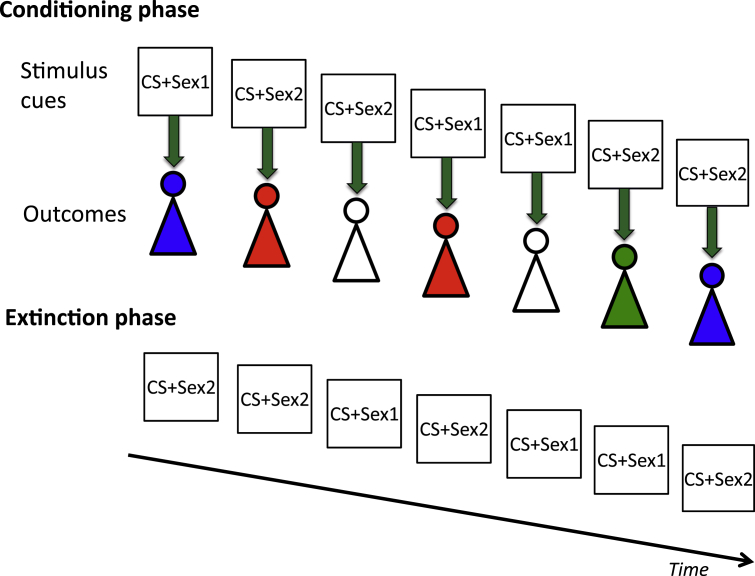
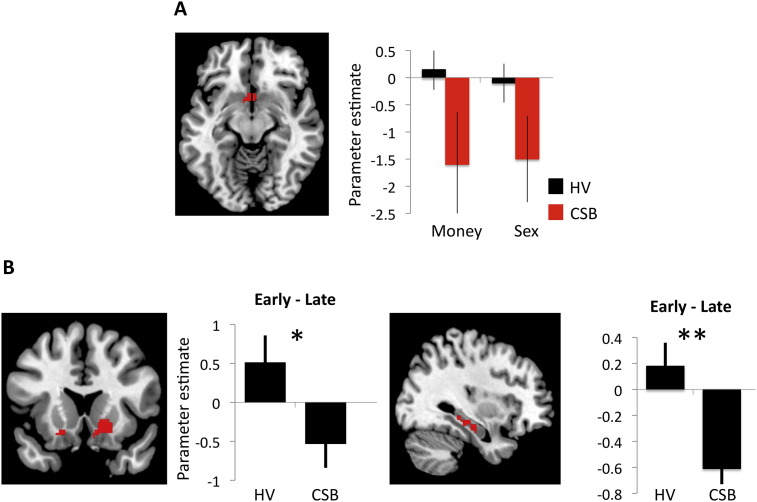
Verification
Claims the paper makes
The claims and statistics of this paper haven’t been checked yet.
Run the check — free, no account needed. It reads the open-access text and checks the sources it cites.
Claims other papers make about this one
Each is checked against this paper’s own text: does it say what the citing paper says it does?
The source backs part of the claim, not all of it — or backs it for a different population, condition or comparison.
In the citing paper
“Individuals who report compulsive sexual behaviour, as compared to individuals who do not, exhibit increased blood flow in the reward system of the brain in response to erotic cues 268-270 , greater responsivity and attention to erotic cues 271-273 , increased gray matter volume in the left amygdala 274 , and decreased right caudate nucleus volume 275 .”
From Emerging experience with selected new categories in the ICD‐11: complex PTSD, prolonged grief disorder, gaming disorder, and compulsive sexual behaviour disorder (2022) · cites this paper as [271]
Experimental — accuracy not yet measured
Self-check
Percentages, sums and reported differences re-computed from the paper’s own numbers.
The self-check needs the paper’s full text.
Citations
Cites
An inventory for measuring depression
BECK, A. T. (1961) · Archives of General Psychiatry · doi:10.1001/archpsyc.1961.01710120031004 · Cited by 38,032
(1970) · Cited by 24,983
(1998) · The Journal of Clinical Psychiatry · Cited by 19,139
SAUNDERS, J. B., AASLAND, O. G., BABOR, T. F., DE LA FUENTE, J. R., & GRANT, M. (1993) · Addiction · doi:10.1111/j.1360-0443.1993.tb02093.x · Cited by 13,597
(1998) · PubMed · Cited by 10,216
A neural substrate of prediction and reward
Schultz, W., Dayan, P., & Montague, P. R. (1997) · Science · doi:10.1126/science.275.5306.1593 · Cited by 9,388
Selective Cortical Undercutting As a Means of Modifying and Studying Frontal Lobe Function in Man
Scoville, W. B. (1949) · Journal of neurosurgery · doi:10.3171/jns.1949.6.1.0065 · Cited by 7,374
Predictive reward signal of dopamine neurons
Schultz, W. (1998) · Journal of Neurophysiology · doi:10.1152/jn.1998.80.1.1 · Cited by 4,564
Whiteside, S. P., & Lynam, D. R. (2001) · Personality and Individual Differences · doi:10.1016/s0191-8869(00)00064-7 · Cited by 4,123
The hippocampal-VTA loop: controlling the entry of information into long-term memory
Lisman, J. E., & Grace, A. A. (2005) · Neuron · doi:10.1016/j.neuron.2005.05.002 · Cited by 1,983
Dopamine-dependent prediction errors underpin reward-seeking behaviour in humans
Pessiglione, M., Seymour, B., Flandin, G., Dolan, R. J., & Frith, C. D. (2006) · Nature · doi:10.1038/nature05051 · Cited by 1,584
Frontal cortex and reward-guided learning and decision-making
Rushworth, M. F. S., Noonan, M. P., Boorman, E. D., Walton, M. E., & Behrens, T. E. (2011) · Neuron · doi:10.1016/j.neuron.2011.05.014 · Cited by 1,111
Dorsal anterior cingulate cortex: A role in reward-based decision making
Bush, G., Vogt, B. A., Holmes, J., Dale, A. M., Greve, D., Jenike, M. A., & Rosen, B. R. (2002) · Proceedings of the National Academy of Sciences · doi:10.1073/pnas.012470999 · Cited by 1,096
Hypersexual disorder: A proposed diagnosis for DSM-V
Kafka, M. P. (2010) · Archives of Sexual Behavior · doi:10.1007/s10508-009-9574-7 · Cited by 1,095
Kreek, M. J., Nielsen, D. A., Butelman, E. R., & LaForge, K. S. (2005) · Nature Neuroscience · doi:10.1038/nn1583 · Cited by 1,024
Wiers, R. W., Eberl, C., Rinck, M., Becker, E. S., & Lindenmeyer, J. (2011) · Psychological Science · doi:10.1177/0956797611400615 · Cited by 912
The effects of emotion on attention: A review of attentional processing of emotional information
Yiend, J. (2010) · Cognition and Emotion · doi:10.1080/02699930903205698 · Cited by 891
Choice, uncertainty and value in prefrontal and cingulate cortex
Rushworth, M. F. S., & Behrens, T. E. J. (2008) · Nature Neuroscience · doi:10.1038/nn2066 · Cited by 866
Contribution of human hippocampal region to novelty detection
Knight, R. T. (1996) · Nature · doi:10.1038/383256a0 · Cited by 848
Neural mechanisms for detecting and remembering novel events
Ranganath, C., & Rainer, G. (2003) · Nature Reviews Neuroscience · doi:10.1038/nrn1052 · Cited by 779
Psychobiology of novelty seeking and drug seeking behavior
Bardo, M. T., Donohew, R. L., & Harrington, N. G. (1996) · Behavioural Brain Research · doi:10.1016/0166-4328(95)00203-0 · Cited by 667
Mazur, J. E., & Odum, A. L. (2015) · Routledge eBooks · doi:10.4324/9781003215950 · Cited by 572
The Addiction-Stroop test: Theoretical considerations and procedural recommendations.
Cox, W. M., Fadardi, J. S., & Pothos, E. M. (2006) · Psychological Bulletin · doi:10.1037/0033-2909.132.3.443 · Cited by 541
Absolute Coding of Stimulus Novelty in the Human Substantia Nigra/VTA
Bunzeck, N., & Düzel, E. (2006) · Neuron · doi:10.1016/j.neuron.2006.06.021 · Cited by 503
Kühn, S., & Gallinat, J. (2011) · European Journal of Neuroscience · doi:10.1111/j.1460-9568.2010.07590.x · Cited by 487
Wills, T. A., Vaccaro, D., & McNamara, G. (1994) · Journal of Substance Abuse · doi:10.1016/s0899-3289(94)90039-6 · Cited by 480
Widespread origin of the primate mesofrontal dopamine system
Williams, S. (1998) · Cerebral Cortex · doi:10.1093/cercor/8.4.321 · Cited by 479
Voon, V., Mole, T. B., Banca, P., Porter, L., Morris, L., Mitchell, S., Lapa, T. R., Karr, J., Harrison, N. A., Potenza, M. N., et al. (2014) · PLoS ONE · doi:10.1371/journal.pone.0102419 · Cited by 462
Self-citationHuman dorsal anterior cingulate cortex neurons mediate ongoing behavioural adaptation
Sheth, S. A., Mian, M. K., Patel, S. R., Asaad, W. F., Williams, Z. M., Dougherty, D. D., Bush, G., & Eskandar, E. N. (2012) · Nature · doi:10.1038/nature11239 · Cited by 441
Impulse Control Disorders in Adult Psychiatric Inpatients
Grant, J. E., Levine, L., Kim, D., & Potenza, M. N. (2005) · American Journal of Psychiatry · doi:10.1176/appi.ajp.162.11.2184 · Cited by 435
Self-citationReport of Findings in a DSM-5 Field Trial for Hypersexual Disorder
Reid, R. C., Carpenter, B. N., Hook, J. N., Garos, S., Manning, J. C., Gilliland, R., Cooper, E. B., McKittrick, H., Davtian, M., & Fong, T. (2012) · The Journal of Sexual Medicine · doi:10.1111/j.1743-6109.2012.02936.x · Cited by 430
Impulse control disorders in parkinson disease: A multicenter case–control study
Voon, V., Sohr, M., Lang, A. E., Potenza, M. N., Siderowf, A. D., Whetteckey, J., Weintraub, D. A., Wunderlich, G. R., & Stacy, M. A. (2011) · Annals of Neurology · doi:10.1002/ana.22356 · Cited by 400
Self-citationA learning model of binge eating: Cue reactivity and cue exposure
Jansen, A. T. M. (1998) · Behaviour Research and Therapy · doi:10.1016/s0005-7967(98)00055-2 · Cited by 377
Cue Reactivity and Cue Reactivity Interventions in Drug Dependence
Childress, A. R., Hole, A. V., Ehrman, R. N., Robbins, S. J., McLellan, A. T., & O’Brien, C. P. (1993) · PsycEXTRA Dataset · doi:10.1037/e495912006-006 · Cited by 368
Conditioning and Sexual Behavior: A Review
Pfaus, J. G., Kippin, T. E., & Centeno, S. (2001) · Hormones and Behavior · doi:10.1006/hbeh.2001.1686 · Cited by 351
An integrative theoretical framework for understanding sexual motivation, arousal, and behavior
Toates, F. (2009) · Journal of Sex Research · doi:10.1080/00224490902747768 · Cited by 339
Conrod, P., O’Leary-Barrett, M., Newton, N. C., Topper, L., Ryan, N. C., Mackie, C. J., & Girard, A. (2013) · JAMA Psychiatry · doi:10.1001/jamapsychiatry.2013.651 · Cited by 302
High-Novelty-Preference Rats are Predisposed to Compulsive Cocaine Self-administration
Belin, D., Berson, N., Balado, É., Piazza, P., & Deroche-Gamonet, V. (2011) · Neuropsychopharmacology · doi:10.1038/npp.2010.188 · Cited by 262
Brain Structure and Functional Connectivity Associated With Pornography Consumption
Kühn, S., & Gallinat, J. (2014) · JAMA Psychiatry · doi:10.1001/jamapsychiatry.2014.93 · Cited by 262
Predicting Compulsive Internet Use: It's All about Sex!
Meerkerk, G.-J., Eijnden, R. J. J. M. V. D., & Garretsen, H. F. L. (2006) · CyberPsychology & Behavior · doi:10.1089/cpb.2006.9.95 · Cited by 257
Impulse control disorders and “behavioural addictions” in the ICD-11
Grant, J. E., Atmaca, M., Fineberg, N. A., Fontenelle, L. F., Matsunaga, H., Janardhan Reddy, Y. C., Simpson, H. B., Thomsen, P. H., van den Heuvel, O. A., Veale, D., et al. (2014) · World Psychiatry · doi:10.1002/wps.20115 · Cited by 227
Imbalance in the sensitivity to different types of rewards in pathological gambling
Sescousse, G., Barbalat, G., Domenech, P., & Dreher, J. (2013) · Brain · doi:10.1093/brain/awt126 · Cited by 202
Fiorino, D. F., & Phillips, A. G. (1999) · Journal of Neuroscience · doi:10.1523/jneurosci.19-01-00456.1999 · Cited by 170
Compulsive Sexual Behavior in Young Adults
Odlaug, B. L., Lust, K. A., Schreiber, L. R. N., Christenson, G., Derbyshire, K. L., Harvanko, A. M., Golden, D., & Grant, J. E. (2013) · Annals of Clinical Psychiatry · doi:10.1177/104012371302500305 · Cited by 152
Attention and Emotional Responses to Sexual Stimuli and Their Relationship to Sexual Desire
Prause, N., Janssen, E., & Hetrick, W. P. (2007) · Archives of Sexual Behavior · doi:10.1007/s10508-007-9236-6 · Cited by 140
Belin, D., & Deroche‐Gamonet, V. (2012) · Cold Spring Harbor Perspectives in Medicine · doi:10.1101/cshperspect.a011940 · Cited by 130
Mechelmans, D. J., Irvine, M. A., Banca, P., Porter, L., Mitchell, S., Mole, T. B., Lapa, T. R., Harrison, N. A., Potenza, M. N., & Voon, V. (2014) · PLoS ONE · doi:10.1371/journal.pone.0105476 · Cited by 128
Self-citationNovelty seeking, incentive salience and acquisition of cocaine self-administration in the rat
Beckmann, J. S., Marusich, J. A., Gipson, C. D., & Bardo, M. T. (2011) · Behavioural Brain Research · doi:10.1016/j.bbr.2010.07.022 · Cited by 119
Ersche, K. D., Bullmore, E. T., Craig, K. J., Shabbir, S. S., Abbott, S., Müller, U., Ooi, C., Suckling, J., Barnes, A., Sahakian, B. J., et al. (2010) · Archives of General Psychiatry · doi:10.1001/archgenpsychiatry.2010.60 · Cited by 108
Klucken, T., Schweckendiek, J., Merz, C. J., Tabbert, K., Walter, B., Kagerer, S., Vaitl, D., & Stark, R. M. (2009) · The Journal of Sexual Medicine · doi:10.1111/j.1743-6109.2009.01405.x · Cited by 100
Impulse-Control Disorders in a College Sample
Odlaug, B. L., & Grant, J. E. (2010) · The Primary Care Companion to The Journal of Clinical Psychiatry · doi:10.4088/pcc.09m00842whi · Cited by 99
Novelty seeking behaviour in Parkinson's disease
Djamshidian, A., O’Sullivan, S. S., Wittmann, B. C., Lees, A. J., & Averbeck, B. B. (2011) · Neuropsychologia · doi:10.1016/j.neuropsychologia.2011.04.026 · Cited by 81
Gender Commonalities and Differences in the Neural Processing of Visual Sexual Stimuli
Wehrum‐Osinsky, S., Klucken, T., Kagerer, S., Walter, B., Hermann, A., Vaitl, D., & Stark, R. M. (2013) · The Journal of Sexual Medicine · doi:10.1111/jsm.12096 · Cited by 69
Pharmacological Dissociation of Novelty Responses in the Human Brain
Bunzeck, N., Guitart‐Masip, M., Dolan, R. J., & Düzel, E. (2013) · Cerebral Cortex · doi:10.1093/cercor/bhs420 · Cited by 57
Sex Attracts: Investigating Individual Differences in Attentional Bias to Sexual Stimuli
Kagerer, S., Wehrum‐Osinsky, S., Klucken, T., Walter, B., Vaitl, D., & Stark, R. M. (2014) · PLoS ONE · doi:10.1371/journal.pone.0107795 · Cited by 54
Changes in the magnitude of the eyeblink startle response during habituation of sexual arousal
Koukounas, E., & Over, R. (2000) · Behaviour Research and Therapy · doi:10.1016/s0005-7967(99)00075-3 · Cited by 53
Redolat, R., Pérez‐Martinez, A., Carrasco, M., & Mesa, P. (2009) · Current Drug Abuse Reviews · doi:10.2174/1874473710902030230 · Cited by 50
Mazur, M. (2015) · Cited by 37
Reward-related attentional biases and adolescent substance use: The TRAILS study.
van Hemel-Ruiter, M. E., de Jong, P. J., Oldehinkel, A. J., & Ostafin, B. D. (2012) · Psychology of Addictive Behaviors · doi:10.1037/a0028271 · Cited by 36
Frohmader, K. S., Lehman, M. N., Laviolette, S. R., & Coolen, L. M. (2011) · Journal of Neuroscience · doi:10.1523/jneurosci.4013-11.2011 · Cited by 33
At the Second Glance: Stability of Neural Responses Toward Visual Sexual Stimuli
Wehrum‐Osinsky, S., Klucken, T., Kagerer, S., Walter, B., Hermann, A., & Stark, R. M. (2014) · The Journal of Sexual Medicine · doi:10.1111/jsm.12653 · Cited by 32
Learning and behavior (5th ed.).
Mazur, J. (2002) · Cited by 32
[Hypersexual disorder will not be included in the DSM V : a contextual analysis].
Toussaint, I., & Pitchot, W. (2013) · PubMed · Cited by 2
Cited by
Sorted by citations
Should compulsive sexual behavior be considered an addiction?
Kraus, S. W., Voon, V., & Potenza, M. N. (2016) · Addiction · doi:10.1111/add.13297 · Cited by 402
Self-citationCan Pornography be Addictive? An fMRI Study of Men Seeking Treatment for Problematic Pornography Use
Gola, M., Wordecha, M., Sescousse, G., Lew-Starowicz, M., Kossowski, B., Wypych, M., Makeig, S., Potenza, M. N., & Marchewka, A. (2017) · Neuropsychopharmacology · doi:10.1038/npp.2017.78 · Cited by 299
Self-citationOnline Porn Addiction: What We Know and What We Don’t—A Systematic Review
de Alarcón, R., de la Iglesia, J., Casado‐Espada, N. M., & Montejo, A. L. (2019) · Journal of Clinical Medicine · doi:10.3390/jcm8010091 · Cited by 306
Grubbs, J. B., Hoagland, K. C., Lee, B. N., Grant, J. T., Davison, P., Reid, R. C., & Kraus, S. W. (2020) · Clinical Psychology Review · doi:10.1016/j.cpr.2020.101925 · Cited by 253
Neuroanatomy and function of human sexual behavior: A neglected or unknown issue?
Calabrò, R. S., Cacciola, A., Bruschetta, D., Milardi, D., Quattrini, F., Sciarrone, F., Rosa, G. L., Bramanti, P., & Anastasi, G. (2019) · Brain and Behavior · doi:10.1002/brb3.1389 · Cited by 228
Metadata
- Authors
- Banca, P., Morris, L. S., Mitchell, S., Harrison, N. A., Potenza, M. N., & Voon, V.
- Affiliations
- University of Cambridge (GB)
- Brighton and Sussex Medical School (GB)
- Yale University (US)
- Corresponding author
- Voon, Valerie
- Venue
- Journal of Psychiatric Research
- Publisher
- Elsevier BV
- Published
- 2016-01
- Volume
- 72
- Pages
- 91-101
- ISSN
- 0022-3956 (ISSN-L)
- PMC
- PMC4683093
- OpenAlex
- W2173747897
- Cited by
- 137
- References
- 64
- Citations by year
- 2026: 8 · 2025: 5 · 2024: 7 · 2023: 6 · 2022: 4 · 2021: 13 · 2020: 57 · 2019: 10 · 2018: 11 · 2017: 8 · 2016: 8
- FWCI
- 11.16
- Type
- journal article
- Language
- en
- Open access
- hybrid
- doi.org
- Locations
- Journal of Psychiatric Research (publishedVersion, cc-by)
- Europe PMC (PubMed Central) (publishedVersion, cc-by)
- PubMed Central (publishedVersion, cc-by)
- PubMed (publishedVersion)
- ORCA Online Research @Cardiff (Cardiff University) (submittedVersion)
- Apollo (University of Cambridge) (submittedVersion, cc-by)
- Funders
- Wellcome Trust (WT093705/Z/10/Z, 093875)
- Topics
- Social Sciences › Psychology › Clinical Psychology › Sexuality, Behavior, and Technology
- Social Sciences › Psychology › Clinical Psychology › Gambling Behavior and Treatments
- Life Sciences › Neuroscience › Cognitive Neuroscience › Neural and Behavioral Psychology Studies
- Keywords
- compulsive sexual behavior, novelty seeking, attentional bias, sexual reward, extinction, approach behavior, sexual imagery, addiction
- MeSH terms
- Adult, Attention, Brain, Conditioning, Psychological, Cues, Exploratory Behavior, Habituation, Psychophysiologic, Humans, Magnetic Resonance Imaging, Male, Neuropsychological Tests, Pattern Recognition, Visual, Photic Stimulation, Reward, Sexual Behavior
About these checks
Registry, retraction, Cites and statistics results are computed, not judged, with one exception: a printed reference that no index lists is read once by a model before it counts as a citation error. Claims are extracted by a model and kept only when their quote appears verbatim in the text; each cited source is then checked, with a model’s help, for whether it says what the claim relies on. Those verdicts can be wrong — read the claim’s quote and the cited source before relying on one.
Statistics and arithmetic are recomputed, not judged.
Confidence bands are shown only for fields calibrated on our annotated test set. None is calibrated yet, so no band is shown.
What counts as a claim ›How we measure confidence ›How we check this ›
Are you an author, or do you see a problem with this page? Request a review
