

The DOI matches its Crossref record; 58 of the 60 references it cites were found in a registry or an index.
Impact of built environment on physical activity and obesity among children and adolescents in China: A narrative systematic review
Open accessAbstract
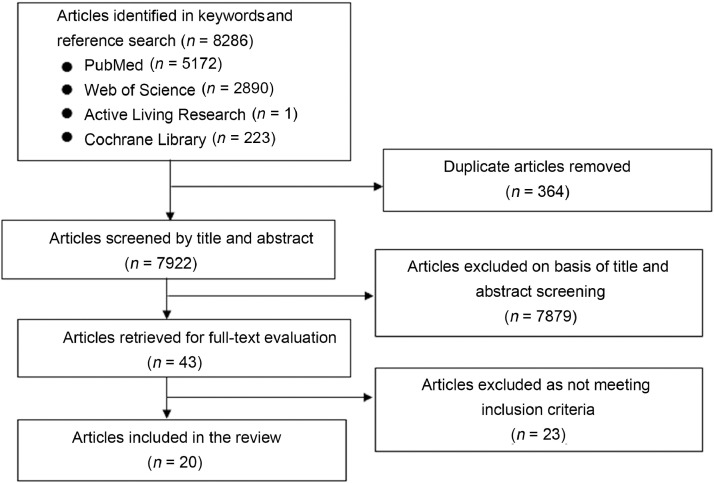
BACKGROUND: Neighborhood built environment may profoundly influence children's physical activity (PA) and body weight. This study systematically reviewed scientific evidence regarding the impact of built environment on PA and obesity among children and adolescents in China. METHODS: A keyword and reference search was conducted in Active Living Research, Cochrane Library, PubMed, and Web of Science. Studies that met all of the following criteria were included in the review: (1) study designs-experimental studies, observational studies, and qualitative studies; (2) study subjects-Chinese children and/or adolescents aged ≤17 years; (3) exposures-neighborhood built environment; (4) outcomes-PA and/or body weight status; (5) article type-peer-reviewed publications; (6) time window of search-from the inception of an electronicbibliographic database to May 31, 2018; (7) country-China; and (8) language-articles written in English. RESULTS: A total of 20 studies, including 16 cross-sectional studies, 3 longitudinal studies, and 1 descriptive study, met the predetermined selection criteria and were included in the review. A total of 13 studies adopted subjective built environment measures reported by parents and/or children,2 adopted objective measures (e.g., geographical information system, field observations), and 5 adopted both objective and subjective measures. PA behaviors included PA, physical inactivity, sedentary behavior, active/passive commuting from/to school, and park visits. Among the 16 studies that provided some quantitative estimates of the influence of built environment on PA and body weight status, all reported a statistically significant relationship in the expected direction. Availability and accessibility in proximity to greenspaces, parks, recreational facilities, and sidewalks were found to be associated with increased PA levels, reduced sedentary behaviors, and/or active commuting among Chinese childrenand adolescents. In contrast, the absence of bike lanes and living in higher density residential areas were associated with increased likelihood of childhood overweight and obesity. CONCLUSION: Neighborhood built environment plays an important role in Chinese children's PA engagement and weight outcomes. Building new exercise facilities and enhancing the accessibility of existing facilities hold the potential to enhance PA engagement among Chinese children and adolescents. In addition, urban designs that incorporate sidewalks, bike lanes, walking paths, less motorized traffic, and lower residential density are likely to promote PA and prevent childhood obesity in China.
Overview
The claims and statistics of this paper haven’t been checked yet.
Run the check — free, no account needed. It reads the open-access text and checks the sources it cites.
Integrity signals
Registry
Cites
Statistics
Figures
Verification
Claims the paper makes
The claims and statistics of this paper haven’t been checked yet.
Run the check — free, no account needed. It reads the open-access text and checks the sources it cites.
Claims other papers make about this one
Each is checked against this paper’s own text: does it say what the citing paper says it does?
In the citing paper
“Evidence from China indicates that built environmental features in the community, such as availability and accessibility of open space, recreational facilities and walkable sidewalks, are likely to facilitate increased physical activity and active commuting, as well as reduced sedentary behaviours among Chinese children and adolescents.”
From Physical activity and health in Chinese children and adolescents: expert consensus statement (2020) (2020) · cites this paper as [109]
In the citing paper
“There is consistent evidence of various environmental influences on the physical activity levels of children and adolescents.109–112”
From Physical activity and health in Chinese children and adolescents: expert consensus statement (2020) (2020) · cites this paper as [109]
In the citing paper
“Commonly reported factors influencing physical activity levels include socioeconomic status (income and education), the physical environment (ambient air and water) and the built environment (neighbourhood design, parks and recreational facilities, green space, safety, access to physical activity facilities and street connectivity).”
From Physical activity and health in Chinese children and adolescents: expert consensus statement (2020) (2020) · cites this paper as [109]
In the citing paper
“In contrast, features such as the lack of bike lanes and high residential density are likely to be associated with childhood overweight and obesity.109”
From Physical activity and health in Chinese children and adolescents: expert consensus statement (2020) (2020) · cites this paper as [109]
Self-check
Percentages, sums and reported differences re-computed from the paper’s own numbers.
The self-check needs the paper’s full text.
Citations
Cites
Child abuse: Adolescent records vs. adult recall
Femina, D. D., Yeager, C. A., & Lewis, D. O. (1990) · Child Abuse & Neglect · doi:10.1016/0145-2134(90)90033-p · Cited by 8,820
Lee, I.-M., Shiroma, E. J., Lobelo, F., Puska, P., Blair, S. N., & Katzmarzyk, P. T. (2012) · The Lancet · doi:10.1016/s0140-6736(12)61031-9 · Cited by 8,215
Correlates of physical activity: why are some people physically active and others not?
Bauman, A. E., Reis, R. S., Sallis, J. F., Wells, J. C., Loos, R. J., & Martin, B. W. (2012) · The Lancet · doi:10.1016/s0140-6736(12)60735-1 · Cited by 4,151 · cited 1×
“The relationship between built environment and PA among children in general has been extensively documented.(16,17) Accumulating evidence suggests that the availability of parks, playgrounds, gyms, and other facilities, as well as other neighborhood features such as walkability and safety, profoundly shape children’s…”
BackgroundAnnual Medical Spending Attributable To Obesity: Payer-And Service-Specific Estimates
Finkelstein, E. A., Trogdon, J. G., Cohen, J. W., & Dietz, W. H. (2009) · Health Affairs · doi:10.1377/hlthaff.28.5.w822 · Cited by 2,956
Danaei, G., Ding, E. L., Mozaffarian, D., Taylor, B., Rehm, J., Murray, C. J. L., & Ezzati, M. (2009) · PLoS Medicine · doi:10.1371/journal.pmed.1000058 · Cited by 2,860
Fit Yourself and Take Your Lungs to Heart
Palange, P., & Bonini, M. (2013) · Respiration · doi:10.1159/000350831 · Cited by 2,780
Global prevalence and trends of overweight and obesity among preschool children
de Onis, M., Blössner, M., & Borghi, E. (2010) · The American Journal of Clinical Nutrition · doi:10.3945/ajcn.2010.29786 · Cited by 2,182 · cited 1×
“In 2010, 43 million children worldwide (35 million in developing countries) were estimated to be overweight or obese.(7) By 2020, the prevalence of childhood overweight/obesity is projected to reach 9%, or 60 million children worldwide.”
BackgroundDavison, K. K., & Lawson, C. T. (2006) · International Journal of Behavioral Nutrition and Physical Activity · doi:10.1186/1479-5868-3-19 · Cited by 966
Neighborhood Environment and Physical Activity Among Youth
Ding, D., Sallis, J. F., Kerr, J., Lee, S., & Rosenberg, D. E. (2011) · American Journal of Preventive Medicine · doi:10.1016/j.amepre.2011.06.036 · Cited by 914 · cited 1×
“Accumulating evidence suggests that the availability of parks, playgrounds, gyms, and other facilities, as well as other neighborhood features such as walkability and safety, profoundly shape children’s daily PA patterns.(18,19) Roemmich et al.”
BackgroundThe Role of Built Environments in Physical Activity, Eating, and Obesity in Childhood
Sallis, J. F., & Glanz, K. (2006) · The Future of Children · doi:10.1353/foc.2006.0009 · Cited by 755 · cited 1×
“Two systematic reviews have investigated the associations between various built environment attributes and childhood obesity.(56,58) Neighborhood features such as walkability, bikeability, and proximity to parks and recreational facilities were found to be associated with increased PA and active commuting.”
BackgroundWang, Y., & Lim, H. (2012) · International Review of Psychiatry · doi:10.3109/09540261.2012.688195 · Cited by 753 · cited 1×
“By 2020, the prevalence of childhood overweight/obesity is projected to reach 9%, or 60 million children worldwide.(8) Based on the 2017 Report on Childhood Obesity in China, the prevalence of childhood overweight increased from 2.”
BackgroundPhysical activity and obesity in children
Hills, A. P., Andersen, L. B., & Byrne, N. M. (2011) · British Journal of Sports Medicine · doi:10.1136/bjsports-2011-090199 · Cited by 728 · cited 1×
“Physical inactivity is a major modifiable risk factor for childhood obesity.(54) A majority of children and adolescents in China fail to meet the recommended guidelines for PA levels.”
BackgroundMolnar, B. E., Gortmaker, S. L., Bull, F., & Buka, S. L. (2004) · American Journal of Health Promotion · doi:10.4278/0890-1171-18.5.378 · Cited by 557 · cited 2×
“Molnar et al.22 found that poorer neighborhood safety was negatively associated with PA among youth aged 11 16 years.”
BackgroundDing, D., & Gebel, K. (2011) · Health & Place · doi:10.1016/j.healthplace.2011.08.021 · Cited by 549 · cited 1×
“The relationship between built environment and PA among children in general has been extensively documented.(16,17) Accumulating evidence suggests that the availability of parks, playgrounds, gyms, and other facilities, as well as other neighborhood features such as walkability and safety, profoundly shape children’s…”
BackgroundRoemmich, J. N., Epstein, L. H., Raja, S., Yin, L., Robinson, J., & Winiewicz, D. (2006) · Preventive Medicine · doi:10.1016/j.ypmed.2006.07.007 · Cited by 412 · cited 2×
“An et al. overweight/obese children from 6.2 million to 35.0 million nationwide.9 Based on the Physical Activity and Fitness in China—the Youth Study, the prevalence of obesity among Chinese school children and adolescents aged 9 17 years reached 12%, and approximately 37% of them did not meet screen time viewing reco…”
BackgroundInfluentialLiu, H., Li, F., Li, J., & Zhang, Y. (2017) · Journal of Environmental Management · doi:10.1016/j.jenvman.2016.12.058 · Cited by 256 · cited 1×
“18 Liu et al. (2017)47 The number of parks within 500 m was asso- ciated with PA (b = 1.2, St. b = 0.1, p = 0.046).”
InfluentialUrbanization and health in China, thinking at the national, local and individual levels
Li, X., Song, J., Lin, T., Dixon, J., Zhang, G., & Ye, H. (2016) · Environmental Health · doi:10.1186/s12940-016-0104-5 · Cited by 223 · cited 2×
“In the coming decades, China is expected to undergo an unprecedented urbanization and urban expansion.(24) This circumstance creates a critical opportunity for urban planners to design smart cities and environments conducive to an active lifestyle among residents, including children and adolescents.”
BackgroundContributions of Built Environment to Childhood Obesity
Rahman, T., Cushing, R. A., & Jackson, R. J. (2011) · Mount Sinai Journal of Medicine A Journal of Translational and Personalized Medicine · doi:10.1002/msj.20235 · Cited by 203 · cited 1×
“Two systematic reviews have investigated the associations between various built environment attributes and childhood obesity.(56,58) Neighborhood features such as walkability, bikeability, and proximity to parks and recreational facilities were found to be associated with increased PA and active commuting.”
BackgroundZhang, W., Yang, J., Ma, L., & Huang, C. (2015) · Urban forestry & urban greening · doi:10.1016/j.ufug.2015.08.006 · Cited by 176
Xiang, F., & Cao, Z. (2017) · Journal of sport and health science/Journal of Sport and Health Science · doi:10.1016/j.jshs.2017.09.006 · Cited by 167
Reed, J. A., & Phillips, D. A. (2005) · Journal of American College Health · doi:10.3200/jach.53.6.285-290 · Cited by 165
Hanibuchi, T., Kawachi, I. I., Nakaya, T., Hirai, H., & Kondo, K. (2011) · BMC Public Health · doi:10.1186/1471-2458-11-657 · Cited by 159 · cited 2×
“Hanibuchi et al.(52) documented that proximity to parks or greenspaces was positively associated with PA frequency among older Japanese adults.”
BackgroundFactors of physical activity among Chinese children and adolescents: a systematic review
Lu, C., Stolk, R. P., Sauer, P. J. J., Sijtsma, A., Wiersma, R., Huang, G., & Corpeleijn, E. (2017) · International Journal of Behavioral Nutrition and Physical Activity · doi:10.1186/s12966-017-0486-y · Cited by 155 · cited 1×
“A majority of children and adolescents in China fail to meet the recommended guidelines for PA levels.(55) 57 Although the traditional perspective mainly blamed individuals themselves for their sedentary lifestyles, increasing attention has now shifted to the environmental determinants of health behavior, in particula…”
BackgroundHe, G., Cerin, E., Huang, Y., & Wong, S. H. (2014) · PLoS ONE · doi:10.1371/journal.pone.0106578 · Cited by 132
Cai, Y., Zhu, X., & Wu, X. (2017) · Journal of sport and health science/Journal of Sport and Health Science · doi:10.1016/j.jshs.2017.09.002 · Cited by 128 · cited 1×
“Based on the Physical Activity and Fitness in China—the Youth Study, the prevalence of obesity among Chinese school children and adolescents aged 9 17 years reached 12%, and approximately 37% of them did not meet screen time viewing recommendations.(10) It is projected that the prevalence of childhood overweight/obesi…”
BackgroundArsenault, B. J., Rana, J. S., Lemieux, I., Després, J., Kastelein, J. J. P., Boekholdt, S. M., Wareham, N. J., & Khaw, K. (2009) · International Journal of Obesity · doi:10.1038/ijo.2009.229 · Cited by 124 · cited 1×
“In contrast, physical inactivity is a leading risk factor for morbidity and mortality.(12) 14 A vast majority of children and adults in both developed and developing countries fall short of the meeting guidelinesrecommended levels for physical activity (PA).”
BackgroundBuilt environmental correlates of physical activity in China: A review
Day, K. (2016) · Preventive Medicine Reports · doi:10.1016/j.pmedr.2016.03.007 · Cited by 119 · cited 3×
“A recent study reviewed the built environmental correlates of PA in China and documented a positive association between PA and proximal nonresidential locations, pedestrian infrastructure, aesthetics, and recreational facilities, as well as a negative association between PA and living in an urban setting.(26) Findings…”
BackgroundResultInfluentialLiu, H., Li, F., Lian-fang, X., & Han, B. (2015) · Journal of Cleaner Production · doi:10.1016/j.jclepro.2015.09.012 · Cited by 108 · cited 1×
“14 Liu et al. (2015)43 Associations and relative importance of pro- portion of residential greenspace on citizens’ park visitation (b =¡0.17, p = 0.010), shortest road distance to nearest park on citizens’ park visitation (b =¡0.12, p = 0.020), walking time to nearest park on citizens’ park…”
BackgroundInfluentialProximity to Sports Facilities and Sports Participation for Adolescents in Germany
Reimers, A. K., Wagner, M. O., Alvanides, S., Steinmayr, A., Reiner, M., Schmidt, S., & Wöll, A. (2014) · PLoS ONE · doi:10.1371/journal.pone.0093059 · Cited by 91 · cited 2×
“Reimers et al.21 reported that adolescent girls residing far away from a gym were less likely to engage in indoor sports activities than those residing near a gym.”
BackgroundFactors Associated with Adolescents' Physical Inactivity in Xi'an City, China
Li, M., Dibley, M. J., Sibbritt, D. W., & Yan, H. (2006) · Medicine & Science in Sports & Exercise · doi:10.1249/01.mss.0000233802.54529.87 · Cited by 80 · cited 3×
“A lack of recreational facilities in a community was found to be positively associated with physical inactivity among local children.(30) In contrast, perceived availability of sport facilities in a neighborhood was positively associated with leisure time overall PA level(32,41) as well as moderate-to-vigorous PA leve…”
BackgroundInfluentialAn, R. (2014) · Public Health · doi:10.1016/j.puhe.2014.11.003 · Cited by 74
Health and Economic Costs of Physical Inactivity
Kruk, J. (2014) · Asian Pacific Journal of Cancer Prevention · doi:10.7314/apjcp.2014.15.18.7499 · Cited by 74
Xu, F., Li, J.-Q., Liang, Y., Wang, Z., Hong, X., Ware, R. S., Leslie, E. R., Sugiyama, T., & Owen, N. G. (2009) · Journal of Urban Health · doi:10.1007/s11524-009-9409-9 · Cited by 72 · cited 1×
“less time on PA and more time on sedentary behaviors such as television viewing.(33,36) Among the 3 studies that estimated the longitudinal relationship between the built environment and body weight status, 2 reported a statistically significant association, whereas the remaining study reported no association.”
BackgroundDiet quality and physical activity in relation to childhood obesity
An, R. (2017) · International Journal of Adolescent Medicine and Health · doi:10.1515/ijamh-2015-0045 · Cited by 67 · cited 1×
“An active lifestyle helps to decrease the risk of obesity in both adults and children.(11) In contrast, physical inactivity is a leading risk factor for morbidity and mortality.”
BackgroundTravert, A.-S., Annerstedt, K. S., & Daivadanam, M. (2019) · International Journal of Environmental Research and Public Health · doi:10.3390/ijerph16081454 · Cited by 67
Family and Neighborhood Correlates of Overweight and Obesogenic Behaviors Among Chinese Children
Bai, L., Adab, P., & Cheng, K. K. (2013) · International Journal of Behavioral Medicine · doi:10.1007/s12529-013-9333-y · Cited by 66 · cited 2×
“, the Neighborhood Environment Walkability Scale).(39,40) Objective built environment measures (e.”
BackgroundLi, M., Dibley, M. J., Sibbritt, D. W., & Yan, H. (2007) · European Journal of Clinical Nutrition · doi:10.1038/sj.ejcn.1602757 · Cited by 61 · cited 1×
“Boys living in places lacking bike lanes were 60% more likely to be overweight or obese.(31) Adolescents living in a higher residential density area were 87% more likely to be overweight.”
BackgroundWang, L., Tang, Y., & Luo, J. (2017) · Journal of Sport and Health Science · doi:10.1016/j.jshs.2017.09.001 · Cited by 61 · cited 1×
“In contrast, perceived availability of sport facilities in a neighborhood was positively associated with leisure time overall PA level(32,41) as well as moderate-to-vigorous PA level.(36,48) Commuting time to the nearest sport facility played an essential role in PA engagement.”
BackgroundThe urban environment, poverty and health in developing countries
Stephens, C. (1995) · Health Policy and Planning · doi:10.1093/heapol/10.2.109 · Cited by 58
Correlates of compliance with recommended levels of physical activity in children
Gomes, T. N., Katzmarzyk, P. T., Hedeker, D., Fogelholm, M., Standage, M., Onywera, V., Lambert, E. V., Tremblay, M. S., Chaput, J.-P., Tudor-Locke, C., et al. (2017) · Scientific Reports · doi:10.1038/s41598-017-16525-9 · Cited by 55
Akpınar, A. (2019) · International Journal of Environmental Research and Public Health · doi:10.3390/ijerph16214281 · Cited by 55
Sedentary Behavior Research in the Chinese Population: A Systematic Scoping Review
Bao, R., Chen, S., Wang, Y., Xu, J., Wang, L., Zou, L., & Cai, Y. (2020) · International Journal of Environmental Research and Public Health · doi:10.3390/ijerph17103576 · Cited by 51
Correlates of physical activity and screen-based behaviors in Chinese children
Huang, Y., Wong, S. H., & Salmon, J. (2013) · Journal of science and medicine in sport · doi:10.1016/j.jsams.2012.12.011 · Cited by 48 · cited 2×
“In contrast, perceived availability of sport facilities in a neighborhood was positively associated with leisure time overall PA level(32,41) as well as moderate-to-vigorous PA level.(36,48) Commuting time to the nearest sport facility played an essential role in PA engagement.”
BackgroundPerception of Physical Activity Participation of Chinese Female Graduate Students: A Case Study
Yan, Z., & Cardinal, B. J. (2013) · Research Quarterly for Exercise and Sport · doi:10.1080/02701367.2013.813895 · Cited by 47 · cited 2×
“Moreover, cultural norms in China may play an important role in children’s PA patterns.(25) For example, Confucian ideology regards sport and PA participation as predominantly masculine in nature, which results in Chinese women engaging in low levels of PA during childhood and adolescence.”
BackgroundEvenson, K. R., Jilcott, S. B., Laraia, B. A., & Ammerman, A. S. (2021) · PubMed Central · doi:10.17615/ykpd-e972 · Cited by 47
Residential density and adolescent overweight in a rapidly urbanising region of mainland China
Xu, F., Li, J., Liang, Y., Wang, Z., Hong, X., Ware, R. S., Leslie, E. R., Sugiyama, T., & Owen, N. G. (2009) · Journal of Epidemiology & Community Health · doi:10.1136/jech.2009.094169 · Cited by 46 · cited 1×
“Adolescents living in a higher residential density area were 87% more likely to be overweight.(34) In contrast, no association was found between neighborhood mixed land use and childhood overweight.”
BackgroundWong, B. Y.-M., Cerin, E., Ho, S. Y., Mak, K., Lo, W., & Lam, T.-H. (2009) · International Journal of Pediatric Obesity · doi:10.3109/17477160903159432 · Cited by 40
Cui, Z., Bauman, A. E., & Dibley, M. J. (2011) · Preventive Medicine · doi:10.1016/j.ypmed.2011.04.005 · Cited by 37
The Effect of Proximity on Park and Beach Use and Physical Activity Among Rural Adolescents
Edwards, N., Giles‐Corti, B., Larson, A., & Beesley, B. (2014) · Journal of Physical Activity and Health · doi:10.1123/jpah.2011-0332 · Cited by 36 · cited 2×
“Edwards et al.(53) reported that proximity to parks and beaches was positively associated with use of those environments for PA among Australian adolescents.”
BackgroundYong, Y., Hong, X., Gurney, J. G., & Wang, Y. (2017) · Journal of Physical Activity and Health · doi:10.1123/jpah.2016-0590 · Cited by 34
Physical activity and prevention of chronic disease in Chinese youth: a public health approach
Li, F., Mao, L., & Chen, P. (2019) · Journal of Sport and Health Science · doi:10.1016/j.jshs.2019.06.008 · Cited by 34
Sport facility proximity and physical activity: Results from the Study of Community Sports in China
Guo, X., Dai, J., Xun, P., Jamieson, L. M., & He, K. (2014) · European Journal of Sport Science · doi:10.1080/17461391.2014.982203 · Cited by 23
Wong, B. Y.-M., Ho, S. Y., Lo, W., Cerin, E., Mak, K., & Lam, T.-H. (2014) · Journal of Physical Activity and Health · doi:10.1123/jpah.2012-0077 · Cited by 23
PROXIMITY TO AN EXERCISE FACILITY AND PHYSICAL ACTIVITY IN CHINA.
Ani, R., & Zheng, J. (2014) · PubMed · Cited by 22
Racial/ethnic disparity in obesity among US youth, 1999–2013
An, R. (2017) · International Journal of Adolescent Medicine and Health · doi:10.1515/ijamh-2015-0068 · Cited by 20 · cited 1×
“psychological problems such as stigmatization and poor selfesteem.(5,6) In 2010, 43 million children worldwide (35 million in developing countries) were estimated to be overweight or obese.”
BackgroundZordan, M., Talamini, G., & Villani, C. (2019) · International Journal of Environmental Research and Public Health · doi:10.3390/ijerph16244934 · Cited by 20
Jia, Y.-N., & Fu, H. (2014) · BMC Public Health · doi:10.1186/1471-2458-14-627 · Cited by 14 · cited 2×
“, the Neighborhood Environment Walkability Scale).(39,40) Objective built environment measures (e.”
BackgroundWong, S. H., Huang, Y., Cerin, E., Gao, Y., Lai, P., & Burnett, A. (2016) · PubMed · Cited by 9
Research works printed but not linked: 1
- PubMed Help. Available at: https://www.ncbi.nlm.nih.gov/books/NBK3827/; [accessed 26.07.2018].
Cited by
Sorted by citations
Physical activity and health in Chinese children and adolescents: expert consensus statement (2020)
Chen, P., Wang, D., Shen, H., Yu, L., Gao, Q., Mao, L., Jiang, F., Luo, Y., Xie, M., Zhang, Y., et al. (2020) · British Journal of Sports Medicine · doi:10.1136/bjsports-2020-102261 · Cited by 225
“109”
Zhu, Z., Tang, Y., Zhuang, J., Liu, Y., Wu, X., Cai, Y., Wang, L., Cao, Z., & Chen, P. (2019) · BMC Public Health · doi:10.1186/s12889-019-6515-9 · Cited by 209
Dixon, B. N., Ugwoaba, U. A., Brockmann, A. N., & Ross, K. M. (2020) · Obesity Reviews · doi:10.1111/obr.13171 · Cited by 159
Yang, L., Yang, H., Yu, B., Lü, Y., Cui, J., & Lin, D. (2023) · Travel Behaviour and Society · doi:10.1016/j.tbs.2023.100673 · Cited by 149
Liu, H., Zhang, M., Ma, Q., Tian, B., Nie, C., Chen, Z., & Li, J. (2020) · Food & Function · doi:10.1039/d0fo00855a · Cited by 123
Metadata
- Authors
- An, R., Shen, J., Yang, Q., & Yang, Y.
- Affiliations
- University of Illinois Urbana-Champaign (US)
- Beijing Sport University (CN)
- East China Normal University (CN)
- Corresponding author
- An, Ruopeng
- Venue
- Journal of Sport and Health Science
- Publisher
- Elsevier BV
- Published
- 2019-03
- Volume
- 8
- Issue
- 2
- Pages
- 153-169
- ISSN
- 2213-2961 (ISSN-L)
- 2095-2546
- PMC
- PMC6451055
- OpenAlex
- W2901880988
- Cited by
- 172
- References
- 60
- Citations by year
- 2026: 19 · 2025: 24 · 2024: 31 · 2023: 26 · 2022: 22 · 2021: 25 · 2020: 18 · 2019: 7
- FWCI
- 2.30
- Type
- journal article
- Language
- en
- Open access
- diamond
- doi.org
- Licence
- Locations
- Journal of sport and health science/Journal of Sport and Health Science (publishedVersion, cc-by-nc-nd)
- PubMed Central (publishedVersion, cc-by-nc-nd)
- PubMed (publishedVersion)
- DOAJ (DOAJ: Directory of Open Access Journals) (submittedVersion, cc-by-sa)
- Topics
- Social Sciences › Transportation › Urban Transport and Accessibility
- Social Sciences › Urban Studies › Urban Green Space and Health
- Health Sciences › Medicine › Public Health, Environmental and Occupational Health › Physical Activity and Health
- Keywords
- built environment, physical activity, childhood obesity, adolescents, sedentary behavior, active commuting, park accessibility, green spaces, recreational facilities, bicycle lanes, housing density, urban design, China
About these checks
Registry, retraction, Cites and statistics results are computed, not judged, with one exception: a printed reference that no index lists is read once by a model before it counts as a citation error. Claims are extracted by a model and kept only when their quote appears verbatim in the text; each cited source is then checked, with a model’s help, for whether it says what the claim relies on. Those verdicts can be wrong — read the claim’s quote and the cited source before relying on one.
Statistics and arithmetic are recomputed, not judged.
Confidence bands are shown only for fields calibrated on our annotated test set. None is calibrated yet, so no band is shown.
What counts as a claim ›How we measure confidence ›How we check this ›
Are you an author, or do you see a problem with this page? Request a review
