

The DOI matches its Crossref record; 135 of the 135 references it cites were found in a registry or an index.
How many TCR clonotypes does a body maintain?
Open accessAbstract
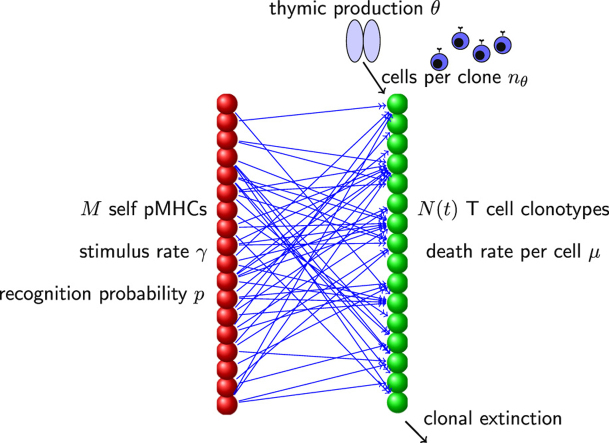
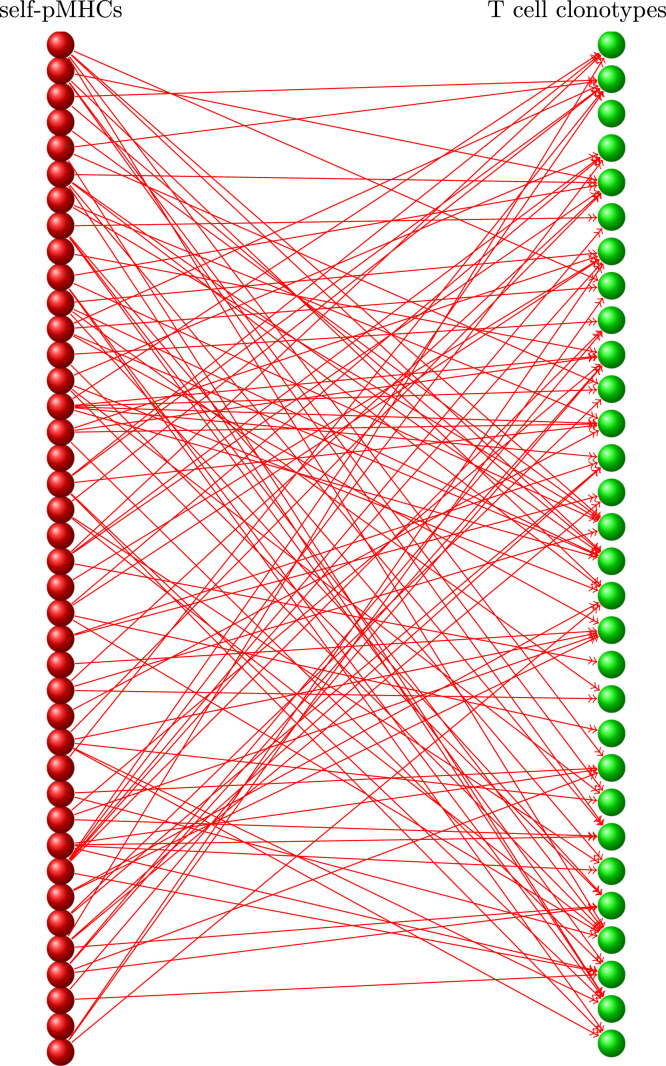
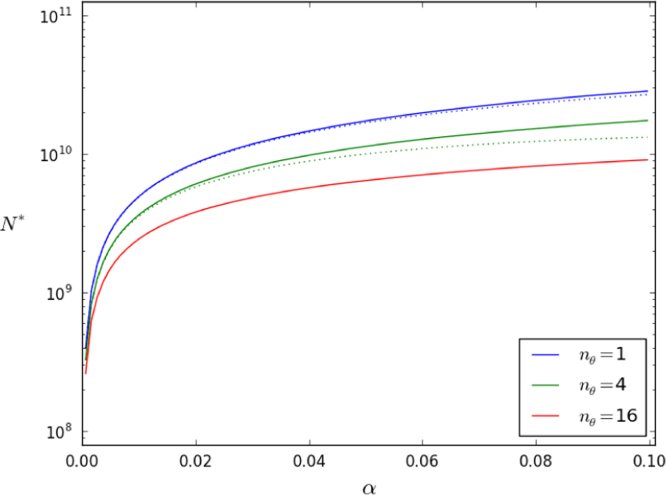
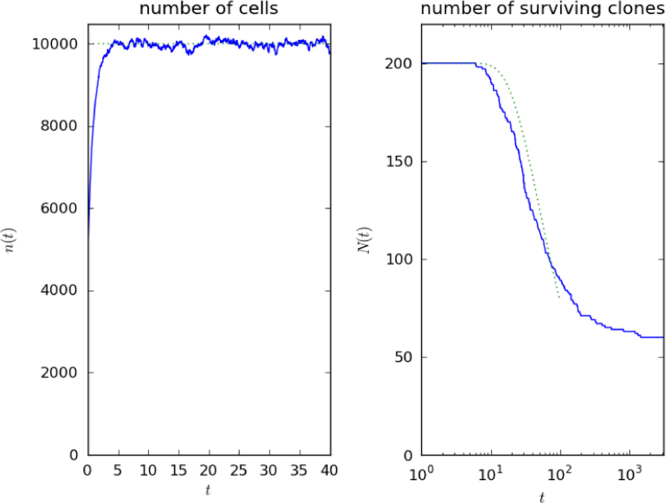
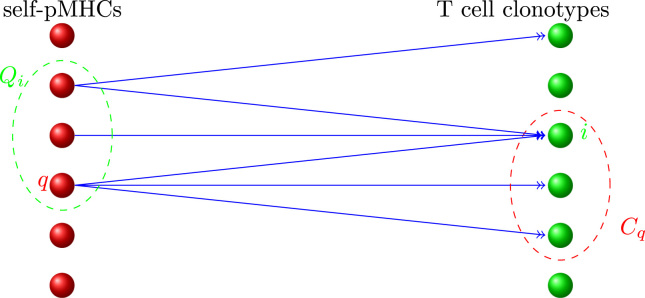
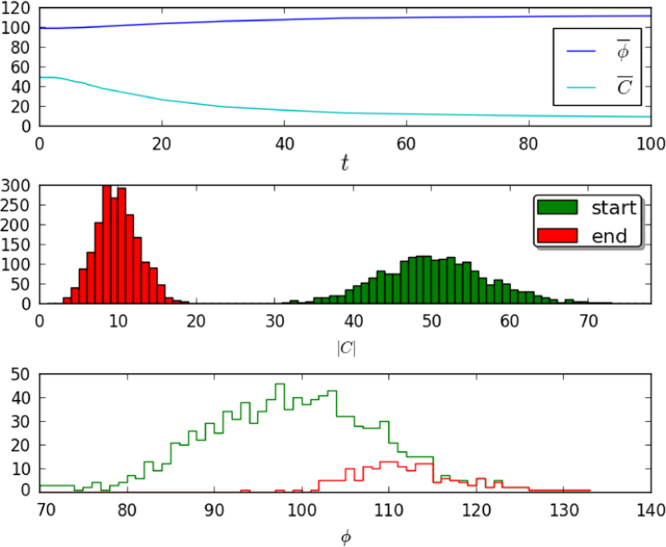
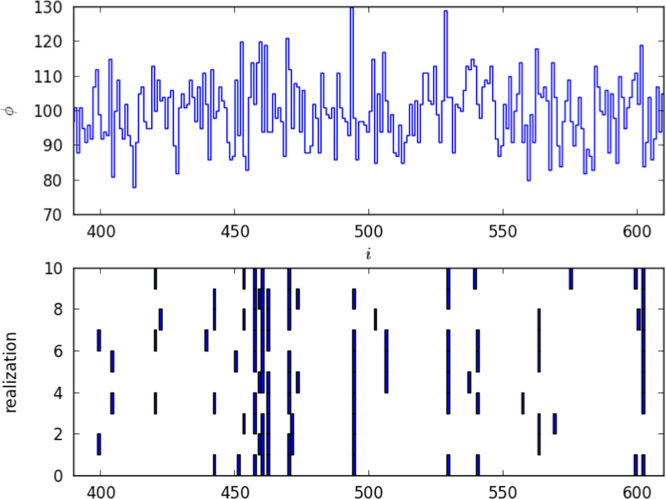
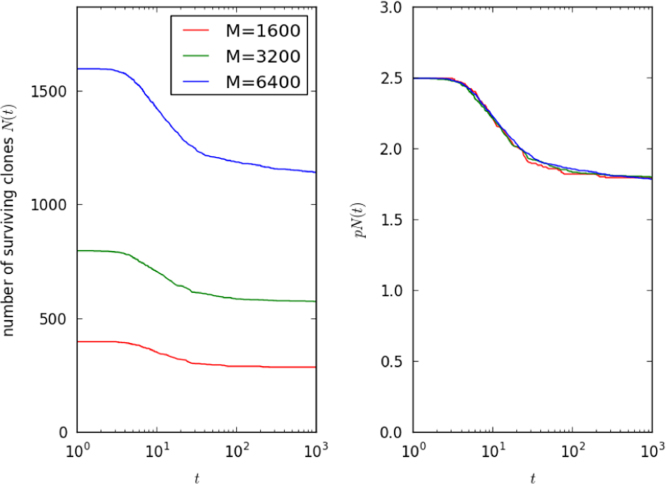
We consider the lifetime of a T cell clonotype, the set of T cells with the same T cell receptor, from its thymic origin to its extinction in a multiclonal repertoire. Using published estimates of total cell numbers and thymic production rates, we calculate the mean number of cells per TCR clonotype, and the total number of clonotypes, in mice and humans. When there is little peripheral division, as in a mouse, the number of cells per clonotype is small and governed by the number of cells with identical TCR that exit the thymus. In humans, peripheral division is important and a clonotype may survive for decades, during which it expands to comprise many cells. We therefore devise and analyse a computational model of homeostasis of a multiclonal population. Each T cell in the model competes for self pMHC stimuli, cells of any one clonotype only recognising a small fraction of the many subsets of stimuli. A constant mean total number of cells is maintained by a balance between cell division and death, and a stable number of clonotypes by a balance between thymic production of new clonotypes and extinction of existing ones. The number of distinct clonotypes in a human body may be smaller than the total number of naive T cells by only one order of magnitude.
Overview
The claims and statistics of this paper haven’t been checked yet.
Run the check — free, no account needed. It reads the open-access text and checks the sources it cites.
Integrity signals
Registry
Cites
Statistics
Figures
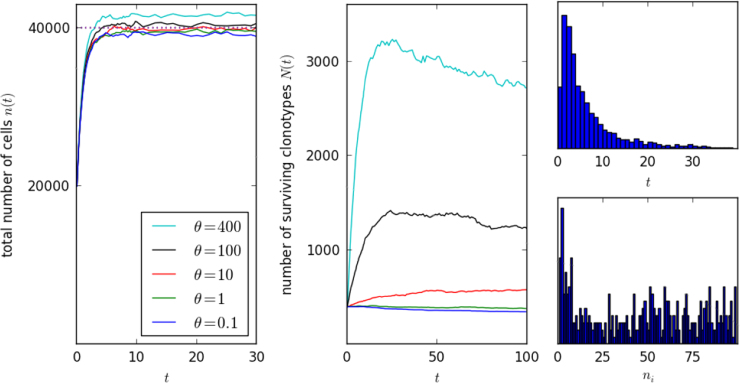
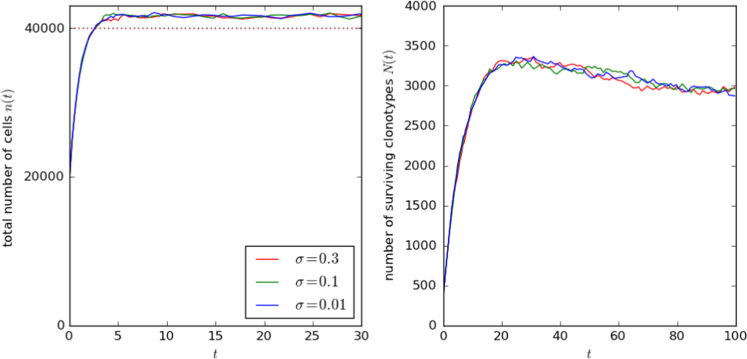
Verification
Claims the paper makes
The claims and statistics of this paper haven’t been checked yet.
Run the check — free, no account needed. It reads the open-access text and checks the sources it cites.
Claims other papers make about this one
Each is checked against this paper’s own text: does it say what the citing paper says it does?
In the citing paper
“This estimate is consistent with TREC frequencies as well as with modeling experiments which predict that the number of distinct sequences in humans is by only one order of magnitude lower than the number of total naive cells”
From Successful and Maladaptive T Cell Aging (2017) · cites this paper as Lythe et al., 2016
Self-check
Percentages, sums and reported differences re-computed from the paper’s own numbers.
The self-check needs the paper’s full text.
Citations
Cites
Continuous Martingales and Brownian Motion
Revuz, D., & Yor, M. (1999) · Grundlehren der mathematischen Wissenschaften · doi:10.1007/978-3-662-06400-9 · Cited by 6,353
An Introduction to Stochastic Modeling
Frey, M. R., Taylor, H. M., & Karlin, S. (1994) · Technometrics · doi:10.2307/1269970 · Cited by 1,278
Comprehensive assessment of T-cell receptor β-chain diversity in αβ T cells
Robins, H. S., Campregher, P. V., Srivastava, S. K., Wacher, A., Turtle, C. J., Kahsai, O., Riddell, S. R., Warren, E. H., & Carlson, C. S. (2009) · Blood · doi:10.1182/blood-2009-04-217604 · Cited by 1,122
A very high level of crossreactivity is an essential feature of the T-cell receptor.
Mason, D. (1998) · Immunology today (Amsterdam. Regular ed.) · doi:10.1016/s0167-5699(98)01299-7 · Cited by 1,067
Stochastic Modelling for Systems Biology
Wilkinson, D. (2006) · Chapman & Hall/CRC eBooks · doi:10.1201/9781420010664 · Cited by 1,041
Moon, J. J., Chu, H., Pepper, M., McSorley, S. J., Jameson, S. C., Kedl, R. M., & Jenkins, M. K. (2007) · Immunity · doi:10.1016/j.immuni.2007.07.007 · Cited by 977
IL-7 is critical for homeostatic proliferation and survival of naïve T cells
Tan, J. T., Dudl, E. P., LeRoy, E., Murray, R. M., Sprent, J., Weinberg, K. I., & Surh, C. D. (2001) · Proceedings of the National Academy of Sciences · doi:10.1073/pnas.161126098 · Cited by 966
A Direct Estimate of the Human αβ T Cell Receptor Diversity
Arstila, T. P., Casrouge, A., Baron, V., Even, J., Kanellopoulos, J., & Kourilsky, P. (1999) · Science · doi:10.1126/science.286.5441.958 · Cited by 931
Human memory T cells: generation, compartmentalization and homeostasis
Farber, D. L., Yudanin, N. A., & Restifo, N. P. (2014) · Nature Reviews Immunology · doi:10.1038/nri3567 · Cited by 897
The Influence of Age on T Cell Generation and TCR Diversity
Naylor, K., Li, G., Vallejo, A. N., Lee, W.-W., Koetz, K., Bryl, E., Witkowski, J., Fulbright, J., Weyand, C. M., & Goronzy, J. J. (2005) · The Journal of Immunology · doi:10.4049/jimmunol.174.11.7446 · Cited by 802
Research works printed but not linked: 2
- Hershberg, 2003, What is the basis of the immune systems specificity?, Math. Model. Comput. Biol. Med., 377
- Merrill, 1994, Development of the T-cell repertoire, Rocky Mt. J. Math., 24, 214
Cited by
Sorted by citations
Mechanisms underlying T cell ageing
Goronzy, J. J., & Weyand, C. M. (2019) · Nature Reviews Immunology · doi:10.1038/s41577-019-0180-1 · Cited by 506
Successful and Maladaptive T Cell Aging
Goronzy, J. J., & Weyand, C. M. (2017) · Immunity · doi:10.1016/j.immuni.2017.03.010 · Cited by 362
Principles and therapeutic applications of adaptive immunity
Chi, H., Pepper, M., & Thomas, P. G. (2024) · Cell · doi:10.1016/j.cell.2024.03.037 · Cited by 394
Cancer Therapy With TCR-Engineered T Cells: Current Strategies, Challenges, and Prospects
Shafer, P. W., Somes, L. K., & Hoyos, V. (2022) · Frontiers in Immunology · doi:10.3389/fimmu.2022.835762 · Cited by 292
Sethna, Z. M., Elhanati, Y., Callan, C. G., Walczak, A. M., & Mora, T. (2019) · Bioinformatics · doi:10.1093/bioinformatics/btz035 · Cited by 235
Metadata
- Authors
- Lythe, G., Callard, R. E., Hoare, R. L., & Molina-París, C.
- Affiliations
- University of Leeds (GB)
- University College London (GB)
- Corresponding author
- Lythe, Grant
- Venue
- Journal of Theoretical Biology
- Publisher
- Elsevier BV
- Published
- 2016-01
- Volume
- 389
- Pages
- 214-224
- ISSN
- 0022-5193 (ISSN-L)
- PMC
- PMC4678146
- OpenAlex
- W2141312574
- Cited by
- 175
- References
- 134
- Citations by year
- 2026: 10 · 2025: 13 · 2024: 14 · 2023: 25 · 2022: 26 · 2021: 22 · 2020: 22 · 2019: 15 · 2018: 13 · 2017: 11 · 2016: 4
- FWCI
- 4.59
- Type
- journal article
- Language
- en
- Open access
- hybrid
- doi.org
- Locations
- Journal of Theoretical Biology (publishedVersion, cc-by)
- PubMed Central (publishedVersion, cc-by)
- PubMed (publishedVersion)
- White Rose Research Online (University of Leeds, The University of Sheffield, University of York) (acceptedVersion)
- UCL Discovery (University College London) (submittedVersion)
- Funders
- BBSRC Research Development Fellowship (BB/G023395/1)
- Topics
- Life Sciences › Immunology and Microbiology › Immunology › T-cell and B-cell Immunology
- Physical Sciences › Computer Science › Artificial Intelligence › Artificial Immune Systems Applications
- Life Sciences › Biochemistry, Genetics and Molecular Biology › Genetics › Evolution and Genetic Dynamics
- Keywords
- T cell clonotypes, T cell receptor repertoire, thymic output, naive T cells
- MeSH terms
- Algorithms, Animals, Cell Division, Computer Simulation, Homeostasis, Humans, Immunologic Memory, Models, Theoretical, Receptors, Antigen, T-Cell, Stochastic Processes, T-Lymphocytes, Thymus Gland, Mice
About these checks
Registry, retraction, Cites and statistics results are computed, not judged, with one exception: a printed reference that no index lists is read once by a model before it counts as a citation error. Claims are extracted by a model and kept only when their quote appears verbatim in the text; each cited source is then checked, with a model’s help, for whether it says what the claim relies on. Those verdicts can be wrong — read the claim’s quote and the cited source before relying on one.
Statistics and arithmetic are recomputed, not judged.
Confidence bands are shown only for fields calibrated on our annotated test set. None is calibrated yet, so no band is shown.
What counts as a claim ›How we measure confidence ›How we check this ›
Are you an author, or do you see a problem with this page? Request a review
