

The DOI matches its Crossref record; 10 of the 10 references it cites were found in a registry or an index.
K-Alpha Calculator—Krippendorff’s Alpha Calculator: A user-friendly tool for computing Krippendorff’s Alpha inter-rater reliability coefficient
Open accessAbstract
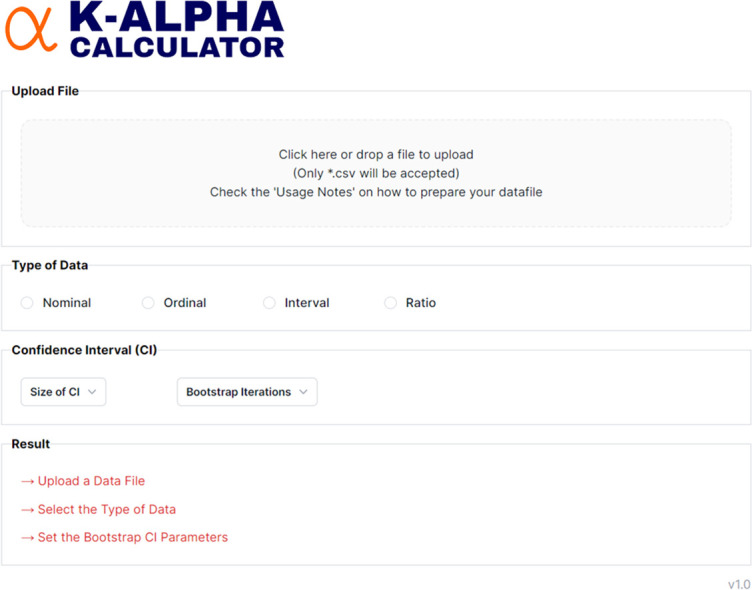
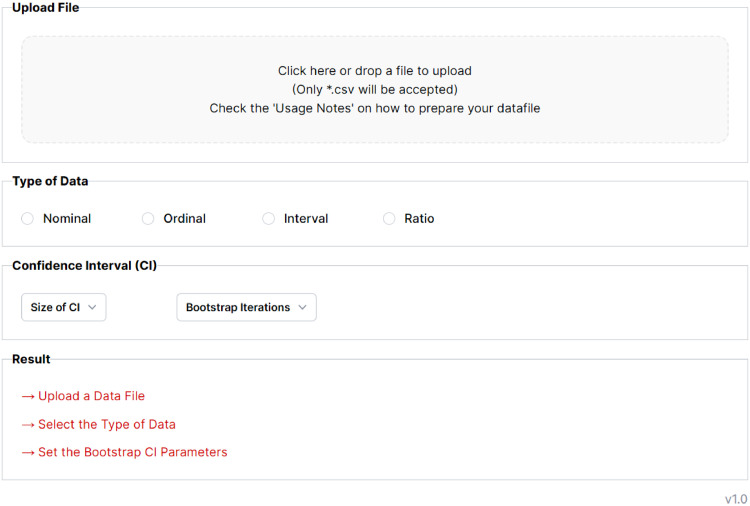
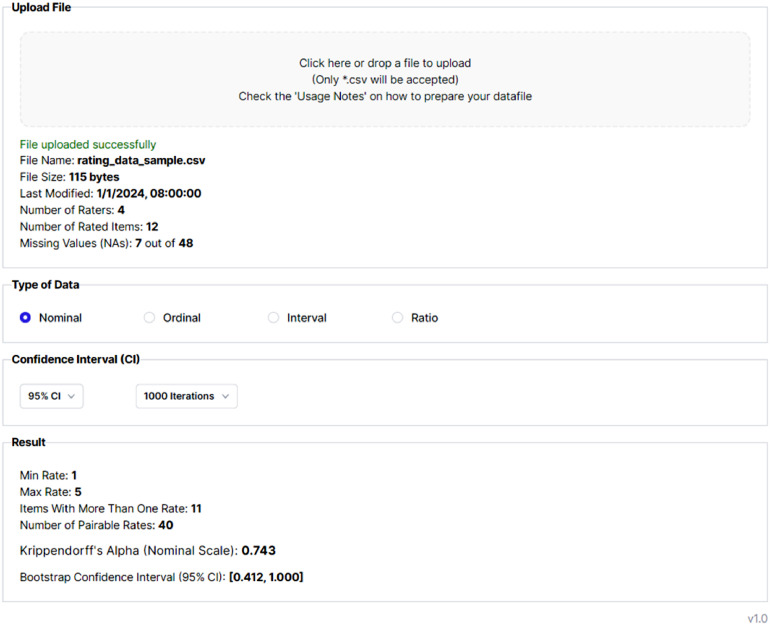
Krippendorff's Alpha is a measure for assessing inter-rater reliability, facilitating triangulated evaluations among multiple raters. Indeed, Krippendorff's Alpha is key in validating the dependability of human assessments, thereby reinforcing the robustness of human-based choices in contexts where interpretive variability could otherwise undermine the research outcomes. Despite its versatility across various data types, the procedure for computing this coefficient might limit its applicability for researchers unfamiliar with specialised statistical software. Addressing this issue, this paper introduces the "K-Alpha Calculator"-Krippendorff's Alpha Calculator-a freely accessible, user-friendly, web application available at https://www.k-alpha.org designed for easy computation of Krippendorff's Alpha. By offering a web interface without any software dependency, the K-Alpha Calculator seeks to promote the broader integration of such a reliability metric in research processes. We envisage that the tool's contribution could support researchers in enhancing methodological rigour, fostering conclusions are rooted in triangulated interpretations and assessments. The K-Alpha Calculator is both a computational tool and an educational resource, encouraging more researchers to include reliability measures in their studies.•Development of the K-Alpha Calculator.The study centres on the introduction of a web-based application: the K-Alpha Calculator. The tool is developed to simplify the calculation of Krippendorff's Alpha without any required software dependency.•User-friendly interface for diverse data types.The K-Alpha Calculator is characterised by its accessibility and user-friendliness, designed to simplify the procedures for computing the Krippendorff's Alpha. Its utility extends to various data types, which aligns with the intrinsic versatility of this coefficient.
Overview
The claims and statistics of this paper haven’t been checked yet.
Run the check — free, no account needed. It reads the open-access text and checks the sources it cites.
Integrity signals
Registry
Cites
Statistics
Figures
Verification
Claims the paper makes
The claims and statistics of this paper haven’t been checked yet.
Run the check — free, no account needed. It reads the open-access text and checks the sources it cites.
Claims other papers make about this one
Each is checked against this paper’s own text: does it say what the citing paper says it does?
In the citing paper
“Inter-coder reliability was 0.81 based on Krippendorff’s Alpha [45,46], indicating a good level of agreement among coders.”
From Help-Seeking Situations Related to Visual Interactions on Mobile Platforms and Recommended Designs for Blind and Visually Impaired Users (2024) · cites this paper as [46]
Self-check
Percentages, sums and reported differences re-computed from the paper’s own numbers.
The self-check needs the paper’s full text.
Citations
Cites
A Coefficient of Agreement for Nominal Scales
Cohen, J. (1960) · Educational and Psychological Measurement · doi:10.1177/001316446002000104 · Cited by 42,398
Content Analysis: An Introduction to Its Methodology
Krippendorff, K. (2019) · doi:10.4135/9781071878781 · Cited by 15,448
Measuring nominal scale agreement among many raters.
Fleiss, J. L. (1971) · Psychological Bulletin · doi:10.1037/h0031619 · Cited by 8,733
Answering the Call for a Standard Reliability Measure for Coding Data
Hayes, A. F., & Krippendorff, K. (2007) · Communication Methods and Measures · doi:10.1080/19312450709336664 · Cited by 4,225
Intercoder Reliability in Qualitative Research: Debates and Practical Guidelines
O’Connor, C., & Joffe, H. (2020) · International Journal of Qualitative Methods · doi:10.1177/1609406919899220 · Cited by 3,871
Answers to 20 questions about interrater reliability and interrater agreement
LeBreton, J. M., & Senter, J. L. (2008) · Organizational Research Methods · doi:10.1177/1094428106296642 · Cited by 3,608
Zapf, A., Castell, S., Morawietz, L., & Karch, A. (2016) · BMC Medical Research Methodology · doi:10.1186/s12874-016-0200-9 · Cited by 377
Zhang, Y. E., Liu, G., Zhang, L., Xu, S., & Cheung, M. W. ‐. (2020) · Journal of Management · doi:10.1177/0149206320917195 · Cited by 212
Multiple‐Principal Demands and CEO Compliance in Emerging Market State‐Owned Enterprises
Apriliyanti, I. D., Dieleman, M. H., & Randøy, T. (2023) · Journal of Management Studies · doi:10.1111/joms.12977 · Cited by 36
KANOM: Stata module to estimate Krippendorff's alpha for nominal variables
Mitnik, P. A. (2016) · RePEc: Research Papers in Economics · Cited by 1
Research works printed but not linked: 2
- Freelon, 2010, ReCal: intercoder reliability calculation as a web service, Int. J. Internet Sci., 5, 20
- Freelon, 2013, ReCal OIR: ordinal, interval, and ratio intercoder reliability as a web service, Int. J. Internet Sci., 8, 10
Cited by
Sorted by citations
Items 201–291 of 291
Verbal Descriptors for Electrotactile Stimulation
van Schaik, M. E., Guo, L., Mader, A., van Erp, J. B. F., & Persson, N. (2026) · CHI Conference on Human Factors in Computing Systems · doi:10.1145/3772318.3791521
“The resulting descriptors, together with those from the researcher, were converted into nominal numerical values by mapping each descriptor to an integer and coding missing values with ’NA’, to prepare the required format for the K-Alpha Calculator [12].”
Mapping the Wizards' Path: A Systematic Review of Wizard-of-Oz in HCI
Yang, R., Du, Y., Du, H., & Huang, K. (2026) · CHI Conference on Human Factors in Computing Systems · doi:10.1145/3772318.3791174 · Cited by 1
Unveiling repetitive visual stages: Media narratives and school shooting coverage post-columbine
Sheridan, T. (2026) · Journalism · doi:10.1177/14648849261442345
Brevik, A., Jerpseth, H., & Lafontan, S. R. (2026) · Frontiers in Education · doi:10.3389/feduc.2026.1904452
What drives the quality of corporate ESG disclosures?
Tsalis, T. Α., Trevlopoulos, N. S., Avlogiaris, G., Kosmas, P., Vatalis, K. Ι., & Nikolaou, I. E. (2026) · The Journal of Risk Finance · doi:10.1108/jrf-04-2025-0199
Reliability testing the appraisal framework for analysing encouraged suicide data
Calloway, L. R. (2026) · Research Methods in Applied Linguistics · doi:10.1016/j.rmal.2026.100318
Saha, D., Banerji, H., & Kumar, U. (2026) · Springer eBooks · doi:10.1007/978-981-95-6750-8_1
Wells, K. M., Eubig, P. A., Livingston, M. L., Bush, B. M., Scarpaci, A., Schultz, J., Stanescu, R. M., & Ovid, D. (2026) · AJP Advances in Physiology Education · doi:10.1152/advan.00285.2025
Famulari, U., & Wilson, T. (2026) · Journalism Practice · doi:10.1080/17512786.2026.2666313
Li, J. J., Jiang, Z. J., Liu, Y., & Xu, H. (2025) · International Conference on Human-Engaged Computing (ICHEC) · doi:10.1145/3786995.3787004
Davies, A., Sainsbury, D. C. G., Collaborative, T. C. M., Medina, J., Russell, C., Humphries, K., Fitzsimons, K. J., Sandy, J. R., Deacon, S. A., & Wren, Y. E. (2026) · The Cleft Palate-Craniofacial Journal · doi:10.1177/10556656261443367
“31,32 Data were cleaned and analysed using Stata/MP version 18 33 and Krippendorf ’ s alpha was calculated using the K-Alpha calculator.”
InfluentialIdentifying the most effective recruitment metrics using analytical hierarchy process
Priyadarsini, P., & Sreejith, S. S. (2026) · Future Business Journal · doi:10.1186/s43093-026-00848-z
Non-empirical scholarship in the Journal of Second Language Writing
Yuan, X. (2026) · Journal of Second Language Writing · doi:10.1016/j.jslw.2026.101312
Neji, S., Rohmann, A., Köstlin, D., Klotzsch, T., Rusch, J., Gimmerthal, S., & Landmann, H. (2026) · Journal of Community & Applied Social Psychology · doi:10.1002/casp.70276
Error analysis of large language model-generated film subtitles using the FAR model
Chuqiao, L., & Ghassemiazghandi, M. (2026) · Cogent Arts and Humanities · doi:10.1080/23311983.2026.2668253
Social media influencers in family travel: positioning patterns and types of appeal
Nella, A., Stergiou, D. P., & Theodoridis, P. K. (2026) · Journal of Hospitality and Tourism Insights · doi:10.1108/jhti-08-2025-1015
Beckmann, L., Donohoe, R., Schmid, D., Kiphuth, I. C., Ludwig, K., & Schenk, T. (2026) · Brain Sciences · doi:10.3390/brainsci16050541 · Cited by 1
“Generally, Krippendorff’s alpha should be greater than 0.67 to indicate moderate agreement, while values above 0.80 are considered to reflect satisfactory agreement [36,37].”
InfluentialTheory of mind, leisure reading, and reading comprehension in adulthood
Tompkins, V., Montgomery, D. E., & Feng, X. (2026) · Cognition · doi:10.1016/j.cognition.2026.106589
Zhang, Y., Sambamoorthi, N., Wiener, R. C., Wang, H., Shen, C., Mitra, S., Findley, P. A., & Sambamoorthi, U. (2026) · International Journal of Environmental Research and Public Health · doi:10.3390/ijerph23060694
“Inter-rater reliability was also evaluated using Krippendorff’s α (ordinal) for the negative, neutral, and positive sentiment categories, excluding other labels [21].”
Hentschel, E., Hein, S. D., Li, N., Westrope, C., Taladay, J., Valentine, G., Leckman, J., Abdurahman, A., Bachir, F., Darwazeh, F., et al. (2026) · Child Development · doi:10.1093/chidev/aacag044
D'Agostino, S., Santarossa, S., Peltz, C. D., & Coyne, P. (2026) · Digital Health · doi:10.1177/20552076261452411
Campbell, K. S., Cosgrove, S. J., & Pacini, M. (2026) · IEEE Transactions on Professional Communication · doi:10.1109/tpc.2026.3685778
“To assess the consistency of coding proactive tactics across raters, we calculated Krippendorff’s Alpha for nominal data, along with bootstrap confidence intervals [45].”
Voltmer, C., & Imperio, C. M. (2026) · Healthcare · doi:10.3390/healthcare14111549
“The negative Krippendorff’s alpha values observed between visual raters and motion capture classifications indicate systematic disagreement beyond chance [20,21], suggesting directional divergence in classification patterns rather than random variability.”
Survey on Inter‐ and Intra‐Observer Variations of the Ultrasound Assessment of Dog Pancreases
Turner, R. B., Firestone, S. M., Dunshea, F. R., & Mansfield, C. (2026) · Veterinary Radiology & Ultrasound · doi:10.1111/vru.70202
“The interpretation of K α values followed established guidelines: Negative values indicate systematic disagreement, 0 indicates no agreement, 0.67 suggests poor agreement, 0.67–0.79 indicates moderate agreement, ≥ 0.80 represents strong agreement, and 1.0 signifies perfect agreement [ 14 ].”
InfluentialBurn, F., Zwick, C., Weibel, J., Fischer, C., Veer, R., Essmann, L., Lampart, M., Chamo, M., George, C., Gafner, S., et al. (2026) · Computational and Structural Biotechnology Journal · doi:10.34133/csbj.0151
“[ 21 ] available at https://www.k-alpha.org and Kendall’s W , which measure the concordance in overall consistency across the 9 raters.”
Warmoes, A., Decabooter, I., Struyven, K., & Consuegra, E. (2026) · Journal of Professional Capital and Community · doi:10.1108/jpcc-06-2025-0064
Pratami, D., Ngadiman, N. H. A., Maulana, M. I. I. M., Hassan, S. A. H. S., & Aisha, A. N. (2026) · Cogent Education · doi:10.1080/2331186x.2026.2681263
Yang, H., Li, M., & Sui, Q. (2026) · Communications in computer and information science · doi:10.1007/978-981-95-9884-7_31
Tegegne, M. D., Tu, S. W., Ibrahim, I., Ronald Cornet, A., Kalhori, S. R. N., & Deserno, T. M. (2026) · PLoS ONE · doi:10.1371/journal.pone.0350733
“We will interpret inter-coder reliability using the predefined thresholds (Table 6), from Krippendorff [35] and Marzi et al. [36].”
Gillanders, C., Castro, D. C., Morgan, P., Franco, A., & Vail, C. (2026) · International Journal of Early Childhood · doi:10.1007/s13158-026-00525-w
Unnithan, S. (2026) · Journalism and Media · doi:10.3390/journalmedia7020128
Pan, Y.-L., Yu, P.-F., Yin, X.-L., Hong-sheng, Y., Long, X., & Tong, Q. (2026) · Educational Technology Research and Development · doi:10.1007/s11423-026-10659-2 · Cited by 1
Sibghatullah, A., Reza, B., Rashid, M. H. A., Pravitasari, E., & Roslan, A. (2026) · The International Review of Retail Distribution and Consumer Research · doi:10.1080/09593969.2026.2691318
Sustainability Through Circular Economy: A Systematic Review of Practices in Urban Green Spaces
Fan, L., Hamedani, S. S., Aslam, S., & Hamedani, S. S. (2026) · Environmental Quality Management · doi:10.1002/tqem.70393
Schutzbach, M., Mais, F., Rentschler, M., Bauernhansl, T., & Miehe, R. (2026) · Cleaner and Circular Bioeconomy · doi:10.1016/j.clcb.2026.100224
Validation of a School Climate Walkthrough Assessment
Neves, J. R., Salle, T. P. L., & Scheel, N. L. (2026) · International Journal of School & Educational Psychology · doi:10.1080/21683603.2026.2690130
“Interrater reliability indicated moderate agreement on the EO across data collectors, Krippendorff’s α = .70, 95% CI [.50-.85] (Marzi et al., 2024).”
APT to Disagree: A Comparative Analysis of Attribution in Commercial TI
Ethembabaoglu, A., van Wegberg, R., Zhauniarovich, Y., & van Eeten, M. J. G. (2026) · IEEE Symposium on Security and Privacy (S&P) · doi:10.1109/sp63933.2026.00215
“To qualify the level of agreement, we interpret Krippendorff’s alpha as it is conventionally understood in the context of IRR [83]: α 0 indicates systematic disagreement, α = 0 indicates chance-level agreement, 0 α 0 .”
Ferris, W. J., Johnston, M. G., Diaz, H., Katsma, M. S., Hurvitz, A. P., Barlow, B., & McDonald, L. S. (2026) · Military Medicine · doi:10.1093/milmed/usag296
Nordin, A., & Warell, A. (2026) · Proceedings of the Design Society · doi:10.1017/pds.2026.10503
“Each author independently coded the samples, and the results were input into the online tool K-Alpha Calculator (Marzi et al., 2024).”
Amin, A., Kothari, S., Mehta, M., Banka, K., Atreya, H., Pradeep, P., Pareek, S., Zhang, N., Hasan, K., & Li, L. (2026) · doi:10.1145/3786175.3788342
Make a Wish: Culturally-Responsive Contexts for Programming Tasks
Graßl, I., & Esche, S. (2026) · ACM Conference on Innovation and Technology in Computer Science Education (ITiCSE) · doi:10.1145/3803400.3809354
“For inter-rater agreement, we obtained Krippendorff’s 𝛼 [25] values of 0.953 (deductive), 0.935 ( inductive: practical ), 0.838 ( inductive: cultural ), and 0.880 ( inductive: daily life ), meeting the requirement of being above 0.800 [17].”
InfluentialHow Can We Know When We See It? A Systematic Review of Cognitive Control Skills and Behaviors
Domino, M., Thompson, J. A., Hicks, A., Jamieson, A. C., Parajuli, K., Edmison, B., Edwards, S. H., & Shaffer, C. A. (2026) · ACM Transactions on Computing Education · doi:10.1145/3821524
“Marzi et al.’s K-Alpha calculator was used to compute this score [60].”
Todorović, L., Bogaerts, A., & Larsen, H. (2026) · Journal of Adolescence · doi:10.1002/jad.70220
“To support consistency in the application of the broad topical codes during the initial deductive coding phase, intercoder reliability was assessed and found satisfactory (Krippendorff's c‐α‐binary = 0.846; Marzi et al. 2024).”
InfluentialSathiyaseelan, A., Balasundaram, S., & Patangia, B. (2026) · International Journal of Systemic Therapy · doi:10.1080/2692398x.2026.2701537 · Cited by 1
Ji, Q., Liu, Z., Zhou, H., Li, L., & Wang, Z. (2026) · Results in Engineering · doi:10.1016/j.rineng.2026.111953
Schreiber, J., Milakis, D., & Stead, D. (2026) · Transport Policy · doi:10.1016/j.tranpol.2026.104300
Kelly, A., Birdsey, M., Patel, R., Marino, L., Samcewicz‐Parham, L., Gnanasekaran, S., & Duffett, E. (2026) · Emergency Medicine Australasia · doi:10.1111/1742-6723.70311
“Classification agreement was measured using Krippendorff's Alpha [5].”
InfluentialBrown‐Sica, M., Croxton, R. A., & Church-Duran, J. (2026) · Reference Services Review · doi:10.1108/rsr-04-2026-0078
Buri, V. D. R. S., Soledispa, B. J. A., Cevallos, A. N. C., & Pincay, L. L. P. (2026) · Visión Académica · doi:10.70577/qxd4m855
The Missing Message: Personalization and Internalization of Government H5N1 Communication
Cook, J., Anderson-Robinson, R., Ganyani, G., Joyner, J.-I., Kayongo, C., Littlefield, R. S., Gamboa, R., Hamner, M., & Leal, G. H. (2026) · Southern Communication Journal · doi:10.1080/1041794x.2026.2710971
Family Matters: Expanding the Dimensions of Quality in Early Childhood and Care
Otero-Mayer, A., Casas, E. E., Gutiérrez-de-Rozas, B., & González-Benito, A. (2026) · Early Childhood Education Journal · doi:10.1007/s10643-026-02308-3
SoK: Understanding the state of IoT-specific vulnerabilities via CVE characterization with LLIoT
Rezaei, T., Bayhan, S., Continella, A., van der Ham, J., & van Rijswijk-Deij, R. (2026) · IEEE European Symposium on Security and Privacy · doi:10.1109/eurosp68448.2026.00093
Kokkas, K., Wang, H., Klein, R., Ismail, N. A., Irwin, N., Moonsamy, M. Z., Naidoo, K., Nel, J. S., Nweke, E. E., Parboosing, R., et al. (2026) · Frontiers in Cellular and Infection Microbiology · doi:10.3389/fcimb.2026.1876326
“For example, despite experts reaching consensus (either two or all three experts agreeing) in 92.26% (310/336) of MCQs (Figure 2), Krippendorff ’ s Alpha for MCQ questions was 0.34, indicating poor expert agreement (Marzi et al., 2024).”
InfluentialSetiawan, A. M., & Wibowo, A. (2026) · International Conference on Intelligent Engineering and Next-Gen Healthcare Systems (IEHNS) · doi:10.1109/iehns68708.2026.11606723
“The average value of the inter-agreement (alpha 0.859) and self-agreement (0.905) are both higher than the widely accepted value of 0.80 [19], indicating high consistency and reliability of the manually labeled data.”
InfluentialEnzinger, S. M., & Dürnberger, C. (2026) · Journal of Biological Education · doi:10.1080/00219266.2026.2702330
Discourse-pragmatic like: An empirically grounded functional taxonomy
Raušová, V. (2026) · Journal of Pragmatics · doi:10.1016/j.pragma.2026.07.003
Phygital strategies in fashion retail: an empirical analysis of leading brands in Spain
Elízaga, R., SanMiguel, P., & Arana, P. A. (2026) · Journal of Fashion Marketing and Management · doi:10.1108/jfmm-07-2025-0393
Huber, A. T., Szucs-Farkas, G., Perrin, L. G., M’Hamdi, B., Bespyatova, S., Christe, A., & Szucs‐Farkas, Z. (2026) · The International Journal of Cardiovascular Imaging · doi:10.1007/s10554-026-03765-y
Sheridan, T. (2026) · Visual Communication Quarterly · doi:10.1080/15551393.2026.2638152
Abdullah, M., Munir, A., Savitri, W. E., Pratiwi, W. R., & Nasrullah, N. (2026) · SSRN Electronic Journal · doi:10.2139/ssrn.7302421
Task-Based Machine Learning Model for Terminal Air Traffic Complexity Prediction
Rogošić, T., Juričić, B., Jurinić, D., & Šajatović, A. (2026) · Aerospace · doi:10.3390/aerospace13080747
“An alpha value of 0.7 exceeds the conventional acceptability threshold of 0.67 [38].”
InfluentialShah, A. M. (2026) · Behaviour and Information Technology · doi:10.1080/0144929x.2026.2718320 · Cited by 2
Reproducing UI contexts described in app reviews with large language models
Jin, R., Liu, T., Chen, J., Zhao, Y., Chen, X., Du, X., Li, L., & Wang, H. (2026) · Automated Software Engineering · doi:10.1007/s10515-026-00660-7
“After the independent annotation, we calculated the inter-rater reliability using Krippendorff’s α (Krippendorff 2004; Marzi et al. 2024), which reached 0.89, indi - cating a substantial level of agreement.”
InfluentialAdoption of Large Language Model for Improving Grading Timing in an Engineering Economics Course
Gray, B., & Fragoso-Diaz, G. (2026) · ASEE Annual Conference & Exposition · doi:10.18260/1-2--59260
Bondjers, K., Willebrand, M., & Arnberg, F. K. (2026) · European Journal of Psychotraumatology · doi:10.1080/20008066.2026.2705788
“Inter-rater agreement was fair (Krippendorff’s α = .79) (Marzi et al., 2024).”
Assessment of SOLID Principles in UML Class Diagrams Using LLMs
Picus, O., Şerban, C., & Motogna, S. (2026) · Lecture notes in computer science · doi:10.1007/978-3-032-36590-3_22
Similarity-Aware Viseme Caching for Efficient Lip-Synchronization of English Speech
Kılıç, D. K., Katıpoğlu, B. İ., & Zeman, M. S. (2026) · Human-Centric Intelligent Systems · doi:10.1007/s44230-026-00170-5
Liu, B., Deng, Y., Liu, H., & Ji, H. (2026) · IET Intelligent Transport Systems · doi:10.1049/itr2.70316
Ejem, A. A., Ogor, U. C., Ozioko, O. R., Igboke, A., Akanmode, O. A., Ibekwe, C., Okeke, S. V., Eze, C. C., Sam-Olaniyan, G. D., Nwokeocha, I. M., et al. (2026) · Societies · doi:10.3390/soc16090287
“…alpha was used to assess inter-coder reliability of the six HBM variables (susceptibility, severity, benefits, barriers, cues to action, and self-efficacy), and the coefficient ranged from 0.80 to 1.0, indicating moderate to perfect agreement [58], confirming the reliability of the coding protocol.”
InfluentialState Veteran Home Resident Reflections on Fall Prevention Strategies
McIntosh, N. M., Clark, V. A., Nash, P., Cobb, N. M., McConnell, E. S., Ritchey, K. C., Pimentel, C. B., Yang, A. W., Jones, J. R., Mills, W. L., et al. (2026) · Journal of the American Medical Directors Association · doi:10.1016/j.jamda.2026.106468
Experiences of ageism in palliative care: Nursing students' perspectives
Aydın, M., Yarar, Y. A., Kaçan, N., & Çakma, M. (2026) · Nurse Education Today · doi:10.1016/j.nedt.2026.107410
Vanhée, L., Boström, E., Lithner, J., Andersson, C., Palmberg, B., Winberg, M., Svahn, O., & Palm, T. (2026) · IEEE Access · doi:10.1109/access.2026.3733324
“According to [57] and [79], α = 1 indicates perfect agreement among raters, α ≥ 0 .”
Burr, W. (2026) · Economics of Innovation and New Technology · doi:10.1080/10438599.2026.2731011
E-commerce digitalization for sustainable agricultural and rural development: models and pathways
Shan, Q. (2026) · Frontiers in Sustainable Food Systems · doi:10.3389/fsufs.2026.1743839
Characterising design tasks for assessing Learners’ Design Competence
Sona, M., Biswas, A., & Chakrabarti, A. (2026) · Design Science · doi:10.1017/dsj.2026.10082
Reply to “Why should more than two reliability coefficients be reported in triage studies?”
Deshayes, L., Hagiwara, M. A., & Bäckström, D. (2026) · Scandinavian Journal of Trauma Resuscitation and Emergency Medicine · doi:10.1186/s13049-026-01698-y
“When the four triage categories were treated as nominal using the K-Alpha Calculator [10], Krippendorff´s alpha was 0.428.”
InfluentialHorcajada‐Reales, C., Gerónimo‐Pardo, M., Augustin, M., & Selva-Sevilla, C. (2026) · International Wound Journal · doi:10.1111/iwj.71065
Kampylis, P., Fragkiadaki-Theodoroulea, M., Kandila, M., & Sampson, D. G. (2026) · Frontiers in Education · doi:10.3389/feduc.2026.1892028
Vegel, A. (2026) · CALICO Journal · doi:10.3138/calico-2025-0034
Famulari, U., & Major, L. H. (2026) · Visual Communication Quarterly · doi:10.1080/15551393.2026.2638167
Li, C., Du, J., & Mohammadpourkarbasi, H. (2026) · HERD Health Environments Research & Design Journal · doi:10.1177/19375867261484104
Basile, M. J., Young, D., Knapp, S., Milinic, T., Vasbinder, A. L., Bartlett, L., Mueller, R., Hartzler, A. L., Berry, D. L., Kapnadak, S. G., et al. (2026) · Heart & Lung · doi:10.1016/j.hrtlng.2026.102969
Fuchs, T., Abdulnazar, A., Rebol, L., Fickert, P., Gremsl, T., & Stadlbauer, V. (2026) · Frontiers in Cell and Developmental Biology · doi:10.3389/fcell.2026.1964880
Ji, Q., Liu, Z., Zhou, H., Li, L., & Wang, Z. (2026) · Applied Intelligence · doi:10.1007/s10489-026-07516-3
Abdullah, M., Munir, A., Savitri, W. E., Pratiwi, W. R., & Nasrullah, A. (2026) · MethodsX · doi:10.1016/j.mex.2026.104204
“Applying the classification thresholds reported in the original article — α ≥ 0.800 as reliable, 0.667 ≤ α < 0.800 as tentatively acceptable, and α < 0.667 as unreliable [1, p. 3; 6, p. 356] — to Table 1 shows that both implementations yield values below the lower threshold for Dataset 1.”
InfluentialUse of artificial intelligence in health education: A bibliometric analysis (2018–2025)
KUNDAKÇI, G. A., Özdemır, İ. H., & Sarsar, F. (2026) · Health Education Journal · doi:10.1177/00178969261489943
Fujak, H., Taylor, T. L., & Hanlon, C. (2026) · Sport Management Review · doi:10.1080/14413523.2026.2749192
MERCADO-REYNA, J., Mendoza-González, R., Luna-García, H., Rosas, F. J. L., Romo, J. C. M., Domínguez-Báez, C.-A., Flores, S. E., & Rivera-Medina, R. J. (2026) · Array · doi:10.1016/j.array.2026.101400
Rosa, M. D., & Toth, F. (2026) · Australian Journal of Public Administration · doi:10.1111/1467-8500.70070
Abril, E. P., & Garetto, A. P. (2026) · Health Communication · doi:10.1080/10410236.2026.2747858
Cognitive dormancy: Supplanting structured learning with AI affordances
Braun, V. (2026) · Computers in Human Behavior Artificial Humans · doi:10.1016/j.chbah.2026.100406
Metadata
- Authors
- Marzi, G., Balzano, M., & Marchiori, D.
- Affiliations
- IMT School for Advanced Studies Lucca (IT)
- Ca' Foscari University of Venice (IT)
- Corresponding author
- Marzi, Giacomo
- Venue
- MethodsX
- Publisher
- Elsevier BV
- Published
- 2024-06
- Volume
- 12
- Pages
- 102545
- ISSN
- 2215-0161 (ISSN-L)
- PMC
- PMC11636850
- OpenAlex
- W4390636334
- Cited by
- 292
- References
- 10
- Citations by year
- 2026: 143 · 2025: 113 · 2024: 36
- FWCI
- 80.91
- Type
- journal article
- Language
- en
- Open access
- gold
- doi.org
- Licence
- Locations
- MethodsX (publishedVersion, cc-by)
- PubMed Central (publishedVersion, cc-by)
- PubMed (publishedVersion)
- ArTS Archivio della ricerca di Trieste (University of Trieste https://www.units.it/) (submittedVersion, cc-by)
- ARCA (Università Ca' Foscari Venezia) (submittedVersion, other-oa)
- DOAJ (DOAJ: Directory of Open Access Journals) (submittedVersion)
- Topics
- Social Sciences › Decision Sciences › Statistics, Probability and Uncertainty › Reliability and Agreement in Measurement
- Social Sciences › Decision Sciences › Management Science and Operations Research › Psychometric Methodologies and Testing
- Social Sciences › Decision Sciences › Statistics, Probability and Uncertainty › Multidisciplinary Science and Engineering Research
- Keywords
- Krippendorff's alpha, inter-rater reliability, web-based calculator, reliability analysis software
About these checks
Registry, retraction, Cites and statistics results are computed, not judged, with one exception: a printed reference that no index lists is read once by a model before it counts as a citation error. Claims are extracted by a model and kept only when their quote appears verbatim in the text; each cited source is then checked, with a model’s help, for whether it says what the claim relies on. Those verdicts can be wrong — read the claim’s quote and the cited source before relying on one.
Statistics and arithmetic are recomputed, not judged.
Confidence bands are shown only for fields calibrated on our annotated test set. None is calibrated yet, so no band is shown.
What counts as a claim ›How we measure confidence ›How we check this ›
Are you an author, or do you see a problem with this page? Request a review
