

The DOI matches its Crossref record; 57 of the 59 references it cites were found in a registry or an index.
Abnormal global processing along the dorsal visual pathway in autism: a possible mechanism for weak visuospatial coherence?
Open accessAbstract
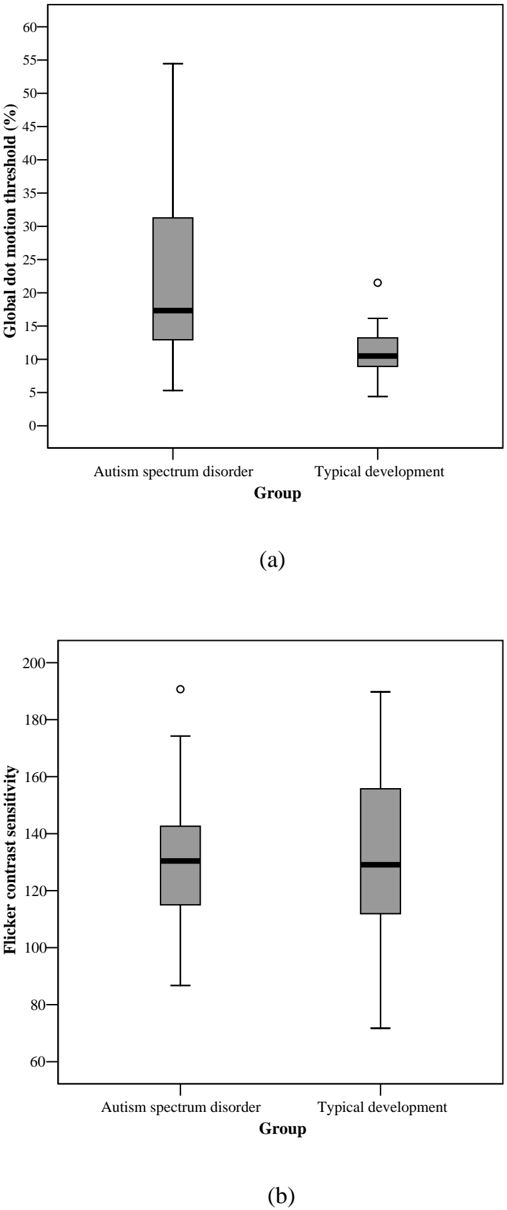
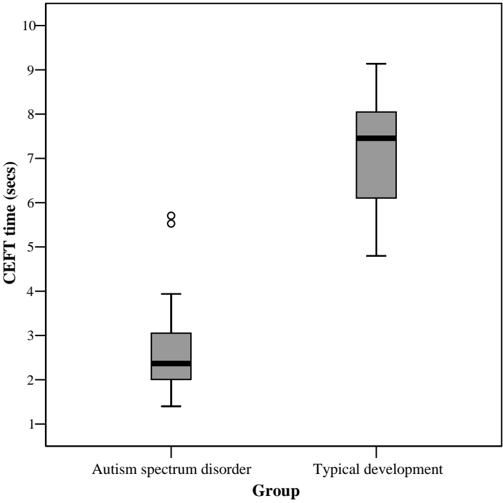
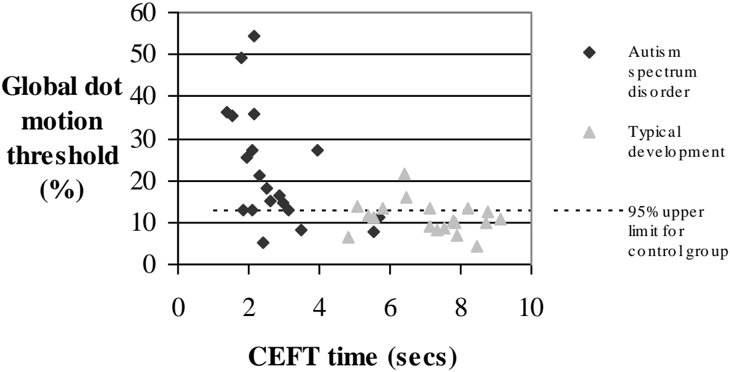
Frith and Happe (Frith, U., & Happe, F. (1994). Autism: Beyond theory of mind. Cognition, 50, 115-132) argue that individuals with autism exhibit 'weak central coherence': an inability to integrate elements of information into coherent wholes. Some authors have speculated that a high-level impairment might be present in the dorsal visual pathway in autism, and furthermore, that this might account for weak central coherence, at least at the visuospatial level. We assessed the integrity of the dorsal visual pathway in children diagnosed with an autism spectrum disorder (ASD), and in typically developing children, using two visual tasks, one examining functioning at higher levels of the dorsal cortical stream (Global Dot Motion (GDM)), and the other assessing lower-level dorsal stream functioning (Flicker Contrast Sensitivity (FCS)). Central coherence was tested using the Children's Embedded Figures Test (CEFT). Relative to the typically developing children, the children with ASD had shorter CEFT latencies and higher GDM thresholds but equivalent FCS thresholds. Additionally, CEFT latencies were inversely related to GDM thresholds in the ASD group. These outcomes indicate that the elevated global motion thresholds in autism are the result of high-level impairments in dorsal cortical regions. Weak visuospatial coherence in autism may be in the form of abnormal cooperative mechanisms in extra-striate cortical areas, which might contribute to differential performance when processing stimuli as Gestalts, including both dynamic (i.e., global motion perception) and static (i.e., disembedding performance) stimuli.
Overview
The claims and statistics of this paper haven’t been checked yet.
Run the check — free, no account needed. It reads the open-access text and checks the sources it cites.
Integrity signals
Registry
Cites
Statistics
Figures
Verification
Claims the paper makes
The claims and statistics of this paper haven’t been checked yet.
Run the check — free, no account needed. It reads the open-access text and checks the sources it cites.
Claims other papers make about this one
Each is checked against this paper’s own text: does it say what the citing paper says it does?
In the citing paper
“As discussed, the larger level of correspondence noise in Pellicano et al. (2005) may have contributed to this difference.”
From Vision in autism spectrum disorders (2009) · cites this paper as Pellicano et al. (2005)
In the citing paper
“Del Viva et al.'s (2006) method was therefore the more robust of the two.”
From Vision in autism spectrum disorders (2009) · cites this paper as Pellicano et al. (2005)
Self-check
Percentages, sums and reported differences re-computed from the paper’s own numbers.
The self-check needs the paper’s full text.
Citations
Cites
Diagnostic and Statistical Manual of Mental Disorders
Williams, J. B. W., & First, M. B. (2013) · Oxford University Press eBooks · doi:10.1093/acrefore/9780199975839.013.104 · Cited by 109,845
Lord, C., Rutter, M., & Le Couteur, A. (1994) · Journal of Autism and Developmental Disorders · doi:10.1007/bf02172145 · Cited by 9,065
(2005) · Choice Reviews Online · doi:10.5860/choice.43-0626 · Cited by 4,726
Segregation of Form, Color, Movement, and Depth: Anatomy, Physiology, and Perception
Livingstone, M. S., & Hubel, D. H. (1988) · Science · doi:10.1126/science.3283936 · Cited by 3,358
The analysis of visual motion: a comparison of neuronal and psychophysical performance
Britten, K., Shadlen, M., Newsome, W., & Movshon, J. (1992) · The Journal of Neuroscience · doi:10.1523/jneurosci.12-12-04745.1992 · Cited by 1,958
Newsome, W., & Pare, E. (1988) · The Journal of Neuroscience · doi:10.1523/jneurosci.08-06-02201.1988 · Cited by 1,615
How parallel are the primate visual pathways?
Merigan, W. H., & Maunsell, J. H. R. (1993) · Annual Review of Neuroscience · doi:10.1146/annurev.ne.16.030193.002101 · Cited by 1,597
Autism: beyond “theory of mind”
Frith, U., & Happé, F. (1994) · Cognition · doi:10.1016/0010-0277(94)90024-8 · Cited by 1,450
(2012) · Springer eBooks · doi:10.1007/springerreference_183812 · Cited by 1,218
A Manual for the embedded figures tests
Witkin, H. A. (1971) · Consulting Psychologists Press eBooks · Cited by 1,204
Cited by
Sorted by citations
Items 201–300 of 322
Wong, O. W. H., Barzilay, R., Lam, A. M. W., Chan, S. S. M., Calkins, M. E., Gur, R. E., & Gur, R. C. (2022) · Psychological Medicine · doi:10.1017/s0033291722001787 · Cited by 15
The perception of social and mechanical causality in young children with ASD
Ray, E. D., & Schlottmann, A. (2007) · Research in Autism · doi:10.1016/j.rasd.2006.11.002 · Cited by 13
Laycock, R., Crewther, S. G., & Chouinard, P. A. (2020) · Current Developmental Disorders Reports · doi:10.1007/s40474-020-00220-y · Cited by 13
Belmonte, M. K., & Carper, R. A. (2006) · Brain and Cognition · doi:10.1016/j.bandc.2005.12.010 · Cited by 12
Thérien, V. D., Degré‐Pelletier, J., Barbeau, É. B., Samson, F., & Soulières, I. (2023) · Cerebral Cortex · doi:10.1093/cercor/bhad195 · Cited by 12
Chakrabarty, M., Atsumi, T., Kaneko, A., Fukatsu, R., & Ide, M. (2021) · European Journal of Neuroscience · doi:10.1111/ejn.15311 · Cited by 10
Reading and coherent motion perception in school age children
Kassaliete, E., Lācis, I., Fomins, S., & Krūmiņa, G. (2015) · Annals of Dyslexia · doi:10.1007/s11881-015-0099-6 · Cited by 10
Banaraki, A. K., Tehrani‐Doost, M., & Esteky, H. (2013) · Europe PMC (PubMed Central) · Cited by 11
Nyström, P., Jones, E. J. H., Darki, F., Bölte, S., & Falck‐Ytter, T. (2020) · Journal of Autism and Developmental Disorders · doi:10.1007/s10803-020-04523-2 · Cited by 11
Neural Mechanisms of Visual Motion Anomalies in Autism: A Two-Decade Update and Novel Aetiology
Spiteri, S., & Crewther, D. P. (2021) · Frontiers in Neuroscience · doi:10.3389/fnins.2021.756841 · Cited by 11
Bellocchi, S., Henry, V., & Baghdadli, A. (2017) · Journal of Cognitive Education and Psychology · doi:10.1891/1945-8959.16.1.77 · Cited by 12
Cahalan, S., Mitroff, S. R., Subiaul, F., & Rosenblau, G. (2025) · Personality Neuroscience · doi:10.1017/pen.2025.10002 · Cited by 11
Laycock, R., Cross, A. J., Nogare, F. D., & Crewther, S. G. (2013) · Autism Research · doi:10.1002/aur.1336 · Cited by 10
Lorang, E. K., & Sterling, A. M. (2017) · Autism & Developmental Language Impairments · doi:10.1177/2396941517745673 · Cited by 10
Ipser, A., Ring, M., Murphy, J., Gaigg, S., & Cook, R. (2016) · Neuropsychologia · doi:10.1016/j.neuropsychologia.2016.03.017 · Cited by 10
Tardif, C., Lainé, F., Rodriguez, M., & Gepner, B. (2007) · HAL · Cited by 10
Electrophysiological study of local/global processing in Williams syndrome
Key, A. P. F., & Dykens, E. M. (2010) · Journal of Neurodevelopmental Disorders · doi:10.1007/s11689-010-9064-1 · Cited by 9
Burt, A. L., Hugrass, L., Frith-Belvedere, T., & Crewther, D. P. (2017) · Frontiers in Human Neuroscience · doi:10.3389/fnhum.2017.00495 · Cited by 10
Gepner, B., & Tardif, C. (2006) · HAL · Cited by 9
From neuronal to human communication disorders: A novel approach to autism
Gepner, B. (2008) · HAL · Cited by 9
Orchard, E. R., Dakin, S. C., & van Boxtel, J. J. A. (2022) · Journal of Vision · doi:10.1167/jov.22.10.19 · Cited by 10
Global motion processing in infants’ visual cortex and the emergence of autism
Hardiansyah, I., Nyström, P., Taylor, M. J., Bölte, S., Ronald, A., & Falck‐Ytter, T. (2023) · Communications Biology · doi:10.1038/s42003-023-04707-3 · Cited by 8
Retzler, C., Boehm, U., Cai, J., Cochrane, A., & Manning, C. (2021) · Quarterly Journal of Experimental Psychology · doi:10.1177/17470218211019939 · Cited by 7
Norcia, A. M., Lee, A., Meredith, W. J., Kohler, P. J., Pei, F., Ghassan, S. A., Libove, R. A., Phillips, J. M., & Hardan, A. Y. (2021) · Journal of Vision · doi:10.1167/jov.21.4.5 · Cited by 8
Brodsky, M. C. (2009) · Springer eBooks · doi:10.1007/978-0-387-69069-8_1 · Cited by 8
Peripheral global neglect in high vs. low autistic tendency
Crewther, D. P., & Crewther, D. P. (2014) · Frontiers in Psychology · doi:10.3389/fpsyg.2014.00284 · Cited by 9
Crewther, D. P., Crewther, D., Bevan, S., Goodale, M. A., & Crewther, S. G. (2015) · Royal Society Open Science · doi:10.1098/rsos.150226 · Cited by 8
Wolford, E., Pesonen, A., Heinonen, K., Lahti‐Pulkkinen, M., Pyhälä, R., Lahti, J. M. T., Hovi, P., Strang‐Karlsson, S., Eriksson, J. G., Andersson, S., et al. (2016) · Journal of Developmental Origins of Health and Disease · doi:10.1017/s2040174416000738 · Cited by 8
Manning, C., Hassall, C. D., Hunt, L. T., Norcia, A. M., Wagenmakers, E., Evans, N. J., & Scerif, G. (2021) · doi:10.31234/osf.io/s5r3m · Cited by 8
Multisensory Processing Differences in Individuals with Autism Spectrum Disorder
Miller, S. H. B., & Wallace, M. T. (2019) · Springer handbook of auditory research · doi:10.1007/978-3-030-10461-0_12 · Cited by 8
Wegiel, J., Brown, W. T., Fauci, G. L., Adayev, T., Kascsak, R. J., Kascsak, R., Flory, M. J., Kaczmarski, W., Kuchna, I., Nowicki, K., et al. (2018) · Autism Research · doi:10.1002/aur.2003 · Cited by 7
Eussen, M. L. J. M., Gool, A. R. V., Louwerse, A., Verhulst, F. C., & Greaves‐Lord, K. (2015) · Autism Research · doi:10.1002/aur.1510 · Cited by 7
Laycock, R., Chan, D. K. Y., & Crewther, S. G. (2017) · Frontiers in Psychology · doi:10.3389/fpsyg.2017.00023 · Cited by 7
Prise en charge des troubles de la communication : La Plateforme de Communication Alternative
Ader, M., Blache, P., & Rauzy, S. (2008) · HAL · Cited by 7
Do local bias and local-to-global interference reflect intact global processing in autism?
Shalev, L. (2007) · Cognitive Neuropsychology · doi:10.1080/02643290701541316 · Cited by 7
ALHO, J. S., Khan, S., Mamashli, F., Perrachione, T. K., Losh, A., McGuiggan, N. M., Graham, S., Nayal, Z., Joseph, R. M., Hämäläinen, M., et al. (2023) · NeuroImage Clinical · doi:10.1016/j.nicl.2023.103336 · Cited by 9
Vers une théorie clinique intégrée des désordres de la constellation autisitique
Gepner, B. (2012) · Développements · doi:10.3917/devel.010.0005 · Cited by 9
Hedenius, M., Hardiansyah, I., & Falck‐Ytter, T. (2022) · Journal of Autism and Developmental Disorders · doi:10.1007/s10803-022-05470-w · Cited by 5
Event-Related Potential Studies of Cognitive Processing Abnormalities in Autism
Sokhadze, E. M., Baruth, J. M., Tasman, A., & Casanova, M. F. (2013) · Springer eBooks · doi:10.1007/978-1-4614-6843-1_4 · Cited by 6
Costa, M. F. (2011) · Neuroscience & Medicine · doi:10.4236/nm.2011.24043 · Cited by 5
Children with ASD Show Impaired Item‐Space Recollection, But Preserved Item‐Color Recollection
Mooney, L. N., Nordahl, C. W., Solomon, M., & Ghetti, S. (2020) · Autism Research · doi:10.1002/aur.2394 · Cited by 4
Speeded Recognition of Fear and Surprise in Autism
Nagy, E., Paton, S. C., Primrose, F., Farkas, T. N., & Pow, C. F. (2018) · Perception · doi:10.1177/0301006618811768 · Cited by 4
Dillen, C., Steyaert, J. G., de Beeck, H. O., & Boets, B. (2014) · Journal of Autism and Developmental Disorders · doi:10.1007/s10803-014-2288-2 · Cited by 5
Neuroimaging of autism spectrum disorders
Herrington, J. D., & Schultz, R. T. (2010) · Cambridge University Press eBooks · doi:10.1017/cbo9780511782091.037 · Cited by 4
Bakroon, A., & Lakshminarayanan, V. (2018) · Clinical Optometry · doi:10.2147/opto.s179336 · Cited by 4
Brodsky, M. C. (2016) · Springer eBooks · doi:10.1007/978-1-4939-3384-6_1 · Cited by 4
Impaired online error-correction disrupts synchronization to external events in autismPreprint
Vishne, G., Jacoby, N., Malinovitch, T., Epstein, T., Frenkel, O., & Ahissar, M. (2020) · bioRxiv (Cold Spring Harbor Laboratory) · doi:10.1101/2020.09.28.316828 · Cited by 4
Motion Processing in ASD : From Low‐Level Information to Higher‐Level Social Information
Ricou, C., Aguillon-Hernandez, N., & Wardak, C. (2025) · Wiley Interdisciplinary Reviews Cognitive Science · doi:10.1002/wcs.70010 · Cited by 4
Lee, I., Fritsch, D. M., Kerz, M., Sowden, J. C., Constable, P. A., Skuse, D., & Thompson, D. (2025) · Scientific Reports · doi:10.1038/s41598-025-11789-y · Cited by 3
Xu, X., Li, Y., Lan, H., Ding, N., Li, W., Zheng, G., & Song, X. (2025) · BMC Psychiatry · doi:10.1186/s12888-025-07235-y · Cited by 3
Electrophysiological Assessment of Visual Function in Autism Spectrum Disorders
Yamasaki, T., Fujita, T., Kamio, Y., & Tobimatsu, S. (2013) · Neuroscience and Biomedical Engineering · doi:10.2174/2213385211301010003 · Cited by 3
George, R. (2016) · Cited by 3
Smith, A. D., & Milne, E. (2017) · Visual Cognition · doi:10.1080/13506285.2017.1332702 · Cited by 3
Costa, M. F. (2011) · Psicologia USP · doi:10.1590/s0103-65642011005000008 · Cited by 3
Bogatova, D., Smirnakis, S. M., & Palagina, G. (2023) · eNeuro · doi:10.1523/eneuro.0102-23.2023 · Cited by 4
Autistic traits in synaesthesia: atypical sensory sensitivity and enhanced perception of detailsPreprint
van Leeuwen, T. M., van Petersen, E., Burghoorn, F., Dingemanse, M., & van Lier, R. (2019) · doi:10.31234/osf.io/vbc68 · Cited by 3
Vision therapy for children with autism spectrum disorder – A review and case report
Arunachalam, V., Suresh, K., Venkatesh, L., & Thiyagarajan, S. (2022) · Biomedicine · doi:10.51248/.v42i4.1833 · Cited by 2
Aesthetic processing in neurodiverse populations
Buck, Z., Michalchyshyn, E., Nishat, A., Lisi, M., Huang, Y., Liu, H., Makarenka, A., Plyngam, C. P., Windle, A., Yang, Z., et al. (2024) · Neuroscience & Biobehavioral Reviews · doi:10.1016/j.neubiorev.2024.105878 · Cited by 3
Unisensory and Multisensory Disruptions in Autism Spectrum Disorders
Kwakye, L. D., & Wallace, M. T. (2009) · Cited by 2
Kaiser, M. D., & Shiffrar, M. (2009) · Cited by 2
Conson, M., Siciliano, M., Trojano, L., Zoccolotti, P., Zappullo, I., Baiano, C., Caputo, G., Russo, A., the LabNPEE group, Cecere, R., et al. (2021) · Journal of Autism and Developmental Disorders · doi:10.1007/s10803-021-05259-3 · Cited by 2
Motion perception and autistic spectrum disorder: A reply to the commentaries
Milne, E., Swettenham, J., & Campbell, R. (2005) · UCL Discovery (University College London) · Cited by 2
Retzler, C., Boehm, U., Cai, J., Cochrane, A., & Manning, C. (2020) · doi:10.31234/osf.io/vc49h · Cited by 2
Salo, S. K., Harries, C. A., Riddoch, M. J., & Smith, A. D. (2024) · Memory & Cognition · doi:10.3758/s13421-024-01531-w · Cited by 1
Eyewitness testimony by adults with autism spectrum disorder
Maras, K. (2013) · doi:10.5255/ukda-sn-851109 · Cited by 1
Developmental changes in visual–cognitive and attentional functions in infancy
Koyano, K., Konishi, Y., Koyano, K., Nakamura, S., Kato, I., Nishida, T., & Kusaka, T. (2023) · Early Human Development · doi:10.1016/j.earlhumdev.2023.105810 · Cited by 1
Sensory and Multisensory Processing Changes and Their Contributions to Autism and Schizophrenia
Vassall, S. G., & Wallace, M. T. (2025) · Current topics in behavioral neurosciences · doi:10.1007/7854_2025_589 · Cited by 1
Pellicano, E. (2012) · Oxford University Press eBooks · doi:10.1093/acprof:oso/9780195315455.003.0007 · Cited by 2
Self-citationWeak Central Coherence Theory Problem Solving in Adults with Asperger Syndrome
Ferderer, M. (2012) · Aquila Digital Community (University of Southern Mississippi) · Cited by 1
Biological motion processing in typical development and in the autism spectrum
Krakowski, A. I. (2014) · CUNY Academic Works (City University of New York) · Cited by 1
Biological motion processing in autism spectrum disorders : a behavioural and fMRI investigation
McKay, L. S. (2010) · Enlighten: Theses (The University of Glasgow) · Cited by 1
Leonard, R. C. (2012) · RMIT Research Repository (RMIT University Library) · doi:10.25439/rmt.27332886
Perceptual integration and visual object recognition in children with high functioning autism
Mansoor, B., Alilou, M. M., Hashemi, T., & Zarei, M. A. (2014) · Majallah-i dānishgāh-i ̒ulūm-i pizishkī-i Kirmānshāh · doi:10.22110/jkums.v17i10.1383
Characteristics of visual function in Asperger’s syndrome and the autism spectrum
Whiskens, A. (2010) · Aston Publications Explorer (Aston University) · doi:10.48780/publications.aston.ac.uk.00009546
Facial motion perception in autism spectrum disorder and neurotypical controls
Girges, C. (2015) · Brunel University Research Archive (BURA) (Brunel University London)
An analysis of embedded figures test performance in individuals with austistic-like traits
Almeida, R. A. (2011) · UWA Profiles and Research Repository (UWA)
DigitalCommons@Th e Texas Medical Center
Gsbs, U., & Hong, J. Y. (2011)
Social perception and social abilities
Kaiser, M. D. (2010) · doi:10.7282/t35q4w6v
Mansoor, B., Hashemi, T., Alilou, M. M., & Zarei, M. A. (2014)
Why hasn't studying perception in autism spectrum disorders helped us create a cognitive model?
Adlam, J. (2015) · PubMed
Early Visual Processing Abnormalities Related to Schizophrenia and Autism Spectrum Disorder
Bedwell, J. S., Ragsdale, K. A., & Deptula, A. E. (2015) · Cambridge University Press eBooks · doi:10.1017/cbo9780511973017.060
Disorders of Shared Representations
Cook, J. L. (2016) · Cambridge University Press eBooks · doi:10.1017/cbo9781107279353.024
The Developmental Trajectory of Contour Integration in Autism Spectrum Disorders
Altschuler, T. S. (2014) · CUNY Academic Works (City University of New York)
Yamaguchi, M. K. (2010) · JAPANESE ORTHOPTIC JOURNAL · doi:10.4263/jorthoptic.039t001
Ruiz, K. P. G. (2014) · Gredos (University of Salamanca) · doi:10.14201/gredos.127388
Facial expression aftereffect and its association with autistic traits in obscured faces
Luo, C. (2017) · DR-NTU (Nanyang Technological University) · doi:10.32657/10356/71113
Visual Search and Task-irrelevant Shape Information in Autism Spectrum Disorder
Tribull, M. (2015) · UCL Discovery (University College London)
Станиславаовна, П. Д., Gorbachevskaya, N. L., & Blagovechtchenski, E. (2016) · Psychological Science and Education · doi:10.17759/pse.2016210305 · Cited by 3
Examinations of social and non-social factors in the neurodevelopment of autism
McCleery, J. P. (2006) · eScholarship (California Digital Library)
Visual motion perception in Autism Spectrum Disorder
Li, K., Chen, G., & Fu, X. (2018) · Advances in Psychological Science · doi:10.3724/sp.j.1042.2018.00831
The subjective wellbeing of Australians with an autism spectrum condition
Thorpe, K. G. (2018) · Figshare
English, M. C. W. (2017) · UWA Profiles and Research Repository (University of Western Australia) · doi:10.4225/23/59d198996e037
Integrated multimodal network approach to PET and MRI based on multidimensional persistent homologyPreprint
Lee, H., Kang, H., Chung, M. K., Lim, S., Kim, B.-N., & Lee, D. S. (2014) · arXiv (Cornell University) · doi:10.48550/arxiv.1410.4620
Metonimia y lectura natural: filogenia del humano signo
de Miguel, C. L. D. S. (2019) · Signa Revista de la Asociación Española de Semiótica · doi:10.5944/signa.vol28.2019.25045
Psychophysical Studies Of Motion Perception In Autism Spectrum Disorders
Bakroon, A. (2019) · UWSpace (University of Waterloo)
وافى, ع. م. ا. م. (2019) · مجلة الإرشاد النفسی · doi:10.21608/cpc.2019.42917
IKEDA, H., & Makoto, W. A. D. A. (2018) · PSYCHOLOGIA · doi:10.2117/psysoc.2019-a006
A cognição espacial e seus distúrbios
Mattei, T. A., & Mattei, J. A. (2019) · Revista Neurociências · doi:10.34024/rnc.2005.v13.8834
Bertone, A., Bonnel, A., & Burack, J. A. (2020) · McGill Journal of Medicine · doi:10.26443/mjm.v12i2.259
Metadata
- Authors
- Pellicano, E., Gibson, L., Maybery, M., Durkin, K., & Badcock, D. R.
- Affiliations
- The University of Western Australia (AU)
- Corresponding author
- Pellicano, Elizabeth
- Venue
- Neuropsychologia
- Publisher
- Elsevier BV
- Published
- 2005
- Volume
- 43
- Issue
- 7
- Pages
- 1044-1053
- ISSN
- 0028-3932 (ISSN-L)
- OpenAlex
- W2113649077
- Cited by
- 322
- References
- 59
- Citations by year
- 2026: 3 · 2025: 10 · 2024: 3 · 2023: 6 · 2022: 7 · 2021: 13 · 2020: 15 · 2019: 22 · 2018: 10 · 2017: 19 · 2016: 16 · 2015: 24 · 2014: 32 · 2013: 21 · 2012: 19
- FWCI
- 5.74
- Type
- journal article
- Language
- en
- Open access
- green
- discovery.ucl.ac.uk
- Licence
- Locations
- Neuropsychologia (publishedVersion)
- PubMed (publishedVersion)
- Explore Bristol Research (publishedVersion)
- UCL Discovery (University College London) (submittedVersion, cc-by-nc-nd)
- UWA Profiles and Research Repository (UWA) (submittedVersion)
- Funders
- Australian Research Council (A00000836, DP0346084, DP0452312)
- Topics
- Life Sciences › Neuroscience › Cognitive Neuroscience › Autism Spectrum Disorder Research
- Life Sciences › Neuroscience › Cognitive Neuroscience › Visual perception and processing mechanisms
- Life Sciences › Neuroscience › Cognitive Neuroscience › Face Recognition and Perception
- Keywords
- autism spectrum disorder, dorsal visual pathway, weak central coherence, global motion perception, Children's Embedded Figures Test, disembedding, extrastriate cortex, global processing
- MeSH terms
- Autistic Disorder, Child, Cues, Discrimination, Psychological, Female, Humans, Male, Mental Processes, Motion Perception, Pattern Recognition, Visual, Reference Values, Space Perception, Visual Pathways, Contrast Sensitivity, Statistics, Nonparametric
About these checks
Registry, retraction, Cites and statistics results are computed, not judged, with one exception: a printed reference that no index lists is read once by a model before it counts as a citation error. Claims are extracted by a model and kept only when their quote appears verbatim in the text; each cited source is then checked, with a model’s help, for whether it says what the claim relies on. Those verdicts can be wrong — read the claim’s quote and the cited source before relying on one.
Statistics and arithmetic are recomputed, not judged.
Confidence bands are shown only for fields calibrated on our annotated test set. None is calibrated yet, so no band is shown.
What counts as a claim ›How we measure confidence ›How we check this ›
Are you an author, or do you see a problem with this page? Request a review
