

The DOI matches its Crossref record; 43 of the 44 references it cites were found in a registry or an index.
Loneliness around the world: Age, gender, and cultural differences in loneliness
Open accessAbstract
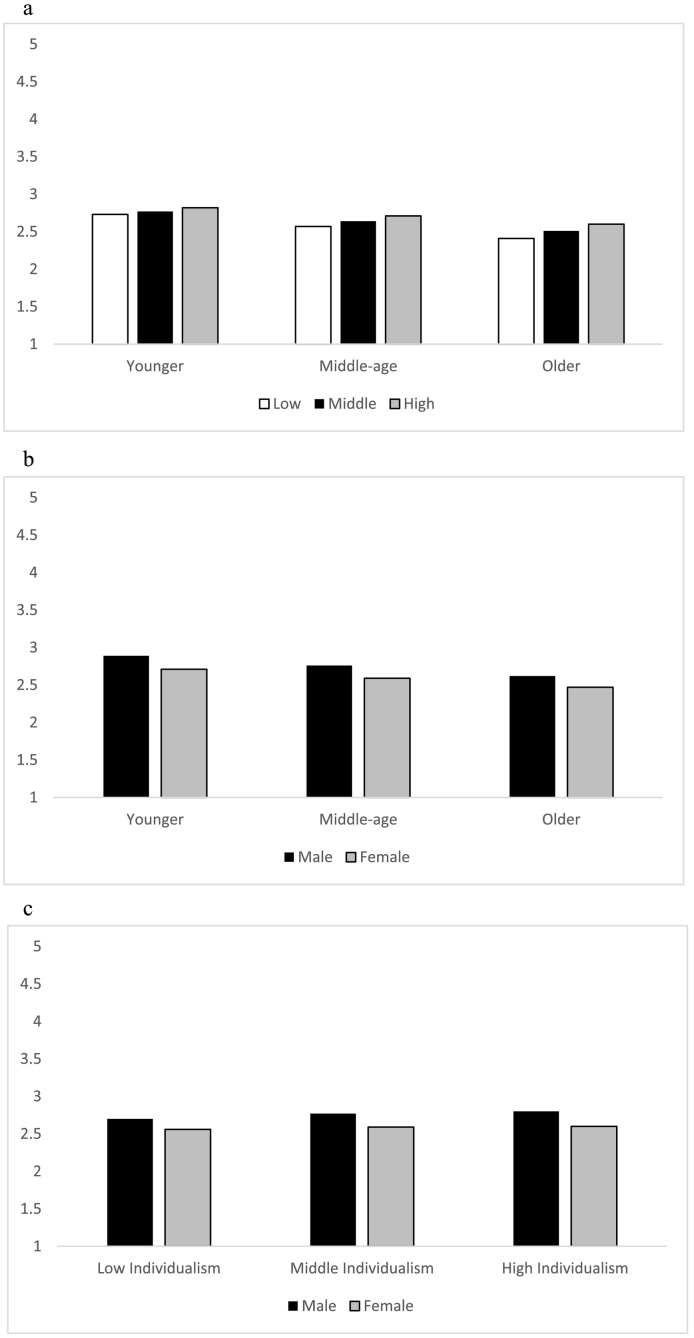
The BBC Loneliness Experiment provided a unique opportunity to examine differences in the experience of lonelines across cultures, age, and gender, and the interaction between these factors. Using those data, we analysed the frequency of loneliness reported by 46,054 participants aged 16-99 years, living across 237 countries, islands, and territories, representing the full range of individualism-collectivism cultures, as defined by Hofstede (1997). Findings showed that loneliness increased with individualism, decreased with age, and was greater in men than in women. We also found that age, gender, and culture interacted to predict loneliness, although those interactions did not qualify the main effects, and simply accentuated them. We found the most vulnerable to loneliness were younger men living in individualistic cultures
Overview
The claims and statistics of this paper haven’t been checked yet.
Run the check — free, no account needed. It reads the open-access text and checks the sources it cites.
Integrity signals
Registry
Cites
Statistics
Figures
Verification
Claims the paper makes
The claims and statistics of this paper haven’t been checked yet.
Run the check — free, no account needed. It reads the open-access text and checks the sources it cites.
Claims other papers make about this one
Each is checked against this paper’s own text: does it say what the citing paper says it does?
The source backs part of the claim, not all of it — or backs it for a different population, condition or comparison.
In the citing paper
“Despite most studies on loneliness among the oldest-old in Western or high-income countries, much less is known about loneliness among the oldest-old in India, a country where collectivism, the family system, and more restrictive (i.e., more, tighter, or more demanding) norms about social relationships are emphasized, differences in correlates of loneliness may be expected [2,12,21,33].”
From Factors associated with loneliness in a national study among persons 80 years and older in India in 2017-2018 (2025) · cites this paper as [2]
Experimental — accuracy not yet measured
Self-check
Percentages, sums and reported differences re-computed from the paper’s own numbers.
The self-check needs the paper’s full text.
Citations
Cites
(2013) · Cited by 44,563
Cultures and Organizations: Software of the Mind.
Triandis, H. C., & Hofstede, G. (1993) · Administrative Science Quarterly · doi:10.2307/2393257 · Cited by 17,696
Loneliness and Social Isolation as Risk Factors for Mortality: A Meta-Analytic Review
Holt-Lunstad, J., Smith, T. B., Baker, M., Harris, T., & Stephenson, D. (2015) · Perspectives on Psychological Science · doi:10.1177/1745691614568352 · Cited by 6,043
UCLA loneliness scale (version 3): reliability, validity, and factor structure
Russell, D. W. (1996) · Journal of Personality Assessment · doi:10.1207/s15327752jpa6601_2 · Cited by 5,800
Loneliness matters: a theoretical and empirical review of consequences and mechanisms
Hawkley, L. C., & Cacioppo, J. T. (2010) · Annals of Behavioral Medicine · doi:10.1007/s12160-010-9210-8 · Cited by 4,782
Cultures and organizations: software of the mind
(1992) · Choice Reviews Online · doi:10.5860/choice.29-4203 · Cited by 3,703
Loneliness: A Source Book of Current Theory, Research and Therapy
Blazer, D. G. (1983) · Journal of Gerontology · doi:10.1093/geronj/38.4.492 · Cited by 2,139
Loneliness Across the Life Span
Qualter, P., Vanhalst, J., Harris, R., Van Roekel, E., Lodder, G., Bangee, M., Maes, M., & Verhagen, M. (2015) · Perspectives on Psychological Science · doi:10.1177/1745691615568999 · Cited by 1,080
Self-citationInfluences on Loneliness in Older Adults: A Meta-Analysis
Pinquart, M., & Sorensen, S. (2001) · Basic and Applied Social Psychology · doi:10.1207/s15324834basp2304_2 · Cited by 1,036
Larson, R. W., Richards, M. H., Moneta, G. B., Holmbeck, G. N., & Duckett, E. (1996) · Developmental Psychology · doi:10.1037/0012-1649.32.4.744 · Cited by 898
Cited by
Sorted by citations
The prevalence of loneliness across 113 countries: systematic review and meta-analysis
Surkalim, D. L., Luo, M., Eres, R., Gebel, K., van Buskirk, J., Bauman, A., & Ding, D. (2022) · BMJ · doi:10.1136/bmj-2021-067068 · Cited by 821
MacIntyre, P. D., Gregersen, T., & Mercer, S. (2020) · System · doi:10.1016/j.system.2020.102352 · Cited by 934
Loneliness from young adulthood to old age: explaining age differences in loneliness
Hawkley, L. C., Buecker, S., Kaiser, T., & Luhmann, M. (2022) · International Journal of Behavioral Development · doi:10.1177/0165025420971048 · Cited by 281
Buecker, S., Mund, M., Chwastek, S., Sostmann, M., & Luhmann, M. (2021) · Psychological Bulletin · doi:10.1037/bul0000332 · Cited by 347
Hickin, N., Käll, A., Shafran, R., Sutcliffe, S., Manzotti, G., & Langan, D. (2021) · Clinical Psychology Review · doi:10.1016/j.cpr.2021.102066 · Cited by 295
Metadata
- Authors
- Barreto, M., Victor, C., Hammond, C., Eccles, A., Richins, M. T., & Qualter, P.
- Affiliations
- University of Exeter (GB)
- Brunel University of London (GB)
- British Broadcasting Corporation (United Kingdom) (GB)
- University of Manchester (GB)
- Corresponding author
- Barreto, Manuela
- Qualter, Pamela
- Venue
- Personality and Individual Differences
- Publisher
- Elsevier BV
- Published
- 2021-02
- Volume
- 169
- Pages
- 110066
- ISSN
- 0191-8869 (ISSN-L)
- PMC
- PMC7768187
- OpenAlex
- W3017163010
- Cited by
- 828
- References
- 44
- Citations by year
- 2026: 138 · 2025: 173 · 2024: 171 · 2023: 142 · 2022: 108 · 2021: 80
- FWCI
- 47.89
- Type
- journal article
- Language
- en
- Open access
- hybrid
- doi.org
- Licence
- Locations
- Personality and Individual Differences (publishedVersion, cc-by)
- Europe PMC (PubMed Central) (publishedVersion, cc-by)
- PubMed Central (publishedVersion, cc-by)
- PubMed (publishedVersion)
- Open Research Exeter (University of Exeter) (publishedVersion, cc-by)
- Brunel University Research Archive (BURA) (Brunel University London) (submittedVersion, cc-by)
- Figshare (submittedVersion, cc-by)
- Research Explorer (The University of Manchester) (submittedVersion, cc-by)
- Funders
- Wellcome Trust (209625/Z/17/Z)
- Topics
- Social Sciences › Health › Health disparities and outcomes
- Social Sciences › Psychology › Social Psychology › Cultural Differences and Values
- Social Sciences › Psychology › Social Psychology › Death Anxiety and Social Exclusion
- Keywords
- loneliness, age differences, gender differences, cultural differences, individualism-collectivism, cross-cultural comparison, interaction effects, young men
About these checks
Registry, retraction, Cites and statistics results are computed, not judged, with one exception: a printed reference that no index lists is read once by a model before it counts as a citation error. Claims are extracted by a model and kept only when their quote appears verbatim in the text; each cited source is then checked, with a model’s help, for whether it says what the claim relies on. Those verdicts can be wrong — read the claim’s quote and the cited source before relying on one.
Statistics and arithmetic are recomputed, not judged.
Confidence bands are shown only for fields calibrated on our annotated test set. None is calibrated yet, so no band is shown.
What counts as a claim ›How we measure confidence ›How we check this ›
Are you an author, or do you see a problem with this page? Request a review
