

clusterProfiler 4.0: A universal enrichment tool for interpreting omics data
Open accessPublished version of a preprint
The DOI matches its Crossref record; 47 of the 47 references it cites were found in a registry or an index.
Abstract
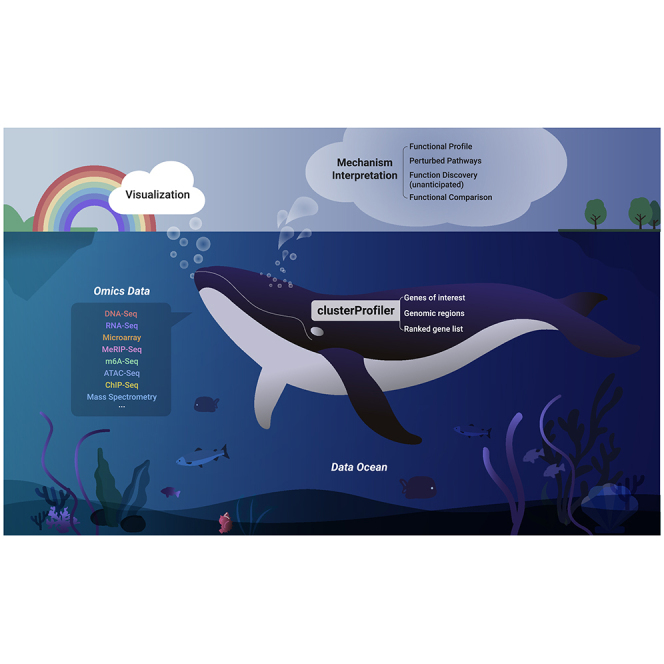
Functional enrichment analysis is pivotal for interpreting high-throughput omics data in life science. It is crucial for this type of tool to use the latest annotation databases for as many organisms as possible. To meet these requirements, we present here an updated version of our popular Bioconductor package, clusterProfiler 4.0. This package has been enhanced considerably compared with its original version published 9 years ago. The new version provides a universal interface for functional enrichment analysis in thousands of organisms based on internally supported ontologies and pathways as well as annotation data provided by users or derived from online databases. It also extends the dplyr and ggplot2 packages to offer tidy interfaces for data operation and visualization. Other new features include gene set enrichment analysis and comparison of enrichment results from multiple gene lists. We anticipate that clusterProfiler 4.0 will be applied to a wide range of scenarios across diverse organisms.
Overview
The claims and statistics of this paper haven’t been checked yet.
Free: it reads the open-access text and checks the first 5 claims that cite a source we can check. Create a free account to check every claim.
Integrity signals
Registry
Cites
Statistics
Figures
Verification
Claims the paper makes
The claims and statistics of this paper haven’t been checked yet.
Free: it reads the open-access text and checks the first 5 claims that cite a source we can check. Create a free account to check every claim.
Claims other papers make about this one
Each is checked against this paper’s own text: does it say what the citing paper says it does?
In the citing paper
“To assess pathway-level changes, gene set enrichment analysis (GSEA) was performed using the GSEA function from the clusterProfiler71,72,73,74 package. Genes were ranked based on their Z-score and enrichment was assessed using the MSigDB Hallmark 2020 gene set library.”
From Integrative analysis of pooled CRISPR screens provide functional insights into AD GWAS risk genes (2026) · cites this paper as [73]
Self-check
Percentages, sums and reported differences re-computed from the paper’s own numbers.
The self-check needs the paper’s full text.
Citations
Cites
Subramanian, A., Tamayo, P., Mootha, V. K., Mukherjee, S., Ebert, B. L., Gillette, M. A., Paulovich, A., Pomeroy, S. L., Golub, T. R., Lander, E. S., et al. (2005) · Proceedings of the National Academy of Sciences · doi:10.1073/pnas.0506580102 · Cited by 53,625
clusterProfiler: an R Package for Comparing Biological Themes Among Gene Clusters
Yu, G., Wang, L.-G., Han, Y., & He, Q.-Y. (2012) · OMICS: A Journal of Integrative Biology · doi:10.1089/omi.2011.0118 · Cited by 36,259 · cited 1×
“The clusterPro fi ler library was fi rst published in 2012 7 and designed to perform over-representation analysis (ORA) 8 using GO and KEGG for several modelorganismsandtocomparefunctionalpro fi lesofvariousconditionson one level (e.g., different treatment groups).”
MethodSelf-citationConesa, A., Götz, S., García-Gómez, J. M., Terol, J., Talón, M., & Robles, M. (2005) · Bioinformatics · doi:10.1093/bioinformatics/bti610 · Cited by 11,495
KEGG: new perspectives on genomes, pathways, diseases and drugs
Kanehisa, M., Furumichi, M., Tanabe, M., Sato, Y., & Morishima, K. (2017) · Nucleic Acids Research · doi:10.1093/nar/gkw1092 · Cited by 8,865 · cited 1×
“19 Molecular functions are represented by networks of interactions and reactions mainly in the form of KEGG pathways and modules.”
BackgroundThe Gene Ontology Resource: 20 years and still GOing strong
The Gene Ontology Consortium (2019) · Nucleic Acids Research · doi:10.1093/nar/gky1055 · Cited by 4,747
GREAT improves functional interpretation of cis-regulatory regions
McLean, C. Y., Bristor, D., Hiller, M., Clarke, S. L., Schaar, B. T., Lowe, C. B., Wenger, A. M., & Bejerano, G. (2010) · Nature Biotechnology · doi:10.1038/nbt.1630 · Cited by 4,502 · cited 1×
“Software tools, such as the Genomic Regions Enrichment of Anno-tations Tool (GREAT), 31 are implemented to follow this strategy.”
MethodChIPseeker: an R/Bioconductor package for ChIP peak annotation, comparison and visualization
Yu, G., Wang, L.-G., & He, Q.-Y. (2015) · Bioinformatics · doi:10.1093/bioinformatics/btv145 · Cited by 4,362
Self-citationMapping identifiers for the integration of genomic datasets with the R/Bioconductor package biomaRt
Durinck, S., Spellman, P. T., Birney, E., & Huber, W. (2009) · Nature Protocols · doi:10.1038/nprot.2009.97 · Cited by 4,197
KAAS: an automatic genome annotation and pathway reconstruction server
Moriya, Y., Itoh, M., Okuda, S., Yoshizawa, A. C., & Kanehisa, M. (2007) · Nucleic Acids Research · doi:10.1093/nar/gkm321 · Cited by 4,153
Fast gene set enrichment analysis
Korotkevich, G., Sukhov, V., Budin, N., Shpak, B., Artyomov, M. N., & Sergushichev, A. (2016) · bioRxiv (Cold Spring Harbor Laboratory) · doi:10.1101/060012 · Cited by 3,454
Cited by
Items 201–214 of 214
Cytochrome bc1 Catalytic Subunit Rip1 Modulates Antifungal Tolerance in Candida auris
Phan-Canh, T., Lackner, M., Chauhan, M., Zenz, L.-M., Chauhan, N., & Kuchler, K. (2026) · ACS Infectious Diseases · doi:10.1021/acsinfecdis.5c01058 · Cited by 1
EXOSC3 G191 Variants Trigger System-Wide Recalibration of RNA Processing Machinery
Wijeratne, H. R. S., Runnebohm, A. M., Barron, M. P., Hampton, A. J., Li, R., Peck Justice, S. A., Lenceski, S. H., Rooney, J. D., Smith-Kinnaman, W. R., Chang, G. S., et al. (2026) · doi:10.64898/2026.01.26.701775 · Cited by 2
Liu, X., Chen, Y.-W., Xu, X., Smith, D., & Fan, F. (2026) · Toxicological Sciences · doi:10.1093/toxsci/kfag021 · Cited by 1
Fariha, F. T. J., Fuad, M., Saha, C. S., Hossen, S., & Hossain, M. J. (2025) · Scientific Reports · doi:10.1038/s41598-025-13315-6 · Cited by 1
(2025) · doi:10.21203/rs.3.rs-6001541/v1 · Cited by 1
Integrative analysis of pooled CRISPR screens provide functional insights into AD GWAS risk genes
Wang, R. Y., Wozniak, G., Wang, X., Mustafa, M., El-Khatib, M., Kahn, E., Heutink, P., Long, H., Kenkare-Mitra, S., Rosenthal, A., et al. (2026) · iScience · doi:10.1016/j.isci.2026.118170 · Cited by 1
scTraitReg: a single-cell multi-omic database of trait-relevant transcription factor eRegulons
Chen, H., Liu, Y., Rui, X., Li, S., Sun, L., Xiao, G., Tang, H., Sun, Y., Guan, X., & Cao, C. (2026) · Nucleic Acids Research · doi:10.1093/nar/gkag1017
Torres‐Ortiz, B. S., Pérez‐Calixto, D., Carretero‐Ortega, J., Guzman‐López, A. G., Pinto‐Dueñas, D. C., Hernández‐Juárez, M., Jiménez‐Escobar, A., Rodríguez‐Hernández, A., Díaz‐Bello, B., Serna‐Márquez, N., et al. (2026) · The FEBS Journal · doi:10.1111/febs.70570
Olinger, B., Anerillas, C., Herman, A. B., Tsitsipatis, D., Banarjee, R., Tanaka, T., Candia, J., Maragkakis, M., Bandinelli, S., Walker, K. A., et al. (2026) · doi:10.64898/2026.02.06.26345739
Richardson, R. A., Navarro, H. T., Nunes Amaral, L. A., & Stoeger, T. (2024) · doi:10.7554/elife.93429.2
Lin, D., Atkinson, J. R., Wu, W., Chen, M., Jayasekara, S., Segal, B. M., Ma, A., & Gao, J. (2026) · doi:10.64898/2026.09.16.752098
Self-citation(2023) · doi:10.1158/2159-8290.22541432.v1
TUT1-catalyzed U6 snRNA 3′-end maturation is essential for RNA splicing and stem cell survival
Fang, Y., Qiu, T., Luo, H., Wang, Y., Yang, C., Wang, M., Dai, Q., Zheng, W., Yin, R., Xiao, X., et al. (2026) · EMBO Reports · doi:10.1038/s44319-026-00759-8
Plcg2 Deficiency Leads to Sex‐Associated Divergent Effects on Glial Transcriptomes
Hartigan, K. A., Dabin, L. C., Kersey, H. N., Jury‐Garfe, N., Sharify, A. D., Kim, B., Lamb, B. T., Bissel, S. J., Lasagna‐Reeves, C., & Kim, J. (2027) · Glia · doi:10.1002/glia.70252
Metadata
- Authors
- Wu, T., Hu, E., Xu, S., Chen, M., Guo, P., Dai, Z., Feng, T., Zhou, L., Tang, W., Zhan, L., Fu, X., Liu, S., Bo, X., & Yu, G.
- Affiliations
- Southern Medical University (CN)
- Beijing Radiation Center (CN)
- Zhujiang Hospital (CN)
- Corresponding author
- Bo, Xiaochen
- Yu, Guangchuang
- Venue
- The Innovation
- Publisher
- Elsevier BV
- Published
- 2021-08
- Volume
- 2
- Issue
- 3
- Pages
- 100141
- ISSN
- 2666-6758 (ISSN-L)
- PMC
- PMC8454663
- OpenAlex
- W3175752499
- Semantic Scholar
- 6d46cee9f9ad76773c2258193b9458575544f82b
- Cited by
- 12,455
- References
- 47
- Citations by year
- 2026: 1640 · 2025: 3394 · 2024: 3720 · 2023: 2383 · 2022: 1199 · 2021: 92
- FWCI
- 592.65
- Type
- journal article
- Language
- en
- Open access
- gold
- doi.org
- Licence
- cc-by-nc-nd
- www.elsevier.com/tdm/userlicense/1.0/ (tdm)
- www.elsevier.com/legal/tdmrep-license (tdm)
- creativecommons.org/licenses/by-nc-nd/4.0/ (vor)
- Locations
- The Innovation (publishedVersion, cc-by-nc-nd)
- bioRxiv (Cold Spring Harbor Laboratory) (acceptedVersion)
- Europe PMC (PubMed Central) (publishedVersion, other-oa)
- PubMed Central (publishedVersion, cc-by-nc-nd)
- PubMed (publishedVersion)
- DOAJ (DOAJ: Directory of Open Access Journals) (submittedVersion, cc-by-sa)
- Funders
- Southern Medical University
- Topics
- Life Sciences › Biochemistry, Genetics and Molecular Biology › Molecular Biology › Bioinformatics and Genomic Networks
- Life Sciences › Biochemistry, Genetics and Molecular Biology › Molecular Biology › Genomics and Phylogenetic Studies
- Health Sciences › Medicine › Health Informatics › Biomedical Text Mining and Ontologies
- Keywords
- functional enrichment, gene set enrichment analysis, omics data interpretation, Bioconductor package, annotation database, cross-species comparison
About these checks
Registry, retraction, Cites and statistics results are computed, not judged, with one exception: a printed reference that no index lists is read once by a model before it counts as a citation error. Claims are extracted by a model and kept only when their quote appears verbatim in the text; each cited source is then checked, with a model’s help, for whether it says what the claim relies on. Those verdicts can be wrong — read the claim’s quote and the cited source before relying on one.
Statistics and arithmetic are recomputed, not judged.
Confidence bands are shown only for fields calibrated on our annotated test set. None is calibrated yet, so no band is shown.
What counts as a claim ›How we measure confidence ›How we check this ›
Are you an author, or do you see a problem with this page? Request a review
Data sources
Bibliographic data: Semantic Scholar, OpenAlex, Crossref.
Contains information from the Semantic Scholar Academic Graph Datasets, made available under the ODC Attribution License (ODC-BY 1.0).
Semantic Scholar’s data is described in: Kinney, R., et al. (2023). The Semantic Scholar Open Data Platform. arXiv:2301.10140.
