

Hormone-evoked calcium release from intracellular stores is a quantal process
Open accessThe DOI matches its Crossref record; 36 of the 36 references it cites were found in a registry or an index.
Abstract
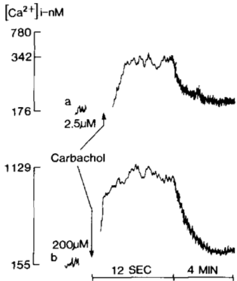
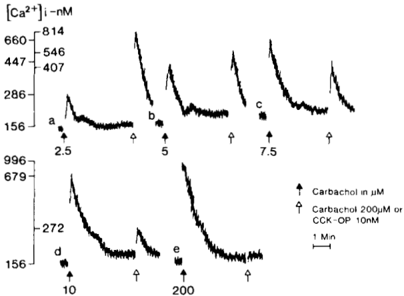
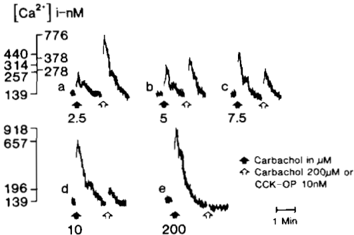
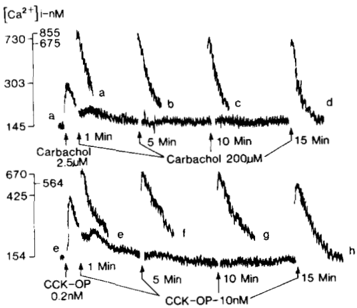
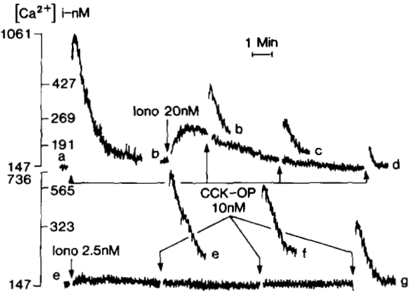
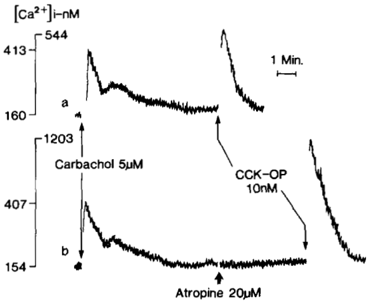
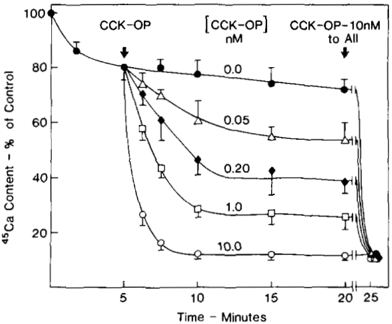
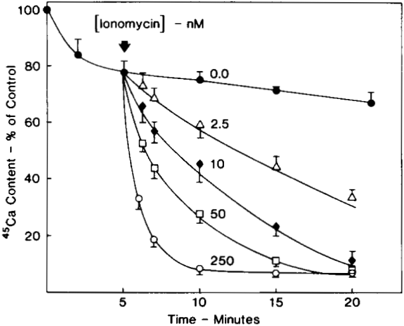
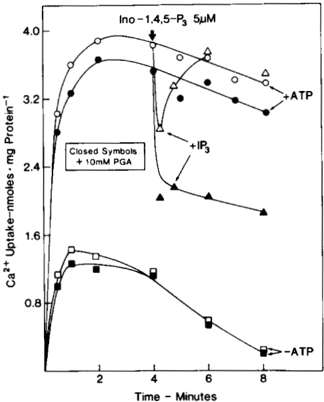
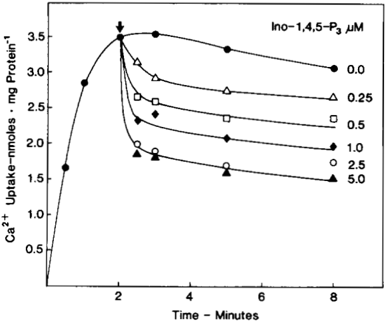
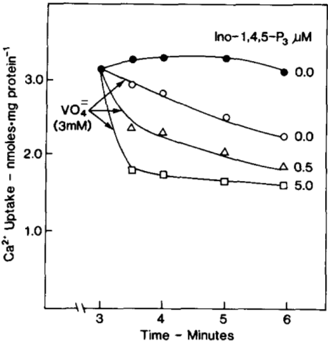
Ca2+ mobilization by hormones, ionomycin, and inositol 1,4,5-trisphosphate (Ins-1,4,5-P3) were studied to determine whether Ca2+ release is a continuous or a quantal process. Hormone-mediated Ca2+ release occurs only during the first 2-4 s of stimulation. Stimulation of acini with a maximal hormone concentration following stimulation with a submaximal concentration resulted in free cytosolic Ca2+ concentration ([Ca2+]i) increase and 45Ca efflux. The peak [Ca2+]i increase induced by a maximal concentration of agonist was nearly constant when cells were prestimulated with a submaximal dose for 1-15 min. Submaximal hormone concentrations release only a fraction of intracellular 45Ca2+, after which intracellular Ca2+ content remains constant. The partially released stores remain depleted until cell stimulation is terminated, at which time the stores reload with Ca2+. For comparison, increasing concentrations of ionomycin resulted in increasing rates of Ca2+ release. Each ionomycin concentration released all the Ca2+ from intracellular stores. We therefore conclude that hormone-evoked Ca2+ release is a quantal rather than a continuous process. In permeabilized cells, increasing concentrations of Ins-1,4,5-P3 resulted in an increased fraction of Ca2+ release. No submaximal Ins-1,4,5-P3 concentration was capable of releasing all the Ins-1,4,5-P3-mobilizable Ca2+. Therefore, it appears that the quantal properties of hormone-evoked Ca2+ release reflect the quantal properties of Ins-1,4,5-P3-mediated Ca2+ release from intracellular stores.
Overview
The claims and statistics of this paper haven’t been checked yet.
Free: it reads the open-access text and checks the first 5 claims that cite a source we can check. Create a free account to check every claim.
Integrity signals
Registry
Cites
Statistics
Figures
Verification
Claims the paper makes
The claims and statistics of this paper haven’t been checked yet.
Free: it reads the open-access text and checks the first 5 claims that cite a source we can check. Create a free account to check every claim.
Claims other papers make about this one
Each is checked against this paper’s own text: does it say what the citing paper says it does?
The source backs part of the claim, not all of it — or backs it for a different population, condition or comparison.
In the citing paper
“Moreover, the ER Ca2+ release mediated by cholinergic signaling occurred in a quantal manner: a submaximal concentration of cholinergic agonist rapidly released a fraction of the ER Ca2+ store, followed by a slower or terminated Ca2+ release56,57.”
From Tumor-specific cholinergic CD4+ T lymphocytes guide immunosurveillance of hepatocellular carcinoma (2023) · cites this paper as [56]
Experimental — accuracy not yet measuredThe cited source says what the claim attributes to it.
In the citing paper
“During persistent submaximal cholinergic stimulation, the ER Ca2+ release elicited by other IP3-dependent agonists is dampened56.”
From Tumor-specific cholinergic CD4+ T lymphocytes guide immunosurveillance of hepatocellular carcinoma (2023) · cites this paper as [56]
Self-check
Percentages, sums and reported differences re-computed from the paper’s own numbers.
The self-check needs the paper’s full text.
Citations
Cites
A new generation of Ca2+ indicators with greatly improved fluorescence properties.
Grynkiewicz, G., Poenie, M., & Tsien, R. Y. (1985) · Journal of Biological Chemistry · doi:10.1016/s0021-9258(19)83641-4 · Cited by 21,607
INOSITOL TRISPHOSPHATE AND DIACYLGLYCEROL: TWO INTERACTING SECOND MESSENGERS
Berridge, M. J. (1987) · Annual Review of Biochemistry · doi:10.1146/annurev.bi.56.070187.001111 · Cited by 3,285
The Metabolism of Phosphoinositide-Derived Messenger Molecules
Majerus, P. W., Connolly, T. M., Deckmyn, H., Ross, T. S., Bross, T. E., Ishii, H., Bansal, V. S., & Wilson, D. B. (1986) · Science · doi:10.1126/science.3024320 · Cited by 715
Involvement of guanine nucleotide-binding protein in the gating of Ca2+ by receptors
Gomperts, B. D. (1983) · Nature · doi:10.1038/306064a0 · Cited by 466
Volpe, P., Krause, K. H., Hashimoto, S., Zorzato, F., Pozzan, T., Meldolesi, J., & Lew, D. P. (1988) · Proceedings of the National Academy of Sciences · doi:10.1073/pnas.85.4.1091 · Cited by 452
Metabolism of inositol 1,4,5-trisphosphate and inositol 1,3,4-trisphosphate in rat parotid glands
Irvine, R. F., Anggård, E. E., Letcher, A. J., & Downes, C. P. (1985) · Biochemical Journal · doi:10.1042/bj2290505 · Cited by 450
Inositol trisphosphate and diacylglycerol as intracellular second messengers in liver
Williamson, J. R., Cooper, R. H., Joseph, S. K., & Thomas, A. P. (1985) · American Journal of Physiology-Cell Physiology · doi:10.1152/ajpcell.1985.248.3.c203 · Cited by 421
Korchak, H. M., Vienne, K., Rutherford, L. E., Wilkenfeld, C., Finkelstein, M. C., & Weissmann, G. (1984) · Journal of Biological Chemistry · doi:10.1016/s0021-9258(17)43011-0 · Cited by 268
Regulation of cytosolic free calcium in fura-2-loaded rat parotid acinar cells.
Merritt, J. E., & Rink, T. J. (1987) · Journal of Biological Chemistry · doi:10.1016/s0021-9258(18)45386-0 · Cited by 246
Specificity of inositol phosphate-stimulated Ca2+ mobilization from Swiss-mouse 3T3 cells
Irvine, R. F., Letcher, A. J., Lander, D. J., & Berridge, M. J. (1986) · Biochemical Journal · doi:10.1042/bj2400301 · Cited by 191
Research works printed but not linked: 7
- Ochs, D. L., Korenbrot, J. I., and Williams, J. A. (1985) Am. J. Physiol. 2 4 9 , G389-G398
- Dormer, R. L., Paulsen, J. H., Licko, W., and Williams, J. A. (1981) Am. J. Physiol. 2 4 0 , G38-G43
- Muallem, S., Pandol, S. J., and Beeker, T. G. (1988) Biochem. J. 39. Leslie, B. A., Burgess, G. M., and Putney, J. W., Jr. (1988) Cell
- Muallem, 1988, Am. J. Physiol., 255, G229
- Muallem, 1988, Am. J. Physiol., 255, G221
- Muallem, S. (1985) Am. J. Physiol. 248, G551-G560 Biol. 102,153-162 in Calcium and Cell Function (Cheung, W. Y., ed), Vol. 4, pp.
- McLennan, 1983, Vol. 4, 151
Cited by
Items 101–200 of 307
Inositol phosphate receptors and calcium disposition in the brain
Ferris, C. D., & Snyder, S. H. (1992) · Journal of Neuroscience · doi:10.1523/jneurosci.12-05-01567.1992 · Cited by 61
Shin, D. M., Luo, X., Wilkie, T. M., Miller, L. J., Peck, A. B., Humphreys‐Beher, M. G., & Muallem, S. (2001) · Journal of Biological Chemistry · doi:10.1074/jbc.m105203200 · Cited by 60
Self-citationPacaud, P., Loirand, G., Grégoire, G., Mironneau, C., & Mironneau, J. (1993) · Journal of Biological Chemistry · doi:10.1016/s0021-9258(18)53553-5 · Cited by 64
Cheek, T. R., Berridge, M. J., Moreton, R. B., Stauderman, K. A., Murawsky, M., & Bootman, M. D. (1994) · Biochemical Journal · doi:10.1042/bj3010879 · Cited by 58
Ca2+ release from subplasmalemmal stores as a primary event during exocytosis in Paramecium cells.
Erxleben, C. F. J., & Plattner, H. (1994) · The Journal of Cell Biology · doi:10.1083/jcb.127.4.935 · Cited by 58
Mechanisms and genetics of photoreceptors desensitization in Drosophila flies
Selinger, Z., Doza, Y. N., & Minke, B. (1993) · Biochimica et Biophysica Acta (BBA) - Molecular Cell Research · doi:10.1016/0167-4889(93)90084-3 · Cited by 57
Combettes, L., Cheek, T. R., & Taylor, C. W. (1996) · The EMBO Journal · doi:10.1002/j.1460-2075.1996.tb00562.x · Cited by 57
Yoo, S. H., So, S. H., Kweon, H. S., Lee, J. S., Kang, M. K., & Jeon, C. J. (2000) · Journal of Biological Chemistry · doi:10.1074/jbc.275.17.12553 · Cited by 56
Characterization of a Selective Antagonist of Neuropeptide Y at the Y2 Receptor
Grouzmann, E., Buclin, T., Martire, M., Cannizzaro, C., Dörner, B., Razaname, A., & Mutter, M. (1997) · Journal of Biological Chemistry · doi:10.1074/jbc.272.12.7699 · Cited by 56
Koizumi, S., Lipp, P., Berridge, M. J., & Bootman, M. D. (1999) · Journal of Biological Chemistry · doi:10.1074/jbc.274.47.33327 · Cited by 56
Swillens, S., Combettes, L., & Champeil, P. (1994) · Proceedings of the National Academy of Sciences · doi:10.1073/pnas.91.21.10074 · Cited by 55
Calcium signalling in platelets and other nonexcitable cells
Sargeant, P., & Sage, S. O. (1994) · Pharmacology & Therapeutics · doi:10.1016/0163-7258(94)90019-1 · Cited by 61
Oancea, E., & Meyer, T. (1996) · Journal of Biological Chemistry · doi:10.1074/jbc.271.29.17253 · Cited by 55
Combettes, L., Claret, M., & Champeil, P. (1992) · FEBS Letters · doi:10.1016/0014-5793(92)80258-i · Cited by 54
Imaging of intracellular calcium stores in single permeabilized lens cells
Churchill, G. C., & Louis, C. F. (1999) · American Journal of Physiology-Cell Physiology · doi:10.1152/ajpcell.1999.276.2.c426 · Cited by 53
Thorn, P., Moreton, R. B., & Berridge, M. J. (1996) · The EMBO Journal · doi:10.1002/j.1460-2075.1996.tb00436.x · Cited by 53
Stochastic models of intracellular calcium signals
Rüdiger, S. (2013) · Physics Reports · doi:10.1016/j.physrep.2013.09.002 · Cited by 56
Henschke, P., & Elliott, S. J. (1995) · Biochemical Journal · doi:10.1042/bj3120485 · Cited by 49
Calcium release from InsP3‐sensitive internal stores initiates action potential in Chara
Biskup, B., Gradmann, D., & Thiel, G. (1999) · FEBS Letters · doi:10.1016/s0014-5793(99)00600-6 · Cited by 49
Flores, J. A., Aguirre, C., Sharma, O. P., & Veldhuis, J. D. (1998) · Endocrinology · doi:10.1210/en.139.8.3606 · Cited by 49
Calcium control on InsP3-induced discharge of calcium from permeabilised hepatocyte pools
Combettes, L., Claret, M., & Champeil, P. (1993) · Cell Calcium · doi:10.1016/0143-4160(93)90049-c · Cited by 49
Regulation of Inositol 1,4,5-Trisphosphate Receptors
Marshall, I. C. B., & Taylor, C. W. (1993) · Journal of Experimental Biology · doi:10.1242/jeb.184.1.161 · Cited by 51
Zeng, W., Xu, X., & Muallem, S. (1996) · Journal of Biological Chemistry · doi:10.1074/jbc.271.31.18520 · Cited by 53
Self-citationNegative control mechanism with features of adaptation controls Ca2+ release in cardiac myocytes
Yasui, K., Palade, P., & Györke, S. (1994) · Biophysical Journal · doi:10.1016/s0006-3495(94)80501-6 · Cited by 47
Mechanisms responsible for quantal Ca2+ release from inositol trisphosphate-sensitive calcium stores
Parys, J. B., Missiaen, L., SMEDT, H. D., Sienaert, I., & Casteels, R. (1996) · Pflügers Archiv - European Journal of Physiology · doi:10.1007/s004240050145 · Cited by 47
Combettes, L., Hannaert-Merah, Z., Coquil, J., Rousseau, C., Claret, M., Swillens, S., & Champeil, P. (1994) · Journal of Biological Chemistry · doi:10.1016/s0021-9258(17)32478-x · Cited by 47
Berestovsky, G. N., & Kataev, A. A. (2005) · European Biophysics Journal · doi:10.1007/s00249-005-0477-9 · Cited by 46
Balla, T., Sim, S.-S., Iida, T., Choi, K. Y., Catt, K. J., & Rhee, S. G. (1991) · Journal of Biological Chemistry · doi:10.1016/s0021-9258(18)54289-7 · Cited by 46
Shao, Y., & McCarthy, K. D. (1995) · Cell Calcium · doi:10.1016/0143-4160(95)90033-0 · Cited by 45
Steenbergen, J. M., & Fay, F. S. (1996) · Journal of Biological Chemistry · doi:10.1074/jbc.271.4.1821 · Cited by 45
Muallem, S., & Loessberg, P. A. (1990) · Journal of Biological Chemistry · doi:10.1016/s0021-9258(19)38232-8 · Cited by 49
Self-citationWILCOX, R. A., Safrany, S. T., Lampe, D., Mills, S. J., Nahorski, S. R., & Potter, B. V. L. (1994) · European Journal of Biochemistry · doi:10.1111/j.1432-1033.1994.tb18972.x · Cited by 45
Zhao, H. L., Khademazad, M., & Muallem, S. (1990) · Journal of Biological Chemistry · doi:10.1016/s0021-9258(18)77188-3 · Cited by 45
Self-citationHirota, J., Michikawa, T., Miyawaki, A., Furuichi, T., Okura, I., & Mikoshiba, K. (1995) · Journal of Biological Chemistry · doi:10.1074/jbc.270.32.19046 · Cited by 45
Cell membrane permeable esters of d-myo-inositol 1,4,5-trisphosphate
Dakin, K., & Li, W.-H. (2007) · Cell Calcium · doi:10.1016/j.ceca.2006.12.003 · Cited by 47
G protein-dependent Ca2+signaling complexes in polarized cells
Muallem, S., & Wilkie, T. M. (1999) · Cell Calcium · doi:10.1054/ceca.1999.0077 · Cited by 49
Self-citationBabich, M., CHOI, H., Johnson, R. M., King, K. L., ALFORD, G. E., & Nissenson, R. A. (1991) · Endocrinology · doi:10.1210/endo-129-3-1463 · Cited by 43
Dupont, G., & Swillens, S. (1996) · Biophysical Journal · doi:10.1016/s0006-3495(96)79373-6 · Cited by 47
GHRP-6 induces a biphasic calcium response in rat pituitary somatotrophs
Bresson‐Bepoldin, L., & Dufy-Barbe, L. (1994) · Cell Calcium · doi:10.1016/0143-4160(94)90064-7 · Cited by 42
Smith, P. M. (1992) · Biochemical Journal · doi:10.1042/bj2830027 · Cited by 42
McCarron, J. G., & Olson, M. L. (2007) · Journal of Biological Chemistry · doi:10.1074/jbc.m708923200 · Cited by 41
Molleman, A., Hoiting, B., Duin, M., van den Akker, J., Nelemans, A., & den Hertog, A. (1991) · Journal of Biological Chemistry · doi:10.1016/s0021-9258(19)67645-3 · Cited by 41
The molecular basis of enzyme secretion
Bruzzone, R. (1990) · Gastroenterology · doi:10.1016/0016-5085(90)90640-m · Cited by 41
Ito, K., Miyashita, Y., & Kasai, H. (1999) · The Journal of Cell Biology · doi:10.1083/jcb.146.2.405 · Cited by 41
RINK, T. J., & Merritt, J. E. (1990) · Current Opinion in Cell Biology · doi:10.1016/0955-0674(90)90007-2 · Cited by 41
Pharmacological modulators of the inositol 1,4,5-trisphosphate receptor
Michelangeli, F., Mezna, M., Tovey, S. C., & Sayers, L. G. (1995) · Neuropharmacology · doi:10.1016/0028-3908(95)00053-9 · Cited by 40
van de Put, F. H. M. M., Pont, J. J. D., & Willems, P. H. G. M. (1994) · Journal of Biological Chemistry · doi:10.1016/s0021-9258(18)99893-5 · Cited by 39
Aberrant Ca2+ signalling through acidic calcium stores in pancreatic acinar cells
Petersen, O. H., Gerasimenko, O. V., Tepikin, A. V., & Gerasimenko, J. V. (2011) · Cell Calcium · doi:10.1016/j.ceca.2011.02.010 · Cited by 40
Quantal Ca2+ release from InsP3-sensitive intracellular Ca2+ stores
Bootman, M. D. (1994) · Molecular and Cellular Endocrinology · doi:10.1016/0303-7207(94)90134-1 · Cited by 38
Imaging of Intracellular Calcium Stores in Individual Permeabilized Pancreatic Acinar Cells
van de Put, F. H. M. M., & Elliott, A. C. (1996) · Journal of Biological Chemistry · doi:10.1074/jbc.271.9.4999 · Cited by 38
Regulation of the Inositol 1,4,5-Trisphosphate-activated Ca2+ Channel by Activation of G Proteins
Xu, X., Zeng, W., & Muallem, S. (1996) · Journal of Biological Chemistry · doi:10.1074/jbc.271.20.11737 · Cited by 38
Self-citationF‐actin‐based Ca signaling—a critical comparison with the current concept of Ca signaling
Lange, K., & Gartzke, J. (2006) · Journal of Cellular Physiology · doi:10.1002/jcp.20717 · Cited by 43
Petersen, C. C. H., Toescu, E. C., Potter, B. V. L., & Petersen, O. H. (1991) · FEBS Letters · doi:10.1016/0014-5793(91)81181-7 · Cited by 37
Camello‐Almaraz, C., Gomez‐Pinilla, P. J., Pozo, M. J., & Camello, P. J. (2008) · Journal of Pineal Research · doi:10.1111/j.1600-079x.2008.00576.x · Cited by 43
Marsh, K. A., & Hill, S. J. (1993) · British Journal of Pharmacology · doi:10.1111/j.1476-5381.1993.tb13767.x · Cited by 37
Kindman, L. A., & Meyer, T. (1993) · Biochemistry · doi:10.1021/bi00056a011 · Cited by 37
Intracellular Calcium: Questions about quantal Ca2+release
Bootman, M. D. (1994) · Current Biology · doi:10.1016/s0960-9822(94)00041-2 · Cited by 36
Tortorici, G., Zhang, B. X., Xu, X., & Muallem, S. (1994) · Journal of Biological Chemistry · doi:10.1016/s0021-9258(18)43926-9 · Cited by 36
Self-citation‘Quantal’ calcium release operated by membrane voltage in frog skeletal muscle
Pizarro, G., Shirokova, N., Tsugorka, A., & Rı́os, E. (1997) · The Journal of Physiology · doi:10.1111/j.1469-7793.1997.289bn.x · Cited by 34
Regulation of IP3R Channel Gating by Ca2+ and Ca2+ Binding Proteins
Foskett, J. K., & Mak, D. D. (2010) · Current topics in membranes · doi:10.1016/s1063-5823(10)66011-5 · Cited by 34
Figueroa, J. A. L., Vignesh, K. S., Deepe, G. S., & Caruso, J. A. (2014) · Metallomics · doi:10.1039/c3mt00283g · Cited by 37
Effect of adenine nucleotides on myo-inositol-1,4,5-trisphosphate-induced calcium release
Missiaen, L., Parys, J. B., SMEDT, H. D., Sienaert, I., Sipma, H., Vanlingen, S., Maes, K., & Casteels, R. (1997) · Biochemical Journal · doi:10.1042/bj3250661 · Cited by 33
Partial calcium release in response to submaximal inositol 1,4,5-trisphosphate receptor activation
Missiaen, L., Parys, J. B., SMEDT, H. D., Oike, M., & Casteels, R. (1994) · Molecular and Cellular Endocrinology · doi:10.1016/0303-7207(94)90133-3 · Cited by 33
Voltage‐ and Ca2+‐activated potassium channels in Ca2+ store control Ca2+ release
Yamashita, M., Sugioka, M., & Ogawa, Y. (2006) · FEBS Journal · doi:10.1111/j.1742-4658.2006.05365.x · Cited by 32
Yoo, S. H., & Lewis, M. S. (2000) · Journal of Biological Chemistry · doi:10.1074/jbc.m001204200 · Cited by 31
Piétri‐Rouxel, F., Hilly, M., & Mauger, J. (1992) · Journal of Biological Chemistry · doi:10.1016/s0021-9258(19)88658-1 · Cited by 31
Mezna, M., & Michelangeli, F. (1996) · Journal of Biological Chemistry · doi:10.1074/jbc.271.50.31818 · Cited by 31
Loomis-Husselbee, J. W., & Dawson, A. P. (1993) · Biochemical Journal · doi:10.1042/bj2890861 · Cited by 31
Calcium regulation and homeostasis
Cheek, T. R. (1991) · Current Opinion in Cell Biology · doi:10.1016/0955-0674(91)90139-p · Cited by 30
The sarcoplasmic reticulum Ca2+ store arrangement in vascular smooth muscle
Rainbow, R. D., MacMillan, D., & McCarron, J. G. (2009) · Cell Calcium · doi:10.1016/j.ceca.2009.09.001 · Cited by 29
Dawson, A. P., Lea, E. J. A., & Irvine, R. F. (2003) · Biochemical Journal · doi:10.1042/bj20021289 · Cited by 29
Kinetic Properties of Nicotinic Acid Adenine Dinucleotide Phosphate-induced Ca2+ Release
Genazzani, A. A., Mezna, M., Summerhill, R. J., Galione, A., & Michelangeli, F. (1997) · Journal of Biological Chemistry · doi:10.1074/jbc.272.12.7669 · Cited by 29
Mollard, P., DUFY, B., Vacher, P., Barker, J. L., & Schlegel, W. (1990) · Biochemical Journal · doi:10.1042/bj2680345 · Cited by 29
The high affinity state of inositol 1,4,5-trisphosphate receptor is a functional state.
Poitras, M. F., Bernier, S. G., Servant, M. J., Richard, D. E., Boulay, G., & Guillemette, G. (1993) · Journal of Biological Chemistry · doi:10.1016/s0021-9258(20)80495-5 · Cited by 29
The four dimensions of calcium signalling in Xenopus oocytes
Delisle, S. (1991) · Cell Calcium · doi:10.1016/0143-4160(91)90022-7 · Cited by 28
Hypotonically Induced Calcium Release from Intracellular Calcium Stores
Missiaen, L., SMEDT, H. D., Parys, J. B., Sienaert, I., Vanlingen, S., Droogmans, G., Nilius, B., & Casteels, R. (1996) · Journal of Biological Chemistry · doi:10.1074/jbc.271.9.4601 · Cited by 28
Reiser, G., Schäfer, R., Donié, F., Hülser, E., Nehls-Sahabandu, M., & Mayr, G. W. (1991) · Biochemical Journal · doi:10.1042/bj2800533 · Cited by 28
Brody, T. (1999) · Elsevier eBooks · doi:10.1016/b978-012134836-6/50013-5 · Cited by 33
Quamme, G. A., Pfeilschifter, J. M., & Murer, H. (1989) · Biochimica et Biophysica Acta (BBA) - Molecular Cell Research · doi:10.1016/0167-4889(89)90045-1 · Cited by 27
Inositol 1, 4, 5-trisphosphate-induced calcium mobilization is localized in Xenopus oocytes
Berridge, M. J. (1989) · Proceedings of the Royal Society B Biological Sciences · doi:10.1098/rspb.1989.0079 · Cited by 27
Beecroft, M. D., & Taylor, C. W. (1997) · Biochemical Journal · doi:10.1042/bj3260215 · Cited by 27
Leong, D. A. (1991) · Cell Calcium · doi:10.1016/0143-4160(91)90025-a · Cited by 27
Hoffman, A., & Goldberg, A. (1994) · Journal of Pharmacokinetics and Biopharmaceutics · doi:10.1007/bf02353789 · Cited by 26
Oldershaw, K. A., Richardson, A., & Taylor, C. W. (1992) · Journal of Biological Chemistry · doi:10.1016/s0021-9258(18)42002-9 · Cited by 26
Treponema denticola Outer Membrane Inhibits Calcium Flux in Gingival Fibroblasts
Ko, K. S., Glogauer, M., McCulloch, C. A., & Ellen, R. P. (1998) · Infection and Immunity · doi:10.1128/iai.66.2.703-709.1998 · Cited by 25
Hüser, J., Stonebraker, J. R., Kockskämper, J., & Blatter, L. A. (1999) · The Journal of Physiology · doi:10.1111/j.1469-7793.1999.101af.x · Cited by 24
Khan, S. Z., Dyer, J. L., & Michelangeli, F. (2001) · Cellular Signalling · doi:10.1016/s0898-6568(00)00140-6 · Cited by 24
Luminal calcium regulation of calcium release from sarcoplasmic reticulum
Hidalgo, C., & Donoso, P. (1995) · Bioscience Reports · doi:10.1007/bf01788370 · Cited by 24
den Hertog, A., Hoiting, B., Molleman, A., den Akker, J. V., Duin, M., & Nelemans, A. (1992) · The Journal of Physiology · doi:10.1113/jphysiol.1992.sp019281 · Cited by 23
Young, K. W., Pinnock, R. D., & Nahorski, S. R. (1998) · Cell Calcium · doi:10.1016/s0143-4160(98)90089-6 · Cited by 21
Functional properties of Drosophila inositol trisphosphate receptors
SWATTON, J. E., MORRIS, S. A., Wissing, F., & Taylor, C. W. (2001) · Biochemical Journal · doi:10.1042/0264-6021:3590435 · Cited by 21
Mezna, M., PATCHICK, T., Tovey, S. C., & Michelangeli, F. (1996) · Biochemical Journal · doi:10.1042/bj3140175 · Cited by 21
Canny, B. J., Jia, L.-G., & Leong, D. A. (1992) · Journal of Biological Chemistry · doi:10.1016/s0021-9258(18)42446-5 · Cited by 20
Thiel, G., & Dityatev, A. E. (1998) · The Journal of Membrane Biology · doi:10.1007/s002329900382 · Cited by 23
Ca(2+)‐dependent negative control mechanism for Ca(2+)‐induced Ca2+ release in crayfish muscle.
Györke, S., & Palade, P. (1994) · The Journal of Physiology · doi:10.1113/jphysiol.1994.sp020133 · Cited by 20
Watras, J. M., Moraru, I. I., Costa, D. J., & Kindman, L. A. (1994) · Biochemistry · doi:10.1021/bi00251a050 · Cited by 21
Ogden, D., Khodakhah, K., Carter, T. D., Gray, P. T. A., & Capiod, T. (1993) · Journal of Experimental Biology · doi:10.1242/jeb.184.1.105 · Cited by 20
Redox-Regulated Heterogeneous Thresholds for Ligand Recruitment among InsP3R Ca2+-Release Channels
Vais, H., Siebert, A. P., Ma, Z., Fernández‐Mongil, M., Foskett, J. K., & Mak, D. D. (2010) · Biophysical Journal · doi:10.1016/j.bpj.2010.04.034 · Cited by 21
Saleem, H., Tovey, S. C., Riley, A. M., Potter, B. V. L., & Taylor, C. W. (2013) · PLoS ONE · doi:10.1371/journal.pone.0058027 · Cited by 23
Pandol, S. J., Schoeffield, M. S., Gukovskaya, A. S., & Rutherford, R. E. (1994) · Biochimica et Biophysica Acta (BBA) - Biomembranes · doi:10.1016/0005-2736(94)90007-8 · Cited by 19
Self-citation
Metadata
- Authors
- Muallem, S., Pandol, S. J., & Beeker, T. G.
- Affiliations
- Cedars-Sinai Medical Center (US)
- Venue
- Journal of Biological Chemistry
- Publisher
- Elsevier BV
- Published
- 1989-01
- Volume
- 264
- Issue
- 1
- Pages
- 205-212
- ISSN
- 0021-9258 (ISSN-L)
- OpenAlex
- W1555351713
- Cited by
- 307
- References
- 36
- Citations by year
- 2026: 1 · 2025: 1 · 2024: 1 · 2023: 1 · 2021: 1 · 2019: 1 · 2016: 1 · 2015: 1 · 2014: 2 · 2013: 4 · 2012: 2
- FWCI
- 12.57
- Type
- journal article
- Language
- en
- Open access
- hybrid
- doi.org
- Licence
- cc-by
- www.elsevier.com/tdm/userlicense/1.0/ (tdm)
- www.elsevier.com/legal/tdmrep-license (tdm)
- creativecommons.org/licenses/by/4.0/ (vor, 11627 d)
- Locations
- Journal of Biological Chemistry (publishedVersion, cc-by)
- PubMed (publishedVersion)
- Funders
- National Institute of Diabetes and Digestive and Kidney Diseases (DK 38938, DK33010)
- Topics
- Life Sciences › Biochemistry, Genetics and Molecular Biology › Physiology › Calcium signaling and nucleotide metabolism
- Life Sciences › Neuroscience › Sensory Systems › Ion Channels and Receptors
- Life Sciences › Biochemistry, Genetics and Molecular Biology › Molecular Biology › Ion channel regulation and function
- Keywords
- quantal release, intracellular calcium stores, inositol 1,4,5-trisphosphate, ionomycin, intracellular calcium, pancreatic acini, calcium efflux
- MeSH terms
- Animals, Atropine, Calcium, Carbachol, Ethers, Inositol Phosphates, Kinetics, Pancreas, Rats, Inbred Strains, Sincalide, Inositol 1,4,5-Trisphosphate, Ionomycin, Rats, In Vitro Techniques
About these checks
Registry, retraction, Cites and statistics results are computed, not judged, with one exception: a printed reference that no index lists is read once by a model before it counts as a citation error. Claims are extracted by a model and kept only when their quote appears verbatim in the text; each cited source is then checked, with a model’s help, for whether it says what the claim relies on. Those verdicts can be wrong — read the claim’s quote and the cited source before relying on one.
Statistics and arithmetic are recomputed, not judged.
Confidence bands are shown only for fields calibrated on our annotated test set. None is calibrated yet, so no band is shown.
What counts as a claim ›How we measure confidence ›How we check this ›
Are you an author, or do you see a problem with this page? Request a review
Data sources
Bibliographic data: Semantic Scholar, OpenAlex, Crossref.
Contains information from the Semantic Scholar Academic Graph Datasets, made available under the ODC Attribution License (ODC-BY 1.0).
Semantic Scholar’s data is described in: Kinney, R., et al. (2023). The Semantic Scholar Open Data Platform. arXiv:2301.10140.
