

Hormone-evoked calcium release from intracellular stores is a quantal process
Open accessThe DOI matches its Crossref record; 36 of the 36 references it cites were found in a registry or an index.
Abstract
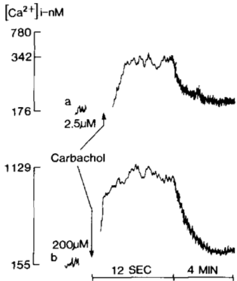
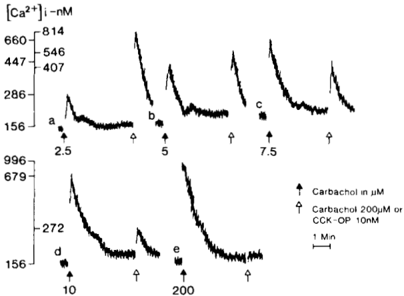
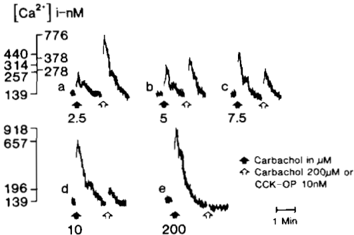
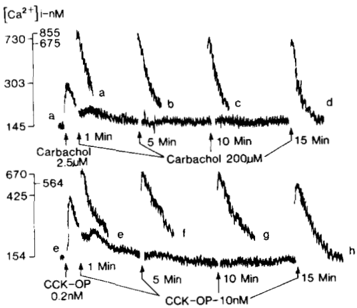
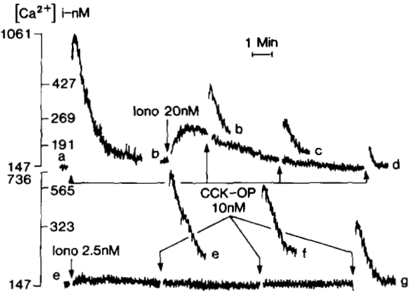
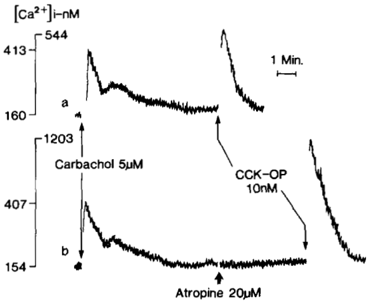
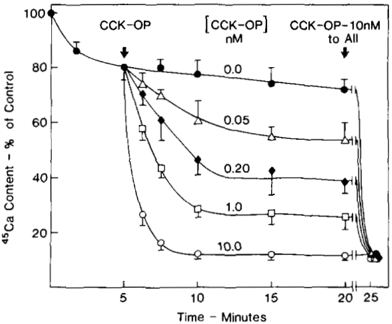
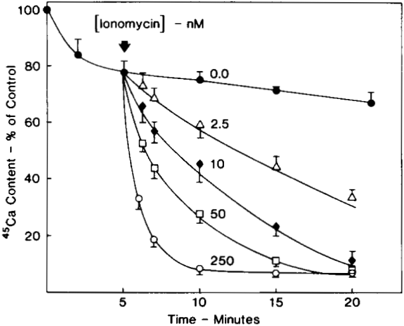
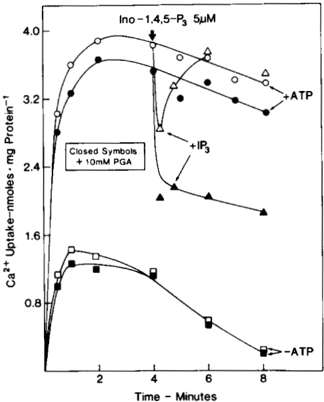
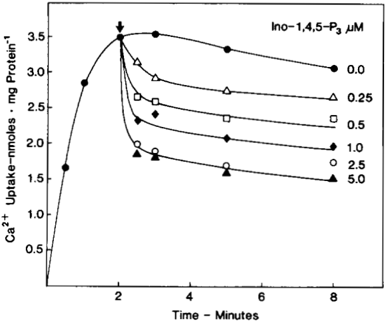
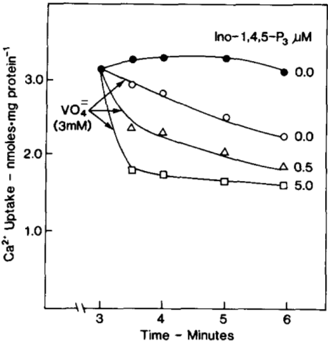
Ca2+ mobilization by hormones, ionomycin, and inositol 1,4,5-trisphosphate (Ins-1,4,5-P3) were studied to determine whether Ca2+ release is a continuous or a quantal process. Hormone-mediated Ca2+ release occurs only during the first 2-4 s of stimulation. Stimulation of acini with a maximal hormone concentration following stimulation with a submaximal concentration resulted in free cytosolic Ca2+ concentration ([Ca2+]i) increase and 45Ca efflux. The peak [Ca2+]i increase induced by a maximal concentration of agonist was nearly constant when cells were prestimulated with a submaximal dose for 1-15 min. Submaximal hormone concentrations release only a fraction of intracellular 45Ca2+, after which intracellular Ca2+ content remains constant. The partially released stores remain depleted until cell stimulation is terminated, at which time the stores reload with Ca2+. For comparison, increasing concentrations of ionomycin resulted in increasing rates of Ca2+ release. Each ionomycin concentration released all the Ca2+ from intracellular stores. We therefore conclude that hormone-evoked Ca2+ release is a quantal rather than a continuous process. In permeabilized cells, increasing concentrations of Ins-1,4,5-P3 resulted in an increased fraction of Ca2+ release. No submaximal Ins-1,4,5-P3 concentration was capable of releasing all the Ins-1,4,5-P3-mobilizable Ca2+. Therefore, it appears that the quantal properties of hormone-evoked Ca2+ release reflect the quantal properties of Ins-1,4,5-P3-mediated Ca2+ release from intracellular stores.
Overview
The claims and statistics of this paper haven’t been checked yet.
Free: it reads the open-access text and checks the first 5 claims that cite a source we can check. Create a free account to check every claim.
Integrity signals
Registry
Cites
Statistics
Figures
Verification
Claims the paper makes
The claims and statistics of this paper haven’t been checked yet.
Free: it reads the open-access text and checks the first 5 claims that cite a source we can check. Create a free account to check every claim.
Claims other papers make about this one
Each is checked against this paper’s own text: does it say what the citing paper says it does?
The source backs part of the claim, not all of it — or backs it for a different population, condition or comparison.
In the citing paper
“Moreover, the ER Ca2+ release mediated by cholinergic signaling occurred in a quantal manner: a submaximal concentration of cholinergic agonist rapidly released a fraction of the ER Ca2+ store, followed by a slower or terminated Ca2+ release56,57.”
From Tumor-specific cholinergic CD4+ T lymphocytes guide immunosurveillance of hepatocellular carcinoma (2023) · cites this paper as [56]
Experimental — accuracy not yet measuredThe cited source says what the claim attributes to it.
In the citing paper
“During persistent submaximal cholinergic stimulation, the ER Ca2+ release elicited by other IP3-dependent agonists is dampened56.”
From Tumor-specific cholinergic CD4+ T lymphocytes guide immunosurveillance of hepatocellular carcinoma (2023) · cites this paper as [56]
Self-check
Percentages, sums and reported differences re-computed from the paper’s own numbers.
The self-check needs the paper’s full text.
Citations
Cites
A new generation of Ca2+ indicators with greatly improved fluorescence properties.
Grynkiewicz, G., Poenie, M., & Tsien, R. Y. (1985) · Journal of Biological Chemistry · doi:10.1016/s0021-9258(19)83641-4 · Cited by 21,607
INOSITOL TRISPHOSPHATE AND DIACYLGLYCEROL: TWO INTERACTING SECOND MESSENGERS
Berridge, M. J. (1987) · Annual Review of Biochemistry · doi:10.1146/annurev.bi.56.070187.001111 · Cited by 3,285
The Metabolism of Phosphoinositide-Derived Messenger Molecules
Majerus, P. W., Connolly, T. M., Deckmyn, H., Ross, T. S., Bross, T. E., Ishii, H., Bansal, V. S., & Wilson, D. B. (1986) · Science · doi:10.1126/science.3024320 · Cited by 715
Involvement of guanine nucleotide-binding protein in the gating of Ca2+ by receptors
Gomperts, B. D. (1983) · Nature · doi:10.1038/306064a0 · Cited by 466
Volpe, P., Krause, K. H., Hashimoto, S., Zorzato, F., Pozzan, T., Meldolesi, J., & Lew, D. P. (1988) · Proceedings of the National Academy of Sciences · doi:10.1073/pnas.85.4.1091 · Cited by 452
Metabolism of inositol 1,4,5-trisphosphate and inositol 1,3,4-trisphosphate in rat parotid glands
Irvine, R. F., Anggård, E. E., Letcher, A. J., & Downes, C. P. (1985) · Biochemical Journal · doi:10.1042/bj2290505 · Cited by 450
Inositol trisphosphate and diacylglycerol as intracellular second messengers in liver
Williamson, J. R., Cooper, R. H., Joseph, S. K., & Thomas, A. P. (1985) · American Journal of Physiology-Cell Physiology · doi:10.1152/ajpcell.1985.248.3.c203 · Cited by 421
Korchak, H. M., Vienne, K., Rutherford, L. E., Wilkenfeld, C., Finkelstein, M. C., & Weissmann, G. (1984) · Journal of Biological Chemistry · doi:10.1016/s0021-9258(17)43011-0 · Cited by 268
Regulation of cytosolic free calcium in fura-2-loaded rat parotid acinar cells.
Merritt, J. E., & Rink, T. J. (1987) · Journal of Biological Chemistry · doi:10.1016/s0021-9258(18)45386-0 · Cited by 246
Specificity of inositol phosphate-stimulated Ca2+ mobilization from Swiss-mouse 3T3 cells
Irvine, R. F., Letcher, A. J., Lander, D. J., & Berridge, M. J. (1986) · Biochemical Journal · doi:10.1042/bj2400301 · Cited by 191
Research works printed but not linked: 7
- Ochs, D. L., Korenbrot, J. I., and Williams, J. A. (1985) Am. J. Physiol. 2 4 9 , G389-G398
- Dormer, R. L., Paulsen, J. H., Licko, W., and Williams, J. A. (1981) Am. J. Physiol. 2 4 0 , G38-G43
- Muallem, S., Pandol, S. J., and Beeker, T. G. (1988) Biochem. J. 39. Leslie, B. A., Burgess, G. M., and Putney, J. W., Jr. (1988) Cell
- Muallem, 1988, Am. J. Physiol., 255, G229
- Muallem, 1988, Am. J. Physiol., 255, G221
- Muallem, S. (1985) Am. J. Physiol. 248, G551-G560 Biol. 102,153-162 in Calcium and Cell Function (Cheung, W. Y., ed), Vol. 4, pp.
- McLennan, 1983, Vol. 4, 151
Cited by
Items 201–300 of 307
Changes in guinea pig gallbladder smooth muscle Ca2+homeostasis by acute acalculous cholecystitis
Gomez‐Pinilla, P. J., Morales, S., Camello‐Almaraz, C., Moreno, R., Pozo, M. J., & Camello, P. J. (2005) · American Journal of Physiology-Gastrointestinal and Liver Physiology · doi:10.1152/ajpgi.00284.2005 · Cited by 19
Gamberucci, A., Fulceri, R., Tarroni, P., Giunti, R., Marcolongo, P., Sorrentino, V., & Benedetti, A. (1995) · Cell Calcium · doi:10.1016/0143-4160(95)90089-6 · Cited by 19
Caffeine mediates cation influx and intracellular Ca2+ release in leech P neurones
Schoppe, J., Hochstrete, P., & Schlue, W. (1997) · Cell Calcium · doi:10.1016/s0143-4160(97)90023-3 · Cited by 18
Identification and characterization of inositol 1,4,5-trisphosphate receptors in rat testis
Tovey, S. C., Godfrey, R. E., Hughes, P. J., Mezna, M., Minchin, S. D., Mikoshiba, K., & Michelangeli, F. (1997) · Cell Calcium · doi:10.1016/s0143-4160(97)90119-6 · Cited by 18
Shuttleworth, T. J. (1995) · Cell Calcium · doi:10.1016/0143-4160(95)90085-3 · Cited by 18
Burdakov, D., & Verkhratsky, A. (2005) · FEBS Letters · doi:10.1016/j.febslet.2005.12.042 · Cited by 19
Sabała, P., Amler, E., & Barańska, J. (1997) · Neurochemistry International · doi:10.1016/s0197-0186(96)00135-0 · Cited by 18
Xenopus Oocytes: Endogenous Electrophysiological Characteristics
Fraser, S. P., & Djamgoz, M. B. A. (1992) · doi:10.1007/978-1-349-12275-2_8 · Cited by 18
PHOTOSENSITIVE CAGED COMPOUNDS
Kao, J. P. Y., & Adams, S. (1993) · Elsevier eBooks · doi:10.1016/b978-0-08-057139-3.50006-5 · Cited by 18
Loirand, G., Grégoire, G., & Pacaud, P. (1994) · The Journal of Physiology · doi:10.1113/jphysiol.1994.sp020276 · Cited by 18
Subcellular Organization of Calcium Signalling in Hepatocytes and the Intact Liver
Thomas, A. P., Renard‐Rooney, D. C., Hajnóczky, G., Gaspers, L. D., Lin, C., & Rooney, T. (2007) · Novartis Foundation symposium · doi:10.1002/9780470514696.ch3 · Cited by 18
Tshipamba, M., SMEDT, H. D., Missiaen, L., Himpens, B., Bosch, L. V. D., & Borghgraef, R. (1993) · Journal of Cellular Physiology · doi:10.1002/jcp.1041550113 · Cited by 18
Analysis of IP3 receptors in and out of cells
Rossi, A. M., Tovey, S. C., Rahman, T., Prole, D. L., & Taylor, C. W. (2011) · Biochimica et Biophysica Acta (BBA) - General Subjects · doi:10.1016/j.bbagen.2011.10.004 · Cited by 22
Regulation of Cytoplasmic Free Ca2+ in Insulin-Secreting Cells
Berggren, P., Arkhammar, P. O. G., Islam, M. S., Juntti‐Berggren, L., Khan, A., Kindmark, H., Köhler, M. G., Larsson, K., Larsson, O., Nilsson, T., et al. (1993) · Advances in experimental medicine and biology · doi:10.1007/978-1-4615-2910-1_3 · Cited by 19
Regan, M. R., Lin, D., Emerick, M. C., & Agnew, W. S. (2005) · Proteins Structure Function and Bioinformatics · doi:10.1002/prot.20225 · Cited by 18
Molecular Analysis of Inositol 1,4,5-Trisphosphate Receptors
Mignery, G. A., & Südhof, T. C. (1993) · Methods in neurosciences · doi:10.1016/b978-0-12-185285-6.50028-2 · Cited by 17
Ca2+ Feedback on “Quantal” Ca2+Release Involving Ryanodine Receptors
Dettbarn, C. A., & Palade, P. (1997) · Molecular Pharmacology · doi:10.1124/mol.52.6.1124 · Cited by 17
Characterizations of two forms of inositol 1,4,5-trisphosphate receptor in rat liver
Piétri‐Rouxel, F., Hilly, M., Claret, M., & Mauger, J. (1990) · Cellular Signalling · doi:10.1016/0898-6568(90)90053-d · Cited by 17
Liu, C., Al-Hafidh, J., Westwick, J. K., & Potter, B. V. L. (1994) · Bioorganic & Medicinal Chemistry · doi:10.1016/s0968-0896(00)82168-9 · Cited by 16
Missiaen, L., Parys, J. B., SMEDT, H. D., Sienaert, I., Bootman, M. D., & Casteels, R. (1996) · Sub-cellular biochemistry/Subcellular biochemistry · doi:10.1007/978-1-4613-0343-5_3 · Cited by 16
Michelangeli, F. (1991) · Journal of Fluorescence · doi:10.1007/bf00865367 · Cited by 16
The inositol 1,4,5-trisphosphate receptor: kinetic properties and regulation
Mauger, J., Lièvremont, J.-P., Piétri‐Rouxel, F., Hilly, M., & Coquil, J. (1994) · Molecular and Cellular Endocrinology · doi:10.1016/0303-7207(94)90131-7 · Cited by 16
Ca2+ Signalling by IP3 Receptors
Taylor, C. W., & Prole, D. L. (2012) · Sub-cellular biochemistry/Subcellular biochemistry · doi:10.1007/978-94-007-3015-1_1 · Cited by 17
Role of acidic stores in secretory epithelia
Gerasimenko, J. V., Peng, S., & Gerasimenko, O. V. (2014) · Cell Calcium · doi:10.1016/j.ceca.2014.04.002 · Cited by 16
Possible roles of inositol 1,4,5‐trisphosphate 3‐kinase B in calcium homeostasis
Soriano, S., & Banting, G. S. (1997) · FEBS Letters · doi:10.1016/s0014-5793(96)01516-5 · Cited by 15
Guillemette, G., Favreau, I., Lamontagne, S., & Boulay, G. (1990) · European Journal of Pharmacology Molecular Pharmacology · doi:10.1016/0922-4106(90)90009-m · Cited by 15
Intracellular calcium release mediated by noradrenaline and acetylcholine in mammalian pineal cells
Marin, A., Ureña, J., & Tabares, L. (1996) · Journal of Pineal Research · doi:10.1111/j.1600-079x.1996.tb00266.x · Cited by 15
Response : Ca 2+ -Induced Ca 2+ Release in Response to Flash Photolysis
Györke, S., & Fill, M. (1994) · Science · doi:10.1126/science.263.5149.987 · Cited by 15
Cholinergic T cells revitalize the tumor immune microenvironment: TIME to ChAT
Zheng, C., Liu, S., Modares, N. F., Paul, M. S., & Mak, T. W. (2025) · Nature Immunology · doi:10.1038/s41590-025-02144-4 · Cited by 19
`Quantal' Ca2+ release at the cytoplasmic aspect of the Ins(1,4,5)P3R channel in smooth muscle
McCarron, J. G., Chalmers, S., & Muir, T. C. (2007) · Journal of Cell Science · doi:10.1242/jcs.017541 · Cited by 14
[Ca2+]i oscillations in rat chromaffin cells: frequency and amplitude modulation by Ca2+ and InsP3
D’Andrea, P., & Grohovaz, F. (1995) · Cell Calcium · doi:10.1016/0143-4160(95)90110-8 · Cited by 14
Reiser, G., Cesar, M., & Binmöller, F.-J. (1992) · Experimental Cell Research · doi:10.1016/0014-4827(92)90097-r · Cited by 14
Frequency modulation of transmitter release
Vautrin, J., Schaffner, A. E., Fontas, B., & Barker, J. L. (1993) · Journal of Physiology-Paris · doi:10.1016/0928-4257(93)90024-n · Cited by 14
Inositol polyphosphates and calcium signaling
Menniti, F. S., Bird, G. S. J., Glennon, M. C., Obie, J. F., Rossier, M. F., & Putney, J. W. (1992) · Molecular and Cellular Neuroscience · doi:10.1016/1044-7431(92)90001-i · Cited by 13
Wu, S., Yu, S., & Seyama, Y. (1996) · The Journal of Biochemistry · doi:10.1093/oxfordjournals.jbchem.a021214 · Cited by 13
Inositolpolyphosphate binding sites and their likely role in calcium regulation in smooth muscle
Zhang, L., Bradley, M. E., & Buxton, I. L. O. (1995) · The International Journal of Biochemistry & Cell Biology · doi:10.1016/1357-2725(95)00111-2 · Cited by 13
Patel, S., & Taylor, C. W. (1995) · Biochemical Journal · doi:10.1042/bj3120789 · Cited by 13
Missiaen, L., Parys, J. B., SMEDT, H. D., Lemaire, F. X., Sienaert, I., Bootman, M. D., & Casteels, R. (1995) · Cell Calcium · doi:10.1016/0143-4160(95)90001-2 · Cited by 13
‘Quantal’ Ca2+ release reassessed – a clue to oscillation and synchronization
Yamashita, M. (2006) · FEBS Letters · doi:10.1016/j.febslet.2006.08.023 · Cited by 12
Rossi, A. M., Riley, A. M., Dupont, G., Rahman, T., Potter, B. V. L., & Taylor, C. W. (2021) · Cell Reports · doi:10.1016/j.celrep.2021.109932 · Cited by 12
Norepinephrine, unlike ATP, induces all‐or‐none increase in cytosolic calcium in thyroid cells
Bizzarri, C., & Corda, D. (1994) · European Journal of Biochemistry · doi:10.1111/j.1432-1033.1994.tb18565.x · Cited by 12
Amplitude modulation of Ca2+ signals induced by histamine in human endothelial cells
Oike, M., Droogmans, G., & Nilius, B. (1994) · Biochimica et Biophysica Acta (BBA) - Molecular Cell Research · doi:10.1016/0167-4889(94)90180-5 · Cited by 12
Cellular actions of inositol phosphates and other natural calcium and magnesium chelators
Luttrell, B. M. (1994) · Cellular Signalling · doi:10.1016/0898-6568(94)90084-1 · Cited by 11
Ca2+ Signaling in Polarized Exocrine Cells
Kiselyov, K. I., Shin, D. M., Luo, X., Ko, S. B. H., & Muallem, S. (2002) · Advances in experimental medicine and biology · doi:10.1007/978-1-4615-0717-8_23 · Cited by 11
Self-citationIda, R., Lee, A., Huang, J. T., Yamaguchi, D. T., & Brandi, M. L. (1994) · Journal of Cellular Physiology · doi:10.1002/jcp.1041600322 · Cited by 11
Missiaen, L., SMEDT, H. D., Parys, J. B., Sienaert, I., Sipma, H., Vanlingen, S., & Casteels, R. (1997) · Biochemical Journal · doi:10.1042/bj3230123 · Cited by 11
Wilcox, R. A., Strupish, J. W., & Nahorski, S. R. (1996) · Cell Calcium · doi:10.1016/s0143-4160(96)90030-5 · Cited by 10
The inositol trisphosphate receptor gene family: Implications for normal and abnormal brain function
Danoff, S. K., & Ross, C. A. (1994) · Progress in Neuro-Psychopharmacology and Biological Psychiatry · doi:10.1016/0278-5846(94)90021-3 · Cited by 10
Ribeiro‐do‐Valle, R. M., Poitras, M. F., Boulay, G., & Guillemette, G. (1994) · Cell Calcium · doi:10.1016/0143-4160(94)90106-6 · Cited by 10
van de Put, F. H. M. M., Hoenderop, J. G. J., Pont, J. J. H. H. M. D., & Willems, P. H. G. M. (1993) · The Journal of Membrane Biology · doi:10.1007/bf00231441 · Cited by 10
Ins(1,4,5)P3 receptor regulation during ‘quantal’ Ca2+ release in smooth muscle
McCarron, J. G., OLSON, M., Rainbow, R. D., MACMILLAN, D., & Chalmers, S. (2007) · Trends in Pharmacological Sciences · doi:10.1016/j.tips.2007.04.007 · Cited by 9
Role of calcium in regulation of phosphoinositide signaling pathway
Patel, J. B., Keith, R. A., Salama, A. I., & Moore, W. C. (1991) · Journal of Molecular Neuroscience · doi:10.1007/bf02896845 · Cited by 9
Göbel, A., Krause, E., Feick, P., & Schulz, I. (2001) · Cell Calcium · doi:10.1054/ceca.2000.0154 · Cited by 9
Missiaen, L., Sipma, H., Parys, J. B., Smet, P. D., Callewaert, G., Hill, E., McCarthy, T. V., & SMEDT, H. D. (1999) · Pflügers Archiv - European Journal of Physiology · doi:10.1007/s004240050833 · Cited by 9
Tyulkova, E. I., Vataeva, L. A., Vetrovoy, O. V., & Romanovskii, D. Y. (2015) · Journal of Evolutionary Biochemistry and Physiology · doi:10.1134/s0022093015020064 · Cited by 9
Hysteresis and bistability in a realistic model for IP 3 -driven Ca 2+ oscillations
Torres, J. J., Willems, P. H. G. M., Kappen, H. J., & Koopman, W. J. H. (2001) · Europhysics Letters (EPL) · doi:10.1209/epl/i2001-00477-3 · Cited by 8
Roevens, P. W. M., & de Courcelles, D. D. C. (1995) · Biochemical Journal · doi:10.1042/bj3070775 · Cited by 8
Jl, H., Sandberg, K. L., Bonner, T. I., & Catt, K. J. (1993) · Cell Calcium · doi:10.1016/0143-4160(93)90090-s · Cited by 8
Receptors and the Inositol Phosphate-Calcium Signaling System
Putney, J. W. (1994) · The Receptors · doi:10.1007/978-1-4612-0301-8_10 · Cited by 8
Regulation of Intracellular Free Calcium
Busa, W. B. (1996) · Springer eBooks · doi:10.1007/978-1-4613-1143-0_21 · Cited by 8
Wakui, M., Wada, J., Kamimura, N., Mio, Y., Sasaki, T., Fukushi, Y., & Nishiyama, A. (1995) · Cellular Signalling · doi:10.1016/0898-6568(95)02006-3 · Cited by 7
Opening up Ca2+ stores with lnsP3
Missiaen, L., Parys, J. B., SMEDT, H. D., Sienaert, I., Henning, R. H., & Casteels, R. (1995) · Nature · doi:10.1038/376299b0 · Cited by 7
Takashi, K., Sato, S., Katsushima, S., Honda, T., Shigeno, C., & Konishi, J. (1991) · Biochimica et Biophysica Acta (BBA) - Molecular Cell Research · doi:10.1016/0167-4889(91)90014-o · Cited by 7
Nagy, K. (1992) · Neuroscience Letters · doi:10.1016/0304-3940(92)90725-m · Cited by 7
GTP-Mediated Communication Between Intracellular Calcium Pools
Gill, D. L., Ghosh, T. K., Short, A. D., Bian, J., & Waldron, R. T. (1993) · Handbook of experimental pharmacology · doi:10.1007/978-3-642-78267-1_40 · Cited by 7
Kinetic basis of quantal calcium release from intracellular calcium stores
Mészáros, L., Zahradnı́ková, A., & Pompeo Volpe, D. (1998) · Cell Calcium · doi:10.1016/s0143-4160(98)90073-2 · Cited by 6
Shorte, S. L., & Schofield, J. G. (1991) · Molecular and Cellular Endocrinology · doi:10.1016/0303-7207(91)90107-4 · Cited by 6
Sharma, K., Gowan, T. A. M., Wang, L., Madesh, M., Kaspar, V., Szalai, G., Thomas, A. P., & Hajnóczky, G. (2000) · American Journal of Physiology-Renal Physiology · doi:10.1152/ajprenal.2000.278.6.f1022 · Cited by 6
Raeymaekers, L. (1998) · Cell Calcium · doi:10.1016/s0143-4160(98)90124-5 · Cited by 5
Klapisz-Wolikow, M., & Saffar, J. L. (1996) · Journal of Cellular Physiology · doi:10.1002/(sici)1097-4652(199605)167:2<359::aid-jcp22>3.0.co;2-1 · Cited by 20
Tanimura, A., Tojyo, Y., & Matsumoto, Y. (1998) · Cell Structure and Function · doi:10.1247/csf.23.129 · Cited by 5
Regulation of Ca2+-Release Channels by Luminal Ca2+
Sienaert, I., SMEDT, H. D., Parys, J. B., & Missiaen, L. (1998) · Springer eBooks · doi:10.1007/978-1-4899-1901-4_8 · Cited by 5
General Aspects of Calcium Signaling
Putney, J. W. (1997) · Molecular biology intelligence unit · doi:10.1007/978-1-4684-6471-9_1 · Cited by 5
STRUCTURE AND FUNCTION OF INOSITOL TRISPHOSPHATE RECEPTORS
Taylor, C. W., & RICHARDSON, A. (1993) · Elsevier eBooks · doi:10.1016/b978-0-08-042184-1.50012-3 · Cited by 5
G protein-coupled receptor activation
Kobilka, B. K. (2005) · CRC Press eBooks · doi:10.3109/9780203503249-7 · Cited by 4
InsP3 Receptor: Functional Properties and Regulation
Борисович, Б. И., & Ehrlich, B. E. (1994) · Elsevier eBooks · doi:10.1016/b978-0-12-550640-3.50038-1 · Cited by 4
Eberhard, M., & Erné, P. (1995) · Journal of Receptors and Signal Transduction · doi:10.3109/10799899509045222 · Cited by 4
Korc, M., Chandrasekar, B., & Siwik, S. A. (1991) · Endocrinology · doi:10.1210/endo-129-1-39 · Cited by 4
Inositol 1,4,5-Trisphosphate Receptor and Chromogranins A and B in Secretory Granules
Yoo, S. H., Kang, M. K., Kwon, H. S., Lee, J. S., So, S. H., Ahn, T., & Jeon, C. J. (2005) · Kluwer Academic Publishers eBooks · doi:10.1007/0-306-46837-9_6 · Cited by 3
Fournier, F., Navarre, P., Matifat, F., Vilbert, C., Collin, T., Guilbault, P., Brûlé, G., & Marlot, D. (1994) · Cell Calcium · doi:10.1016/0143-4160(94)90016-7 · Cited by 3
InsP3 Receptor and Intracellular Calcium Release
Shuttleworth, T. J. (1994) · Elsevier eBooks · doi:10.1016/b978-0-12-550640-3.50037-x · Cited by 3
Chapter 28. Inositol Trisphosphate Receptors
Joseph, S. K. (1992) · Annual reports in medicinal chemistry · doi:10.1016/s0065-7743(08)60426-1 · Cited by 3
McCarron, J. G., Chalmers, S., Wilson, C., & Sandison, M. E. (2016) · Springer eBooks · doi:10.1007/978-3-319-29635-7_11 · Cited by 2
Ca 21 Feedback on "Quantal" Ca 21 Release Involving Ryanodine Receptors
Dettbarn, C. A., & Palade, P. (1997) · Cited by 2
Ca2+-compartments in smooth-muscle cells
Casteels, R., Raeymaekers, L., Missiaen, L., & Himpens, B. (1992) · The Japanese Journal of Pharmacology · doi:10.1016/s0021-5198(19)59902-4 · Cited by 2
In Vitro Systems for the Investigation of Calcium Homeostasis and Calcium-Induced Cell Damage
Campbell, I. C., & Abdulla, E. M. (1995) · Elsevier eBooks · doi:10.1016/b978-012168055-8/50044-3 · Cited by 2
Ríos, E., & Pizarro, G. (2026) · The Journal of General Physiology · doi:10.1085/jgp.202613968 · Cited by 1
Electromechanical and Pharmacomechanical Coupling in Vascular Smooth Muscle Cells
Droogmans, G., Nilius, B., SMEDT, H. D., Parys, J. B., & Missiaen, L. (2001) · Elsevier eBooks · doi:10.1016/b978-012656975-9/50031-6 · Cited by 1
Regulation of IP3 Receptor Ca2+ Release Channels
Iino, M. (2000) · Handbook of experimental pharmacology · doi:10.1007/978-3-642-57083-4_24 · Cited by 1
Calcium signaling in smooth muscle
Himpens, B., Missiaen, L., & Casteels, R. (2000) · Advances in organ biology · doi:10.1016/s1569-2590(00)08007-1 · Cited by 1
Moran, A., & Turner, R. J. (1996) · Molecular and Cellular Biochemistry · doi:10.1007/bf00225882 · Cited by 1
Cristóvão, A. J., & Carvalho, C. A. M. (1992) · Cellular Signalling · doi:10.1016/0898-6568(92)90049-e · Cited by 1
Calcium et foie Calcium and Liver
Tran, D., Noël, J., & Claret, M. (1993) · Archives of Physiology and Biochemistry · doi:10.3109/13813459309008890 · Cited by 1
Neuropeptides (Neurokinins, Bombesin, Neurotensin, Cholecystokinins, Opioids) and Smooth Muscle
Regoli, D. C., Rouissi, N., & D’Orléans-Juste, P. (1994) · Handbook of experimental pharmacology · doi:10.1007/978-3-642-78920-5_8 · Cited by 1
Quantal calcium release and calcium entry in the pancreatic acinar cell.
Sj, P., & Re, R. (1992) · PubMed Central · Cited by 1
Cellular Calcium and Phospholipid Metabolism Mediate Pancreatic Enzyme Secretion
Pandol, S. J., Shoeffield-Payne, M. S., Hsu, Y.-L., Krims, P. E., & Muallem, S. (1990) · Elsevier eBooks · doi:10.1016/b978-0-12-689330-4.50011-0 · Cited by 1
Self-citationSwillens, S. (1992) · Methods in neurosciences · doi:10.1016/b978-0-12-185269-6.50032-1
Qian, X., Niu, X., & Magleby, K. L. (2006) · The Journal of General Physiology · doi:10.1085/jgp.200609486092706c
Kaimachnikov, N. P., & Vg, N. (1996) · Bioscience Reports · doi:10.1007/bf01207265
Metadata
- Authors
- Muallem, S., Pandol, S. J., & Beeker, T. G.
- Affiliations
- Cedars-Sinai Medical Center (US)
- Venue
- Journal of Biological Chemistry
- Publisher
- Elsevier BV
- Published
- 1989-01
- Volume
- 264
- Issue
- 1
- Pages
- 205-212
- ISSN
- 0021-9258 (ISSN-L)
- OpenAlex
- W1555351713
- Cited by
- 307
- References
- 36
- Citations by year
- 2026: 1 · 2025: 1 · 2024: 1 · 2023: 1 · 2021: 1 · 2019: 1 · 2016: 1 · 2015: 1 · 2014: 2 · 2013: 4 · 2012: 2
- FWCI
- 12.57
- Type
- journal article
- Language
- en
- Open access
- hybrid
- doi.org
- Licence
- cc-by
- www.elsevier.com/tdm/userlicense/1.0/ (tdm)
- www.elsevier.com/legal/tdmrep-license (tdm)
- creativecommons.org/licenses/by/4.0/ (vor, 11627 d)
- Locations
- Journal of Biological Chemistry (publishedVersion, cc-by)
- PubMed (publishedVersion)
- Funders
- National Institute of Diabetes and Digestive and Kidney Diseases (DK 38938, DK33010)
- Topics
- Life Sciences › Biochemistry, Genetics and Molecular Biology › Physiology › Calcium signaling and nucleotide metabolism
- Life Sciences › Neuroscience › Sensory Systems › Ion Channels and Receptors
- Life Sciences › Biochemistry, Genetics and Molecular Biology › Molecular Biology › Ion channel regulation and function
- Keywords
- quantal release, intracellular calcium stores, inositol 1,4,5-trisphosphate, ionomycin, intracellular calcium, pancreatic acini, calcium efflux
- MeSH terms
- Animals, Atropine, Calcium, Carbachol, Ethers, Inositol Phosphates, Kinetics, Pancreas, Rats, Inbred Strains, Sincalide, Inositol 1,4,5-Trisphosphate, Ionomycin, Rats, In Vitro Techniques
About these checks
Registry, retraction, Cites and statistics results are computed, not judged, with one exception: a printed reference that no index lists is read once by a model before it counts as a citation error. Claims are extracted by a model and kept only when their quote appears verbatim in the text; each cited source is then checked, with a model’s help, for whether it says what the claim relies on. Those verdicts can be wrong — read the claim’s quote and the cited source before relying on one.
Statistics and arithmetic are recomputed, not judged.
Confidence bands are shown only for fields calibrated on our annotated test set. None is calibrated yet, so no band is shown.
What counts as a claim ›How we measure confidence ›How we check this ›
Are you an author, or do you see a problem with this page? Request a review
Data sources
Bibliographic data: Semantic Scholar, OpenAlex, Crossref.
Contains information from the Semantic Scholar Academic Graph Datasets, made available under the ODC Attribution License (ODC-BY 1.0).
Semantic Scholar’s data is described in: Kinney, R., et al. (2023). The Semantic Scholar Open Data Platform. arXiv:2301.10140.
