

Hormone-evoked calcium release from intracellular stores is a quantal process
Open accessThe DOI matches its Crossref record; 36 of the 36 references it cites were found in a registry or an index.
Abstract
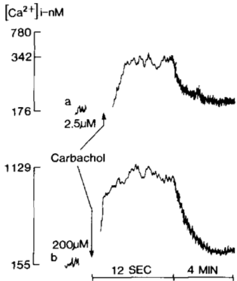
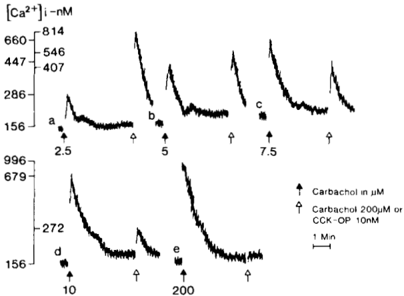
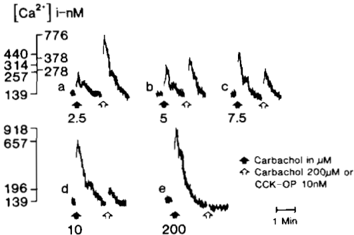
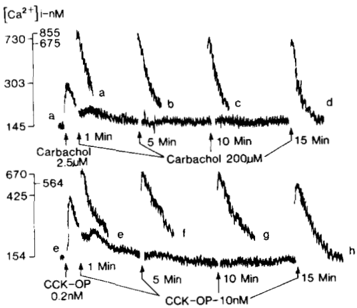
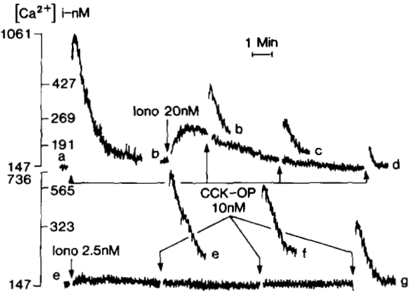
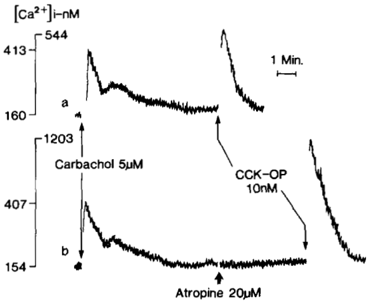
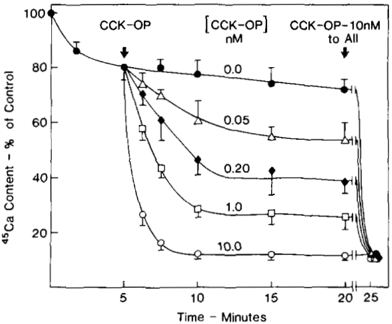
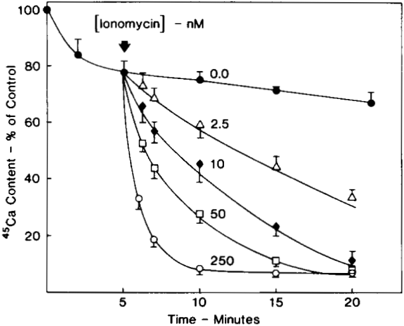
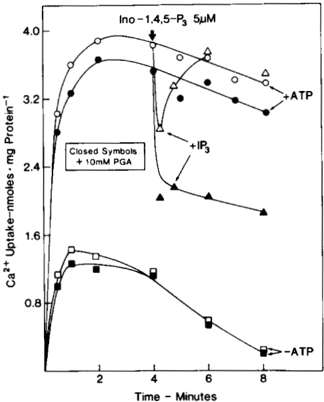
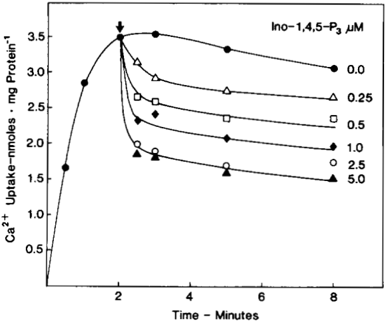
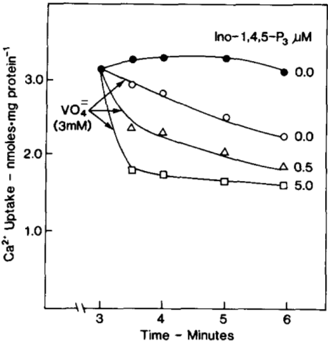
Ca2+ mobilization by hormones, ionomycin, and inositol 1,4,5-trisphosphate (Ins-1,4,5-P3) were studied to determine whether Ca2+ release is a continuous or a quantal process. Hormone-mediated Ca2+ release occurs only during the first 2-4 s of stimulation. Stimulation of acini with a maximal hormone concentration following stimulation with a submaximal concentration resulted in free cytosolic Ca2+ concentration ([Ca2+]i) increase and 45Ca efflux. The peak [Ca2+]i increase induced by a maximal concentration of agonist was nearly constant when cells were prestimulated with a submaximal dose for 1-15 min. Submaximal hormone concentrations release only a fraction of intracellular 45Ca2+, after which intracellular Ca2+ content remains constant. The partially released stores remain depleted until cell stimulation is terminated, at which time the stores reload with Ca2+. For comparison, increasing concentrations of ionomycin resulted in increasing rates of Ca2+ release. Each ionomycin concentration released all the Ca2+ from intracellular stores. We therefore conclude that hormone-evoked Ca2+ release is a quantal rather than a continuous process. In permeabilized cells, increasing concentrations of Ins-1,4,5-P3 resulted in an increased fraction of Ca2+ release. No submaximal Ins-1,4,5-P3 concentration was capable of releasing all the Ins-1,4,5-P3-mobilizable Ca2+. Therefore, it appears that the quantal properties of hormone-evoked Ca2+ release reflect the quantal properties of Ins-1,4,5-P3-mediated Ca2+ release from intracellular stores.
Overview
The claims and statistics of this paper haven’t been checked yet.
Free: it reads the open-access text and checks the first 5 claims that cite a source we can check. Create a free account to check every claim.
Integrity signals
Registry
Cites
Statistics
Figures
Verification
Claims the paper makes
The claims and statistics of this paper haven’t been checked yet.
Free: it reads the open-access text and checks the first 5 claims that cite a source we can check. Create a free account to check every claim.
Claims other papers make about this one
Each is checked against this paper’s own text: does it say what the citing paper says it does?
The source backs part of the claim, not all of it — or backs it for a different population, condition or comparison.
In the citing paper
“Moreover, the ER Ca2+ release mediated by cholinergic signaling occurred in a quantal manner: a submaximal concentration of cholinergic agonist rapidly released a fraction of the ER Ca2+ store, followed by a slower or terminated Ca2+ release56,57.”
From Tumor-specific cholinergic CD4+ T lymphocytes guide immunosurveillance of hepatocellular carcinoma (2023) · cites this paper as [56]
Experimental — accuracy not yet measuredThe cited source says what the claim attributes to it.
In the citing paper
“During persistent submaximal cholinergic stimulation, the ER Ca2+ release elicited by other IP3-dependent agonists is dampened56.”
From Tumor-specific cholinergic CD4+ T lymphocytes guide immunosurveillance of hepatocellular carcinoma (2023) · cites this paper as [56]
Self-check
Percentages, sums and reported differences re-computed from the paper’s own numbers.
The self-check needs the paper’s full text.
Citations
Cites
A new generation of Ca2+ indicators with greatly improved fluorescence properties.
Grynkiewicz, G., Poenie, M., & Tsien, R. Y. (1985) · Journal of Biological Chemistry · doi:10.1016/s0021-9258(19)83641-4 · Cited by 21,607
INOSITOL TRISPHOSPHATE AND DIACYLGLYCEROL: TWO INTERACTING SECOND MESSENGERS
Berridge, M. J. (1987) · Annual Review of Biochemistry · doi:10.1146/annurev.bi.56.070187.001111 · Cited by 3,285
The Metabolism of Phosphoinositide-Derived Messenger Molecules
Majerus, P. W., Connolly, T. M., Deckmyn, H., Ross, T. S., Bross, T. E., Ishii, H., Bansal, V. S., & Wilson, D. B. (1986) · Science · doi:10.1126/science.3024320 · Cited by 715
Involvement of guanine nucleotide-binding protein in the gating of Ca2+ by receptors
Gomperts, B. D. (1983) · Nature · doi:10.1038/306064a0 · Cited by 466
Volpe, P., Krause, K. H., Hashimoto, S., Zorzato, F., Pozzan, T., Meldolesi, J., & Lew, D. P. (1988) · Proceedings of the National Academy of Sciences · doi:10.1073/pnas.85.4.1091 · Cited by 452
Metabolism of inositol 1,4,5-trisphosphate and inositol 1,3,4-trisphosphate in rat parotid glands
Irvine, R. F., Anggård, E. E., Letcher, A. J., & Downes, C. P. (1985) · Biochemical Journal · doi:10.1042/bj2290505 · Cited by 450
Inositol trisphosphate and diacylglycerol as intracellular second messengers in liver
Williamson, J. R., Cooper, R. H., Joseph, S. K., & Thomas, A. P. (1985) · American Journal of Physiology-Cell Physiology · doi:10.1152/ajpcell.1985.248.3.c203 · Cited by 421
Korchak, H. M., Vienne, K., Rutherford, L. E., Wilkenfeld, C., Finkelstein, M. C., & Weissmann, G. (1984) · Journal of Biological Chemistry · doi:10.1016/s0021-9258(17)43011-0 · Cited by 268
Regulation of cytosolic free calcium in fura-2-loaded rat parotid acinar cells.
Merritt, J. E., & Rink, T. J. (1987) · Journal of Biological Chemistry · doi:10.1016/s0021-9258(18)45386-0 · Cited by 246
Specificity of inositol phosphate-stimulated Ca2+ mobilization from Swiss-mouse 3T3 cells
Irvine, R. F., Letcher, A. J., Lander, D. J., & Berridge, M. J. (1986) · Biochemical Journal · doi:10.1042/bj2400301 · Cited by 191
Research works printed but not linked: 7
- Ochs, D. L., Korenbrot, J. I., and Williams, J. A. (1985) Am. J. Physiol. 2 4 9 , G389-G398
- Dormer, R. L., Paulsen, J. H., Licko, W., and Williams, J. A. (1981) Am. J. Physiol. 2 4 0 , G38-G43
- Muallem, S., Pandol, S. J., and Beeker, T. G. (1988) Biochem. J. 39. Leslie, B. A., Burgess, G. M., and Putney, J. W., Jr. (1988) Cell
- Muallem, 1988, Am. J. Physiol., 255, G229
- Muallem, 1988, Am. J. Physiol., 255, G221
- Muallem, S. (1985) Am. J. Physiol. 248, G551-G560 Biol. 102,153-162 in Calcium and Cell Function (Cheung, W. Y., ed), Vol. 4, pp.
- McLennan, 1983, Vol. 4, 151
Cited by
Inositol trisphosphate and calcium signalling
Berridge, M. J. (1993) · Nature · doi:10.1038/361315a0 · Cited by 6,545
Inositol Trisphosphate Receptor Ca2+Release Channels
Foskett, J. K., White, C., Cheung, K.-H., & Mak, D.-O. D. (2007) · Physiological Reviews · doi:10.1152/physrev.00035.2006 · Cited by 1,188
‘Quanta’ Ca2+ release and the control of Ca2+ entry by inositol phosphates ‐ a possible mechanism
Irvine, R. F. (1990) · FEBS Letters · doi:10.1016/0014-5793(90)80692-c · Cited by 739
Berridge, M. J. (1990) · Journal of Biological Chemistry · doi:10.1016/s0021-9258(19)38704-6 · Cited by 601
Quasi-synaptic calcium signal transmission between endoplasmic reticulum and mitochondria
Csordas, G. (1999) · The EMBO Journal · doi:10.1093/emboj/18.1.96 · Cited by 540
The Inositol Phosphate-Calcium Signaling System in Nonexcitable Cells
PUTNEY, J. W., & BIRD, G. S. J. (1993) · Endocrine Reviews · doi:10.1210/edrv-14-5-610 · Cited by 502
The elemental principles of calcium signaling
Bootman, M. D., & Berridge, M. J. (1995) · Cell · doi:10.1016/0092-8674(95)90179-5 · Cited by 454
Petersen, O. H. (1992) · The Journal of Physiology · doi:10.1113/jphysiol.1992.sp019028 · Cited by 436
Spontaneous calcium release from inositol trisphosphate-sensitive calcium stores
Missiaen, L., Taylor, C. W., & Berridge, M. J. (1991) · Nature · doi:10.1038/352241a0 · Cited by 361
Quantal puffs of intracellular Ca2+ evoked by inositol trisphosphate in Xenopus oocytes.
Yao, Y., Choi, J., & Parker, I. (1995) · The Journal of Physiology · doi:10.1113/jphysiol.1995.sp020538 · Cited by 346
Reading the patterns in living cells —the physics of ca2+signaling
Falcke, M. (2004) · Advances in Physics · doi:10.1080/00018730410001703159 · Cited by 331
Ryanodine Receptor Adaptation: Control Mechanism of Ca 2+ -Induced Ca 2+ Release in Heart
Györke, S., & Fill, M. (1993) · Science · doi:10.1126/science.8387229 · Cited by 325
IP3 Receptors: Toward Understanding Their Activation
Taylor, C. W., & Tovey, S. C. (2010) · Cold Spring Harbor Perspectives in Biology · doi:10.1101/cshperspect.a004010 · Cited by 301
Polarized Expression of Ca2+ Channels in Pancreatic and Salivary Gland Cells
Lee, M. G., Xu, X., Zeng, W., Diaz, J., Wojcikiewicz, R. J. H., Kuo, T. H., Wuytack, F., Racymaekers, L., & Muallem, S. (1997) · Journal of Biological Chemistry · doi:10.1074/jbc.272.25.15765 · Cited by 293
Self-citationMissiaen, L., De Smedt, H., Droogmans, G., & Casteels, R. (1992) · Nature · doi:10.1038/357599a0 · Cited by 260
Henzi, V., & MacDermott, A. B. (1992) · Neuroscience · doi:10.1016/0306-4522(92)90049-8 · Cited by 250
KURIYAMA, H., KITAMURA, K., ITOH, T., & INOUE, R. (1998) · Physiological Reviews · doi:10.1152/physrev.1998.78.3.811 · Cited by 245
Park, M. K. (2000) · The EMBO Journal · doi:10.1093/emboj/19.21.5729 · Cited by 239
Calcium-Induced Restructuring of Nuclear Envelope and Endoplasmic Reticulum Calcium Stores
Subramanian, K., & Meyer, T. (1997) · Cell · doi:10.1016/s0092-8674(00)80281-0 · Cited by 236
Elementary events of InsP3-induced Ca2+ liberation in Xenopus oocytes: hot spots, puffs and blips
Parker, I., Choi, J., & Yao, Y. (1996) · Cell Calcium · doi:10.1016/s0143-4160(96)90100-1 · Cited by 233
(1991) · Proceedings of the Royal Society of London. Series B: Biological Sciences · doi:10.1098/rspb.1991.0154 · Cited by 223
Local Control Model of Excitation–Contraction Coupling in Skeletal Muscle
Stern, M. D., Pizarro, G., & Ríos, E. (1997) · The Journal of General Physiology · doi:10.1085/jgp.110.4.415 · Cited by 218
Bezprozvanny, I., & Ehrlich, B. E. (1994) · The Journal of general physiology · doi:10.1085/jgp.104.5.821 · Cited by 212
Localized All-or-None Calcium Liberation by Inositol Trisphosphate
Parker, I., & Ivorra, I. (1990) · Science · doi:10.1126/science.2237441 · Cited by 199
Calcium oscillations in electrically non-excitable cells
Jacob, R. (1990) · Biochimica et Biophysica Acta (BBA) - Molecular Cell Research · doi:10.1016/0167-4889(90)90152-4 · Cited by 187
Polarized Expression of Ca2+ Pumps in Pancreatic and Salivary Gland Cells
Lee, M. G., Xu, X., Zeng, W., Diaz, J., Kuo, T. H., Wuytack, F., Racymaekers, L., & Muallem, S. (1997) · Journal of Biological Chemistry · doi:10.1074/jbc.272.25.15771 · Cited by 186
Self-citationTransient calcium release induced by successive increments of inositol 1,4,5-trisphosphate.
Meyer, T., & Stryer, L. (1990) · Proceedings of the National Academy of Sciences · doi:10.1073/pnas.87.10.3841 · Cited by 177
Cytoplasmic calcium oscillations: A two pool model
Berridge, M. J. (1991) · Cell Calcium · doi:10.1016/0143-4160(91)90009-4 · Cited by 176
De Smedt, H., Missiaen, L., Parys, J. B., Bootman, M. D., Mertens, L., Van Den Bosch, L., & Casteels, R. (1994) · Journal of Biological Chemistry · doi:10.1016/s0021-9258(17)31861-6 · Cited by 172
The inositol trisphosphate calcium channel is inactivated by inositol trisphosphate
Hajnóczky, G., & Thomas, A. P. (1994) · Nature · doi:10.1038/370474a0 · Cited by 161
Mak, D. D., & Foskett, J. K. (1997) · The Journal of General Physiology · doi:10.1085/jgp.109.5.571 · Cited by 151
The endoplasmic reticulum: one continuous or several separate Ca2+ stores?
Petersen, O. H., Tepikin, A. V., & Park, M. K. (2001) · Trends in Neurosciences · doi:10.1016/s0166-2236(00)01787-2 · Cited by 156
Structure and function of inositol triphosphate receptors
Taylor, C. W., & Richardson, A. (1991) · Pharmacology & Therapeutics · doi:10.1016/0163-7258(91)90043-l · Cited by 167
Critical Regions for Activation Gating of the Inositol 1,4,5-Trisphosphate Receptor
Uchida, K., Miyauchi, H., Furuichi, T., Michikawa, T., & Mikoshiba, K. (2003) · Journal of Biological Chemistry · doi:10.1074/jbc.m300646200 · Cited by 164
Ito, K., Miyashita, Y., & Kasai, H. (1997) · The EMBO Journal · doi:10.1093/emboj/16.2.242 · Cited by 147
Choe, C.-U., & Ehrlich, B. E. (2006) · Science s STKE · doi:10.1126/stke.3632006re15 · Cited by 147
Quantal calcium release by purified reconstituted inositol 1,4,5-trisphosphate receptors
Ferris, C. D., Cameron, A. M., Huganir, R. L., & Snyder, S. H. (1992) · Nature · doi:10.1038/356350a0 · Cited by 135
Joseph, S. K., Lin, C., Pierson, S., Thomas, A. P., & Maranto, A. R. (1995) · Journal of Biological Chemistry · doi:10.1074/jbc.270.40.23310 · Cited by 129
Sullivan, K. M. C., Busa, W. B., & Wilson, K. L. (1993) · Cell · doi:10.1016/0092-8674(93)90366-x · Cited by 142
Quantal Ca2+ mobilization stimulated by inositol 1,4,5-trisphosphate in permeabilized hepatocytes
Oldershaw, K. A., Nunn, D. L., & Taylor, C. W. (1991) · Biochemical Journal · doi:10.1042/bj2780705 · Cited by 125
Bootman, M. D., Berridge, M. J., & Taylor, C. W. (1992) · The Journal of Physiology · doi:10.1113/jphysiol.1992.sp019121 · Cited by 125
Irvine, R. F. (1991) · BioEssays · doi:10.1002/bies.950130810 · Cited by 130
Inositol 1,4,5-Trisphosphate and Its Receptors
Parys, J. B., & SMEDT, H. D. (2012) · Advances in experimental medicine and biology · doi:10.1007/978-94-007-2888-2_11 · Cited by 139
Calcium and inositol 1,4,5-triphosphate receptors: a complex relationship
Taylor, C. W., & Marshall, I. C. B. (1992) · Trends in Biochemical Sciences · doi:10.1016/0968-0004(92)90009-x · Cited by 116
Champeil, P., Combettes, L., BERTHON, B., Doucet, E., Orlowski, S., & Claret, M. (1989) · Journal of Biological Chemistry · doi:10.1016/s0021-9258(19)84623-9 · Cited by 121
Matsu-ura, T., Michikawa, T., Inoue, T., Miyawaki, A., Yoshida, M., & Mikoshiba, K. (2006) · The Journal of Cell Biology · doi:10.1083/jcb.200512141 · Cited by 112
Grierson, J. P., & Meldolesi, J. (1995) · Journal of Biological Chemistry · doi:10.1074/jbc.270.9.4451 · Cited by 113
Taylor, C. W., & Potter, B. V. L. (1990) · Biochemical Journal · doi:10.1042/bj2660189 · Cited by 113
Heterogeneity of channel density in inositol-1,4,5-trisphosphate-sensitive Ca2+ stores
Hirose, K., & lino, M. (1994) · Nature · doi:10.1038/372791a0 · Cited by 112
Yoo, S. H., & Albanesi, J. P. (1990) · Journal of Biological Chemistry · doi:10.1016/s0021-9258(18)77367-5 · Cited by 115
Calcium ion homeostasis in smooth muscle
Missiaen, L., SMEDT, H. D., Droogmans, G., Himpens, B., & Casteels, R. (1992) · Pharmacology & Therapeutics · doi:10.1016/0163-7258(92)90017-t · Cited by 128
Brown, G. R., Sayers, L. G., Kirk, C. J., Michell, R. H., & Michelangeli, F. (1992) · Biochemical Journal · doi:10.1042/bj2820309 · Cited by 111
Hierarchical organization of calcium signals in hepatocytes: from experiments to models
Dupont, G., Swillens, S., Clair, C., Tordjmann, T., & Combettes, L. (2000) · Biochimica et Biophysica Acta (BBA) - Molecular Cell Research · doi:10.1016/s0167-4889(00)00090-2 · Cited by 107
Regulation of Calcium in Salivary Gland Secretion
Ambudkar, I. S. (2000) · Critical Reviews in Oral Biology & Medicine · doi:10.1177/10454411000110010301 · Cited by 118
Mechanisms involved in the cellular calcium homeostasis in vascular smooth muscle: Calcium pumps
Marín, J., Encabo, A., Briones, A. M., García-Cohen, E. C., & Alonso, M. J. (1998) · Life Sciences · doi:10.1016/s0024-3205(98)00393-2 · Cited by 138
The Heterogeneity of ER Ca2+ Stores Has a Key Role in Nonmuscle Cell Signaling and Function
Meldolesi, J., & Pozzan, T. (1998) · The Journal of Cell Biology · doi:10.1083/jcb.142.6.1395 · Cited by 108
Tanimura, A., Nezu, A., Morita, T., Turner, R. J., & Tojyo, Y. (2004) · Journal of Biological Chemistry · doi:10.1074/jbc.c400312200 · Cited by 110
Parys, J. B., Missiaen, L., SMEDT, H. D., & Casteels, R. (1993) · Journal of Biological Chemistry · doi:10.1016/s0021-9258(19)74589-x · Cited by 103
Sorting of calcium signals at the junctions of endoplasmic reticulum and mitochondria
Csordás, G., & Hajnóczky, G. (2001) · Cell Calcium · doi:10.1054/ceca.2000.0191 · Cited by 105
Yang, L., Rhee, S. G., & WILLIAMSON, J. R. (1994) · Journal of Biological Chemistry · doi:10.1016/s0021-9258(17)37261-7 · Cited by 107
The biological relevance of the binding of calcium ions by inositol phosphates.
Luttrell, B. M. (1993) · Journal of Biological Chemistry · doi:10.1016/s0021-9258(18)53883-7 · Cited by 105
Signalling specificity in GPCR-dependent Ca2+ signalling
Kiselyov, K. I., Shin, D. M., & Muallem, S. (2003) · Cellular Signalling · doi:10.1016/s0898-6568(02)00074-8 · Cited by 114
Self-citationCalcium-dependent Clustering of Inositol 1,4,5-Trisphosphate Receptors
Wilson, B. S., Pfeiffer, J. R., Smith, A. J., Oliver, J. M., Oberdorf, J. A., & Wojcikiewicz, R. J. H. (1998) · Molecular Biology of the Cell · doi:10.1091/mbc.9.6.1465 · Cited by 108
Luminal Ca2+ controls the activation of the inositol 1,4,5-trisphosphate receptor by cytosolic Ca2+
Missiaen, L., SMEDT, H. D., Droogmans, G., & Casteels, R. (1992) · Journal of Biological Chemistry · doi:10.1016/s0021-9258(18)50041-7 · Cited by 92
Inositol 1,4,5-trisphosphate receptors in the endoplasmic reticulum: A single-channel point of view
Mak, D.-O. D., & Foskett, J. K. (2015) · Cell Calcium · doi:10.1016/j.ceca.2014.12.008 · Cited by 90
Hajnóczky, G., Gao, E., Nomura, T., Hoek, J. B., & Thomas, A. P. (1993) · Biochemical Journal · doi:10.1042/bj2930413 · Cited by 89
Calcium and inositol trisphosphate receptors
Taylor, C. W., & Traynor, D. (1995) · The Journal of Membrane Biology · doi:10.1007/bf00237369 · Cited by 104
Jha, A., Chung, W. Y., Vachel, L., Maléth, J., Lake, S., Zhang, G., Ahuja, M., & Muallem, S. (2019) · The EMBO Journal · doi:10.15252/embj.2018101452 · Cited by 98
Self-citationIino, M., Yamazawa, T., Miyashita, Y., Endo, M., & Kasai, H. (1993) · The EMBO Journal · doi:10.1002/j.1460-2075.1993.tb06224.x · Cited by 87
Renard‐Rooney, D. C., Hajnóczky, G., Seitz, M. B., Schneider, T. G., & Thomas, A. P. (1993) · Journal of Biological Chemistry · doi:10.1016/s0021-9258(19)49505-7 · Cited by 86
Brooks, R. C., McCarthy, K. D., Lapetina, E. G., & Morell, P. (1989) · Journal of Biological Chemistry · doi:10.1016/s0021-9258(19)47230-x · Cited by 86
Quantal Ca2+ release from caffeine-sensitive stores in adrenal chromaffin cells.
Cheek, T. R., Moreton, R. B., Berridge, M. J., Stauderman, K. A., Murawsky, M., & Bootman, M. D. (1993) · Journal of Biological Chemistry · doi:10.1016/s0021-9258(19)74220-3 · Cited by 85
Short, A. D., Klein, M. G., Schneider, M. F., & Gill, D. L. (1993) · Journal of Biological Chemistry · doi:10.1016/s0021-9258(19)74470-6 · Cited by 83
Kaplin, A. I., Ferris, C. D., Voglmaier, S. M., & Snyder, S. H. (1994) · Journal of Biological Chemistry · doi:10.1016/s0021-9258(19)62001-6 · Cited by 83
Models of the inositol trisphosphate receptor
Sneyd, J., & Falcke, M. (2004) · Progress in Biophysics and Molecular Biology · doi:10.1016/j.pbiomolbio.2004.11.001 · Cited by 98
Luminal communication between intracellular calcium stores modulated by GTP and the cytoskeleton.
Hajnóczky, G., Lin, C., & Thomas, A. P. (1994) · Journal of Biological Chemistry · doi:10.1016/s0021-9258(17)34058-9 · Cited by 80
Misra, U. K., Chu, C. T., Rubenstein, D. S., Gawdi, G., & Pizzo, S. V. (1993) · Biochemical Journal · doi:10.1042/bj2900885 · Cited by 78
Calcium pools, calcium entry, and cell growth
Gill, D. L., Waldron, R. T., Rys‐Sikora, K. E., Ufret-Vincenty, C. A., Graber, M. N., Favre, C., & Alfonso, A. (1996) · Bioscience Reports · doi:10.1007/bf01206203 · Cited by 77
Sayers, L. G., Brown, G. R., Michell, R. H., & Michelangeli, F. (1993) · Biochemical Journal · doi:10.1042/bj2890883 · Cited by 77
Arora, P. D., Bibby, K. J., & McCulloch, C. A. G. (1994) · Journal of Cellular Physiology · doi:10.1002/jcp.1041610202 · Cited by 76
Tumor-specific cholinergic CD4+ T lymphocytes guide immunosurveillance of hepatocellular carcinoma
Zheng, C., Snow, B. E., Elia, A. J., Nechanitzky, R., Dominguez-Brauer, C., Liu, S., Tong, Y., Cox, M. A., Focaccia, E., Wakeham, A. C., et al. (2023) · Nature Cancer · doi:10.1038/s43018-023-00624-w · Cited by 75
Luminal Ca2+ increases the affinity of inositol 1,4,5-trisphosphate for its receptor
Oldershaw, K. A., & Taylor, C. W. (1993) · Biochemical Journal · doi:10.1042/bj2920631 · Cited by 75
Receptor-operated Ca2+ signaling and crosstalk in stimulus secretion coupling
Tsunoda, Y. (1993) · Biochimica et Biophysica Acta (BBA) - Reviews on Biomembranes · doi:10.1016/0304-4157(93)90008-c · Cited by 90
Inositol 1,4,5-trisphosphate-induced Ca2+ release is inhibited by mitochondrial depolarization
COLLINS, T. J., Lipp, P., Berridge, M. J., Wenhong, L. I., & Bootman, M. D. (2000) · Biochemical Journal · doi:10.1042/0264-6021:3470593 · Cited by 81
Wojcikiewicz, R. J., & Nahorski, S. R. (1991) · Journal of Biological Chemistry · doi:10.1016/s0021-9258(18)54559-2 · Cited by 72
Ca2+ release from inositol trisphosphate-sensitive stores is not modulated by intraluminal [Ca2+].
Shuttleworth, T. J. (1992) · Journal of Biological Chemistry · doi:10.1016/s0021-9258(19)50561-0 · Cited by 70
Elementary events of agonist-induced Ca2+ release in vascular endothelial cells
Hüser, J., & Blatter, L. A. (1997) · American Journal of Physiology-Cell Physiology · doi:10.1152/ajpcell.1997.273.5.c1775 · Cited by 69
Erxleben, C. F. J., Klauke, N., Floetenmeyer, M., Blanchard, M., Braun, C., & Plattner, H. (1997) · The Journal of Cell Biology · doi:10.1083/jcb.136.3.597 · Cited by 76
Yoo, S. H., & Lewis, M. S. (1996) · Journal of Biological Chemistry · doi:10.1074/jbc.271.29.17041 · Cited by 72
Ogura, A., Myojo, Y., & Higashida, H. (1990) · Journal of Biological Chemistry · doi:10.1016/s0021-9258(19)39808-4 · Cited by 67
Consequences of Functional Expression of the Plasma Membrane Ca2+ Pump Isoform 1a
Liu, B.-F., Xu, X., Fridman, R. A., Muallem, S., & Kuo, T. H. (1996) · Journal of Biological Chemistry · doi:10.1074/jbc.271.10.5536 · Cited by 67
Self-citationPhasic characteristic of elementary Ca2+ release sites underlies quantal responses to IP3
Callamaras, N., & Parker, I. (2000) · The EMBO Journal · doi:10.1093/emboj/19.14.3608 · Cited by 66
NASH, M. S., Young, K. W., Willars, G. B., Challiss, R. A. J., & Nahorski, S. R. (2001) · Biochemical Journal · doi:10.1042/0264-6021:3560137 · Cited by 71
Somlyo, A. V., Horiuti, K., Trentham, D. R., Kitazawa, T., & Somlyo, A. P. (1992) · Journal of Biological Chemistry · doi:10.1016/s0021-9258(18)41672-9 · Cited by 66
Mak, D. D., Pearson, J. E., Loong, K. P. C., Datta, S., Fernández‐Mongil, M., & Foskett, J. K. (2007) · EMBO Reports · doi:10.1038/sj.embor.7401087 · Cited by 66
Spacial Compartmentalization of Ca2+ Signaling Complexes in Pancreatic Acini
Xu, X., Zeng, W., Diaz, J., & Muallem, S. (1996) · Journal of Biological Chemistry · doi:10.1074/jbc.271.40.24684 · Cited by 63
Self-citationMarchant, J. S., & Taylor, C. W. (1998) · Biochemistry · doi:10.1021/bi980808k · Cited by 63
Tanimura, A., & Turner, R. J. (1996) · The Journal of Cell Biology · doi:10.1083/jcb.132.4.607 · Cited by 62
Smoothly graded Ca2+ release from inositol 1,4,5-trisphosphate-sensitive Ca2+ stores.
Bootman, M. D., Cheek, T. R., Moreton, R. B., Bennett, D. L., & Berridge, M. J. (1994) · Journal of Biological Chemistry · doi:10.1016/s0021-9258(17)31460-6 · Cited by 62
Ionescu, L., Cheung, K., Vais, H., Mak, D. D., White, C., & Foskett, J. K. (2006) · The Journal of Physiology · doi:10.1113/jphysiol.2006.109504 · Cited by 61
Metadata
- Authors
- Muallem, S., Pandol, S. J., & Beeker, T. G.
- Affiliations
- Cedars-Sinai Medical Center (US)
- Venue
- Journal of Biological Chemistry
- Publisher
- Elsevier BV
- Published
- 1989-01
- Volume
- 264
- Issue
- 1
- Pages
- 205-212
- ISSN
- 0021-9258 (ISSN-L)
- OpenAlex
- W1555351713
- Cited by
- 307
- References
- 36
- Citations by year
- 2026: 1 · 2025: 1 · 2024: 1 · 2023: 1 · 2021: 1 · 2019: 1 · 2016: 1 · 2015: 1 · 2014: 2 · 2013: 4 · 2012: 2
- FWCI
- 12.57
- Type
- journal article
- Language
- en
- Open access
- hybrid
- doi.org
- Licence
- cc-by
- www.elsevier.com/tdm/userlicense/1.0/ (tdm)
- www.elsevier.com/legal/tdmrep-license (tdm)
- creativecommons.org/licenses/by/4.0/ (vor, 11627 d)
- Locations
- Journal of Biological Chemistry (publishedVersion, cc-by)
- PubMed (publishedVersion)
- Funders
- National Institute of Diabetes and Digestive and Kidney Diseases (DK 38938, DK33010)
- Topics
- Life Sciences › Biochemistry, Genetics and Molecular Biology › Physiology › Calcium signaling and nucleotide metabolism
- Life Sciences › Neuroscience › Sensory Systems › Ion Channels and Receptors
- Life Sciences › Biochemistry, Genetics and Molecular Biology › Molecular Biology › Ion channel regulation and function
- Keywords
- quantal release, intracellular calcium stores, inositol 1,4,5-trisphosphate, ionomycin, intracellular calcium, pancreatic acini, calcium efflux
- MeSH terms
- Animals, Atropine, Calcium, Carbachol, Ethers, Inositol Phosphates, Kinetics, Pancreas, Rats, Inbred Strains, Sincalide, Inositol 1,4,5-Trisphosphate, Ionomycin, Rats, In Vitro Techniques
About these checks
Registry, retraction, Cites and statistics results are computed, not judged, with one exception: a printed reference that no index lists is read once by a model before it counts as a citation error. Claims are extracted by a model and kept only when their quote appears verbatim in the text; each cited source is then checked, with a model’s help, for whether it says what the claim relies on. Those verdicts can be wrong — read the claim’s quote and the cited source before relying on one.
Statistics and arithmetic are recomputed, not judged.
Confidence bands are shown only for fields calibrated on our annotated test set. None is calibrated yet, so no band is shown.
What counts as a claim ›How we measure confidence ›How we check this ›
Are you an author, or do you see a problem with this page? Request a review
Data sources
Bibliographic data: Semantic Scholar, OpenAlex, Crossref.
Contains information from the Semantic Scholar Academic Graph Datasets, made available under the ODC Attribution License (ODC-BY 1.0).
Semantic Scholar’s data is described in: Kinney, R., et al. (2023). The Semantic Scholar Open Data Platform. arXiv:2301.10140.
