

Ganglioside-mediated modulation of cell growth. Specific effects of GM3 on tyrosine phosphorylation of the epidermal growth factor receptor
Open accessThe DOI matches its Crossref record; 62 of the 62 references it cites were found in a registry or an index.
Abstract
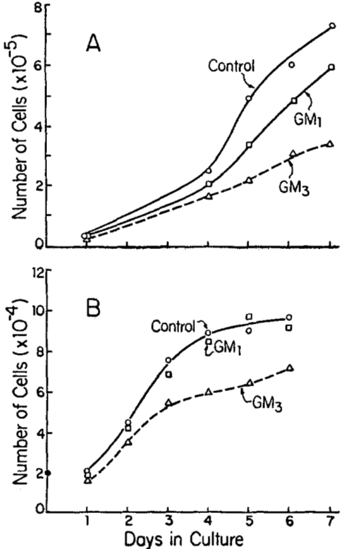
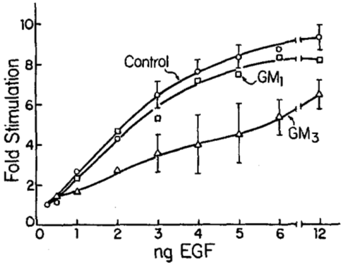
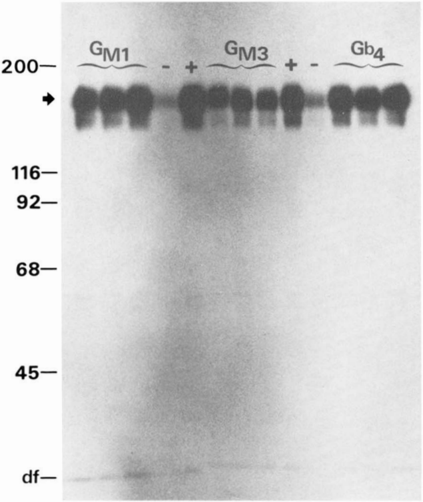
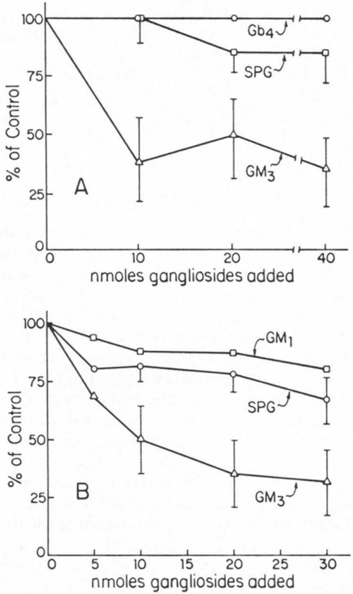
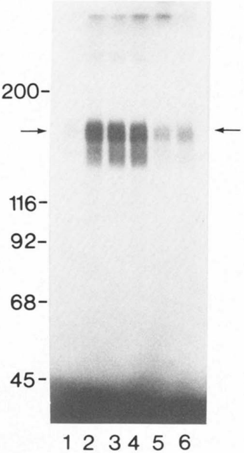
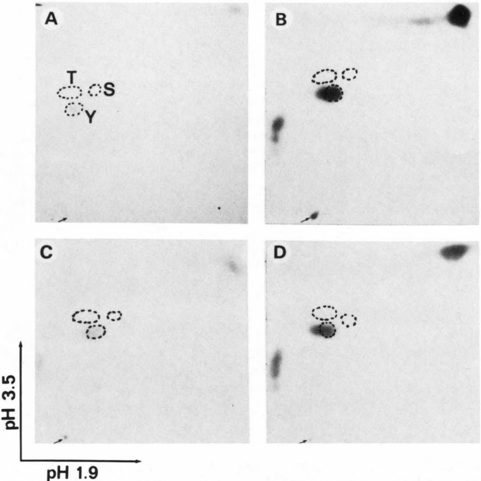
Epidermal growth factor- (EGF) dependent tyrosine phosphorylation of the EGF receptor was inhibited by the exogenous addition of GM3 to a membrane preparation and to purified EGF receptor adsorbed to antireceptor-antibody-Sepharose (Bremer, E. G., Schlessinger, J., and Hakomori, S. (1986) J. Biol. Chem. 261, 2434-2440). A specific functional correlation between GM3 and EGF receptor function has been further assessed in this study, employing two variant clones of A431 cells showing completely different growth responses to EGF. The A1S clone showed EGF cell growth stimulation and contained GM3 whereas the A5I clone, whose growth was completely inhibited by EGF addition, lacked detectable GM3. Both the endogenous and EGF-dependent receptor tyrosine-kinase activities were low in the A1S clone and were only minimally inhibited by the exogenous addition of GM3. In contrast the EGF receptor kinase activity in A5I cells was much higher and was more strongly inhibited by GM3 than it was in A1S cells. The EGF receptor fraction prepared from A1S cells, eluted from an anti-EGF receptor antibody-Sepharose column, contained GM3, in contrast to the fraction prepared from A5I cells, which lacked detectable GM3. The receptor kinase activity in vitro was greatly influenced by detergent and ATP concentration. GM3 affected the receptor kinase in a biphasic manner, i.e. GM3 was inhibitory at a low concentration of detergent under a physiological concentration of ATP and stimulatory at a high concentration of detergent. In contrast lyso-GM3 displayed a monophasic inhibitory effect under a wide range of detergent concentrations. Lyso-CDH (lactosylsphingosine) had no detectable effect on the receptor kinase activity. The presence of a small quantity of lyso-GM3 in A431 cells was detected after DEAE-Sepharose chromatography followed by high performance liquid chromatography in a n-propanolyl alcohol-ammonia system. It is possible that de-N-fatty acylation of gangliosides could be an effective means to modulate EGF receptor function in membranes.
Overview
The claims and statistics of this paper haven’t been checked yet.
Free: it reads the open-access text and checks the first 5 claims that cite a source we can check. Create a free account to check every claim.
Integrity signals
Registry
Cites
Statistics
Figures
Verification
Claims the paper makes
The claims and statistics of this paper haven’t been checked yet.
Free: it reads the open-access text and checks the first 5 claims that cite a source we can check. Create a free account to check every claim.
Claims other papers make about this one
Each is checked against this paper’s own text: does it say what the citing paper says it does?
The source backs part of the claim, not all of it — or backs it for a different population, condition or comparison.
In the citing paper
“For example, subtly different forms of the sialylated ganglioside GM3 can have differential effects on tyrosine kinase signaling of the EGF receptor (517 -522)”
From Biological roles of glycans (2017) · cites this paper as [517]
Experimental — accuracy not yet measured
Self-check
Percentages, sums and reported differences re-computed from the paper’s own numbers.
The self-check needs the paper’s full text.
Citations
Cites
Cleavage of Structural Proteins during the Assembly of the Head of Bacteriophage T4
LAEMMLI, U. K. (1970) · Nature · doi:10.1038/227680a0 · Cited by 249,961
Protein Purification by Affinity Chromatography
Cuatrecasas, P. (1970) · Journal of Biological Chemistry · doi:10.1016/s0021-9258(18)63022-4 · Cited by 2,796
Quantitive estimation of sialic acids
Svennerholm, L. (1957) · Biochimica et Biophysica Acta · doi:10.1016/0006-3002(57)90254-8 · Cited by 2,765
Udenfriend, S., Stein, S., Böhlen, P., Dairman, W., Leimgruber, W., & Weigele, M. (1972) · Science · doi:10.1126/science.178.4063.871 · Cited by 2,649
A simple, specific spray for the detection of phospholipids on thin-layer chromatograms
Dittmer, J. C., & Lester, R. L. (1964) · Journal of Lipid Research · doi:10.1016/s0022-2275(20)40272-x · Cited by 2,149
CHROMATOGRAPHlC SEPARATION OF HUMAN BRAIN GANGLIOSIDES*
Svennerholm, L. (1963) · Journal of Neurochemistry · doi:10.1111/j.1471-4159.1963.tb08933.x · Cited by 1,643
Hannun, Y. A., Loomis, C. R., Merrill, A. H., & Bell, R. M. (1986) · Journal of Biological Chemistry · doi:10.1016/s0021-9258(18)67133-9 · Cited by 1,156
[42] Detection and quantification of phosphotyrosine in proteins
Cooper, J. A., Sefton, B. M., & Hunter, T. (1983) · Methods in Enzymology · doi:10.1016/0076-6879(83)99075-4 · Cited by 1,142
Cohen, S., Carpenter, G., & King, L. (1980) · Journal of Biological Chemistry · doi:10.1016/s0021-9258(19)85573-4 · Cited by 858
Bretscher, M. S. (1973) · Science · doi:10.1126/science.181.4100.622 · Cited by 846
Research works printed but not linked: 2
- Klenk, E., and Heuer, K. (1960) Z. Verdauungs Stoffwechselkran- kheiten 20,180-183
- Buss, J. E., Kudlow, J. E., Lazar, C. S., and Gill, G. N. (1982) Proc. Natl. Acad. Sci. U. S. A. 79,2574-2578
Cited by
Items 101–200 of 705
A crucial role of plasma membrane-associated sialidase in the survival of human cancer cells
Wada, T., Hata, K., Yamaguchi, K., Shiozaki, K., Koseki, K., Moriya, S., & Miyagi, T. (2007) · Oncogene · doi:10.1038/sj.onc.1210341 · Cited by 108
Immunonutrition: role of biosurfactants, fiber, and probiotic bacteria
Bengmark, S. (1998) · Nutrition · doi:10.1016/s0899-9007(98)00030-6 · Cited by 118
A Bisubstrate Analog Inhibitor for a(1→2)-FucosyItransferase
Palcic, M. M., Heerze, L. D., Srivastava, O. P., & Hindsgaul, O. (1989) · Journal of Biological Chemistry · doi:10.1016/s0021-9258(18)71475-0 · Cited by 101
Exogenous Ganglioside GD1a Enhances Epidermal Growth Factor Receptor Binding and Dimerization
Liu, Y., Li, R., & Ladisch, S. (2004) · Journal of Biological Chemistry · doi:10.1074/jbc.m402880200 · Cited by 105
Inokuchi, J., Momosaki, K., Shimeno, H., Nagamatsu, A., & Radin, N. S. (1989) · Journal of Cellular Physiology · doi:10.1002/jcp.1041410316 · Cited by 97
Regulation of epidermal growth factor receptor signal transduction. Role of gangliosides.
Weis, F. M., & Davis, R. J. (1990) · Journal of Biological Chemistry · doi:10.1016/s0021-9258(19)38507-2 · Cited by 97
Zador, I. Z., Deshmukh, G. D., Kunkel, R., Johnson, K., Radin, N. S., & Shayman, J. A. (1993) · Journal of Clinical Investigation · doi:10.1172/jci116299 · Cited by 96
Ganglioside-specific Binding Protein on Rat Brain Membranes
Tiemeyer, M., Yasuda, Y., & Schnaar, R. L. (1989) · Journal of Biological Chemistry · doi:10.1016/s0021-9258(18)94239-0 · Cited by 96
Valley, C. C., Arndt‐Jovin, D. J., Karedla, N., Steinkamp, M. P., Chizhik, A. I., Hlavacek, W. S., Wilson, B. S., Lidke, K. A., & Lidke, D. S. (2015) · Molecular Biology of the Cell · doi:10.1091/mbc.e15-05-0269 · Cited by 100
Trafficking of glycosphingolipids in eukaryotic cells; sorting and recycling of lipids
Hoekstra, D., & Kok, J. W. (1992) · Biochimica et Biophysica Acta (BBA) - Reviews on Biomembranes · doi:10.1016/0304-4157(92)90002-r · Cited by 102
Influence of dietary gangliosides on neonatal brain development
McJarrow, P., Schnell, N., Jumpsen, J., & Clandinin, T. M. (2009) · Nutrition Reviews · doi:10.1111/j.1753-4887.2009.00211.x · Cited by 102
Glycosphingolipid–Protein Interaction in Signal Transduction
Russo, D., Parashuraman, S., & D’Angelo, G. (2016) · International Journal of Molecular Sciences · doi:10.3390/ijms17101732 · Cited by 102
Glycosynapses: microdomains controlling carbohydrate-dependent cell adhesion and signaling
Hakomori, S. (2004) · Anais da Academia Brasileira de Ciências · doi:10.1590/s0001-37652004000300010 · Cited by 109
Self-citationSimons, M., Friedrichson, T., Schulz, J. B., Pitto, M., Masserini, M., & Kurzchalia, T. V. (1999) · Molecular Biology of the Cell · doi:10.1091/mbc.10.10.3187 · Cited by 100
Mirkin, B. L., Clark, S. H., & Zhang, C. (2002) · Cell Proliferation · doi:10.1046/j.1365-2184.2002.00228.x · Cited by 95
Expression Cloning of a Human GT3 Synthase
Nakayama, J., Fukuda, M. N., Hirabayashi, Y., Kanamori, A., Sasaki, K., Nishi, T., & Fukuda, M. (1996) · Journal of Biological Chemistry · doi:10.1074/jbc.271.7.3684 · Cited by 92
Davis, R. J., Gironès, N., & Faucher, M. (1988) · Journal of Biological Chemistry · doi:10.1016/s0021-9258(18)60726-4 · Cited by 98
Gangliosides as Therapeutic Targets for Cancer
Fredman, P., Hedberg, K., & Brezicka, T. (2003) · BioDrugs · doi:10.2165/00063030-200317030-00002 · Cited by 101
Glycosphingolipid composition of MDA-MB-231 and MCF-7 human breast cancer cell lines
Nohara, K., Wang, F., & Spiegel, S. (1998) · Breast Cancer Research and Treatment · doi:10.1023/a:1005986606010 · Cited by 91
Gangliosides Activate Trk Receptors by Inducing the Release of Neurotrophins
Rabin, S. J., Bachis, A., & Mocchetti, I. (2002) · Journal of Biological Chemistry · doi:10.1074/jbc.m203240200 · Cited by 93
Felding‐Habermann, B., Igarashi, Y., Fenderson, B. A., Park, L. S., Radin, N. S., Inokuchi, J., Strassmann, G., Handa, K., & Hakomori, S. (1990) · Biochemistry · doi:10.1021/bi00478a028 · Cited by 90
Self-citationImokawa, G. (2009) · Journal of Dermatological Science · doi:10.1016/j.jdermsci.2009.04.006 · Cited by 102
Higuchi, K., Junko, H. A. R. A., Okamoto, R., Kawashima, M., & Imokawa, G. (2000) · Biochemical Journal · doi:10.1042/0264-6021:3500747 · Cited by 90
Lillehoj, E. P., Hyun, S. W., Feng, C., Zhang, L., Liu, A., Guang, W., Nguyen, C., Luzina, I. G., Atamas, S. P., Passaniti, A., et al. (2012) · Journal of Biological Chemistry · doi:10.1074/jbc.m111.292888 · Cited by 89
Plasma Membrane-associated Sialidase as a Crucial Regulator of Transmembrane Signalling
Miyagi, T., Wada, T., Yamaguchi, K., Hata, K., & Shiozaki, K. (2008) · The Journal of Biochemistry · doi:10.1093/jb/mvn089 · Cited by 100
Kameyama, A., Ishida, H., Kiso, M., & Hasegawa, A. (1991) · Journal of Carbohydrate Chemistry · doi:10.1080/07328309108543931 · Cited by 88
Léon, A., Toso, R. D., Presti, D. L., Benvegnú, D. M., Facci, L., Kirschner, G., Tettamanti, G., & Toffano, G. (1988) · Journal of Neuroscience · doi:10.1523/jneurosci.08-03-00746.1988 · Cited by 88
Wang, X.-Q., Sun, P., & Paller, A. S. (2003) · Journal of Biological Chemistry · doi:10.1074/jbc.m308818200 · Cited by 87
GD2 ganglioside biosynthesis is a distinct biochemical event in human melanoma tumor progression
Thurin, J., Thurin, M., Herlyn, M., Elder, D. E., Steplewski, Z., Clark, W. H., & Koprowski, H. (1986) · FEBS Letters · doi:10.1016/0014-5793(86)81522-8 · Cited by 85
Dewald, J., Colomb, F., Bobowski-Gerard, M., Groux-Degroote, S., & Delannoy, P. (2016) · Cells · doi:10.3390/cells5040043 · Cited by 84
Disease-associated glycans on cell surface proteins
Takahashi, M., Kizuka, Y., Ohtsubo, K., Gu, J., & Taniguchi, N. (2016) · Molecular Aspects of Medicine · doi:10.1016/j.mam.2016.04.008 · Cited by 91
Toledo, M. S., Suzuki, É., Handa, K., & Hakomori, S. (2004) · Journal of Biological Chemistry · doi:10.1074/jbc.m403857200 · Cited by 88
Self-citationGanglioside GM3 inhibition of EGF receptor mediated signal transduction
Rebbaa, A., Hurh, J., Yamamoto, H., Kersey, D. S., & Bremer, E. G. (1996) · Glycobiology · doi:10.1093/glycob/6.4.399 · Cited by 83
Self-citationWang, X.-Q., Sun, P., & Paller, A. S. (2002) · Journal of Biological Chemistry · doi:10.1074/jbc.m208257200 · Cited by 83
Role of N‐glycosylation in EGFR ectodomain ligand binding
Irani, M. A., Kannan, S., & Verma, C. S. (2017) · Proteins Structure Function and Bioinformatics · doi:10.1002/prot.25314 · Cited by 99
Watanabe, R., Οhyama, C., Aoki, H., Takahashi, T., Satoh, M., Saito, S., Hoshi, S., Ishii, A., Saito, M., & Arai, Y. (2002) · PubMed · Cited by 90
Pestana, E. S., Tenev, T., Groß, S., Stoyanov, B., Ogata, M., & Böhmer, F. (1999) · Oncogene · doi:10.1038/sj.onc.1202794 · Cited by 81
Northwood, I. C., & Davis, R. J. (1988) · Journal of Biological Chemistry · doi:10.1016/s0021-9258(18)68517-5 · Cited by 83
Sialidase activities of cultured human fibroblasts and the metabolism of GM3 ganglioside.
Usuki, S., Lyu, S. C., & Sweeley, C. C. (1988) · Journal of Biological Chemistry · doi:10.1016/s0021-9258(18)68721-6 · Cited by 83
Wang, X.-Q., Sun, P., O’Gorman, M. R. G., Tai, T., & Paller, A. S. (2001) · Glycobiology · doi:10.1093/glycob/11.7.515 · Cited by 82
Ganglioside GM3 and its biological functions
Prokazova, N. V., Samovilova, N. N., Gracheva, E. V., & Golovanova, N. K. (2009) · Biochemistry (Moscow) · doi:10.1134/s0006297909030018 · Cited by 95
Cellular Gangliosides Promote Growth Factor-induced Proliferation of Fibroblasts
Li, R., Manela, J., Kong, Y., & Ladisch, S. (2000) · Journal of Biological Chemistry · doi:10.1074/jbc.m906368199 · Cited by 78
Gangliosides in Cancer Cell Signaling
Groux‐Degroote, S., Rodríguez‐Walker, M., Dewald, J. H., Daniotti, J. L., & Delannoy, P. (2018) · Progress in molecular biology and translational science · doi:10.1016/bs.pmbts.2017.10.003 · Cited by 80
Bhunia, A. K., Han, H., Snowden, A., & Chatterjee, S. B. (1996) · Journal of Biological Chemistry · doi:10.1074/jbc.271.18.10660 · Cited by 89
Shedding and uptake of gangliosides and glycosylphosphatidylinositol-anchored proteins
Lauc, G., & Heffer, M. (2005) · Biochimica et Biophysica Acta (BBA) - General Subjects · doi:10.1016/j.bbagen.2005.11.014 · Cited by 87
Review: Glycosphingolipids in health and disease.
Zhang, X., & Kiechle, F. L. (2004) · PubMed · Cited by 90
Gangliosides: The Double-Edge Sword of Neuro-Ectodermal Derived Tumors
Cavdarli, S., Groux‐Degroote, S., & Delannoy, P. (2019) · Biomolecules · doi:10.3390/biom9080311 · Cited by 87
Carbohydrate to carbohydrate interaction in development process and cancer progression
Handa, K., & Hakomori, S. (2012) · Glycoconjugate Journal · doi:10.1007/s10719-012-9380-7 · Cited by 81
Self-citationGanglioside GD3 shedding by human malignant melanoma cells
Bernhard, H., Büschenfelde, K. M. Z., & Dippold, W. G. (1989) · International Journal of Cancer · doi:10.1002/ijc.2910440127 · Cited by 76
Yates, A. J., Walters, J. D., Wood, C. L., & Johnson, D. (1989) · Journal of Neurochemistry · doi:10.1111/j.1471-4159.1989.tb07308.x · Cited by 75
Subcellular distribution and biosynthesis of rat liver gangliosides
Matyas, G. R., & Morré, D. J. (1987) · Biochimica et Biophysica Acta (BBA) - Lipids and Lipid Metabolism · doi:10.1016/0005-2760(87)90089-0 · Cited by 73
Gangliosides as Signaling Regulators in Cancer
Sasaki, N., Toyoda, M., & Ishiwata, T. (2021) · International Journal of Molecular Sciences · doi:10.3390/ijms22105076 · Cited by 76
Petry, K. G., Greinix, H. T., Nudelman, E. D., Eisen, H., Hakomori, S.-I., Levy, H. L., & Reichardt, J. K. V. (1991) · Biochemical Medicine and Metabolic Biology · doi:10.1016/0885-4505(91)90054-o · Cited by 72
Self-citationArai, T., Bhunia, A. K., Chatterjee, S. B., & Bulkley, G. B. (1998) · Circulation Research · doi:10.1161/01.res.82.5.540 · Cited by 74
Choi, H., Chung, T., Kang, S., Lee, Y., Ko, J., Kim, J.-G., & Kim, C. (2006) · Glycobiology · doi:10.1093/glycob/cwj105 · Cited by 77
Inhibition of Integrin-linked Kinase/Protein Kinase B/Akt Signaling
Wang, X.-Q., Sun, P., & Paller, A. S. (2001) · Journal of Biological Chemistry · doi:10.1074/jbc.m106563200 · Cited by 80
Fukumoto, S., Miyazaki, H., Goto, G., Urano, T., Furukawa, K., & Furukawa, K. (1999) · Journal of Biological Chemistry · doi:10.1074/jbc.274.14.9271 · Cited by 72
[44] Gangliosides that modulate membrane protein function
Igarashi, Y., Nojiri, H., Hanai, N., & Hakomori, S. (1989) · Methods in enzymology on CD-ROM/Methods in enzymology · doi:10.1016/0076-6879(89)79152-7 · Cited by 71
Self-citationMiura, Y., Kainuma, M., Jiang, H., Velasco, H., Vogt, P. K., & Hakomori, S. (2004) · Proceedings of the National Academy of Sciences · doi:10.1073/pnas.0407297101 · Cited by 70
Self-citationWang, Y., Che, C., Chiu, J., & He, Q. (2007) · Journal of Proteome Research · doi:10.1021/pr070399r · Cited by 73
Rusnati, M., Tanghetti, E., Urbinati, C., Tulipano, G., Marchesini, S., Ziche, M., & Presta, M. (1999) · Molecular Biology of the Cell · doi:10.1091/mbc.10.2.313 · Cited by 70
Yada, Y., Higuchi, K., & Imokawa, G. (1995) · Journal of Biological Chemistry · doi:10.1074/jbc.270.21.12677 · Cited by 71
Mueller, V., Honigmann, A., Ringemann, C., Medda, R., Schwarzmann, G. O. H., & Eggeling, C. (2012) · Methods in enzymology on CD-ROM/Methods in enzymology · doi:10.1016/b978-0-12-405539-1.00001-4 · Cited by 76
Gangliosides in Membrane Organization
Sonnino, S., Chiricozzi, E., Grassi, S., Mauri, L., Prioni, S., & Prinetti, A. (2018) · Progress in molecular biology and translational science · doi:10.1016/bs.pmbts.2017.12.007 · Cited by 75
Higashi, H., OMORI, A., & Yamagata, T. (1992) · Journal of Biological Chemistry · doi:10.1016/s0021-9258(19)50169-7 · Cited by 68
Valdes‐Gonzalez, T., Goto‐Inoue, N., Hirano, W., Ishiyama, H., Hayasaka, T., Setou, M., & Taki, T. (2011) · Journal of Neurochemistry · doi:10.1111/j.1471-4159.2010.07152.x · Cited by 67
Ganglioside GM3 and Its Role in Cancer
Zheng, C., Terreni, M., Sollogoub, M., & Zhang, Y. (2018) · Current Medicinal Chemistry · doi:10.2174/0929867325666180129100619 · Cited by 71
Gangliosides as Regulators of Cell Membrane Organization and Functions
Sonnino, S., & Prinetti, A. (2010) · Advances in experimental medicine and biology · doi:10.1007/978-1-4419-6741-1_12 · Cited by 70
Brocklyn, J. R. V., Bremer, E. G., & Yates, A. J. (1993) · Journal of Neurochemistry · doi:10.1111/j.1471-4159.1993.tb03581.x · Cited by 67
Self-citationMukherjee, P., Faber, A. C., Shelton, L. M., Baek, R. C., Chiles, T. C., & Seyfried, T. N. (2008) · Journal of Lipid Research · doi:10.1194/jlr.m800002-jlr200 · Cited by 66
Hasegawa, Y., Takahashi, M., Ariki, S., Asakawa, D., Tajiri, M., Wada, Y., Yamaguchi, Y., Nishitani, C., Takamiya, R., Saito, A., et al. (2014) · Oncogene · doi:10.1038/onc.2014.20 · Cited by 72
Song, Y., Kitajima, K., Inoue, S., & Inoue, Y. (1991) · Journal of Biological Chemistry · doi:10.1016/s0021-9258(18)54726-8 · Cited by 66
Kanda, T. (1994) · The Journal of Cell Biology · doi:10.1083/jcb.126.1.235 · Cited by 66
The expanding organelle lipidomes: current knowledge and challenges
Sarmento, M. J., Llorente, A., Petan, T., Khnykin, D., Popa, I., Perković, M. N., Konjevod, M., & Jaganjac, M. (2023) · Cellular and Molecular Life Sciences · doi:10.1007/s00018-023-04889-3 · Cited by 80
Abnormalities of glycosphingolipid, sulfatide, and ceramide in the polycystic (cpk/cpk) mouse.
Deshmukh, G. D., Radin, N. S., Gattone, V. H., & Shayman, J. A. (1994) · Journal of Lipid Research · doi:10.1016/s0022-2275(20)41159-9 · Cited by 67
Yamashita, K., Ohkura, T., Okada, S., Yabuuchi, H., & Kobata, A. (1981) · Journal of Biological Chemistry · doi:10.1016/s0021-9258(19)69322-1 · Cited by 65
Minoguchi, K., Swaim, W. D., Berenstein, E. H., & Siraganian, R. P. (1994) · Journal of Biological Chemistry · doi:10.1016/s0021-9258(17)37681-0 · Cited by 65
Gillard, B. K., Thurmon, L. T., & Marcus, D. M. (1992) · Cell Motility and the Cytoskeleton · doi:10.1002/cm.970210402 · Cited by 65
Kok, J., Eskelinen, S. M., Hoekstra, K., & Hoekstra, D. (1989) · Proceedings of the National Academy of Sciences · doi:10.1073/pnas.86.24.9896 · Cited by 64
Recent advances in identifying the functions of gangliosides
Fishman, P. H. (1986) · Chemistry and Physics of Lipids · doi:10.1016/0009-3084(86)90049-6 · Cited by 64
Ganglioside-modulated protein phosphorylation in myelin.
Chan, K. F. (1987) · Journal of Biological Chemistry · doi:10.1016/s0021-9258(18)61672-2 · Cited by 63
Regulation fo protein kinase C activity by various lipids
Farooqui, A. A., Farooqui, T., Yates, A. J., & Horrocks, L. A. (1988) · Neurochemical Research · doi:10.1007/bf00973288 · Cited by 64
The Systems Biology of Glycosylation
Murrell, M. P., Yarema, K. J., & Levchenko, A. (2004) · ChemBioChem · doi:10.1002/cbic.200400143 · Cited by 69
Meuillet, E. J., Mania-Farnell, B. L., George, D., Inokuchi, J., & Bremer, E. G. (2000) · Experimental Cell Research · doi:10.1006/excr.1999.4509 · Cited by 66
Self-citationGlycolipid composition in bladder tumor: A crucial role of GM3 ganglioside in tumor invasion
Kawamura, S., Οhyama, C., Watanabe, R., Satoh, M., Saito, S., Hoshi, S., Gasa, S., & Orikasa, S. (2001) · International Journal of Cancer · doi:10.1002/ijc.1482 · Cited by 63
Gillard, B. K., Heath, J. P., Thurmon, L. T., & Marcus, D. M. (1991) · Experimental Cell Research · doi:10.1016/0014-4827(91)90062-y · Cited by 63
The interplay between bioactive sphingolipids and steroid hormones
Lucki, N. C., & Sewer, M. B. (2010) · Steroids · doi:10.1016/j.steroids.2010.01.020 · Cited by 67
Ganglioside GD1a Enhances VEGF-Induced Endothelial Cell Proliferation and Migration
Lang, Z., Guerrera, M. F., Li, R., & Ladisch, S. (2001) · Biochemical and Biophysical Research Communications · doi:10.1006/bbrc.2001.4630 · Cited by 62
Dreyfus, H., Guérold, B., Freysz, L., & Hicks, D. (1997) · Analytical Biochemistry · doi:10.1006/abio.1997.2143 · Cited by 62
Meuillet, E. J., Kroes, R. A., Yamamoto, H., Warner, T. G., Ferrari, J., Mania-Farnell, B. L., George, D., Rebbaa, A., Moskal, J. R., & Bremer, E. G. (1999) · PubMed · Cited by 70
Self-citationN-glycan of ErbB family plays a crucial role in dimer formation and tumor promotion
Takahashi, M., Yokoe, S., Asahi, M., Lee, S. H., Li, W., Osumi, D., Miyoshi, E., & Taniguchi, N. (2007) · Biochimica et Biophysica Acta (BBA) - General Subjects · doi:10.1016/j.bbagen.2007.10.019 · Cited by 63
Uptake and metabolism of exogenous glycosphingolipids by cultured cells
Schwarzmann, G. O. H. (2001) · Seminars in Cell and Developmental Biology · doi:10.1006/scdb.2000.0233 · Cited by 62
Zurita, A. R., Maccioni, H. J. F., & Daniotti, J. L. (2001) · Biochemical Journal · doi:10.1042/0264-6021:3550465 · Cited by 61
Usuki, S., Hoops, P., & Sweeley, C. C. (1988) · Journal of Biological Chemistry · doi:10.1016/s0021-9258(18)38012-8 · Cited by 71
Galactocerebroside and sulfatide independently mediate Ca2+ responses in oligodendrocytes
Dyer, C. A., & Benjamins, J. A. (1991) · Journal of Neuroscience Research · doi:10.1002/jnr.490300414 · Cited by 61
Roles of plasma membrane-associated sialidase NEU3 in human cancers
Miyagi, T., Wada, T., & Yamaguchi, K. (2007) · Biochimica et Biophysica Acta (BBA) - General Subjects · doi:10.1016/j.bbagen.2007.09.016 · Cited by 64
Lyso-glycosphingolipids: presence and consequences
van Eijk, M., Ferraz, M. J., Boot, R. G., & Aerts, J. M. F. G. (2020) · Essays in Biochemistry · doi:10.1042/ebc20190090 · Cited by 68
Glycosphingolipids that Can Regulate Nerve Growth and Repair
Cuello, A. C. (1990) · Advances in pharmacology · doi:10.1016/s1054-3589(08)60338-5 · Cited by 59
Spiegel, S., & Panagiotopoulos, C. (1988) · Experimental Cell Research · doi:10.1016/0014-4827(88)90474-0 · Cited by 59
Yokoe, S., Takahashi, M., Asahi, M., Lee, S. H., Li, W., Osumi, D., Miyoshi, E., & Taniguchi, N. (2007) · Cancer Research · doi:10.1158/0008-5472.can-06-3023 · Cited by 57
Metadata
- Authors
- Bremer, E. G., Schlessinger, J., & Hakomori, S.
- Affiliations
- Rush University Medical Center (US)
- Venue
- Journal of Biological Chemistry
- Publisher
- Elsevier BV
- Published
- 1986-02
- Volume
- 261
- Issue
- 5
- Pages
- 2434-2440
- ISSN
- 0021-9258 (ISSN-L)
- OpenAlex
- W2098862614
- Cited by
- 706
- References
- 62
- Citations by year
- 2026: 4 · 2025: 8 · 2024: 3 · 2023: 8 · 2022: 12 · 2021: 9 · 2020: 9 · 2019: 11 · 2018: 10 · 2017: 6 · 2016: 11 · 2015: 12 · 2014: 10 · 2013: 10 · 2012: 13
- FWCI
- 12.11
- Type
- journal article
- Language
- en
- Open access
- hybrid
- doi.org
- Licence
- cc-by
- www.elsevier.com/tdm/userlicense/1.0/ (tdm)
- www.elsevier.com/legal/tdmrep-license (tdm)
- creativecommons.org/licenses/by/4.0/ (vor, 12686 d)
- Locations
- Journal of Biological Chemistry (publishedVersion, cc-by)
- PubMed (publishedVersion)
- Funders
- National Institutes of Health
- National Cancer Institute (CA20026)
- Topics
- Life Sciences › Biochemistry, Genetics and Molecular Biology › Molecular Biology › Sphingolipid Metabolism and Signaling
- Health Sciences › Medicine › Oncology › HER2/EGFR in Cancer Research
- Life Sciences › Biochemistry, Genetics and Molecular Biology › Molecular Biology › Protein Kinase Regulation and GTPase Signaling
- Keywords
- GM3 ganglioside, epidermal growth factor receptor, tyrosine phosphorylation, receptor tyrosine kinase activity, cell growth regulation, A431 cells, ATP levels
- MeSH terms
- Amino Acids, Animals, Carcinoma, Squamous Cell, Cattle, Cell Division, Cell Line, Depression, Chemical, Dogs, Epidermal Growth Factor, Female, Fibroblasts, G(M1) Ganglioside, G(M3) Ganglioside, Gangliosides, Humans, Immunosorbent Techniques, Mouth Neoplasms, Ovarian Neoplasms, Phosphorylation, Receptors, Cell Surface, Tyrosine, Phosphotyrosine, Mice, ErbB Receptors
About these checks
Registry, retraction, Cites and statistics results are computed, not judged, with one exception: a printed reference that no index lists is read once by a model before it counts as a citation error. Claims are extracted by a model and kept only when their quote appears verbatim in the text; each cited source is then checked, with a model’s help, for whether it says what the claim relies on. Those verdicts can be wrong — read the claim’s quote and the cited source before relying on one.
Statistics and arithmetic are recomputed, not judged.
Confidence bands are shown only for fields calibrated on our annotated test set. None is calibrated yet, so no band is shown.
What counts as a claim ›How we measure confidence ›How we check this ›
Are you an author, or do you see a problem with this page? Request a review
Data sources
Bibliographic data: Semantic Scholar, OpenAlex, Crossref.
Contains information from the Semantic Scholar Academic Graph Datasets, made available under the ODC Attribution License (ODC-BY 1.0).
Semantic Scholar’s data is described in: Kinney, R., et al. (2023). The Semantic Scholar Open Data Platform. arXiv:2301.10140.
