

The DOI matches its Crossref record; 31 of the 31 references it cites were found in a registry or an index; none of the 6 sources its claims cite is checked for support yet.
Low density lipoprotein receptor internalizes low density and very low density lipoproteins that are bound to heparan sulfate proteoglycans via lipoprotein lipase
Open accessAbstract
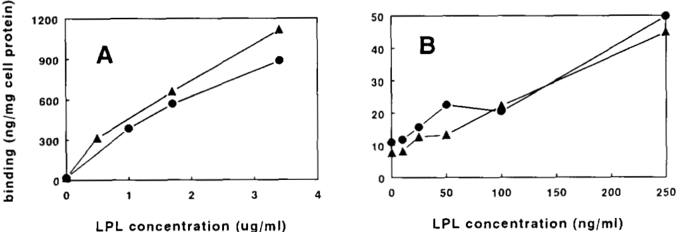
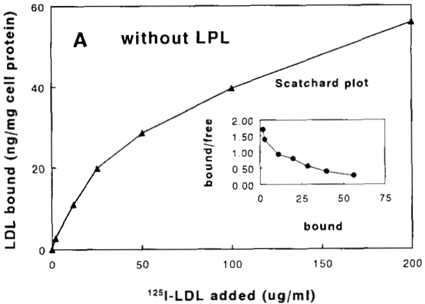
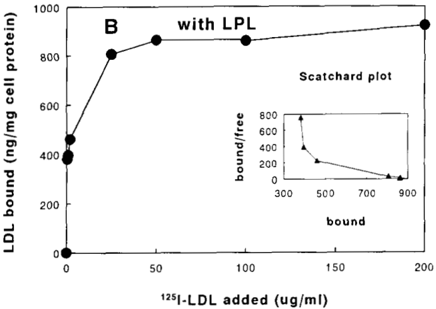
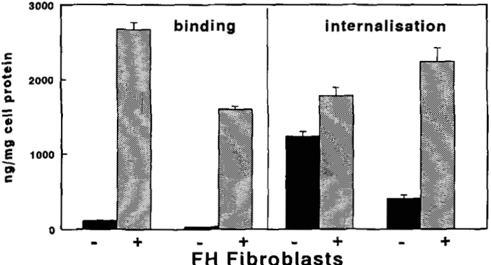
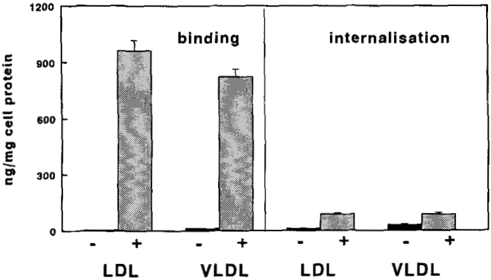
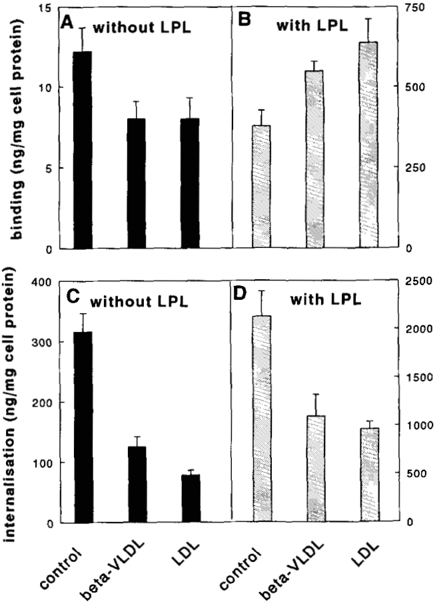
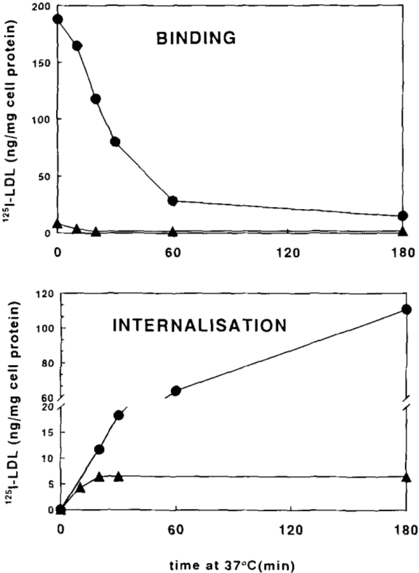
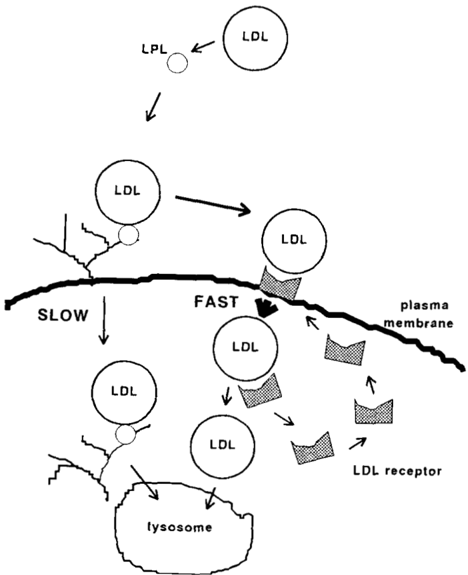
It has previously been shown that lipoprotein lipase (LPL) enhances the binding of low density lipoproteins (LDL) and very low density lipoproteins (VLDL) to HepG2 cells and fibroblasts, up to 80-fold. This increase in binding is LDL receptor-independent and is due to a bridging of LPL between extracellular heparan sulfate proteoglycans (HSPG) and the lipoproteins. In the present paper, we show that preincubation of the cells with LPL, followed by washing prior to the binding experiment, increased binding to the same extent as occurs when the binding is performed in the presence of LPL. This indicates that the formation of a complex of LPL with the lipoproteins is not a prerequisite of binding. Binding curves and Scatchard analyses reveal that both the number of binding sites and the affinity of the binding are increased 20-30-fold by the addition of 3.4 micrograms/ml LPL. The addition of LPL also resulted in an enhanced uptake and subsequent lysosomal degradation of both LDL and VLDL when compared with binding, although to a lesser extent (up to 25-fold when measured after 5 h at 37 degrees C). Strikingly, enhanced uptake did not occur in LDL receptor-negative fibroblasts. In addition, down-regulation of the LDL receptor activity by preincubation of the cells for 48 h with either LDL or beta-VLDL resulted in a parallel decrease in the uptake of LPL-mediated HSPG-bound LDL, whereas the LPL-mediated binding itself was not diminished. These observations indicate that the uptake of LPL-mediated HSPG-bound LDL and VLDL mainly proceeds via the LDL receptor. Binding of labeled LDL to the cells at 4 degrees C for 2 h followed by a chase period at 37 degrees C revealed that in absolute terms, the initial rate of internalization of HSPG-bound LDL is comparable with that of LDL receptor-bound LDL (0.58 and 0.44 ng/min/mg of cell protein, respectively). We conclude that in LDL receptor-positive cells, the LPL-mediated binding of LDL and VLDL to HSPG is followed by internalization of the lipoproteins mainly through the rapid process of the classical LDL receptor recycling system, whereas only a minor portion is internalized via the much slower process of HSPG uptake.
Overview
AI snapshot
Written from the paper’s full text.
TL;DR
LPL bridges LDL and VLDL to cell-surface heparan sulfate proteoglycans (HSPG), and the major portion of these HSPG-bound lipoproteins is subsequently internalized via the classical LDL receptor rather than by slow HSPG uptake. The paper concludes that LPL-mediated binding is LDL receptor-independent, but LPL-mediated uptake and lysosomal degradation are mainly LDL receptor-dependent.
Key findings
- Preincubating cells with LPL followed by washing increased LDL binding as much as adding LPL during the binding assay, indicating that LPL–lipoprotein complex formation is not required for enhanced binding.
- Binding curves and Scatchard analyses showed that LPL increased both the number of binding sites and binding affinity about 20–30-fold; the abstract reports this with 3.4 pg/ml LPL, and Fig. 2 reports an approximately 20-fold higher maximum LDL binding after preincubation with 1.7 pg/ml LPL.
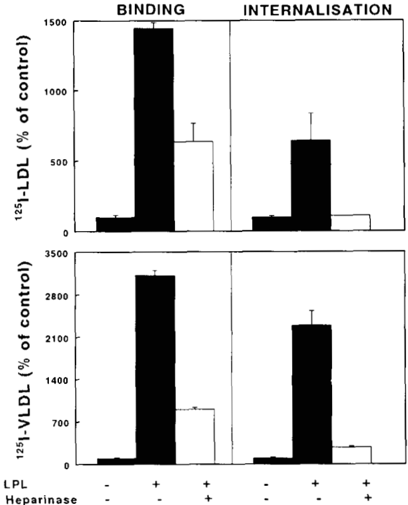
- LPL enhanced uptake and lysosomal degradation of LDL and VLDL, though less than binding: the abstract states up to 25-fold after 5 h at 37 °C, while Fig. 3 reports internalization increases of 6-fold for LDL and 23-fold for VLDL after 4 h with heat-inactivated LPL.
- Down-regulation of LDL receptor activity decreased uptake of LPL-mediated HSPG-bound LDL in parallel with reduced LDL receptor-bound LDL uptake, while LPL-mediated binding itself was not diminished; the initial internalization rate of HSPG-bound LDL was comparable to LDL receptor-bound LDL (0.58 versus 0.44 ng/min/mg cell protein).
Methods
- Cultured HepG2 cells, normal fibroblasts, and LDL receptor-negative fibroblasts from a patient with homozygous familial hypercholesterolemia were used; LDL, VLDL, and β-VLDL were isolated by ultracentrifugation, iodinated, and incubated with cells in the presence or absence of bovine LPL from skimmed milk or heat-inactivated LPL.
- Binding was measured at 0–4 °C with 10 µg/ml ¹²⁵I-labeled lipoprotein; uptake, intracellular content, and degradation were measured at 37 °C, with trypsin treatment to separate surface-bound from internalized lipoprotein, and with heparinase, chloroquine, or NH₄Cl treatments as indicated.
- Main analyses included binding curves, Scatchard plots, degradation assays, LDL receptor down-regulation by preincubation with LDL or β-VLDL, and chase experiments to measure internalization rates.
Limitations
- The paper states that the relevance of these cell-culture data to the in vivo fate of lipoproteins is still unclear, and that most experiments used LPL concentrations more than 100 times the physiological range of 8–25 ng/ml, although 25 ng/ml LPL still increased LDL binding about 1.5-fold.
- The discussion notes discrepancies with other studies, attributing them to differences in measuring total cell association versus discriminating bound and internalized lipoprotein, different sampling times, and expressing internalization as percent of total radioactivity rather than absolute ng/min/mg cell protein.
- The text itself contains an apparent inconsistency: the abstract says enhanced uptake did not occur in LDL receptor-negative fibroblasts, whereas the discussion says internalization was increased considerably in those cells but was much less efficient than in control fibroblasts.
Model-written summary. Check it against the paper before relying on it.
Integrity signals
Registry
Cites
Statistics
Figures
Verification
Claims the paper makes
13 Own result · 12 Own interpretation · 6 Sources not found
A result the paper reports from its own data — it cites no other source for it, so there is none to check. The quote shows it is in the paper.
In the paper
“In Fig. lB, it is shown that the LPL-mediated binding of LDL is already evident at more physiological concentrations of LPL (ng/ml range).”
§ Low Density Lipoprotein Receptor Internalizes Low Density and Very Low Density Lipoproteins That Are Bound to Heparan Sulfate Proteoglycans via Lipoprotein Lipase* > RESULTS
plaindirect- Asserted: passes — The authors put it forward as true.
- Checkable: passes — It can be checked against evidence.
- Load-bearing: unclear — It is unclear whether the paper’s conclusions depend on it.
- Based: passes — The paper gives a reason why it holds.
A result the paper reports from its own data — it cites no other source for it, so there is none to check. The quote shows it is in the paper.
In the paper
“In the present paper, we show that preincubation of the cells with LPL, followed by washing prior to the binding experiment, increased binding to the same extent as occurs when the binding is performed in the presence of LPL.”
plaindirect- Asserted: passes — The authors put it forward as true.
- Checkable: passes — It can be checked against evidence.
- Load-bearing: passes — The paper’s conclusions depend on it.
- Based: passes — The paper gives a reason why it holds.
A result the paper reports from its own data — it cites no other source for it, so there is none to check. The quote shows it is in the paper.
In the paper
“Fig, 3 shows that besides the inhibition of the LPLmediated binding of LDL and VLDL, treatment of the cells with heparinase also resulted in inhibition of the LPL-mediated internalization of both lipoproteins.”
§ Low Density Lipoprotein Receptor Internalizes Low Density and Very Low Density Lipoproteins That Are Bound to Heparan Sulfate Proteoglycans via Lipoprotein Lipase* > RESULTS
plaindirect- Asserted: passes — The authors put it forward as true.
- Checkable: passes — It can be checked against evidence.
- Load-bearing: passes — The paper’s conclusions depend on it.
- Based: passes — The paper gives a reason why it holds.
A result the paper reports from its own data — it cites no other source for it, so there is none to check. The quote shows it is in the paper.
In the paper
“Binding of labeled LDL to the cells at 4”
plain- Asserted: passes — The authors put it forward as true.
- Checkable: passes — It can be checked against evidence.
- Load-bearing: passes — The paper’s conclusions depend on it.
- Based: passes — The paper gives a reason why it holds.
A result the paper reports from its own data — it cites no other source for it, so there is none to check. The quote shows it is in the paper.
In the paper
“Strikingly, parallel results were obtained for the uptake of LPL-mediated HSPG-bound LDL (50 and 45% of the control value, respectively) (D).”
§ Low Density Lipoprotein Receptor Internalizes Low Density and Very Low Density Lipoproteins That Are Bound to Heparan Sulfate Proteoglycans via Lipoprotein Lipase* > FH Fibroblasts
plaincorrelational- Asserted: passes — The authors put it forward as true.
- Checkable: passes — It can be checked against evidence.
- Load-bearing: passes — The paper’s conclusions depend on it.
- Based: passes — The paper gives a reason why it holds.
A result the paper reports from its own data — it cites no other source for it, so there is none to check. The quote shows it is in the paper.
In the paper
“However, in contrast to the binding, the internalization of LDL and VLDL in receptornegative fibroblasts did not reach the same order of magnitude as that measured for receptor-positive fibroblasts.”
§ Low Density Lipoprotein Receptor Internalizes Low Density and Very Low Density Lipoproteins That Are Bound to Heparan Sulfate Proteoglycans via Lipoprotein Lipase* > FH Fibroblasts
plain- Asserted: passes — The authors put it forward as true.
- Checkable: passes — It can be checked against evidence.
- Load-bearing: passes — The paper’s conclusions depend on it.
- Based: passes — The paper gives a reason why it holds.
A result the paper reports from its own data — it cites no other source for it, so there is none to check. The quote shows it is in the paper.
In the paper
“Binding curves and Scatchard analyses reveal that both the number of binding sites and the affinity of the binding are increased 20-30-fold by the addition of 3.4 pg/ml LPL.”
plaindirect- Asserted: passes — The authors put it forward as true.
- Checkable: passes — It can be checked against evidence.
- Load-bearing: passes — The paper’s conclusions depend on it.
- Based: passes — The paper gives a reason why it holds.
A result the paper reports from its own data — it cites no other source for it, so there is none to check. The quote shows it is in the paper.
In the paper
“We found that the LPL-mediated binding of lipoproteins is not suppressed by preincubation of the cells with lipoproteins (Fig. 5).”
§ Low Density Lipoprotein Receptor Internalizes Low Density and Very Low Density Lipoproteins That Are Bound to Heparan Sulfate Proteoglycans via Lipoprotein Lipase* > DISCUSSION
plain- Asserted: passes — The authors put it forward as true.
- Checkable: passes — It can be checked against evidence.
- Load-bearing: passes — The paper’s conclusions depend on it.
- Based: passes — The paper gives a reason why it holds.
A result the paper reports from its own data — it cites no other source for it, so there is none to check. The quote shows it is in the paper.
In the paper
“The addition of LPL also resulted in an enhanced uptake and subsequent lysosomal degradation of both LDL and VLDL when compared with binding, although to a lesser extent (up to 25-fold when measured after 5 h at 37”
plaindirect- Asserted: passes — The authors put it forward as true.
- Checkable: passes — It can be checked against evidence.
- Load-bearing: passes — The paper’s conclusions depend on it.
- Based: passes — The paper gives a reason why it holds.
A result the paper reports from its own data — it cites no other source for it, so there is none to check. The quote shows it is in the paper.
In the paper
“However, we also found that in contrast to the binding, the uptake of HSPG-bound LDL is suppressed parallel to the down-regulation of the LDL receptor activity (Fig. 5, C and D).”
§ Low Density Lipoprotein Receptor Internalizes Low Density and Very Low Density Lipoproteins That Are Bound to Heparan Sulfate Proteoglycans via Lipoprotein Lipase* > DISCUSSION
plaincorrelational- Asserted: passes — The authors put it forward as true.
- Checkable: passes — It can be checked against evidence.
- Load-bearing: passes — The paper’s conclusions depend on it.
- Based: passes — The paper gives a reason why it holds.
- It may state two separate claims as one. 10
- The quote only partly states this claim. 1
- Probably not a substantial claim. 2
In the paper
“As shown in Fig. 6, most of the LDL receptor-bound LDL has been internalized within 10-15 min, which is in accordance with the recycling time reported earlier for the classical LDL receptor (28).”
§ Low Density Lipoprotein Receptor Internalizes Low Density and Very Low Density Lipoproteins That Are Bound to Heparan Sulfate Proteoglycans via Lipoprotein Lipase* > DISCUSSION
What the sources say
- Not matchedcites [28]
Couldn’t be matched to a paper in Crossref, so it can’t be checked.
plaincorrelational- Asserted: passes — The authors put it forward as true.
- Checkable: passes — It can be checked against evidence.
- Load-bearing: passes — The paper’s conclusions depend on it.
- Based: passes — The paper gives a reason why it holds.
It may state two separate claims as one.
- Not matched
A result the paper reports from its own data — it cites no other source for it, so there is none to check. The quote shows it is in the paper.
In the paper
“In Fig. 3, it is shown that in the presence of heat-inactivated LPL, not only the binding of LDL and VLDL is enhanced (about 14and 31-fold for LDL and VLDL, respectively) but also the internalization (expressed as the amount of intracellular plus degraded lipoprotein) is increased, although to a lesser extent (6-and 23-fold for LDL and VLDL, respectively).”
§ Low Density Lipoprotein Receptor Internalizes Low Density and Very Low Density Lipoproteins That Are Bound to Heparan Sulfate Proteoglycans via Lipoprotein Lipase* > RESULTS
plaindirect- Asserted: passes — The authors put it forward as true.
- Checkable: passes — It can be checked against evidence.
- Load-bearing: passes — The paper’s conclusions depend on it.
- Based: passes — The paper gives a reason why it holds.
It may state two separate claims as one.
A result the paper reports from its own data — it cites no other source for it, so there is none to check. The quote shows it is in the paper.
In the paper
“In addition, down-regulation of the LDL receptor activity by preincubation of the cells for 48 h with either LDL or 8-VLDL resulted in a parallel decrease in the uptake of LPL-mediated HSPG-bound LDL, whereas the LPL-mediated binding itself was not diminished.”
plaindirect- Asserted: passes — The authors put it forward as true.
- Checkable: passes — It can be checked against evidence.
- Load-bearing: passes — The paper’s conclusions depend on it.
- Based: passes — The paper gives a reason why it holds.
It may state two separate claims as one.
In the paper
“This increase in binding is LDL receptor-independent and is due to a bridging of LPL between extracellular heparan sulfate proteoglycans (HSPG) and the lipoproteins.”
What the sources say
- Not matchedcites [15]
Couldn’t be matched to a paper in Crossref, so it can’t be checked.
plaindirect- Asserted: passes — The authors put it forward as true.
- Checkable: passes — It can be checked against evidence.
- Load-bearing: passes — The paper’s conclusions depend on it.
- Based: passes — The paper gives a reason why it holds.
It may state two separate claims as one.
- Not matched
A conclusion the paper draws from its own results — it cites no other source for it, so there is none to check. The quote shows it is in the paper.
In the paper
“At 37”
plaindirect- Asserted: passes — The authors put it forward as true.
- Checkable: passes — It can be checked against evidence.
- Load-bearing: passes — The paper’s conclusions depend on it.
- Based: passes — The paper gives a reason why it holds.
It may state two separate claims as one. The quote only partly states this claim.
A conclusion the paper draws from its own results — it cites no other source for it, so there is none to check. The quote shows it is in the paper.
In the paper
“Thus, although the LPL-mediated binding of LDL and VLDL occurs via HSPG, the major part of the subsequent internalization of these lipoproteins is mediated via the LDL receptor.”
§ Low Density Lipoprotein Receptor Internalizes Low Density and Very Low Density Lipoproteins That Are Bound to Heparan Sulfate Proteoglycans via Lipoprotein Lipase* > FH Fibroblasts
plaindirect- Asserted: passes — The authors put it forward as true.
- Checkable: passes — It can be checked against evidence.
- Load-bearing: passes — The paper’s conclusions depend on it.
- Based: passes — The paper gives a reason why it holds.
It may state two separate claims as one.
In the paper
“It has previously been shown that lipoprotein lipase (LPL) enhances the binding of low density lipoproteins (LDL) and very low density lipoproteins (VLDL) to HepG2 cells and fibroblasts, up to 80-fold.”
What the sources say
- Not matchedcites [15]
Couldn’t be matched to a paper in Crossref, so it can’t be checked.
boosteddirect- Asserted: passes — The authors put it forward as true.
- Checkable: passes — It can be checked against evidence.
- Load-bearing: passes — The paper’s conclusions depend on it.
- Based: passes — The paper gives a reason why it holds.
Probably not a substantial claim.
- Not matched
In the paper
“Trypsin removes both cell-bound lipoproteins and cell-bound lipoprotein lipase (26).”
§ Low Density Lipoprotein Receptor Internalizes Low Density and Very Low Density Lipoproteins That Are Bound to Heparan Sulfate Proteoglycans via Lipoprotein Lipase* > MATERIALS AND METHODS
What the sources say
- Not matchedcites [26]
Couldn’t be matched to a paper in Crossref, so it can’t be checked.
plaindirect- Asserted: passes — The authors put it forward as true.
- Checkable: passes — It can be checked against evidence.
- Load-bearing: passes — The paper’s conclusions depend on it.
- Based: passes — The paper gives a reason why it holds.
It may state two separate claims as one.
- Not matched
In the paper
“LDL receptornegative fibroblasts were obtained from a patient with homozygous familial hypercholesterolemia (25).”
§ Low Density Lipoprotein Receptor Internalizes Low Density and Very Low Density Lipoproteins That Are Bound to Heparan Sulfate Proteoglycans via Lipoprotein Lipase* > MATERIALS AND METHODS
What the sources say
- Not matchedcites [25]
Couldn’t be matched to a paper in Crossref, so it can’t be checked.
plainSingle case- Asserted: passes — The authors put it forward as true.
- Checkable: passes — It can be checked against evidence.
- Load-bearing: passes — The paper’s conclusions depend on it.
- Based: passes — The paper gives a reason why it holds.
Probably not a substantial claim.
- Not matched
A conclusion the paper draws from its own results — it cites no other source for it, so there is none to check. The quote shows it is in the paper.
In the paper
“We conclude that in LDL receptor-positive cells, the LPL-mediated binding of LDL and VLDL to HSPG is followed by internalization of the lipoproteins mainly through the rapid process of the classical LDL receptor recycling system, whereas only a minor portion is internalized via the much slower process of HSPG uptake.”
plaindirect- Asserted: passes — The authors put it forward as true.
- Checkable: passes — It can be checked against evidence.
- Load-bearing: passes — The paper’s conclusions depend on it.
- Based: passes — The paper gives a reason why it holds.
It may state two separate claims as one.
A conclusion the paper draws from its own results — it cites no other source for it, so there is none to check. The quote shows it is in the paper.
In the paper
“The fact that in normal cells the uptake of LPL-mediated HSPG-bound LDL continues up to 60 min indicates that the LDL-receptor recycling system is saturated during 4-6 LDL receptor cycles and, consequently, the rate-limiting step in this process.”
§ Low Density Lipoprotein Receptor Internalizes Low Density and Very Low Density Lipoproteins That Are Bound to Heparan Sulfate Proteoglycans via Lipoprotein Lipase* > DISCUSSION
hedgeddirect- Asserted: passes — The authors put it forward as true.
- Checkable: passes — It can be checked against evidence.
- Load-bearing: passes — The paper’s conclusions depend on it.
- Based: passes — The paper gives a reason why it holds.
It may state two separate claims as one.
A conclusion the paper draws from its own results — it cites no other source for it, so there is none to check. The quote shows it is in the paper.
In the paper
“From these results, we conclude that the LPL-mediated HSPG-bound LDL and VLDL are also taken up and directed to the lysosomes for degradation.”
§ Low Density Lipoprotein Receptor Internalizes Low Density and Very Low Density Lipoproteins That Are Bound to Heparan Sulfate Proteoglycans via Lipoprotein Lipase* > RESULTS
plaindirect- Asserted: passes — The authors put it forward as true.
- Checkable: passes — It can be checked against evidence.
- Load-bearing: passes — The paper’s conclusions depend on it.
- Based: passes — The paper gives a reason why it holds.
It may state two separate claims as one.
The authors state this as an assumption.
The LRP binds only apoE-containing lipoproteins.
“while the LRP is assumed to bind only apoE-containing lipoproteins.”
The authors state this as an assumption.
The LRP contains no heparan sulfate side chains.
“whereas the LRP is assumed to contain no heparan sulfate side chains.”
Claims other papers make about this one
Each is checked against this paper’s own text: does it say what the citing paper says it does?
In the citing paper
“LPL is known to facilitate the uptake of lipoproteins in the liver (127–130).”
From Regulation of lipoprotein metabolism by ANGPTL3, ANGPTL4, and ANGPTL8 (2021) · cites this paper as [130]
Self-check
Percentages, sums and reported differences re-computed from the paper’s own numbers.
Each contradiction between two passages listed here was confirmed by an independent check.
Rated major: it would touch a result — a value a result rests on, reported and recomputed p-values on opposite sides of the significance level, two passages that conflict with no sign which is right, or a cited work retracted before this paper was published.
In the paper
§ Low Density Lipoprotein Receptor Internalizes Low Density and Very Low Density Lipoproteins That Are Bound to Heparan Sulfate Proteoglycans via Lipoprotein Lipase*
“Strikingly, enhanced uptake did not occur in LDL receptornegative fibroblasts.”
§ Low Density Lipoprotein Receptor Internalizes Low Density and Very Low Density Lipoproteins That Are Bound to Heparan Sulfate Proteoglycans via Lipoprotein Lipase* > DISCUSSION
“we also show that in LDL receptor-negative fibroblasts, the internalization of LDL and VLDL is increased considerably upon incubation of the cells with LPL (Fig. 4).”
Rated minor: it would not touch a result — a value no result rests on, a p-value that stays on the same side of the significance level, or a conflict that is clerical, resolved elsewhere in the paper, or outside its own findings.
In the paper
§ Low Density Lipoprotein Receptor Internalizes Low Density and Very Low Density Lipoproteins That Are Bound to Heparan Sulfate Proteoglycans via Lipoprotein Lipase*
“down-regulation of the LDL receptor activity by preincubation of the cells for 48 h with either LDL or 8-VLDL”
§ Low Density Lipoprotein Receptor Internalizes Low Density and Very Low Density Lipoproteins That Are Bound to Heparan Sulfate Proteoglycans via Lipoprotein Lipase* > FH Fibroblasts
“the cells were first incubated with HSA alone, DMEM/HSA supplemented with 200 pg/ml rat P-VLDL, or DMEM/HSA supplemented with 300 pg/ml human LDL, as indicated, at 37 "C for a period of 24 h.”
Citations
Cites
PROTEIN MEASUREMENT WITH THE FOLIN PHENOL REAGENT
Lowry, O. H., Rosebrough, N., Farr, A. L., & Randall, R. (1951) · Journal of Biological Chemistry · doi:10.1016/s0021-9258(19)52451-6 · Cited by 316,394
Bilheimer, D. W., Eisenberg, S., & Levy, R. I. (1972) · Biochimica et Biophysica Acta (BBA) - Lipids and Lipid Metabolism · doi:10.1016/0005-2760(72)90034-3 · Cited by 1,815
Separation of plasma lipoproteins by density-gradient ultracentrifugation
Redgrave, T. G., Roberts, D., & West, C. E. (1975) · Analytical Biochemistry · doi:10.1016/0003-2697(75)90488-1 · Cited by 1,101
Herz, J., Hamann, U., Rogne, S., Myklebost, O., Gausepohlꝉ, H., & Stanley, K. K. (1988) · The EMBO Journal · doi:10.1002/j.1460-2075.1988.tb03306.x · Cited by 955
A stable, radioactive substrate emulsion for assay of lipoprotein lipase
Nilsson‐Ehle, P., & Schotz, M. C. (1976) · Journal of Lipid Research · doi:10.1016/s0022-2275(20)41752-3 · Cited by 841
The LDL–receptor–related protein, LRP, is an apolipoprotein E-binding protein
Beisiegel†, U., Weber, W. T., Ihrke, G., Herz, J., & Stanley, K. K. (1989) · Nature · doi:10.1038/341162a0 · Cited by 680
Kowal, R. C., Herz, J., Goldstein, J. L., Esser, V., & Brown, M. S. (1989) · Proceedings of the National Academy of Sciences · doi:10.1073/pnas.86.15.5810 · Cited by 595
Strickland, D. K., Ashcom, J. D., Williams, S., Burgess, W. H., Migliorini, M., & Argraves, W. S. (1990) · Journal of Biological Chemistry · doi:10.1016/s0021-9258(18)38172-9 · Cited by 558
Lipoprotein receptors in the liver. Control signals for plasma cholesterol traffic.
Brown, M. S., & Goldstein, J. L. (1983) · Journal of Clinical Investigation · doi:10.1172/jci111044 · Cited by 545
Beisiegel, U., Weber, W., & Bengtsson-Olivecrona, G. (1991) · Proceedings of the National Academy of Sciences · doi:10.1073/pnas.88.19.8342 · Cited by 468
Research works printed but not linked: 5
- De Water, 1992, Biochem. J., 281, 62
- Tajima, 1984, J. Biol. Chem., 96, 1753
- Olivecrona, 1989, Curr. Opin. Lipid., 1, 112
- Villeli, 1991, Med. Sei. Res., 19, 111
- Vilaro, 1988, Am. J. Physiol., 254, G711
Cited by
Sorted by citations
Items 201–214 of 214
Lubaszewski, W., Stolarz, K., Olszanecka, A., Jabrocka‐Hybel, A., Kieć‐Wilk, B., Dembinska-Kiec, A., & Kawecka−Jaszcz, K. (2005) · Jagiellonian University Repository (Jagiellonian University)
The Role of Liver X Receptors in Reverse Cholesterol Transport and Atherosclerosis
Breevoort, S. R. (2014) · doi:10.18130/v3925p
(1998) · Elsevier eBooks · doi:10.1016/b978-012186060-8/50015-2
Lyon, M. (1998) · Springer eBooks · doi:10.1007/978-94-011-4932-7_15
Critical illness and cholesterol levels
Zadák, Z. (2022) · Elsevier eBooks · doi:10.1016/b978-0-323-85857-1.00010-9
Characterization of Hepatitis C Virus interaction with heparan sulfate proteoglycans
Xu, Y. (2014) · theses.fr (ABES) · doi:10.70675/b8c9dc27z15cfz4921zad5czee757d47d341
Gene therapy for the genetic dyslipoproteinaemias
Brewer, H. B., Brown, D. R., Kashyap, V. S., Applebaum-Bowden, D. M., Hoeg, J. M., Maeda, N., & Santamarina-Fojo, S. (1995) · Developments in cardiovascular medicine · doi:10.1007/978-94-011-6585-3_8
Is Hypertriglyceridemia always a Risk Factor?
de Man, F. H. A. F., Hoffer, M. J. V., Smelt, A. H. M., Leuven, J. A. G., & van der Laarse, A. (1997) · Developments in cardiovascular medicine · doi:10.1007/978-94-009-0037-0_9
Perlecan Heparan Sulfate Proteoglycan
Fuki, I. V., Iozzo, R. V., & Williams, K. J. (2000) · Journal of Biological Chemistry · doi:10.1074/jbc.m909173199 · Cited by 95
Parthasarathy, N., Goldberg, I. J., Sivaram, P., Mulloy, B., Flory, D. M., & Wagner, W. D. (1994) · Journal of Biological Chemistry · doi:10.1016/s0021-9258(17)31802-1 · Cited by 90
Wilsie, L. C., & Orlando, R. A. (2003) · Journal of Biological Chemistry · doi:10.1074/jbc.m208786200 · Cited by 68
Amar, M. J. A., Dugi, K. A., Haudenschild, C. C., Shamburek, R. D., Foger, B., Chase, M., Bensadoun, A., Hoyt, R. F., Brewer, H. B., & Santamarina-Fojo, S. (1998) · Journal of Lipid Research · doi:10.1016/s0022-2275(20)33323-x · Cited by 54
White, O., Aligabi, Z., Burks, K. H., Tang, J., Stitziel, N. O., Goldberg, I. J., Remaley, A. T., & Lucero, D. (2025) · doi:10.1101/2025.03.02.640965 · Cited by 4
Metadata
- Authors
- Mulder, M., Lombardi, P., Jansen, H., van Berkel, T. J., Frants, R. R., & Havekes, L. M.
- Affiliations
- Netherlands Organisation for Applied Scientific Research (NL)
- Venue
- Journal of Biological Chemistry
- Publisher
- Elsevier BV
- Published
- 1993-05
- Volume
- 268
- Issue
- 13
- Pages
- 9369-9375
- ISSN
- 0021-9258 (ISSN-L)
- OpenAlex
- W1525062280
- Cited by
- 214
- References
- 31
- Citations by year
- 2025: 3 · 2024: 1 · 2023: 1 · 2022: 1 · 2021: 5 · 2020: 2 · 2019: 1 · 2018: 1 · 2017: 2 · 2016: 1 · 2015: 5 · 2014: 5 · 2013: 6 · 2012: 5
- FWCI
- 15.93
- Type
- journal article
- Language
- en
- Open access
- hybrid
- doi.org
- Licence
- Locations
- Journal of Biological Chemistry (publishedVersion, cc-by)
- PubMed (publishedVersion)
- TNO Repository (submittedVersion)
- Repository hosted by TU Delft Library (TU Delft) (submittedVersion)
- Data Archiving and Networked Services (DANS) (submittedVersion, other-oa)
- Topics
- Health Sciences › Medicine › Cardiology and Cardiovascular Medicine › Lipid metabolism and disorders
- Life Sciences › Biochemistry, Genetics and Molecular Biology › Biochemistry › Cholesterol and Lipid Metabolism
- Health Sciences › Medicine › Cardiology and Cardiovascular Medicine › Lipoproteins and Cardiovascular Health
- Keywords
- heparan sulfate proteoglycans, lipoprotein lipase, low-density lipoprotein, VLDL, LDL receptor, receptor internalization, lipoprotein uptake, lysosomal degradation, LDL receptor recycling, receptor down-regulation, hepatic lipoprotein metabolism, fibroblasts, HepG2 cells, lipoprotein binding
- MeSH terms
- Animals, Biological Transport, Cattle, Female, Fibroblasts, Heparan Sulfate, Carcinoma, Hepatocellular, Humans, Kinetics, Lipoprotein Lipase, Lipoproteins, LDL, Lipoproteins, VLDL, Liver Neoplasms, Milk, Models, Biological, Polysaccharide-Lyases, Protein Binding, Proteoglycans, Receptors, LDL, Tumor Cells, Cultured, Heparin Lyase, Heparan Sulfate Proteoglycans
About these checks
Registry, retraction, Cites and statistics results are computed, not judged, with one exception: a printed reference that no index lists is read once by a model before it counts as a citation error. Claims are extracted by a model and kept only when their quote appears verbatim in the text; each cited source is then checked, with a model’s help, for whether it says what the claim relies on. Those verdicts can be wrong — read the claim’s quote and the cited source before relying on one.
A language model drew the claims from the paper on 2026-11-10, under version 3 of the claim definition (model deepseek-v4.1-flash, prompt extract-v3).
A second model labelled each claim on 2026-11-10 (model jev-1.13-20260917, definition revision gold-guideline-v0.2).
Statistics and arithmetic are recomputed, not judged.
Confidence bands are shown only for fields calibrated on our annotated test set. None is calibrated yet, so no band is shown.
What counts as a claim ›How we measure confidence ›How we check this ›
Are you an author, or do you see a problem with this page? Request a review
