

Technological transitions as evolutionary reconfiguration processes: a multi-level perspective and a case-study
Open accessThe DOI matches its Crossref record; 86 of the 94 references it cites were found in a registry or an index; 1 of the 45 sources its claims cite were checked for support.
Overview
CoChat Summary
TL;DR
Geels proposes a multi-level perspective on technological transitions, combining evolutionary economics and technology studies around niches, sociotechnical regimes, and landscape. He illustrates it with a qualitative longitudinal case study of the transition from sailing ships to steamships, 1780–1900, identifying niche-cumulation, technological add-on/hybridisation, and riding along with market growth.
Key findings
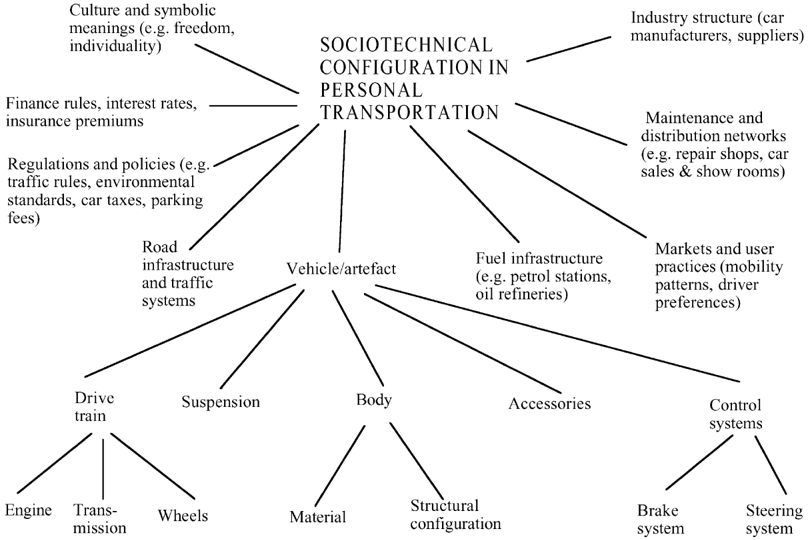
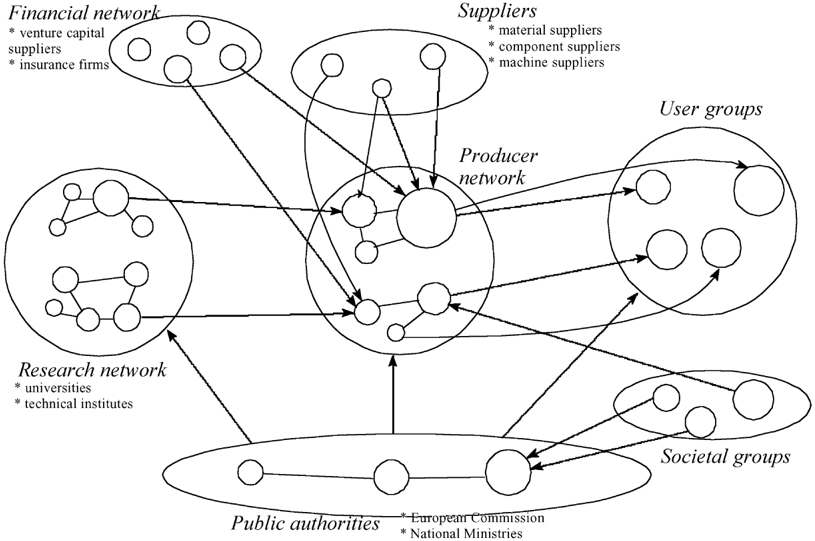
- Technological transitions are major, long-term changes in how societal functions are fulfilled; they involve not only technology but also user practices, regulation, industrial networks, infrastructure, and symbolic meaning or culture.
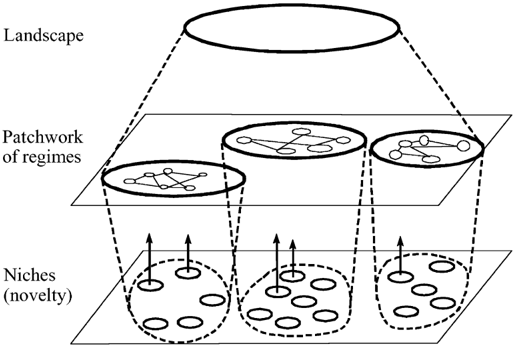
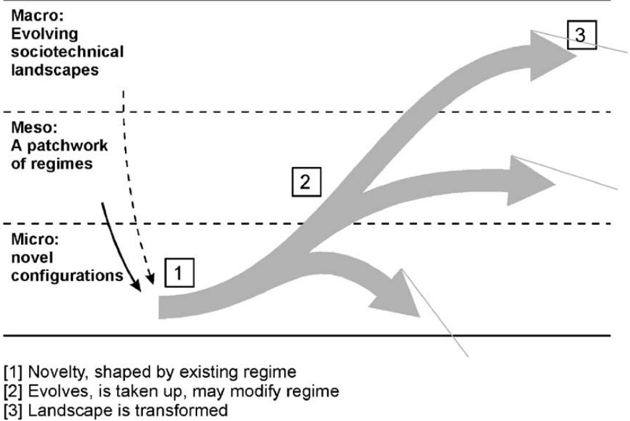
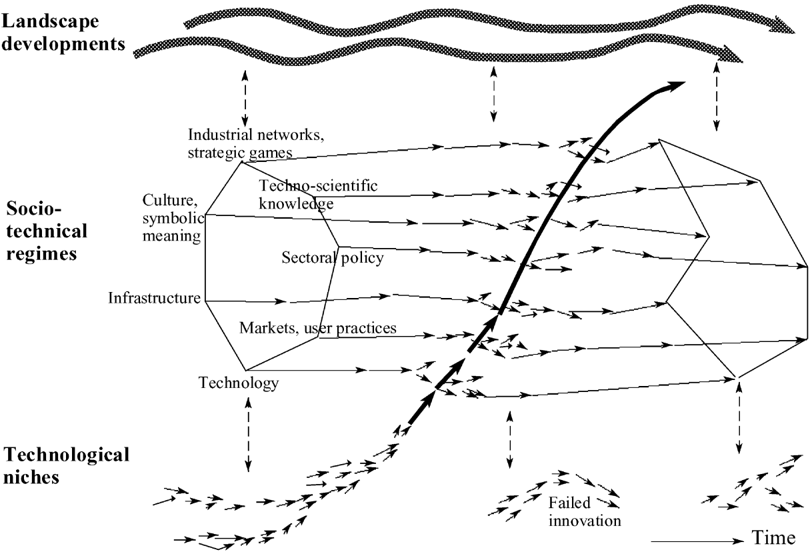
- The multi-level perspective treats niches as loci of radical variety, sociotechnical regimes as selection/retention mechanisms, and the landscape as slower external structure; breakthroughs occur when developments at multiple levels align and create a “window of opportunity.”
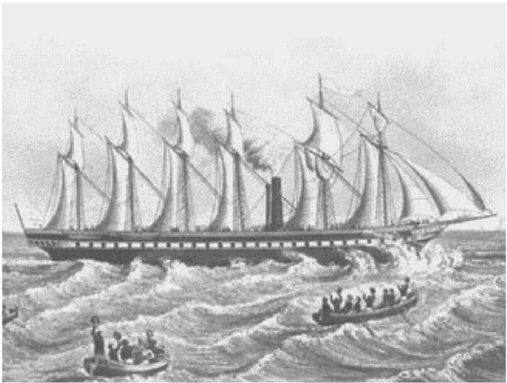
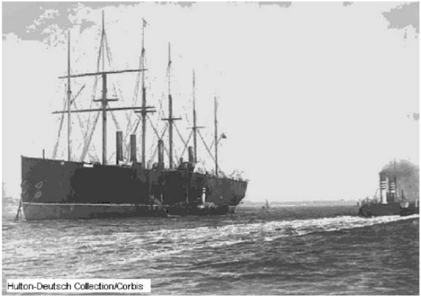
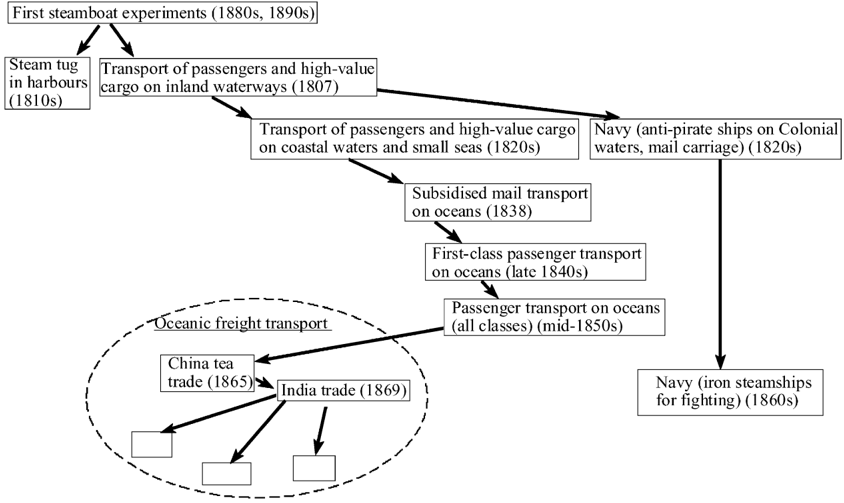
- In the steamship case, breakthrough followed niche-cumulation through inland waterways, coastal routes, mail subsidies, passenger transport, and freight; mechanisms included steam engines as auxiliary add-ons to sailing ships, hybrid sail/steam and iron/wood forms, and riding along with market growth.
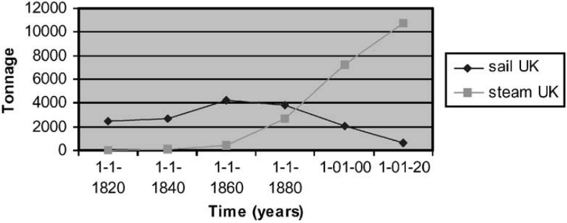
- Reported numbers include: European emigrants travelling by steamer rose from 45% in 1863 to 81% in 1866; compound engines enabled fuel-consumption reductions of 60%; the distance margin where steam was competitive reached 3000–3500 miles by the late 1860s; during the steamship mania (1869–1874), steamers rose from 17% to 31% of British registered tonnage.
Methods
- The paper uses “appreciative theory,” synthesising insights from evolutionary economics and technology studies into a multi-level perspective.
- It presents a qualitative longitudinal case study of the transition from sailing ships to steamships, 1780–1900, focused on Great Britain.
- The case is written in a mosaic style, shifting across markets, ship designs, insurance rules, actor groups, institutions, mail subsidies, persistent/emerging problems, and management practices to illustrate the conceptual framework.
Limitations
- The paper states that the multi-level perspective is fairly complex, requires many data, often qualitative, and that sociotechnical regimes are a broad unit of analysis with difficult-to-draw precise boundaries; boundary work deserves more attention.
- The paper states that the single case study has a drawback because 19th-century craft-based innovation differs from 20th-century science-based innovation, and the perspective would be more robust with more case studies varied over time periods and sectors.
- Evident in the text: the empirical analysis is focused on Great Britain and shipping, and the mechanisms are illustrated through selected historical examples rather than formal comparative or quantitative testing.
Model-written summary. Check it against the paper before relying on it.
Integrity signals
Registry
Cites
Statistics
Figures

Verification
Claims the paper makes
1 Valid · 5 Not valid · 42 Not checked · 63 Own results and interpretations
The cited sources support only part of this claim — read each source’s verdict below.
In the paper
“Aspecific mechanism in the breakthrough of radical innovations is technological add-on and hybridisation . It means that new technologies in their early phase physically link up with established technologies, often to solve particular bottlenecks. Thus, old and new technologies do not immediately compete head on, but form some sort of symbiosis (see also Pistorius and Utterback, 1997).”
What the sources say
- Partly supportedcites Pistorius and Utterback, 1997 matched to “Multi-mode interaction among technologies” (1997) sourceExperimental — accuracy not yet measured
Split into 2 atoms — 0 confirmed, 2 partially supported, 0 disputed, 0 misattributed, 0 unverifiable. Expand the claim to see per-atom verdicts.
plainstates a cause- Asserted: passes — The authors put it forward as true.
- Checkable: passes — It can be checked against evidence.
- Load-bearing: passes — The paper’s conclusions depend on it.
- Based: passes — The paper gives a reason why it holds.
- Partly supported
A result the paper states — it cites no source for it, so there is none to check. The quote shows it is in the paper.
In the paper
“These subsidies created a protective environment for the use and development of oceanic steamships.”
plainstates a cause- Asserted: passes — The authors put it forward as true.
- Checkable: passes — It can be checked against evidence.
- Load-bearing: unclear — It is unclear whether the paper’s conclusions depend on it.
- Based: passes — The paper gives a reason why it holds.
- Rests on an assumption not shown here.
In the paper
“Between 1838 and 1862 a global network of British intercontinental steam companies was created on the basis of imperial mail subsidies (Broeze, 1982).”
What the sources say
- Not matchedcites Broeze, 1982
An author–year citation the paper’s reference list doesn’t settle. We don’t search these by name.
plainstates a cause- Asserted: passes — The authors put it forward as true.
- Checkable: passes — It can be checked against evidence.
- Load-bearing: unclear — It is unclear whether the paper’s conclusions depend on it.
- Based: passes — The paper gives a reason why it holds.
- Rests on an assumption not shown here.
- Not matched
A result the paper states — it cites no source for it, so there is none to check. The quote shows it is in the paper.
In the paper
“Another innovation in the late 18th century shipping regime was the emergence of new social groups: professional shipowners, shipbrokers and insurance companies.”
plain- Asserted: passes — The authors put it forward as true.
- Checkable: passes — It can be checked against evidence.
- Load-bearing: unclear — It is unclear whether the paper’s conclusions depend on it.
- Based: passes — The paper gives a reason why it holds.
- Rests on an assumption not shown here.
A result the paper states — it cites no source for it, so there is none to check. The quote shows it is in the paper.
In the paper
“The emergence of professional shipowners was stimulated by the French Wars (1789-1815) which pushed up freight prices as demand for ships increased.”
plainstates a cause- Asserted: passes — The authors put it forward as true.
- Checkable: passes — It can be checked against evidence.
- Load-bearing: unclear — It is unclear whether the paper’s conclusions depend on it.
- Based: passes — The paper gives a reason why it holds.
- Rests on an assumption not shown here.
24 more claims
Create a free account to see all 111 claims and every source verdict.
- Probably not a substantial claim. 28
- It may state two separate claims as one. 69
- The quote only partly states this claim. 2
Claims other papers make about this one
Each is checked against this paper’s own text: does it say what the citing paper says it does?
In the citing paper
“The model of Geels (2002) describes new technologies as arising and maturing within existing technology systems [18].”
From Lessons Learned From a Living Lab on the Broad Adoption of eHealth in Primary Health Care (2018) · cites this paper as [18]
In the citing paper
“The multi-level perspective (Rip and Kemp, 1998;Geels, 2002;Geels, 2004;Geels and Schot, 2007) is a framework for understanding sustainability transitions that provides an overall view of the multi-dimensional complexity of changes in socio-technical systems.”
From Ontologies, socio-technical transitions (to sustainability), and the multi-level perspective (2010) · cites this paper as Geels, 2002
Citations
Cites
An Evolutionary Theory of Economic Change.
Loasby, B. J., Nelson, R. R., & Winter, S. G. (1983) · The Economic Journal · doi:10.2307/2232409 · Cited by 21,366
(1934) · SSRN Electronic Journal · Cited by 7,609
Technological Discontinuities and Organizational Environments
Tushman, M. L., & Anderson, P. (1986) · Administrative Science Quarterly · doi:10.2307/2392832 · Cited by 6,112
von Hippel, E. (2007) · Das Summa Summarum des Management · doi:10.1007/978-3-8349-9320-5_10 · Cited by 5,098
Technical Change and Economic Theory.
Swann, P., & Dosi, G. (1989) · The Economic Journal · doi:10.2307/2234048 · Cited by 4,041
Shaping Technology, Building Society: Studies in Sociotechnical Change.
Lynch, M., Bijker, W. E., & Law, J. (1993) · Contemporary Sociology · doi:10.2307/2074370 · Cited by 3,540
Technological Discontinuities and Dominant Designs: A Cyclical Model of Technological Change
Anderson, P., & Tushman, M. L. (1990) · Administrative Science Quarterly · doi:10.2307/2393511 · Cited by 3,255
Bijker, W. E., Hughes, T. P., & Pinch, T. (1987) · Cited by 2,957
Kemp, R., Schot, J., & Hoogma, R. (1998) · Technology Analysis & Strategic Management · doi:10.1080/09537329808524310 · Cited by 2,860
Innovation: Mapping the winds of creative destruction
Abernathy, W. J., & Clark, K. B. (1985) · Research Policy · doi:10.1016/0048-7333(85)90021-6 · Cited by 2,791
Research works printed but not linked: 9
- Broeze, F.J.A., 1982. The international diffusion of ocean steam navigation: the myth of the retardation of Netherlands steam navigation to the East Indies. Economisch-en Sociaal-Historisch Jaarboek 45, 77-95.
- Callon, M. (Ed.), 1998. The Laws of the Market. Blackwell, Oxford.
- Garrat, G.R.M., Goodman, D.C., Russel, C.A., 1973. Science and Engineering, Units 14 and 15. Open University Press, Bletchley.
- Jackson, G., 1998. Ports, ships and government in the nineteenth and twentieth centuries. In: Van Royen, P.C., Fischer, L.R., Williams, D.M. (Eds.), Proceedings of the Second International Congress of Maritime History on Frutta di Mare: Evolution and revolution in the maritime world in the 19th and 20th centuries. Amsterdam/Rotterdam, The Netherlands, 5-8 June, 1996. Batavian Lion International, Amsterdam, pp. 161-176.
- Lundvall, B.A., 1988. Innovation as an interactive process: from user-producer interaction to the national system of innovation. In: Dosi, G., Freeman, C., Nelson, R., Silverberg, G., Soete, L. (Eds.), Technical Change and Economic Theory. Pinter, London, pp. 349-369.
- Maddocks, M., 1982. De Grote Oversteek. Time-Life, London. Mayntz, R., Hughes, T.P. (Eds.), 1988. The Development of Large
- Mokyr, J., 1990. The Lever of Riches. Oxford University Press, New York.
- Rip, A., Kemp, R., 1996. Towards a Theory of Socio-Technical Change. Mimeo University of Twente, Report prepared for Batelle Pacific Northwest Laboratories, Washington, DC. (An edited version has been published as book chapter Rip and Kemp 1998).
- Sloan, E.W., 1998. Private enterprise as public utility: the management of capital in two centuries of shipping business. In: Van Royen, P.C., Fischer, L.R., Williams, D.M. (Eds.), Proceedings of the Second International Congress of Maritime History on Frutta di Mare: Evolution and Revolution in the Maritime World in the 19th and 20th Centuries. Amsterdam/Rotterdam, The Netherlands, 5-8 June, 1996. Batavian Lion International, Amsterdam, pp. 89-100.
Cited by
Items 1,601–1,700 of 7,210
Rural electrification with household wind systems in remote high wind regions
Leary, J., Schaube, P., & Clementi, L. V. (2019) · Energy Sustainable Development/Energy for sustainable development · doi:10.1016/j.esd.2019.07.008 · Cited by 48
Pekkanen, T. (2020) · Journal of Business Ethics · doi:10.1007/s10551-019-04419-x · Cited by 54
Cowell, R. (2020) · Geoforum · doi:10.1016/j.geoforum.2020.03.009 · Cited by 42
Aránguiz, P., Palau-Salvador, G., Belda, A. M., & Peris, J. (2020) · Sustainability · doi:10.3390/su12093553 · Cited by 68
Framing in Renewable Energy Policies: A Glossary
Wolsink, M. (2020) · Energies · doi:10.3390/en13112871 · Cited by 55
Gasselin, P., Lardon, S., Cerdan, C. M. T., Loudiyi, S., & Sautier, D. (2020) · Review of Agricultural Food and Environmental Studies · doi:10.1007/s41130-020-00119-7 · Cited by 70
Birney, A. (2021) · Sustainability Science · doi:10.1007/s11625-021-00956-5 · Cited by 54
Wilke, U., Schlaile, M. P., Urmetzer, S., Mueller, M., Bogner, K., & Pyka, A. (2021) · Journal of Agricultural and Environmental Ethics · doi:10.1007/s10806-021-09861-4 · Cited by 53
“…of neglecting, for example, the path dependence and resistance to change of technological regimes and socio-technical systems (e.g., Dosi, 1982; Geels, 2002) as well as the necessary non-technological (e.g., social and transformative) innovations and an adequate societal implementation (see…”
BackgroundA field perspective on sustainability transitions: The case of religious organizations
Koehrsen, J., & Huber, F. (2021) · Environmental Innovation and Societal Transitions · doi:10.1016/j.eist.2021.09.005 · Cited by 55
Monstadt, J., Torrens, J. C. L., Jain, M., Macrorie, R., & Smith, S. R. (2022) · Current Opinion in Environmental Sustainability · doi:10.1016/j.cosust.2022.101157 · Cited by 53
Examining understanding, acceptance, and support for the biorefinery concept among EU policy‐makers
Peck, P., Bennett, S. J., Bissett‐Amess, R., Lenhart, J., & Mozaffarian, H. (2009) · Biofuels, Bioproducts and Biorefining · doi:10.1002/bbb.154 · Cited by 38
Transition towards sustainable material innovation: evidence and evaluation of the Flemish case
Crabbé, A., Jacobs, R., Hoof, V. V., Bergmans, A., & Acker, K. V. (2012) · Journal of Cleaner Production · doi:10.1016/j.jclepro.2012.01.023 · Cited by 55
Transgovernance: Advancing Sustainability Governance
Meuleman, L. (2012) · Springer eBooks · doi:10.1007/978-3-642-28009-2 · Cited by 58
E-Governance systems as socio-technical transitions using multi-level perspective with case studies
Kompella, L. (2017) · Technological Forecasting and Social Change · doi:10.1016/j.techfore.2017.06.024 · Cited by 56
Discussion of the enabling environments for decentralised water systems
Moglia, M., Alexander, K., & Sharma, A. K. (2011) · Water Science & Technology · doi:10.2166/wst.2011.443 · Cited by 45
Utopia competition: a new approach to the micro-foundations of sustainability transitions
Almudí, I., Fatás‐Villafranca, F., & Potts, J. (2016) · Journal of Bioeconomics · doi:10.1007/s10818-016-9239-2 · Cited by 40
Rooftop PV and the Renewable Energy Transition; a Review of Driving Forces and Analytical Frameworks
Wilkinson, S., John, M. B., & Morrison, G. M. (2021) · Sustainability · doi:10.3390/su13105613 · Cited by 43
Bibliometric Analysis of Multi-Level Perspective on Sustainability Transition Research
Wang, C., Lv, T., Cai, R., Xu, J., & Wang, L. (2022) · Sustainability · doi:10.3390/su14074145 · Cited by 44
Applied engineering education for soft skills in the context of sustainability and mobility
Tell, J., & Hoveskog, M. (2022) · International Journal of Sustainability in Higher Education · doi:10.1108/ijshe-07-2022-0202 · Cited by 46
Cordes, D. L., & Marinova, D. V. (2023) · Discover Sustainability · doi:10.1007/s43621-022-00109-3 · Cited by 52
“The multi-level perspective (MLP) of STTT (Geels) [73] may be used to illustrate sustainable development and sustainability transitions for poverty alleviation [57].”
MethodMoritz, J., McPartlin, M., Tuomisto, H. L., & Ryynänen, T. (2023) · Research Policy · doi:10.1016/j.respol.2023.104866 · Cited by 42
Böse, F., Wimmers, A., Steigerwald, B., & von Hirschhausen, C. (2024) · Energy Research & Social Science · doi:10.1016/j.erss.2024.103448 · Cited by 45
Béné, C., & Abdulai, A. (2024) · Frontiers in Sustainable Food Systems · doi:10.3389/fsufs.2024.1399024 · Cited by 58
Bolton, R., & Foxon, T. J. (2011) · Competition and Regulation in Network Industries · doi:10.1177/178359171101200101 · Cited by 49
An age structured demographic theory of technological change
Mercure, J.-F. (2015) · Journal of Evolutionary Economics · doi:10.1007/s00191-015-0413-9 · Cited by 37
Replacing Copper with New Carbon Nanomaterials in Electrical Machine Windings
Pyrhonen, J. J., Montonen, J., Lindh, P., Vauterin, J. J., & Otto, M. (2015) · International Review of Electrical Engineering (IREE) · doi:10.15866/iree.v10i1.5253 · Cited by 43
Meijer, I. S. M., & Hekkert, M. P. (2007) · Journal of Environmental Policy & Planning · doi:10.1080/15239080701622865 · Cited by 42
Novotny, M., & Laestadius, S. (2014) · Technology Analysis and Strategic Management · doi:10.1080/09537325.2014.912789 · Cited by 38
Understanding Constraints in the Dynamics of a Research Programme Intended as a Niche Innovation
Kloet, R. R., Hessels, L. K., Zweekhorst, M. B. M., Broerse, J. E. W., & Buning, T. D. C. (2012) · Science and Public Policy · doi:10.1093/scipol/scs081 · Cited by 37
Sustainability that backfires: the case of biogas in Emilia Romagna
Cavicchi, B. (2016) · Environmental Innovation and Societal Transitions · doi:10.1016/j.eist.2016.02.001 · Cited by 41
Ferguson, B. C., Brown, R. R., & Deletić, A. (2013) · Ecology and Society · doi:10.5751/es-05901-180457 · Cited by 43
Becker, S. L., & Reusser, D. E. (2016) · International Journal of Disaster Risk Reduction · doi:10.1016/j.ijdrr.2016.05.005 · Cited by 51
The times they are a‐changing: Making the transition toward a sustainable economy
Morone, P. (2016) · Biofuels Bioproducts and Biorefining · doi:10.1002/bbb.1647 · Cited by 44
Trapp, J. H., Kerber, H., & Schramm, E. (2017) · Environmental Earth Sciences · doi:10.1007/s12665-017-6461-8 · Cited by 47
Hubeau, M., Marchand, F., & Huylenbroeck, G. V. (2017) · Sustainability · doi:10.3390/su9061027 · Cited by 52
Status and future dynamics of decentralised renewable energy niche building processes in Argentina
Schaube, P., Ortíz, W., & Recalde, M. Y. (2017) · Energy Research & Social Science · doi:10.1016/j.erss.2017.10.037 · Cited by 48
Large-scale biogas generation in Bolivia – A stepwise reconfiguration
Lönnqvist, T., Sandberg, T., Birbuet, J. C., Olsson, J., Espinosa, C., Thorin, E., Grönkvist, S., & Gómez, M. F. (2018) · Journal of Cleaner Production · doi:10.1016/j.jclepro.2018.01.174 · Cited by 43
Noboa, E., & Upham, P. (2018) · Energy Research & Social Science · doi:10.1016/j.erss.2018.07.014 · Cited by 44
Platform strategies for innovation ecosystem: Double-case study of Chinese automobile manufactures
Ding, L., Ye, R. M., & Wu, J. (2018) · Journal of Cleaner Production · doi:10.1016/j.jclepro.2018.11.139 · Cited by 41
Assembled but unrehearsed: corporate food power and the ‘dance’ of supply chain sustainability
Freidberg, S. (2018) · The Journal of Peasant Studies · doi:10.1080/03066150.2018.1534835 · Cited by 42
Sunio, V., Gaspay, S. M., Guillen, M. D., Mariano, P., & Mora, R. (2019) · Transportation Research Part A Policy and Practice · doi:10.1016/j.tra.2019.09.004 · Cited by 53
Collaborating constructively for sustainable biotechnology
Matthews, N. E., Cizauskas, C. A., Layton, D. S., Stamford, L., & Shapira, P. (2019) · Scientific Reports · doi:10.1038/s41598-019-54331-7 · Cited by 40
Empowered but powerless? Reassessing the citizens’ power dynamics of the German energy transition
Schwarz, L. (2019) · Energy Research & Social Science · doi:10.1016/j.erss.2019.101405 · Cited by 44
Stiles, J. (2020) · Environmental Innovation and Societal Transitions · doi:10.1016/j.eist.2019.12.001 · Cited by 54
Kattirtzi, M., & Winskel, M. (2020) · Technological Forecasting and Social Change · doi:10.1016/j.techfore.2020.119924 · Cited by 53
Stegmaier, P., Visser, V. R., & Kuhlmann, S. (2021) · Energy Sustainability and Society · doi:10.1186/s13705-021-00287-4 · Cited by 59
Lam, D. P. M., Martín‐López, B., Horcea‐Milcu, A., & Lang, D. J. (2020) · Sustainability Science · doi:10.1007/s11625-020-00881-z · Cited by 49
Salmenperä, H. (2021) · Journal of Cleaner Production · doi:10.1016/j.jclepro.2021.125986 · Cited by 54
Robertson, S. (2015) · Journal of Cleaner Production · doi:10.1016/j.jclepro.2015.04.074 · Cited by 50
Hyysalo, S. (2021) · Routledge eBooks · doi:10.4324/9781003133919 · Cited by 64
Mexico’s renewable energy innovation system: Geothermal and solar photovoltaics case study
Fernandez, A. D. J., & Watson, J. (2022) · Environmental Innovation and Societal Transitions · doi:10.1016/j.eist.2022.04.004 · Cited by 45
Roelfsema, M., van Soest, H. L., den Elzen, M. G. J., de Coninck, H., Kuramochi, T., Harmsen, M. J. H. M., Dafnomilis, I., Höhne, N., & van Vuuren, D. P. (2022) · Environmental Science & Policy · doi:10.1016/j.envsci.2022.05.001 · Cited by 62
“An extension of the systems thinking field is the introduction of transition dynamics in IAMs, to be able to identify intervention points (Meadows, 2008) that can set off self-reinforcing feedback loops and provide more insight into those factors that balance the system and include lock-in and path dependency that lea…”
BackgroundEnergy transition management towards a low-carbon world
Zhou, P., Gao, S., Lv, Y., et al. (2022) · Frontiers of Engineering Management · doi:10.1007/s42524-022-0201-9 · Cited by 37
“Geels (2002) proposed the Multi-level Perspective (MLP), which is the most influential framework among the socio–technical analyses of the low-carbon energy transition.”
Iizuka, M. (2015) · Innovation and Development · doi:10.1080/2157930x.2015.1049850 · Cited by 47
Assessing Decentralised Water Solutions: Towards a Framework for Adaptive Learning
Moglia, M., Cook, S., Sharma, A. K., & Burn, S. (2010) · Water Resources Management · doi:10.1007/s11269-010-9696-7 · Cited by 37
Development of photovoltaic power generation in China: A transition perspective
Liu, D., & Shiroyama, H. (2013) · Renewable and Sustainable Energy Reviews · doi:10.1016/j.rser.2013.05.014 · Cited by 45
Andersen, A. D. (2015) · Innovation and Development · doi:10.1080/2157930x.2014.996855 · Cited by 45
Weisenfeld, U., & Hauerwaas, A. (2018) · Research Policy · doi:10.1016/j.respol.2018.02.015 · Cited by 42
Sociotechnical controversies as warning signs for niche governance
Belmin, R., Meynard, J.-M., Julhia, L., & Casabianca, F. (2018) · Agronomy for Sustainable Development · doi:10.1007/s13593-018-0521-7 · Cited by 37
“Therefore, several scholars emphasized the need to support the development of sociotechnical niches (Darnhofer 2014; Geels 2002; Meynard and Messéan 2014).”
Meso-level factors in technological transitions: The development of TD-SCDMA in China
Zhang, M. Y. (2015) · Research Policy · doi:10.1016/j.respol.2015.11.006 · Cited by 38
Smooth sailing ahead? Policy options for China's new energy vehicle industry in the post-subsidy era
Du, Y., Guo, Z., & Bao, H. (2023) · Energy Research & Social Science · doi:10.1016/j.erss.2023.103359 · Cited by 43
Laurenti, R., Lazarevic, D., Poulikidou, S., Montrucchio, V., Bistagnino, L., & Frostell, B. M. (2014) · Journal of Cleaner Production · doi:10.1016/j.jclepro.2014.03.001 · Cited by 44
Pettersen, I. N., Boks, C., & Tukker, A. (2013) · International Journal of Technology Management · doi:10.1504/ijtm.2013.055580 · Cited by 48
Good practices for advancing urban mobility innovation: A case study of one-way carsharing
Terrien, C., Maniak, R., Chen, B., & Shaheen, S. (2016) · Research in Transportation Business & Management · doi:10.1016/j.rtbm.2016.08.001 · Cited by 56
Jadin, I., Meyfroidt, P., Pereira, J. Z., & Lambin, É. F. (2016) · Land · doi:10.3390/land6010001 · Cited by 38
Visions and Expectations for the Norwegian Bioeconomy
Hansen, L., & Bjørkhaug, H. (2017) · Sustainability · doi:10.3390/su9030341 · Cited by 49
Gritsenko, D. (2017) · Energy Policy · doi:10.1016/j.enpol.2017.10.014 · Cited by 39
The diffusion of sustainable family farming practices in Colombia: an emerging sociotechnical niche?
Ortíz, W., Vilsmaier, U., & Ósorio, A. A. (2017) · Sustainability Science · doi:10.1007/s11625-017-0493-6 · Cited by 49
Disruptive innovation and energy transitions: Is Christensen’s theory helpful?
McDowall, W. (2017) · Energy Research & Social Science · doi:10.1016/j.erss.2017.10.049 · Cited by 51
Tracing Sustainability Transformations and Drivers of Green Economy Approaches in the Global South
Lederer, M., Wallbott, L., & Bauer, S. (2018) · The Journal of Environment & Development · doi:10.1177/1070496517747661 · Cited by 50
Generative urbanization in Africa? A sociotechnical systems view of Tanzania’s urban transition
Murphy, J. T., & Carmody, P. (2018) · Urban Geography · doi:10.1080/02723638.2018.1500249 · Cited by 43
Roesler, T., & Hassler, M. (2018) · Energy Policy · doi:10.1016/j.enpol.2018.07.012 · Cited by 41
Principles of innovation to build nutrition-sensitive food systems in South Asia
Glover, D., & Poole, N. (2018) · Food Policy · doi:10.1016/j.foodpol.2018.10.010 · Cited by 51
McConville, J. R., Kvarnström, E., Maiteki, J. M., & Niwagaba, C. B. (2019) · Urban Water Journal · doi:10.1080/1573062x.2019.1700290 · Cited by 44
Collaborative governance in energy regions – Experiences from an Austrian region
Sedlacek, S., Tötzer, T., & Lund-Durlacher, D. (2020) · Journal of Cleaner Production · doi:10.1016/j.jclepro.2020.120256 · Cited by 40
Educating for transitions: ecovillages as transdisciplinary sustainability “classrooms”
Roysen, R., & Cruz, T. C. D. S. (2020) · International Journal of Sustainability in Higher Education · doi:10.1108/ijshe-01-2020-0009 · Cited by 45
Galvan, M. G., Cuppen, E. H. W. J., & Taanman, M. (2020) · Environmental Innovation and Societal Transitions · doi:10.1016/j.eist.2020.07.008 · Cited by 57
Sociotechnical Context and Agroecological Transition for Smallholder Farms in Benin and Burkina Faso
Tapsoba, P. K., Aoudji, A. K. N., Konkobo, M. K., Kestemont, M., Legay, C., & Achigan-Dako, E. G. (2020) · Agronomy · doi:10.3390/agronomy10091447 · Cited by 48
Hoinle, B., Roose, I., & Shekhar, H. (2021) · Sustainability · doi:10.3390/su13073680 · Cited by 50
Learning for transitions: An experiential learning strategy for urban experiments
Beukers, E., & Bertolini, L. (2021) · Environmental Innovation and Societal Transitions · doi:10.1016/j.eist.2021.09.004 · Cited by 47
Mann, C., Loft, L., & Hernández‐Morcillo, M. (2021) · Ecosystem Services · doi:10.1016/j.ecoser.2021.101384 · Cited by 41
Low-carbon energy transition with the sun and forest: Solar-driven hydrogen production from biomass
Takeda, S., Nam, H., & Chapman, A. J. (2021) · International Journal of Hydrogen Energy · doi:10.1016/j.ijhydene.2021.11.203 · Cited by 39
Νίκας, Α., Koasidis, K., Köberle, A. C., Kourtesi, G., & Doukas, H. (2021) · Renewable and Sustainable Energy Reviews · doi:10.1016/j.rser.2021.112022 · Cited by 45
What Do We Know about Zero-Emission Vehicle Mandates?
Axsen, J., Hardman, S., & Jenn, A. T. (2022) · Environmental Science & Technology · doi:10.1021/acs.est.1c08581 · Cited by 45
Torre, A., Wallet, F., & Huang, J. (2023) · Journal of Rural Studies · doi:10.1016/j.jrurstud.2022.12.034 · Cited by 45
Jensen, J. O., Jørgensen, M. S., Elle, M., & Lauridsen, E. H. (2012) · Sustainability Science Practice and Policy · doi:10.1080/15487733.2012.11908088 · Cited by 36
Achterbergh, R., Lakeman, P., Stemerding, D., Moors, E. H. M., & Cornel, M. C. (2007) · Health Policy · doi:10.1016/j.healthpol.2007.02.007 · Cited by 42
Game Changers: The Big Green Challenge and the Role of Challenge Grants in Social Innovation
Tjörnbo, O., & Westley, F. R. (2012) · Journal of Social Entrepreneurship · doi:10.1080/19420676.2012.726007 · Cited by 36
Approaches for Transitions Towards Sustainable Development: Status Quo and Challenges
Chang, R., Zuo, J., Zhao, Z., Soebarto, V. I., Zillante, G., & Gan, X. (2017) · Sustainable Development · doi:10.1002/sd.1661 · Cited by 57
Lost in Transition? Directions for an Economic Geography of Urban Sustainability Transitions
Fastenrath, S., & Braun, B. (2018) · Sustainability · doi:10.3390/su10072434 · Cited by 46
Twenty Challenges for Innovation StudiesPreprint
Martin, B. R. (2016) · SSRN Electronic Journal · doi:10.2139/ssrn.2744637 · Cited by 39
Sankaran, S., Müller, R., & Drouin, N. (2020) · Systems Research and Behavioral Science · doi:10.1002/sres.2744 · Cited by 35
Mann, C. (2015) · Ecosystem Services · doi:10.1016/j.ecoser.2015.07.001 · Cited by 48
Gazull, L., Gautier, D., & Montagné, P. (2019) · Energy Policy · doi:10.1016/j.enpol.2019.03.017 · Cited by 26
Transformative innovation policy – lessons from the innovation system literature
Lundvall, B. (2023) · Innovation and Development · doi:10.1080/2157930x.2022.2158996 · Cited by 57
Megaprojects as niches of sociotechnical transitions: The case of digitalization in UK construction
Papadonikolaki, E., Morgan, B., & Papachristos, G. (2023) · Environmental Innovation and Societal Transitions · doi:10.1016/j.eist.2023.100728 · Cited by 42
SME Internationalization and Export Performance: A Systematic Review with Bibliometric Analysis
Calheiros-Lobo, N., Ferreira, J. V., & Au‐Yong‐Oliveira, M. (2023) · Sustainability · doi:10.3390/su15118473 · Cited by 98
Vale, M., Peponi, A., Carvalho, L., Veloso, A. P., Queirós, M., & Morgado, P. (2023) · European Urban and Regional Studies · doi:10.1177/09697764231194316 · Cited by 45
“Cluster 2 (green; 23 keywords) is populated by research drawing on the foundational concepts and frameworks from Sustainability Transition’s research, such as the Multi-level Perspective (e.g. Geels, 2002) and the Technological Innovation System’s framework (Bergek et al., 2008).”
BackgroundCurrie, T. E., Mulder, M. B., Fogarty, L., Schlüter, M., Folke, C., Haider, L. J., Caniglia, G., Tavoni, A., Jansen, R. E. V., Jørgensen, P. S., et al. (2023) · Philosophical Transactions of the Royal Society B Biological Sciences · doi:10.1098/rstb.2022.0262 · Cited by 44
“Research on socio-technical transitions has developed a framework that integrates evolutionary theory to understand how technological innovations spread and become dominant in societies [103].”
McMaster, R., Noble, B. F., & Poelzer, G. (2023) · Renewable and Sustainable Energy Reviews · doi:10.1016/j.rser.2023.114232 · Cited by 48
Metadata
- Authors
- Geels, F. W.
- Affiliations
- University of Twente (NL)
- Corresponding author
- Geels, Frank W.
- ORCID
- Geels, Frank W.
- Venue
- Research Policy
- Publisher
- Elsevier BV
- Published
- 2002-12
- Volume
- 31
- Issue
- 8-9
- Pages
- 1257-1274
- ISSN
- 0048-7333 (ISSN-L)
- OpenAlex
- W2099330597
- Cited by
- 7,275
- References
- 94
- Citations by year
- 2026: 983 · 2025: 624 · 2024: 502 · 2023: 504 · 2022: 503 · 2021: 598 · 2020: 526 · 2019: 417 · 2018: 493 · 2017: 357 · 2016: 301 · 2015: 293 · 2014: 241 · 2013: 201 · 2012: 204
- FWCI
- 16.68
- Type
- journal article
- Language
- en
- Open access
- bronze
- doi.org
- Licence
- www.elsevier.com/tdm/userlicense/1.0/ (tdm)
- Locations
- Research Policy (publishedVersion)
- Research Explorer (The University of Manchester) (submittedVersion, other-oa)
- University of Twente Research Information (submittedVersion)
- TU/e Research Portal (submittedVersion)
- RePEc: Research Papers in Economics (submittedVersion)
- Figshare (submittedVersion, cc-by)
- University of Twente Research Information (submittedVersion, other-oa)
- Funders
- Nederlandse Organisatie voor Wetenschappelijk Onderzoek
- Topics
- Physical Sciences › Environmental Science › Global and Planetary Change › Sustainability and Climate Change Governance
- Social Sciences › Decision Sciences › Management Science and Operations Research › Innovation Diffusion and Forecasting
- Social Sciences › Economics, Econometrics and Finance › Economics and Econometrics › Economic Theory and Institutions
- Keywords
- technological transition, multi-level perspective, evolutionary economics, technology studies, hybridization, market growth, industrial networks, user practices, regulation, infrastructure
About these checks
Registry, retraction, Cites and statistics results are computed, not judged, with one exception: a printed reference that no index lists is read once by a model before it counts as a citation error. Claims are extracted by a model and kept only when their quote appears verbatim in the text; each cited source is then checked, with a model’s help, for whether it says what the claim relies on. Those verdicts can be wrong — read the claim’s quote and the cited source before relying on one.
The claim verdicts this report counts are experimental: their accuracy is not yet measured.
A language model drew the claims from the paper on 2026-10-10, under version 3 of the claim definition (model deepseek-v4.1-flash, prompt extract-v3).
A second model labelled each claim on 2026-10-10 (model jev-1.13-20260917, definition revision gold-guideline-v0.2).
Cited sources are checked with a language model’s help (gpt-6-sol).
Statistics and arithmetic are recomputed, not judged.
Confidence bands are shown only for fields calibrated on our annotated test set. None is calibrated yet, so no band is shown.
What counts as a claim ›How we measure confidence ›How we check this ›
Are you an author, or do you see a problem with this page? Request a review
Data sources
Bibliographic data: Semantic Scholar, OpenAlex, Crossref.
Contains information from the Semantic Scholar Academic Graph Datasets, made available under the ODC Attribution License (ODC-BY 1.0).
Semantic Scholar’s data is described in: Kinney, R., et al. (2023). The Semantic Scholar Open Data Platform. arXiv:2301.10140.
