

Technological transitions as evolutionary reconfiguration processes: a multi-level perspective and a case-study
Open accessThe DOI matches its Crossref record; 86 of the 94 references it cites were found in a registry or an index; 1 of the 45 sources its claims cite were checked for support.
Overview
CoChat Summary
TL;DR
Geels proposes a multi-level perspective on technological transitions, combining evolutionary economics and technology studies around niches, sociotechnical regimes, and landscape. He illustrates it with a qualitative longitudinal case study of the transition from sailing ships to steamships, 1780–1900, identifying niche-cumulation, technological add-on/hybridisation, and riding along with market growth.
Key findings
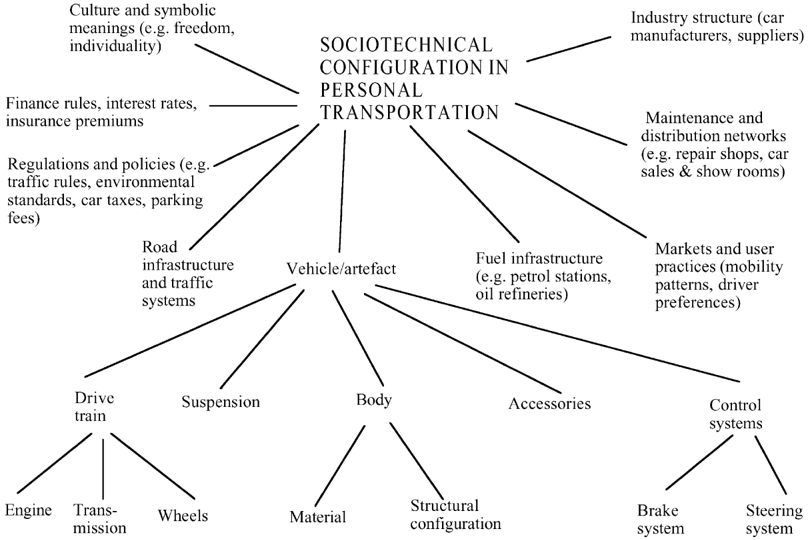
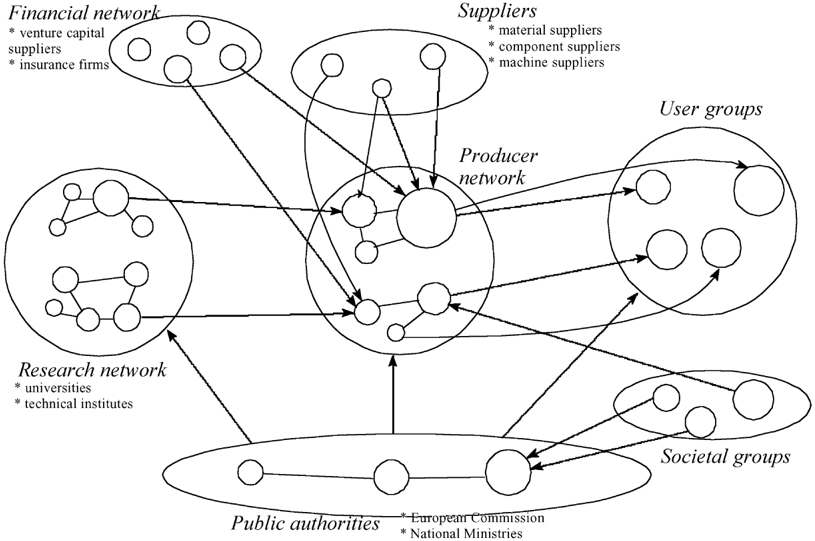
- Technological transitions are major, long-term changes in how societal functions are fulfilled; they involve not only technology but also user practices, regulation, industrial networks, infrastructure, and symbolic meaning or culture.
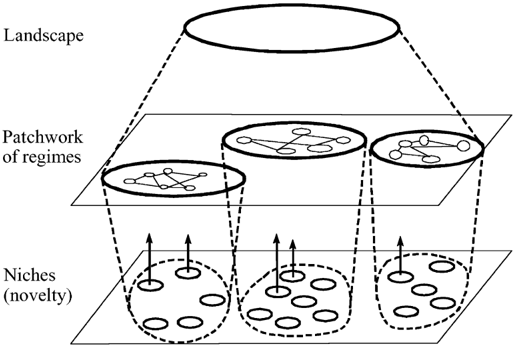
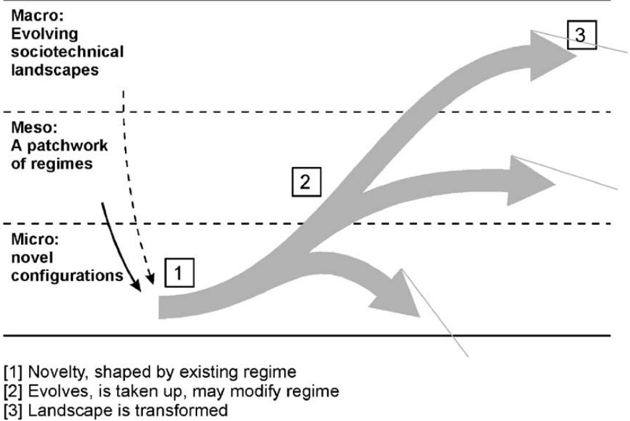
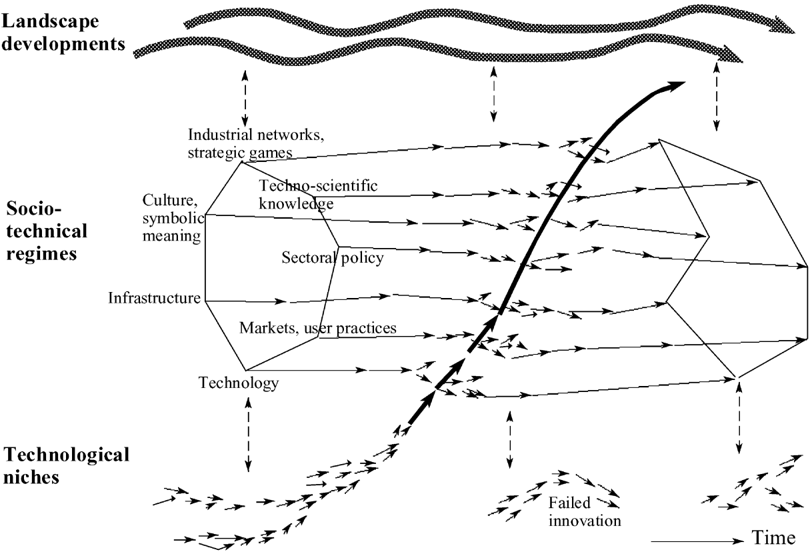
- The multi-level perspective treats niches as loci of radical variety, sociotechnical regimes as selection/retention mechanisms, and the landscape as slower external structure; breakthroughs occur when developments at multiple levels align and create a “window of opportunity.”
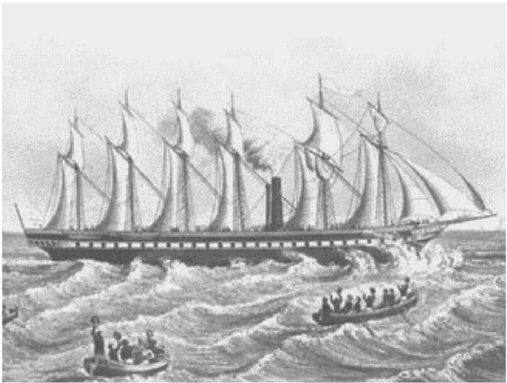
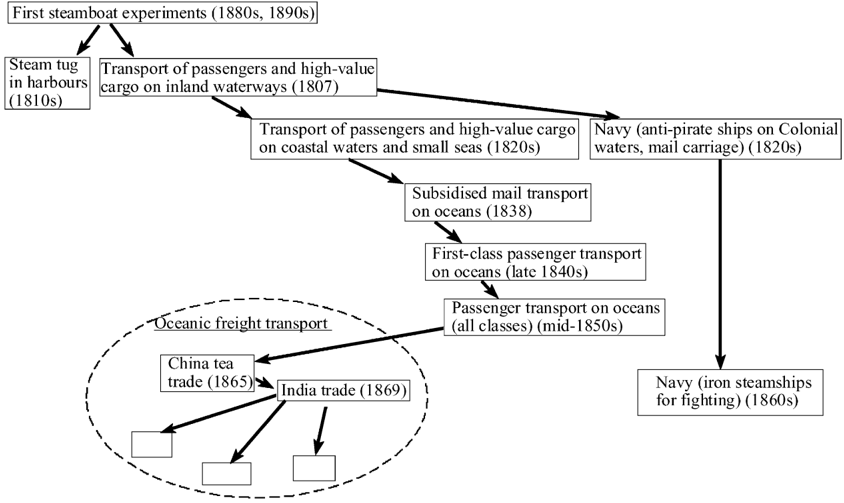
- In the steamship case, breakthrough followed niche-cumulation through inland waterways, coastal routes, mail subsidies, passenger transport, and freight; mechanisms included steam engines as auxiliary add-ons to sailing ships, hybrid sail/steam and iron/wood forms, and riding along with market growth.
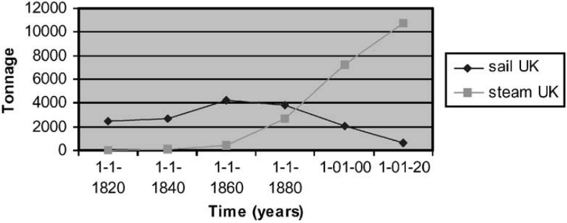
- Reported numbers include: European emigrants travelling by steamer rose from 45% in 1863 to 81% in 1866; compound engines enabled fuel-consumption reductions of 60%; the distance margin where steam was competitive reached 3000–3500 miles by the late 1860s; during the steamship mania (1869–1874), steamers rose from 17% to 31% of British registered tonnage.
Methods
- The paper uses “appreciative theory,” synthesising insights from evolutionary economics and technology studies into a multi-level perspective.
- It presents a qualitative longitudinal case study of the transition from sailing ships to steamships, 1780–1900, focused on Great Britain.
- The case is written in a mosaic style, shifting across markets, ship designs, insurance rules, actor groups, institutions, mail subsidies, persistent/emerging problems, and management practices to illustrate the conceptual framework.
Limitations
- The paper states that the multi-level perspective is fairly complex, requires many data, often qualitative, and that sociotechnical regimes are a broad unit of analysis with difficult-to-draw precise boundaries; boundary work deserves more attention.
- The paper states that the single case study has a drawback because 19th-century craft-based innovation differs from 20th-century science-based innovation, and the perspective would be more robust with more case studies varied over time periods and sectors.
- Evident in the text: the empirical analysis is focused on Great Britain and shipping, and the mechanisms are illustrated through selected historical examples rather than formal comparative or quantitative testing.
Model-written summary. Check it against the paper before relying on it.
Integrity signals
Registry
Cites
Statistics
Figures

Verification
Claims the paper makes
1 Valid · 5 Not valid · 42 Not checked · 63 Own results and interpretations
The cited sources support only part of this claim — read each source’s verdict below.
In the paper
“Aspecific mechanism in the breakthrough of radical innovations is technological add-on and hybridisation . It means that new technologies in their early phase physically link up with established technologies, often to solve particular bottlenecks. Thus, old and new technologies do not immediately compete head on, but form some sort of symbiosis (see also Pistorius and Utterback, 1997).”
What the sources say
- Partly supportedcites Pistorius and Utterback, 1997 matched to “Multi-mode interaction among technologies” (1997) sourceExperimental — accuracy not yet measured
Split into 2 atoms — 0 confirmed, 2 partially supported, 0 disputed, 0 misattributed, 0 unverifiable. Expand the claim to see per-atom verdicts.
plainstates a cause- Asserted: passes — The authors put it forward as true.
- Checkable: passes — It can be checked against evidence.
- Load-bearing: passes — The paper’s conclusions depend on it.
- Based: passes — The paper gives a reason why it holds.
- Partly supported
A result the paper states — it cites no source for it, so there is none to check. The quote shows it is in the paper.
In the paper
“These subsidies created a protective environment for the use and development of oceanic steamships.”
plainstates a cause- Asserted: passes — The authors put it forward as true.
- Checkable: passes — It can be checked against evidence.
- Load-bearing: unclear — It is unclear whether the paper’s conclusions depend on it.
- Based: passes — The paper gives a reason why it holds.
- Rests on an assumption not shown here.
In the paper
“Between 1838 and 1862 a global network of British intercontinental steam companies was created on the basis of imperial mail subsidies (Broeze, 1982).”
What the sources say
- Not matchedcites Broeze, 1982
An author–year citation the paper’s reference list doesn’t settle. We don’t search these by name.
plainstates a cause- Asserted: passes — The authors put it forward as true.
- Checkable: passes — It can be checked against evidence.
- Load-bearing: unclear — It is unclear whether the paper’s conclusions depend on it.
- Based: passes — The paper gives a reason why it holds.
- Rests on an assumption not shown here.
- Not matched
A result the paper states — it cites no source for it, so there is none to check. The quote shows it is in the paper.
In the paper
“Another innovation in the late 18th century shipping regime was the emergence of new social groups: professional shipowners, shipbrokers and insurance companies.”
plain- Asserted: passes — The authors put it forward as true.
- Checkable: passes — It can be checked against evidence.
- Load-bearing: unclear — It is unclear whether the paper’s conclusions depend on it.
- Based: passes — The paper gives a reason why it holds.
- Rests on an assumption not shown here.
A result the paper states — it cites no source for it, so there is none to check. The quote shows it is in the paper.
In the paper
“The emergence of professional shipowners was stimulated by the French Wars (1789-1815) which pushed up freight prices as demand for ships increased.”
plainstates a cause- Asserted: passes — The authors put it forward as true.
- Checkable: passes — It can be checked against evidence.
- Load-bearing: unclear — It is unclear whether the paper’s conclusions depend on it.
- Based: passes — The paper gives a reason why it holds.
- Rests on an assumption not shown here.
24 more claims
Create a free account to see all 111 claims and every source verdict.
- Probably not a substantial claim. 28
- It may state two separate claims as one. 69
- The quote only partly states this claim. 2
Claims other papers make about this one
Each is checked against this paper’s own text: does it say what the citing paper says it does?
In the citing paper
“The model of Geels (2002) describes new technologies as arising and maturing within existing technology systems [18].”
From Lessons Learned From a Living Lab on the Broad Adoption of eHealth in Primary Health Care (2018) · cites this paper as [18]
In the citing paper
“The multi-level perspective (Rip and Kemp, 1998;Geels, 2002;Geels, 2004;Geels and Schot, 2007) is a framework for understanding sustainability transitions that provides an overall view of the multi-dimensional complexity of changes in socio-technical systems.”
From Ontologies, socio-technical transitions (to sustainability), and the multi-level perspective (2010) · cites this paper as Geels, 2002
Citations
Cites
An Evolutionary Theory of Economic Change.
Loasby, B. J., Nelson, R. R., & Winter, S. G. (1983) · The Economic Journal · doi:10.2307/2232409 · Cited by 21,366
(1934) · SSRN Electronic Journal · Cited by 7,609
Technological Discontinuities and Organizational Environments
Tushman, M. L., & Anderson, P. (1986) · Administrative Science Quarterly · doi:10.2307/2392832 · Cited by 6,112
von Hippel, E. (2007) · Das Summa Summarum des Management · doi:10.1007/978-3-8349-9320-5_10 · Cited by 5,098
Technical Change and Economic Theory.
Swann, P., & Dosi, G. (1989) · The Economic Journal · doi:10.2307/2234048 · Cited by 4,041
Shaping Technology, Building Society: Studies in Sociotechnical Change.
Lynch, M., Bijker, W. E., & Law, J. (1993) · Contemporary Sociology · doi:10.2307/2074370 · Cited by 3,540
Technological Discontinuities and Dominant Designs: A Cyclical Model of Technological Change
Anderson, P., & Tushman, M. L. (1990) · Administrative Science Quarterly · doi:10.2307/2393511 · Cited by 3,255
Bijker, W. E., Hughes, T. P., & Pinch, T. (1987) · Cited by 2,957
Kemp, R., Schot, J., & Hoogma, R. (1998) · Technology Analysis & Strategic Management · doi:10.1080/09537329808524310 · Cited by 2,860
Innovation: Mapping the winds of creative destruction
Abernathy, W. J., & Clark, K. B. (1985) · Research Policy · doi:10.1016/0048-7333(85)90021-6 · Cited by 2,791
Research works printed but not linked: 9
- Broeze, F.J.A., 1982. The international diffusion of ocean steam navigation: the myth of the retardation of Netherlands steam navigation to the East Indies. Economisch-en Sociaal-Historisch Jaarboek 45, 77-95.
- Callon, M. (Ed.), 1998. The Laws of the Market. Blackwell, Oxford.
- Garrat, G.R.M., Goodman, D.C., Russel, C.A., 1973. Science and Engineering, Units 14 and 15. Open University Press, Bletchley.
- Jackson, G., 1998. Ports, ships and government in the nineteenth and twentieth centuries. In: Van Royen, P.C., Fischer, L.R., Williams, D.M. (Eds.), Proceedings of the Second International Congress of Maritime History on Frutta di Mare: Evolution and revolution in the maritime world in the 19th and 20th centuries. Amsterdam/Rotterdam, The Netherlands, 5-8 June, 1996. Batavian Lion International, Amsterdam, pp. 161-176.
- Lundvall, B.A., 1988. Innovation as an interactive process: from user-producer interaction to the national system of innovation. In: Dosi, G., Freeman, C., Nelson, R., Silverberg, G., Soete, L. (Eds.), Technical Change and Economic Theory. Pinter, London, pp. 349-369.
- Maddocks, M., 1982. De Grote Oversteek. Time-Life, London. Mayntz, R., Hughes, T.P. (Eds.), 1988. The Development of Large
- Mokyr, J., 1990. The Lever of Riches. Oxford University Press, New York.
- Rip, A., Kemp, R., 1996. Towards a Theory of Socio-Technical Change. Mimeo University of Twente, Report prepared for Batelle Pacific Northwest Laboratories, Washington, DC. (An edited version has been published as book chapter Rip and Kemp 1998).
- Sloan, E.W., 1998. Private enterprise as public utility: the management of capital in two centuries of shipping business. In: Van Royen, P.C., Fischer, L.R., Williams, D.M. (Eds.), Proceedings of the Second International Congress of Maritime History on Frutta di Mare: Evolution and Revolution in the Maritime World in the 19th and 20th Centuries. Amsterdam/Rotterdam, The Netherlands, 5-8 June, 1996. Batavian Lion International, Amsterdam, pp. 89-100.
Cited by
Items 1,901–2,000 of 7,210
Triple, Quadruple, and Higher-Order Helices: Historical Phenomena and (Neo-)Evolutionary ModelsPreprint
Leydesdorff, L., & Smith, H. L. (2021) · SSRN Electronic Journal · doi:10.2139/ssrn.3817410 · Cited by 30
“While a trajectory can locally be stabilized like a river in a valley – Sahal (1985) used the metaphor of innovation avenues – a regime can be globalized (i.e. meta-stabilized) in a four-dimensional hyper-geometry (Waddington, 1957; see Geels, 2002).”
Digitalisation for smarter cities: moving from a static to a dynamic view
Nochta, T., Wan, L., Schooling, J. M., Lemanski, C., Parlikad, A. K., & Jin, Y. (2018) · Proceedings of the Institution of Civil Engineers - Smart Infrastructure and Construction · doi:10.1680/jsmic.19.00001 · Cited by 34
Upham, P., Eberhardt, L., & Klapper, R. (2020) · Energy Research & Social Science · doi:10.1016/j.erss.2020.101710 · Cited by 32
Les initiatives citoyennes et leur changement d’échelle
Bricas, N., & Douillet, M. (2021) · Éditions Quæ eBooks · doi:10.35690/978-2-7592-3353-3/c19 · Cited by 30
Rajagopalan, S., & Breetz, H. L. (2022) · Environmental Innovation and Societal Transitions · doi:10.1016/j.eist.2022.02.004 · Cited by 35
Organizing for transformation: post-growth in International Political Economy
Hasselbalch, J., Kranke, M., & Chertkovskaya, E. (2023) · Review of International Political Economy · doi:10.1080/09692290.2023.2208871 · Cited by 47
“Using the language of the popular multi-level perspective (MLP) in innovation and transition studies, we may say that change typically originates in ‘technological niches’, from where new solutions can be mainstreamed to ‘socio-technical regimes’ (Geels, 2002, pp. 1260–1263).”
BackgroundEhnert, F. (2023) · Journal of Cleaner Production · doi:10.1016/j.jclepro.2023.138084 · Cited by 41
The dynamics of sustainability transitions: An archetype for transformation
Gottschamer, L., & Walters, J. P. (2023) · Environmental Innovation and Societal Transitions · doi:10.1016/j.eist.2023.100767 · Cited by 37
Sustainability transitions in tourism: on the transformation of a fragmented sector
Magnusson, T., Karabağ, S. F., Wigger, K. A., & Andersson, G. (2023) · Tourism Geographies · doi:10.1080/14616688.2023.2291700 · Cited by 45
“…founding framework in sustainability transitions studies, the multi-level perspective (MlP) steers the analyst towards the dialectics of stability and change. it describes transitions as co-evolutionary processes characterised by interactions between niches, regimes, and landscapes (Geels, 2002).”
BackgroundPapachristos, G., Papadonikolaki, E., & Morgan, B. (2024) · Technovation · doi:10.1016/j.technovation.2024.102967 · Cited by 36
“First, structuration theory provides the basis for exchange of insights on multi-level research and theoretical integration between transitions and PM (Geels, 2002, 2004; Geraldi and S ¨ oderlund, 2018; Sydow and Windeler, 2020; Windeler and Sydow, 2001).”
BackgroundInfluentialTracking the provincial energy transition in China: A comprehensive index
Zhou, D., Chen, T., Ding, H., & Wang, Q. (2024) · Energy · doi:10.1016/j.energy.2024.131879 · Cited by 31
Digital Transformation and Precision Farming as Catalysts of Rural Development
Ronzhin, A. L., Фигурек, А., Surovtsev, V. N., & Dibirova, K. A. (2025) · Land · doi:10.3390/land14071464 · Cited by 55
Framing of regimes and transition strategies: An application to housing construction in Denmark
Jensen, J. S. (2012) · Environmental Innovation and Societal Transitions · doi:10.1016/j.eist.2012.08.002 · Cited by 35
Sustainability Transitions: A Survey of an Emerging Field of Research
Falcone, P. M. (2014) · Environmental Management and Sustainable Development · doi:10.5296/emsd.v3i2.6239 · Cited by 41
Integrated approaches to natural resources management—Theory and practice
Tengberg, A. E., & Valencia, S. C. (2018) · Land Degradation and Development · doi:10.1002/ldr.2946 · Cited by 33
Horne, R. E., & Moloney, S. (2018) · European Planning Studies · doi:10.1080/09654313.2018.1472745 · Cited by 31
Jedelhauser, M., Mehr, J., & Binder, C. R. (2018) · Sustainability · doi:10.3390/su10061980 · Cited by 31
An agent-based model of climate-energy policies to promote wind propulsion technology in shipping
Karslen, R., Papachristos, G., & Rehmatulla, N. (2019) · Environmental Innovation and Societal Transitions · doi:10.1016/j.eist.2019.01.006 · Cited by 40
de Roo, N., Almekinders, C., Leeuwis, C., & Tefera, T. (2019) · Agricultural Systems · doi:10.1016/j.agsy.2019.04.004 · Cited by 37
Canıtez, F. (2019) · Cities · doi:10.1016/j.cities.2019.06.006 · Cited by 39
A transition to an innovative and inclusive bioeconomy in Aragon, Spain
Hernández, M. A. S., Fons, M. V. S., & Rodríguez, M. E. L. (2019) · Environmental Innovation and Societal Transitions · doi:10.1016/j.eist.2019.08.003 · Cited by 32
Pioneers’ Insights into Governing Social Innovation for Sustainable Anti-Consumption
Ziesemer, F., Hüttel, A., & Balderjahn, I. (2019) · Sustainability · doi:10.3390/su11236663 · Cited by 38
Slayton, R. M. (2020) · Science Technology & Human Values · doi:10.1177/0162243919901159 · Cited by 38
The Organization of Ancient Economies: A Global Perspective
Hirth, K. G. (2020) · Cambridge University Press eBooks · doi:10.1017/9781108859707 · Cited by 51
Zhang, B., Ma, L., & Liu, Z. (2020) · Sustainability · doi:10.3390/su12208664 · Cited by 34
Kuriyama, A., & Abe, N. (2020) · Renewable and Sustainable Energy Reviews · doi:10.1016/j.rser.2020.110610 · Cited by 36
Härri, A., Levänen, J., & Koistinen, K. (2020) · Sustainability · doi:10.3390/su122410355 · Cited by 37
Planning in the Face of Extraordinary Uncertainty: Lessons from the COVID-19 Pandemic
Ibert, O., Baumgart, S., Siedentop, S., & Weith, T. (2021) · Planning Practice and Research · doi:10.1080/02697459.2021.1991124 · Cited by 38
“…opportunity to practically stress-test the robustness of influential conceptual ideas, such as ‘resilience’ (Elmquist et al., 2019; Meerow & Newell, 2019) or ‘transformation’ and ‘transition’ (Geels, 2002; Kanda & Kivimaa, 2020), under the conditions of a ‘forced experiment’ (Acuto et al., 2020).”
BackgroundVelasco, M. J. P., Iglesias‐Pascual, R., & Barral, Á. (2021) · Energy Research & Social Science · doi:10.1016/j.erss.2021.102467 · Cited by 34
Johnson, F. X., Canales, N., Fielding, M., Gladkykh, G., Aung, M. T., Bailis, R., Ogeya, M., & Olsson, O. (2022) · Journal of Environmental Policy & Planning · doi:10.1080/1523908x.2022.2037412 · Cited by 43
“There may also be considerable interaction across levels that affects the choice of pathways, requiring integrative and iterative approaches and multi-level governance (Geels, 2002; Turnheim et al., 2015).”
BackgroundPinning it down? Measuring innovation for sustainability transitions
Krlev, G., & Terstriep, J. (2022) · Environmental Innovation and Societal Transitions · doi:10.1016/j.eist.2022.11.005 · Cited by 38
Projecting for sustainability transitions
Winch, G., Geels, F. W., Locatelli, G., & Sergeeva, N. (2023) · International Journal of Project Management · doi:10.1016/j.ijproman.2023.102456 · Cited by 40
Self-citation(IPCC), I. P. O. C. C. (2023) · Cambridge University Press eBooks · doi:10.1017/9781009157926.003 · Cited by 48
Innovation, Technology Development and Transfer
Change, I. P. O. C. (2023) · Cambridge University Press eBooks · doi:10.1017/9781009157926.018 · Cited by 41
Ortíz, W., Dienst, C., & Terrapon-Pfaff, J. (2012) · Sustainability · doi:10.3390/su4030341 · Cited by 35
The Frontiers of Networked Governance
Huppé, G. A., Creech, H., & Knoblauch, D. (2012) · Cited by 51
Let's Get This Transition Moving!
Meadowcroft, J. (2016) · Canadian Public Policy · doi:10.3138/cpp.2015-028 · Cited by 38
Savvidou, G., & Nykvist, B. (2020) · Energy Policy · doi:10.1016/j.enpol.2020.111679 · Cited by 42
The UN, the Urban Sustainable Development Goal, and the New Urban Agenda
Rudd, A., Simon, D., Cardama, M., Birch, E. L., & Revi, A. (2018) · Cambridge University Press eBooks · doi:10.1017/9781316647554.011 · Cited by 43
Loet Leydesdorff, A., Иванова, И., & Meyer, M. S. (2017) · SSRN Electronic Journal · doi:10.2139/ssrn.2937647 · Cited by 29
Moss, T. (2016) · Social Studies of Science · doi:10.1177/0306312716657205 · Cited by 34
Gaitán‐Cremaschi, D., Valbuena, D., & Klerkx, L. (2024) · Agriculture and Human Values · doi:10.1007/s10460-024-10562-7 · Cited by 32
“The analytical framework of this study is based on three key components: the multi-level perspective (MLP) on socio-technical transitions (Geels 2002); the X-curve model, (Hebinck et al. 2022); and the roles and categorizations of transition intermediaries, guided by the MLP and the X-curve model.”
Reimagining Business and Management as a Force for Good
McPhail, K., Kafouros, M. I., McKiernan, P., & Cornelius, N. (2024) · British Journal of Management · doi:10.1111/1467-8551.12846 · Cited by 37
Divergent paths for green transition: regional disparities in technology diversification
Grashof, N., & Basilico, S. (2024) · Regional Studies · doi:10.1080/00343404.2024.2363327 · Cited by 41
“…established technological trajectory characterised by incremental change processes; and (3) the socio-technical landscape that encompasses exogenous (societal) events and developments, such as demographic change or rapid shocks through wars, for instance (Basilico & Grashof, 2024; Geels, 2002).”
(Un)usual advocacy coalitions in a multi-system setting: the case of hydrogen in Germany
Löhr, M., Markard, J., & Ohlendorf, N. (2024) · Policy Sciences · doi:10.1007/s11077-024-09536-7 · Cited by 37
“To study the politics of transitions, scholars have combined key concepts from transition studies such as the multi-level perspective (Geels, 2002, 2019) with policy process frameworks (Kern & Rogge, 2018) such as the ACF (Markard et al., 2016) or multiple streams (Derwort et al., 2021).”
BackgroundInfluentialTechnological innovation system analyses and sustainability Transitions: A literature review
Weckowska, D. M., WEISS, D. N., Schwäbe, C., & Dreher, C. (2024) · Environmental Innovation and Societal Transitions · doi:10.1016/j.eist.2024.100935 · Cited by 54
Jano-Ito, M. A., & Crawford‐Brown, D. (2015) · Renewable and Sustainable Energy Reviews · doi:10.1016/j.rser.2015.10.153 · Cited by 39
McLellan, B. C., Chapman, A. J., & 青木, 一. (2016) · Journal of Cleaner Production · doi:10.1016/j.jclepro.2015.12.092 · Cited by 28
A synthesis of key factors for sustainability in social–ecological systems
Frey, U. J. (2016) · Sustainability Science · doi:10.1007/s11625-016-0395-z · Cited by 35
Transitioning to a more sustainable residential built environment in Sydney?
Foong, D., Mitchell, P., Wagstaff, N., Duncan, E., & McManus, P. (2017) · Geo Geography and Environment · doi:10.1002/geo2.33 · Cited by 35
Smart, Digitally Enhanced Learning Ecosystems: Bottlenecks to Sustainability in Georgia
Jeladze, E., & Pata, K. (2018) · Sustainability · doi:10.3390/su10082672 · Cited by 28
Factors Determining Digital Learning Ecosystem Smartness in Schools
Jeladze, E., Pata, K., & Quaicoe, J. S. (2017) · Interaction design & architecture(s)/ID&A Interaction design & architecture(s) · doi:10.55612/s-5002-035-002 · Cited by 28
The ‘patchy’ spread of renewables: A socio-territorial perspective on the energy transition process
Carrosio, G., & Scotti, I. (2019) · Energy Policy · doi:10.1016/j.enpol.2019.02.057 · Cited by 35
Unfolding eco-industrial parks through niche experimentation: Insights from three Italian cases
Susur, E., Carrillo, D. M., Chiaroni, D., & Nuchera, A. H. (2019) · Journal of Cleaner Production · doi:10.1016/j.jclepro.2019.118069 · Cited by 31
Progress and setbacks: The two faces of technology emergence
Kapoor, R., & Klueter, T. M. (2019) · Research Policy · doi:10.1016/j.respol.2019.103874 · Cited by 37
The Weak Sustainability of the Salmon Feed Transition in Norway – A Bioeconomic Case Study
Hansen, L. (2019) · Frontiers in Marine Science · doi:10.3389/fmars.2019.00764 · Cited by 34
Rao, Y. (2020) · Sustainable Computing Informatics and Systems · doi:10.1016/j.suscom.2020.100396 · Cited by 28
Koasidis, K., Karamaneas, A., Νίκας, Α., Neofytou, H., Hermansen, E. A. T., Vaillancourt, K., & Doukas, H. (2020) · Sustainability · doi:10.3390/su12145832 · Cited by 30
Governing urban sustainability transitions: urban planning regime and modes of governance
Nieminen, J., Salomaa, A., & Juhola, S. K. (2020) · Journal of Environmental Planning and Management · doi:10.1080/09640568.2020.1776690 · Cited by 37
Kanger, L., & Sillak, S. (2020) · Technology in Society · doi:10.1016/j.techsoc.2020.101393 · Cited by 34
The Future of Service Post-COVID-19 Pandemic, Volume 1: Rapid Adoption of Digital Service Technology
Lee, J., & Han, S. H. (2021) · The ICT and Evolution of Work · doi:10.1007/978-981-33-4126-5 · Cited by 54
Territorial Energy Vulnerability Assessment to Enhance Just Energy Transition of Cities
Calvo, R., Amigo, C., Billi, M., González, M. F., Urquiza, A., Álamos, N., & Navea, J. (2021) · Frontiers in Sustainable Cities · doi:10.3389/frsc.2021.635976 · Cited by 38
“Elements such as artifacts, knowledge, economic capital, human resources, cultural meanings, natural resources, regulations, among others, are the central focus of sociotechnical analysis (Geels, 2002, 2004, 2011).”
BackgroundGraaf, L., Werland, S., Lah, O., Martin, E., Mejia, A., Barriga, M. R. M., Nguyen, H. T., Teko, E., & Shrestha, S. (2021) · Sustainability · doi:10.3390/su13169045 · Cited by 41
“Pressure from outside the dominant, car-centered urban mobility regime (following Geels’s Multi-Level Perspective: the ‘landscape’ level; [4,5]) comes from a variety of directions: An ever increasing number of cities have adopted climate strategies and actions plans, or sustainable development strategies, which compri…”
BackgroundInfluentialBjerkan, K. Y., Bjørge, N. M., & Babri, S. (2021) · Energy Research & Social Science · doi:10.1016/j.erss.2021.102294 · Cited by 31
Global nutrient equity for people and the planet
Kahiluoto, H., Pickett, K. E., & Steffen, W. (2021) · Nature Food · doi:10.1038/s43016-021-00391-w · Cited by 31
Fraske, T. (2022) · Digital Geography and Society · doi:10.1016/j.diggeo.2022.100031 · Cited by 49
In a Sea of Empires: Networks and Crossings in the Revolutionary Caribbean
Mulich, J. (2020) · Cambridge University Press eBooks · doi:10.1017/9781108779289 · Cited by 38
Magnani, N., & Cittati, V.-M. (2022) · Energies · doi:10.3390/en15051624 · Cited by 45
Cooking up an electric revolution: The political economy of e-cooking
Newell, P. J., & Daley, F. (2022) · Energy Research & Social Science · doi:10.1016/j.erss.2022.102730 · Cited by 35
Climate Solidarity: A Framework and Research Agenda for Low‐Carbon Behavior
Bazzani, G. (2023) · Sociological Forum · doi:10.1111/socf.12885 · Cited by 42
The spatial dynamics of niche trajectory: The case of wave energy
Fontes, M., Sousa, C., & Ferreira, J. F. P. (2015) · Environmental Innovation and Societal Transitions · doi:10.1016/j.eist.2015.09.003 · Cited by 38
Using past transitions to inform scenarios for the future of renewable raw materials in the UK
Bennett, S. J. (2012) · Energy Policy · doi:10.1016/j.enpol.2012.03.073 · Cited by 42
Entrepreneurial learning in Italian high-tech start-ups: an exploratory study
Massis, A. D., Minola, T., & Viviani, D. (2011) · International Journal of Innovation and Learning · doi:10.1504/ijil.2012.044331 · Cited by 31
An Exploratory Analysis of the Dutch Electricity System in Transition
Kwakkel, J. H., & Yücel, G. (2012) · Journal of the Knowledge Economy · doi:10.1007/s13132-012-0128-1 · Cited by 38
Towards a regime-based typology of market evolution
Dijk, M., Orsato, R. J., & Kemp, R. (2014) · Technological Forecasting and Social Change · doi:10.1016/j.techfore.2014.10.002 · Cited by 36
de Meene, S. J. V., & Brown, R. R. (2009) · JAWRA Journal of the American Water Resources Association · doi:10.1111/j.1752-1688.2009.00377.x · Cited by 37
Cellular Automata Modeling Framework for Urban Water Reuse Planning and Management
Kandiah, V., Berglund, E. Z., & Binder, A. R. (2016) · Journal of Water Resources Planning and Management · doi:10.1061/(asce)wr.1943-5452.0000696 · Cited by 28
Social-ecological transformations of Inner Mongolia: a sustainability perspective
Xu, G., & Wu, J. (2016) · Ecological Processes · doi:10.1186/s13717-016-0067-z · Cited by 34
How institutional logics hamper innovation: The case of animal testing
Kooijman, M., Hekkert, M. P., van Meer, P. J. K., Moors, E. H. M., & Schellekens, H. (2017) · Technological Forecasting and Social Change · doi:10.1016/j.techfore.2017.02.003 · Cited by 37
Getting on the ground: Exploring the determinants of utility-scale solar PV in Rwanda
Rodríguez-Manotas, J., Bhamidipati, P. L., & Haselip, J. (2018) · Energy Research & Social Science · doi:10.1016/j.erss.2018.03.007 · Cited by 32
Zagata, L., Hrabák, J., & Lošťák, M. (2019) · Agroecology and Sustainable Food Systems · doi:10.1080/21683565.2019.1585400 · Cited by 32
A network perspective to niche-regime interactions and learning at the regime level
Costa, I., Bui, S., Schutter, O. D., & Dedeurwaerdere, T. (2022) · Environmental Innovation and Societal Transitions · doi:10.1016/j.eist.2022.03.001 · Cited by 33
Municipalities as change agents? Reconsidering roles and policies in local energy sector-coupling
Schmieder, L., Scheer, D., Gaiser, J., Jendritzki, I., & Kraus, B. (2023) · Energy Research & Social Science · doi:10.1016/j.erss.2023.103210 · Cited by 37
“The Multi-Level Perspective (MLP) by Geels [11] is a prominent framework for understanding and analyzing transformative change in large socio-technical environment.”
BackgroundMethodInfluentialSufficiency in passenger transport and its potential for lowering energy demand
Arnz, M., & Krumm, A. (2023) · Environmental Research Letters · doi:10.1088/1748-9326/acea98 · Cited by 36
The landscape, trends, challenges, and opportunities of sustainable mobility and transport
Chen, Y., Li, C., Wang, W., Zhang, Y., Chen, X. M., & Gao, Z. (2025) · npj Sustainable Mobility and Transport · doi:10.1038/s44333-025-00026-8 · Cited by 32
“Additionally, numerous citations related to transport system transformation 61,62 underscore the role of sustainable transportdevelopmentindrivingurbantransportinnovation,characterized bytheadoptionofintelligentandsustainablepractices,includingnew…”
Field configuring events shaping sustainability transitions? The case of solar PV in India
Jolly, S., & Raven, R. P. J. M. (2015) · Technological Forecasting and Social Change · doi:10.1016/j.techfore.2015.08.015 · Cited by 34
Estevan, D. G., Mezquita, A., Ferrer, S., & Monfort, E. (2016) · Journal of Cleaner Production · doi:10.1016/j.jclepro.2016.01.021 · Cited by 31
Williams, J. (2017) · Journal of Cleaner Production · doi:10.1016/j.jclepro.2017.03.236 · Cited by 27
Going back to the roots: the fourth generation of Swedish eco-villages
Magnusson, D. (2018) · Scottish Geographical Journal · doi:10.1080/14702541.2018.1465199 · Cited by 35
A Sustainability Lighthouse—Supporting Transition Leadership and Conversations on Desirable Futures
Holmberg, J., & Larsson, J. (2018) · Sustainability · doi:10.3390/su10113842 · Cited by 49
Scherrer, A., Plötz, P., & van Laerhoven, F. (2020) · Environmental Innovation and Societal Transitions · doi:10.1016/j.eist.2020.01.005 · Cited by 29
Change Agents’ Perspectives on Spatial–Relational Proximities and Urban Food Niches
Gugerell, C., & Penker, M. (2020) · Sustainability · doi:10.3390/su12062333 · Cited by 35
Magnusson, T., Anderberg, S., Dahlgren, S., & Svensson, N. (2020) · Transportation Research Interdisciplinary Perspectives · doi:10.1016/j.trip.2020.100128 · Cited by 33
Automobilities after SARS-CoV-2: A Socio-Technical Perspective
Wang, L., & Wells, P. (2020) · Sustainability · doi:10.3390/su12155978 · Cited by 37
Farstad, M., Vinge, H., & Stræte, E. P. (2020) · Agriculture and Human Values · doi:10.1007/s10460-020-10134-5 · Cited by 36
Tourais, P., & Videira, N. (2021) · Environmental Innovation and Societal Transitions · doi:10.1016/j.eist.2021.01.002 · Cited by 34
A culture‐led approach to understanding energy transitions in China: The correlative epistemology
Huang, P., Westman, L. K., & Broto, V. C. (2021) · Transactions of the Institute of British Geographers · doi:10.1111/tran.12453 · Cited by 33
Zhang, F., Chung, C. K. L., Lu, T., & Wu, F. (2021) · Cities · doi:10.1016/j.cities.2021.103294 · Cited by 34
“It posits technological transition as a non-linear process produced by the interplay of developments at three analytical levels: niche, regime and landscape (Geels, 2002, 2004; Rip & Kemp, 1998).”
Brem, A., & Nylund, P. A. (2021) · Journal of Cleaner Production · doi:10.1016/j.jclepro.2021.128964 · Cited by 29
Metadata
- Authors
- Geels, F. W.
- Affiliations
- University of Twente (NL)
- Corresponding author
- Geels, Frank W.
- ORCID
- Geels, Frank W.
- Venue
- Research Policy
- Publisher
- Elsevier BV
- Published
- 2002-12
- Volume
- 31
- Issue
- 8-9
- Pages
- 1257-1274
- ISSN
- 0048-7333 (ISSN-L)
- OpenAlex
- W2099330597
- Cited by
- 7,275
- References
- 94
- Citations by year
- 2026: 983 · 2025: 624 · 2024: 502 · 2023: 504 · 2022: 503 · 2021: 598 · 2020: 526 · 2019: 417 · 2018: 493 · 2017: 357 · 2016: 301 · 2015: 293 · 2014: 241 · 2013: 201 · 2012: 204
- FWCI
- 16.68
- Type
- journal article
- Language
- en
- Open access
- bronze
- doi.org
- Licence
- www.elsevier.com/tdm/userlicense/1.0/ (tdm)
- Locations
- Research Policy (publishedVersion)
- Research Explorer (The University of Manchester) (submittedVersion, other-oa)
- University of Twente Research Information (submittedVersion)
- TU/e Research Portal (submittedVersion)
- RePEc: Research Papers in Economics (submittedVersion)
- Figshare (submittedVersion, cc-by)
- University of Twente Research Information (submittedVersion, other-oa)
- Funders
- Nederlandse Organisatie voor Wetenschappelijk Onderzoek
- Topics
- Physical Sciences › Environmental Science › Global and Planetary Change › Sustainability and Climate Change Governance
- Social Sciences › Decision Sciences › Management Science and Operations Research › Innovation Diffusion and Forecasting
- Social Sciences › Economics, Econometrics and Finance › Economics and Econometrics › Economic Theory and Institutions
- Keywords
- technological transition, multi-level perspective, evolutionary economics, technology studies, hybridization, market growth, industrial networks, user practices, regulation, infrastructure
About these checks
Registry, retraction, Cites and statistics results are computed, not judged, with one exception: a printed reference that no index lists is read once by a model before it counts as a citation error. Claims are extracted by a model and kept only when their quote appears verbatim in the text; each cited source is then checked, with a model’s help, for whether it says what the claim relies on. Those verdicts can be wrong — read the claim’s quote and the cited source before relying on one.
The claim verdicts this report counts are experimental: their accuracy is not yet measured.
A language model drew the claims from the paper on 2026-10-10, under version 3 of the claim definition (model deepseek-v4.1-flash, prompt extract-v3).
A second model labelled each claim on 2026-10-10 (model jev-1.13-20260917, definition revision gold-guideline-v0.2).
Cited sources are checked with a language model’s help (gpt-6-sol).
Statistics and arithmetic are recomputed, not judged.
Confidence bands are shown only for fields calibrated on our annotated test set. None is calibrated yet, so no band is shown.
What counts as a claim ›How we measure confidence ›How we check this ›
Are you an author, or do you see a problem with this page? Request a review
Data sources
Bibliographic data: Semantic Scholar, OpenAlex, Crossref.
Contains information from the Semantic Scholar Academic Graph Datasets, made available under the ODC Attribution License (ODC-BY 1.0).
Semantic Scholar’s data is described in: Kinney, R., et al. (2023). The Semantic Scholar Open Data Platform. arXiv:2301.10140.
