

Technological transitions as evolutionary reconfiguration processes: a multi-level perspective and a case-study
Open accessThe DOI matches its Crossref record; 86 of the 94 references it cites were found in a registry or an index; 1 of the 45 sources its claims cite were checked for support.
Overview
CoChat Summary
TL;DR
Geels proposes a multi-level perspective on technological transitions, combining evolutionary economics and technology studies around niches, sociotechnical regimes, and landscape. He illustrates it with a qualitative longitudinal case study of the transition from sailing ships to steamships, 1780–1900, identifying niche-cumulation, technological add-on/hybridisation, and riding along with market growth.
Key findings
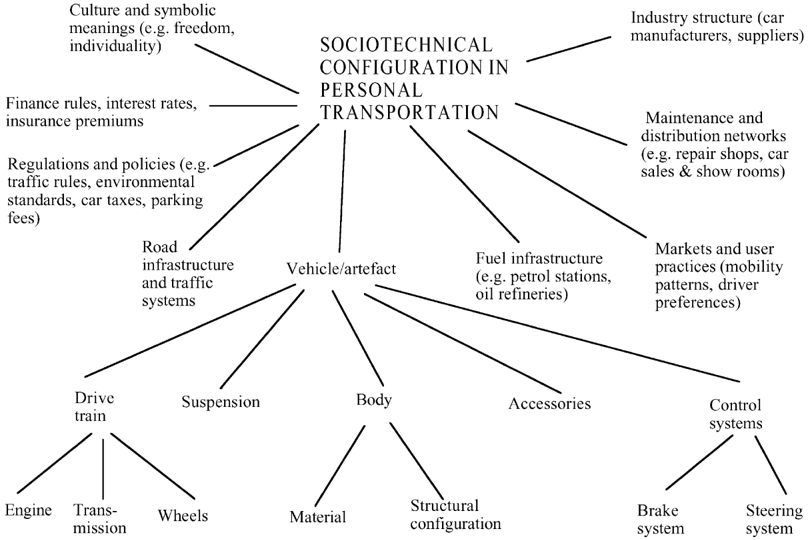
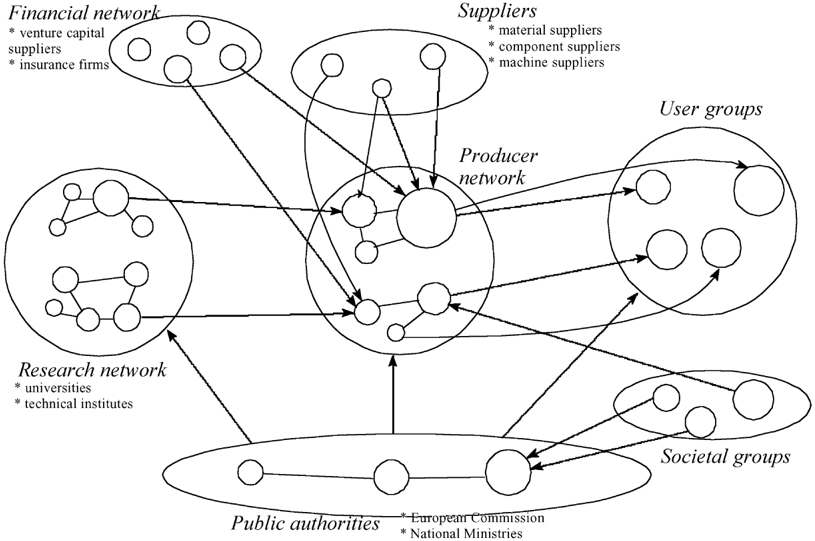
- Technological transitions are major, long-term changes in how societal functions are fulfilled; they involve not only technology but also user practices, regulation, industrial networks, infrastructure, and symbolic meaning or culture.
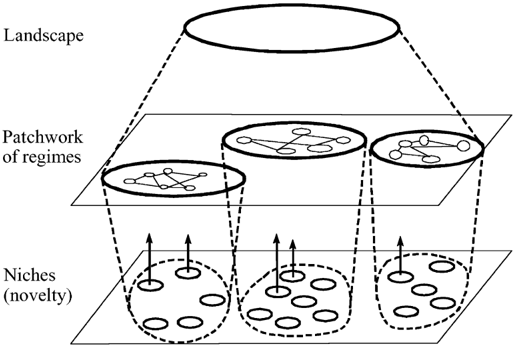
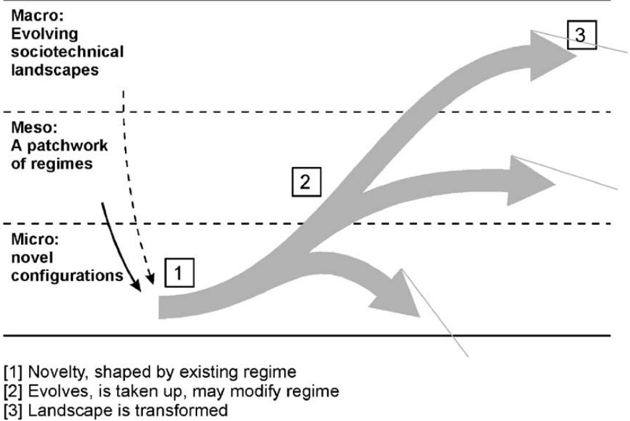
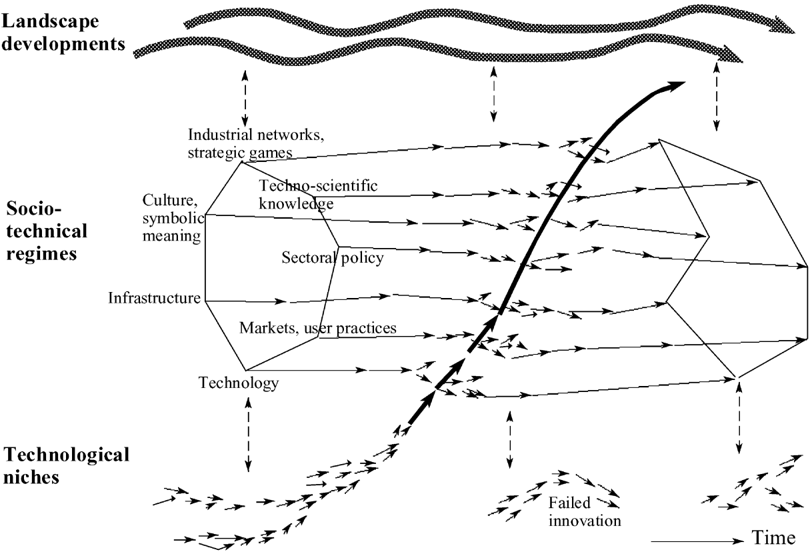
- The multi-level perspective treats niches as loci of radical variety, sociotechnical regimes as selection/retention mechanisms, and the landscape as slower external structure; breakthroughs occur when developments at multiple levels align and create a “window of opportunity.”
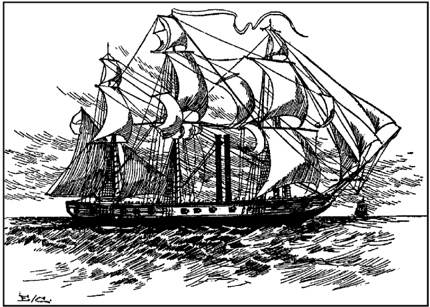
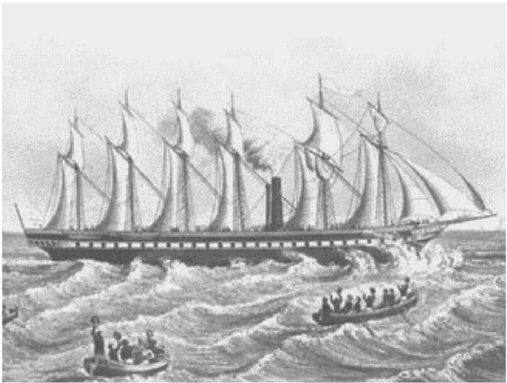
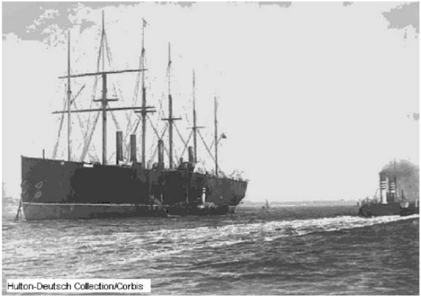
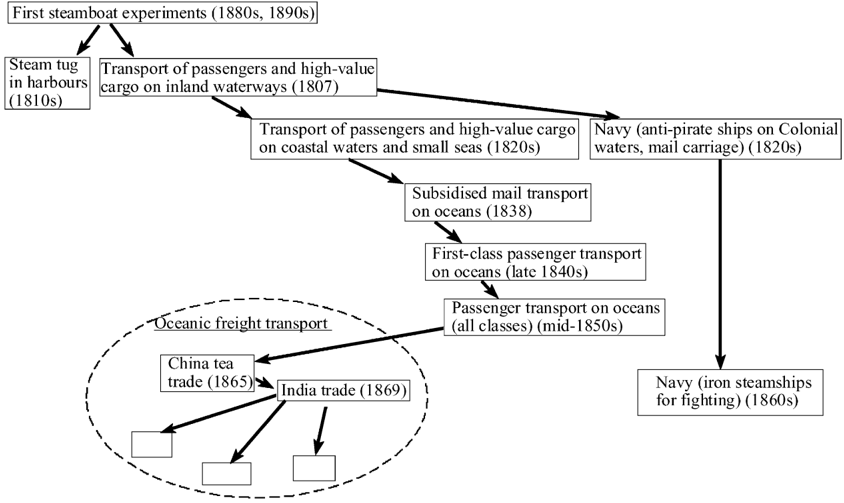
- In the steamship case, breakthrough followed niche-cumulation through inland waterways, coastal routes, mail subsidies, passenger transport, and freight; mechanisms included steam engines as auxiliary add-ons to sailing ships, hybrid sail/steam and iron/wood forms, and riding along with market growth.
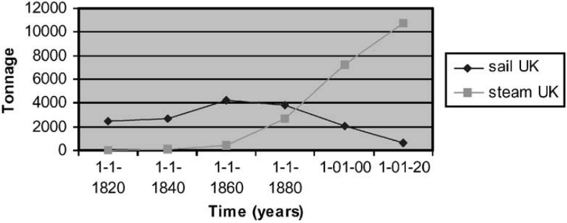
- Reported numbers include: European emigrants travelling by steamer rose from 45% in 1863 to 81% in 1866; compound engines enabled fuel-consumption reductions of 60%; the distance margin where steam was competitive reached 3000–3500 miles by the late 1860s; during the steamship mania (1869–1874), steamers rose from 17% to 31% of British registered tonnage.
Methods
- The paper uses “appreciative theory,” synthesising insights from evolutionary economics and technology studies into a multi-level perspective.
- It presents a qualitative longitudinal case study of the transition from sailing ships to steamships, 1780–1900, focused on Great Britain.
- The case is written in a mosaic style, shifting across markets, ship designs, insurance rules, actor groups, institutions, mail subsidies, persistent/emerging problems, and management practices to illustrate the conceptual framework.
Limitations
- The paper states that the multi-level perspective is fairly complex, requires many data, often qualitative, and that sociotechnical regimes are a broad unit of analysis with difficult-to-draw precise boundaries; boundary work deserves more attention.
- The paper states that the single case study has a drawback because 19th-century craft-based innovation differs from 20th-century science-based innovation, and the perspective would be more robust with more case studies varied over time periods and sectors.
- Evident in the text: the empirical analysis is focused on Great Britain and shipping, and the mechanisms are illustrated through selected historical examples rather than formal comparative or quantitative testing.
Model-written summary. Check it against the paper before relying on it.
Integrity signals
Registry
Cites
Statistics
Figures
Verification
Claims the paper makes
1 Valid · 5 Not valid · 42 Not checked · 63 Own results and interpretations
The cited sources support only part of this claim — read each source’s verdict below.
In the paper
“Aspecific mechanism in the breakthrough of radical innovations is technological add-on and hybridisation . It means that new technologies in their early phase physically link up with established technologies, often to solve particular bottlenecks. Thus, old and new technologies do not immediately compete head on, but form some sort of symbiosis (see also Pistorius and Utterback, 1997).”
What the sources say
- Partly supportedcites Pistorius and Utterback, 1997 matched to “Multi-mode interaction among technologies” (1997) sourceExperimental — accuracy not yet measured
Split into 2 atoms — 0 confirmed, 2 partially supported, 0 disputed, 0 misattributed, 0 unverifiable. Expand the claim to see per-atom verdicts.
plainstates a cause- Asserted: passes — The authors put it forward as true.
- Checkable: passes — It can be checked against evidence.
- Load-bearing: passes — The paper’s conclusions depend on it.
- Based: passes — The paper gives a reason why it holds.
- Partly supported
A result the paper states — it cites no source for it, so there is none to check. The quote shows it is in the paper.
In the paper
“These subsidies created a protective environment for the use and development of oceanic steamships.”
plainstates a cause- Asserted: passes — The authors put it forward as true.
- Checkable: passes — It can be checked against evidence.
- Load-bearing: unclear — It is unclear whether the paper’s conclusions depend on it.
- Based: passes — The paper gives a reason why it holds.
- Rests on an assumption not shown here.
In the paper
“Between 1838 and 1862 a global network of British intercontinental steam companies was created on the basis of imperial mail subsidies (Broeze, 1982).”
What the sources say
- Not matchedcites Broeze, 1982
An author–year citation the paper’s reference list doesn’t settle. We don’t search these by name.
plainstates a cause- Asserted: passes — The authors put it forward as true.
- Checkable: passes — It can be checked against evidence.
- Load-bearing: unclear — It is unclear whether the paper’s conclusions depend on it.
- Based: passes — The paper gives a reason why it holds.
- Rests on an assumption not shown here.
- Not matched
A result the paper states — it cites no source for it, so there is none to check. The quote shows it is in the paper.
In the paper
“Another innovation in the late 18th century shipping regime was the emergence of new social groups: professional shipowners, shipbrokers and insurance companies.”
plain- Asserted: passes — The authors put it forward as true.
- Checkable: passes — It can be checked against evidence.
- Load-bearing: unclear — It is unclear whether the paper’s conclusions depend on it.
- Based: passes — The paper gives a reason why it holds.
- Rests on an assumption not shown here.
A result the paper states — it cites no source for it, so there is none to check. The quote shows it is in the paper.
In the paper
“The emergence of professional shipowners was stimulated by the French Wars (1789-1815) which pushed up freight prices as demand for ships increased.”
plainstates a cause- Asserted: passes — The authors put it forward as true.
- Checkable: passes — It can be checked against evidence.
- Load-bearing: unclear — It is unclear whether the paper’s conclusions depend on it.
- Based: passes — The paper gives a reason why it holds.
- Rests on an assumption not shown here.
24 more claims
Create a free account to see all 111 claims and every source verdict.
- Probably not a substantial claim. 28
- It may state two separate claims as one. 69
- The quote only partly states this claim. 2
Claims other papers make about this one
Each is checked against this paper’s own text: does it say what the citing paper says it does?
In the citing paper
“The model of Geels (2002) describes new technologies as arising and maturing within existing technology systems [18].”
From Lessons Learned From a Living Lab on the Broad Adoption of eHealth in Primary Health Care (2018) · cites this paper as [18]
In the citing paper
“The multi-level perspective (Rip and Kemp, 1998;Geels, 2002;Geels, 2004;Geels and Schot, 2007) is a framework for understanding sustainability transitions that provides an overall view of the multi-dimensional complexity of changes in socio-technical systems.”
From Ontologies, socio-technical transitions (to sustainability), and the multi-level perspective (2010) · cites this paper as Geels, 2002
Citations
Cites
An Evolutionary Theory of Economic Change.
Loasby, B. J., Nelson, R. R., & Winter, S. G. (1983) · The Economic Journal · doi:10.2307/2232409 · Cited by 21,366
(1934) · SSRN Electronic Journal · Cited by 7,609
Technological Discontinuities and Organizational Environments
Tushman, M. L., & Anderson, P. (1986) · Administrative Science Quarterly · doi:10.2307/2392832 · Cited by 6,112
von Hippel, E. (2007) · Das Summa Summarum des Management · doi:10.1007/978-3-8349-9320-5_10 · Cited by 5,098
Technical Change and Economic Theory.
Swann, P., & Dosi, G. (1989) · The Economic Journal · doi:10.2307/2234048 · Cited by 4,041
Shaping Technology, Building Society: Studies in Sociotechnical Change.
Lynch, M., Bijker, W. E., & Law, J. (1993) · Contemporary Sociology · doi:10.2307/2074370 · Cited by 3,540
Technological Discontinuities and Dominant Designs: A Cyclical Model of Technological Change
Anderson, P., & Tushman, M. L. (1990) · Administrative Science Quarterly · doi:10.2307/2393511 · Cited by 3,255
Bijker, W. E., Hughes, T. P., & Pinch, T. (1987) · Cited by 2,957
Kemp, R., Schot, J., & Hoogma, R. (1998) · Technology Analysis & Strategic Management · doi:10.1080/09537329808524310 · Cited by 2,860
Innovation: Mapping the winds of creative destruction
Abernathy, W. J., & Clark, K. B. (1985) · Research Policy · doi:10.1016/0048-7333(85)90021-6 · Cited by 2,791
Research works printed but not linked: 9
- Broeze, F.J.A., 1982. The international diffusion of ocean steam navigation: the myth of the retardation of Netherlands steam navigation to the East Indies. Economisch-en Sociaal-Historisch Jaarboek 45, 77-95.
- Callon, M. (Ed.), 1998. The Laws of the Market. Blackwell, Oxford.
- Garrat, G.R.M., Goodman, D.C., Russel, C.A., 1973. Science and Engineering, Units 14 and 15. Open University Press, Bletchley.
- Jackson, G., 1998. Ports, ships and government in the nineteenth and twentieth centuries. In: Van Royen, P.C., Fischer, L.R., Williams, D.M. (Eds.), Proceedings of the Second International Congress of Maritime History on Frutta di Mare: Evolution and revolution in the maritime world in the 19th and 20th centuries. Amsterdam/Rotterdam, The Netherlands, 5-8 June, 1996. Batavian Lion International, Amsterdam, pp. 161-176.
- Lundvall, B.A., 1988. Innovation as an interactive process: from user-producer interaction to the national system of innovation. In: Dosi, G., Freeman, C., Nelson, R., Silverberg, G., Soete, L. (Eds.), Technical Change and Economic Theory. Pinter, London, pp. 349-369.
- Maddocks, M., 1982. De Grote Oversteek. Time-Life, London. Mayntz, R., Hughes, T.P. (Eds.), 1988. The Development of Large
- Mokyr, J., 1990. The Lever of Riches. Oxford University Press, New York.
- Rip, A., Kemp, R., 1996. Towards a Theory of Socio-Technical Change. Mimeo University of Twente, Report prepared for Batelle Pacific Northwest Laboratories, Washington, DC. (An edited version has been published as book chapter Rip and Kemp 1998).
- Sloan, E.W., 1998. Private enterprise as public utility: the management of capital in two centuries of shipping business. In: Van Royen, P.C., Fischer, L.R., Williams, D.M. (Eds.), Proceedings of the Second International Congress of Maritime History on Frutta di Mare: Evolution and Revolution in the Maritime World in the 19th and 20th Centuries. Amsterdam/Rotterdam, The Netherlands, 5-8 June, 1996. Batavian Lion International, Amsterdam, pp. 89-100.
Cited by
Items 3,001–3,100 of 7,210
Energy market liberalization and the emergence of new energy ventures in Germany
Pant, P., & Belz, F. (2025) · Energy Policy · doi:10.1016/j.enpol.2025.114882 · Cited by 13
Spira, F., & Baker-Shelley, A. (2014) · World sustainability series · doi:10.1007/978-3-319-08837-2_15 · Cited by 13
Vassilakopoulou, P., & Marmaras, N. (2015) · Health Policy and Technology · doi:10.1016/j.hlpt.2015.04.006 · Cited by 17
Data and models for exploring sustainability of human well-being in global environmental change
Deffuant, G., Alvarez, I., Barreteau, O., de Vries, B. J. M., Edmonds, B., Gilbert, N., Gotts, N. M., Jabot, F., Janssen, S. J. C., Hildén, M., et al. (2012) · The European Physical Journal Special Topics · doi:10.1140/epjst/e2012-01704-2 · Cited by 11
Paradox of Transition: Two Reports on How to Move Towards Sustainable Food Systems
Friedmann, H. (2017) · Development and Change · doi:10.1111/dech.12329 · Cited by 17
Hölscher, K., & Frantzeskaki, N. (2020) · Palgrave studies in environmental transformation, transition and accountability · doi:10.1007/978-3-030-49040-9_4 · Cited by 13
Applicability of carbon nanotube materials in present-day and future electrical machines
Pyrhonen, J. J., Otto, M., Ayguzina, V. V., et al. (2020) · International Conference on Electrical Machines (ICEM) · doi:10.1109/icem49940.2020.9270684 · Cited by 11
No legitimacy: A study of private sector sanitation development in the Global South
Fischer, K., Kokko, S., & McConville, J. R. (2020) · Environmental Innovation and Societal Transitions · doi:10.1016/j.eist.2020.11.006 · Cited by 12
Nagy, E., Rustas, C. B., & Mark‐Herbert, C. (2021) · Sustainability · doi:10.3390/su13147628 · Cited by 20
“When a change in a socio-technical system occurs, it is called a socio-technical transition [27,30].”
BackgroundThe changing landscape of deep transitions: Sociotechnical imprinting and chemical warfare
McLeish, C., Johnstone, P., & Schot, J. (2022) · Environmental Innovation and Societal Transitions · doi:10.1016/j.eist.2022.03.008 · Cited by 21
Pickard, C., & Pasqualino, R. (2022) · Systems · doi:10.3390/systems10040090 · Cited by 12
Women, fisheries technology and development: toward new research approaches
Williams, M. J., & Syddall, V. M. (2022) · Gender Technology and Development · doi:10.1080/09718524.2022.2125456 · Cited by 15
“In the new millennium, Geels (2002, 2004) built on the technology and systems approaches, broadening the methodology of the “sectoral systems of innovation” to a more dynamic interplay of actors, levels and institutions in systems change referred to as “socio-technical systems.””
MethodWoodward, A., de Graaff, A. M., Dieleman, M. A., Roberts, B., Fuhr, D. C., Broerse, J. E. W., Sijbrandij, M., Cuijpers, P. J., Ventevogel, P., Gerretsen, B., et al. (2022) · SSM - Mental Health · doi:10.1016/j.ssmmh.2022.100171 · Cited by 16
Manzano, R. M., & Pérez, J. E. (2023) · Boletín de la Asociación de Geógrafos Españoles · doi:10.21138/bage.3336 · Cited by 29
Wentworth, C., Warsaw, P., Isaacs, K., Traoré, A., Hammon, A., & Lewis, A. (2023) · Agriculture and Human Values · doi:10.1007/s10460-023-10445-3 · Cited by 15
“Friedmann ( 2016), however, utilizes the theory of transitions first introduced by Geels ( 2002) to present another possibility.”
MethodCrowdsourced data indicates broadband has a positive impact on local business creation
Chen, Y. P., Oughton, E. J., Zagdanski, J., Jia, M. M., & Tyler, P. (2023) · Telematics and Informatics · doi:10.1016/j.tele.2023.102035 · Cited by 22
Santos, D. (2023) · Environmental Innovation and Societal Transitions · doi:10.1016/j.eist.2023.100783 · Cited by 16
Schmid-Petri, H., & Elschner, S. G. (2024) · Energy Research & Social Science · doi:10.1016/j.erss.2024.103431 · Cited by 13
Modelling sustainable energy futures for the UK
Allen, P. M., & Varga, L. (2014) · Futures · doi:10.1016/j.futures.2014.01.005 · Cited by 12
Fighting for a future: an actor-oriented planning approach to landscape preservation in Galicia
Swagemakers, P., Rodríguez, D. C., García, M. D. D., et al. (2014) · Geografisk Tidsskrift-Danish Journal of Geography · doi:10.1080/00167223.2013.876206 · Cited by 11
Söderholm, K. (2013) · Environmental Innovation and Societal Transitions · doi:10.1016/j.eist.2013.03.001 · Cited by 17
A transition perspective on alternatives to coal in Chinese district heating
Zhang, J., & Lucia, L. D. (2015) · International Journal of Sustainable Energy Planning and Management · doi:10.5278/ijsepm.2015.6.5 · Cited by 21
Hui, A. (2017) · Applied Mobilities · doi:10.1080/23800127.2017.1380977 · Cited by 15
Why Novel Sanitary Systems are Hardly Introduced?
Blanken, M., Verweij, C., & Mulder, K. F. (2018) · Journal of Sustainable Development of Energy Water and Environment Systems · doi:10.13044/j.sdewes.d6.0214 · Cited by 11
Co-evolutionary and systemic study on the evolution of emerging stem cell-based therapies
Ávila-Robinson, A., Islam, N., & Sengoku, S. (2018) · Technological Forecasting and Social Change · doi:10.1016/j.techfore.2018.10.012 · Cited by 14
An assessment of worm control practices used by alpaca farmers in Australia
Rashid, M. H., Stevenson, M. A., Campbell, A. J. D., Vaughan, J. L., Beveridge, I., & Jabbar, A. (2018) · Veterinary Parasitology · doi:10.1016/j.vetpar.2018.12.006 · Cited by 11
Markov models of policy support for technology transitions
Brozynski, M. T., & Leibowicz, B. D. (2020) · European Journal of Operational Research · doi:10.1016/j.ejor.2020.03.066 · Cited by 12
Typologie et perspective d’évolution de l’agriculture biologique au Cameroun
Bayiha, G. D. L. P., Temple, L., Mathé, S., et al. (2019) · Cahiers Agricultures · doi:10.1051/cagri/2019003 · Cited by 11
La viabilité du maraîchage urbain à l’épreuve de l’installation professionnelle
Plateau, L., Maughan, N., Pipart, N., Visser, M., Hermesse, J., & Maréchal, K. (2019) · Cahiers Agricultures · doi:10.1051/cagri/2019005 · Cited by 12
Reflexive climate service infrastructure relations
Stegmaier, P., Hamaker-Taylor, R., & Alonso, E. J. (2020) · Climate Services · doi:10.1016/j.cliser.2020.100151 · Cited by 15
Doyon, A., Moore, T., Moloney, S., et al. (2020) · Journal of Environmental Planning and Management · doi:10.1080/09640568.2019.1702512 · Cited by 11
Sjøtun, S. G. (2020) · Geoforum · doi:10.1016/j.geoforum.2020.05.001 · Cited by 12
Priming the pump of impact entrepreneurship and social finance in China
Jia, X. (2020) · Agriculture and Human Values · doi:10.1007/s10460-020-10130-9 · Cited by 13
Kaweesa, S. H., Bilali, H. E., & Loiskandl, W. (2020) · Environment Development and Sustainability · doi:10.1007/s10668-020-00936-2 · Cited by 18
Kritische Perspektiven auf eine automatisierte und vernetzte Mobilität
Dangschat, J. S., & Stickler, A. (2020) · Springer eBooks · doi:10.1007/978-3-658-30750-9_3 · Cited by 15
Alves, A. C., Vonortas, N. S., & Zawislak, P. A. (2020) · Science and Public Policy · doi:10.1093/scipol/scaa059 · Cited by 15
Randall, R. G., & Allen, S. A. (2021) · International Journal of Critical Infrastructure Protection · doi:10.1016/j.ijcip.2021.100454 · Cited by 15
Transformative Innovation Policy in Emerging Economies: What Does It Entail?
Ordóñez–Matamoros, G., Centeno, J. P., Andrade-Sastoque, E., & Camargo, M. A. P. (2021) · Palgrave studies in democracy, innovation, and entrepreneurship for growth · doi:10.1007/978-3-030-80832-7_6 · Cited by 13
New Integrated Urban Knowledge for the Cities We Want
Bai, X., Elmqvist, T., Frantzeskaki, N., McPhearson, T., Simon, D., Maddox, D., Watkins, M., Romero‐Lankao, P., Parnell, S. M., Griffith, C. A., et al. (2018) · Cambridge University Press eBooks · doi:10.1017/9781316647554.055 · Cited by 16
Kiisel, M., & Remm, L. (2022) · Small-scale Forestry · doi:10.1007/s11842-022-09501-3 · Cited by 16
“To understand the opportunities of forest owners to prepare for such a change in forestry we apply the multi-level perspective (MLP) of socio-technical transitions as analytical framework (Geels 2002, 2004).”
MethodCompatibility in cross-city innovation transfer: Importance of existing local experiments
Wang, S., & Bai, X. (2022) · Environmental Innovation and Societal Transitions · doi:10.1016/j.eist.2022.09.003 · Cited by 14
Governance of uncertainty in implementing mobility innovations: A comparison of two Dutch cases
Akse, R., Veeneman, W. W., Marchau, V., & Ritter, S. M. (2023) · Research in Transportation Economics · doi:10.1016/j.retrec.2023.101278 · Cited by 13
PARTICIPATORY PROTOTYPING FOR FUTURE CITIES
van Waart, P., Mulder, I. J., & de Bont, C. J. P. M. (2015) · Data Archiving and Networked Services (DANS) · Cited by 19
Dialogues of Sustainable Urbanisation: Social Science Research and Transitions to Urban Contexts
Condie, J., & Cooper-Ryan, A. M. (2015) · Cited by 19
Ornetzeder, M., & Rohracher, H. (2009) · Cited by 22
Morone, P., & Cottoni, L. (2016) · Elsevier eBooks · doi:10.1016/b978-0-08-100455-5.00004-7 · Cited by 13
Verbong, G. P. J., & Geels, F. W. (2008) · International Conference on Infrastructure Systems and Services: Building Networks for a Brighter Future · doi:10.1109/infra.2008.5439655 · Cited by 11
Self-citationFrom ‘Alternative’ to ‘Advanced’: Mainstreaming of Sustainable Technologies
Sørensen, K. H. (2015) · Science & Technology Studies · doi:10.23987/sts.55355 · Cited by 17
A framework for technology transfer potential assessment
Estep, J., & Daim, T. U. (2016) · Portland International Conference on Management of Engineering and Technology (PICMET) · doi:10.1109/picmet.2016.7806626 · Cited by 11
Emerging Nordic food approaches
Manniche, J., & Sæther, B. (2017) · European Planning Studies · doi:10.1080/09654313.2017.1327036 · Cited by 14
Pelli, P., Kangas, J., & Pykäläinen, J. (2018) · World sustainability series · doi:10.1007/978-3-319-73028-8_2 · Cited by 19
Kundu, D. K., Gupta, A., MOL, A. P. J., Rahman, M. M., & van Halem, D. (2018) · Technology in Society · doi:10.1016/j.techsoc.2018.01.010 · Cited by 13
How to tell the story of change and transition of the energy, ecological and societal systems
Birat, J. (2020) · Matériaux & Techniques · doi:10.1051/mattech/2021005 · Cited by 14
Sustainability Transformation Emerging from Better Governance
Romero‐Lankao, P., Frantzeskaki, N., & Griffith, C. A. (2018) · Cambridge University Press eBooks · doi:10.1017/9781316647554.015 · Cited by 17
Rationales for co-operation between firms and States within an emerging radical innovation
Bourgeois, B., & Mima, S. (2003) · Springer eBooks · doi:10.1007/978-3-540-24822-4_4 · Cited by 11
Hoogma, R., Kemp, R., Schot, J., & Truffer, B. (2005) · doi:10.4324/9780203994061-12 · Cited by 10
Bolton, R. (2011) · White Rose eTheses Online (University of Leeds, The University of Sheffield, University of York) · Cited by 14
Bauknecht, D. (2012) · Cited by 12
Enviromental Innovations, Complementarity and Local/Global CooperationPreprint
Cainelli, G., Mazzanti, M., & Zoboli, R. (2011) · RePEc: Research Papers in Economics · Cited by 11
Rode, J., & Crassard, F. (2007) · Cited by 19
From intelligent to smart cities
Moore, T. (2013) · Australian Planner · doi:10.1080/07293682.2013.810163 · Cited by 11
Technology assessment of renewable energy sustainability in South Africa
Musango, J. K. (2012) · SUNScholar (Stellenbosch University) · Cited by 28
Innovation - a New GuidePreprint
Fagerberg, J. (2013) · RePEc: Research Papers in Economics · Cited by 64
Biomass Energy Outlook in Malaysia using Functions of Innovation SystemsPreprint
Nyakuma, B. B. (2018) · Preprints.org · doi:10.20944/preprints201802.0158.v1 · Cited by 10
Value chain transformations in the transition to a sustainable bioeconomyPreprint
Clay, P. M., & Sellare, J. (2022) · SSRN Electronic Journal · doi:10.2139/ssrn.4193583 · Cited by 15
Schöpper, Y., Digmayer, C., Bartusch, R., Ebrahim, O., Hermens, S. E., Nejabat, R., Steireif, N., Wendorff, J., Jakobs, E.-M., Lohrberg, F., et al. (2024) · SSRN Electronic Journal · doi:10.2139/ssrn.4683145 · Cited by 10
Škare, M., Gavurová, B., & Sinković, D. (2025) · Energy Economics · doi:10.1016/j.eneco.2025.108825 · Cited by 17
Gharbi, S., Zarrad, O., Kalai, M., & Helali, K. (2025) · Discover Sustainability · doi:10.1007/s43621-025-01531-z · Cited by 19
“In parallel, socio-technical transition theories [68] offer a framework for understanding systemic transformations that involve technological innovation, institutional change, and shifts in societal regimes.”
InfluentialRecharging the planet: The sustainability potential of second-life electric vehicle batteries
Alam, Z., & Gheewala, S. H. (2025) · Journal of Energy Storage · doi:10.1016/j.est.2025.119720 · Cited by 16
Dahl, O., Ekroos, A., Heiskanen, K., Husgafvel, R., Pajunen, N., & Virtanen, K. (2017) · MDPI eBooks · doi:10.3390/books978-3-03842-334-8-5 · Cited by 17
The Collaborative Process of Sustainable Innovations under the Lens of Actor–Network Theory
Aka, K. G., & Labelle, F. (2021) · Sustainability · doi:10.3390/su131910756 · Cited by 18
Dietze, V., & Feindt, P. H. (2023) · International Journal of Agricultural Sustainability · doi:10.1080/14735903.2023.2166230 · Cited by 10
“…and implementation of an innovation requires not only technical changes but also changes in social dimensions such as user practices, regulations, processes, organizations, networks, actors ’ behaviour or their relationship to each other (Cooke et al., 1997; Geels, 2002; Klerkx et al., 2010).”
Backgroundvan Summeren, L. F. M., Wieczorek, A. J., Verbong, G. P. J., & Bombaerts, G. J. T. (2022) · Environmental Innovation and Societal Transitions · doi:10.1016/j.eist.2023.100761 · Cited by 18
Scaling up community wind energy: the relevance of autonomy and community
Warlenius, R., & Nettelbladt, S. (2023) · Energy Sustainability and Society · doi:10.1186/s13705-023-00411-6 · Cited by 14
“External barriers and enablers discussed in the literature include changing market regulations [14, 15, 17, 23], political change [14, 53], and government support or lack thereof [9, 18, 29, 51, 54, 56, 57].”
BackgroundNew Horizons for Innovation Studies: Doing Without, Doing With Less
Goulet, F., & Vinck, D. (2023) · Edward Elgar Publishing eBooks · doi:10.4337/9781803925554 · Cited by 16
Knowledge and Digital Technology
Glückler, J., & Panitz, R. (2024) · Knowledge and space · doi:10.1007/978-3-031-39101-9 · Cited by 13
Weisenfeld, U., & Rollert, K. E. (2024) · Energy Research & Social Science · doi:10.1016/j.erss.2024.103512 · Cited by 13
Fiala, V., & Jacob, K. H. (2024) · Sustainability Science · doi:10.1007/s11625-024-01505-6 · Cited by 14
“…levels: (i) the regime level, representing the structures and actors of the current mainstream; (ii) the niche level, representing smaller spaces somehow protected from the regime; and (iii) the landscape level, representing long-term macro drivers that impact both regime and niches (Geels 2002).”
Barnikol, J., & Liefner, I. (2024) · Technological Forecasting and Social Change · doi:10.1016/j.techfore.2024.123444 · Cited by 16
Schmitt, P., & Magnusson, D. (2024) · Planning Practice and Research · doi:10.1080/02697459.2024.2355421 · Cited by 10
“This multi-layered and complex understanding of urban change originates particularly from a sociotechnical perspective on transition studies (Geels, 2002; Geels & Schot, 2010; Markard et al ., 2012).”
BackgroundScaling carbon removal systems: deploying direct air capture amidst Canada’s low-carbon transition
Cortinovis, S. R., Craik, N., Moreno‐Cruz, J., Motlaghzadeh, K., & Schweizer, V. J. (2024) · Frontiers in Climate · doi:10.3389/fclim.2024.1338647 · Cited by 15
“The MLP is well-suited for the purposes of this study because it provides us with a basis to identify the different components of a socio-technical system and theorize how they interact with one another to shape economic, political, and social outcomes, particularly as they destabilize and restabilize the system in re…”
BackgroundMethodInfluentialFraming for the protein transition: Eight pathways to foster plant-based diets through design
Peeters, A.-L., Tromp, N., Bulah, B. M., van der Meer, M., van den Boom, L. A. T. P., & Hekkert, P. (2024) · Environmental Innovation and Societal Transitions · doi:10.1016/j.eist.2024.100848 · Cited by 23
Transforming the food environment: An assemblage-based research approach
Cifuentes, M. L., & Sonnino, R. (2024) · Environmental Innovation and Societal Transitions · doi:10.1016/j.eist.2024.100874 · Cited by 18
Habiburrahman, M., Nurcahyo, R., Ma'aram, A. B., & Natsuda, K. (2024) · Sustainability · doi:10.3390/su16145855 · Cited by 22
Fouladvand, J., Ateş, E., Sarı, Y., & Okur, Ö. (2024) · Applied Energy · doi:10.1016/j.apenergy.2024.123932 · Cited by 13
Akse, R. (2024) · Technological Forecasting and Social Change · doi:10.1016/j.techfore.2024.123796 · Cited by 14
Navigating sustainable transition processes at the local level: The case of Energy Island Bornholm
Hansen, A. S., Manniche, J., & Larsen, K. T. (2024) · Environmental Innovation and Societal Transitions · doi:10.1016/j.eist.2024.100930 · Cited by 10
Ntostoglou, E., Martin, V., Khatiwada, D., & Urban, F. (2024) · Waste Management · doi:10.1016/j.wasman.2024.11.030 · Cited by 11
Nie, X., Zhao, W. M., & Guan, J. (2024) · British Food Journal · doi:10.1108/bfj-11-2023-1039 · Cited by 13
Moores, A., Charalampopoulos, D., Williams, A. G., & Rivera, X. C. S. (2025) · Frontiers in Sustainable Food Systems · doi:10.3389/fsufs.2024.1502468 · Cited by 15
Rajendran, R., Krishnaswamy, J., Subramaniam, N., & Viswanathan, P. K. (2025) · Utilities Policy · doi:10.1016/j.jup.2025.101898 · Cited by 14
Toy, S., Whitmarsh, L. E., & Sun, Y. (2025) · Transport Reviews · doi:10.1080/01441647.2025.2457091 · Cited by 15
“There are several theories that could be could be applied to develop new knowledge on zero-car households such as the Socio-Technical Transition Theory (Geels, 2002), which takes a multi-level perspective of the evolution of social and technical aspects of societies in transition, the Capability, Opportunity, Motivati…”
Chlebna, C., & Suitner, J. (2025) · Review of Regional Research · doi:10.1007/s10037-025-00231-5 · Cited by 17
“The most commonly applied frameworks are the multi-level perspective (MLP) (Kemp et al. 1998; Rip and Kemp 1998; Geels 2002) and technological innovation systems (TIS) (Carlsson and Stankiewicz 1991; Hekkert et al. 2007; Bergek et al. 2008).”
The determinants of ecological footprint of production: A spatial panel data estimation
Nikou, V., & Sardianou, E. (2025) · Sustainable Futures · doi:10.1016/j.sftr.2025.100508 · Cited by 10
Collaboration for Tackling Grand Challenges: A Curated Conversation
Leixnering, S., Jancsary, D. C., Ayrault, J., Gehman, J., Gray, B., Linnenluecke, M. K., Meyer, R. E., & Pavez, I. (2025) · Journal of Management Inquiry · doi:10.1177/10564926251330828 · Cited by 17
“…to renewable energy sources on a global scale involves substantial changes in regulation, technology, industrial con fi gura-tions, infrastructure, and end-user practices (e.g., by companies, local communities, households), and action needs to be harmonized for effective progress (Geels, 2002).”
Jönsson, J., & Priebe, J. (2025) · Geoforum · doi:10.1016/j.geoforum.2025.104319 · Cited by 10
Yang, C., Luo, H., Yang, S., Li, L., & Liu, Q. (2025) · Technovation · doi:10.1016/j.technovation.2025.103307 · Cited by 15
Wu, D., Li, T., Cai, H., & Cai, S. (2025) · Systems · doi:10.3390/systems13070615 · Cited by 20
Tsvetkova, A., Gustafsson, M., & Wikström, K. (2014) · Greening of industry networks studies · doi:10.1007/978-3-319-05077-5_12 · Cited by 11
East Africa in the Early Indian Ocean World Slave Trade: The Zanj Revolt Reconsidered
Campbell, G. (2016) · Springer eBooks · doi:10.1007/978-3-319-33822-4_12 · Cited by 16
Metadata
- Authors
- Geels, F. W.
- Affiliations
- University of Twente (NL)
- Corresponding author
- Geels, Frank W.
- ORCID
- Geels, Frank W.
- Venue
- Research Policy
- Publisher
- Elsevier BV
- Published
- 2002-12
- Volume
- 31
- Issue
- 8-9
- Pages
- 1257-1274
- ISSN
- 0048-7333 (ISSN-L)
- OpenAlex
- W2099330597
- Cited by
- 7,275
- References
- 94
- Citations by year
- 2026: 983 · 2025: 624 · 2024: 502 · 2023: 504 · 2022: 503 · 2021: 598 · 2020: 526 · 2019: 417 · 2018: 493 · 2017: 357 · 2016: 301 · 2015: 293 · 2014: 241 · 2013: 201 · 2012: 204
- FWCI
- 16.68
- Type
- journal article
- Language
- en
- Open access
- bronze
- doi.org
- Licence
- www.elsevier.com/tdm/userlicense/1.0/ (tdm)
- Locations
- Research Policy (publishedVersion)
- Research Explorer (The University of Manchester) (submittedVersion, other-oa)
- University of Twente Research Information (submittedVersion)
- TU/e Research Portal (submittedVersion)
- RePEc: Research Papers in Economics (submittedVersion)
- Figshare (submittedVersion, cc-by)
- University of Twente Research Information (submittedVersion, other-oa)
- Funders
- Nederlandse Organisatie voor Wetenschappelijk Onderzoek
- Topics
- Physical Sciences › Environmental Science › Global and Planetary Change › Sustainability and Climate Change Governance
- Social Sciences › Decision Sciences › Management Science and Operations Research › Innovation Diffusion and Forecasting
- Social Sciences › Economics, Econometrics and Finance › Economics and Econometrics › Economic Theory and Institutions
- Keywords
- technological transition, multi-level perspective, evolutionary economics, technology studies, hybridization, market growth, industrial networks, user practices, regulation, infrastructure
About these checks
Registry, retraction, Cites and statistics results are computed, not judged, with one exception: a printed reference that no index lists is read once by a model before it counts as a citation error. Claims are extracted by a model and kept only when their quote appears verbatim in the text; each cited source is then checked, with a model’s help, for whether it says what the claim relies on. Those verdicts can be wrong — read the claim’s quote and the cited source before relying on one.
The claim verdicts this report counts are experimental: their accuracy is not yet measured.
A language model drew the claims from the paper on 2026-10-10, under version 3 of the claim definition (model deepseek-v4.1-flash, prompt extract-v3).
A second model labelled each claim on 2026-10-10 (model jev-1.13-20260917, definition revision gold-guideline-v0.2).
Cited sources are checked with a language model’s help (gpt-6-sol).
Statistics and arithmetic are recomputed, not judged.
Confidence bands are shown only for fields calibrated on our annotated test set. None is calibrated yet, so no band is shown.
What counts as a claim ›How we measure confidence ›How we check this ›
Are you an author, or do you see a problem with this page? Request a review
Data sources
Bibliographic data: Semantic Scholar, OpenAlex, Crossref.
Contains information from the Semantic Scholar Academic Graph Datasets, made available under the ODC Attribution License (ODC-BY 1.0).
Semantic Scholar’s data is described in: Kinney, R., et al. (2023). The Semantic Scholar Open Data Platform. arXiv:2301.10140.
