

Technological transitions as evolutionary reconfiguration processes: a multi-level perspective and a case-study
Open accessThe DOI matches its Crossref record; 86 of the 94 references it cites were found in a registry or an index; 1 of the 45 sources its claims cite were checked for support.
Overview
CoChat Summary
TL;DR
Geels proposes a multi-level perspective on technological transitions, combining evolutionary economics and technology studies around niches, sociotechnical regimes, and landscape. He illustrates it with a qualitative longitudinal case study of the transition from sailing ships to steamships, 1780–1900, identifying niche-cumulation, technological add-on/hybridisation, and riding along with market growth.
Key findings
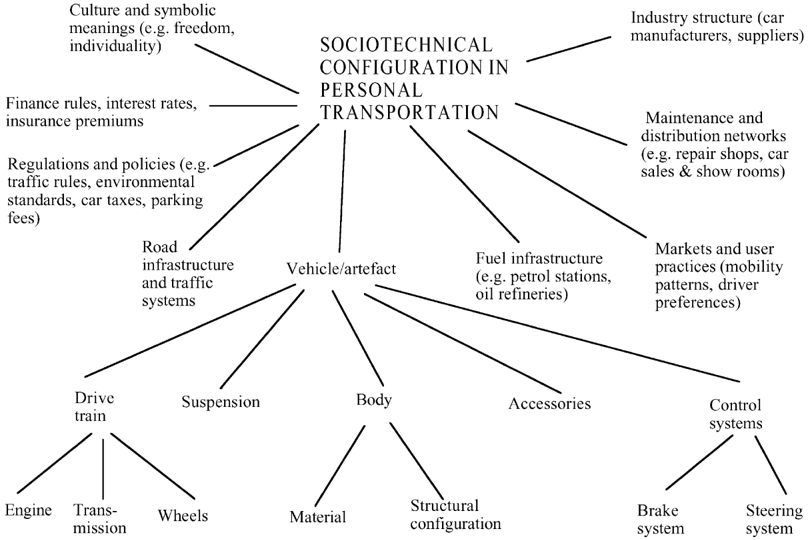
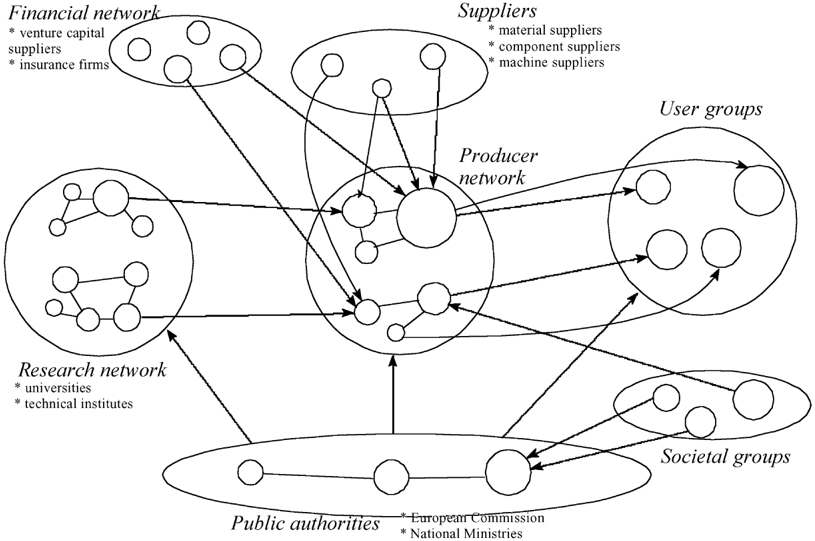
- Technological transitions are major, long-term changes in how societal functions are fulfilled; they involve not only technology but also user practices, regulation, industrial networks, infrastructure, and symbolic meaning or culture.
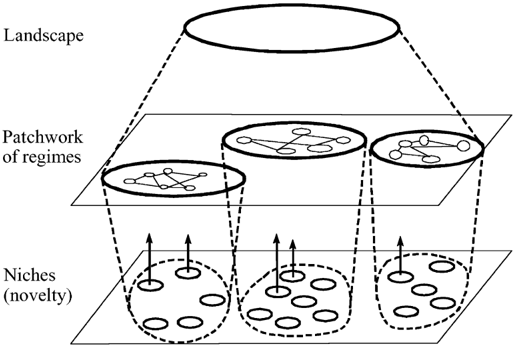
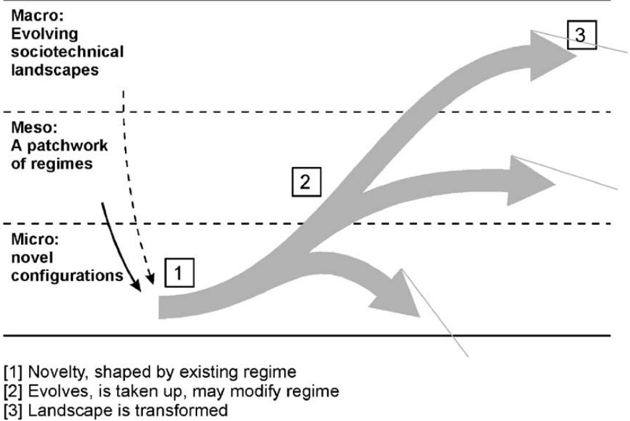
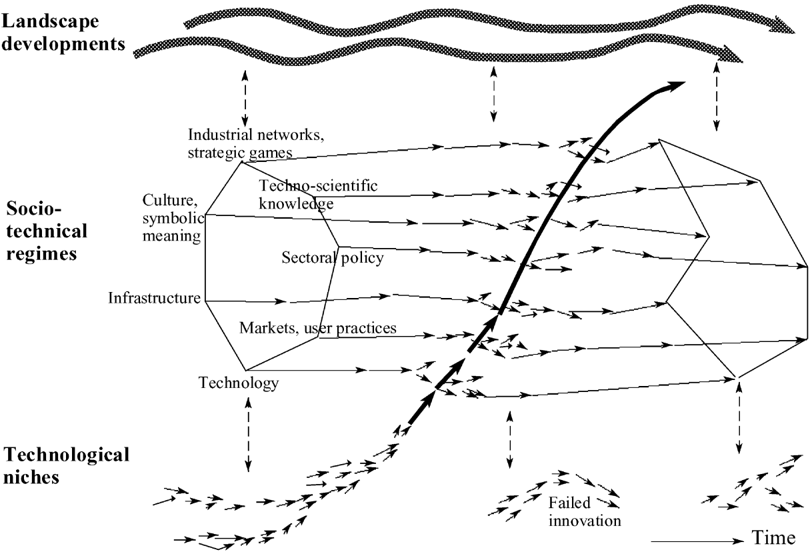
- The multi-level perspective treats niches as loci of radical variety, sociotechnical regimes as selection/retention mechanisms, and the landscape as slower external structure; breakthroughs occur when developments at multiple levels align and create a “window of opportunity.”
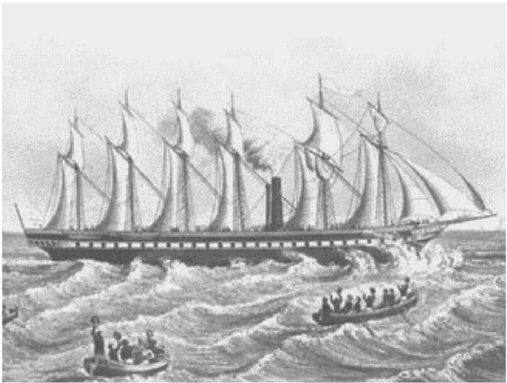
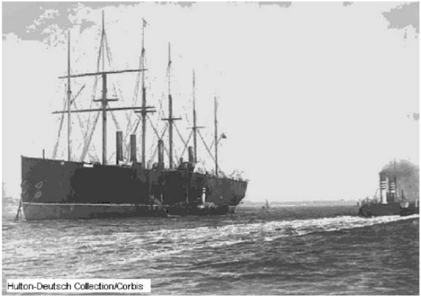
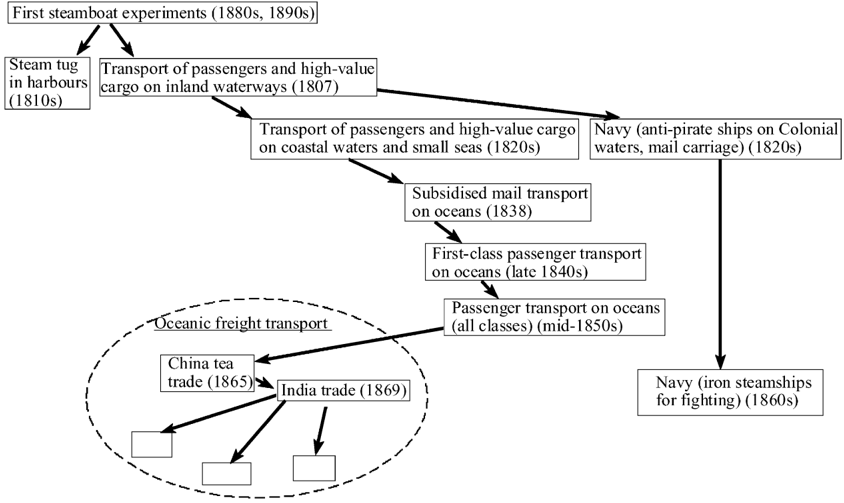
- In the steamship case, breakthrough followed niche-cumulation through inland waterways, coastal routes, mail subsidies, passenger transport, and freight; mechanisms included steam engines as auxiliary add-ons to sailing ships, hybrid sail/steam and iron/wood forms, and riding along with market growth.
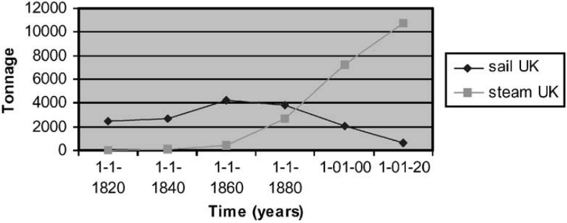
- Reported numbers include: European emigrants travelling by steamer rose from 45% in 1863 to 81% in 1866; compound engines enabled fuel-consumption reductions of 60%; the distance margin where steam was competitive reached 3000–3500 miles by the late 1860s; during the steamship mania (1869–1874), steamers rose from 17% to 31% of British registered tonnage.
Methods
- The paper uses “appreciative theory,” synthesising insights from evolutionary economics and technology studies into a multi-level perspective.
- It presents a qualitative longitudinal case study of the transition from sailing ships to steamships, 1780–1900, focused on Great Britain.
- The case is written in a mosaic style, shifting across markets, ship designs, insurance rules, actor groups, institutions, mail subsidies, persistent/emerging problems, and management practices to illustrate the conceptual framework.
Limitations
- The paper states that the multi-level perspective is fairly complex, requires many data, often qualitative, and that sociotechnical regimes are a broad unit of analysis with difficult-to-draw precise boundaries; boundary work deserves more attention.
- The paper states that the single case study has a drawback because 19th-century craft-based innovation differs from 20th-century science-based innovation, and the perspective would be more robust with more case studies varied over time periods and sectors.
- Evident in the text: the empirical analysis is focused on Great Britain and shipping, and the mechanisms are illustrated through selected historical examples rather than formal comparative or quantitative testing.
Model-written summary. Check it against the paper before relying on it.
Integrity signals
Registry
Cites
Statistics
Figures

Verification
Claims the paper makes
1 Valid · 5 Not valid · 42 Not checked · 63 Own results and interpretations
The cited sources support only part of this claim — read each source’s verdict below.
In the paper
“Aspecific mechanism in the breakthrough of radical innovations is technological add-on and hybridisation . It means that new technologies in their early phase physically link up with established technologies, often to solve particular bottlenecks. Thus, old and new technologies do not immediately compete head on, but form some sort of symbiosis (see also Pistorius and Utterback, 1997).”
What the sources say
- Partly supportedcites Pistorius and Utterback, 1997 matched to “Multi-mode interaction among technologies” (1997) sourceExperimental — accuracy not yet measured
Split into 2 atoms — 0 confirmed, 2 partially supported, 0 disputed, 0 misattributed, 0 unverifiable. Expand the claim to see per-atom verdicts.
plainstates a cause- Asserted: passes — The authors put it forward as true.
- Checkable: passes — It can be checked against evidence.
- Load-bearing: passes — The paper’s conclusions depend on it.
- Based: passes — The paper gives a reason why it holds.
- Partly supported
A result the paper states — it cites no source for it, so there is none to check. The quote shows it is in the paper.
In the paper
“These subsidies created a protective environment for the use and development of oceanic steamships.”
plainstates a cause- Asserted: passes — The authors put it forward as true.
- Checkable: passes — It can be checked against evidence.
- Load-bearing: unclear — It is unclear whether the paper’s conclusions depend on it.
- Based: passes — The paper gives a reason why it holds.
- Rests on an assumption not shown here.
In the paper
“Between 1838 and 1862 a global network of British intercontinental steam companies was created on the basis of imperial mail subsidies (Broeze, 1982).”
What the sources say
- Not matchedcites Broeze, 1982
An author–year citation the paper’s reference list doesn’t settle. We don’t search these by name.
plainstates a cause- Asserted: passes — The authors put it forward as true.
- Checkable: passes — It can be checked against evidence.
- Load-bearing: unclear — It is unclear whether the paper’s conclusions depend on it.
- Based: passes — The paper gives a reason why it holds.
- Rests on an assumption not shown here.
- Not matched
A result the paper states — it cites no source for it, so there is none to check. The quote shows it is in the paper.
In the paper
“Another innovation in the late 18th century shipping regime was the emergence of new social groups: professional shipowners, shipbrokers and insurance companies.”
plain- Asserted: passes — The authors put it forward as true.
- Checkable: passes — It can be checked against evidence.
- Load-bearing: unclear — It is unclear whether the paper’s conclusions depend on it.
- Based: passes — The paper gives a reason why it holds.
- Rests on an assumption not shown here.
A result the paper states — it cites no source for it, so there is none to check. The quote shows it is in the paper.
In the paper
“The emergence of professional shipowners was stimulated by the French Wars (1789-1815) which pushed up freight prices as demand for ships increased.”
plainstates a cause- Asserted: passes — The authors put it forward as true.
- Checkable: passes — It can be checked against evidence.
- Load-bearing: unclear — It is unclear whether the paper’s conclusions depend on it.
- Based: passes — The paper gives a reason why it holds.
- Rests on an assumption not shown here.
24 more claims
Create a free account to see all 111 claims and every source verdict.
- Probably not a substantial claim. 28
- It may state two separate claims as one. 69
- The quote only partly states this claim. 2
Claims other papers make about this one
Each is checked against this paper’s own text: does it say what the citing paper says it does?
In the citing paper
“The model of Geels (2002) describes new technologies as arising and maturing within existing technology systems [18].”
From Lessons Learned From a Living Lab on the Broad Adoption of eHealth in Primary Health Care (2018) · cites this paper as [18]
In the citing paper
“The multi-level perspective (Rip and Kemp, 1998;Geels, 2002;Geels, 2004;Geels and Schot, 2007) is a framework for understanding sustainability transitions that provides an overall view of the multi-dimensional complexity of changes in socio-technical systems.”
From Ontologies, socio-technical transitions (to sustainability), and the multi-level perspective (2010) · cites this paper as Geels, 2002
Citations
Cites
An Evolutionary Theory of Economic Change.
Loasby, B. J., Nelson, R. R., & Winter, S. G. (1983) · The Economic Journal · doi:10.2307/2232409 · Cited by 21,366
(1934) · SSRN Electronic Journal · Cited by 7,609
Technological Discontinuities and Organizational Environments
Tushman, M. L., & Anderson, P. (1986) · Administrative Science Quarterly · doi:10.2307/2392832 · Cited by 6,112
von Hippel, E. (2007) · Das Summa Summarum des Management · doi:10.1007/978-3-8349-9320-5_10 · Cited by 5,098
Technical Change and Economic Theory.
Swann, P., & Dosi, G. (1989) · The Economic Journal · doi:10.2307/2234048 · Cited by 4,041
Shaping Technology, Building Society: Studies in Sociotechnical Change.
Lynch, M., Bijker, W. E., & Law, J. (1993) · Contemporary Sociology · doi:10.2307/2074370 · Cited by 3,540
Technological Discontinuities and Dominant Designs: A Cyclical Model of Technological Change
Anderson, P., & Tushman, M. L. (1990) · Administrative Science Quarterly · doi:10.2307/2393511 · Cited by 3,255
Bijker, W. E., Hughes, T. P., & Pinch, T. (1987) · Cited by 2,957
Kemp, R., Schot, J., & Hoogma, R. (1998) · Technology Analysis & Strategic Management · doi:10.1080/09537329808524310 · Cited by 2,860
Innovation: Mapping the winds of creative destruction
Abernathy, W. J., & Clark, K. B. (1985) · Research Policy · doi:10.1016/0048-7333(85)90021-6 · Cited by 2,791
Research works printed but not linked: 9
- Broeze, F.J.A., 1982. The international diffusion of ocean steam navigation: the myth of the retardation of Netherlands steam navigation to the East Indies. Economisch-en Sociaal-Historisch Jaarboek 45, 77-95.
- Callon, M. (Ed.), 1998. The Laws of the Market. Blackwell, Oxford.
- Garrat, G.R.M., Goodman, D.C., Russel, C.A., 1973. Science and Engineering, Units 14 and 15. Open University Press, Bletchley.
- Jackson, G., 1998. Ports, ships and government in the nineteenth and twentieth centuries. In: Van Royen, P.C., Fischer, L.R., Williams, D.M. (Eds.), Proceedings of the Second International Congress of Maritime History on Frutta di Mare: Evolution and revolution in the maritime world in the 19th and 20th centuries. Amsterdam/Rotterdam, The Netherlands, 5-8 June, 1996. Batavian Lion International, Amsterdam, pp. 161-176.
- Lundvall, B.A., 1988. Innovation as an interactive process: from user-producer interaction to the national system of innovation. In: Dosi, G., Freeman, C., Nelson, R., Silverberg, G., Soete, L. (Eds.), Technical Change and Economic Theory. Pinter, London, pp. 349-369.
- Maddocks, M., 1982. De Grote Oversteek. Time-Life, London. Mayntz, R., Hughes, T.P. (Eds.), 1988. The Development of Large
- Mokyr, J., 1990. The Lever of Riches. Oxford University Press, New York.
- Rip, A., Kemp, R., 1996. Towards a Theory of Socio-Technical Change. Mimeo University of Twente, Report prepared for Batelle Pacific Northwest Laboratories, Washington, DC. (An edited version has been published as book chapter Rip and Kemp 1998).
- Sloan, E.W., 1998. Private enterprise as public utility: the management of capital in two centuries of shipping business. In: Van Royen, P.C., Fischer, L.R., Williams, D.M. (Eds.), Proceedings of the Second International Congress of Maritime History on Frutta di Mare: Evolution and Revolution in the Maritime World in the 19th and 20th Centuries. Amsterdam/Rotterdam, The Netherlands, 5-8 June, 1996. Batavian Lion International, Amsterdam, pp. 89-100.
Cited by
Items 4,301–4,400 of 7,210
Future Installation, Production and Global Trade of Clean Energy Technologies
Hembach-Stunden, K., Banning, M., Becker, L., Lutz, C., Matschoss, P., Klann, U., & Horst, J. (2024) · Sustainability · doi:10.3390/su162310482 · Cited by 7
Information Requirements and Legal Framework for Multimodal Transport System Coordination
Wittenberg, D., Paschke, A., Kukuk, A., & Pannek, J. (2024) · Logistics · doi:10.3390/logistics8040123 · Cited by 8
The Future: Challenges of Tomorrow for European Post-industrial Landscapes
Stojčić, N., Pavičić, J., & Zdilar, A. (2024) · Applied innovation and technology management · doi:10.1007/978-3-031-75649-8_3 · Cited by 3
Bridging Data Governance and Socio-Technical Transitions to Understand Sustainable Smart Cities
Nassar, J. B., Sharp, D., Anwar, M., Bartram, L., & Goodwin, S. (2024) · Journal of Urban Technology · doi:10.1080/10630732.2024.2444238 · Cited by 6
“…and civil society might not be su ffi cient to unpack nuanced implications on SCTs. Transition pathways are often based on the MLP framework (Geels, 2002) and involve the characterization of the regime and landscape pressures, the delineation of niche-based processes, and the identi fi…”
Nothing there . A small Armenian town between disappearance and endurance
Gunko, M. (2025) · Social & Cultural Geography · doi:10.1080/14649365.2025.2483712 · Cited by 4
Seebauer, S., Posch, E. L., Thaler, T., Winkler, C., & Mitter, H. (2025) · Mitigation and Adaptation Strategies for Global Change · doi:10.1007/s11027-025-10221-0 · Cited by 8
“In transition theory, the multi-level perspective on socio-technical transitions (MLP) cen - ters on socio-cultural landscapes, socio-technical regimes, and niches factors (Geels 2002 ; Raven et al. 2012).”
Hector, V., Friedrich, J., Schlaile, M. P., Panagiotou, A., & Bieling, C. (2025) · Agriculture and Human Values · doi:10.1007/s10460-025-10732-1 · Cited by 4
“…of agency has also received increasing atten - tion in transition studies highlighting the importance of collective but also individual actors and their activities and practices for facilitating changes in socio-technical systems (e.g. Geels 2002, 2011; Duygan et al. 2019; Huttunen et al. 2021 ).”
Embracing the tension: managing short-term horizons in long-term transitions
Beach, C., Chen, S. M., Lee, M., & Starr, R. G., Jr. (2025) · Research in Hospitality Management · doi:10.1080/22243534.2024.2441387 · Cited by 5
“Elkington’s (1994) triple bottom line identified the three dimensions of sustainability that firms must consider in their operations, while Geels’ (2002) multi-level perspective analyses how sustainable transitions unfold across levels, from niche (individual) practices to regime (organisational)…”
InfluentialFrom General Patterns to Middle-range: A Proposal for a Top-down Theorizing Strategy
Kanger, L. (2015) · Sociology · doi:10.1177/0038038515587640 · Cited by 4
Landscapes of Energies, a Perspective on the Energy Transition
Nadaï, A., & Maria-Jose, P. (2015) · Springer eBooks · doi:10.1007/978-94-017-9843-3_2 · Cited by 3
Understanding and navigating industrial emergence
Probert, D. R., Ford, S. J., Routley, M. J., O’Sullivan, E., & Phaal, R. (2013) · Proceedings of the Institution of Mechanical Engineers Part B Journal of Engineering Manufacture · doi:10.1177/0954405413479113 · Cited by 3
Ratinen, M., & Lund, P. D. (2016) · Palgrave Macmillan UK eBooks · doi:10.1057/978-1-137-55631-8_14 · Cited by 4
Dynamics of Bioplastics Development in Indonesia
Soesanto, Q. M. B., Prihadyanti, D., Hartiningsih, H., et al. (2016) · STI Policy and Management Journal · doi:10.14203/stipm.2016.48 · Cited by 3
Essegbey, G. O., Sakyi-Dawson, O., Kossou, D. K., Ouologuem, B., Dembele, F., Adu-Acheampong, R., & Jiggins, J. (2017) · Cahiers Agricultures · doi:10.1051/cagri/2017034 · Cited by 6
Mühlemeier, S. (2018) · Zeitschrift für Energiewirtschaft · doi:10.1007/s12398-018-0237-z · Cited by 3
BARRIERS TO RADICAL INNOVATIONS AS STABLE DESIGNS: INSIGHTS FROM AN IT CASE STUDY
Kompella, L. (2019) · International Journal of Innovation Management · doi:10.1142/s1363919619500476 · Cited by 2
Exploring the Psychological basis for Transitions in the Archaeological Record
Gabora, L. M., & Smith, C. M. (2019) · Routledge eBooks · doi:10.4324/9780429488818-12 · Cited by 4
Landscape of participatory city makers: A distinct understanding through different lenses
de Koning, J., Puerari, E., Mulder, I. J., & Loorbach, D. A. (2019) · FormAkademisk - forskningstidsskrift for design og designdidaktikk · doi:10.7577/formakademisk.2706 · Cited by 3
Towards a New Approach of Innovation in Less Developed Regional Business Ecosystems
Katimertzopoulos, F., & Vlados, C. M. (2019) · International Journal of Business and Economic Sciences Applied Research · doi:10.25103/ijbesar.122.03 · Cited by 7
Toppinen, A., Sauru, M., Pätäri, S., et al. (2018) · Osuva (University of Vaasa) · Cited by 3
Learning Through Collaboration: The Case of City Deals in The Netherlands
Dignum, M., Hamers, D., & Evers, D. (2020) · Palgrave studies in sub-national governance · doi:10.1007/978-3-030-36048-1_7 · Cited by 3
Alrashoud, K. A. (2020) · Springer eBooks · doi:10.1007/978-981-15-5803-0_5 · Cited by 4
Niche evolution, external circumstances, and network transformation
Dias, M. F. P., & Ramírez, M. (2020) · Revista Brasileira de Inovação · doi:10.20396/rbi.v19i0.8657550 · Cited by 9
Preventing Foodborne Illness: Norovirus
Schneider, K. R., Goodrich, R. M., Mahovic, M. J., & Shukla, R. (2019) · EDIS · doi:10.32473/edis-fs129-2005 · Cited by 3
Köhlke, J. (2019) · CIRED · doi:10.34890/970 · Cited by 3
Raumwirksamkeit des individuellen hoch- und vollautomatisierten Verkehrs
Dangschat, J. S. (2020) · Studien zur Mobilitäts- und Verkehrsforschung/Studien zur Mobilitäts- und Verkehrsforschung · doi:10.1007/978-3-658-31413-2_7 · Cited by 8
Bypassing the Obvious: Implementing Cutting Edge Ideas for Futuring Urban Landscapes
Roggema, R. (2021) · Urban and Regional Planning · doi:10.11648/j.urp.20210601.11 · Cited by 4
Шкарупа, О. В., Боронос, В. Г., Vlasenko, D., et al. (2021) · Problems and Perspectives in Management · doi:10.21511/ppm.19(1).2021.13 · Cited by 3
Communs et services urbains : un croisement fructueux ?
GOUVELLO, B. D., & Jaglin, S. (2021) · Flux · doi:10.3917/flux1.124.0001 · Cited by 3
A study of the challenges and opportunities to adopting renewable energy in Oman
Al-Sarihi, A. (2018) · doi:10.25560/84739 · Cited by 4
The Hiding Hand, Persistent Fragile Action, and Sustainable Development
Krlev, G. (2022) · Nonprofit and civil society studies · doi:10.1007/978-3-030-98008-5_7 · Cited by 5
van den Bergh, J. C. J. M. (2018) · Cambridge University Press eBooks · doi:10.1017/9781108564922.011 · Cited by 3
Digitale Zukünfte der Universität: Szenarien soziotechnischen Wandels
Wieser, B., Bangerl, M. M., & Karatas, K. (2022) · Österreichische Zeitschrift für Soziologie · doi:10.1007/s11614-022-00507-x · Cited by 3
Buddenberg, J., Buhl, J., & Liedtke, C. (2014) · Springer eBooks · doi:10.1007/978-3-658-02437-6_19 · Cited by 6
Transition to Clean Coal Technologies in India
Patil, A. C. (2009) · Computer-aided chemical engineering/Computer aided chemical engineering · doi:10.1016/s1570-7946(09)70679-0 · Cited by 3
Actionable Solutions to Tackle Future Energy Uncertainties
Patil, A. C., Herder, P., & Weijnen, M. (2006) · Conference proceedings/Conference proceedings - IEEE International Conference on Systems, Man, and Cybernetics · doi:10.1109/icsmc.2005.1571722 · Cited by 3
Introduction: the economic dynamics of fuel cell technologies
Avadikyan, A., Cohendet, P. S., & Héraud, J.-A. (2003) · Springer eBooks · doi:10.1007/978-3-540-24822-4_1 · Cited by 3
Augustsson, N., Holmström, J., & Nilsson, A. (2015) · Journal of the Korea society of IT services · doi:10.9716/kits.2015.14.2.337 · Cited by 3
The European CCS Demonstration Project Network — A forum for first movers
Bennett, S. J., Kelleher, M., Kruizinga, E., et al. (2011) · Energy Procedia · doi:10.1016/j.egypro.2011.02.543 · Cited by 3
Food futures: system transitions towards UK food security
Lee, R., & Marsden, T. (2011) · Journal of Human Rights and the Environment · doi:10.4337/jhre.2011.02.04 · Cited by 3
Challenges and Tensions in Area Based Transitions
Spekkink, W., Eshuis, J., Loorbach, D. A., Roorda, C., Stuiver, M., & van Steenbergen, F. (2012) · Wageningen University & Research Publications · Cited by 3
Zhang, R., & Xing-san, Q. (2008) · International Conference on Management Science and Engineering (ICMSE) · doi:10.1109/icmse.2008.4669146 · Cited by 3
Foxon, T. J., Burgess, J. A., Hammond, G. P., et al. (2010) · ORCA Online Research @Cardiff (Cardiff University) · Cited by 3
Sustainable Industrial Air Pollution Management
Chandrappa, R., & Kulshrestha, U. C. (2015) · Environmental science and engineering · doi:10.1007/978-3-319-21596-9_5 · Cited by 4
Komoto, K., Cunow, E., Breyer, C., et al. (2012) · EU PVSEC · doi:10.4229/27theupvsec2012-6cv.4.21 · Cited by 3
Triple Helixes, Classification Schemes and the Knowledge Ecologies of Innovation
Wixted, B., & Cozzens, S. E. (2007) · Summit (Simon Fraser University) · Cited by 3
The need for industrial transformation
Wieczorek, A. J., & Vellinga, P. (2004) · TU/e Research Portal · Cited by 3
Handbook of sustainable development: a book review
Henninger, C. E., & Boyer, R. H. W. (2015) · Journal of Cleaner Production · doi:10.1016/j.jclepro.2015.06.077 · Cited by 3
Barriers to Public Sector Innovation
Demircioğlu, M. A., & Audretsch, D. B. (2024) · Cambridge University Press eBooks · doi:10.1017/9781009279277.009 · Cited by 3
Guido, L., & Carrizo, S. C. (2016) · L’Ordinaire des Amériques · doi:10.4000/orda.3134 · Cited by 3
Lokale Innovationsimpulse und die Transformation des deutschen Energiesystems
Alle, K., Fettke, U., Fuchs, G., & Hinderer, N. (2017) · Energie in Naturwissenschaft, Technik, Wirtschaft und Gesellschaft · doi:10.1007/978-3-658-14801-0_1 · Cited by 5
Nemes, G., & Augustyn, A. M. (2017) · Innovation and Development · doi:10.1080/2157930x.2017.1281221 · Cited by 4
Mejía-Dugand, S. (2015) · Linköping University Electronic Press eBooks · doi:10.3384/diss.diva-117947 · Cited by 3
Hvordan kan staten fremme innovation, der fører til bæredygtige energisystemer?
Nielsen, H. Ø., & Pedersen, A. B. (2013) · Politica · doi:10.7146/politica.v45i3.69771 · Cited by 5
Military Technologies and Politics
Smit, W. A. (2009) · Oxford University Press eBooks · doi:10.1093/oxfordhb/9780199270439.003.0039 · Cited by 3
What works? An ANFIS-based policy evaluation framework for electric vehicle technology development
Özel, F. M., Davies, H., & Wells, P. (2017) · International Journal of Electric and Hybrid Vehicles · doi:10.1504/ijehv.2017.10008524 · Cited by 6
López-Fogués, A., Fernández‐Baldor, Á., & Aristizábal, A. B. (2017) · Gestión y Análisis de Políticas Públicas · doi:10.24965/gapp.v0i18.10427 · Cited by 6
Schiffelers, M.-J. W. A. (2015) · ALTEX · doi:10.14573/altex.1501261s · Cited by 3
Birch, K. (2018) · Springer eBooks · doi:10.1007/978-3-319-91424-4_2 · Cited by 3
Relações Multiníveis e Inovação Sustentável: O Programa Veículo Elétrico da Itaipu Brasil
de Mendonça, A. T. B. B., da Cunha, S. K., & Nascimento, T. C. (2018) · Revista Eletrônica de Ciência Administrativa · doi:10.21529/recadm.2018013 · Cited by 5
Examining urban Africa’s low carbon and energy transition pathways
Silver, J., & Marvin, S. (2018) · Routledge eBooks · doi:10.4324/9781315164779-9 · Cited by 4
Mainstreaming av passivhus : En studie av energieffektiva bostadshus i Sverige
Niskanen, J. (2018) · Linköping studies in arts and science · doi:10.3384/diss.diva-152758 · Cited by 3
ICT Exports and Environmental Degradation: The Case of South America
Moreno-Hurtado, C., Wilman-Santiago, O.-M., & Ochoa-Jiménez, D. (2019) · Iberian Conference on Information Systems and Technologies (CISTI) · doi:10.23919/cisti.2019.8760843 · Cited by 3
Zur geographischen Spezifizierung soziotechnischer Systeme
Truffer, B. (2013) · TATuP Zeitschrift für Technikfolgenabschätzung in Theorie und Praxis · doi:10.14512/tatup.22.2.20 · Cited by 3
André‐Lamat, V., & Sacareau, I. (2019) · Développement durable et territoires · doi:10.4000/developpementdurable.16190 · Cited by 4
The Transition to Improved Water-Related Energy Management: Enabling Contexts for Policy Innovation
Binks, A. N., Head, B. W., Lant, P. A., & Kenway, S. J. (2020) · Water · doi:10.3390/w12020557 · Cited by 4
Wojciechowski, M. J., Favareto, A. D. S., Vega, S. M. R., & Viégas, I. F. P. (2020) · Redes · doi:10.17058/redes.v25i1.14639 · Cited by 10
Managerial levers of market-shaping strategies: An abductive inquiry
Storbacka, K., & Nenonen, S. (2021) · Journal of Global Scholars of Marketing Science · doi:10.1080/21639159.2020.1808836 · Cited by 9
at, A. D. (2015) · International Journal of Innovation and Knowledge Management in Middle East and North Africa · doi:10.47556/j.ijikmmena.4.2.2015.1 · Cited by 3
Reprint of: Social movements and free innovation
Jeppesen, L. B. (2021) · Research Policy · doi:10.1016/j.respol.2021.104288 · Cited by 5
Have the cats been herded? An evaluation framework for simultaneous public interventions
Bhagavathy, S. M., Cardenes, I., & McCulloch, M. D. (2021) · Energy Research & Social Science · doi:10.1016/j.erss.2021.102278 · Cited by 3
Collaborative and Equitable Urban Citizen Science
MacClune, K., Venkateswaran, K., Wahab, B., Petersen, S., Mani, N., Singh, B. K., & Singh, A. K. (2018) · Cambridge University Press eBooks · doi:10.1017/9781316647554.014 · Cited by 4
Avdeitchikova, S., & Coenen, L. (2015) · Edward Elgar Publishing eBooks · doi:10.4337/9781849808248.00024 · Cited by 7
THE GENESIS AND EVOLUTION OF DIGITAL PAYMENT PLATFORMS
Hjelholt, M., & Damsgaard, J. (2012) · CBS Research Portal (Copenhagen Business School) · Cited by 3
The Geography of Urban Sustainability Transitions: A Critical Review
Mourato, J. M., & de Wit, F. (2021) · World sustainability series · doi:10.1007/978-3-030-86304-3_33 · Cited by 6
Les Grands Auteurs en Management de l'innovation et de la créativité
Boutillier, S., & Laperche, B. (2016) · EMS Editions eBooks · doi:10.3917/ems.burge.2016.01.0037 · Cited by 3
Social Ecology State of the Art and Future Prospects
Kramm, J., Zimmermann, M., Pichler, M., & Schaffartzik, A. (2017) · MDPI eBooks · doi:10.3390/books978-3-03842-547-2 · Cited by 3
Cultures and Local Practices of Sustainability. ROUTES Towards Sustainability Network
Vélez, A. E. B., Casals, A., & Valdivieso, G. (2021) · doi:10.18566/978-958-764-999-4 · Cited by 4
17. Online Conferences: Some History, Methods and Benefits
Byrd, N. (2021) · Open Book Publishers · doi:10.11647/obp.0213.28 · Cited by 3
Schumpeterian economic dynamics of greening: propagation of green eco-platforms
Mathews, J. A. (2020) · Economic complexity and evolution · doi:10.1007/978-3-030-84931-3_14 · Cited by 4
Ceschin, F. (2014) · Greenleaf Publishing eBooks · doi:10.9774/gleaf.978-1-909493-69-8_10 · Cited by 9
Cordes, D. L., Latifi, S., & Morrison, G. M. (2022) · SN Business & Economics · doi:10.1007/s43546-022-00328-w · Cited by 3
“It potentially serves to provide structure to innovation and to inform socio-technical transition theory (STTT) (Geels 2002).”
BackgroundMoro, A., & Legale, E. (2023) · City Territory and Architecture · doi:10.1186/s40410-022-00190-1 · Cited by 5
“Geels in his work on the transition of complex societal systems and its contextualisation to urban settings with a focus on innovating practices and processes (Geels 2002; Geels and Schot 2007) as further analysed and developed with reference to urban context and design practices (Concilio Tosoni 2019).”
BackgroundCombining Short-Term Economic Recovery with Long-Term Sustainability
Chewpreecha, U., Pollitt, H., & Mercure, J.-F. (2023) · International papers in political economy · doi:10.1007/978-3-031-19256-2_6 · Cited by 4
Transdisciplinary Approaches to Engineering R&D: Importance of Understanding Values and Culture
Brent, A. (2013) · Springer eBooks · doi:10.1007/978-1-4020-8939-8_90 · Cited by 3
Brand, B., & Fink, T. (2014) · Publication Server of the Wuppertal Institute (Wuppertal Institute) · Cited by 5
e-Textbooks: Towards the New Socio-Technical Regime
Pata, K., Eradze, M., & Laanpere, M. (2014) · Lecture notes in computer science · doi:10.1007/978-3-319-13296-9_25 · Cited by 3
Regional patterns of co-patenting by technological fields, a Europe - US comparison
Kroll, H., & Mallig, N. (2009) · Atlanta Conference on Science and Innovation Policy · doi:10.1109/acsip.2009.5367852 · Cited by 5
Distribution of responsibility in socio-technical networks: the Promest case
Doorn, N., Raven, R. P. J. M., & Royakkers, L. M. M. (2011) · Technology Analysis and Strategic Management · doi:10.1080/09537325.2011.558403 · Cited by 3
Managing technological transitions: prospects, places, publics and policy
Hodson, M., & Marvin, S. (2006) · University of Salford Institutional Repository (University of Salford) · Cited by 5
How Could Sustainability Transition Theories Support Practice-Based Strategic Planning?
Bush, J., Aye, L., Hes, D., et al. (2017) · Theory and practice of urban sustainability transitions · doi:10.1007/978-981-10-4792-3_5 · Cited by 3
Adopter une vision dynamique de l’innovation soutenable : le cas des circuits courts alimentaires
Brûlé-Gapihan, É., Laude, A., & Maclouf, É. (2017) · Revue d économie industrielle · doi:10.4000/rei.6598 · Cited by 9
Building social capital for constructive adaptive capacity under social stress
Wang, Y., Ko, P., & Law, N. W. Y. (2020) · Journal of Professional Capital and Community · doi:10.1108/jpcc-07-2020-0057 · Cited by 3
Vasseur, V. (2014) · Research Publications (Maastricht University) · doi:10.26481/dis.20141002vv · Cited by 7
Exploring the possibility of the insurance industry as a solar water heater driver in South Africa
Kritzinger, K. (2011) · SUNScholar (Stellenbosch University) · doi:10.13140/rg.2.2.20371.99366 · Cited by 7
Engel, N. (2008) · RePEc: Research Papers in Economics · Cited by 3
Schroeder, P. (2010) · Open Access Victoria University of Wellington | Te Herenga Waka (Figshare) · doi:10.26686/wgtn.16996840 · Cited by 8
Community activism and sustainability: a multi-dimensional assessmentPreprint
Celata, F., & Sanna, V. S. (2014) · RePEc: Research Papers in Economics · Cited by 15
Machacek, E. (2012) · Lund University Publications Student Papers (Lund University) · Cited by 4
Understanding Change and Difference in the Global Automotive Industry
Wells, P. (2015) · doi:10.1002/9781118802366.ch2 · Cited by 3
Metadata
- Authors
- Geels, F. W.
- Affiliations
- University of Twente (NL)
- Corresponding author
- Geels, Frank W.
- ORCID
- Geels, Frank W.
- Venue
- Research Policy
- Publisher
- Elsevier BV
- Published
- 2002-12
- Volume
- 31
- Issue
- 8-9
- Pages
- 1257-1274
- ISSN
- 0048-7333 (ISSN-L)
- OpenAlex
- W2099330597
- Cited by
- 7,275
- References
- 94
- Citations by year
- 2026: 983 · 2025: 624 · 2024: 502 · 2023: 504 · 2022: 503 · 2021: 598 · 2020: 526 · 2019: 417 · 2018: 493 · 2017: 357 · 2016: 301 · 2015: 293 · 2014: 241 · 2013: 201 · 2012: 204
- FWCI
- 16.68
- Type
- journal article
- Language
- en
- Open access
- bronze
- doi.org
- Licence
- www.elsevier.com/tdm/userlicense/1.0/ (tdm)
- Locations
- Research Policy (publishedVersion)
- Research Explorer (The University of Manchester) (submittedVersion, other-oa)
- University of Twente Research Information (submittedVersion)
- TU/e Research Portal (submittedVersion)
- RePEc: Research Papers in Economics (submittedVersion)
- Figshare (submittedVersion, cc-by)
- University of Twente Research Information (submittedVersion, other-oa)
- Funders
- Nederlandse Organisatie voor Wetenschappelijk Onderzoek
- Topics
- Physical Sciences › Environmental Science › Global and Planetary Change › Sustainability and Climate Change Governance
- Social Sciences › Decision Sciences › Management Science and Operations Research › Innovation Diffusion and Forecasting
- Social Sciences › Economics, Econometrics and Finance › Economics and Econometrics › Economic Theory and Institutions
- Keywords
- technological transition, multi-level perspective, evolutionary economics, technology studies, hybridization, market growth, industrial networks, user practices, regulation, infrastructure
About these checks
Registry, retraction, Cites and statistics results are computed, not judged, with one exception: a printed reference that no index lists is read once by a model before it counts as a citation error. Claims are extracted by a model and kept only when their quote appears verbatim in the text; each cited source is then checked, with a model’s help, for whether it says what the claim relies on. Those verdicts can be wrong — read the claim’s quote and the cited source before relying on one.
The claim verdicts this report counts are experimental: their accuracy is not yet measured.
A language model drew the claims from the paper on 2026-10-10, under version 3 of the claim definition (model deepseek-v4.1-flash, prompt extract-v3).
A second model labelled each claim on 2026-10-10 (model jev-1.13-20260917, definition revision gold-guideline-v0.2).
Cited sources are checked with a language model’s help (gpt-6-sol).
Statistics and arithmetic are recomputed, not judged.
Confidence bands are shown only for fields calibrated on our annotated test set. None is calibrated yet, so no band is shown.
What counts as a claim ›How we measure confidence ›How we check this ›
Are you an author, or do you see a problem with this page? Request a review
Data sources
Bibliographic data: Semantic Scholar, OpenAlex, Crossref.
Contains information from the Semantic Scholar Academic Graph Datasets, made available under the ODC Attribution License (ODC-BY 1.0).
Semantic Scholar’s data is described in: Kinney, R., et al. (2023). The Semantic Scholar Open Data Platform. arXiv:2301.10140.
