

Technological transitions as evolutionary reconfiguration processes: a multi-level perspective and a case-study
Open accessThe DOI matches its Crossref record; 86 of the 94 references it cites were found in a registry or an index; 1 of the 45 sources its claims cite were checked for support.
Overview
CoChat Summary
TL;DR
Geels proposes a multi-level perspective on technological transitions, combining evolutionary economics and technology studies around niches, sociotechnical regimes, and landscape. He illustrates it with a qualitative longitudinal case study of the transition from sailing ships to steamships, 1780–1900, identifying niche-cumulation, technological add-on/hybridisation, and riding along with market growth.
Key findings
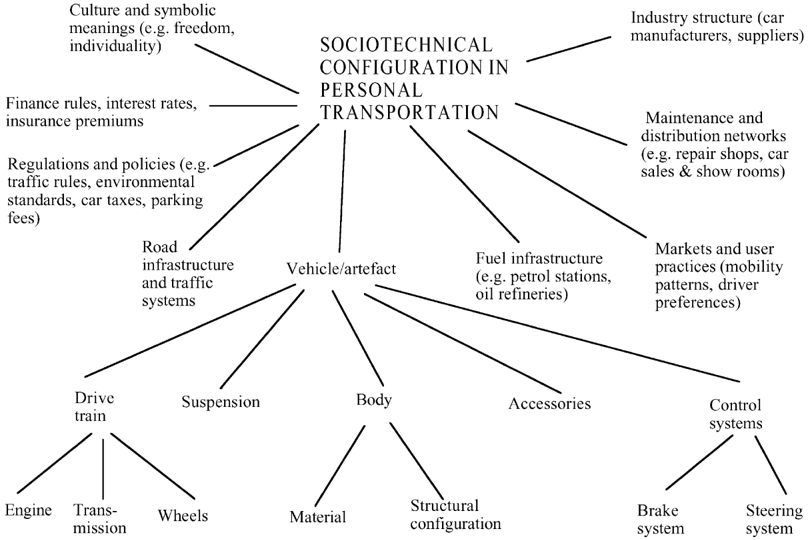
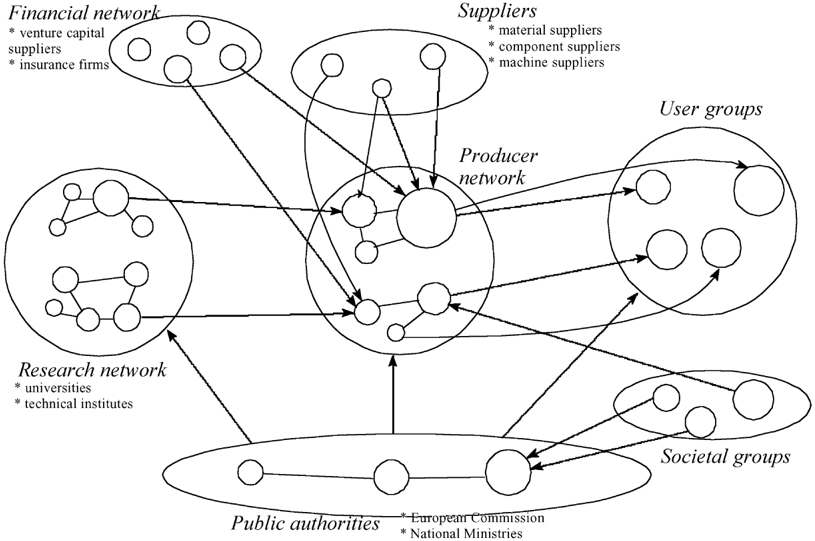
- Technological transitions are major, long-term changes in how societal functions are fulfilled; they involve not only technology but also user practices, regulation, industrial networks, infrastructure, and symbolic meaning or culture.
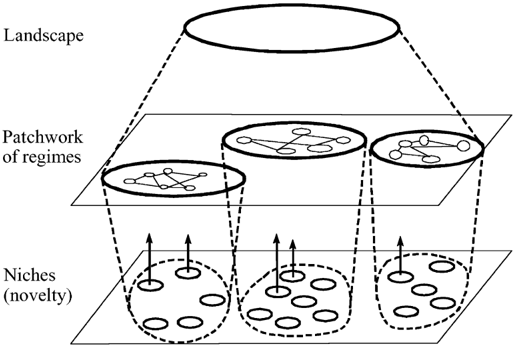
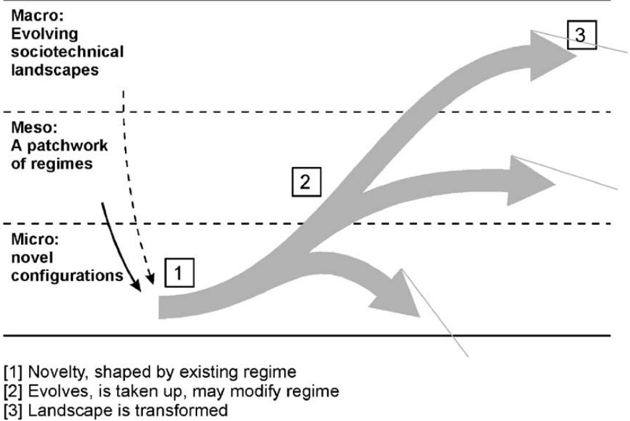
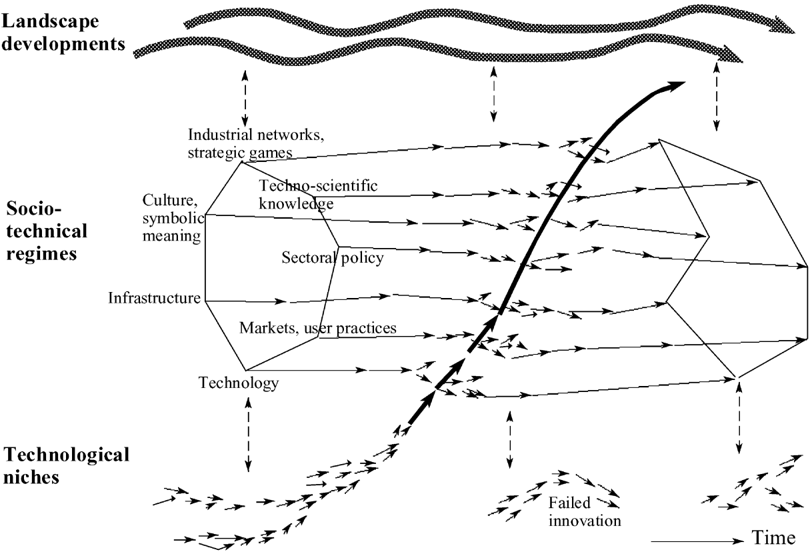
- The multi-level perspective treats niches as loci of radical variety, sociotechnical regimes as selection/retention mechanisms, and the landscape as slower external structure; breakthroughs occur when developments at multiple levels align and create a “window of opportunity.”
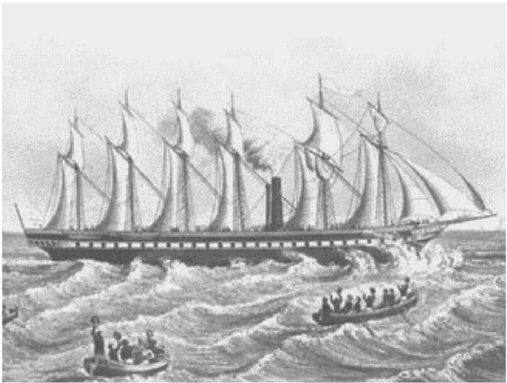
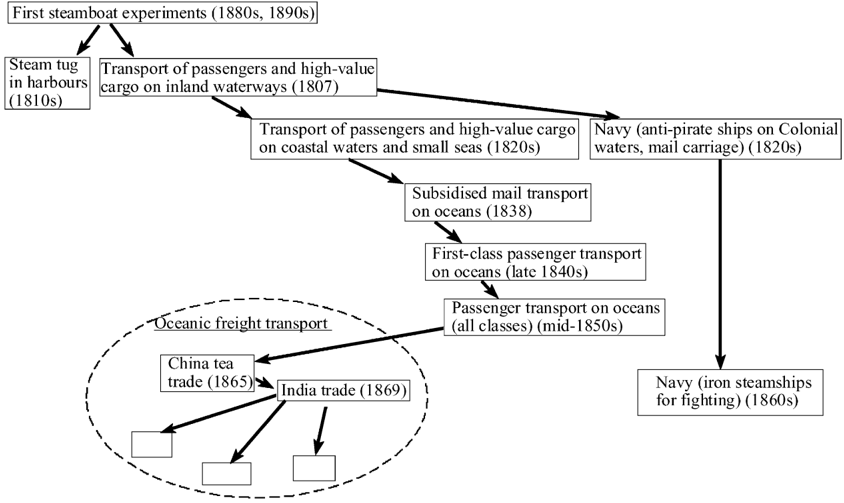
- In the steamship case, breakthrough followed niche-cumulation through inland waterways, coastal routes, mail subsidies, passenger transport, and freight; mechanisms included steam engines as auxiliary add-ons to sailing ships, hybrid sail/steam and iron/wood forms, and riding along with market growth.
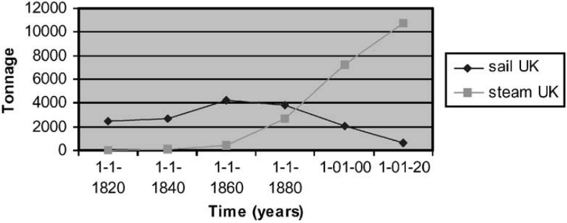
- Reported numbers include: European emigrants travelling by steamer rose from 45% in 1863 to 81% in 1866; compound engines enabled fuel-consumption reductions of 60%; the distance margin where steam was competitive reached 3000–3500 miles by the late 1860s; during the steamship mania (1869–1874), steamers rose from 17% to 31% of British registered tonnage.
Methods
- The paper uses “appreciative theory,” synthesising insights from evolutionary economics and technology studies into a multi-level perspective.
- It presents a qualitative longitudinal case study of the transition from sailing ships to steamships, 1780–1900, focused on Great Britain.
- The case is written in a mosaic style, shifting across markets, ship designs, insurance rules, actor groups, institutions, mail subsidies, persistent/emerging problems, and management practices to illustrate the conceptual framework.
Limitations
- The paper states that the multi-level perspective is fairly complex, requires many data, often qualitative, and that sociotechnical regimes are a broad unit of analysis with difficult-to-draw precise boundaries; boundary work deserves more attention.
- The paper states that the single case study has a drawback because 19th-century craft-based innovation differs from 20th-century science-based innovation, and the perspective would be more robust with more case studies varied over time periods and sectors.
- Evident in the text: the empirical analysis is focused on Great Britain and shipping, and the mechanisms are illustrated through selected historical examples rather than formal comparative or quantitative testing.
Model-written summary. Check it against the paper before relying on it.
Integrity signals
Registry
Cites
Statistics
Figures

Verification
Claims the paper makes
1 Valid · 5 Not valid · 42 Not checked · 63 Own results and interpretations
The cited sources support only part of this claim — read each source’s verdict below.
In the paper
“Aspecific mechanism in the breakthrough of radical innovations is technological add-on and hybridisation . It means that new technologies in their early phase physically link up with established technologies, often to solve particular bottlenecks. Thus, old and new technologies do not immediately compete head on, but form some sort of symbiosis (see also Pistorius and Utterback, 1997).”
What the sources say
- Partly supportedcites Pistorius and Utterback, 1997 matched to “Multi-mode interaction among technologies” (1997) sourceExperimental — accuracy not yet measured
Split into 2 atoms — 0 confirmed, 2 partially supported, 0 disputed, 0 misattributed, 0 unverifiable. Expand the claim to see per-atom verdicts.
plainstates a cause- Asserted: passes — The authors put it forward as true.
- Checkable: passes — It can be checked against evidence.
- Load-bearing: passes — The paper’s conclusions depend on it.
- Based: passes — The paper gives a reason why it holds.
- Partly supported
A result the paper states — it cites no source for it, so there is none to check. The quote shows it is in the paper.
In the paper
“These subsidies created a protective environment for the use and development of oceanic steamships.”
plainstates a cause- Asserted: passes — The authors put it forward as true.
- Checkable: passes — It can be checked against evidence.
- Load-bearing: unclear — It is unclear whether the paper’s conclusions depend on it.
- Based: passes — The paper gives a reason why it holds.
- Rests on an assumption not shown here.
In the paper
“Between 1838 and 1862 a global network of British intercontinental steam companies was created on the basis of imperial mail subsidies (Broeze, 1982).”
What the sources say
- Not matchedcites Broeze, 1982
An author–year citation the paper’s reference list doesn’t settle. We don’t search these by name.
plainstates a cause- Asserted: passes — The authors put it forward as true.
- Checkable: passes — It can be checked against evidence.
- Load-bearing: unclear — It is unclear whether the paper’s conclusions depend on it.
- Based: passes — The paper gives a reason why it holds.
- Rests on an assumption not shown here.
- Not matched
A result the paper states — it cites no source for it, so there is none to check. The quote shows it is in the paper.
In the paper
“Another innovation in the late 18th century shipping regime was the emergence of new social groups: professional shipowners, shipbrokers and insurance companies.”
plain- Asserted: passes — The authors put it forward as true.
- Checkable: passes — It can be checked against evidence.
- Load-bearing: unclear — It is unclear whether the paper’s conclusions depend on it.
- Based: passes — The paper gives a reason why it holds.
- Rests on an assumption not shown here.
A result the paper states — it cites no source for it, so there is none to check. The quote shows it is in the paper.
In the paper
“The emergence of professional shipowners was stimulated by the French Wars (1789-1815) which pushed up freight prices as demand for ships increased.”
plainstates a cause- Asserted: passes — The authors put it forward as true.
- Checkable: passes — It can be checked against evidence.
- Load-bearing: unclear — It is unclear whether the paper’s conclusions depend on it.
- Based: passes — The paper gives a reason why it holds.
- Rests on an assumption not shown here.
24 more claims
Create a free account to see all 111 claims and every source verdict.
- Probably not a substantial claim. 28
- It may state two separate claims as one. 69
- The quote only partly states this claim. 2
Claims other papers make about this one
Each is checked against this paper’s own text: does it say what the citing paper says it does?
In the citing paper
“The model of Geels (2002) describes new technologies as arising and maturing within existing technology systems [18].”
From Lessons Learned From a Living Lab on the Broad Adoption of eHealth in Primary Health Care (2018) · cites this paper as [18]
In the citing paper
“The multi-level perspective (Rip and Kemp, 1998;Geels, 2002;Geels, 2004;Geels and Schot, 2007) is a framework for understanding sustainability transitions that provides an overall view of the multi-dimensional complexity of changes in socio-technical systems.”
From Ontologies, socio-technical transitions (to sustainability), and the multi-level perspective (2010) · cites this paper as Geels, 2002
Citations
Cites
An Evolutionary Theory of Economic Change.
Loasby, B. J., Nelson, R. R., & Winter, S. G. (1983) · The Economic Journal · doi:10.2307/2232409 · Cited by 21,366
(1934) · SSRN Electronic Journal · Cited by 7,609
Technological Discontinuities and Organizational Environments
Tushman, M. L., & Anderson, P. (1986) · Administrative Science Quarterly · doi:10.2307/2392832 · Cited by 6,112
von Hippel, E. (2007) · Das Summa Summarum des Management · doi:10.1007/978-3-8349-9320-5_10 · Cited by 5,098
Technical Change and Economic Theory.
Swann, P., & Dosi, G. (1989) · The Economic Journal · doi:10.2307/2234048 · Cited by 4,041
Shaping Technology, Building Society: Studies in Sociotechnical Change.
Lynch, M., Bijker, W. E., & Law, J. (1993) · Contemporary Sociology · doi:10.2307/2074370 · Cited by 3,540
Technological Discontinuities and Dominant Designs: A Cyclical Model of Technological Change
Anderson, P., & Tushman, M. L. (1990) · Administrative Science Quarterly · doi:10.2307/2393511 · Cited by 3,255
Bijker, W. E., Hughes, T. P., & Pinch, T. (1987) · Cited by 2,957
Kemp, R., Schot, J., & Hoogma, R. (1998) · Technology Analysis & Strategic Management · doi:10.1080/09537329808524310 · Cited by 2,860
Innovation: Mapping the winds of creative destruction
Abernathy, W. J., & Clark, K. B. (1985) · Research Policy · doi:10.1016/0048-7333(85)90021-6 · Cited by 2,791
Research works printed but not linked: 9
- Broeze, F.J.A., 1982. The international diffusion of ocean steam navigation: the myth of the retardation of Netherlands steam navigation to the East Indies. Economisch-en Sociaal-Historisch Jaarboek 45, 77-95.
- Callon, M. (Ed.), 1998. The Laws of the Market. Blackwell, Oxford.
- Garrat, G.R.M., Goodman, D.C., Russel, C.A., 1973. Science and Engineering, Units 14 and 15. Open University Press, Bletchley.
- Jackson, G., 1998. Ports, ships and government in the nineteenth and twentieth centuries. In: Van Royen, P.C., Fischer, L.R., Williams, D.M. (Eds.), Proceedings of the Second International Congress of Maritime History on Frutta di Mare: Evolution and revolution in the maritime world in the 19th and 20th centuries. Amsterdam/Rotterdam, The Netherlands, 5-8 June, 1996. Batavian Lion International, Amsterdam, pp. 161-176.
- Lundvall, B.A., 1988. Innovation as an interactive process: from user-producer interaction to the national system of innovation. In: Dosi, G., Freeman, C., Nelson, R., Silverberg, G., Soete, L. (Eds.), Technical Change and Economic Theory. Pinter, London, pp. 349-369.
- Maddocks, M., 1982. De Grote Oversteek. Time-Life, London. Mayntz, R., Hughes, T.P. (Eds.), 1988. The Development of Large
- Mokyr, J., 1990. The Lever of Riches. Oxford University Press, New York.
- Rip, A., Kemp, R., 1996. Towards a Theory of Socio-Technical Change. Mimeo University of Twente, Report prepared for Batelle Pacific Northwest Laboratories, Washington, DC. (An edited version has been published as book chapter Rip and Kemp 1998).
- Sloan, E.W., 1998. Private enterprise as public utility: the management of capital in two centuries of shipping business. In: Van Royen, P.C., Fischer, L.R., Williams, D.M. (Eds.), Proceedings of the Second International Congress of Maritime History on Frutta di Mare: Evolution and Revolution in the Maritime World in the 19th and 20th Centuries. Amsterdam/Rotterdam, The Netherlands, 5-8 June, 1996. Batavian Lion International, Amsterdam, pp. 89-100.
Cited by
Items 4,401–4,500 of 7,210
Nastar, M. (2014) · Lund University Publications (Lund University) · Cited by 12
Environmental Innovation Policy. Is Steering Innovation Processes Possible?
Kemp, R., & Zundel, S. (2007) · Physica-Verlag eBooks · doi:10.1007/978-3-7908-1650-1_3 · Cited by 3
Comparative Analysis and Synthesis Report
Hermans, F., Klerkx, L., & Roep, D. (2011) · Socio-Environmental Systems Modeling · Cited by 3
Coenen, L., Moodysson, J., & Martin, H. (2013) · RePEc: Research Papers in Economics · Cited by 6
Behavioural models of technological change
Zeppini, P. (2011) · UvA-DARE (University of Amsterdam) · Cited by 5
CAN DEMONSTRATION PROJECTS ACT AS A MECHANISM FOR PROMOTING A TRANSITION
Farrelly, M. A., Brown, R. R., & Davis, C. (2009) · Cited by 4
Brown, R. R., & Keath, N. (2007) · Rainwater and Urban Design · Cited by 3
Davies, M. (2016) · SUNScholar (Stellenbosch University) · Cited by 5
Assessment of Future Energy Demand: A Methodological ReviewPreprint
Nursimulu, A. (2015) · SSRN Electronic Journal · doi:10.2139/ssrn.2831916 · Cited by 3
An investigation into planning for urban resilience through niche interventions
Doyon, A. (2016) · Minerva Access (University of Melbourne) · Cited by 5
Buurma, J. S., Beers, P. J., & Smit, P. (2016) · doi:10.18174/400594 · Cited by 3
Business nets : classification and management mechanisms
Möller, K., & Rajala, A. (2006) · Aaltodoc (Aalto University) · Cited by 51
Transformative change in contemporary Australian agriculture
Sinclair, K. B. (2014) · Charles Sturt University Research Output (CRO) · Cited by 4
Urban Sustainability Transition
Loorbach, D. A. (2017) · Wiley eBooks · doi:10.1002/9781119007241.ch10 · Cited by 6
Naus, J. (2017) · doi:10.18174/423138 · Cited by 11
Muilerman, S. (2019) · doi:10.18174/499620 · Cited by 5
The grassroots energy transition: the success and governance of local low-carbon energy initiatives
Warbroek, B. (2019) · doi:10.3990/1.9789036548427 · Cited by 7
Bremmer, J., Hoes, A.-C., de Lauwere, C., & Smit, A. B. (2020) · doi:10.18174/526698 · Cited by 4
The socio-political dimensions of agricultural technology promotion in Ethiopia
de Roo, N. (2020) · doi:10.18174/530481 · Cited by 5
Cooper, M. H. (2020) · SSRN Electronic Journal · doi:10.2139/ssrn.3693861 · Cited by 4
Nilson, K., & Tuvlind, A. (2020) · KTH Publication Database DiVA (KTH Royal Institute of Technology) · Cited by 7
Souza, J. C. P. V. B. (2020) · doi:10.18174/533112 · Cited by 4
Mormina, M., & Istratii, R. (2021) · SSRN Electronic Journal · doi:10.2139/ssrn.3827371 · Cited by 3
Bertassini, A. C., Ometto, A. R., & Gerólamo, M. C. (2021) · doi:10.31880/10344/10196 · Cited by 3
Peter W. G. Morris: In memoriam
Winch, G., & Pinto, J. K. (2022) · International Journal of Project Management · doi:10.1016/j.ijproman.2022.01.003 · Cited by 3
Assessing Change Agency in Urban Experiments for Sustainability TransitionsPreprint
Roebke, L., Grillitsch, M., & Coenen, L. (2022) · SSRN Electronic Journal · doi:10.2139/ssrn.4069227 · Cited by 3
“Thus, technological transitions emerge from the niche and are scaled up if there is enough pressure for change on the regime from the landscape and niche levels (Geels, 2002, 2019; Köhler et al., 2019).”
BackgroundMethodOpening Up The Tools For Doing Science: The Case Of The Global Open Science Hardware MovementPreprint
Arancio, J. (2020) · doi:10.31235/osf.io/46keb · Cited by 3
Bäumle, P., Hirschmann, D., & Feser, D. (2022) · SSRN Electronic Journal · doi:10.2139/ssrn.4159600 · Cited by 6
van Summeren, L. F. M., Wieczorek, A. J., Verbong, G. P. J., et al. (2022) · SSRN Electronic Journal · doi:10.2139/ssrn.4203646 · Cited by 3
Guest editorial: Special issue: Multidimensional sustainability – transitions and convergences
Lobo, R. C. G., Gilbertz, S. J., & de Morais, J. C. P. (2024) · International Journal of Innovation Science · doi:10.1108/ijis-04-2024-279 · Cited by 3
Loan Guarantee and Portfolio Greening: Evidence from European Credit RegistersPreprint
Buchetti, B., Lin, L. X., Miquel-Flores, I., Perdichizzi, S., & Reghezza, A. (2024) · SSRN Electronic Journal · doi:10.2139/ssrn.4731209 · Cited by 5
Edgell, R. (2024) · SSRN Electronic Journal · doi:10.2139/ssrn.4993807 · Cited by 3
Castillo-Ospina, D. A., Pinto, M. R., & Ometto, A. R. (2025) · SSRN Electronic Journal · doi:10.2139/ssrn.5078635 · Cited by 3
Optimal Diversity in Investments with Recombinant InnovationPreprint
van den Bergh, J. C. J. M., & Zeppini-Rossi, P. (2008) · SSRN Electronic Journal · doi:10.2139/ssrn.1274093 · Cited by 3
Hyman, K. (2011) · SUNScholar (Stellenbosch University) · Cited by 6
Sharmeen, F., Drost, D., & Meurs, H. (2020) · Research in Transportation Economics · doi:10.1016/j.retrec.2020.100959 · Cited by 14
Feng, K., & Schmidt, J. A. (2019) · IOP Conference Series Earth and Environmental Science · doi:10.1088/1755-1315/323/1/012179 · Cited by 2
Naranjo, J. I. C., & Cantor, G. A. F. (2024) · Revista de Economia e Sociologia Rural · doi:10.1590/1806-9479.2022.271345 · Cited by 4
Leveraging keystone agents in extractive industries to advance sustainability
Scholtens, B. (2023) · Global Environmental Change · doi:10.1016/j.gloenvcha.2023.102794 · Cited by 3
Dell’Olio, M., & Reeve, J. L. (2024) · British Journal of General Practice · doi:10.3399/bjgp.2023.0514 · Cited by 4
Infrastructures and Transformation: Between Path Dependency and Opening-Up for Experimental Change
Böschen, S., Hermens, S. E., Jakobs, E.-M., Lohrberg, F., Madlener, R., Mütze‐Niewöhner, S., Reicher, C., & Schöpper, Y. (2024) · Springer eBooks · doi:10.1007/978-3-031-54700-3_4 · Cited by 6
Rangel, R. R. (2024) · RECIMA21 - Revista Científica Multidisciplinar · doi:10.47820/recima21.v5i6.5382 · Cited by 2
Data-Mediated Environments: Reality after the Metaverse
Heemsbergen, L. J. (2024) · IntechOpen eBooks · doi:10.5772/intechopen.1006622 · Cited by 12
Pauker, M., & Hamiduddin, I. (2024) · Urban Research & Practice · doi:10.1080/17535069.2024.2429450 · Cited by 2
“We show how niche and regime-level actors have employed strategic calculation to challenge this regime, attempting to Geels 2002, 1263), from (Geels and Schot 2007, 401). manage landscape-level tensions arising from intensified commodification of land and housing.”
Flaherty, D., Hoefnagel, I., Hogervorst, P. A. M., & Klaassen, P. (2025) · Sustainability & Circularity NOW · doi:10.1055/a-2540-9377 · Cited by 2
“…Perspective (MLP) to study the transition to a safe, sustainable, and circular IB The MLP, developed by Rip and Kemp [56] and refined by Geels [57] provides a systems perspective that inspired and guided our research question and was instrumental in delineating our study population and…”
Lin, Y., & Liu, P. (2025) · R and D Management · doi:10.1111/radm.12761 · Cited by 2
“Previous studies have focused on understanding how technological transitions occur and the mechanisms in the transition process (Geels 2002; Henderson and Clark 1990).”
Lim, E. J., Fell, M. J., & Shipworth, D. (2025) · Energy Research & Social Science · doi:10.1016/j.erss.2025.104072 · Cited by 4
Revisiting the role of private voluntary standards and initiatives in decarbonising shipping
Rehmatulla, N., Schwarz, K., & Nameghi, F. H. (2025) · Marine Policy · doi:10.1016/j.marpol.2025.106707 · Cited by 2
“The interview findings showed that an important driver is that the landscape [52] in shipping has shifted significantly.”
Kanakis, I., Arapostathis, S., & Rozakis, S. (2025) · Sustainability · doi:10.3390/su17094228 · Cited by 3
Whittington, D., Nauges, C., & Damania, R. (2025) · Environmental Research Letters · doi:10.1088/1748-9326/add750 · Cited by 2
“In each of these three phases, society’s urban water supply objectives institutional arrangements (or rules) governing water and sanitation management define water regimes (Geels 2002, Geels and Schot 2007).”
The Global Green Shift: History, Dynamics, and Prospects
Fagerberg, J. (2025) · Oxford University Press eBooks · doi:10.1093/oxfordhb/9780198883487.013.2 · Cited by 3
Neij, L., Lompar, S. S., Heiskanen, E., et al. (2025) · Oxford Open Energy · doi:10.1093/ooenergy/oiaf004 · Cited by 2
Applying biotechnology for advanced frugal innovation for prosperity in the 21st century
Liefner, I., Worbs, L., Barnikol, J., Heiden, S., Lucas, H., & Rao, B. C. (2025) · Technovation · doi:10.1016/j.technovation.2025.103275 · Cited by 6
Figueira, M., de Brito, A. G., & de Sousa, I. M. N. (2025) · Environmental and Sustainability Indicators · doi:10.1016/j.indic.2025.100752 · Cited by 10
Circular practice in the bioeconomy: Barriers and transition pathways in agri-food
Faulkner, J.-P., Murphy, E., & Scott, M. J. (2026) · Journal of Environmental Management · doi:10.1016/j.jenvman.2026.129699 · Cited by 3
Resilience Orientation in Bioeconomy Policies - A Global Comparative Analysis
Proestou, M., Goritz, N., & Feindt, P. H. (2025) · Circular Economy and Sustainability · doi:10.1007/s43615-025-00643-y · Cited by 3
“Finally, the bioeconomy transformation involves the creation of new and niche markets as well as regime shifts that inherently require transform-ability [7, 72].”
From control to care: Trans-hegemonic approaches to just-sustainability transformations
Nelson, V. (2025) · Environmental Science & Policy · doi:10.1016/j.envsci.2025.104115 · Cited by 8
Pathways from street experiments to transformation: a systematic review of theories of change
Grandel, G., & Berger, M. (2025) · Transport Reviews · doi:10.1080/01441647.2025.2523282 · Cited by 8
“This is theorised most often with the multi-level perspective (MLP) for socio-technical change (Geels, 2002).”
Loodts, N., Frison, C., Dendoncker, N., & Hermesse, J. (2025) · Sustainability Science · doi:10.1007/s11625-025-01715-6 · Cited by 2
“Two contributions, based on the multi-level perspective (Geels 2002, 2004; Geels and Schot 2007), stress the historical dimension of de-territori-alisation/re-terrirorialisation dynamics, showing how these depend on the fluctuations of the socio-political and environmental landscape.”
Multi-system Interactions among Finnish Textile Companies for Adopting Circular Economy Practices
Haukkala, T., Salmenperä, H., & Ovaska, J. (2025) · Circular Economy and Sustainability · doi:10.1007/s43615-025-00622-3 · Cited by 5
“In transition, many of the niche level experiments will not succeed in their struggle to make their way to the regime level [6].”
InfluentialTsou, C.-T., & Bao, Z. (2025) · Asian Journal of Technology Innovation · doi:10.1080/19761597.2025.2543787 · Cited by 2
“Tsou and Kim (2024a) examine cross-system interactions using the concepts of multi-level perspective (MLP) developed by Frank W. Geels (2002) and multi-scalar MLP (Bunnell & Coe, 2001; Raven et al., 2012), extending it by incorporating the technological sector and geographical space dimensions.”
InfluentialJacquet, C., & Siqueira, T. T. D. S. (2025) · Environmental Innovation and Societal Transitions · doi:10.1016/j.eist.2025.101038 · Cited by 5
Finkill, G., Gough, C., Mander, S. L., & Jones, C. (2025) · Energy Policy · doi:10.1016/j.enpol.2025.114832 · Cited by 3
Runhaar, H. A. C., van Doorm, S., Cartagena, L. B., de Graaff, S., Offringa, C., Oers, L. M. V., Pustilnik, N., Remorie, E., Lageweg, W., & Raven, R. P. J. M. (2025) · Environmental Science & Policy · doi:10.1016/j.envsci.2025.104206 · Cited by 5
Grafström, J., Poelzer, G. A., & Pettersson, J. (2025) · Mineral Economics · doi:10.1007/s13563-025-00540-8 · Cited by 8
“The framework draws on systems theory and transition literature, including constraint propagation (Arthur 1989), socio-technical feedback (Geels 2002, 2005), and institutional lock-in (Pierson 2000).”
Tetteh, S., Amoabeng-Nimako, S., Leeuwis, C., Freeman, C., Maat, H., Macnaghten, P., Doukkali, R., Bindraban, P. S., Ingenbleek, P. T. M., Dittoh, S., et al. (2025) · Nutrient Cycling in Agroecosystems · doi:10.1007/s10705-025-10439-z · Cited by 3
“Geels (2002) and others (Schot and Geels 2008) identified that a sociotechnical regime comprises six different elements: technology, market, policy, industry, science, and culture.”
InfluentialGasbarro, F., & Bazzani, F. (2025) · Transport Policy · doi:10.1016/j.tranpol.2025.103822 · Cited by 3
Azimi, M. N., Rahman, M. M., & Maraseni, T. (2025) · Sustainable Futures · doi:10.1016/j.sftr.2025.101351 · Cited by 7
Existing Sustainability Interventions are Insufficient to Scale Up Cocoa Agroforestry in West Africa
Kouakou, K. M., Lyons-White, J. P., Thompson, W. J., Addoah, T., Cammelli, F., Blaser, W. J., Maguire-Rajpaul, V. A., Dawoe, E., & Garrett, R. D. (2025) · Sustainable Development · doi:10.1002/sd.70266 · Cited by 14
Zhang, F., Zhang, J., & Hussain, M. (2025) · Land · doi:10.3390/land14102071 · Cited by 2
“To strengthen the theoretical basis, this study frames these five areas within the concepts of classical regional integration theory (Balassa, 1961) [9], collaborative governance theory (Emerson et al., 2012) [21], and sustainability transition theory (Geels, 2002) [22].”
Assembling the plant-based meat proposition: Towards food systems transitions in Australia
McGregor, A., RICKARDS, L. A., Houston, D., & Goodman, M. K. (2025) · Environment and Planning E Nature and Space · doi:10.1177/25148486251388555 · Cited by 2
“The MLP was popularised by Geels (2002) as a heuristic to help conceptualise how sectors or industries transition into more sustainable forms.”
Evaluating battery electric vehicle policies: a benefit-cost analysis framework
Anilan, V., Vij, A., Connor, J., Barrie, H., & Ardeshiri, A. (2025) · Transportation · doi:10.1007/s11116-025-10690-x · Cited by 6
To clear-cut or not to clear-cut: Diversifying benefits from small-scale forestry in Sweden
Stryamets, N., Elbakidze, M., Dawson, L., et al. (2025) · Forest Ecosystems · doi:10.1016/j.fecs.2025.100401 · Cited by 2
“…perspective (MLP) framework, which conceptualizes socio-technical transitions as processes resulting from the interaction be-tween innovations at the niche level, the stability of incumbent socio-technical regimes, and broader pressures from the landscape level (Geels, 2002, 2005, 2011).”
Analyzing the Nexus Between Economic Policies and SDG 13 in G7 Countries: An fsQCA Approach
Rasheed, M., & Liu, J. (2025) · Sustainable Development · doi:10.1002/sd.70371 · Cited by 2
Lee, H., Lee, C.-H., Lim, S., & Chun, K. W. (2025) · Sustainability · doi:10.3390/su17219733 · Cited by 3
Baur, P., Jennings, R., Aliu, S., Calo, A. J., Farhangi, M., He, Y., Kanki, K., Koch, A.-K., Kiyoyama, Y., Martin, M. A., et al. (2025) · Frontiers in Sustainable Food Systems · doi:10.3389/fsufs.2025.1653448 · Cited by 4
Elantary, A. R. (2025) · Sustainability · doi:10.3390/su172210349 · Cited by 2
An industrial strategy for EU cohesion in an era of transformation
Propris, L. D., & Labory, S. (2025) · Contemporary Social Science · doi:10.1080/21582041.2025.2590108 · Cited by 7
“…drivers and dynamics of technological transitions across technological paradigms have been explored by the Multi-Level Perspective (MLP) framework (Geels, 2002; Geels & Schot, 2007) which argues that system change occurs when a set of new technologies challenges existing ones by moving in from…”
Human Capital and the Sustainable Energy Transition: A Socio-Economic Perspective
Klonowska-Matynia, M. (2025) · Sustainability · doi:10.3390/su172310710 · Cited by 2
A prescriptive route optimization model for industrial firms advancing twin transition
Khatua, S., Haque, S., Panda, D., & De, D. (2025) · Sustainable Futures · doi:10.1016/j.sftr.2025.101558 · Cited by 3
Fischer, F., & Schwab, A.-K. (2025) · npj Climate Action · doi:10.1038/s44168-025-00310-w · Cited by 6
“Sustainability transition studies investigate how innovations from the bottomupmayleadtosystemicchanges 65,66 .”
Tavares, H. P., Christo, E. D. S., Sampaio, N. A. D. S., Junior, J. E. M., Aguiar, L. G. D. A., Cardoso, R. P., & de Almeida, M. D. G. D. (2025) · Discover Sustainability · doi:10.1007/s43621-025-02480-3 · Cited by 4
“Drawing from the Multi-Level Perspective (MLP) on sustainability transitions developed by Geels [8], energy transitions encompass transformations across three analytical levels: technological niches (where radical innovations emerge), socio-technical regimes (dominant practices, technologies, and…”
Yadav, A., Anandhukrishna, A. S., Reddy, K. A., & Manoj, P. (2025) · Discover Sustainability · doi:10.1007/s43621-025-02090-z · Cited by 2
“…the framework incorporates socio-behavioral dimensions such as affordability, cultural acceptability, gender roles, and fuel choice—elements emphasized in multi-level perspective (MLP) transition studies, where household-level practices interact with broader regime and landscape pressures [69].”
Pedersen, R. L., & Nicholas, K. A. (2025) · Agriculture and Human Values · doi:10.1007/s10460-025-10807-z · Cited by 4
“Other transformation theories widely used in sustainability literature, such as transition theory (Geels 2002; Kemp et al. 2007), social-ecological resilience (Olsson et al. 2014 ), leverage points (Meadows 1999; Abson et al. 2017), and three spheres of transformation (O’Brien and Sygna 2013 ),…”
Bridging the gap: Innovation systems and sustainable development in developing countries
Arboleda-Muñoz, G. A., Chaparro‐Banegas, N., & Roig‐Tierno, N. (2025) · Journal of Open Innovation Technology Market and Complexity · doi:10.1016/j.joitmc.2025.100713 · Cited by 7
Advancing energy justice through ESG: The role of confucian culture and digital finance
Xin, B., Wang, Y., Peng, W., Tan, H., & Kwon, J. (2026) · Research in International Business and Finance · doi:10.1016/j.ribaf.2026.103296 · Cited by 3
Jackson, R. D., & Gratton, C. (2026) · Frontiers in Sustainable Food Systems · doi:10.3389/fsufs.2025.1696429 · Cited by 2
Mediation roles and ecologies within resilience-focused urban living labs
Antaki, N., Petrescu, D., Schalk, M., Brandao, E., Calciu, D., & Marin, V. (2026) · Buildings and Cities · doi:10.5334/bc.608 · Cited by 2
Mouafo, A. D., Tei, A., Ferrari, C., Wide, P., & Santén, V. (2026) · Technological Forecasting and Social Change · doi:10.1016/j.techfore.2026.124559 · Cited by 6
How digital platforms enable sustainability transitions in the built environment
Ninan, J., Zaharia, A., & Bosch-Rekveldt, M. G. C. (2026) · Construction Management and Economics · doi:10.1080/01446193.2026.2629869 · Cited by 3
“It captures influences from technological niches, entrenched industry regimes, and broader landscape contexts and highlight its impact in bringing about sustainability transitions (Geels 2002).”
Antecedents of biochar adoption for sustainable agriculture and circular economy
Rasheed, M. H., Qayyum, A., Alomair, A., & Naim, A. S. A. (2026) · Discover Sustainability · doi:10.1007/s43621-026-02763-3 · Cited by 2
Emerging trends in mid-rise timber construction: insights from the DACH region
Santana-Sosa, A., Simsek, E., & Kovačić, I. (2026) · Frontiers in Built Environment · doi:10.3389/fbuil.2025.1744132 · Cited by 3
Chen, Y., Acheampong, R. A., & Liu, L. (2026) · Cities · doi:10.1016/j.cities.2026.106841 · Cited by 2
On different lanes: A cross-case analysis of urban experimentation for autonomous driving
Stein, V., Fraske, T., & Schippl, J. (2026) · Technological Forecasting and Social Change · doi:10.1016/j.techfore.2026.124616 · Cited by 2
“As such, autonomous driving can be understood as part of a socio-technical transition, involving long-term changes in technologies, institutions and actor constellations (Fraedrich et al., 2015; Geels, 2002; K ¨ ohler et al., 2019).”
Agrawal, R., & Wankhede, V. A. (2026) · International Journal of Lean Six Sigma · doi:10.1108/ijlss-01-2025-0012 · Cited by 3
Aagaard, A. (2026) · Research Policy · doi:10.1016/j.respol.2026.105457 · Cited by 3
Mapping sustainable transitions in tourism
Beach, C., Lee, M., Chen, S. M., & Starr, R. G., Jr. (2026) · Journal of Hospitality and Tourism Management · doi:10.1016/j.jhtm.2026.101436 · Cited by 3
Haralambides, H. E., AKDAMAR, E., & Akgül, E. F. (2026) · The Asian Journal of Shipping and Logistics · doi:10.1016/j.ajsl.2026.03.001 · Cited by 3
Tsomb, E. I. B. T. (2026) · Sustainable Development · doi:10.1002/sd.70962 · Cited by 4
Metadata
- Authors
- Geels, F. W.
- Affiliations
- University of Twente (NL)
- Corresponding author
- Geels, Frank W.
- ORCID
- Geels, Frank W.
- Venue
- Research Policy
- Publisher
- Elsevier BV
- Published
- 2002-12
- Volume
- 31
- Issue
- 8-9
- Pages
- 1257-1274
- ISSN
- 0048-7333 (ISSN-L)
- OpenAlex
- W2099330597
- Cited by
- 7,275
- References
- 94
- Citations by year
- 2026: 983 · 2025: 624 · 2024: 502 · 2023: 504 · 2022: 503 · 2021: 598 · 2020: 526 · 2019: 417 · 2018: 493 · 2017: 357 · 2016: 301 · 2015: 293 · 2014: 241 · 2013: 201 · 2012: 204
- FWCI
- 16.68
- Type
- journal article
- Language
- en
- Open access
- bronze
- doi.org
- Licence
- www.elsevier.com/tdm/userlicense/1.0/ (tdm)
- Locations
- Research Policy (publishedVersion)
- Research Explorer (The University of Manchester) (submittedVersion, other-oa)
- University of Twente Research Information (submittedVersion)
- TU/e Research Portal (submittedVersion)
- RePEc: Research Papers in Economics (submittedVersion)
- Figshare (submittedVersion, cc-by)
- University of Twente Research Information (submittedVersion, other-oa)
- Funders
- Nederlandse Organisatie voor Wetenschappelijk Onderzoek
- Topics
- Physical Sciences › Environmental Science › Global and Planetary Change › Sustainability and Climate Change Governance
- Social Sciences › Decision Sciences › Management Science and Operations Research › Innovation Diffusion and Forecasting
- Social Sciences › Economics, Econometrics and Finance › Economics and Econometrics › Economic Theory and Institutions
- Keywords
- technological transition, multi-level perspective, evolutionary economics, technology studies, hybridization, market growth, industrial networks, user practices, regulation, infrastructure
About these checks
Registry, retraction, Cites and statistics results are computed, not judged, with one exception: a printed reference that no index lists is read once by a model before it counts as a citation error. Claims are extracted by a model and kept only when their quote appears verbatim in the text; each cited source is then checked, with a model’s help, for whether it says what the claim relies on. Those verdicts can be wrong — read the claim’s quote and the cited source before relying on one.
The claim verdicts this report counts are experimental: their accuracy is not yet measured.
A language model drew the claims from the paper on 2026-10-10, under version 3 of the claim definition (model deepseek-v4.1-flash, prompt extract-v3).
A second model labelled each claim on 2026-10-10 (model jev-1.13-20260917, definition revision gold-guideline-v0.2).
Cited sources are checked with a language model’s help (gpt-6-sol).
Statistics and arithmetic are recomputed, not judged.
Confidence bands are shown only for fields calibrated on our annotated test set. None is calibrated yet, so no band is shown.
What counts as a claim ›How we measure confidence ›How we check this ›
Are you an author, or do you see a problem with this page? Request a review
Data sources
Bibliographic data: Semantic Scholar, OpenAlex, Crossref.
Contains information from the Semantic Scholar Academic Graph Datasets, made available under the ODC Attribution License (ODC-BY 1.0).
Semantic Scholar’s data is described in: Kinney, R., et al. (2023). The Semantic Scholar Open Data Platform. arXiv:2301.10140.
