

Technological transitions as evolutionary reconfiguration processes: a multi-level perspective and a case-study
Open accessThe DOI matches its Crossref record; 86 of the 94 references it cites were found in a registry or an index; 1 of the 45 sources its claims cite were checked for support.
Overview
CoChat Summary
TL;DR
Geels proposes a multi-level perspective on technological transitions, combining evolutionary economics and technology studies around niches, sociotechnical regimes, and landscape. He illustrates it with a qualitative longitudinal case study of the transition from sailing ships to steamships, 1780–1900, identifying niche-cumulation, technological add-on/hybridisation, and riding along with market growth.
Key findings
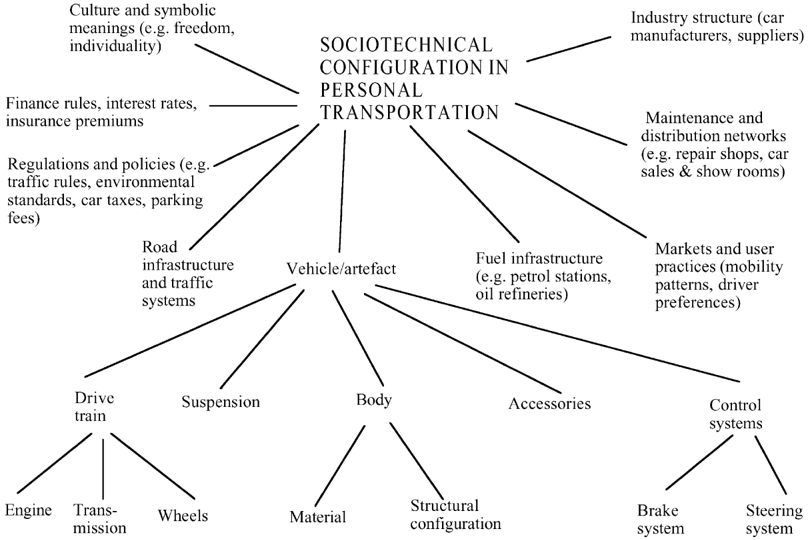
- Technological transitions are major, long-term changes in how societal functions are fulfilled; they involve not only technology but also user practices, regulation, industrial networks, infrastructure, and symbolic meaning or culture.
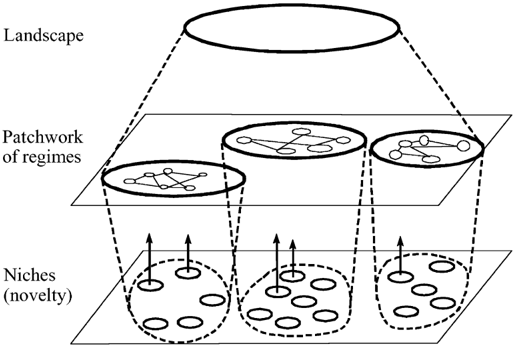
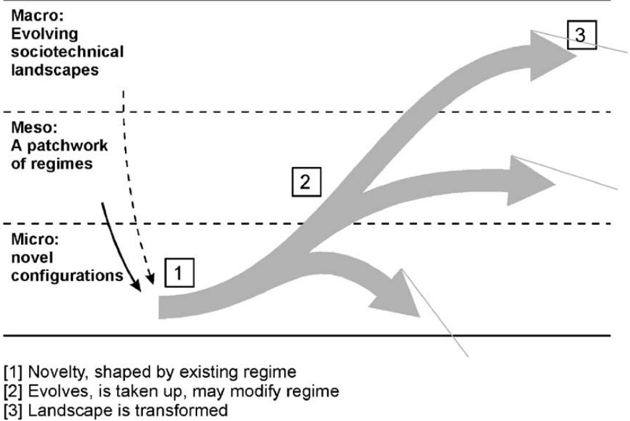
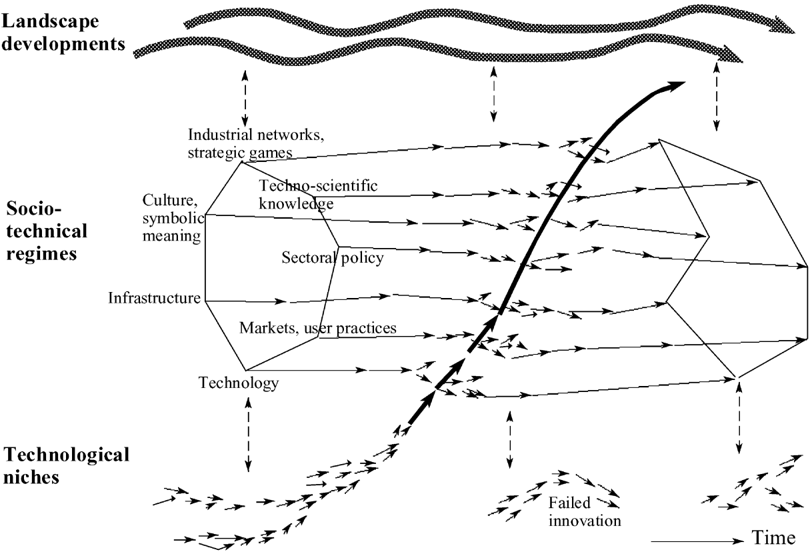
- The multi-level perspective treats niches as loci of radical variety, sociotechnical regimes as selection/retention mechanisms, and the landscape as slower external structure; breakthroughs occur when developments at multiple levels align and create a “window of opportunity.”
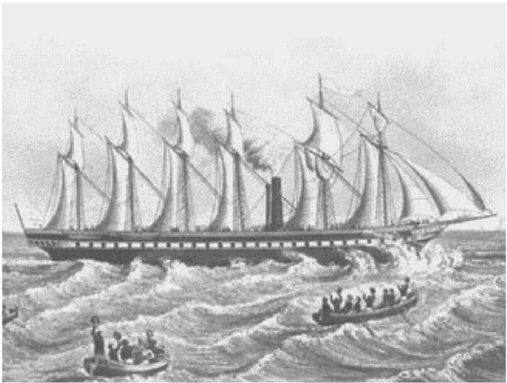
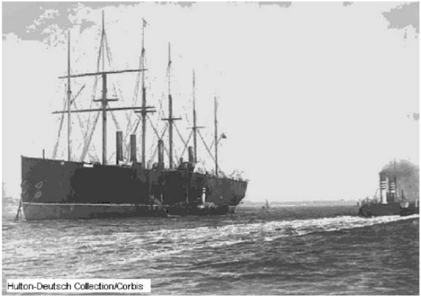
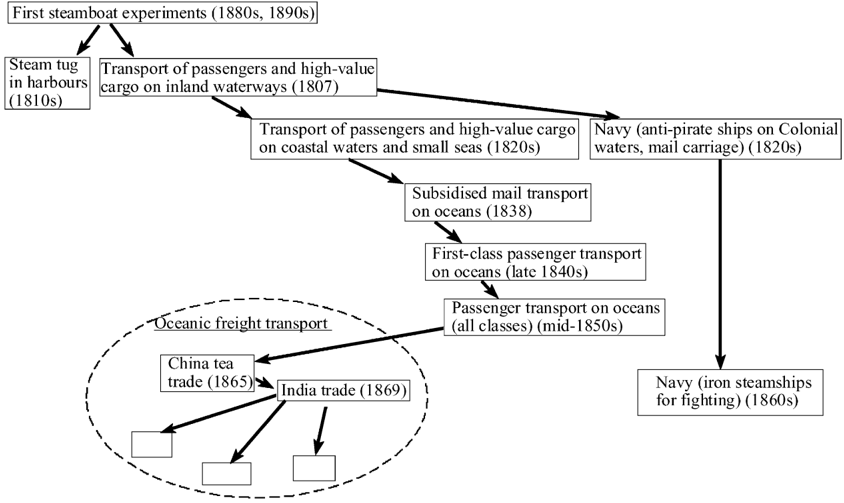
- In the steamship case, breakthrough followed niche-cumulation through inland waterways, coastal routes, mail subsidies, passenger transport, and freight; mechanisms included steam engines as auxiliary add-ons to sailing ships, hybrid sail/steam and iron/wood forms, and riding along with market growth.
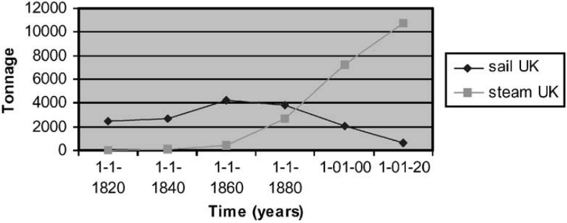
- Reported numbers include: European emigrants travelling by steamer rose from 45% in 1863 to 81% in 1866; compound engines enabled fuel-consumption reductions of 60%; the distance margin where steam was competitive reached 3000–3500 miles by the late 1860s; during the steamship mania (1869–1874), steamers rose from 17% to 31% of British registered tonnage.
Methods
- The paper uses “appreciative theory,” synthesising insights from evolutionary economics and technology studies into a multi-level perspective.
- It presents a qualitative longitudinal case study of the transition from sailing ships to steamships, 1780–1900, focused on Great Britain.
- The case is written in a mosaic style, shifting across markets, ship designs, insurance rules, actor groups, institutions, mail subsidies, persistent/emerging problems, and management practices to illustrate the conceptual framework.
Limitations
- The paper states that the multi-level perspective is fairly complex, requires many data, often qualitative, and that sociotechnical regimes are a broad unit of analysis with difficult-to-draw precise boundaries; boundary work deserves more attention.
- The paper states that the single case study has a drawback because 19th-century craft-based innovation differs from 20th-century science-based innovation, and the perspective would be more robust with more case studies varied over time periods and sectors.
- Evident in the text: the empirical analysis is focused on Great Britain and shipping, and the mechanisms are illustrated through selected historical examples rather than formal comparative or quantitative testing.
Model-written summary. Check it against the paper before relying on it.
Integrity signals
Registry
Cites
Statistics
Figures

Verification
Claims the paper makes
1 Valid · 5 Not valid · 42 Not checked · 63 Own results and interpretations
The cited sources support only part of this claim — read each source’s verdict below.
In the paper
“Aspecific mechanism in the breakthrough of radical innovations is technological add-on and hybridisation . It means that new technologies in their early phase physically link up with established technologies, often to solve particular bottlenecks. Thus, old and new technologies do not immediately compete head on, but form some sort of symbiosis (see also Pistorius and Utterback, 1997).”
What the sources say
- Partly supportedcites Pistorius and Utterback, 1997 matched to “Multi-mode interaction among technologies” (1997) sourceExperimental — accuracy not yet measured
Split into 2 atoms — 0 confirmed, 2 partially supported, 0 disputed, 0 misattributed, 0 unverifiable. Expand the claim to see per-atom verdicts.
plainstates a cause- Asserted: passes — The authors put it forward as true.
- Checkable: passes — It can be checked against evidence.
- Load-bearing: passes — The paper’s conclusions depend on it.
- Based: passes — The paper gives a reason why it holds.
- Partly supported
A result the paper states — it cites no source for it, so there is none to check. The quote shows it is in the paper.
In the paper
“These subsidies created a protective environment for the use and development of oceanic steamships.”
plainstates a cause- Asserted: passes — The authors put it forward as true.
- Checkable: passes — It can be checked against evidence.
- Load-bearing: unclear — It is unclear whether the paper’s conclusions depend on it.
- Based: passes — The paper gives a reason why it holds.
- Rests on an assumption not shown here.
In the paper
“Between 1838 and 1862 a global network of British intercontinental steam companies was created on the basis of imperial mail subsidies (Broeze, 1982).”
What the sources say
- Not matchedcites Broeze, 1982
An author–year citation the paper’s reference list doesn’t settle. We don’t search these by name.
plainstates a cause- Asserted: passes — The authors put it forward as true.
- Checkable: passes — It can be checked against evidence.
- Load-bearing: unclear — It is unclear whether the paper’s conclusions depend on it.
- Based: passes — The paper gives a reason why it holds.
- Rests on an assumption not shown here.
- Not matched
A result the paper states — it cites no source for it, so there is none to check. The quote shows it is in the paper.
In the paper
“Another innovation in the late 18th century shipping regime was the emergence of new social groups: professional shipowners, shipbrokers and insurance companies.”
plain- Asserted: passes — The authors put it forward as true.
- Checkable: passes — It can be checked against evidence.
- Load-bearing: unclear — It is unclear whether the paper’s conclusions depend on it.
- Based: passes — The paper gives a reason why it holds.
- Rests on an assumption not shown here.
A result the paper states — it cites no source for it, so there is none to check. The quote shows it is in the paper.
In the paper
“The emergence of professional shipowners was stimulated by the French Wars (1789-1815) which pushed up freight prices as demand for ships increased.”
plainstates a cause- Asserted: passes — The authors put it forward as true.
- Checkable: passes — It can be checked against evidence.
- Load-bearing: unclear — It is unclear whether the paper’s conclusions depend on it.
- Based: passes — The paper gives a reason why it holds.
- Rests on an assumption not shown here.
24 more claims
Create a free account to see all 111 claims and every source verdict.
- Probably not a substantial claim. 28
- It may state two separate claims as one. 69
- The quote only partly states this claim. 2
Claims other papers make about this one
Each is checked against this paper’s own text: does it say what the citing paper says it does?
In the citing paper
“The model of Geels (2002) describes new technologies as arising and maturing within existing technology systems [18].”
From Lessons Learned From a Living Lab on the Broad Adoption of eHealth in Primary Health Care (2018) · cites this paper as [18]
In the citing paper
“The multi-level perspective (Rip and Kemp, 1998;Geels, 2002;Geels, 2004;Geels and Schot, 2007) is a framework for understanding sustainability transitions that provides an overall view of the multi-dimensional complexity of changes in socio-technical systems.”
From Ontologies, socio-technical transitions (to sustainability), and the multi-level perspective (2010) · cites this paper as Geels, 2002
Citations
Cites
An Evolutionary Theory of Economic Change.
Loasby, B. J., Nelson, R. R., & Winter, S. G. (1983) · The Economic Journal · doi:10.2307/2232409 · Cited by 21,366
(1934) · SSRN Electronic Journal · Cited by 7,609
Technological Discontinuities and Organizational Environments
Tushman, M. L., & Anderson, P. (1986) · Administrative Science Quarterly · doi:10.2307/2392832 · Cited by 6,112
von Hippel, E. (2007) · Das Summa Summarum des Management · doi:10.1007/978-3-8349-9320-5_10 · Cited by 5,098
Technical Change and Economic Theory.
Swann, P., & Dosi, G. (1989) · The Economic Journal · doi:10.2307/2234048 · Cited by 4,041
Shaping Technology, Building Society: Studies in Sociotechnical Change.
Lynch, M., Bijker, W. E., & Law, J. (1993) · Contemporary Sociology · doi:10.2307/2074370 · Cited by 3,540
Technological Discontinuities and Dominant Designs: A Cyclical Model of Technological Change
Anderson, P., & Tushman, M. L. (1990) · Administrative Science Quarterly · doi:10.2307/2393511 · Cited by 3,255
Bijker, W. E., Hughes, T. P., & Pinch, T. (1987) · Cited by 2,957
Kemp, R., Schot, J., & Hoogma, R. (1998) · Technology Analysis & Strategic Management · doi:10.1080/09537329808524310 · Cited by 2,860
Innovation: Mapping the winds of creative destruction
Abernathy, W. J., & Clark, K. B. (1985) · Research Policy · doi:10.1016/0048-7333(85)90021-6 · Cited by 2,791
Research works printed but not linked: 9
- Broeze, F.J.A., 1982. The international diffusion of ocean steam navigation: the myth of the retardation of Netherlands steam navigation to the East Indies. Economisch-en Sociaal-Historisch Jaarboek 45, 77-95.
- Callon, M. (Ed.), 1998. The Laws of the Market. Blackwell, Oxford.
- Garrat, G.R.M., Goodman, D.C., Russel, C.A., 1973. Science and Engineering, Units 14 and 15. Open University Press, Bletchley.
- Jackson, G., 1998. Ports, ships and government in the nineteenth and twentieth centuries. In: Van Royen, P.C., Fischer, L.R., Williams, D.M. (Eds.), Proceedings of the Second International Congress of Maritime History on Frutta di Mare: Evolution and revolution in the maritime world in the 19th and 20th centuries. Amsterdam/Rotterdam, The Netherlands, 5-8 June, 1996. Batavian Lion International, Amsterdam, pp. 161-176.
- Lundvall, B.A., 1988. Innovation as an interactive process: from user-producer interaction to the national system of innovation. In: Dosi, G., Freeman, C., Nelson, R., Silverberg, G., Soete, L. (Eds.), Technical Change and Economic Theory. Pinter, London, pp. 349-369.
- Maddocks, M., 1982. De Grote Oversteek. Time-Life, London. Mayntz, R., Hughes, T.P. (Eds.), 1988. The Development of Large
- Mokyr, J., 1990. The Lever of Riches. Oxford University Press, New York.
- Rip, A., Kemp, R., 1996. Towards a Theory of Socio-Technical Change. Mimeo University of Twente, Report prepared for Batelle Pacific Northwest Laboratories, Washington, DC. (An edited version has been published as book chapter Rip and Kemp 1998).
- Sloan, E.W., 1998. Private enterprise as public utility: the management of capital in two centuries of shipping business. In: Van Royen, P.C., Fischer, L.R., Williams, D.M. (Eds.), Proceedings of the Second International Congress of Maritime History on Frutta di Mare: Evolution and Revolution in the Maritime World in the 19th and 20th Centuries. Amsterdam/Rotterdam, The Netherlands, 5-8 June, 1996. Batavian Lion International, Amsterdam, pp. 89-100.
Cited by
Items 6,201–6,300 of 7,210
Der elektronische/digitale Personalausweis im internationalen Vergleich (E-ID)
Hemesath, S., & Gerrits, L. (2025) · Springer eBooks · doi:10.1007/978-3-658-37373-3_50
Lakshmanan, R., Ritala, P., Aaltonen, P. H. M., & Nylund, P. A. (2025) · SSRN Electronic Journal · doi:10.2139/ssrn.5160055
Reconfiguring Industry. Ambition Versus Policy on the Path Towards Net-ZeroPreprint
Finkill, G., Gough, C., Mander, S. L., et al. (2025) · SSRN Electronic Journal · doi:10.2139/ssrn.5163991
Pickering, J., Koh, S. C. L., Greenwood, S., Reynolds, C. J., Martin, V., GUO, R., & Fayad, R. (2025) · SSRN Electronic Journal · doi:10.2139/ssrn.5095175
Jadon, R. (2025) · Advances in finance, accounting, and economics book series · doi:10.4018/979-8-3693-7570-9.ch037 · Cited by 1
Grid in Transition: Balancing Solar Growth and Energy Security in an Emerging Economy
Tavadyan, A. (2025) · Lecture notes in networks and systems · doi:10.1007/978-3-031-80710-7_2
Magaudda, P. (2025) · Prometheus · doi:10.13169/prometheus.40.2.0092
“…of keeping together large-scale views about the role of users in the innovation process, as in the case of the sociotechnical change approach ( Geels, 2002), with streams of research, prevalently associated with the insistence of science and technology studies on theoretically driven and…”
Suffizienzorientierte Stadtentwicklung
Lage, J. (2024) · Springer eBooks · doi:10.1007/978-3-658-42419-0_37-1
Aránguiz, P., Palau-Salvador, G., & Peris, J. (2025) · World sustainability series · doi:10.1007/978-3-031-80434-2_2 · Cited by 1
Moustier, P., & Rieutort, L. (2024) · Revue de géographie alpine · doi:10.4000/13q18
Hybridization and Transition in Farming Systems: The Example of Champsaur-Gapençais (Hautes-Alpes)
Moustier, P., & Rieutort, L. (2024) · Revue de géographie alpine · doi:10.4000/13q1a
Yoon, N., Aliyeva, S., & Sohn, S. Y. (2025) · Clean Technologies and Environmental Policy · doi:10.1007/s10098-025-03170-4 · Cited by 1
“In the context of energy transitions, O&G sector is often represented as a regime, while the energy transition signifies a shift toward niche markets (Geels 2002).”
Social Sustainability Assessment
Singh, A. K. (2025) · Springer eBooks · doi:10.1007/978-3-031-83852-1_8
Charbonneau, M., Preux, T., Thivet, D., Degrémont, I., Zahm, F., Gagnepain, C., Schlur, M., Alaoui, A. I., Huguet, M., Puyo, J.-Y., et al. (2024) · Géocarrefour · doi:10.4000/13tpr · Cited by 1
Berriet-Solliec, M., Lapostolle, D., Lépicier, D., & Sauvineau, J. (2024) · Géocarrefour · doi:10.4000/13tpx
Frayssignes, J. (2024) · Géocarrefour · doi:10.4000/13tps
Aubry, N. (2024) · Géocarrefour · doi:10.4000/13tpv
Lacombe, V., & Rajaonson, J. (2024) · Géocarrefour · doi:10.4000/13tpu · Cited by 1
RD&I Portfolio for the Sustainable Decommissioning of Offshore O&G Structures in Brazil
Sena, F. A., Freitas, L. R., & Silva, L. R. (2025) · Offshore Technology Conference · doi:10.4043/35685-ms
Lighthouse Modernization through Unmanned Systems: Advancing Maritime Navigational Safety
Kamia, S. C., Hadiningrat, K. P. S. S., & Silalahi, V. A. J. M. (2025) · JIPOWER Journal of Intellectual Power · doi:10.63786/jipower.v2i1.34
Imbalanced Green Innovation Capacity at the Water-Energy-Food Nexus for Global River ManagementPreprint
Wu, S., Wei, Y., & Gan, L. (2025) · SSRN Electronic Journal · doi:10.2139/ssrn.5239877
Kayser-Tourigny, M., & Scherrer, F. (2025) · Springer eBooks · doi:10.1007/978-3-031-82896-6_5
Basovskaya, E. (2025) · Scientific Research and Development Economics · doi:10.12737/2587-9111-2025-13-2-20-24
Li, Y., & Lin, G. C. S. (2025) · International Journal of Urban and Regional Research · doi:10.1111/1468-2427.13347
Kalliomäki, H., Woodson, T. S., Kunttu, L., Kuusisto, J., Trischler, J., & Kalliokoski, J. (2025) · SSRN Electronic Journal · doi:10.2139/ssrn.5249974
A View on Incumbent Peripheral Actors in Sustainability Transitions
Coen, M., Chevrollier, N., van Hal, A., & Nijhof, A. (2025) · Journal of Sustainability Research · doi:10.20900/jsr20250030
“At the outset, the emphasis is on identifying and developing niche solutions [22,26] or, as Nijhof et al. [13] indicate, alternatives that challenge the status quo.”
Villalobos, P. A. (2025) · SSRN Electronic Journal · doi:10.2139/ssrn.5251352
BELTRAN, C. A. M., ESCOBAR-SOTO, J., Gallón, L., & Zuluaga, J. A. F. (2025) · SSRN Electronic Journal · doi:10.2139/ssrn.5251357
Nogueira, C. F. S. V., Cruz, A. R., Pinto, H., & Marques, J. F. (2025) · SSRN Electronic Journal · doi:10.2139/ssrn.5251359
Nogueira, C. F. S. V., Cruz, A. R., Pinto, H., & Marques, J. F. (2025) · SSRN Electronic Journal · doi:10.2139/ssrn.5251361
Schafer, L. J. (2025) · SSRN Electronic Journal · doi:10.2139/ssrn.5254215
Li, S., Liu, L., Lu, J., Wang, X., Tang, F., & Xu, L. (2024) · IEEE Conference on Energy Internet and Energy System Integration (EI2) · doi:10.1109/ei264398.2024.10991907
“The so-called social technology system is an overall system connected by necessary factors to realize certain social functions (energy, transportation, water resources, etc.), and it is one of the important industry innovation systems [8].”
Müller, L., & Scheer, D. (2025) · SSRN Electronic Journal · doi:10.2139/ssrn.5258370
An Integrative Methodology for Urban and Regional Circular Economy TransitionPreprint
Wessberg, N., Paiho, S., & Kuusisto, J. (2025) · SSRN Electronic Journal · doi:10.2139/ssrn.5260552
Sustainability Education -A Dynamic Prescriptive Framework for Pedagogy and CurriculumPreprint
Khan, T. (2025) · SSRN Electronic Journal · doi:10.2139/ssrn.5259943
Transformative Innovation for the Amazon Rainforest in Madre de Dios, Peru
Harman, U., Saravia, M., & García, A. M. O. (2025) · Emerald Group Publishing Limited eBooks · doi:10.1108/978-1-83797-747-520251010
Resilience and Malleability: New Directions for Socio-metabolic Research in Times of Multiple CrisesPreprint
Haberl, H., Giljum, S., Krausmann, F., Schaffartzik, A., Staritz, C., Stefan Thurner, A., Brückner, M., Streeck, J., Wiedenhofer, D., & Pachauri, S. (2025) · SSRN Electronic Journal · doi:10.2139/ssrn.5263671
Kakaza, L., & Enow, S. T. (2025) · Administratio publica. · doi:10.61967/adminpub.2025.33.1.6
AI Models and AI Algorithms. The History of Innovation Society to Shape the Future
Cobzaru, P., & Țugui, A. (2025) · Algorithms for intelligent systems · doi:10.1007/978-981-96-1452-3_34
Bor, S., & O’Shea, G. (2025) · Springer eBooks · doi:10.1007/978-3-031-87492-5_3
Sustainable Food Systems: Case Studies of Successful Insect-Based Enterprises
Abajue, M. C., & Wogu, M. N. (2025) · Springer eBooks · doi:10.1007/978-3-031-90087-7_12
A Circular Economy Transition TheoryPreprint
Vogel, R., & Geissdoerfer, M. (2025) · SSRN Electronic Journal · doi:10.2139/ssrn.5275010
Towards Re-Energising Air Travel Stakeholder Groups’ Perceived Stakes on Decarbonising AviationPreprint
Anderson, H. A., & Poblete, L. A. (2025) · SSRN Electronic Journal · doi:10.2139/ssrn.5277468
Ahn, S. (2025) · SSRN Electronic Journal · doi:10.2139/ssrn.5279192
Adiprasetio, J., Rahmawan, D., Wibowo, K. A., Aliifa, D. N., & Hartanto, R. D. (2025) · Global Knowledge, Memory and Communication · doi:10.1108/gkmc-12-2024-0873
Digitalization and the Emergence of E-Mobility Technology in German Regions
Kudic, M., Wolf, P., & Buchmann, T. O. (2024) · Journal of Innovation Economics & Management · doi:10.3917/e.jie.045.0095
Connecting innovation and policy to reduce to carbon emissions from manufacturing
Pirgova, L., Pollen, C., & Owen, A. M. (2025) · E3S Web of Conferences · doi:10.1051/e3sconf/202562903001
Torre, A., & Wallet, F. (2025) · Revue d’Économie Régionale & Urbaine · doi:10.3917/reru.253.0381 · Cited by 1
Möglichkeiten und Grenzen politischer Steuerung in der Verkehrspolitik
Sack, D., Straßheim, H., & Zimmermann, K. (2025) · Springer eBooks · doi:10.1007/978-3-658-37557-7_18
Kein Richtiges Leben im Falschen? Die Grenzen der Verkehrswende unter herrschenden Bedingungen
Knie, A. (2025) · Springer eBooks · doi:10.1007/978-3-658-37557-7_3
Transdisziplinäre Experimentierräume als Forschungsstrategien in der Mobilitätswende
Haus, J. (2025) · Springer eBooks · doi:10.1007/978-3-658-37557-7_27
Ghilardi, M. A., & Loren, S. (2023) · interconnections journal of posthumanism · doi:10.26522/posthumanismjournal.v2i1.4235
Nylund, P. A., & Brem, A. (2025) · Management Review Quarterly · doi:10.1007/s11301-025-00536-2 · Cited by 4
“Sustainability transitions have been fruitfully studied using Geels’ (2002) framework (Savaget et al. 2019; Ahmadov et al. 2023).”
Increasing public acceptance of fuel cell vehicles in Germany: A perspective on pioneer users
Kauschke, L., & Vogt, J. (2025) · International Journal of Hydrogen Energy · doi:10.1016/j.ijhydene.2025.05.356 · Cited by 2
Accounting for Additive Impacts in Circular Plastic Life Cycles
Logan, H. M., Lisiecki, M., & Damgaard, A. (2024) · Springer handbooks · doi:10.1007/978-3-031-66209-6_35 · Cited by 2
Basovskiy, L., & Basovskaya, E. (2025) · Scientific Research and Development Economics · doi:10.12737/2587-9111-2025-13-3-11-17
Garfield, D., & Brukas, V. (2025) · Journal of Forest Business Research · doi:10.62320/jfbr.v4i1.72 · Cited by 1
Transformative Potential of Digital Manufacturing Laboratories: Insights from Mexico and Spain
Castellanos, C. B., & Fernández‐Baldor, Á. (2025) · Knowledge · doi:10.3390/knowledge5030012
“Regimes legitimize dominant norms, regulations, and cultural practices, supported by both public and private actors [15,18].”
GB energy networks: experts' views on future pathways and multi-vector energy networks approach
Oduro, R., & Taylor, P. (2025) · Frontiers in Sustainable Energy Policy · doi:10.3389/fsuep.2025.1514717
Bersalli, G., Gottheit, D., & Lilliestam, J. (2025) · SSRN Electronic Journal · doi:10.2139/ssrn.5348535
Sustainability Transitions for Energy Efficiency in Buildings in the UK
Kurul, E. (2025) · Advances in sustainability science and technology · doi:10.1007/978-981-96-3086-8_3
Innovations in the Field of Transport and Mobility
Canzler, W. (2025) · Springer eBooks · doi:10.1007/978-3-031-25143-6_73-1
The Lame Duck Dilemma: On the Barriers and Dilemmas of Disseminating Innovations from Niche ProjectsPreprint
Jacobsson, M., & Linderoth, H. C. J. (2025) · SSRN Electronic Journal · doi:10.2139/ssrn.5353183
Assessing ongoing sustainability transitions: The state of food system transition in the Netherlands
Praasterink, F., Beers, P. J., Hassink, J., House, J., & van der Horst, H. M. (2025) · NJAS Impact in Agricultural and Life Sciences · doi:10.1080/27685241.2025.2534486 · Cited by 4
“…between dominant structures and practices within a societal system, called the socio-technical regime , and a system’s environment of slow external developments (e.g. climate change) and high-impact external events (e.g. a pandemic), called the landscape (De Haan & Rotmans, 2011; Geels, 2002).”
Sortir de l’impasse du changement d’échelle
Caron, P. (2025) · Perspective · doi:10.19182/perspective/37910
Jonkers, I. R., Chevrollier, N., Plugge, A., & Vester, T. (2025) · SSRN Electronic Journal · doi:10.2139/ssrn.5366919
Making Sdg Follow-Up and Review Transformative: The Responsive, Interactive and Embedded FrameworkPreprint
Amanuma, N., Olsen, S. H., Onoda, S., Moinuddin, M., Ortiz-Moya, F., & Zusman, E. (2025) · SSRN Electronic Journal · doi:10.2139/ssrn.5371084
The Significance of Law Pertaining to the Implementation of Servitisation in Business Models
Krasuski, A. (2025) · Studies in systems, decision and control · doi:10.1007/978-3-031-98901-8_3
Aruninta, A., Palopakon, Y., & Matsushima, H. (2025) · SSRN Electronic Journal · doi:10.2139/ssrn.5376277
The Role of System-Level Agency in Regional Sustainability Transition: Insight from Baotou, ChinaPreprint
Luo, C., & Xu, Y. (2025) · SSRN Electronic Journal · doi:10.2139/ssrn.5358565
Community Resilience Across a Fossil Fuel Dependent Region
Aumeier, M. S., & Fischer, A. P. (2025) · Society & Natural Resources · doi:10.1080/08941920.2025.2534952
“Transition theory provides useful context for considering how community systems may shift during broader socio-economic transformations, including energy transitions (Geels, 2002; Su et al., 2017; Morris and Jungjohann 2016).”
Aruninta, A., Matsushima, H., & Palopakon, Y. (2025) · SSRN Electronic Journal · doi:10.2139/ssrn.5381872
Peters, A. (2025) · SSRN Electronic Journal · doi:10.2139/ssrn.5359717
Sharma, M., & Gupta, S. (2025) · IGI Global eBooks · doi:10.4018/979-8-3373-0908-8.ch007 · Cited by 1
Analysis of food policymaking through a food systems lens: a review of analytical frameworks
Stanley, I., & Murrin, C. M. (2025) · Public Health Nutrition · doi:10.1017/s1368980025100906 · Cited by 1
“All policy cycle stages Advocacy Coalition Framework (19) Analytical Full Full Partial Kaleidoscope model of policy change (30) Analytical Partial Partial Partial SUN Multisectoral Planning Framework (51) Evaluative Partial Full Partial The Policy Science Framework (68) Analytical Partial Partial None Policy cycle: Ag…”
Reframing Green Skills Ecosystems in Fragile States: A Case Study of Lebanon's Workforce Transition
Makdissi, E., Saliba, G., Makdissi, R., Achkouty, L., & Mekdessi, S. (2025) · International Journal of Sustainability in Business and Economics · doi:10.51137/wrp.ijsbe.2025.emra.45874 · Cited by 1
“• Sustainability transitions theory (Geels, 2002; Markard et al., 2012) helps frame the green economy as a systemic shift that requires changes not only in technology, but also in education, social practices, and governance structures.”
Park, H.-S., & Kwon, H.-Y. (2025) · SSRN Electronic Journal · doi:10.2139/ssrn.5382953
Siegler, M. (2025) · Springer eBooks · doi:10.1007/978-3-662-71115-6_2
Embracing the Tension: Managing Short-Term Horizons in Long-Term TransitionsPreprint
Beach, C., Chen, S. M., Lee, M., et al. (2025) · SSRN Electronic Journal · doi:10.2139/ssrn.5395348
Rios, C. M., Silva, C., & Carvalho, L. (2025) · SSRN Electronic Journal · doi:10.2139/ssrn.5399094
Foulds, C., Jones, A. W., Royston, S., & Pasqualino, R. (2025) · Energy Reports · doi:10.1016/j.egyr.2025.08.025 · Cited by 1
When Good Technology Goes Unnoticed: How Professional Incentive Systems Create Innovation ResistancePreprint
Dror, D. M. (2025) · SSRN Electronic Journal · doi:10.2139/ssrn.5399976
(2025) · Vandenhoeck & Ruprecht eBooks · doi:10.13109/9783666363979.15
(2025) · Vandenhoeck & Ruprecht eBooks · doi:10.13109/9783666363979.287
(2025) · Vandenhoeck & Ruprecht eBooks · doi:10.13109/9783666363979.9
(2025) · Vandenhoeck & Ruprecht eBooks · doi:10.13109/9783666363979.front
(2025) · Vandenhoeck & Ruprecht eBooks · doi:10.13109/9783666363979.67
(2025) · Vandenhoeck & Ruprecht eBooks · doi:10.13109/9783666363979.267
(2025) · Vandenhoeck & Ruprecht eBooks · doi:10.13109/9783666363979.11
(2025) · Vandenhoeck & Ruprecht eBooks · doi:10.13109/9783666363979.toc
(2025) · Vandenhoeck & Ruprecht eBooks · doi:10.13109/9783666363979.143
(2025) · Vandenhoeck & Ruprecht eBooks · doi:10.13109/9783666363979.245
Transitioning to a circular built environment through project ecosystems
Bansal, P. (2026) · Long Range Planning · doi:10.1016/j.lrp.2026.102676 · Cited by 1
Systemtransformationen: Eine Infrastrukturgeschichte der Stadt Leipzig 1980-2000
Höss, L. (2025) · Vandenhoeck & Ruprecht eBooks · doi:10.13109/9783666363979
Cox, B. (2025) · Active Travel Studies · doi:10.16997/ats.1756
Gaitán‐Cremaschi, D., & Klerkx, L. (2025) · SSRN Electronic Journal · doi:10.2139/ssrn.5393466 · Cited by 1
The Diffusion of Sustainability and Scaling Deep
Boyle, E. (2025) · Energy, climate and the environment · doi:10.1007/978-3-031-93498-8_7
Metadata
- Authors
- Geels, F. W.
- Affiliations
- University of Twente (NL)
- Corresponding author
- Geels, Frank W.
- ORCID
- Geels, Frank W.
- Venue
- Research Policy
- Publisher
- Elsevier BV
- Published
- 2002-12
- Volume
- 31
- Issue
- 8-9
- Pages
- 1257-1274
- ISSN
- 0048-7333 (ISSN-L)
- OpenAlex
- W2099330597
- Cited by
- 7,275
- References
- 94
- Citations by year
- 2026: 983 · 2025: 624 · 2024: 502 · 2023: 504 · 2022: 503 · 2021: 598 · 2020: 526 · 2019: 417 · 2018: 493 · 2017: 357 · 2016: 301 · 2015: 293 · 2014: 241 · 2013: 201 · 2012: 204
- FWCI
- 16.68
- Type
- journal article
- Language
- en
- Open access
- bronze
- doi.org
- Licence
- www.elsevier.com/tdm/userlicense/1.0/ (tdm)
- Locations
- Research Policy (publishedVersion)
- Research Explorer (The University of Manchester) (submittedVersion, other-oa)
- University of Twente Research Information (submittedVersion)
- TU/e Research Portal (submittedVersion)
- RePEc: Research Papers in Economics (submittedVersion)
- Figshare (submittedVersion, cc-by)
- University of Twente Research Information (submittedVersion, other-oa)
- Funders
- Nederlandse Organisatie voor Wetenschappelijk Onderzoek
- Topics
- Physical Sciences › Environmental Science › Global and Planetary Change › Sustainability and Climate Change Governance
- Social Sciences › Decision Sciences › Management Science and Operations Research › Innovation Diffusion and Forecasting
- Social Sciences › Economics, Econometrics and Finance › Economics and Econometrics › Economic Theory and Institutions
- Keywords
- technological transition, multi-level perspective, evolutionary economics, technology studies, hybridization, market growth, industrial networks, user practices, regulation, infrastructure
About these checks
Registry, retraction, Cites and statistics results are computed, not judged, with one exception: a printed reference that no index lists is read once by a model before it counts as a citation error. Claims are extracted by a model and kept only when their quote appears verbatim in the text; each cited source is then checked, with a model’s help, for whether it says what the claim relies on. Those verdicts can be wrong — read the claim’s quote and the cited source before relying on one.
The claim verdicts this report counts are experimental: their accuracy is not yet measured.
A language model drew the claims from the paper on 2026-10-10, under version 3 of the claim definition (model deepseek-v4.1-flash, prompt extract-v3).
A second model labelled each claim on 2026-10-10 (model jev-1.13-20260917, definition revision gold-guideline-v0.2).
Cited sources are checked with a language model’s help (gpt-6-sol).
Statistics and arithmetic are recomputed, not judged.
Confidence bands are shown only for fields calibrated on our annotated test set. None is calibrated yet, so no band is shown.
What counts as a claim ›How we measure confidence ›How we check this ›
Are you an author, or do you see a problem with this page? Request a review
Data sources
Bibliographic data: Semantic Scholar, OpenAlex, Crossref.
Contains information from the Semantic Scholar Academic Graph Datasets, made available under the ODC Attribution License (ODC-BY 1.0).
Semantic Scholar’s data is described in: Kinney, R., et al. (2023). The Semantic Scholar Open Data Platform. arXiv:2301.10140.
