

Technological transitions as evolutionary reconfiguration processes: a multi-level perspective and a case-study
Open accessThe DOI matches its Crossref record; 86 of the 94 references it cites were found in a registry or an index; 1 of the 45 sources its claims cite were checked for support.
Overview
CoChat Summary
TL;DR
Geels proposes a multi-level perspective on technological transitions, combining evolutionary economics and technology studies around niches, sociotechnical regimes, and landscape. He illustrates it with a qualitative longitudinal case study of the transition from sailing ships to steamships, 1780–1900, identifying niche-cumulation, technological add-on/hybridisation, and riding along with market growth.
Key findings
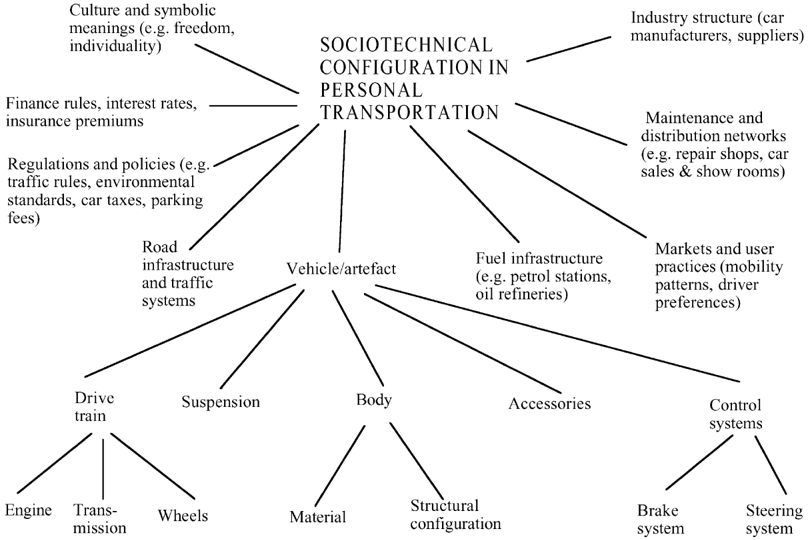
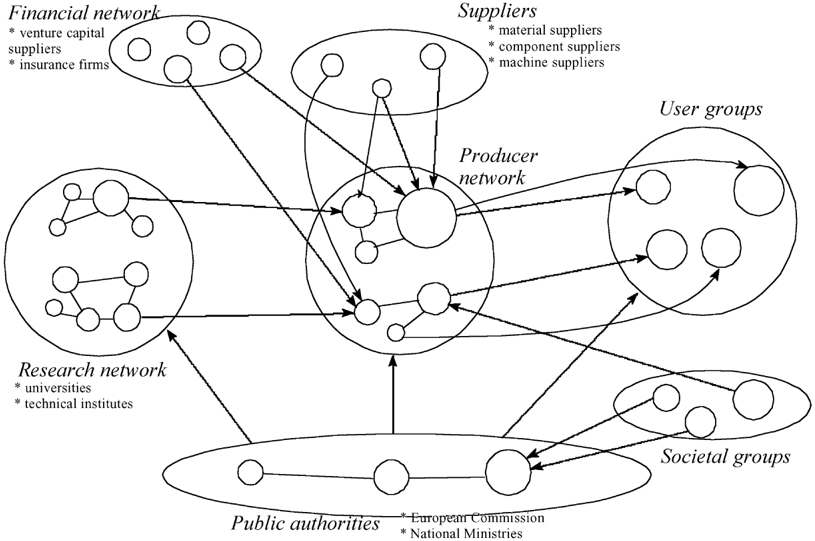
- Technological transitions are major, long-term changes in how societal functions are fulfilled; they involve not only technology but also user practices, regulation, industrial networks, infrastructure, and symbolic meaning or culture.
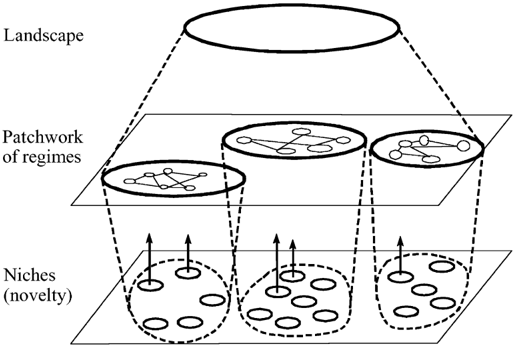
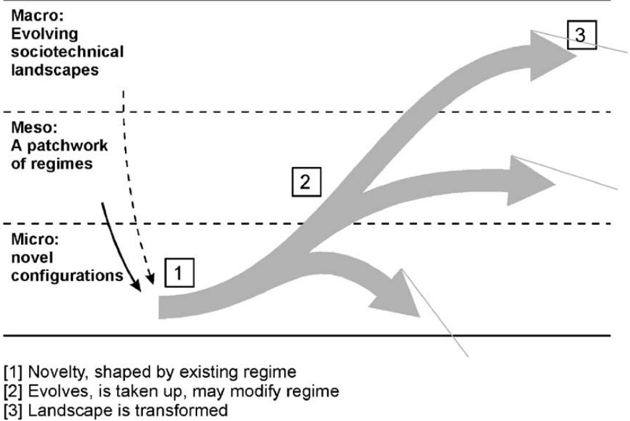
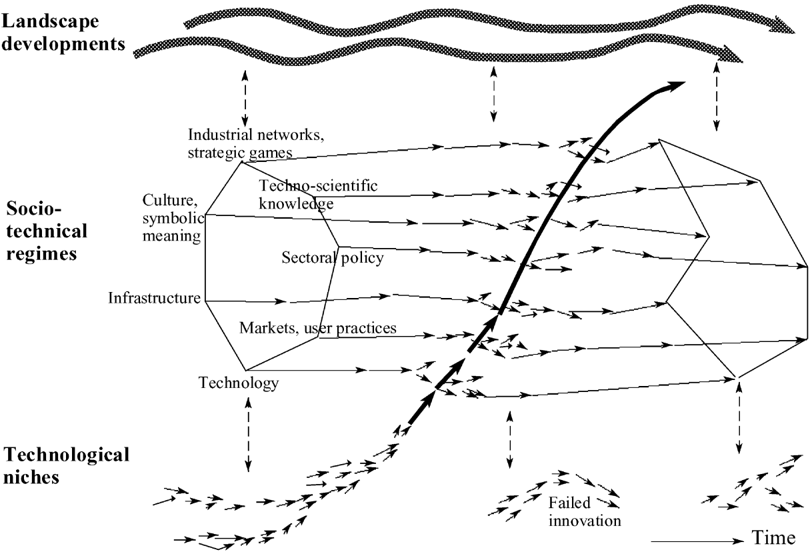
- The multi-level perspective treats niches as loci of radical variety, sociotechnical regimes as selection/retention mechanisms, and the landscape as slower external structure; breakthroughs occur when developments at multiple levels align and create a “window of opportunity.”
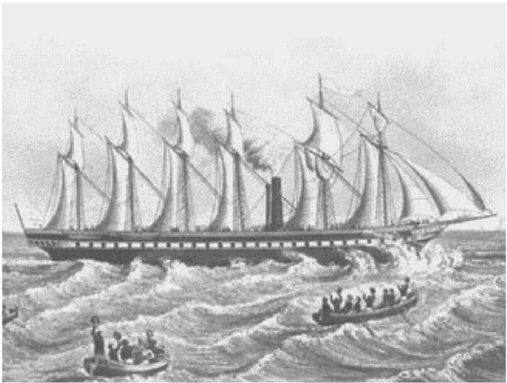
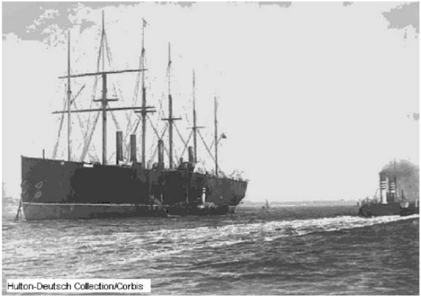
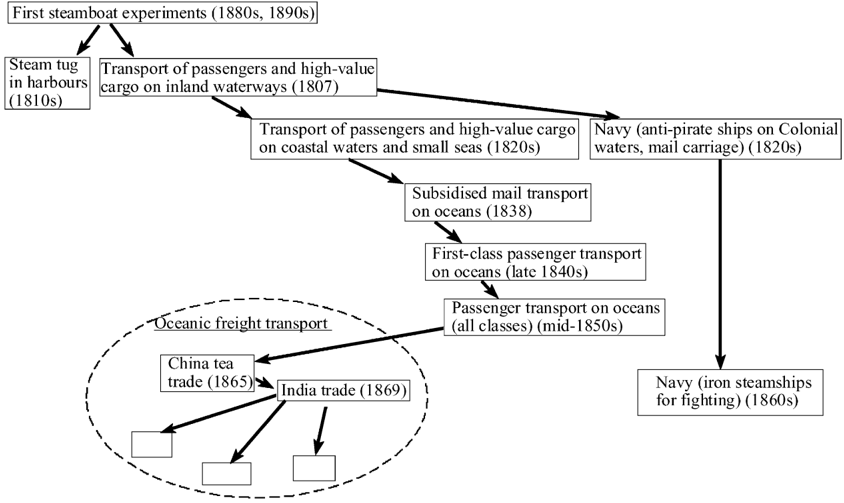
- In the steamship case, breakthrough followed niche-cumulation through inland waterways, coastal routes, mail subsidies, passenger transport, and freight; mechanisms included steam engines as auxiliary add-ons to sailing ships, hybrid sail/steam and iron/wood forms, and riding along with market growth.
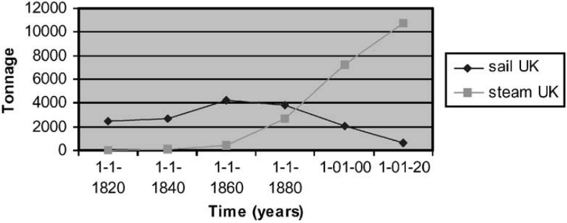
- Reported numbers include: European emigrants travelling by steamer rose from 45% in 1863 to 81% in 1866; compound engines enabled fuel-consumption reductions of 60%; the distance margin where steam was competitive reached 3000–3500 miles by the late 1860s; during the steamship mania (1869–1874), steamers rose from 17% to 31% of British registered tonnage.
Methods
- The paper uses “appreciative theory,” synthesising insights from evolutionary economics and technology studies into a multi-level perspective.
- It presents a qualitative longitudinal case study of the transition from sailing ships to steamships, 1780–1900, focused on Great Britain.
- The case is written in a mosaic style, shifting across markets, ship designs, insurance rules, actor groups, institutions, mail subsidies, persistent/emerging problems, and management practices to illustrate the conceptual framework.
Limitations
- The paper states that the multi-level perspective is fairly complex, requires many data, often qualitative, and that sociotechnical regimes are a broad unit of analysis with difficult-to-draw precise boundaries; boundary work deserves more attention.
- The paper states that the single case study has a drawback because 19th-century craft-based innovation differs from 20th-century science-based innovation, and the perspective would be more robust with more case studies varied over time periods and sectors.
- Evident in the text: the empirical analysis is focused on Great Britain and shipping, and the mechanisms are illustrated through selected historical examples rather than formal comparative or quantitative testing.
Model-written summary. Check it against the paper before relying on it.
Integrity signals
Registry
Cites
Statistics
Figures

Verification
Claims the paper makes
1 Valid · 5 Not valid · 42 Not checked · 63 Own results and interpretations
The cited sources support only part of this claim — read each source’s verdict below.
In the paper
“Aspecific mechanism in the breakthrough of radical innovations is technological add-on and hybridisation . It means that new technologies in their early phase physically link up with established technologies, often to solve particular bottlenecks. Thus, old and new technologies do not immediately compete head on, but form some sort of symbiosis (see also Pistorius and Utterback, 1997).”
What the sources say
- Partly supportedcites Pistorius and Utterback, 1997 matched to “Multi-mode interaction among technologies” (1997) sourceExperimental — accuracy not yet measured
Split into 2 atoms — 0 confirmed, 2 partially supported, 0 disputed, 0 misattributed, 0 unverifiable. Expand the claim to see per-atom verdicts.
plainstates a cause- Asserted: passes — The authors put it forward as true.
- Checkable: passes — It can be checked against evidence.
- Load-bearing: passes — The paper’s conclusions depend on it.
- Based: passes — The paper gives a reason why it holds.
- Partly supported
A result the paper states — it cites no source for it, so there is none to check. The quote shows it is in the paper.
In the paper
“These subsidies created a protective environment for the use and development of oceanic steamships.”
plainstates a cause- Asserted: passes — The authors put it forward as true.
- Checkable: passes — It can be checked against evidence.
- Load-bearing: unclear — It is unclear whether the paper’s conclusions depend on it.
- Based: passes — The paper gives a reason why it holds.
- Rests on an assumption not shown here.
In the paper
“Between 1838 and 1862 a global network of British intercontinental steam companies was created on the basis of imperial mail subsidies (Broeze, 1982).”
What the sources say
- Not matchedcites Broeze, 1982
An author–year citation the paper’s reference list doesn’t settle. We don’t search these by name.
plainstates a cause- Asserted: passes — The authors put it forward as true.
- Checkable: passes — It can be checked against evidence.
- Load-bearing: unclear — It is unclear whether the paper’s conclusions depend on it.
- Based: passes — The paper gives a reason why it holds.
- Rests on an assumption not shown here.
- Not matched
A result the paper states — it cites no source for it, so there is none to check. The quote shows it is in the paper.
In the paper
“Another innovation in the late 18th century shipping regime was the emergence of new social groups: professional shipowners, shipbrokers and insurance companies.”
plain- Asserted: passes — The authors put it forward as true.
- Checkable: passes — It can be checked against evidence.
- Load-bearing: unclear — It is unclear whether the paper’s conclusions depend on it.
- Based: passes — The paper gives a reason why it holds.
- Rests on an assumption not shown here.
A result the paper states — it cites no source for it, so there is none to check. The quote shows it is in the paper.
In the paper
“The emergence of professional shipowners was stimulated by the French Wars (1789-1815) which pushed up freight prices as demand for ships increased.”
plainstates a cause- Asserted: passes — The authors put it forward as true.
- Checkable: passes — It can be checked against evidence.
- Load-bearing: unclear — It is unclear whether the paper’s conclusions depend on it.
- Based: passes — The paper gives a reason why it holds.
- Rests on an assumption not shown here.
24 more claims
Create a free account to see all 111 claims and every source verdict.
- Probably not a substantial claim. 28
- It may state two separate claims as one. 69
- The quote only partly states this claim. 2
Claims other papers make about this one
Each is checked against this paper’s own text: does it say what the citing paper says it does?
In the citing paper
“The model of Geels (2002) describes new technologies as arising and maturing within existing technology systems [18].”
From Lessons Learned From a Living Lab on the Broad Adoption of eHealth in Primary Health Care (2018) · cites this paper as [18]
In the citing paper
“The multi-level perspective (Rip and Kemp, 1998;Geels, 2002;Geels, 2004;Geels and Schot, 2007) is a framework for understanding sustainability transitions that provides an overall view of the multi-dimensional complexity of changes in socio-technical systems.”
From Ontologies, socio-technical transitions (to sustainability), and the multi-level perspective (2010) · cites this paper as Geels, 2002
Citations
Cites
An Evolutionary Theory of Economic Change.
Loasby, B. J., Nelson, R. R., & Winter, S. G. (1983) · The Economic Journal · doi:10.2307/2232409 · Cited by 21,366
(1934) · SSRN Electronic Journal · Cited by 7,609
Technological Discontinuities and Organizational Environments
Tushman, M. L., & Anderson, P. (1986) · Administrative Science Quarterly · doi:10.2307/2392832 · Cited by 6,112
von Hippel, E. (2007) · Das Summa Summarum des Management · doi:10.1007/978-3-8349-9320-5_10 · Cited by 5,098
Technical Change and Economic Theory.
Swann, P., & Dosi, G. (1989) · The Economic Journal · doi:10.2307/2234048 · Cited by 4,041
Shaping Technology, Building Society: Studies in Sociotechnical Change.
Lynch, M., Bijker, W. E., & Law, J. (1993) · Contemporary Sociology · doi:10.2307/2074370 · Cited by 3,540
Technological Discontinuities and Dominant Designs: A Cyclical Model of Technological Change
Anderson, P., & Tushman, M. L. (1990) · Administrative Science Quarterly · doi:10.2307/2393511 · Cited by 3,255
Bijker, W. E., Hughes, T. P., & Pinch, T. (1987) · Cited by 2,957
Kemp, R., Schot, J., & Hoogma, R. (1998) · Technology Analysis & Strategic Management · doi:10.1080/09537329808524310 · Cited by 2,860
Innovation: Mapping the winds of creative destruction
Abernathy, W. J., & Clark, K. B. (1985) · Research Policy · doi:10.1016/0048-7333(85)90021-6 · Cited by 2,791
Research works printed but not linked: 9
- Broeze, F.J.A., 1982. The international diffusion of ocean steam navigation: the myth of the retardation of Netherlands steam navigation to the East Indies. Economisch-en Sociaal-Historisch Jaarboek 45, 77-95.
- Callon, M. (Ed.), 1998. The Laws of the Market. Blackwell, Oxford.
- Garrat, G.R.M., Goodman, D.C., Russel, C.A., 1973. Science and Engineering, Units 14 and 15. Open University Press, Bletchley.
- Jackson, G., 1998. Ports, ships and government in the nineteenth and twentieth centuries. In: Van Royen, P.C., Fischer, L.R., Williams, D.M. (Eds.), Proceedings of the Second International Congress of Maritime History on Frutta di Mare: Evolution and revolution in the maritime world in the 19th and 20th centuries. Amsterdam/Rotterdam, The Netherlands, 5-8 June, 1996. Batavian Lion International, Amsterdam, pp. 161-176.
- Lundvall, B.A., 1988. Innovation as an interactive process: from user-producer interaction to the national system of innovation. In: Dosi, G., Freeman, C., Nelson, R., Silverberg, G., Soete, L. (Eds.), Technical Change and Economic Theory. Pinter, London, pp. 349-369.
- Maddocks, M., 1982. De Grote Oversteek. Time-Life, London. Mayntz, R., Hughes, T.P. (Eds.), 1988. The Development of Large
- Mokyr, J., 1990. The Lever of Riches. Oxford University Press, New York.
- Rip, A., Kemp, R., 1996. Towards a Theory of Socio-Technical Change. Mimeo University of Twente, Report prepared for Batelle Pacific Northwest Laboratories, Washington, DC. (An edited version has been published as book chapter Rip and Kemp 1998).
- Sloan, E.W., 1998. Private enterprise as public utility: the management of capital in two centuries of shipping business. In: Van Royen, P.C., Fischer, L.R., Williams, D.M. (Eds.), Proceedings of the Second International Congress of Maritime History on Frutta di Mare: Evolution and Revolution in the Maritime World in the 19th and 20th Centuries. Amsterdam/Rotterdam, The Netherlands, 5-8 June, 1996. Batavian Lion International, Amsterdam, pp. 89-100.
Cited by
Items 6,301–6,400 of 7,210
Why Some Countries Lead and Others Lag? The Political Economy of Promoting Battery Electric VehiclesPreprint
Anilan, V., Vij, A., & Barrie, H. (2025) · SSRN Electronic Journal · doi:10.2139/ssrn.5408390
Dedinec, A., Dedinec, A., Dedinec, A., et al. (2025) · SSRN Electronic Journal · doi:10.2139/ssrn.5429284
Decoding transformative push of agroecological innovation in smallholding farming systems
Galiana-Carballo, C., & Palau-Salvador, G. (2026) · Journal of Agriculture and Food Research · doi:10.1016/j.jafr.2026.102964 · Cited by 1
Amorim, N. L., & de Oliveira, V. M. (2025) · Revista Eletrônica de Ciência Administrativa · doi:10.21529/recadm.2025011
“Esta recomendação se baseia na compreensão de que os EISs não operam em isolamento, mas são constantemente influenciados por fatores externos, conforme discutido por alguns autores, tais como Geels (2002) e Smith et al. (2005), em seus estudos sobre transições sociotécnicas.”
Behavioral dimensions of technological diversification in the U.S. light-duty vehicle fleet
Taylor, M. R., & Fujita, K. S. (2025) · Advances in transport policy and planning · doi:10.1016/bs.atpp.2025.07.001
Kohaupt-Cepera, K. (2025) · Transportation Research Interdisciplinary Perspectives · doi:10.1016/j.trip.2025.101612
Lähteenmäki, J., & Mähönen, P. (2025) · SSRN Electronic Journal · doi:10.2139/ssrn.5497589
How socio-political streams shape sustainability transitions: the case of a European rail networkPreprint
Meelen, T., & Dool, T. (2025) · SSRN Electronic Journal · doi:10.2139/ssrn.5499497
Energy Policy Theory and Frontier Issues and Methods
Wang, D. (2025) · Industrial ecology and environmental management · doi:10.1007/978-3-031-88451-1_1 · Cited by 1
Khan, M., Buravelli, S. K. P., Pappala, S. N., et al. (2025) · Studies in big data · doi:10.1007/978-3-031-97609-4_41
Brunnström, L., & Lazaric, N. (2025) · Design science and innovation · doi:10.1007/978-3-031-96173-1_1 · Cited by 1
(2025) · Elsevier eBooks · doi:10.1016/b978-0-443-22392-1.16001-8
Between constraint and possibility: transformative innovation policies in less developed regionsPreprint
Molica, F. (2025) · SSRN Electronic Journal · doi:10.2139/ssrn.5572150
Palmer, H. (2025) · Sustainability Science · doi:10.1007/s11625-025-01750-3 · Cited by 1
“A transformative space often aligns with the transition theory concept of ‘niches’ in that it fosters innovation capable of influencing larger regimes (Geels 2002).”
Han, J. (2025) · Sustainability · doi:10.3390/su17198964 · Cited by 1
Neue Handlungsweisen etablieren für Nachhaltigkeit auf Quartiersebene
Diersch, S., Graf, A., Rubarth, A., et al. (2025) · Springer eBooks · doi:10.1007/978-3-658-45871-3_11
Organizational Blindness and Paralysis in the Face of Disruption: A Sensemaking PerspectivePreprint
Kamel, M. S., Conway, S., & Gasparin, M. (2025) · SSRN Electronic Journal · doi:10.2139/ssrn.5587675
Locusts as a sustainable protein source: perceptions and nutritional awareness among Saudi citizens
Alhajri, A. S. (2025) · Frontiers in Sustainable Food Systems · doi:10.3389/fsufs.2025.1685008
Huang, Z., Zhou, J., Zhou, B., et al. (2025) · SSRN Electronic Journal · doi:10.2139/ssrn.5643285
Understanding human roles in AI-driven aviation through an evolutionary economics lens
Navarro-Meneses, F. J., & Pablo-Martí, F. (2025) · Business and management · doi:10.3846/bm.2025.1547 · Cited by 1
APPLICABILITY OF EXPLORATORY SCENARIO PLANNING IN URBAN TRANSPORTATION PLANNING PROCESSES
Ishigami, T., Inahara, H., Ishii, R., et al. (2025) · Journal of the City Planning Institute of Japan · doi:10.11361/journalcpij.60.1567
Pugliese, M. S., Boffelli, A., Brumana, M., & Kalchschmidt, M. G. M. (2025) · Creativity and Innovation Management · doi:10.1111/caim.70020 · Cited by 5
Espín-Sarzosa, D., Valencia, F., Montedonico, M., Lanyon, C., Vega-Herrera, J., & Palma-Behnke, R. E. (2025) · IntechOpen eBooks · doi:10.5772/intechopen.1012858 · Cited by 1
Innovation Drivers for Emerging Economies: Evidence of Dual Transition in Bangladesh
Khan, A., & Sharma, R. (2025) · Millennial Asia · doi:10.1177/09763996251378574
Rao, P. B., & Inampudi, P. (2025) · IGI Global eBooks · doi:10.4018/979-8-3373-2454-8.ch013
Click for Care, Care for Planet: Sustainable Marketing Drivers of Telemedicine Adoption
Ocak, A. (2025) · Telemedicine Reports · doi:10.1177/26924366251394120
The First Nuclear Century: A Long-Term Analysis of Nuclear Reactor Development in the US (1939–2024)
Böse, F. (2025) · Studies in energy, resource and environmental economics · doi:10.1007/978-3-031-99894-2_11
Gheitasi, F., Shah, T., & Mahapatra, K. (2025) · Sustainability · doi:10.3390/su17219707 · Cited by 2
A Framework for Peri-Urban Transitions through the BIO-INTEL-MOB approachPreprint
Capkin, S. O. K., Persia, L., & Usami, D. S. (2025) · SSRN Electronic Journal · doi:10.2139/ssrn.5702064
A Framework for Peri-Urban Transitions through the BIO-INTEL-MOB approachPreprint
Capkin, S. O. K., Persia, L., & Usami, D. S. (2025) · SSRN Electronic Journal · doi:10.2139/ssrn.5702062
Just Energy Transition, Market Making and the Missed Affordances of Cleantech
Anspach, D. S., & Cloutier, C. (2025) · Journal of Business Research · doi:10.1016/j.jbusres.2026.116441
Gray, T. R., & Foord, D. (2025) · SSRN Electronic Journal · doi:10.2139/ssrn.5736499
Burger-Menzel, B. (2025) · Springer eBooks · doi:10.1007/978-3-658-48617-4_9
From Mitigation to Transformation: An Evolutionary Perspective on the Just Green Transition
Tapia, C., Giacometti, A., Moodie, J. R., Cedergren, E., & Shaneh, A. (2025) · Springer eBooks · doi:10.1007/978-3-031-95075-9_5 · Cited by 5
The Risks of Purposive Transitions in Albania—What to Expect by the Just Green Transition
Imami, F., Bejko, A., & Aliaj, B. (2025) · Springer eBooks · doi:10.1007/978-3-031-95075-9_14 · Cited by 3
Pathways to Just Green Transitions: Reflections and Future Directions
Berisha, E., Moodie, J. R., Allkja, L., et al. (2025) · Springer eBooks · doi:10.1007/978-3-031-95075-9_27
Railway traction decarbonisation: a critical analysis of railway innovation
Burrows, A., & Petrović, M. (2025) · Transportation research procedia · doi:10.1016/j.trpro.2025.10.075
Typology of Five Generations of Heavy Trucks
Liu, L., Liu, L., Danilovic, M., et al. (2025) · World Journal of Engineering and Technology · doi:10.4236/wjet.2025.134060
Modern Theoretical Approaches and Methodology for Water and Hydro Energy Systems
Siakwah, P., & Torto, O. (2025) · Palgrave studies in climate resilient societies · doi:10.1007/978-3-032-04485-3_2
Sustainable Entrepreneurship Emergence as Practice: A Multi-Level Pathway Model
Pardede, G., Sijabat, R., Parani, R., Tan, J. D., Ataupah, J., Yatmo, A. H., & Bisowarno, S. D. (2025) · F1000Research · doi:10.12688/f1000research.171837.1 · Cited by 2
“Perspectives on sustainability transitions often emphasize policy-led changes such as systemic change driven by state actors or industrial shifts (Geels, 2002).”
InfluentialOperationalising Sustainability: A Structured Approach to Systemic Transformation
Grabkowsky, B. J. (2025) · Springer eBooks · doi:10.1007/978-3-031-97872-2_28
The Green New Product Problem: growth or greenflation?Preprint
O’Donovan, N. (2025) · SSRN Electronic Journal · doi:10.2139/ssrn.5784604
Managing Innovation in Geoheritage Education: A VR Case Study of Shek O, Hong Kong
Pun, B. L. F., Fung, A. Y. H., Ko, J., Leung, C. K., & Chan, C. (2025) · Environment Innovation and Management · doi:10.1142/s3060901125500279
Debel, M. T., & Wang, F. (2025) · Green Energy and Environmental Technology · doi:10.5772/geet.20250101
Reforming Indias ESG Reporting: Lessons from the EU and South Africa
Nair, K. (2025) · Indian Journal of Energy and Energy Resources · doi:10.54105/ijeer.a1054.05011125
Shamsuddoha, M., Hossain, A. I., Dewan, I., et al. (2025) · Logistics · doi:10.3390/logistics9040171
“This research drew on socio-technical transition theory to examine how modest innovations, such as JSC production in rural locations, can stimulate SMEs and larger businesses to adopt renewable energy sources [19].”
Hao, Y., Liu, A., Wang, Z., et al. (2025) · SSRN Electronic Journal · doi:10.2139/ssrn.5802783
Dominant Designs: Explaining Standardization in Ecosystems and Sustainability Transitions
Brem, A., & Nylund, P. A. (2025) · doi:10.1109/temsconglobal64363.2025.11238313
“Dominant design is a cornerstone for theorization on technological innovation [1] and technology transitions [2].”
Translations, alliances, and betrayals
Rodríguez, A., Figari, M., Rossi, V., et al. (2025) · Agrociencia Uruguay · doi:10.31285/agro.29.1662
Territorial socio-technical innovations
Rivaben, I. F. (2025) · Agrociencia Uruguay · doi:10.31285/agro.29.1629
Exploring the protection-versus-influence paradox in local grassroots niches
Bruehwiler, N., Hausmann, R., Kos, L., & Roysen, R. (2025) · Journal of Cleaner Production · doi:10.1016/j.jclepro.2025.147161 · Cited by 1
Green, C. W., & Hurley, T. A. (2012) · Emerald Group Publishing Limited eBooks · doi:10.1108/978-1-62396-060-520251003
Andreola, M. (2025) · Discover Sustainability · doi:10.1007/s43621-025-01623-w · Cited by 1
“This aligns with many relevant studies applying the Multi-Level Perspective [26, 28, 85], which emphasize the resilience of established regimes and the difficulty of integrating alternative practices.”
How to Give Ethical Input on Animal Research Transitions: Ideal and Nonideal Theory
Müller, N. D. (2025) · Journal of Agricultural and Environmental Ethics · doi:10.1007/s10806-025-09965-1
“For example, philosophers can draw on the multi-level perspective (Geels, 2002; Kanger et al., 2020 ), the X-Curve model (Hebinck et al., 2022 ), or approaches like transition management (Kemp et al., 2007; Loorbach, 2007).”
Ng, T. W., Long, J. Y., Tan, L. E., & Yap, J. H. (2025) · Results in Engineering · doi:10.1016/j.rineng.2025.108574
Olfati‐Saber, R. (2025) · SSRN Electronic Journal · doi:10.2139/ssrn.5860839
Policy innovations for sustainable waste management in Yogyakarta City
Fitriana, K. N., Suranto, Akalili, A., et al. (2025) · IOP Conference Series Earth and Environmental Science · doi:10.1088/1755-1315/1556/1/012083
Green and Renewable Energy Policy in Relation to Financial Literacy in México
Vargas-Hernández, J. G. (2025) · IGI Global eBooks · doi:10.4018/979-8-3373-6766-8.ch004
The Impact of Green and Renewable Energy Policy on Climate Risk Management
Jamel, L. M. (2025) · IGI Global eBooks · doi:10.4018/979-8-3373-6766-8.ch012
Fueling the Future With SAF: How Airlines Are Reshaping Value Chains for a Decarbonized Aviation
Damergy, G. (2025) · IGI Global eBooks · doi:10.4018/979-8-3373-3790-6.ch003
Heterogeneous Cooperation, Boundary Objects, and Boundary Zones
Meister, M. (2025) · Springer eBooks · doi:10.1007/978-3-031-25143-6_24-1
Velu, C. K., Norman, K. W., Zhu, Y., Putra, F. H. R., & Noble, C. (2025) · Springer eBooks · doi:10.1007/978-3-031-99808-9_1
Developing a conceptual framework for a citizen Science-based agroecology self-assessment tool
Mupangwa, W., Maharaj, U., Taylor, J., Dickens, C. W. S., Choruma, D. J., Pike, T., Dirwai, T. L., Nyawira, S. S., Geck, M. S., & Braithwaite, I. (2025) · Frontiers in Agronomy · doi:10.3389/fagro.2025.1646470
Comunità concrete e principio territoriale. Verso pratiche pattizie di cittadinanza territoriale
Perrone, C. (2025) · Territori · doi:10.36253/979-12-215-0781-2.58
Worden door financiële prikkels meer elektrische auto’s verkocht?
Sierzchula, W., Bakker, S., Maat, K., & van Wee, B. (2015) · Research Repository (Delft University of Technology)
Finding structural parameters for energy efficient cities
Read, S., Mashayekhi, A., & Rocco, R. (2014) · Research Repository (Delft University of Technology)
The role of consumers in the transition towards sustainability. The case of food supplyPreprint
Randelli, F. (2013) · RePEc: Research Papers in Economics
The market introduction of Superwind in the Netherlands
Manné, D. J. (2009) · Research Repository (Delft University of Technology) · Cited by 2
Schipper, P. A. (2014) · Research Repository (Delft University of Technology)
Shafeey, F. E. (2013) · UPT. Syiah Kuala University Library (Syiah Kuala University)
Gospodarka niskowęglowa w Polsce-wyzwania wynikające z transformacji
Talik, S., Bielewska, A., & Wieczorek, A. J. (2013) · TU/e Research Portal
Genetic screening programs for susceptibility to disease in Denmark
Bitsch, L. (2008)
Yücel, G., & van Daalen, C. (2008) · Research Repository (Delft University of Technology)
Exploring a case of the eco-innovation journey in the UK food processing sector
Langendahl, P.-A., Cook, M., & Potter, S. (2010) · Open Research Online (The Open University)
Additional file 1 of The circular bioeconomy: a driver for system integration
Schipfer, F., Burli, P., Fritsche, U., Hennig, C., Stricker, F., Wirth, M., Proskurina, S., & Loaiza, S. S. (2024) · Figshare · doi:10.6084/m9.figshare.26732398
Savage, J. M., & Kubicki, B. (2010) · INFM-OAR (INFN Catania) · doi:10.5281/zenodo.199836
Additional file 2 of The circular bioeconomy: a driver for system integration
Schipfer, F., Burli, P., Fritsche, U. R., Hennig, C., Stricker, F., Wirth, M., Proskurina, S., & Loaiza, S. S. (2024) · Figshare · doi:10.6084/m9.figshare.26732401
Undesirable Systems, Undesired Ends: The (Un)Bearable Heaviness of Phasing-Out Pesticides?
Turnheim, B., Barbier, M., & Matt, M. (2025) · SpringerBriefs in applied sciences and technology · doi:10.1007/978-3-031-88369-9_4
Aubois-Liogier, V. (2025) · Nouvelles perspectives en sciences sociales · doi:10.7202/1119801ar
Fain, E., Lemarié, S., Fugeray-Scarbel, A., et al. (2025) · SSRN Electronic Journal · doi:10.2139/ssrn.5522191
Co-creation of governance innovations for sustainable forest ecosystem services in EuropePreprint
Kluvankova, T., Špaček, M., Brnkaľáková, S., et al. (2025) · SSRN Electronic Journal · doi:10.2139/ssrn.5527127
3394.4 Canals: transport infrastructure and geopolitics
Sattich, T. (2025) · De Gruyter eBooks · doi:10.1515/9783111195544-026
Value creation driving the market transformation for a sustainable innovationPreprint
Lehtimäki, T., Keränen, O., Komulainen, H., & Ulkuniemi, P. (2025) · SSRN Electronic Journal · doi:10.2139/ssrn.5554640
Kallinikos, J., & Yoo, Y. (2025) · Springer eBooks · doi:10.1007/978-3-031-25143-6_55-1 · Cited by 1
de Wit, F., Meelen, T., Boersma, E., Avelino, F., & Hajer, M. A. (2025) · SSRN Electronic Journal · doi:10.2139/ssrn.5554641
AI-driven innovation for urban sustainability: Unlocking the SdGs in Amman Municipality
Zyadat, B. T. E. A., & Abuqauod, G. R. (2025) · EDPACS · doi:10.1080/07366981.2025.2582223
The transition-democracy nexus: A temporal-analytical perspectivePreprint
Farag, A., Oshri, O., & Fishhendler, I. (2025) · SSRN Electronic Journal · doi:10.2139/ssrn.5783798 · Cited by 1
Principals in High-Performing, High-Poverty, Minority-Serving Schools in Texas
Murakami, E., & Kearney, W. S. (2019) · Emerald Group Publishing Limited eBooks · doi:10.1108/978-1-64113-503-020251003
Soto-Robles, A., Monteiro, M. B., & Ramos, T. R. P. (2025) · International Journal of Organization Theory and Behavior · doi:10.1108/ijotb-01-2025-0015
Khalayleh, Y., Matias, J. C. D. O., & Pimentel, C. M. O. (2025) · European Journal of Sustainable Development Research · doi:10.29333/ejosdr/17554
“2) Resilience-based sustainability framing as a landscape-agency coupling mechanism MLP highlights how landscape shocks open windows for realignment (Geels, 2002).”
InfluentialMoustapha, T., & Séguin, C. (2025) · SSRN Electronic Journal · doi:10.2139/ssrn.5924885
Ilcus, C. (2025) · SSRN Electronic Journal · doi:10.2139/ssrn.5933717
Astratova, G. V., Tronina, V. E., & Onwusiribe, C. N. (2025) · IGI Global eBooks · doi:10.4018/979-8-3373-1676-5.ch004
Toward a Framework of Innovation Ecosystem Performance: A Case Study
Adams, J. A., Dedehayir, O., Mäkinen, S., & Ortt, R. (2025) · IEEE Transactions on Engineering Management · doi:10.1109/tem.2025.3646635
How to govern mission-oriented innovation policy – The case of the German Energy Research ProgramPreprint
Schwäbe, C., Dreher, C., Voss, F. A., & Kovač, M. (2025) · SSRN Electronic Journal · doi:10.2139/ssrn.5960365
Measuring Real Energy Price Gaps: The Real PLI Framework for Competitiveness Monitoring
Nomura, K., & Inaba, S. (2025) · Sustainability · doi:10.3390/su18010084
Liu, M., Zhao, C., Zhang, J., Bai, X., & Luo, J. (2025) · Asia Pacific Journal of Marketing and Logistics · doi:10.1108/apjml-01-2025-0102
Liu, J., Gao, W., Zhang, X., & ZHANG, J. (2025) · Transport Policy · doi:10.1016/j.tranpol.2025.103978
Haque, P. I., Shirin, C., & Abdul, M. K. (2025) · Sustainable Environment and Business · doi:10.64907/xkmf.v5i4seb.1
Renewable Energy Adoption and Its Economic Impact in Saudi Arabia: A Panel Data Approach
Ali, M. (2025) · SAGE Open · doi:10.1177/21582440251410808
“This transformation is not merely technical but also institutional, economic, and social (Geels, 2002).”
Metadata
- Authors
- Geels, F. W.
- Affiliations
- University of Twente (NL)
- Corresponding author
- Geels, Frank W.
- ORCID
- Geels, Frank W.
- Venue
- Research Policy
- Publisher
- Elsevier BV
- Published
- 2002-12
- Volume
- 31
- Issue
- 8-9
- Pages
- 1257-1274
- ISSN
- 0048-7333 (ISSN-L)
- OpenAlex
- W2099330597
- Cited by
- 7,275
- References
- 94
- Citations by year
- 2026: 983 · 2025: 624 · 2024: 502 · 2023: 504 · 2022: 503 · 2021: 598 · 2020: 526 · 2019: 417 · 2018: 493 · 2017: 357 · 2016: 301 · 2015: 293 · 2014: 241 · 2013: 201 · 2012: 204
- FWCI
- 16.68
- Type
- journal article
- Language
- en
- Open access
- bronze
- doi.org
- Licence
- www.elsevier.com/tdm/userlicense/1.0/ (tdm)
- Locations
- Research Policy (publishedVersion)
- Research Explorer (The University of Manchester) (submittedVersion, other-oa)
- University of Twente Research Information (submittedVersion)
- TU/e Research Portal (submittedVersion)
- RePEc: Research Papers in Economics (submittedVersion)
- Figshare (submittedVersion, cc-by)
- University of Twente Research Information (submittedVersion, other-oa)
- Funders
- Nederlandse Organisatie voor Wetenschappelijk Onderzoek
- Topics
- Physical Sciences › Environmental Science › Global and Planetary Change › Sustainability and Climate Change Governance
- Social Sciences › Decision Sciences › Management Science and Operations Research › Innovation Diffusion and Forecasting
- Social Sciences › Economics, Econometrics and Finance › Economics and Econometrics › Economic Theory and Institutions
- Keywords
- technological transition, multi-level perspective, evolutionary economics, technology studies, hybridization, market growth, industrial networks, user practices, regulation, infrastructure
About these checks
Registry, retraction, Cites and statistics results are computed, not judged, with one exception: a printed reference that no index lists is read once by a model before it counts as a citation error. Claims are extracted by a model and kept only when their quote appears verbatim in the text; each cited source is then checked, with a model’s help, for whether it says what the claim relies on. Those verdicts can be wrong — read the claim’s quote and the cited source before relying on one.
The claim verdicts this report counts are experimental: their accuracy is not yet measured.
A language model drew the claims from the paper on 2026-10-10, under version 3 of the claim definition (model deepseek-v4.1-flash, prompt extract-v3).
A second model labelled each claim on 2026-10-10 (model jev-1.13-20260917, definition revision gold-guideline-v0.2).
Cited sources are checked with a language model’s help (gpt-6-sol).
Statistics and arithmetic are recomputed, not judged.
Confidence bands are shown only for fields calibrated on our annotated test set. None is calibrated yet, so no band is shown.
What counts as a claim ›How we measure confidence ›How we check this ›
Are you an author, or do you see a problem with this page? Request a review
Data sources
Bibliographic data: Semantic Scholar, OpenAlex, Crossref.
Contains information from the Semantic Scholar Academic Graph Datasets, made available under the ODC Attribution License (ODC-BY 1.0).
Semantic Scholar’s data is described in: Kinney, R., et al. (2023). The Semantic Scholar Open Data Platform. arXiv:2301.10140.
