

Technological transitions as evolutionary reconfiguration processes: a multi-level perspective and a case-study
Open accessThe DOI matches its Crossref record; 86 of the 94 references it cites were found in a registry or an index; 1 of the 45 sources its claims cite were checked for support.
Overview
CoChat Summary
TL;DR
Geels proposes a multi-level perspective on technological transitions, combining evolutionary economics and technology studies around niches, sociotechnical regimes, and landscape. He illustrates it with a qualitative longitudinal case study of the transition from sailing ships to steamships, 1780–1900, identifying niche-cumulation, technological add-on/hybridisation, and riding along with market growth.
Key findings
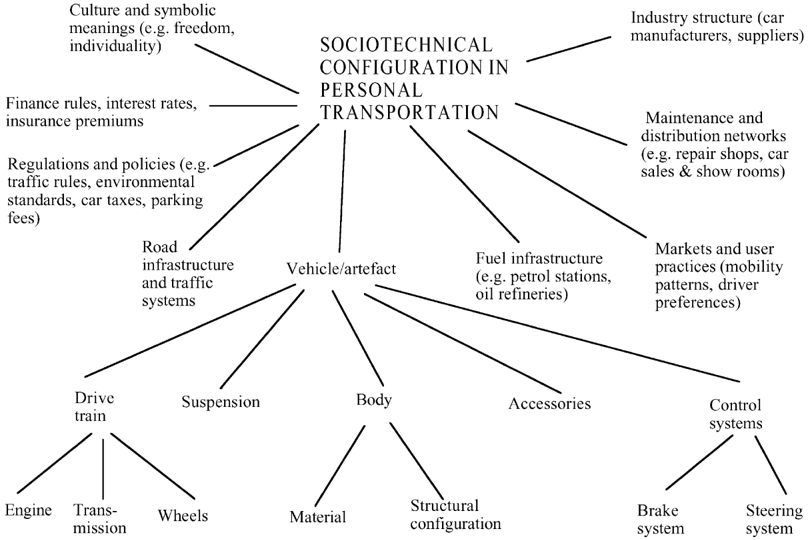
- Technological transitions are major, long-term changes in how societal functions are fulfilled; they involve not only technology but also user practices, regulation, industrial networks, infrastructure, and symbolic meaning or culture.
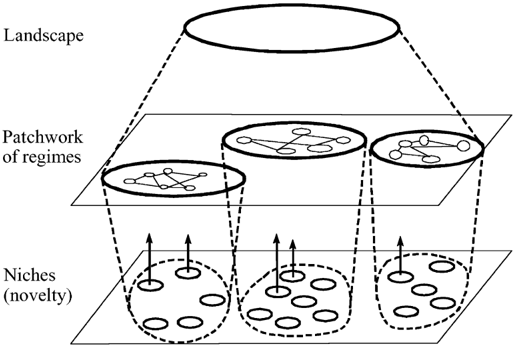
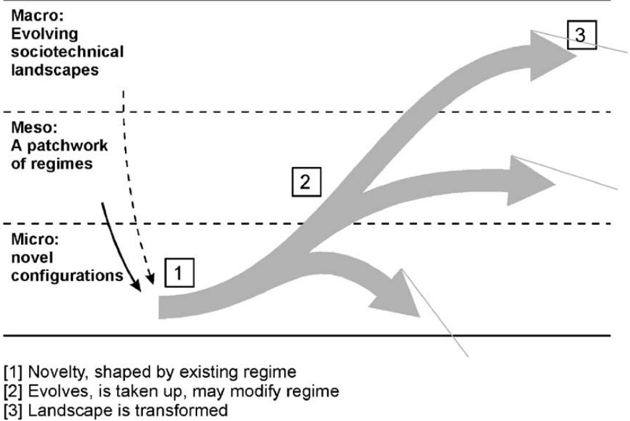
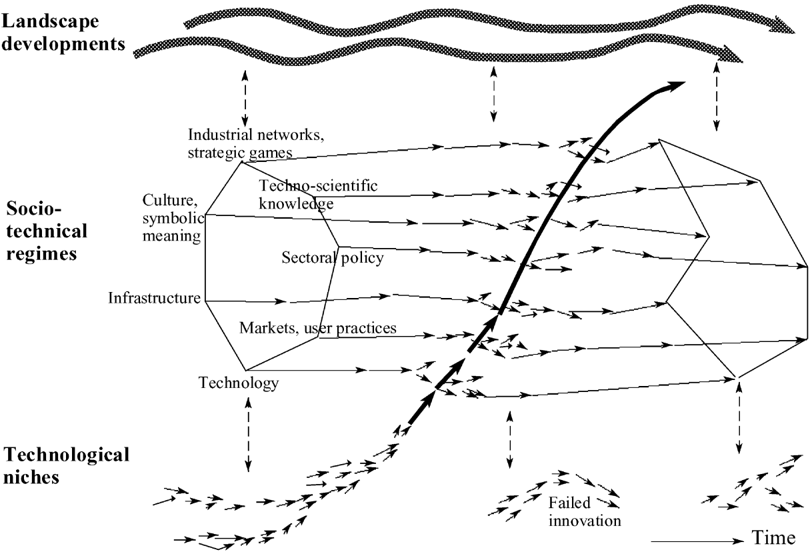
- The multi-level perspective treats niches as loci of radical variety, sociotechnical regimes as selection/retention mechanisms, and the landscape as slower external structure; breakthroughs occur when developments at multiple levels align and create a “window of opportunity.”
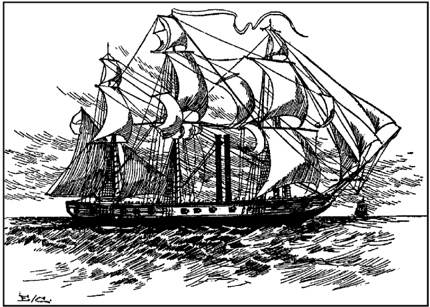
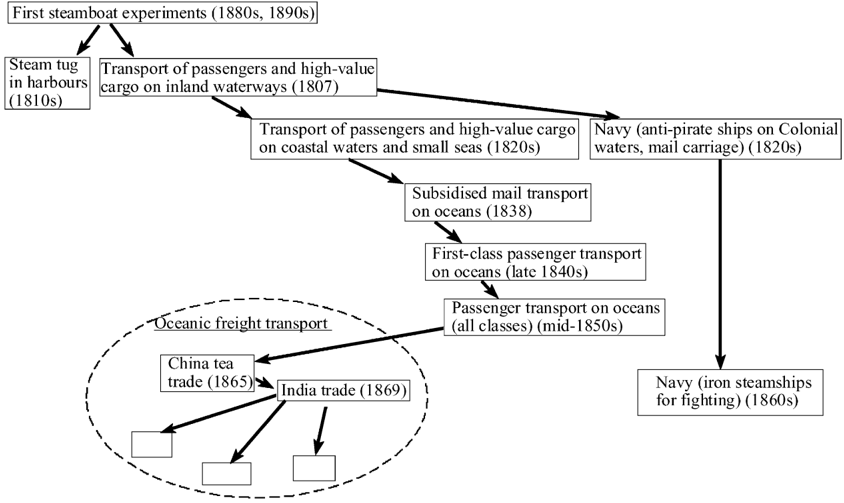
- In the steamship case, breakthrough followed niche-cumulation through inland waterways, coastal routes, mail subsidies, passenger transport, and freight; mechanisms included steam engines as auxiliary add-ons to sailing ships, hybrid sail/steam and iron/wood forms, and riding along with market growth.
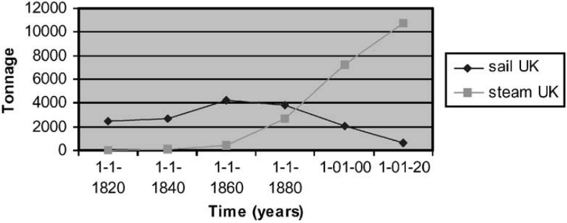
- Reported numbers include: European emigrants travelling by steamer rose from 45% in 1863 to 81% in 1866; compound engines enabled fuel-consumption reductions of 60%; the distance margin where steam was competitive reached 3000–3500 miles by the late 1860s; during the steamship mania (1869–1874), steamers rose from 17% to 31% of British registered tonnage.
Methods
- The paper uses “appreciative theory,” synthesising insights from evolutionary economics and technology studies into a multi-level perspective.
- It presents a qualitative longitudinal case study of the transition from sailing ships to steamships, 1780–1900, focused on Great Britain.
- The case is written in a mosaic style, shifting across markets, ship designs, insurance rules, actor groups, institutions, mail subsidies, persistent/emerging problems, and management practices to illustrate the conceptual framework.
Limitations
- The paper states that the multi-level perspective is fairly complex, requires many data, often qualitative, and that sociotechnical regimes are a broad unit of analysis with difficult-to-draw precise boundaries; boundary work deserves more attention.
- The paper states that the single case study has a drawback because 19th-century craft-based innovation differs from 20th-century science-based innovation, and the perspective would be more robust with more case studies varied over time periods and sectors.
- Evident in the text: the empirical analysis is focused on Great Britain and shipping, and the mechanisms are illustrated through selected historical examples rather than formal comparative or quantitative testing.
Model-written summary. Check it against the paper before relying on it.
Integrity signals
Registry
Cites
Statistics
Figures
Verification
Claims the paper makes
1 Valid · 5 Not valid · 42 Not checked · 63 Own results and interpretations
The cited sources support only part of this claim — read each source’s verdict below.
In the paper
“Aspecific mechanism in the breakthrough of radical innovations is technological add-on and hybridisation . It means that new technologies in their early phase physically link up with established technologies, often to solve particular bottlenecks. Thus, old and new technologies do not immediately compete head on, but form some sort of symbiosis (see also Pistorius and Utterback, 1997).”
What the sources say
- Partly supportedcites Pistorius and Utterback, 1997 matched to “Multi-mode interaction among technologies” (1997) sourceExperimental — accuracy not yet measured
Split into 2 atoms — 0 confirmed, 2 partially supported, 0 disputed, 0 misattributed, 0 unverifiable. Expand the claim to see per-atom verdicts.
plainstates a cause- Asserted: passes — The authors put it forward as true.
- Checkable: passes — It can be checked against evidence.
- Load-bearing: passes — The paper’s conclusions depend on it.
- Based: passes — The paper gives a reason why it holds.
- Partly supported
A result the paper states — it cites no source for it, so there is none to check. The quote shows it is in the paper.
In the paper
“These subsidies created a protective environment for the use and development of oceanic steamships.”
plainstates a cause- Asserted: passes — The authors put it forward as true.
- Checkable: passes — It can be checked against evidence.
- Load-bearing: unclear — It is unclear whether the paper’s conclusions depend on it.
- Based: passes — The paper gives a reason why it holds.
- Rests on an assumption not shown here.
In the paper
“Between 1838 and 1862 a global network of British intercontinental steam companies was created on the basis of imperial mail subsidies (Broeze, 1982).”
What the sources say
- Not matchedcites Broeze, 1982
An author–year citation the paper’s reference list doesn’t settle. We don’t search these by name.
plainstates a cause- Asserted: passes — The authors put it forward as true.
- Checkable: passes — It can be checked against evidence.
- Load-bearing: unclear — It is unclear whether the paper’s conclusions depend on it.
- Based: passes — The paper gives a reason why it holds.
- Rests on an assumption not shown here.
- Not matched
A result the paper states — it cites no source for it, so there is none to check. The quote shows it is in the paper.
In the paper
“Another innovation in the late 18th century shipping regime was the emergence of new social groups: professional shipowners, shipbrokers and insurance companies.”
plain- Asserted: passes — The authors put it forward as true.
- Checkable: passes — It can be checked against evidence.
- Load-bearing: unclear — It is unclear whether the paper’s conclusions depend on it.
- Based: passes — The paper gives a reason why it holds.
- Rests on an assumption not shown here.
A result the paper states — it cites no source for it, so there is none to check. The quote shows it is in the paper.
In the paper
“The emergence of professional shipowners was stimulated by the French Wars (1789-1815) which pushed up freight prices as demand for ships increased.”
plainstates a cause- Asserted: passes — The authors put it forward as true.
- Checkable: passes — It can be checked against evidence.
- Load-bearing: unclear — It is unclear whether the paper’s conclusions depend on it.
- Based: passes — The paper gives a reason why it holds.
- Rests on an assumption not shown here.
24 more claims
Create a free account to see all 111 claims and every source verdict.
- Probably not a substantial claim. 28
- It may state two separate claims as one. 69
- The quote only partly states this claim. 2
Claims other papers make about this one
Each is checked against this paper’s own text: does it say what the citing paper says it does?
In the citing paper
“The model of Geels (2002) describes new technologies as arising and maturing within existing technology systems [18].”
From Lessons Learned From a Living Lab on the Broad Adoption of eHealth in Primary Health Care (2018) · cites this paper as [18]
In the citing paper
“The multi-level perspective (Rip and Kemp, 1998;Geels, 2002;Geels, 2004;Geels and Schot, 2007) is a framework for understanding sustainability transitions that provides an overall view of the multi-dimensional complexity of changes in socio-technical systems.”
From Ontologies, socio-technical transitions (to sustainability), and the multi-level perspective (2010) · cites this paper as Geels, 2002
Citations
Cites
An Evolutionary Theory of Economic Change.
Loasby, B. J., Nelson, R. R., & Winter, S. G. (1983) · The Economic Journal · doi:10.2307/2232409 · Cited by 21,366
(1934) · SSRN Electronic Journal · Cited by 7,609
Technological Discontinuities and Organizational Environments
Tushman, M. L., & Anderson, P. (1986) · Administrative Science Quarterly · doi:10.2307/2392832 · Cited by 6,112
von Hippel, E. (2007) · Das Summa Summarum des Management · doi:10.1007/978-3-8349-9320-5_10 · Cited by 5,098
Technical Change and Economic Theory.
Swann, P., & Dosi, G. (1989) · The Economic Journal · doi:10.2307/2234048 · Cited by 4,041
Shaping Technology, Building Society: Studies in Sociotechnical Change.
Lynch, M., Bijker, W. E., & Law, J. (1993) · Contemporary Sociology · doi:10.2307/2074370 · Cited by 3,540
Technological Discontinuities and Dominant Designs: A Cyclical Model of Technological Change
Anderson, P., & Tushman, M. L. (1990) · Administrative Science Quarterly · doi:10.2307/2393511 · Cited by 3,255
Bijker, W. E., Hughes, T. P., & Pinch, T. (1987) · Cited by 2,957
Kemp, R., Schot, J., & Hoogma, R. (1998) · Technology Analysis & Strategic Management · doi:10.1080/09537329808524310 · Cited by 2,860
Innovation: Mapping the winds of creative destruction
Abernathy, W. J., & Clark, K. B. (1985) · Research Policy · doi:10.1016/0048-7333(85)90021-6 · Cited by 2,791
Research works printed but not linked: 9
- Broeze, F.J.A., 1982. The international diffusion of ocean steam navigation: the myth of the retardation of Netherlands steam navigation to the East Indies. Economisch-en Sociaal-Historisch Jaarboek 45, 77-95.
- Callon, M. (Ed.), 1998. The Laws of the Market. Blackwell, Oxford.
- Garrat, G.R.M., Goodman, D.C., Russel, C.A., 1973. Science and Engineering, Units 14 and 15. Open University Press, Bletchley.
- Jackson, G., 1998. Ports, ships and government in the nineteenth and twentieth centuries. In: Van Royen, P.C., Fischer, L.R., Williams, D.M. (Eds.), Proceedings of the Second International Congress of Maritime History on Frutta di Mare: Evolution and revolution in the maritime world in the 19th and 20th centuries. Amsterdam/Rotterdam, The Netherlands, 5-8 June, 1996. Batavian Lion International, Amsterdam, pp. 161-176.
- Lundvall, B.A., 1988. Innovation as an interactive process: from user-producer interaction to the national system of innovation. In: Dosi, G., Freeman, C., Nelson, R., Silverberg, G., Soete, L. (Eds.), Technical Change and Economic Theory. Pinter, London, pp. 349-369.
- Maddocks, M., 1982. De Grote Oversteek. Time-Life, London. Mayntz, R., Hughes, T.P. (Eds.), 1988. The Development of Large
- Mokyr, J., 1990. The Lever of Riches. Oxford University Press, New York.
- Rip, A., Kemp, R., 1996. Towards a Theory of Socio-Technical Change. Mimeo University of Twente, Report prepared for Batelle Pacific Northwest Laboratories, Washington, DC. (An edited version has been published as book chapter Rip and Kemp 1998).
- Sloan, E.W., 1998. Private enterprise as public utility: the management of capital in two centuries of shipping business. In: Van Royen, P.C., Fischer, L.R., Williams, D.M. (Eds.), Proceedings of the Second International Congress of Maritime History on Frutta di Mare: Evolution and Revolution in the Maritime World in the 19th and 20th Centuries. Amsterdam/Rotterdam, The Netherlands, 5-8 June, 1996. Batavian Lion International, Amsterdam, pp. 89-100.
Cited by
Items 6,501–6,600 of 7,210
Green hydrogen at the edge of trade uncertainty: A cross-country quantile study
Lin, W., Qiyan, G., Ali, S., Ali, S., & Nazar, R. (2026) · Environment Development and Sustainability · doi:10.1007/s10668-026-07442-x
Green, N., Becken, S., & Job, H. (2026) · Discover Environment · doi:10.1007/s44274-026-00637-z
Wali, B. (2026) · Transportation Research Part A Policy and Practice · doi:10.1016/j.tra.2026.104941 · Cited by 3
Fernandes, M. T. (2026) · Advances in management and applied economics · doi:10.47260/amae/1633
Sishekano, N., & Sakala, E. (2026) · Journal of Natural and Applied Sciences · doi:10.53974/unza.jonas.7.2.1321
Zaikova, A., Hauge, B., Çağman, S., Havukainen, J., Astrup, T. F., & Horttanainen, M. (2026) · Circular Economy and Sustainability · doi:10.1007/s43615-026-00863-w · Cited by 2
“Geels [ 10 ] also emphasizes that the interconnectedness of system elements contributes to stability of the established system, often resisting change.”
InfluentialSuttikhana, I., Ha, M. K. T. T., Le, T.-D., & Ashaolu, T. J. (2026) · European Journal of Development Research · doi:10.1057/s41287-026-00743-x
“Beyond these two models, the Multi-Level Perspective (MLP) is a leading framework in sustainability transitions (Geels 2002, 2011).”
Feng, J., Akbar, U. A., Kumari, S., Ahmad, S. F., & Ali, W. (2026) · Regional Environmental Change · doi:10.1007/s10113-026-02565-3
“The conclusions suggest that local food systems, identified as “niche innovations”, may have the capacity to shape broader socio-technical food regimes (Geels 2002; Lamine and Marsden 2023).”
Lu, X., Yan, Y., Yang, G., & Xing, J. (2026) · Information Processing & Management · doi:10.1016/j.ipm.2026.104699 · Cited by 1
Kim, D. H., Park, J.-E., & Lee, S. (2026) · Sustainability · doi:10.3390/su18063038
Rios, C. M., Silva, C., & Carvalho, L. (2026) · Environmental Innovation and Societal Transitions · doi:10.1016/j.eist.2026.101129 · Cited by 1
Scaling as negotiation of power: implications for responsible scalingPreprint
McGuire, E., Ewell, H. L. D., Luu, T. T. G., Sanginga, D., Kabirigi, M., & Baa, O. E. (2026) · SSRN Electronic Journal · doi:10.2139/ssrn.6438139
van Tongeren, P., & Negacz, K. (2026) · Journal of the Science of Food and Agriculture · doi:10.1002/jsfa.70575
Energiepolitik in der Vergleichenden Politikwissenschaft
Knodt, M., Kemmerzell, J., & Bruch, N. (2026) · Springer eBooks · doi:10.1007/978-3-658-02993-7_91-1
Gale, T., Barrena, J., Cardona, L. S., & Ibarra, S. (2026) · Sustainability Science · doi:10.1007/s11625-025-01796-3 · Cited by 3
“…understanding of macro environmental factors affecting the Aysén regional energy regime and main micro innovation niches under experimentation (Geels 2002, 2004; Geels and Schot 2007; Coenen et al. 2012), this research explored available technical and scientific research and policy to…”
InfluentialInfrastructure Transitions Through Nature-Based Solutions: Aligning Perceptions
Dorst, H., van Kempen, S., & Vliet, A. B. (2026) · Infrastructures · doi:10.3390/infrastructures11030102 · Cited by 1
Korin, A., Rantala, T., Korhonen, T., & Saari, U. A. (2026) · Cleaner Production Letters · doi:10.1016/j.clpl.2026.100138
Do, C. V., Nguyen, M. K., & Nguyen, V. H. P. (2026) · Springer eBooks · doi:10.1007/978-3-031-71164-0_95-1
Sili, M. (2026) · Revista de Economia e Sociologia Rural · doi:10.1590/1806-9479.2026.295119
Rokio, M., Ahola, T., & Ståhle, M. (2026) · Project Leadership and Society · doi:10.1016/j.plas.2026.100220
Energy information infrastructures: Beyond system conceptions of energy and digitalisation
Silvast, A., Hyysalo, S., Williams, R., & Rommetveit, K. (2026) · Energy Research & Social Science · doi:10.1016/j.erss.2026.104674 · Cited by 1
Ruiz, S. C. M. (2026) · SSRN Electronic Journal · doi:10.2139/ssrn.6467495
Beyond Capacity: The Structural Roots of Europe’s Transition VulnerabilityPreprint
Perdana, S., Prioglio, F., & Vielle, M. (2026) · SSRN Electronic Journal · doi:10.2139/ssrn.6468929
Responsible Scaling for Agri-Food System Transformation: A Phased R4D FrameworkPreprint
Maredia, M. K., Boughton, D., & Fisher, I. (2026) · SSRN Electronic Journal · doi:10.2139/ssrn.6468683
Monitoring, Reporting and Verification of Emission Data in China
Zhu, R., Qian, X., & Zhou, W. (2026) · World sustainability series · doi:10.1007/978-981-95-5953-4_22
Bissel, M., & Goetting, K. (2026) · Transportation Research Part A Policy and Practice · doi:10.1016/j.tra.2026.104982
Evolving and exploiting Packet Switched networks in the UK between 1982 and 2000
Smith, E. H., Miller, C. G., & Norton, M. J. (2026) · Internet Histories · doi:10.1080/24701475.2026.2648934
“Our approach describes an evolutionary process, reminiscent of Geels (2002) analysis of how technological transitions can evolve through variation, selection and retention, as well as through a process of unfolding and reconfiguration.”
Mi, Z. (2026) · Theoretical and Applied Climatology · doi:10.1007/s00704-026-06162-6
Classifying patent value categories using semi-supervised topic modelling
Liu, D., & Fang, Z. (2026) · Applied Economics · doi:10.1080/00036846.2026.2645697
Local deployment of renewable energy: The beginnings of urban-rural mutualism?
Verhaeghe, L. (2021) · Espaces et sociétés · doi:10.3917/e.esp.182.0033
Fostering Innovation Systems for the Transition to a Bioeconomy
Pyka, A., & Klaus Prettner, A. (2026) · Springer eBooks · doi:10.1007/978-3-032-09098-0_32
Rights of Nature, Intercultural Respect, and Climate Change
Steel, D. P., Vasquez-Fernandez, A. M., Cripps, R., Crookall, B., DesRoches, C. T., & Mintz‐Woo, K. (2026) · The Monist · doi:10.1093/monist/onag006 · Cited by 1
Green Innovation and the Plastic Society
Raman, S., & Santos, D. (2026) · Springer eBooks · doi:10.1007/978-981-95-7805-4_1
Inter- and Transdisciplinary Research in Bioeconomy
Knierim, A., Bae, S., Herrera, B., & Sae-heng, P. (2026) · Springer eBooks · doi:10.1007/978-3-032-09098-0_37
Villagómez-Resendiz, R., Dangles, O., & González‐Zeas, D. (2026) · SSRN Electronic Journal · doi:10.2139/ssrn.6487001
Molina, E. R., Miller, M. X. A., Maldonado-Astudillo, Y. I., & Salazar, R. (2026) · Discover Sustainability · doi:10.1007/s43621-026-03090-3
Monitoring path dependence in multi-technological organizations
Bröring, S., Waßenhoven, A., Berg, S., & Rennings, M. (2026) · World Patent Information · doi:10.1016/j.wpi.2026.102455
Sanz, P. D. P., Rozborski, F., & Kriechbaum, M. (2026) · Environmental Innovation and Societal Transitions · doi:10.1016/j.eist.2026.101130
Munir, S. (2026) · Development and sustainability in economics and finance. · doi:10.1016/j.dsef.2026.100133
MyCrystalBall - A Game-Based Learning and Foresight Framework Based on PETIES
Karl, C. K. (2026) · Lecture notes in computer science · doi:10.1007/978-3-032-20129-4_9
Bisiaux, J. (2015) · theses.fr (ABES) · doi:10.70675/2bf699ccz41edz4d84z8b21z6261b151458f · Cited by 2
Just Green Transition in the Eastern Partnership. Lessons from the Western Balkans
Katcharava, K. (2026) · Europa XXI · doi:10.7163/eu21.2025.49.9
Une croissance sans limite ? : vers une nouvelle géographie de l’élevage au Vietnam
Cesaro, J. (2016) · theses.fr (ABES) · doi:10.70675/81f21d4fz78bbz4491z84dcz459c785bb522 · Cited by 6
Chen, Y., & Yu, Z. (2026) · SSRN Electronic Journal · doi:10.2139/ssrn.6506775
Chen, B. (2018) · theses.fr (ABES) · doi:10.70675/bb79af5dz6c4ez4f78z9348zf9e9d6a9a3dc · Cited by 1
Petit, T. (2017) · theses.fr (ABES) · doi:10.70675/5ae6065bz8cf2z44f4za70cz645d8f644d7b · Cited by 6
Girard, M. (2017) · theses.fr (ABES) · doi:10.70675/6f09b071z9935z44dczb7dbzdfa33e744253 · Cited by 9
Özgür, İ. T., Çahantimur, A. I., & Öztürk, R. B. (2026) · Environment and Urbanization · doi:10.1177/09562478261423806
Arik, E. (2018) · theses.fr (ABES) · doi:10.70675/204aecdeza28cz434cz9998zc493377b16aa · Cited by 3
Stephens, R. J. S. (2020) · theses.fr (ABES) · doi:10.70675/c63c9321z60cbz4db5z920dz6f0cb26d6129 · Cited by 5
de Rouffignac, A. (2019) · theses.fr (ABES) · doi:10.70675/3a225e24zf708z4b00z9263z7be25545d43f · Cited by 2
Adam, A. (2019) · theses.fr (ABES) · doi:10.70675/6886bc57z1ab9z4aabz977ez0813634bf808 · Cited by 3
Balaye, F. (2019) · theses.fr (ABES) · doi:10.70675/3882373dz8898z4028z9671z1541d5bf7ded · Cited by 1
Phung, C. G. (2018) · theses.fr (ABES) · doi:10.70675/320f6edczca9fz45c0zaa78zcceeea657a2a · Cited by 2
Joubert, J. (2018) · theses.fr (ABES) · doi:10.70675/d0ead8b3z690dz464bzbd83za9e818a2f2a8 · Cited by 2
Vidal, A. (2019) · theses.fr (ABES) · doi:10.70675/11302d99z5d6bz4ef3z9f76z6b6a28d0952e · Cited by 2
Faire la transition énergétique bas-carbone ou comment réaliser l'avènement d'un mythe ?
Millot, A. (2019) · theses.fr (ABES) · doi:10.70675/1520e84bz69bbz4421z8b4ezfb2959a8dc67 · Cited by 8
Projects as the enablers of ecosystem’s emergence : The case of the connected autonomous mobility
Marcocchia, G. (2019) · theses.fr (ABES) · doi:10.70675/e97a4972z9113z48b1z98f7z4c2d5ca769fd · Cited by 5
Angbo-Kouakou, E. (2019) · theses.fr (ABES) · doi:10.70675/f439f69ezf7c8z4df9zb388z3fb056b20b3f · Cited by 2
Les dynamiques industrielles des filières : une application au domaine des oléo-protéagineux
Assogba, G. (2018) · theses.fr (ABES) · doi:10.70675/7a670c85z0ef3z446fz8384z789940eb4d74 · Cited by 7
Villes en transition énergétique : recomposition de l'action urbaine de l'énergie en Allemagne
Gamberini, J. (2016) · theses.fr (ABES) · doi:10.70675/17f9f626z95cfz482fzbc7aze6b78186df49
The political economy of degrowth
Parrique, T. (2019) · theses.fr (ABES) · doi:10.70675/990ea551ze617z4de3z89fazcd0812c1d9c6 · Cited by 132
Deljanin, É. (2019) · theses.fr (ABES) · doi:10.70675/9f379344zbe62z4f35z9739z241634c66756
Les Modèles Economiques dans la Transition Energétique bas carbone à l'Echelle Locale
Ragazzi, G. (2018) · theses.fr (ABES) · doi:10.70675/ae776f17zb6adz488cza642z5e20919f1eec · Cited by 1
Schers, J. (2018) · theses.fr (ABES) · doi:10.70675/acd7d421z8badz4bbez8491z45246cabb041 · Cited by 5
Cholez, C. (2019) · theses.fr (ABES) · doi:10.70675/948d2100zb236z491cz9688z2ba642c5b597 · Cited by 6
Hervé, M. E. T. (2021) · theses.fr (ABES) · doi:10.70675/5d9672dbzf8d0z4098z9dd9zc9026183fb1a · Cited by 1
Bayiha, G. D. L. P. (2020) · theses.fr (ABES) · doi:10.70675/d259adc0z43ccz404azbf82z38fd06719634
Lenglet, J. (2020) · theses.fr (ABES) · doi:10.70675/1ebf842cz0916z422bz9867z7cdc287073f5 · Cited by 13
Wokuri, P. (2020) · theses.fr (ABES) · doi:10.70675/1822a2bfz2bcaz458azae12z94e2f4ff0cee · Cited by 2
Boulestreau, Y. (2021) · theses.fr (ABES) · doi:10.70675/5b545c32z7512z4b09z90fczce712dd9ab1c · Cited by 5
L’agriculture face aux politiques alimentaires : une analyse comparée dans trois régions françaises
Pahun, J. (2020) · theses.fr (ABES) · doi:10.70675/17864ca1zabc0z4c3bzbfefze6dc9681fcd3 · Cited by 19
Pellissier, F. (2021) · theses.fr (ABES) · doi:10.70675/9b3ce511z0cd5z42acz962fzb7230b964969 · Cited by 17
Paoli, M. D., & Andreucci, M. B. (2026) · Open Research Europe · doi:10.12688/openreseurope.22604.1
Iken, N. (2021) · theses.fr (ABES) · doi:10.70675/9c280be5zb233z4f63zae10z6ecae768ebb5 · Cited by 6
Bakker, T. (2021) · theses.fr (ABES) · doi:10.70675/31b8534czf0a0z4ebaz8808z5f8e9341c272 · Cited by 7
Achmad, B., Diniyati, D., Hani, A., et al. (2026) · Forest Science and Technology · doi:10.1080/21580103.2026.2650307
Santoire, E. (2021) · theses.fr (ABES) · doi:10.70675/c4848203z9126z47a6zabe3z0f8b58935d12
Energy-Efficient Memristor-Based Artificial Intelligence Accelerators using In/Near Memory Computing
Harabi, K.-E. (2023) · theses.fr (ABES) · doi:10.70675/0d4bc45bzeef3z40b2z8ce9z8b08b84ee143 · Cited by 9
Dis, R. V. (2023) · theses.fr (ABES) · doi:10.70675/367ae537z1443z4f6az8aabzeef47821aa2a · Cited by 2
Sheng, W. J., & Darroch, N. (2026) · SSRN Electronic Journal · doi:10.2139/ssrn.6537229
Metadata
- Authors
- Geels, F. W.
- Affiliations
- University of Twente (NL)
- Corresponding author
- Geels, Frank W.
- ORCID
- Geels, Frank W.
- Venue
- Research Policy
- Publisher
- Elsevier BV
- Published
- 2002-12
- Volume
- 31
- Issue
- 8-9
- Pages
- 1257-1274
- ISSN
- 0048-7333 (ISSN-L)
- OpenAlex
- W2099330597
- Cited by
- 7,275
- References
- 94
- Citations by year
- 2026: 983 · 2025: 624 · 2024: 502 · 2023: 504 · 2022: 503 · 2021: 598 · 2020: 526 · 2019: 417 · 2018: 493 · 2017: 357 · 2016: 301 · 2015: 293 · 2014: 241 · 2013: 201 · 2012: 204
- FWCI
- 16.68
- Type
- journal article
- Language
- en
- Open access
- bronze
- doi.org
- Licence
- www.elsevier.com/tdm/userlicense/1.0/ (tdm)
- Locations
- Research Policy (publishedVersion)
- Research Explorer (The University of Manchester) (submittedVersion, other-oa)
- University of Twente Research Information (submittedVersion)
- TU/e Research Portal (submittedVersion)
- RePEc: Research Papers in Economics (submittedVersion)
- Figshare (submittedVersion, cc-by)
- University of Twente Research Information (submittedVersion, other-oa)
- Funders
- Nederlandse Organisatie voor Wetenschappelijk Onderzoek
- Topics
- Physical Sciences › Environmental Science › Global and Planetary Change › Sustainability and Climate Change Governance
- Social Sciences › Decision Sciences › Management Science and Operations Research › Innovation Diffusion and Forecasting
- Social Sciences › Economics, Econometrics and Finance › Economics and Econometrics › Economic Theory and Institutions
- Keywords
- technological transition, multi-level perspective, evolutionary economics, technology studies, hybridization, market growth, industrial networks, user practices, regulation, infrastructure
About these checks
Registry, retraction, Cites and statistics results are computed, not judged, with one exception: a printed reference that no index lists is read once by a model before it counts as a citation error. Claims are extracted by a model and kept only when their quote appears verbatim in the text; each cited source is then checked, with a model’s help, for whether it says what the claim relies on. Those verdicts can be wrong — read the claim’s quote and the cited source before relying on one.
The claim verdicts this report counts are experimental: their accuracy is not yet measured.
A language model drew the claims from the paper on 2026-10-10, under version 3 of the claim definition (model deepseek-v4.1-flash, prompt extract-v3).
A second model labelled each claim on 2026-10-10 (model jev-1.13-20260917, definition revision gold-guideline-v0.2).
Cited sources are checked with a language model’s help (gpt-6-sol).
Statistics and arithmetic are recomputed, not judged.
Confidence bands are shown only for fields calibrated on our annotated test set. None is calibrated yet, so no band is shown.
What counts as a claim ›How we measure confidence ›How we check this ›
Are you an author, or do you see a problem with this page? Request a review
Data sources
Bibliographic data: Semantic Scholar, OpenAlex, Crossref.
Contains information from the Semantic Scholar Academic Graph Datasets, made available under the ODC Attribution License (ODC-BY 1.0).
Semantic Scholar’s data is described in: Kinney, R., et al. (2023). The Semantic Scholar Open Data Platform. arXiv:2301.10140.
