

Effectiveness and cost-effectiveness of mindfulness-based cognitive therapy compared with maintenance antidepressant treatment in the prevention of depressive relapse or recurrence (PREVENT): a randomised controlled trial
Open accessThe DOI matches its Crossref record; 46 of the 46 references it cites were found in a registry or an index; 11 of the 43 sources its claims cite were checked for support.
Abstract
BACKGROUND: Individuals with a history of recurrent depression have a high risk of repeated depressive relapse or recurrence. Maintenance antidepressants for at least 2 years is the current recommended treatment, but many individuals are interested in alternatives to medication. Mindfulness-based cognitive therapy (MBCT) has been shown to reduce risk of relapse or recurrence compared with usual care, but has not yet been compared with maintenance antidepressant treatment in a definitive trial. We aimed to see whether MBCT with support to taper or discontinue antidepressant treatment (MBCT-TS) was superior to maintenance antidepressants for prevention of depressive relapse or recurrence over 24 months. METHODS: In this single-blind, parallel, group randomised controlled trial (PREVENT), we recruited adult patients with three or more previous major depressive episodes and on a therapeutic dose of maintenance antidepressants, from primary care general practices in urban and rural settings in the UK. Participants were randomly assigned to either MBCT-TS or maintenance antidepressants (in a 1:1 ratio) with a computer-generated random number sequence with stratification by centre and symptomatic status. Participants were aware of treatment allocation and research assessors were masked to treatment allocation. The primary outcome was time to relapse or recurrence of depression, with patients followed up at five separate intervals during the 24-month study period. The primary analysis was based on the principle of intention to treat. The trial is registered with Current Controlled Trials, ISRCTN26666654. FINDINGS: Between March 23, 2010, and Oct 21, 2011, we assessed 2188 participants for eligibility and recruited 424 patients from 95 general practices. 212 patients were randomly assigned to MBCT-TS and 212 to maintenance antidepressants. The time to relapse or recurrence of depression did not differ between MBCT-TS and maintenance antidepressants over 24 months (hazard ratio 0·89, 95% CI 0·67-1·18; p=0·43), nor did the number of serious adverse events. Five adverse events were reported, including two deaths, in each of the MBCT-TS and maintenance antidepressants groups. No adverse events were attributable to the interventions or the trial. INTERPRETATION: We found no evidence that MBCT-TS is superior to maintenance antidepressant treatment for the prevention of depressive relapse in individuals at risk for depressive relapse or recurrence. Both treatments were associated with enduring positive outcomes in terms of relapse or recurrence, residual depressive symptoms, and quality of life. FUNDING: National Institute for Health Research (NIHR) Health Technology Assessment (HTA) programme, and NIHR Collaboration for Leadership in Applied Health Research and Care South West Peninsula.
Overview
CoChat Summary
TL;DR
In adults with recurrent depression and at least three prior major depressive episodes, mindfulness-based cognitive therapy with support to taper/discontinue antidepressants (MBCT-TS) was not superior to maintenance antidepressants for preventing depressive relapse or recurrence over 24 months. Both treatments were associated with enduring positive outcomes, and MBCT-TS was not more cost-effective than maintenance antidepressants.
Key findings
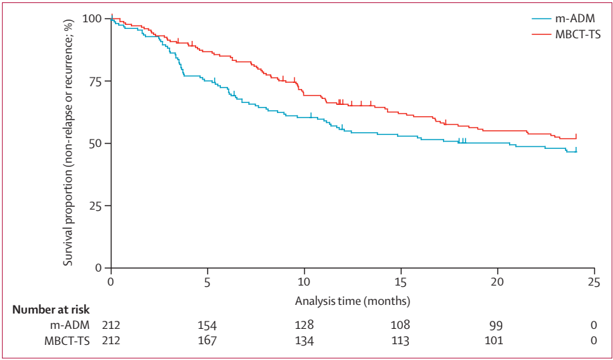
- Primary outcome: no difference in time to relapse/recurrence over 24 months (HR 0.89, 95% CI 0.67–1.18; p=0.43); relapse occurred in 94/212 (44%) MBCT-TS participants vs 100/212 (47%) maintenance antidepressant participants.
- Secondary outcomes showed no evidence of superiority of MBCT-TS over maintenance antidepressants; no secondary outcome treatment effect exceeded a standardised mean difference of 0.4.
- Cost-effectiveness: MBCT-TS attendance cost £112 per participant; total health and social care cost did not differ significantly (mean difference £124, 95% CI −749.98 to 972.57; p=0.80). In QALYs, MBCT-TS was dominated by maintenance antidepressants, and the probability of MBCT-TS being more cost-effective did not rise above 52%.
- Exploratory subgroup: a significant interaction with reported childhood abuse was noted; MBCT-TS reduced relapse/recurrence in the high-abuse subgroup (49/105 [47%] vs 65/111 [59%]) but showed slightly higher risk in the low-abuse subgroup (44/105 [42%] vs 35/101 [35%]).
- Serious adverse events: ten reported, four fatal, evenly split between groups (three non-fatal and two fatal in each group); none attributed to the interventions or trial.
Methods
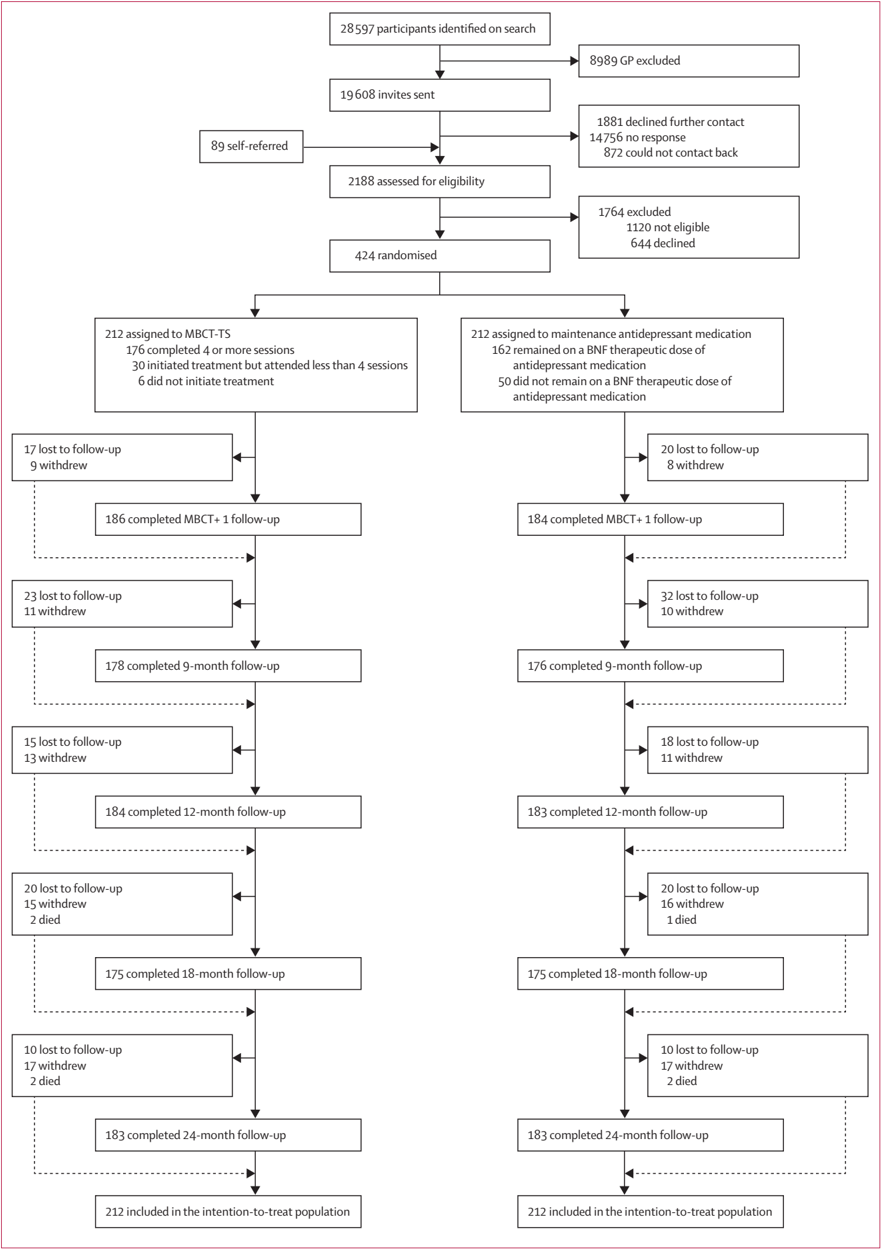
- Multicentre, pragmatic, single-blind, parallel-group randomised controlled trial (PREVENT) in UK primary care; 424 adults with recurrent major depressive disorder in full or partial remission, ≥3 previous major depressive episodes, and on a therapeutic dose of maintenance antidepressants were recruited from 95 general practices and randomised 1:1 to MBCT-TS or maintenance antidepressants.
- Primary outcome was time to relapse or recurrence of depression over 24 months, assessed retrospectively with the SCID depression module; primary analysis was intention-to-treat using Cox regression adjusted for stratification variables.
- Secondary outcomes included depression-free days, residual depressive symptoms, psychiatric/medical comorbidity, quality of life, and cost-effectiveness; economic analysis used health and social care and societal perspectives, QALYs from EQ-5D, and cost-effectiveness acceptability curves.
Limitations
- The paper states the sample was at high risk, currently taking antidepressants, and open both to a group psychosocial treatment and to discontinuing or continuing medication, so findings are generalisable only to individuals in equipoise about preventive treatment; recruitment was by primary care database search and invitation rather than GP discussion of options.
- The paper states there was no usual care or attention control group, so effects of MBCT cannot be inferred to be specific to MBCT; the pragmatic design meant a subgroup in both groups did not comply with the invitation to discontinue antidepressants, so antidepressant medication was not fully controlled.
- The text also makes evident that assessor masking fidelity was only moderate (assessors correctly guessed allocation for 56% of assessments), the adherence-based secondary analyses were non-randomised and prone to selection bias and confounding, and there was a protocol discrepancy: WHOQOL was not listed as a secondary outcome in the published protocol or ISRCTN register.
Model-written summary. Check it against the paper before relying on it.
Integrity signals
Registry
Cites
Statistics
Figures
Verification
Claims the paper makes
10 Valid · 0 Not valid · 20 Not checked · 69 Own results and interpretations
The sources with a verdict support this claim; the rest weren’t checked yet, have no full text we could read, or their verdicts aren’t rated yet.
In the paper
“Before this study, only two small studies 10,39 had compared MBCT-TS with maintenance antidepressants (panel).”
§ Eff ectiveness and cost-eff ectiveness of mindfulness-based cognitive therapy compared with maintenance antidepressant treatment in the prevention of depressive relapse or recurrence (PREVENT): a randomised controlled trial > Discussion
What the sources say
- Not checked — no full text of the sourcecites [10] Kuyken W, Byford S, Taylor RS, et al. Mindfulness-based cognitive therapy to prevent relapse in recurrent depression. J Consult Clin Psychol 2008; 76: 966-78. source
- Supportedcites [39] Segal ZV, Bieling P, Young T, et al. Antidepressant monotherapy vs sequential pharmacotherapy and mindfulness-based cognitive therapy, or placebo, for relapse prophylaxis in recurrent depression. Arch Gen Psychiatry 2010; 67: 1256-64. source
The Abstract reports that this study randomized 84 remitted patients to maintenance antidepressants, MBCT, or placebo. It also describes one earlier MBCT trial comparing survival with maintenance pharmacotherapy. The cited paper is therefore one of the two small comparison studies identified by the citing sentence, though it cannot by itself establish that no others preceded the citing study. (LLM, conf=0.87)
plain- Asserted: passes — The authors put it forward as true.
- Checkable: passes — It can be checked against evidence.
- Load-bearing: unclear — It is unclear whether the paper’s conclusions depend on it.
- Based: passes — The paper gives a reason why it holds.
The sources with a verdict support this claim; the rest weren’t checked yet, have no full text we could read, or their verdicts aren’t rated yet.
In the paper
“The results further suggest that psychosocial treatments such as MBCT and CBT 7,40,43 off er added value for patients who need them most (ie, those at highest risk of depressive relapse or recurrence).”
§ Eff ectiveness and cost-eff ectiveness of mindfulness-based cognitive therapy compared with maintenance antidepressant treatment in the prevention of depressive relapse or recurrence (PREVENT): a randomised controlled trial > Discussion
What the sources say
- Supportedcites [7] Williams JMG, Crane C, Barnhofer T, et al. Mindfulness-based cognitive therapy for preventing relapse in recurrent depression: a randomized dismantling trial. J Consult Clin Psychol 2014; 82: 275-86. source
In Discussion > Principal Findings, the authors suggest that prophylactic psychosocial treatment may benefit more vulnerable patients in remission, while cognitive therapy and MBCT may add little therapeutic effect for less vulnerable patients. They distinguish this from treatment for acute depression, and their reported MBCT benefit among patients with more childhood trauma supports the claim’s focus on relapse prevention. (LLM, conf=0.90)
- Not checked — no full text of the sourcecites [40] Stangier U, Hilling C, Heidenreich T, et al. Maintenance cognitive-behavioral therapy and manualized psychoeducation in the treatment of recurrent depression: a multicenter prospective randomized controlled trial. Am J Psychiatry 2013; 170: 624-32. source
- Not checked — no full text of the sourcecites [43] Bockting CL, Schene AH, Spinhoven P, et al. Preventing relapse/ recurrence in recurrent depression with cognitive therapy: a randomized controlled trial. J Consult Clin Psychol 2005; 73: 647-57. source
hedgedstates a possible cause- Asserted: passes — The authors put it forward as true.
- Checkable: passes — It can be checked against evidence.
- Load-bearing: passes — The paper’s conclusions depend on it.
- Based: passes — The paper gives a reason why it holds.
- Supported
Every source the paper cites for this claim was checked and supports it.
In the paper
“Consistent with an emergent pattern of fi ndings, 7 MBCT might confer most benefi t to patients at greatest risk of relapse.”
§ Eff ectiveness and cost-eff ectiveness of mindfulness-based cognitive therapy compared with maintenance antidepressant treatment in the prevention of depressive relapse or recurrence (PREVENT): a randomised controlled trial > Discussion
What the sources say
- Supportedcites [7] Williams JMG, Crane C, Barnhofer T, et al. Mindfulness-based cognitive therapy for preventing relapse in recurrent depression: a randomized dismantling trial. J Consult Clin Psychol 2014; 82: 275-86. source
The Discussion (Principal Findings; page not provided) reports that MBCT reduced relapse risk among participants with more childhood trauma, a marker of vulnerability, but not among those with less or no such history. It also describes this as consistent with earlier findings of greater benefit among patients vulnerable to relapse. The claim’s tentative wording matches that evidence. (LLM, conf=0.93)
hedgedstates a possible causen = 274- Asserted: passes — The authors put it forward as true.
- Checkable: passes — It can be checked against evidence.
- Load-bearing: passes — The paper’s conclusions depend on it.
- Based: passes — The paper gives a reason why it holds.
- Supported
A result the paper reports from its own data — it cites no other source for it, so there is none to check. The quote shows it is in the paper.
In the paper
“Five adverse events were reported, including two deaths, in each of the MBCT-TS and maintenance antidepressants groups.”
§ Eff ectiveness and cost-eff ectiveness of mindfulness-based cognitive therapy compared with maintenance antidepressant treatment in the prevention of depressive relapse or recurrence (PREVENT): a randomised controlled trial > Abstract
plain- Asserted: passes — The authors put it forward as true.
- Checkable: passes — It can be checked against evidence.
- Load-bearing: unclear — It is unclear whether the paper’s conclusions depend on it.
- Based: passes — The paper gives a reason why it holds.
A result the paper reports from its own data — it cites no other source for it, so there is none to check. The quote shows it is in the paper.
In the paper
“nor did the number of serious adverse events.”
§ Eff ectiveness and cost-eff ectiveness of mindfulness-based cognitive therapy compared with maintenance antidepressant treatment in the prevention of depressive relapse or recurrence (PREVENT): a randomised controlled trial > Abstract
plainn = 424- Asserted: passes — The authors put it forward as true.
- Checkable: passes — It can be checked against evidence.
- Load-bearing: unclear — It is unclear whether the paper’s conclusions depend on it.
- Based: passes — The paper gives a reason why it holds.
31 more claims
Create a free account to see all 99 claims and to verify the 1 reference still open.
- Probably not a substantial claim. 43
- It may state two separate claims as one. 30
Claims other papers make about this one
Each is checked against this paper’s own text: does it say what the citing paper says it does?
The source backs part of the claim, not all of it — or backs it for a different population, condition or comparison.
In the citing paper
“and 29 of 212 (13.7%) reduced the dose by a minimum of 50%.”
From Approaches for discontinuation versus continuation of long-term antidepressant use for depressive and anxiety disorders in adults (2021) · cites this paper as Kuyken 2015
Experimental — accuracy not yet measuredThe source backs part of the claim, not all of it — or backs it for a different population, condition or comparison.
In the citing paper
“Kuyken 2015 reported that 124 of 212 (59%) discontinued the antidepressant”
From Approaches for discontinuation versus continuation of long-term antidepressant use for depressive and anxiety disorders in adults (2021) · cites this paper as Kuyken 2015
Experimental — accuracy not yet measuredThe source backs part of the claim, not all of it — or backs it for a different population, condition or comparison.
In the citing paper
“Data show no differences between discontinuation and continuation in the physical domain (MD -0.22, 95% CI -2.16 to 1.73; 455 participants, 2 studies; I = 65%; random-effects model)”
From Approaches for discontinuation versus continuation of long-term antidepressant use for depressive and anxiety disorders in adults (2021) · cites this paper as Kuyken 2015
Experimental — accuracy not yet measuredThe source backs part of the claim, not all of it — or backs it for a different population, condition or comparison.
In the citing paper
“There was no difference in risk of relapse (as defined by study authors) between participants discontinuing antidepressants with support from MBCT or PCT compared to those continuing antidepressants (HR 0.89, 95% CI 0.66 to 1.19; 690 participants, 3 studies).”
From Approaches for discontinuation versus continuation of long-term antidepressant use for depressive and anxiety disorders in adults (2021) · cites this paper as Kuyken 2015
Experimental — accuracy not yet measuredThe source backs part of the claim, not all of it — or backs it for a different population, condition or comparison.
In the citing paper
“the psychological domain (MD 0.37, 95% CI -0.75 to 1.49; 455 participants, 2 studies; I = 46%; random-effects model)”
From Approaches for discontinuation versus continuation of long-term antidepressant use for depressive and anxiety disorders in adults (2021) · cites this paper as Kuyken 2015
Experimental — accuracy not yet measured
30 more claims about this paper
Create a free account to see every claim other papers make about this one.
Self-check
Percentages, sums and reported differences re-computed from the paper’s own numbers.
Each contradiction between two passages listed here was confirmed by an independent check.
Rated minor: it would not touch a result — a value no result rests on, a p-value that stays on the same side of the significance level, or a conflict that is clerical, resolved elsewhere in the paper, or outside its own findings.
In the paper
§ Eff ectiveness and cost-eff ectiveness of mindfulness-based cognitive therapy compared with maintenance antidepressant treatment in the prevention of depressive relapse or recurrence (PREVENT): a randomised controlled trial > Results
“Physical 14•5 (6•5) 14•4 (5•1) Psychological 12•6 (2•6) 12•3 (2•6)”
§ Eff ectiveness and cost-eff ectiveness of mindfulness-based cognitive therapy compared with maintenance antidepressant treatment in the prevention of depressive relapse or recurrence (PREVENT): a randomised controlled trial > References
“WHO-QoL physical health domain 0•07 0•02 m-ADM 12•3 (2•6) 205 14•3 (3•0) 173 14•8 (3•2) 141 14•7 (3•3) 157 14•7 (3•3) 149 14•9 (5•5) 167 MBCT-TS 12•6 (2•6) 209”
Citations
Cites
An Introduction to the Bootstrap
Efron, B., & Tibshirani, R. J. (1994) · doi:10.1201/9780429246593 · Cited by 40,500
CONSORT 2010 Statement: updated guidelines for reporting parallel group randomised trials
the CONSORT Group, Schulz, K. F., Altman, D. G., & Moher, D. (2010) · BMC Medicine · doi:10.1186/1741-7015-8-18 · Cited by 13,371
Development of the World Health Organization WHOQOL-BREF Quality of Life Assessment
THE WHOQOL GROUP (1998) · Psychological Medicine · doi:10.1017/s0033291798006667 · Cited by 7,933
EuroQol: the current state of play
Brooks, R. (1996) · Health Policy · doi:10.1016/0168-8510(96)00822-6 · Cited by 5,815
Kabat-Zinn, J. (1982) · General Hospital Psychiatry · doi:10.1016/0163-8343(82)90026-3 · Cited by 4,255
Schafer, J. L. (1999) · Statistical Methods in Medical Research · doi:10.1177/096228029900800102 · Cited by 3,949
CONSORT 2010 statement: updated guidelines for reporting parallel group randomized trials
Schulz, K. F., Altman, D. G., Moher, D., & for the CONSORT Group* (2010) · Annals of Internal Medicine · doi:10.7326/0003-4819-152-11-201006010-00232 · Cited by 3,824
(1958) · Journal of the American Pharmaceutical Association (Scientific ed.) · doi:10.1002/jps.3030470133 · Cited by 2,489
Boutron, I., Moher, D., Altman, D. G., Schulz, K. F., Ravaud, P., & for the CONSORT Group* (2008) · Annals of Internal Medicine · doi:10.7326/0003-4819-148-4-200802190-00008 · Cited by 2,292
Wilamowska (2010) · doi:10.1001/archpsyc.1988.01800320058007 · Cited by 2,115
Ma, S. H., & Teasdale, J. D. (2004) · Journal of Consulting and Clinical Psychology · doi:10.1037/0022-006x.72.1.31 · Cited by 1,390
Mindfulness-based cognitive therapy for depression
(2006) · Buddhist Thought and Applied Psychological Research · doi:10.4324/9780203098899-33 · Cited by 1,324
Three-Year Outcomes for Maintenance Therapies in Recurrent Depression
Frank, E. (1990) · Archives of General Psychiatry · doi:10.1001/archpsyc.1990.01810240013002 · Cited by 1,297
An Introduction to the Bootstrap.
Kimber, A., Efron, B., & Tibshirani, R. J. (1994) · The Statistician · doi:10.2307/2348146 · Cited by 1,245
The World Health Organization Health and Work Performance Questionnaire (HPQ)
Kessler, R. C., Barber, C., Beck, A., Berglund, P., Cleary, P. D., McKenas, D., Pronk, N., Simon, G., Stang, P., Ustun, T. B., et al. (2003) · Journal of Occupational and Environmental Medicine · doi:10.1097/01.jom.0000052967.43131.51 · Cited by 1,148
Net Health Benefits: A New Framework for the Analysis of Uncertainty in Cost-Effectiveness Analysis
Stinnett, A. A., & Mullahy, J. (1998) · Medical Decision Making · doi:10.1177/0272989x98018002s09 · Cited by 1,102
Mindfulness-based cognitive therapy for depression
Kumari, D., & Satyapal, N. (2025) · Industrial Psychiatry Journal · doi:10.4103/ipj.ipj_127_24 · Cited by 997
Relapse prevention with antidepressant drug treatment in depressive disorders: a systematic review
Geddes, J. R., Carney, S. M., Davies, C., Furukawa, T. A., Kupfer, D. J., Frank, E., & Goodwin, G. M. (2003) · The Lancet · doi:10.1016/s0140-6736(03)12599-8 · Cited by 945
Multiple recurrences of major depressive disorder
Solomon, D. A., Keller, M. B., Leon, A. C., Mueller, T. I., Lavori, P. W., Shea, M. T., Coryell, W., Warshaw, M., Turvey, C., Maser, J. D., et al. (2000) · American Journal of Psychiatry · doi:10.1176/appi.ajp.157.2.229 · Cited by 835
Piet, J., & Hougaard, E. (2011) · Clinical Psychology Review · doi:10.1016/j.cpr.2011.05.002 · Cited by 807
How should cost data in pragmatic randomised trials be analysed?
Thompson, S. G. (2000) · BMJ · doi:10.1136/bmj.320.7243.1197 · Cited by 772
Mindfulness-based cognitive therapy to prevent relapse in recurrent depression.
Kuyken, W., Byford, S., Taylor, R. S., Watkins, E., Holden, E., White, K., Barrett, B., Byng, R., Evans, A., Mullan, E., et al. (2008) · Journal of Consulting and Clinical Psychology · doi:10.1037/a0013786 · Cited by 770
Self-citationPrevalence and clinical course of depression: a review
Richards, D. (2011) · Clinical Psychology Review · doi:10.1016/j.cpr.2011.07.004 · Cited by 623
Paying the price: the cost of mental health care in England to 2026
McCrone, P., Dhanasiri, S., Patel, A. K., Knapp, M. R. J., & Lawton-Smith, S. H. (2008) · Research Portal (King's College London) · Cited by 591
Continuation of Low-Dose Aspirin Therapy in Peptic Ulcer Bleeding: A Randomized Trial
Sung, J. J. Y., Lau, J. Y. W., Ching, J. Y. L., Wu, J. C. Y., Lee, Y. T., Chiu, P. W. Y., Leung, V. K. S., Wong, V. W. S., & Chan, F. K. L. (2010) · Annals of Internal Medicine · doi:10.7326/0003-4819-152-1-201001050-00179 · Cited by 520
(2013) · Cited by 481
Segal, Z. V., Teasdale, J. D., Williams, J. M., & Gemar, M. C. (2002) · Clinical Psychology & Psychotherapy · doi:10.1002/cpp.320 · Cited by 432
Segal, Z. V., Bieling, P., Young, T., MacQueen, G., Cooke, R., Martin, L., Bloch, R., & Levitan, R. D. (2010) · Archives of General Psychiatry · doi:10.1001/archgenpsychiatry.2010.168 · Cited by 429
A guide to cost-effectiveness acceptability curves
Fenwick, E., & Byford, S. (2005) · British Journal of Psychiatry · doi:10.1192/bjp.187.2.106 · Cited by 420
Williams, J. M. G., Crane, C., Barnhofer, T., Brennan, K., Duggan, D. S., Fennell, M. J. V., Hackmann, A., Krusche, A., Muse, K., Von Rohr, I. R., et al. (2014) · Journal of Consulting and Clinical Psychology · doi:10.1037/a0035036 · Cited by 420
Five-Year Outcome for Maintenance Therapies in Recurrent Depression
Kupfer, D. J. (1992) · Archives of General Psychiatry · doi:10.1001/archpsyc.1992.01820100013002 · Cited by 370
A practical guide for calculating indirect costs of disease
Koopmanschap, M. A., & Rutten, F. F. H. (1996) · PharmacoEconomics · doi:10.2165/00019053-199610050-00003 · Cited by 358
PARKER, G., ROUSSOS, J., HADZI-PAVLOVIC, D., MITCHELL, P., WILHELM, K., & AUSTIN, M.-P. (1997) · Psychological Medicine · doi:10.1017/s003329179700545x · Cited by 304
The GRID-HAMD: standardization of the Hamilton Depression Rating Scale
Williams, J. B. W., Kobak, K. A., Bech, P., Engelhardt, N., Evans, K., Lipsitz, J., Olin, J., Pearson, J., & Kalali, A. (2008) · International Clinical Psychopharmacology · doi:10.1097/yic.0b013e3282f948f5 · Cited by 295
CONSORT 2010 Statement: Updated Guidelines for Reporting Parallel Group Randomized Trials
Schulz, K. F., Altman, D. G., & Moher, D. (2011) · Annals of Internal Medicine · doi:10.7326/0003-4819-154-4-201102150-00017 · Cited by 259
Crane, R. S., Eames, C., Kuyken, W., Hastings, R. P., Williams, J. M. G., Bartley, T., Evans, A., Silverton, S., Soulsby, J. G., & Surawy, C. (2013) · Assessment · doi:10.1177/1073191113490790 · Cited by 255
Self-citationBockting, C. L. H., DELTA Study Group, Schene, A. H., Spinhoven, P., Koeter, M. W. J., Wouters, L. F., Huyser, J., & Kamphuis, J. H. (2005) · Journal of Consulting and Clinical Psychology · doi:10.1037/0022-006x.73.4.647 · Cited by 249
(2007) · Encyclopedia of Measurement and Statistics · doi:10.4135/9781412952644.n49 · Cited by 190
Stangier, U., Hilling, C., Heidenreich, T., Risch, A. K., Barocka, A., Schlösser, R., Kronfeld, K., Ruckes, C., Berger, H., Röschke, J., et al. (2013) · American Journal of Psychiatry · doi:10.1176/appi.ajp.2013.12060734 · Cited by 174
Mindfulness-based cognitive therapy: a promising new approach to preventing depressive relapse
Williams, J. M. G., & Kuyken, W. (2012) · British Journal of Psychiatry · doi:10.1192/bjp.bp.111.104745 · Cited by 126
Self-citationNet Health Benefits: A New Framework for the Analysis of Uncertainty in Cost-Effectiveness Analysis
Stinnett, A. A., & Mullahy, J. (1998) · National Bureau of Economic Research · doi:10.3386/t0227 · Cited by 110
Miniati, M., Rucci, P., Benvenuti, A., Frank, E., Buttenfield, J., Giorgi, G., & Cassano, G. B. (2010) · Journal of Psychiatric Research · doi:10.1016/j.jpsychires.2009.09.008 · Cited by 106
Kuyken, W., Byford, S., Byng, R., Dalgleish, T., Lewis, G., Taylor, R., Watkins, E. R., Hayes, R., Lanham, P., Kessler, D., et al. (2010) · Trials · doi:10.1186/1745-6215-11-99 · Cited by 48 · cited 1×
“There is therefore a discrepancy between the published protocol that does not list the WHOQOL as a secondary outcome (Kuyken et al, 2010) and this outcome paper, which does report it.”
ResultSelf-citationDoes mindfulness based cognitive therapy prevent relapse of depression?
Kuyken, W., Crane, R., & Dalgleish, T. (2012) · BMJ · doi:10.1136/bmj.e7194 · Cited by 34
Self-citationGeddes, Carney, S. M., & Davies, C. (2004) · The Lancet · Cited by 27
Kuyken, W., Byford, S., Byng, R., Dalgleish, T., Lewis, G., Taylor, R., Watkins, E. R., Hayes, R., Lanham, P., Kessler, D., et al. (2014) · Trials · doi:10.1186/1745-6215-15-217 · Cited by 13
Self-citation
Research works printed but not linked: 1
- Williams JBW. A structured clinical interview guide for the Hamilton Depression Rating Scale. Arch Gen Psychiatry 1998; 45: 742-47. · DOI
Cited by
Creswell, J. D. (2017) · Annual Review of Psychology · doi:10.1146/annurev-psych-042716-051139 · Cited by 1,702
Van Dam, N. T., van Vugt, M. K., Vago, D. R., Schmalzl, L., Saron, C. D., Olendzki, A., Meissner, T., Lazar, S. W., Kerr, C. E., Gorchov, J., et al. (2018) · Perspectives on Psychological Science · doi:10.1177/1745691617709589 · Cited by 1,506
Mindfulness-based cognitive therapy for depression
Kumari, D., & Satyapal, N. (2025) · Industrial Psychiatry Journal · doi:10.4103/ipj.ipj_127_24 · Cited by 997
Reflecting on rumination: Consequences, causes, mechanisms and treatment of rumination
Watkins, E. R., & Roberts, H. (2020) · Behaviour Research and Therapy · doi:10.1016/j.brat.2020.103573 · Cited by 862
Self-citationKuyken, W., Warren, F. C., Taylor, R. S., Whalley, B., Crane, C., Bondolfi, G., Hayes, R., Huijbers, M., Ma, H., Schweizer, S., et al. (2016) · JAMA Psychiatry · doi:10.1001/jamapsychiatry.2016.0076 · Cited by 821
Self-citation
Metadata
- Authors
- Kuyken, W., Hayes, R., Barrett, B., Byng, R., Dalgleish, T., Kessler, D., Lewis, G., Watkins, E., Brejcha, C., Cardy, J., Causley, A., Cowderoy, S., Evans, A., Gradinger, F., Kaur, S., Lanham, P., Morant, N., Richards, J., Shah, P., Sutton, H., Vicary, R., Weaver, A., Wilks, J., Williams, M., Taylor, R. S., & Byford, S.
- Affiliations
- University of Exeter (GB)
- King's College London (GB)
- Peninsula College of Medicine and Dentistry (GB)
- MRC Cognition and Brain Sciences Unit (GB)
- University of Bristol (GB)
- University College London (GB)
- University of Cambridge (GB)
- Corresponding author
- Kuyken, Willem
- ORCID
- Venue
- The Lancet
- Publisher
- Elsevier BV
- Published
- 2015-07
- Volume
- 386
- Issue
- 9988
- Pages
- 63-73
- ISSN
- 0099-5355 (ISSN-L)
- 0140-6736
- OpenAlex
- W2163837537
- Semantic Scholar
- 81bd8c13832a518d11d215b8a80aad817a749d43
- Cited by
- 527
- References
- 45
- Citations by year
- 2026: 29 · 2025: 36 · 2024: 34 · 2023: 47 · 2022: 37 · 2021: 43 · 2020: 62 · 2019: 52 · 2018: 54 · 2017: 50 · 2016: 58 · 2015: 24
- FWCI
- 76.87
- Type
- journal article
- Language
- en
- Open access
- hybrid
- doi.org
- Licence
- cc-by
- www.elsevier.com/tdm/userlicense/1.0/ (tdm)
- creativecommons.org/licenses/by/4.0/ (vor)
- Locations
- The Lancet (publishedVersion, cc-by)
- PubMed (publishedVersion)
- ENLIGHTEN (Jurnal Bimbingan dan Konseling Islam) (acceptedVersion)
- UCL Discovery (University College London) (submittedVersion)
- Figshare (submittedVersion)
- Research Portal (King's College London) (submittedVersion, cc-by)
- Open Research Exeter (University of Exeter) (submittedVersion, cc-by)
- PEARL (University of Plymouth) (submittedVersion)
- Bristol Research (University of Bristol) (submittedVersion, cc-by)
- Funders
- National Institute for Health Research Health Technology Assessment (NIHR HTA) programme (project number: 08/56/01)
- Topics
- Social Sciences › Psychology › Clinical Psychology › Mindfulness and Compassion Interventions
- Health Sciences › Medicine › Pharmacology (medical) › Treatment of Major Depression
- Social Sciences › Psychology › Experimental and Cognitive Psychology › Anxiety, Depression, Psychometrics, Treatment, Cognitive Processes
- Keywords
- mindfulness-based cognitive therapy, relapse prevention, depression recurrence, recurrent depression, antidepressant tapering, antidepressant discontinuation, cost-effectiveness, primary care, serious adverse events
- MeSH terms
- Adult, Aged, Antidepressive Agents, Combined Modality Therapy, Major Depressive Disorder, Drug Administration Schedule, Female, Humans, Male, Middle Aged, Quality of Life, Recurrence, Socioeconomic Factors, Cognitive Behavioral Therapy, Single-Blind Method, Treatment Outcome, Young Adult, Mindfulness
About these checks
Registry, retraction, Cites and statistics results are computed, not judged, with one exception: a printed reference that no index lists is read once by a model before it counts as a citation error. Claims are extracted by a model and kept only when their quote appears verbatim in the text; each cited source is then checked, with a model’s help, for whether it says what the claim relies on. Those verdicts can be wrong — read the claim’s quote and the cited source before relying on one.
The claim verdicts this report counts are experimental: their accuracy is not yet measured.
A language model drew the claims from the paper on 2026-10-10, under version 3 of the claim definition (model deepseek-v4.1-flash, prompt extract-v3).
A second model labelled each claim on 2026-10-10 (model jev-1.13-20260917, definition revision gold-guideline-v0.2).
Cited sources are checked with a language model’s help (gpt-6-sol).
Statistics and arithmetic are recomputed, not judged.
Confidence bands are shown only for fields calibrated on our annotated test set. None is calibrated yet, so no band is shown.
What counts as a claim ›How we measure confidence ›How we check this ›
Are you an author, or do you see a problem with this page? Request a review
Data sources
Bibliographic data: Semantic Scholar, OpenAlex, Crossref.
Contains information from the Semantic Scholar Academic Graph Datasets, made available under the ODC Attribution License (ODC-BY 1.0).
Semantic Scholar’s data is described in: Kinney, R., et al. (2023). The Semantic Scholar Open Data Platform. arXiv:2301.10140.
