

The DOI matches its Crossref record; 32 of the 33 references it cites were found in a registry or an index, and 1 are not checked yet.
Does happiness itself directly affect mortality? The prospective UK Million Women Study
Open accessAbstract
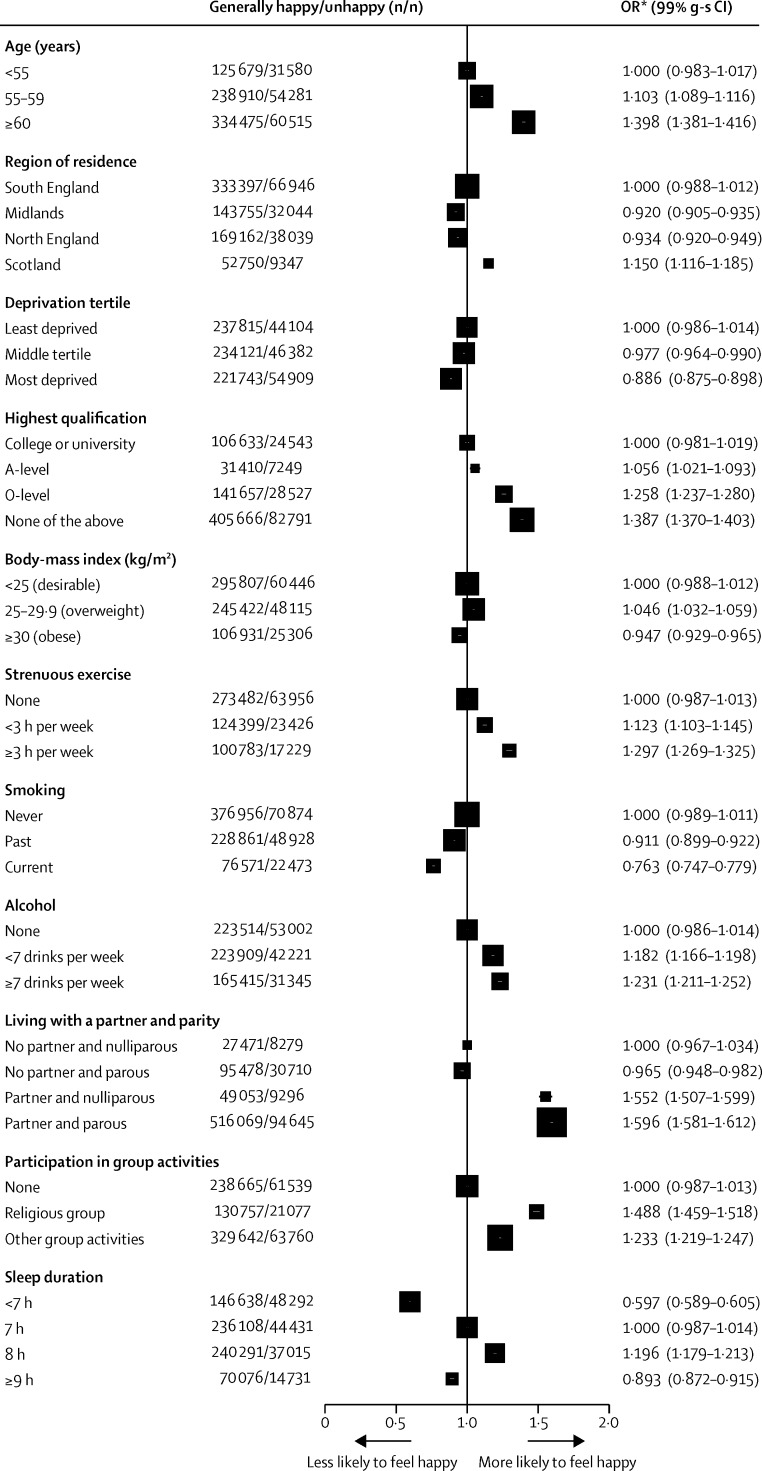
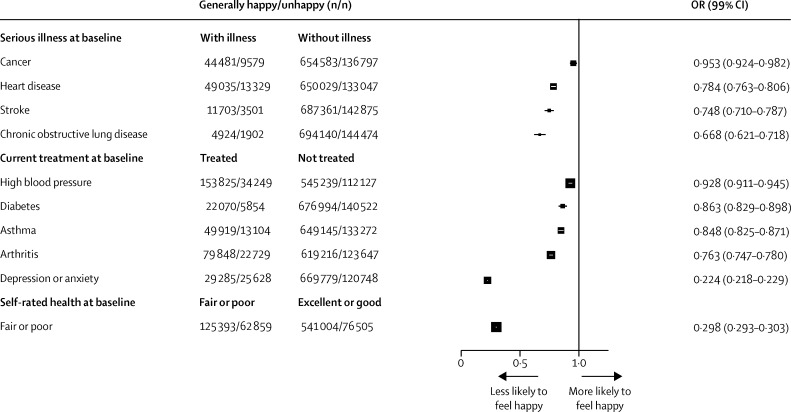
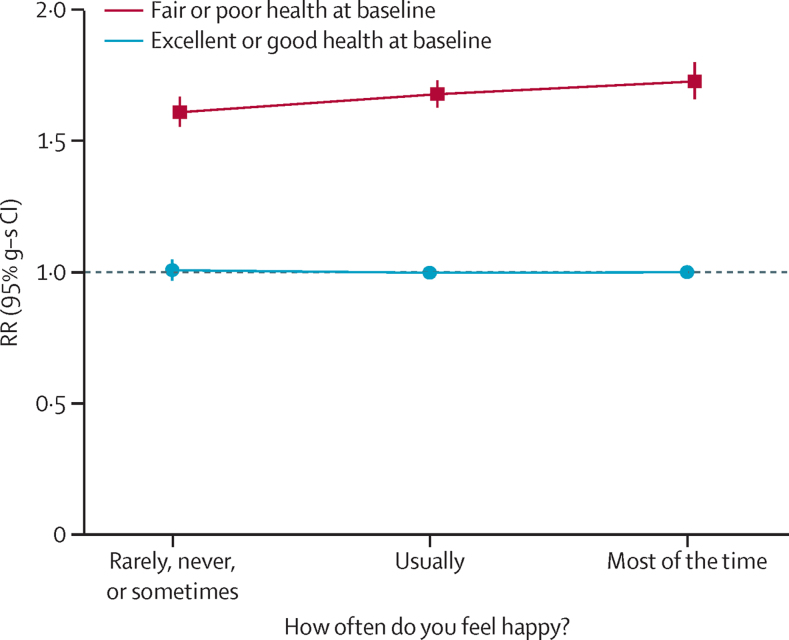
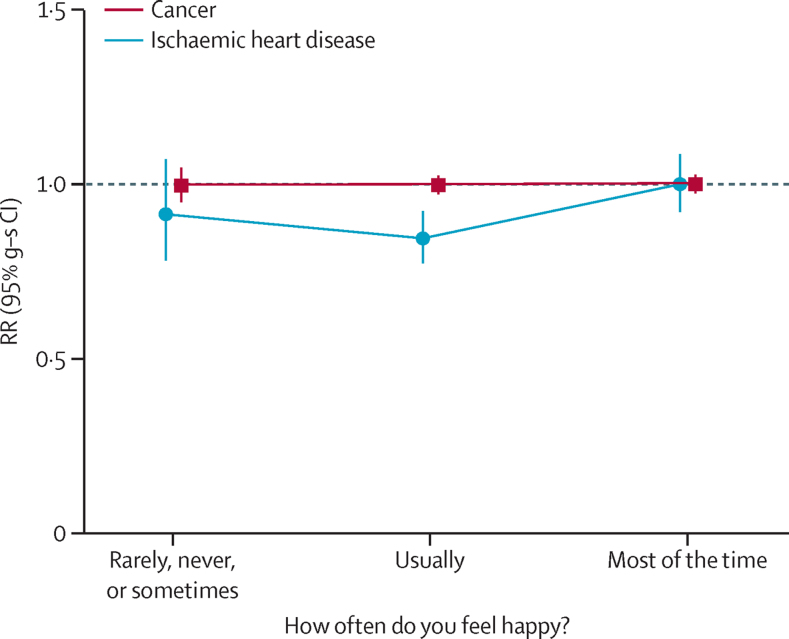
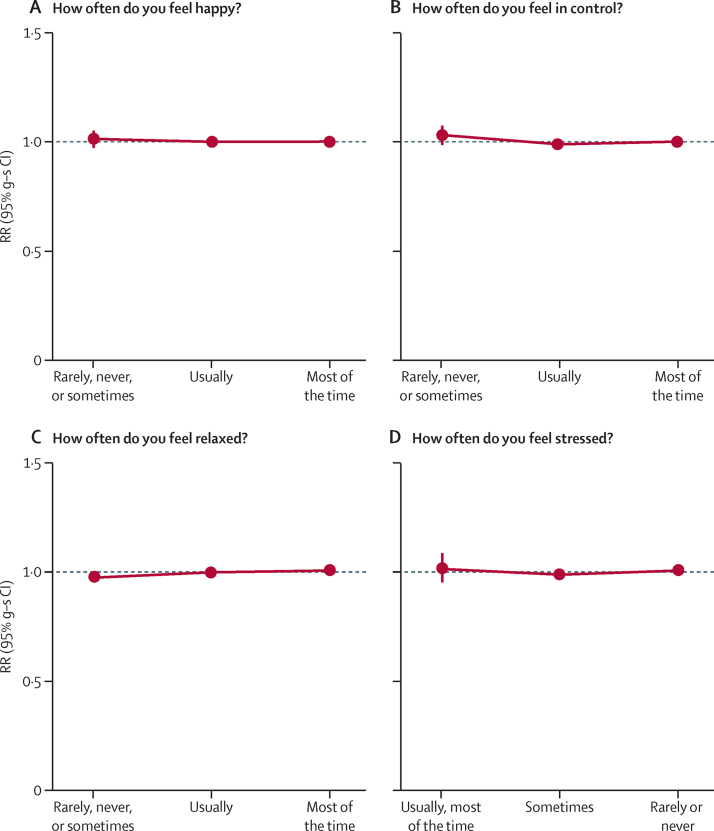
BACKGROUND: Poor health can cause unhappiness and poor health increases mortality. Previous reports of reduced mortality associated with happiness could be due to the increased mortality of people who are unhappy because of their poor health. Also, unhappiness might be associated with lifestyle factors that can affect mortality. We aimed to establish whether, after allowing for the poor health and lifestyle of people who are unhappy, any robust evidence remains that happiness or related subjective measures of wellbeing directly reduce mortality. METHODS: The Million Women Study is a prospective study of UK women recruited between 1996 and 2001 and followed electronically for cause-specific mortality. 3 years after recruitment, the baseline questionnaire for the present report asked women to self-rate their health, happiness, stress, feelings of control, and whether they felt relaxed. The main analyses were of mortality before Jan 1, 2012, from all causes, from ischaemic heart disease, and from cancer in women who did not have heart disease, stroke, chronic obstructive lung disease, or cancer at the time they answered this baseline questionnaire. We used Cox regression, adjusted for baseline self-rated health and lifestyle factors, to calculate mortality rate ratios (RRs) comparing mortality in women who reported being unhappy (ie, happy sometimes, rarely, or never) with those who reported being happy most of the time. FINDINGS: Of 719,671 women in the main analyses (median age 59 years [IQR 55-63]), 39% (282,619) reported being happy most of the time, 44% (315,874) usually happy, and 17% (121,178) unhappy. During 10 years (SD 2) follow-up, 4% (31,531) of participants died. Self-rated poor health at baseline was strongly associated with unhappiness. But after adjustment for self-rated health, treatment for hypertension, diabetes, asthma, arthritis, depression, or anxiety, and several sociodemographic and lifestyle factors (including smoking, deprivation, and body-mass index), unhappiness was not associated with mortality from all causes (adjusted RR for unhappy vs happy most of the time 0·98, 95% CI 0·94-1·01), from ischaemic heart disease (0·97, 0·87-1·10), or from cancer (0·98, 0·93-1·02). Findings were similarly null for related measures such as stress or lack of control. INTERPRETATION: In middle-aged women, poor health can cause unhappiness. After allowing for this association and adjusting for potential confounders, happiness and related measures of wellbeing do not appear to have any direct effect on mortality. FUNDING: UK Medical Research Council, Cancer Research UK.
Overview
The claims and statistics of this paper haven’t been checked yet.
Run the check — free, no account needed. It reads the open-access text and checks the sources it cites.
Integrity signals
Registry
Cites
Statistics
Figures
Verification
Claims the paper makes
The claims and statistics of this paper haven’t been checked yet.
Run the check — free, no account needed. It reads the open-access text and checks the sources it cites.
Claims other papers make about this one
Each is checked against this paper’s own text: does it say what the citing paper says it does?
The cited source says what the claim attributes to it.
In the citing paper
“However, in the Million Women Study, there was no association of happiness with risk of mortality after accounting for health status, although concerns have been raised about the study methodology. 79,80”
From Psychological Health, Well-Being, and the Mind-Heart-Body Connection: A Scientific Statement From the American Heart Association (2021) · cites this paper as [79]
Self-check
Percentages, sums and reported differences re-computed from the paper’s own numbers.
The self-check needs the paper’s full text.
Citations
Cites
Self-rated health and mortality: a review of twenty-seven community studies.
Idler, E. L., & Benyamini, Y. (1997) · Journal of Health and Social Behavior · doi:10.2307/2955359 · Cited by 8,598
Breast cancer and hormone-replacement therapy in the Million Women Study
Beral, V. (2003) · The Lancet · doi:10.1016/s0140-6736(03)14065-2 · Cited by 2,986
Self-citationWell-Being Over Time in Britain and the USA
Oswald, A. J., & Blanchflower, D. G. (1999) · Cited by 2,774
Subjective wellbeing, health, and ageing
Steptoe, A., Deaton, A., & Stone, A. A. (2014) · The Lancet · doi:10.1016/s0140-6736(13)61489-0 · Cited by 2,538
Happy People Live Longer: Subjective Well‐Being Contributes to Health and Longevity
Diener, E., & Chan, M. Y. (2011) · Applied Psychology: Health and Well-Being · doi:10.1111/j.1758-0854.2010.01045.x · Cited by 2,260
Does positive affect influence health?
Pressman, S. D., & Cohen, S. (2005) · Psychological Bulletin · doi:10.1037/0033-2909.131.6.925 · Cited by 2,087
Chida, Y., & Steptoe, A. (2008) · Psychosomatic Medicine · doi:10.1097/psy.0b013e31818105ba · Cited by 1,592
Health and Deprivation: Inequality and the North
Townsend, P. D., Phillimore, P., & Beattie, A. (1987) · DOAJ (DOAJ: Directory of Open Access Journals) · Cited by 1,473
Breast cancer and hormone-replacement therapy: the Million Women Study
Beral, V., Banks, E., REEVES, G. K., & Bull, D. (2003) · The Lancet · doi:10.1016/s0140-6736(03)14596-5 · Cited by 1,270
Self-citationPERCEIVED HEALTH AND MORTALITY: A NINE-YEAR FOLLOW-UP OF THE HUMAN POPULATION LABORATORY COHORT1
Kaplan, G. A., & Camacho, T. C. (1983) · American Journal of Epidemiology · doi:10.1093/oxfordjournals.aje.a113541 · Cited by 1,078
Cited by
Sorted by citations
Items 201–258 of 258
Personality in Nonhuman Animals
Bell, A. M., & Bensky, M. K. (2020) · Cambridge University Press eBooks · doi:10.1017/9781108264822.023 · Cited by 1
Weiß, A., & Deary, I. J. (2020) · Cambridge University Press eBooks · doi:10.1017/9781108264822.005 · Cited by 2
Personality and the Unconscious
Perugini, M., Richetin, J., & Costantini, G. (2020) · Cambridge University Press eBooks · doi:10.1017/9781108264822.008 · Cited by 2
Ali, A., & Ishaq, R. (2021) · Advances in Social Sciences Research Journal · doi:10.14738/assrj.84.9632 · Cited by 1
Happier People Are Less Likely to Be Unemployed: Evidence from Longitudinal Data in GermanyPreprint
O’Connor, K. J. (2017) · SSRN Electronic Journal · doi:10.2139/ssrn.2959118 · Cited by 1
Unhappiness Is UnpredictabilityPreprint
Okulicz-Kozaryn, A., & Golden, L. M. (2017) · SSRN Electronic Journal · doi:10.2139/ssrn.3044540 · Cited by 1
Happiness is FlextimePreprint
Okulicz‐Kozaryn, A., & Golden, L. M. (2017) · SSRN Electronic Journal · doi:10.2139/ssrn.2965318 · Cited by 1
Brown, N. (2019) · University of Groningen research database (University of Groningen / Centre for Information Technology) · doi:10.33612/diss.99196913 · Cited by 1
Corr, P. J., & Matthews, G. (2020) · Cambridge University Press eBooks · doi:10.1017/9781108264822.001 · Cited by 1
Addendum: Statistical Analyses and Computer Programming in Personality
Corr, P. J., & Matthews, G. (2020) · Cambridge University Press eBooks · doi:10.1017/9781108264822.045 · Cited by 1
Why does purpose in life predict mortality in older adults?Preprint
Sias, R. W., & Turtle, H. J. (2022) · medRxiv · doi:10.1101/2022.03.13.22272312 · Cited by 1
Happiness, Unhappiness, and Risk for Death
Wald, A. (2016) · Journal watch · doi:10.1056/nejm-jw.na40654
Glücklichsein verlängert nicht das Leben
Füeßl, H. S. (2016) · MMW - Fortschritte der Medizin · doi:10.1007/s15006-016-7871-3
Happiness, health, and mortality
Stringer, S., & Veldkamp, C. L. S. (2016) · The Lancet · doi:10.1016/s0140-6736(16)30894-7
Taiwo, M. O., & Bickersteth, F.-T. (2017) · American Journal of Applied Psychology · doi:10.12691/ajap-5-1-4
“In understanding psychology of health outcomes, many studies have found association between psychological wellbeing and medication adherence in chronic illnesses [15,20,21,27].”
BackgroundHeilmayr, D. (2018) · Oxford University Press eBooks · doi:10.1093/obo/9780199828340-0217
Zagalo, N., & Merino, F. (2018) · Estudos em Comunicação
Gesundheit, Lebensstil und Subjektives Wohlbefinden aus ökonomischer Perspektive
Winner, H. (2019) · Springer eBooks · doi:10.1007/978-3-658-22282-6_12
Lee, C.-F., & Tang, S. (2020) · Health · doi:10.4236/health.2020.129089
“Happiness is a kind of evaluation of subjective feelings on life which are held by individuals [1], and is also one of the core concepts affecting human health and quality of life [2] as well as constructing positive psychology.”
BackgroundPersonality Assessment Methods
Boyle, G. J., & Helmes, E. (2020) · Cambridge University Press eBooks · doi:10.1017/9781108264822.011 · Cited by 1
Schermer, J. A., & Saklofske, D. H. (2020) · Cambridge University Press eBooks · doi:10.1017/9781108264822.014
Social Relations and Social Support
Austin, E. Q., Knack, J. M., Jensen‐Campbell, L. A., & Rex‐Lear, M. (2020) · Cambridge University Press eBooks · doi:10.1017/9781108264822.036
Population-Based Health Studies: An Overview of Principles and Methods
Bennett, D., & Clarke, R. (2020) · Springer eBooks · doi:10.1007/978-981-15-7666-9_1
History of Longevity Discourses
Gullette, M. M. (2021) · Springer eBooks · doi:10.1007/978-3-030-22009-9_269
Corr, P. J., & Matthews, G. (2020) · Cambridge University Press eBooks · doi:10.1017/9781108264822.002
Johnson, S. J., Robertson, I. T., & Cooper, C. L. (2017) · Springer eBooks · doi:10.1007/978-3-319-62548-5_1 · Cited by 1
Happiness inequality in young adults: a nationwide cross sectional study from IranPreprint
Montazeri, A., Tavousi, M., Mehrizi, A. A. H., Sadighi, J., Farzadi, F., Maftoon, F., Aeenparast, A., & Mozafari, R. (2019) · Research Square · doi:10.21203/rs.2.11781/v1
Kulturelle Dimensionen und Subjektives Wohlbefinden im Kulturvergleich
Genkova, P. (2021) · Springer eBooks · doi:10.1007/978-3-658-27789-5_22
Association Between Happiness and Objective/Subjective Economic Status Among Older Adults in MyanmarPreprint
Sasaki, Y., Shobugawa, Y., Nozaki, I., Takagi, D., Nagamine, Y., Funato, M., Chihara, Y., Shirakura, Y., Lwin, K. T., Zin, P. E., et al. (2020) · Research Square · doi:10.21203/rs.3.rs-122513/v1
History of Longevity Discourses
Gullette, M. M. (2019) · Springer eBooks · doi:10.1007/978-3-319-69892-2_269-1
Corr, P. J., & Matthews, G. (2020) · Cambridge University Press eBooks · doi:10.1017/9781108264822.046
Psihologija subjektivnega blagostanja: znanstvena spoznanja o sreči
Avsec, A., Kavčič, T., & Kocjan, G. Z. (2022) · Založba Univerze v Ljubljani (University of Ljubljana Press) eBooks · doi:10.4312/9789617128475 · Cited by 3
Preventive health consultations in general practice for vulnerable adults with psychosocial problems
Freund, K. S. (2022) · VBN Forskningsportal (Aalborg Universitet) · doi:10.54337/aau492714658
Health Determinants in the Era of Sustainable Development Goals (SDGs): An Overview
Alam, M. A., & Rahman, S. (2023) · Springer eBooks · doi:10.1007/978-3-031-40128-2_16
sarlak, M., Haydari, H., غفاری, خ., & Davoodi, H. (2023) · doi:10.61838/kman.aftj.4.5.32
Tuna, H. İ., Hakbilen, S., Yılmaz, S. D., & Ünver, G. (2024) · Pain Management Nursing · doi:10.1016/j.pmn.2024.02.005
Le bonheur, c’est bon pour la santé ?
Thalmann, Y.-A. (2024) · Cerveau & Psycho · doi:10.3917/cerpsy.165.0072
Stress as a Factor Stimulating Cancer Progression and Metastasis and Increasing Cancer Mortality
Mravec, B. (2024) · Springer eBooks · doi:10.1007/978-3-031-68590-3_35
Self-perceived oral health and happiness
Cademartori, M. G., Karam, S. A., Chisini, L. A., Collares, K., Azevedo, M. S., Demarco, F. F., & Corrêa, M. B. (2024) · Brazilian journal of oral sciences/Brazilian Journal of Oral Sciences · doi:10.20396/bjos.v23i00.8669979
Amonoo, H. L., Daskalakis, E. P., Lam, J. A., Wolfe, E. D., Guo, M., Onyeaka, H., Newcomb, R. A., Barata, A., Ghanime, P. M., Keane, E. P., et al. (2024) · Journal of Psychosocial Oncology · doi:10.1080/07347332.2024.2410929
Sun, C., Meng, D., Wang, L., Jin, M., Shen, Q., Wang, S., Xu, G., & Bai, Y. (2025) · Geriatric Nursing · doi:10.1016/j.gerinurse.2025.03.031
Lomas, T., Padgett, R. N., Koga, H. K., Kim, E., Pawelski, J. O., Makridis, C. A., Gundersen, C., Bradshaw, M., Pertel, N. L., Shiba, K., et al. (2025) · Research Square · doi:10.21203/rs.3.rs-7303632/v1
Does Urbanization Increase Happiness in Africa?
Dongmo, A. D., & Avom, D. (2025) · Natural Resources Forum · doi:10.1111/1477-8947.70029
Filgueira, P., & Espínola, S. S. R. (2025) · Research Square · doi:10.21203/rs.3.rs-7892672/v1
García‐García, I., Carrard, J., D’Amelio, P., Daeppen, J.-B., Gibertoni, S., Heini, A. F., Ivanišević, J., Rietschel, E., Tanačković, G., & Donica, O. (2026) · Frontiers in Psychology · doi:10.3389/fpsyg.2026.1749193
“Lower scores in subjective happiness are associated with stress ratings and with poorer health (Cohen-Louck and Levy, 2023; Liu et al., 2016).”
Additional file 1 of Happy people live longer because they are healthy people
Song, C. F., Tay, P. K. C., Gwee, X., Wee, S. L., & Ng, T. P. (2023) · Figshare · doi:10.6084/m9.figshare.23706917
Zhu, C., Lian, Z., Huang, Y., Zhong, Q., & Wang, J. (2024) · Figshare · doi:10.6084/m9.figshare.26612804
Zhu, C., Lian, Z., Huang, Y., Zhong, Q., & Wang, J. (2024) · Figshare · doi:10.6084/m9.figshare.26612807
Posey, L. L., Tennyson, S. L., & Zhu, N. (2025) · Insurance Mathematics and Economics · doi:10.1016/j.insmatheco.2025.103204
de Toledo, L. C., Oliveira, C. C., de Assis, J. G. N., Paiva, L. G., Cabral, L. F., Malaguti, C., & José, A. (2026) · Brazilian Journal of Physical Therapy · doi:10.1016/j.bjpt.2026.101577
“29 Physical exercise was demonstrated to increase feelings of happiness and well-being, 5,11 – 16 but physiological mechanisms underlying these effects on emotional aspects are not completely understood.”
Panasiuk, S. L., Rosella, L. C., Page‐Gould, E., & Cheung, F. (2026) · American Journal of Epidemiology · doi:10.1093/aje/kwag088
“9 , 17 These limitations stem from researcher subjectivity in specifying causal models and from the lack of conclusive evidence in the literature on causal directions between relevant variables.”
Fukuhara, H., Hozawa, A., Nakaya, N., Kogure, M., Momma, H., & Nagatomi, R. (2026) · Journal of Psychiatric Research · doi:10.1016/j.jpsychires.2026.04.031
Genecov, M., & Yeager, D. S. (2026) · BMC Public Health · doi:10.1186/s12889-026-27188-5
“The importance of picking the right well-being measures and control variables can be seen in the case of Liu and colleagues’ [59] study of over 700,000 women—nearly half of the total measurements in this meta-analysis—that used the single question “How often do you feel happy?” on a four-point…”
Emotions and cardiovascular disease in women
Maukel, L., Spaderna, H., & Weidner, G. (2026) · Elsevier eBooks · doi:10.1016/b978-0-443-45863-7.00060-3
de Toledo, L. C., Oliviera, C. C., de Assis, J. G. N., Pereira, J. B., Paiva, L. G., de Sousa, N. B., Malaguti, C., & José, A. (2026) · Health Science Reports · doi:10.1002/hsr2.72764
Happiness, Pleasure and Longevity
Brouillard, P., & Jangid, K. K. (2026) · Journal of Psychology and Neuroscience · doi:10.47485/2693-2490.1178
The Relationship between Frequency of Laughter and HappinessPreprint
SHIBATA, M., & Ojima, T. (2026) · Research Square · doi:10.21203/rs.3.rs-10986812/v1
SHIBATA, M., & Ojima, T. (2026) · Research Square · doi:10.21203/rs.3.rs-11079431/v1
Metadata
- Authors
- Liu, B., Floud, S., Pirie, K., Green, J., Peto, R., & Beral, V.
- Affiliations
- UNSW Sydney (AU)
- University of Oxford (GB)
- Corresponding author
- Liu, Bette
- Venue
- The Lancet
- Publisher
- Elsevier BV
- Published
- 2016-02
- Volume
- 387
- Issue
- 10021
- Pages
- 874-881
- ISSN
- 0099-5355 (ISSN-L)
- 0140-6736
- PMC
- PMC5075047
- OpenAlex
- W2192905344
- Cited by
- 259
- References
- 32
- Citations by year
- 2026: 11 · 2025: 15 · 2024: 14 · 2023: 20 · 2022: 19 · 2021: 18 · 2020: 64 · 2019: 19 · 2018: 27 · 2017: 33 · 2016: 18
- FWCI
- 43.20
- Type
- journal article
- Language
- en
- Open access
- hybrid
- doi.org
- Locations
- The Lancet (publishedVersion, cc-by)
- Europe PMC (PubMed Central) (publishedVersion, cc-by)
- PubMed Central (publishedVersion, cc-by)
- PubMed (publishedVersion)
- UNSWorks (UNSW Sydney) (submittedVersion, cc-by)
- The Sydney eScholarship Repository (The University of Sydney) (submittedVersion)
- UNSWorks (University of New South Wales, Sydney, Australia) (submittedVersion, cc-by)
- Funders
- Cancer Research UK (16491)
- British Heart Foundation
- Medical Research Council (MR/K02700X/1)
- National Health and Medical Research Council
- Topics
- Social Sciences › Psychology › Social Psychology › Psychological Well-being and Life Satisfaction
- Social Sciences › Health › Health disparities and outcomes
- Health Sciences › Health Professions › General Health Professions › Health, psychology, and well-being
- Keywords
- happiness, mortality, subjective well-being, self-rated health, ischemic heart disease, cancer mortality, stress, perceived control, relaxation, lifestyle factors, women's health, Million Women Study, anxiety and depression, smoking, socioeconomic deprivation, body mass index, hypertension, diabetes mellitus, asthma, arthritis, cause-specific mortality
- MeSH terms
- Aged, Female, Follow-Up Studies, United Kingdom, Happiness, Health Status, Humans, Middle Aged, Mortality, Neoplasms, Prospective Studies, Proportional Hazards Models, Myocardial Ischemia
About these checks
Registry, retraction, Cites and statistics results are computed, not judged, with one exception: a printed reference that no index lists is read once by a model before it counts as a citation error. Claims are extracted by a model and kept only when their quote appears verbatim in the text; each cited source is then checked, with a model’s help, for whether it says what the claim relies on. Those verdicts can be wrong — read the claim’s quote and the cited source before relying on one.
Statistics and arithmetic are recomputed, not judged.
Confidence bands are shown only for fields calibrated on our annotated test set. None is calibrated yet, so no band is shown.
What counts as a claim ›How we measure confidence ›How we check this ›
Are you an author, or do you see a problem with this page? Request a review
