

Adjunctive everolimus therapy for treatment-resistant focal-onset seizures associated with tuberous sclerosis (EXIST-3): a phase 3, randomised, double-blind, placebo-controlled study
Open accessThe DOI matches its Crossref record; 31 of the 31 references it cites were found in a registry or an index.
Abstract
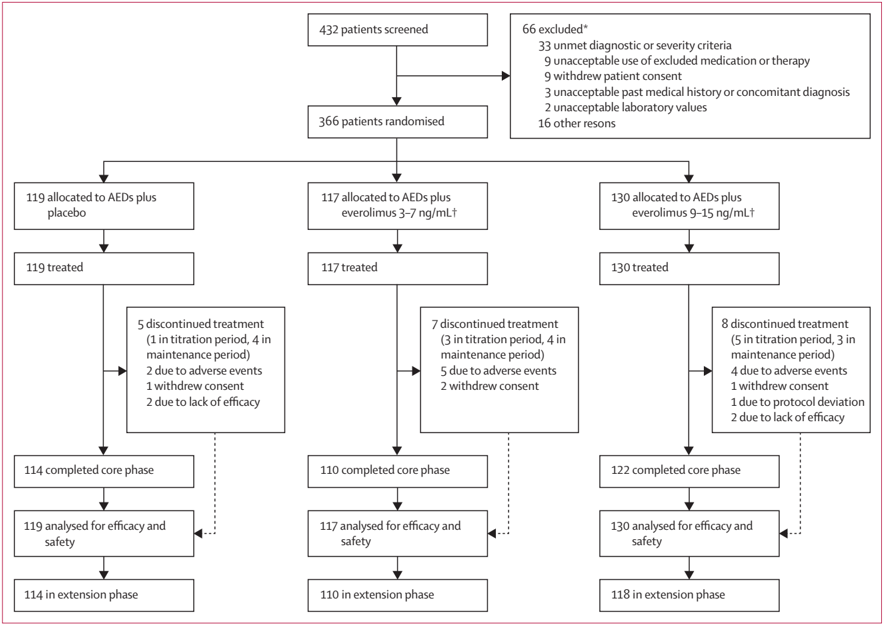
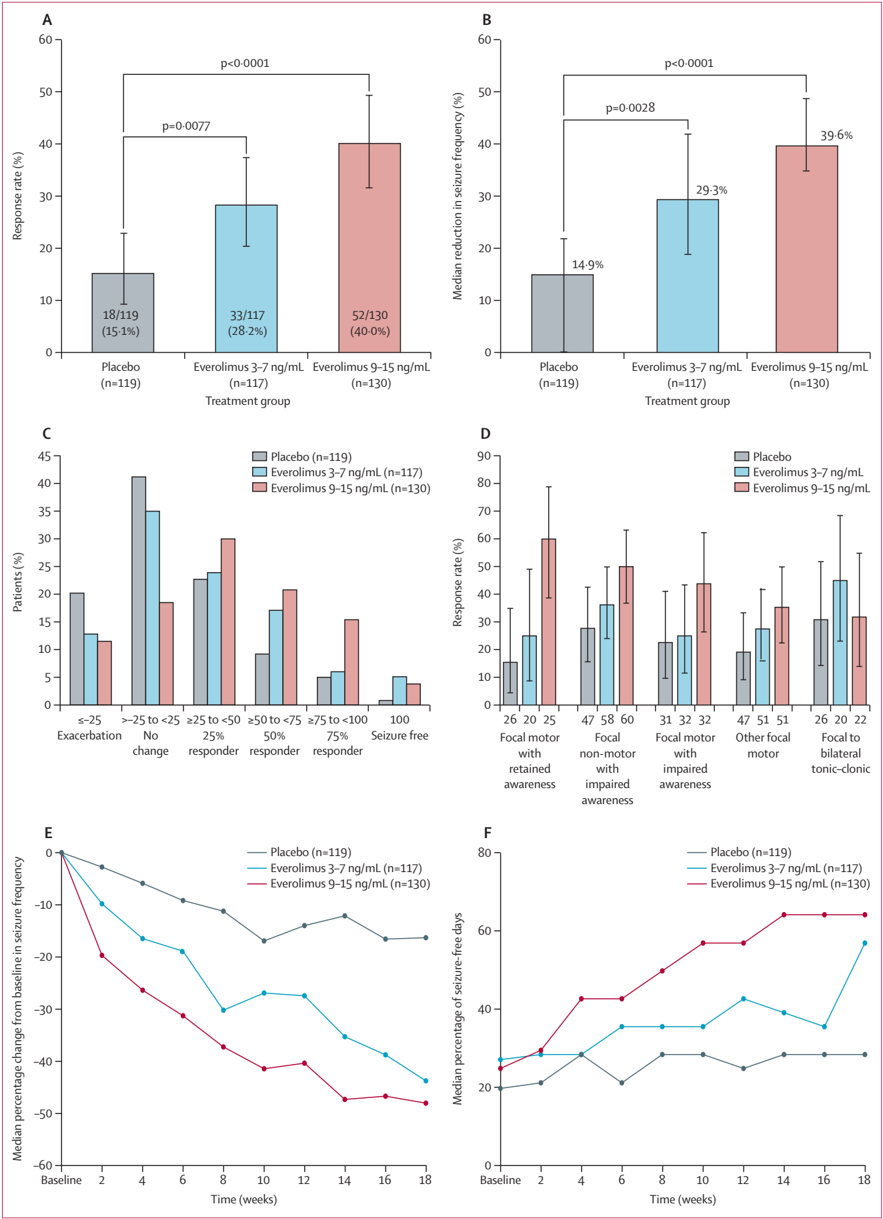
BACKGROUND: Everolimus, a mammalian target of rapamycin (mTOR) inhibitor, has been used for various benign tumours associated with tuberous sclerosis complex. We assessed the efficacy and safety of two trough exposure concentrations of everolimus, 3-7 ng/mL (low exposure) and 9-15 ng/mL (high exposure), compared with placebo as adjunctive therapy for treatment-resistant focal-onset seizures in tuberous sclerosis complex. METHODS: In this phase 3, randomised, double-blind, placebo-controlled study, eligible patients aged 2-65 years with tuberous sclerosis complex and treatment-resistant seizures (≥16 in an 8-week baseline phase) receiving one to three concomitant antiepileptic drugs were recruited from 99 centres across 25 countries. Participants were randomly assigned (1:1:1), via permuted-block randomisation (block size of six) implemented by Interactive Response Technology software, to receive placebo, low-exposure everolimus, or high-exposure everolimus. Randomisation was stratified by age subgroup (<6 years, 6 to <12 years, 12 to <18 years, and ≥18 years). Patients, investigators, site personnel, and the sponsor's study team were masked to treatment allocation. The starting dose of everolimus depended on age, body-surface area, and concomitant use of cytochrome 3A4/P-glycoprotein inducers. Dose adjustments were done to attain target trough ranges during a 6-week titration period, and as needed during a 12-week maintenance period of core phase. Patients or their caregivers recorded events in a seizure diary throughout the study. The primary endpoint was change from baseline in the frequency of seizures during the maintenance period, defined as response rate (the proportion of patients achieving ≥50% reduction in seizure frequency) and median percentage reduction in seizure frequency, in all randomised patients. This study is registered with ClinicalTrials.gov, number NCT01713946. FINDINGS: Between July 3, 2013, and May 29, 2015, 366 patients were enrolled and randomly assigned to placebo (n=119), low-exposure everolimus, (n=117), or high-exposure everolimus (n=130). The response rate was 15·1% with placebo (95% CI 9·2-22·8; 18 patients) compared with 28·2% for low-exposure everolimus (95% CI 20·3-37·3; 33 patients; p=0·0077) and 40·0% for high-exposure everolimus (95% CI 31·5-49·0; 52 patients; p<0·0001). The median percentage reduction in seizure frequency was 14·9% (95% CI 0·1-21·7) with placebo versus 29·3% with low-exposure everolimus (95% CI 18·8-41·9; p=0·0028) and 39·6% with high-exposure everolimus (95% CI 35·0-48·7; p<0·0001). Grade 3 or 4 adverse events occurred in 13 (11%) patients in the placebo group, 21 (18%) in the low-exposure group, and 31 (24%) in the high-exposure group. Serious adverse events were reported in three (3%) patients who received placebo, 16 (14%) who received low-exposure everolimus, and 18 (14%) who received high-exposure everolimus. Adverse events led to treatment discontinuation in two (2%) patients in the placebo group versus six (5%) in the low-exposure group and four (3%) in the high-exposure group. INTERPRETATION: Adjunctive everolimus treatment significantly reduced seizure frequency with a tolerable safety profile compared with placebo in patients with tuberous sclerosis complex and treatment-resistant seizures. FUNDING: Novartis Pharmaceuticals Corporation.
Overview
The claims and statistics of this paper haven’t been checked yet.
Free: it reads the open-access text and checks the first 5 claims that cite a source we can check. Create a free account to check every claim.
Integrity signals
Registry
Cites
Statistics
Figures
Verification
Claims the paper makes
The claims and statistics of this paper haven’t been checked yet.
Free: it reads the open-access text and checks the first 5 claims that cite a source we can check. Create a free account to check every claim.
Claims other papers make about this one
Each is checked against this paper’s own text: does it say what the citing paper says it does?
The source backs part of the claim, not all of it — or backs it for a different population, condition or comparison.
In the citing paper
“mTOR pathway inhibitors, including everolimus and sirolimus may be beneficial as a targeted treatment 131 .”
From Developmental and epileptic encephalopathies (2024) · cites this paper as [131]
Experimental — accuracy not yet measuredThe source backs part of the claim, not all of it — or backs it for a different population, condition or comparison.
In the citing paper
“One example is the EXIST-3 RCT in which the mTOR inhibitor everolimus was trialled in patients with drug-resistant focal seizures in the setting of tuberous sclerosis complex, due to pathogenic variants in the mTOR pathway genes, TSC1 or TSC2.”
From Developmental and epileptic encephalopathies (2024) · cites this paper as [131]
Experimental — accuracy not yet measuredThe cited source says what the claim attributes to it.
In the citing paper
“In this RCT, responder rates were greater with higher-dose everolimus than with placebo; however, they were perhaps less compelling than one might expect for a precision therapy (40% vs 15.1%, p<0.0001) 131 .”
From Developmental and epileptic encephalopathies (2024) · cites this paper as [131]
The cited source says what the claim attributes to it.
In the citing paper
“Effects on cognition and other neuropsychiatric symptoms were not reported.”
From Developmental and epileptic encephalopathies (2024) · cites this paper as [131]
In the citing paper
“Subsequently, inhibitors of mTOR have been proposed as treatments for such syndromes and one drug Everolimus has been approved for treatment of seizures in tuberous sclerosis (French et al., 2016).”
From Getting to the cores of autism (2019) · cites this paper as French et al., 2016
Self-check
Percentages, sums and reported differences re-computed from the paper’s own numbers.
The self-check needs the paper’s full text.
Citations
Cites
Kwan, P., Schachter, S. C., & Brodie, M. J. (2011) · New England Journal of Medicine · doi:10.1056/nejmra1004418 · Cited by 1,052
Everolimus for Subependymal Giant-Cell Astrocytomas in Tuberous Sclerosis
Krueger, D. A., Care, M. M., Holland, K., Agricola, K., Tudor, C., Mangeshkar, P., Wilson, K. A., Byars, A., Sahmoud, T., & Franz, D. N. (2010) · New England Journal of Medicine · doi:10.1056/nejmoa1001671 · Cited by 1,006
Self-citationBissler, J. J., Kingswood, J. C., Radzikowska, E., Zonnenberg, B. A., Frost, M., Belousova, E., Sauter, M., Nonomura, N., Brakemeier, S., de Vries, P. J., et al. (2013) · The Lancet · doi:10.1016/s0140-6736(12)61767-x · Cited by 880
Franz, D. N., Belousova, E., Sparagana, S., Bebin, E. M., Frost, M., Kuperman, R., Witt, O., Kohrman, M. H., Flamini, J. R., Wu, J. Y., et al. (2013) · The Lancet · doi:10.1016/s0140-6736(12)61134-9 · Cited by 794
Self-citationArroyo, S., Rumià, J., Martínez, I., & Ribalta, T. (1998) · PubMed · Cited by 652
Rapamycin prevents epilepsy in a mouse model of tuberous sclerosis complex.
Zeng, L., Xu, L., Gutmann, D. H., & Wong, M. (2008) · Annals of Neurology · doi:10.1002/ana.21331 · Cited by 639
The natural history of epilepsy in tuberous sclerosis complex
Chu‐Shore, C. J., Major, P., Camposano, S., Muzykewicz, D., & Thiele, E. A. (2010) · Epilepsia · doi:10.1111/j.1528-1167.2009.02474.x · Cited by 637
Neurological and neuropsychiatric aspects of tuberous sclerosis complex
Curatolo, P., Moavero, R., & de Vries, P. J. (2015) · The Lancet Neurology · doi:10.1016/s1474-4422(15)00069-1 · Cited by 600
Self-citationMeikle, L., Pollizzi, K., Egnor, A., Kramvis, I., Lane, H., Sahin, M., & Kwiatkowski, D. J. (2008) · The Journal of Neuroscience · doi:10.1523/jneurosci.0955-08.2008 · Cited by 501
Efficacy and Safety of Oral Lacosamide as Adjunctive Therapy in Adults with Partial‐Onset Seizures
Ben‐Menachem, E., Biton, V., Jatuzis, D., Abou‐Khalil, B., Doty, P., & Rudd, G. D. (2007) · Epilepsia · doi:10.1111/j.1528-1167.2007.01188.x · Cited by 485
Adjunctive perampanel for refractory partial-onset seizures: Randomized phase III study 304
French, J. A., Krauss, G. L., Biton, V., Squillacote, D., Yang, H., Laurenza, A., Kumar, D., Rogawski, M. A., Campanille, V., Floridia, J., et al. (2012) · Neurology · doi:10.1212/wnl.0b013e3182635735 · Cited by 479
Self-citationMolecular Targets for Antiepileptic Drug Development
Meldrum, B. S., & Rogawski, M. A. (2007) · Neurotherapeutics · doi:10.1016/j.nurt.2006.11.010 · Cited by 468
Everolimus treatment of refractory epilepsy in tuberous sclerosis complex
Krueger, D. A., Wilfong, A. A., Holland‐Bouley, K., Anderson, A. E., Agricola, K., Tudor, C., Mays, M., Lopez, C. M., Kim, M., & Franz, D. N. (2013) · Annals of Neurology · doi:10.1002/ana.23960 · Cited by 389
Self-citationRufinamide for generalized seizures associated with Lennox–Gastaut syndrome
Glauser, T., Kluger, G., Sachdeo, R., Krauss, G., Perdomo, C., & Arroyo, S. (2008) · Neurology · doi:10.1212/01.wnl.0000303813.95800.0d · Cited by 356
Development of new antiepileptic drugs: challenges, incentives, and recent advances
Perucca, E., French, J., & Bialer, M. (2007) · The Lancet Neurology · doi:10.1016/s1474-4422(07)70215-6 · Cited by 339
Self-citationPerampanel for tonic-clonic seizures in idiopathic generalized epilepsy: A randomized trial
French, J. A., Krauss, G. L., Wechsler, R. T., Wang, X.-F., DiVentura, B., Brandt, C., Trinka, E., O'Brien, T. J., Laurenza, A., Patten, A., et al. (2015) · Neurology · doi:10.1212/wnl.0000000000001930 · Cited by 329
Self-citationEverolimus long-term safety and efficacy in subependymal giant cell astrocytoma
Krueger, D. A., Care, M. M., Agricola, K., Tudor, C., Mays, M., & Franz, D. N. (2013) · Neurology · doi:10.1212/wnl.0b013e3182815428 · Cited by 210
Self-citationWong, M. (2010) · Epilepsia · doi:10.1111/j.1528-1167.2009.02341.x · Cited by 205
Efficacy and safety of adjunctive ezogabine (retigabine) in refractory partial epilepsy
Brodie, M. J., Lerche, H., Gil-Nagel, A., Elger, C., Hall, S., Shin, P., Nohria, V., Mansbach, H., & On behalf of the RESTORE 2 Study Group (2010) · Neurology · doi:10.1212/wnl.0b013e3181fd6170 · Cited by 192
Talos, D. M., Kwiatkowski, D. J., Cordero, K., Black, P. M., & Jensen, F. E. (2008) · Annals of Neurology · doi:10.1002/ana.21342 · Cited by 156
McMahon, J., Huang, X., Yang, J., Komatsu, M., Yue, Z., Qian, J., Zhu, X., & Huang, Y. (2012) · The Journal of Neuroscience · doi:10.1523/jneurosci.2392-12.2012 · Cited by 155
Cardamone, M., Flanagan, D., Mowat, D. R., Kennedy, S., Chopra, M., & Lawson, J. A. (2014) · The Journal of Pediatrics · doi:10.1016/j.jpeds.2013.12.053 · Cited by 154
Self-citationMechanistic Target of Rapamycin (mTOR) in Tuberous Sclerosis Complex-Associated Epilepsy
Curatolo, P. (2014) · Pediatric Neurology · doi:10.1016/j.pediatrneurol.2014.10.028 · Cited by 148
Self-citationWeston, M. C., Chen, H., & Swann, J. W. (2012) · The Journal of Neuroscience · doi:10.1523/jneurosci.1283-12.2012 · Cited by 121
Feliciano, D. M., Lin, T. V., Hartman, N. W., Bartley, C. M., Kubera, C., Hsieh, L., Lafourcade, C., O'Keefe, R. A., & Bordey, A. (2013) · International Journal of Developmental Neuroscience · doi:10.1016/j.ijdevneu.2013.02.008 · Cited by 91
Everolimus in tuberous sclerosis patients with intractable epilepsy: A treatment option?
Wiegand, G., May, T. W., Ostertag, P., Boor, R., Stephani, U., & Franz, D. N. (2013) · European Journal of Paediatric Neurology · doi:10.1016/j.ejpn.2013.06.002 · Cited by 85
Self-citationBeach, R. C., & Reading, R. (2005) · Archives of Disease in Childhood · doi:10.1136/adc.2004.065441 · Cited by 62
Is mTOR inhibition a systemic treatment for tuberous sclerosis?
Moavero, R., Coniglio, A., Garaci, F., & Curatolo, P. (2013) · Italian Journal of Pediatrics · doi:10.1186/1824-7288-39-57 · Cited by 56
Self-citationGenetic animal models of malformations of cortical development and epilepsy
Wong, M., & Roper, S. N. (2015) · Journal of Neuroscience Methods · doi:10.1016/j.jneumeth.2015.04.007 · Cited by 43
French, J. A., di Nicola, S., & Arrigo, C. (2005) · Epilepsia · doi:10.1111/j.1528-1167.2005.04005.x · Cited by 31
Self-citationBudde, K., Zonnenberg, B. A., Frost, M., Cheung, W. K., Urva, S., Brechenmacher, T., Stein, K. F., Chen, D., Kingswood, J. C., & Bissler, J. J. (2015) · British Journal of Clinical Pharmacology · doi:10.1111/bcp.12834 · Cited by 28
Research works printed but not linked: 1
- 20. European Medicines Agency. Guideline on clinical investigation of medicinal products in the treatment of epileptic disorders. July 22, 2010. CHMP/EWP/566/98 Rev.2/Corr. http:// wwwemaeuropaeu/docs/en_GB/document_library/Scientifi c_ guideline/2010/01/WC500070043pdf (accessed July 8, 2016).
Cited by
Thijs, R. D., Surges, R., O'Brien, T. J., & Sander, J. W. (2019) · The Lancet · doi:10.1016/s0140-6736(18)32596-0 · Cited by 2,183
Devinsky, O., Vezzani, A., O'Brien, T. J., Jette, N., Scheffer, I. E., de Curtis, M., & Perucca, P. (2018) · Nature Reviews Disease Primers · doi:10.1038/nrdp.2018.24 · Cited by 959
Northrup, H., Aronow, M. E., Bebin, E. M., Bissler, J., Darling, T. N., de Vries, P. J., Frost, M. D., Fuchs, Z., Gosnell, E. S., Gupta, N., et al. (2021) · Pediatric Neurology · doi:10.1016/j.pediatrneurol.2021.07.011 · Cited by 736
“82 mTORi may also be favored for potential bene fi t to treat additional manifestations of TSC that frequently coexist in patients with SEGA, such as medically refractory epilepsy 83 or renal angio-myolipoma.”
BackgroundSelf-citationDrug development in the era of precision medicine
Dugger, S. A., Platt, A., & Goldstein, D. B. (2018) · Nature Reviews Drug Discovery · doi:10.1038/nrd.2017.226 · Cited by 493
Löscher, W., & Klein, P. (2021) · CNS Drugs · doi:10.1007/s40263-021-00827-8 · Cited by 367
“TSC, which can also result in multiple seizure types, can be treated specifically and mechanistically by the mechanistic target of rapamycin (mTOR) inhibitor everolimus [45] in addition to multiple other medications [46].”
Background
Metadata
- Authors
- French, J. A., Lawson, J. A., Yapici, Z., Ikeda, H., Polster, T., Nabbout, R., Curatolo, P., de Vries, P. J., Dlugos, D. J., Berkowitz, N., Voi, M., Peyrard, S., Pelov, D., & Franz, D. N.
- Affiliations
- NYU Langone Health (US)
- Sydney Children's Hospital (AU)
- National Epilepsy Center (JP)
- Krankenhaus Mara (DE)
- Hôpital Necker-Enfants Malades (FR)
- Policlinico Tor Vergata (IT)
- Children's Hospital of Philadelphia (US)
- Cincinnati Children's Hospital Medical Center (US)
- Corresponding author
- French, Jacqueline A
- ORCID
- Venue
- The Lancet
- Publisher
- Elsevier BV
- Published
- 2016-10
- Volume
- 388
- Issue
- 10056
- Pages
- 2153-2163
- ISSN
- 0099-5355 (ISSN-L)
- 0140-6736
- OpenAlex
- W2511912940
- Cited by
- 764
- References
- 31
- Citations by year
- 2026: 55 · 2025: 75 · 2024: 57 · 2023: 78 · 2022: 76 · 2021: 97 · 2020: 108 · 2019: 73 · 2018: 65 · 2017: 69 · 2016: 10
- FWCI
- 58.25
- Type
- journal article
- Language
- en
- Open access
- hybrid
- doi.org
- Licence
- cc-by-nc-nd
- www.elsevier.com/tdm/userlicense/1.0/ (tdm)
- creativecommons.org/licenses/by-nc-nd/4.0/ (vor)
- Locations
- The Lancet (publishedVersion, cc-by-nc-nd)
- PubMed (publishedVersion)
- Cineca Institutional Research Information System (Tor Vergata University) (submittedVersion)
- INFM-OAR (INFN Catania) (submittedVersion, cc-by-nc-nd)
- Funders
- Novartis Pharmaceuticals Corporation
- Topics
- Health Sciences › Medicine › Genetics (clinical) › Tuberous Sclerosis Complex Research
- Health Sciences › Medicine › Clinical Neurology › Epilepsy research and treatment
- Health Sciences › Medicine › Pediatrics, Perinatology and Child Health › Pharmacological Effects and Toxicity Studies
- Keywords
- everolimus, tuberous sclerosis complex, focal seizures, drug-resistant epilepsy, adjunctive antiepileptic therapy, mTOR inhibitors, seizure frequency reduction, antiepileptic drug interactions, adverse events, pharmacovigilance
- MeSH terms
- Everolimus, Adolescent, Adult, Aged, Anticonvulsants, Antineoplastic Agents, Child, Child, Preschool, Combined Modality Therapy, Dose-Response Relationship, Drug, Double-Blind Method, Female, Humans, Male, Middle Aged, Seizures, Tuberous Sclerosis
About these checks
Registry, retraction, Cites and statistics results are computed, not judged, with one exception: a printed reference that no index lists is read once by a model before it counts as a citation error. Claims are extracted by a model and kept only when their quote appears verbatim in the text; each cited source is then checked, with a model’s help, for whether it says what the claim relies on. Those verdicts can be wrong — read the claim’s quote and the cited source before relying on one.
Statistics and arithmetic are recomputed, not judged.
Confidence bands are shown only for fields calibrated on our annotated test set. None is calibrated yet, so no band is shown.
What counts as a claim ›How we measure confidence ›How we check this ›
Are you an author, or do you see a problem with this page? Request a review
Data sources
Bibliographic data: Semantic Scholar, OpenAlex, Crossref.
Contains information from the Semantic Scholar Academic Graph Datasets, made available under the ODC Attribution License (ODC-BY 1.0).
Semantic Scholar’s data is described in: Kinney, R., et al. (2023). The Semantic Scholar Open Data Platform. arXiv:2301.10140.
