

Adjunctive everolimus therapy for treatment-resistant focal-onset seizures associated with tuberous sclerosis (EXIST-3): a phase 3, randomised, double-blind, placebo-controlled study
Open accessThe DOI matches its Crossref record; 31 of the 31 references it cites were found in a registry or an index.
Abstract
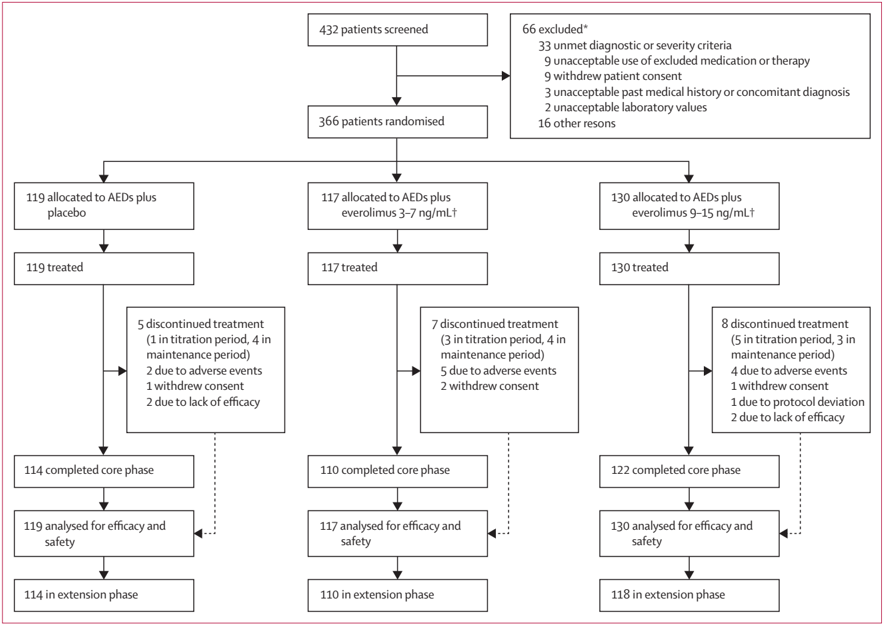
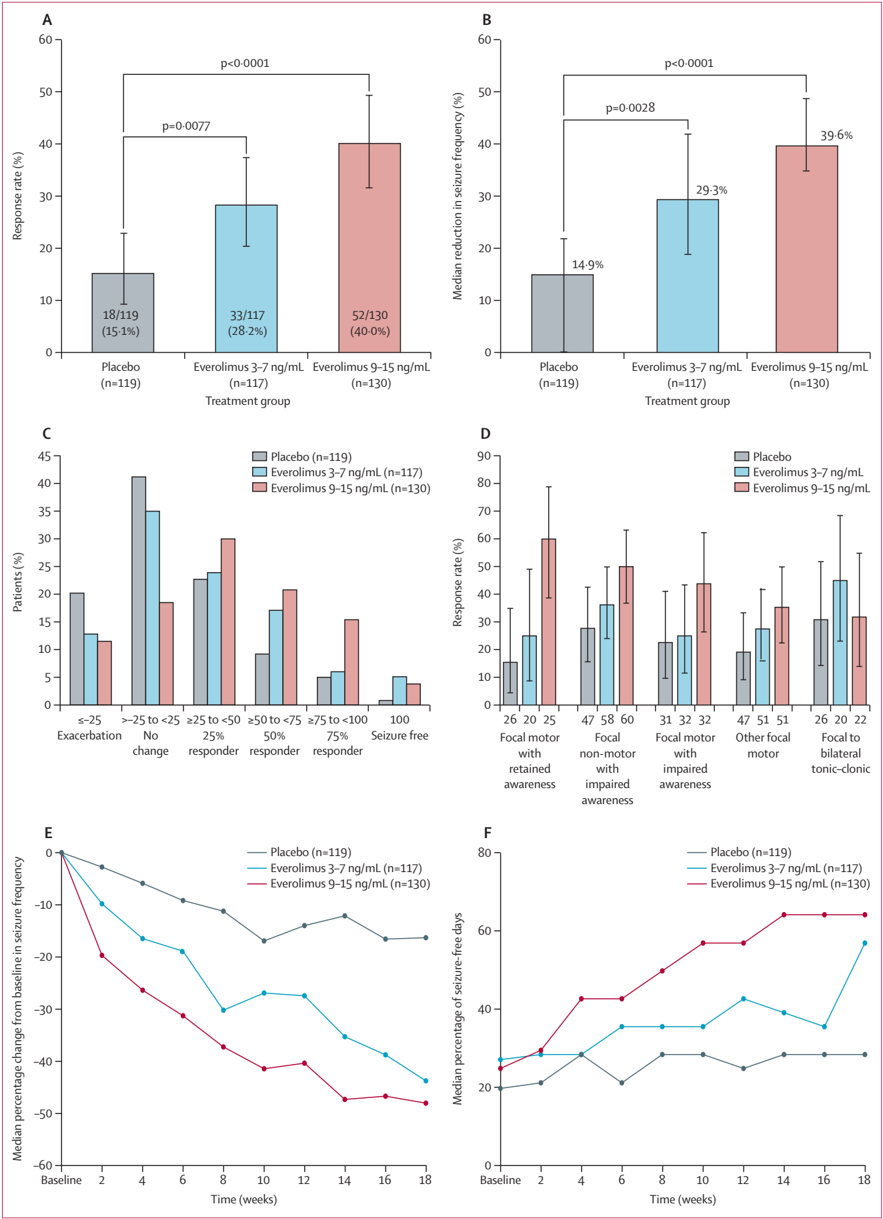
BACKGROUND: Everolimus, a mammalian target of rapamycin (mTOR) inhibitor, has been used for various benign tumours associated with tuberous sclerosis complex. We assessed the efficacy and safety of two trough exposure concentrations of everolimus, 3-7 ng/mL (low exposure) and 9-15 ng/mL (high exposure), compared with placebo as adjunctive therapy for treatment-resistant focal-onset seizures in tuberous sclerosis complex. METHODS: In this phase 3, randomised, double-blind, placebo-controlled study, eligible patients aged 2-65 years with tuberous sclerosis complex and treatment-resistant seizures (≥16 in an 8-week baseline phase) receiving one to three concomitant antiepileptic drugs were recruited from 99 centres across 25 countries. Participants were randomly assigned (1:1:1), via permuted-block randomisation (block size of six) implemented by Interactive Response Technology software, to receive placebo, low-exposure everolimus, or high-exposure everolimus. Randomisation was stratified by age subgroup (<6 years, 6 to <12 years, 12 to <18 years, and ≥18 years). Patients, investigators, site personnel, and the sponsor's study team were masked to treatment allocation. The starting dose of everolimus depended on age, body-surface area, and concomitant use of cytochrome 3A4/P-glycoprotein inducers. Dose adjustments were done to attain target trough ranges during a 6-week titration period, and as needed during a 12-week maintenance period of core phase. Patients or their caregivers recorded events in a seizure diary throughout the study. The primary endpoint was change from baseline in the frequency of seizures during the maintenance period, defined as response rate (the proportion of patients achieving ≥50% reduction in seizure frequency) and median percentage reduction in seizure frequency, in all randomised patients. This study is registered with ClinicalTrials.gov, number NCT01713946. FINDINGS: Between July 3, 2013, and May 29, 2015, 366 patients were enrolled and randomly assigned to placebo (n=119), low-exposure everolimus, (n=117), or high-exposure everolimus (n=130). The response rate was 15·1% with placebo (95% CI 9·2-22·8; 18 patients) compared with 28·2% for low-exposure everolimus (95% CI 20·3-37·3; 33 patients; p=0·0077) and 40·0% for high-exposure everolimus (95% CI 31·5-49·0; 52 patients; p<0·0001). The median percentage reduction in seizure frequency was 14·9% (95% CI 0·1-21·7) with placebo versus 29·3% with low-exposure everolimus (95% CI 18·8-41·9; p=0·0028) and 39·6% with high-exposure everolimus (95% CI 35·0-48·7; p<0·0001). Grade 3 or 4 adverse events occurred in 13 (11%) patients in the placebo group, 21 (18%) in the low-exposure group, and 31 (24%) in the high-exposure group. Serious adverse events were reported in three (3%) patients who received placebo, 16 (14%) who received low-exposure everolimus, and 18 (14%) who received high-exposure everolimus. Adverse events led to treatment discontinuation in two (2%) patients in the placebo group versus six (5%) in the low-exposure group and four (3%) in the high-exposure group. INTERPRETATION: Adjunctive everolimus treatment significantly reduced seizure frequency with a tolerable safety profile compared with placebo in patients with tuberous sclerosis complex and treatment-resistant seizures. FUNDING: Novartis Pharmaceuticals Corporation.
Overview
The claims and statistics of this paper haven’t been checked yet.
Free: it reads the open-access text and checks the first 5 claims that cite a source we can check. Create a free account to check every claim.
Integrity signals
Registry
Cites
Statistics
Figures
Verification
Claims the paper makes
The claims and statistics of this paper haven’t been checked yet.
Free: it reads the open-access text and checks the first 5 claims that cite a source we can check. Create a free account to check every claim.
Claims other papers make about this one
Each is checked against this paper’s own text: does it say what the citing paper says it does?
The source backs part of the claim, not all of it — or backs it for a different population, condition or comparison.
In the citing paper
“mTOR pathway inhibitors, including everolimus and sirolimus may be beneficial as a targeted treatment 131 .”
From Developmental and epileptic encephalopathies (2024) · cites this paper as [131]
Experimental — accuracy not yet measuredThe source backs part of the claim, not all of it — or backs it for a different population, condition or comparison.
In the citing paper
“One example is the EXIST-3 RCT in which the mTOR inhibitor everolimus was trialled in patients with drug-resistant focal seizures in the setting of tuberous sclerosis complex, due to pathogenic variants in the mTOR pathway genes, TSC1 or TSC2.”
From Developmental and epileptic encephalopathies (2024) · cites this paper as [131]
Experimental — accuracy not yet measuredThe cited source says what the claim attributes to it.
In the citing paper
“In this RCT, responder rates were greater with higher-dose everolimus than with placebo; however, they were perhaps less compelling than one might expect for a precision therapy (40% vs 15.1%, p<0.0001) 131 .”
From Developmental and epileptic encephalopathies (2024) · cites this paper as [131]
The cited source says what the claim attributes to it.
In the citing paper
“Effects on cognition and other neuropsychiatric symptoms were not reported.”
From Developmental and epileptic encephalopathies (2024) · cites this paper as [131]
In the citing paper
“Subsequently, inhibitors of mTOR have been proposed as treatments for such syndromes and one drug Everolimus has been approved for treatment of seizures in tuberous sclerosis (French et al., 2016).”
From Getting to the cores of autism (2019) · cites this paper as French et al., 2016
Self-check
Percentages, sums and reported differences re-computed from the paper’s own numbers.
The self-check needs the paper’s full text.
Citations
Cites
Kwan, P., Schachter, S. C., & Brodie, M. J. (2011) · New England Journal of Medicine · doi:10.1056/nejmra1004418 · Cited by 1,052
Everolimus for Subependymal Giant-Cell Astrocytomas in Tuberous Sclerosis
Krueger, D. A., Care, M. M., Holland, K., Agricola, K., Tudor, C., Mangeshkar, P., Wilson, K. A., Byars, A., Sahmoud, T., & Franz, D. N. (2010) · New England Journal of Medicine · doi:10.1056/nejmoa1001671 · Cited by 1,006
Self-citationBissler, J. J., Kingswood, J. C., Radzikowska, E., Zonnenberg, B. A., Frost, M., Belousova, E., Sauter, M., Nonomura, N., Brakemeier, S., de Vries, P. J., et al. (2013) · The Lancet · doi:10.1016/s0140-6736(12)61767-x · Cited by 880
Franz, D. N., Belousova, E., Sparagana, S., Bebin, E. M., Frost, M., Kuperman, R., Witt, O., Kohrman, M. H., Flamini, J. R., Wu, J. Y., et al. (2013) · The Lancet · doi:10.1016/s0140-6736(12)61134-9 · Cited by 794
Self-citationArroyo, S., Rumià, J., Martínez, I., & Ribalta, T. (1998) · PubMed · Cited by 652
Rapamycin prevents epilepsy in a mouse model of tuberous sclerosis complex.
Zeng, L., Xu, L., Gutmann, D. H., & Wong, M. (2008) · Annals of Neurology · doi:10.1002/ana.21331 · Cited by 639
The natural history of epilepsy in tuberous sclerosis complex
Chu‐Shore, C. J., Major, P., Camposano, S., Muzykewicz, D., & Thiele, E. A. (2010) · Epilepsia · doi:10.1111/j.1528-1167.2009.02474.x · Cited by 637
Neurological and neuropsychiatric aspects of tuberous sclerosis complex
Curatolo, P., Moavero, R., & de Vries, P. J. (2015) · The Lancet Neurology · doi:10.1016/s1474-4422(15)00069-1 · Cited by 600
Self-citationMeikle, L., Pollizzi, K., Egnor, A., Kramvis, I., Lane, H., Sahin, M., & Kwiatkowski, D. J. (2008) · The Journal of Neuroscience · doi:10.1523/jneurosci.0955-08.2008 · Cited by 501
Efficacy and Safety of Oral Lacosamide as Adjunctive Therapy in Adults with Partial‐Onset Seizures
Ben‐Menachem, E., Biton, V., Jatuzis, D., Abou‐Khalil, B., Doty, P., & Rudd, G. D. (2007) · Epilepsia · doi:10.1111/j.1528-1167.2007.01188.x · Cited by 485
Research works printed but not linked: 1
- 20. European Medicines Agency. Guideline on clinical investigation of medicinal products in the treatment of epileptic disorders. July 22, 2010. CHMP/EWP/566/98 Rev.2/Corr. http:// wwwemaeuropaeu/docs/en_GB/document_library/Scientifi c_ guideline/2010/01/WC500070043pdf (accessed July 8, 2016).
Cited by
Thijs, R. D., Surges, R., O'Brien, T. J., & Sander, J. W. (2019) · The Lancet · doi:10.1016/s0140-6736(18)32596-0 · Cited by 2,183
Devinsky, O., Vezzani, A., O'Brien, T. J., Jette, N., Scheffer, I. E., de Curtis, M., & Perucca, P. (2018) · Nature Reviews Disease Primers · doi:10.1038/nrdp.2018.24 · Cited by 959
Northrup, H., Aronow, M. E., Bebin, E. M., Bissler, J., Darling, T. N., de Vries, P. J., Frost, M. D., Fuchs, Z., Gosnell, E. S., Gupta, N., et al. (2021) · Pediatric Neurology · doi:10.1016/j.pediatrneurol.2021.07.011 · Cited by 736
“82 mTORi may also be favored for potential bene fi t to treat additional manifestations of TSC that frequently coexist in patients with SEGA, such as medically refractory epilepsy 83 or renal angio-myolipoma.”
BackgroundSelf-citationDrug development in the era of precision medicine
Dugger, S. A., Platt, A., & Goldstein, D. B. (2018) · Nature Reviews Drug Discovery · doi:10.1038/nrd.2017.226 · Cited by 493
Löscher, W., & Klein, P. (2021) · CNS Drugs · doi:10.1007/s40263-021-00827-8 · Cited by 367
“TSC, which can also result in multiple seizure types, can be treated specifically and mechanistically by the mechanistic target of rapamycin (mTOR) inhibitor everolimus [45] in addition to multiple other medications [46].”
BackgroundMolecular logic of mTORC1 signalling as a metabolic rheostat
Valvezan, A. J., & Manning, B. D. (2019) · Nature Metabolism · doi:10.1038/s42255-019-0038-7 · Cited by 306
Manford, M. (2017) · Journal of Neurology · doi:10.1007/s00415-017-8394-2 · Cited by 299
“366 patients showed a dose-related seizure reduction of up to 40% with everolimus, in patients with TS [83].”
BackgroundGetting to the cores of autism
Iakoucheva, L. M., Muotri, A. R., & Sebat, J. (2019) · Cell · doi:10.1016/j.cell.2019.07.037 · Cited by 260
“Subsequently, inhibitors of mTOR have been proposed as treatments for such syndromes and one drug Everolimus (Novartis) has been approved for treatment of seizures in tuberous sclerosis (French et al., 2016).”
BackgroundNeurobiological bases of autism–epilepsy comorbidity: a focus on excitation/inhibition imbalance
Bozzi, Y., Provenzano, G., & Casarosa, S. (2018) · European Journal of Neuroscience · doi:10.1111/ejn.13595 · Cited by 250
“As an example, mutations in TSC and phosphatase and tensin homolog (PTEN) lead to overactivation of the mTOR pathway and are associated with syndromic forms of ASD (Huber et al., 2015; Sahin & Sur, 2015).”
BackgroundInfluentialEpilepsy in tuberous sclerosis complex: Findings from the TOSCA Study
Nabbout, R., Belousova, E., Benedik, M. P., Carter, T., Cottin, V., Curatolo, P., Dahlin, M., D´Amato, L., d'Augères, G. B., de Vries, P. J., et al. (2019) · Epilepsia Open · doi:10.1002/epi4.12286 · Cited by 244
Self-citationRibierre, T., Deleuze, C., Bacq, A., Baldassari, S., Marsan, E., Chipaux, M., Muraca, G., Roussel, D., Navarro, V., Leguern, E., et al. (2018) · Journal of Clinical Investigation · doi:10.1172/jci99384 · Cited by 241
Abnormal mTOR Activation in Autism
Winden, K. D., Ebrahimi-Fakhari, D., & Sahin, M. (2018) · Annual Review of Neuroscience · doi:10.1146/annurev-neuro-080317-061747 · Cited by 222
A review of seizures and epilepsy following traumatic brain injury
Fordington, S., & Manford, M. (2020) · Journal of Neurology · doi:10.1007/s00415-020-09926-w · Cited by 191
Review: Mechanistic target of rapamycin (mTOR) pathway, focal cortical dysplasia and epilepsy
Marsan, E., & Baulac, S. (2018) · Neuropathology and Applied Neurobiology · doi:10.1111/nan.12463 · Cited by 191
Management of epilepsy associated with tuberous sclerosis complex: Updated clinical recommendations
Curatolo, P., Nabbout, R., Lagae, L., Aronica, E., Ferreira, J. C., Feucht, M., Hertzberg, C., Jansen, A. C., Jansen, F., Kotulska, K., et al. (2018) · European Journal of Paediatric Neurology · doi:10.1016/j.ejpn.2018.05.006 · Cited by 190
Self-citationInfluence of seizures on early development in tuberous sclerosis complex
Capal, J. K., Bernardino-Cuesta, B., Horn, P. S., Murray, D., Byars, A. W., Bing, N. M., Kent, B., Pearson, D. A., Sahin, M., & Krueger, D. A. (2017) · Epilepsy & Behavior · doi:10.1016/j.yebeh.2017.02.007 · Cited by 189
Drug development for refractory epilepsy: The past 25 years and beyond
Golyala, A., & Kwan, P. (2017) · Seizure · doi:10.1016/j.seizure.2016.11.022 · Cited by 188
Epilepsy in patients with autism: links, risks and treatment challenges
Besag, F. (2017) · Neuropsychiatric Disease and Treatment · doi:10.2147/ndt.s120509 · Cited by 182
“34,35 Advances in chromosomal microarray analysis have made detection of small chromosomal variations possible.”
Ebrahimi-Fakhari, D., Mann, L. L., Poryo, M., Graf, N., von Kries, R., Heinrich, B., Ebrahimi-Fakhari, D., Flotats-Bastardas, M., Gortner, L., Zemlin, M., et al. (2018) · Orphanet Journal of Rare Diseases · doi:10.1186/s13023-018-0870-y · Cited by 181
Strzelczyk, A., & Schubert-Bast, S. (2022) · CNS Drugs · doi:10.1007/s40263-022-00955-9 · Cited by 179
“Everolimus, an oral protein kinase inhibitor of the mTOR signalling, is a targeted therapy indicated for the treatment of refractory seizures and subependymal giant cell astrocytoma associated with TSC [270, 271].”
MethodInfluentialTargeting ageing with rapamycin and its derivatives in humans: a systematic review
Lee, D. J. W., Hodzic Kuerec, A., & Maier, A. B. (2024) · The Lancet Healthy Longevity · doi:10.1016/s2666-7568(23)00258-1 · Cited by 175
New epilepsy therapies in development
Klein, P., Kaminski, R. M., Koepp, M., & Löscher, W. (2024) · Nature Reviews Drug Discovery · doi:10.1038/s41573-024-00981-w · Cited by 154
“Examples of successful repurposing are the anorectic amphetamine derivative fenfluramine for Dravet syndrome and LGS, and the immunosuppressant everolimus as an antiseizure therapy in patients with TSC and other mechanistic target of rapamycin (mTOR)-opathies 58 .”
InfluentialBalestrini, S., & Sisodiya, S. M. (2018) · Neuroscience Letters · doi:10.1016/j.neulet.2017.01.014 · Cited by 157
Clinical Management of Drug Resistant Epilepsy: A Review on Current Strategies
Guery, D., & Rheims, S. (2021) · Neuropsychiatric Disease and Treatment · doi:10.2147/ndt.s256699 · Cited by 185
“Beyond decreasing the volume of TSC-related tumors, especially giant astrocytoma or angiomyolipoma, everolimus, a drug inhibiting the mTOR pathway, significantly reduces seizure frequency in patients with TSC.(54) Because of the role of abnormalities in the mTOR pathways of some focal cortical dysplasia,(55,56) antise…”
BackgroundKhan, S., Nobili, L., Khatami, R., Loddenkemper, T., Cajochen, C., Dijk, D.-J., & Eriksson, S. H. (2018) · The Lancet Neurology · doi:10.1016/s1474-4422(18)30335-1 · Cited by 167
Borrie, S. C., Brems, H., Legius, E., & Bagni, C. (2017) · Annual Review of Genomics and Human Genetics · doi:10.1146/annurev-genom-091416-035332 · Cited by 165
An update for epilepsy research and antiepileptic drug development: Toward precise circuit therapy
Wang, Y., & Chen, Z. (2019) · Pharmacology & Therapeutics · doi:10.1016/j.pharmthera.2019.05.010 · Cited by 161
Pharmacoresistance – Epidemiology, mechanisms, and impact on epilepsy treatment
Janmohamed, M., Brodie, M. J., & Kwan, P. (2019) · Neuropharmacology · doi:10.1016/j.neuropharm.2019.107790 · Cited by 187
Tuberous sclerosis complex: review based on new diagnostic criteria
Portocarrero, L. K. L., Quental, K. N., Samorano, L. P., de Oliveira, Z. N. P., & Machado, M. C. R. (2018) · Anais Brasileiros de Dermatologia · doi:10.1590/abd1806-4841.20186972 · Cited by 174
Developmental and epileptic encephalopathies
Scheffer, I. E., Zuberi, S., Mefford, H. C., Guerrini, R., & McTague, A. (2024) · Nature Reviews Disease Primers · doi:10.1038/s41572-024-00546-6 · Cited by 158
“In this RCT, responder rates were greater with higher-dose everolimus than with placebo; however, they were perhaps less compelling than one might expect for a precision therapy (40% vs 15.1%, p<0.0001) 131 .”
InfluentialNeuroinflammation in epileptogenesis: from pathophysiology to therapeutic strategies
Li, W., Wu, J., Zeng, Y., & Zheng, W. (2023) · Frontiers in Immunology · doi:10.3389/fimmu.2023.1269241 · Cited by 158
“Recently, evidences from both lab investigations and clinical trials show treatments targeting mTOR signaling present promising anti-seizure effects, but usually associate with serious adverse events (156).”
BackgroundRenal disease in tuberous sclerosis complex: pathogenesis and therapy
Lam, H. C., Siroky, B. J., & Henske, E. P. (2018) · Nature Reviews Nephrology · doi:10.1038/s41581-018-0059-6 · Cited by 144
Epilepsy genetics: clinical impacts and biological insights
Ellis, C. A., Petrovski, S., & Berkovic, S. F. (2019) · The Lancet Neurology · doi:10.1016/s1474-4422(19)30269-8 · Cited by 151
mTOR and neuroinflammation in epilepsy: implications for disease progression and treatment
Ravizza, T., Scheper, M., Di Sapia, R., Gorter, J., Aronica, E., & Vezzani, A. (2024) · Nature Reviews Neuroscience · doi:10.1038/s41583-024-00805-1 · Cited by 141
“Everolimus has been approved by the FDA and the EMA for treating refractory seizures in patients with TSC aged 2 years and older, based on the positive outcomes of the EXIST-3 trial (NCT01713946) 52,53 .”
Hasskarl, J. (2018) · Recent results in cancer research/Recent Results in Cancer Research · doi:10.1007/978-3-319-91442-8_8 · Cited by 153
Presentation and Diagnosis of Tuberous Sclerosis Complex in Infants
Davis, P. E., Filip‐Dhima, R., Sideridis, G. D., Peters, J. M., Au, K. S., Northrup, H., Bebin, E. M., Wu, J. Y., Krueger, D. A., & Şahin, M. (2017) · PEDIATRICS · doi:10.1542/peds.2016-4040 · Cited by 140
Everolimus for treatment of tuberous sclerosis complex‐associated neuropsychiatric disorders
Krueger, D. A., Sadhwani, A., Byars, A. W., de Vries, P. J., Franz, D. N., Whittemore, V. H., Filip‐Dhima, R., Murray, D., Kapur, K., & Sahin, M. (2017) · Annals of Clinical and Translational Neurology · doi:10.1002/acn3.494 · Cited by 133
“Overall frequency of AE was identical in the placebo and everolimus groups, and the types of AE encountered were consistent with those previously reported in human everolimus clinical trials for SEGA, epilepsy, and angiomyolipoma in individuals with TSC.(8,47,48) We did find that grade 3/4 AE and SAE were more common…”
BackgroundResultSelf-citationNguyen, L. H., Mahadeo, T., & Bordey, A. (2019) · The Journal of Neuroscience · doi:10.1523/jneurosci.2260-18.2019 · Cited by 126
“Although clinical trials with the mTOR inhibitor everolimus improved seizure control in many TSC patients, 30 – 40% of patients did not satisfactorily respond to treatment (Krueger et al., 2013; Wiegand et al., 2013; French et al., 2016).”
Saffari, A., Brösse, I., Wiemer‐Kruel, A., Wilken, B., Kreuzaler, P., Hahn, A., Bernhard, M. K., van Tilburg, C. M., Hoffmann, G. F., Gorenflo, M., et al. (2019) · Orphanet Journal of Rare Diseases · doi:10.1186/s13023-019-1077-6 · Cited by 136
Amin, S., Lux, A., & O'Callaghan, F. (2019) · British Journal of Clinical Pharmacology · doi:10.1111/bcp.13780 · Cited by 119
“18 Rapamycin and everolimus are drugs that are known to inhibit mTOR and recent studies have shown that they can reduce TSC-related lesions such as kidney AMLs, brain SEGAs and facial angiofibromas (73-77).”
BackgroundAdvances in epilepsy gene discovery and implications for epilepsy diagnosis and treatment
Symonds, J. D., Zuberi, S. M., & Johnson, M. R. (2017) · Current Opinion in Neurology · doi:10.1097/wco.0000000000000433 · Cited by 140
A clinical update on tuberous sclerosis complex‐associated neuropsychiatric disorders (TAND)
de Vries, P. J., Wilde, L., de Vries, M. C., Moavero, R., Pearson, D. A., & Curatolo, P. (2018) · American Journal of Medical Genetics Part C: Seminars in Medical Genetics · doi:10.1002/ajmg.c.31637 · Cited by 121
“…mTOR inhibitors may well improve TAND and quality of life through the indirect management of, for instance, SEGA, AML, or epilepsy, for which these medications have received marketing authorization in the United States and Europe (Bissler et al., 2013; Franz et al., 2013; French et al., 2016).”
BackgroundSelf-citationEpilepsy in the mTORopathies: opportunities for precision medicine
Moloney, P. B., Cavalleri, G. L., & Delanty, N. (2021) · Brain Communications · doi:10.1093/braincomms/fcab222 · Cited by 125
“reduction in seizure frequency compared with 15% treated with placebo.(12) Increasing and sustained reduc-”
BackgroundInfluentialCuratolo, P., Specchio, N., & Aronica, E. (2022) · The Lancet Neurology · doi:10.1016/s1474-4422(22)00213-7 · Cited by 111
Self-citationA randomized controlled trial with everolimus for IQ and autism in tuberous sclerosis complex
Overwater, I. E., Rietman, A. B., Mous, S. E., Bindels-de Heus, K., Rizopoulos, D., ten Hoopen, L. W., van der Vaart, T., Jansen, F. E., Elgersma, Y., Moll, H. A., et al. (2019) · Neurology · doi:10.1212/wnl.0000000000007749 · Cited by 120
“The recent registration trial on everolimus for intractable TSC-related epilepsy suggested higher trough levels may be more effective for seizures, and this could also be true for cognition and behavior.(4) However, also in that trial, higher trough levels were difficult to achieve due to adverse events and interactio…”
BackgroundIdentifying mutations in epilepsy genes: Impact on treatment selection
Perucca, P., & Perucca, E. (2019) · Epilepsy Research · doi:10.1016/j.eplepsyres.2019.03.001 · Cited by 132
Current practice in diagnostic genetic testing of the epilepsies
Krey, I., Platzer, K., Esterhuizen, A. I., Berkovic, S. F., Helbig, I., Hildebrand, M. S., Lerche, H., Lowenstein, D. H., Møller, R. S., Poduri, A., et al. (2022) · Epileptic Disorders · doi:10.1684/epd.2022.1448 · Cited by 127
Curatolo, P., Franz, D. N., Lawson, J. A., Yapici, Z., Ikeda, H., Polster, T., Nabbout, R., de Vries, P. J., Dlugos, D. J., Fan, J., et al. (2018) · The Lancet Child & Adolescent Health · doi:10.1016/s2352-4642(18)30099-3 · Cited by 115
Self-citationEpilepsy genetics: Current knowledge, applications, and future directions
Myers, K. A., Johnstone, D. L., & Dyment, D. A. (2018) · Clinical Genetics · doi:10.1111/cge.13414 · Cited by 130
“and its analogs that directly inhibit mTOR activity in epilepsy in tuberous sclerosis.(183) Seizures in tuberous sclerosis typically start before”
BackgroundThiele, E. A., Bebin, E. M., Filloux, F. M., Kwan, P., Loftus, R., Sahebkar, F., Sparagana, S. P., & Wheless, J. W. (2021) · Epilepsia · doi:10.1111/epi.17150 · Cited by 123
Hamilton, P., Soryal, I., Dhahri, P. A., Wimalachandra, W. S. B., Leat, A., Hughes, D., Toghill, N., Hodson, J. A., Sawlani, V., Hayton, T., et al. (2018) · Seizure · doi:10.1016/j.seizure.2018.03.022 · Cited by 115
Tuberous sclerosis: a review of the past, present, and future
Uysal, S. P., & Şahin, M. (2020) · TURKISH JOURNAL OF MEDICAL SCIENCES · doi:10.3906/sag-2002-133 · Cited by 119
Monogenic Epilepsies: Disease Mechanisms, Clinical Phenotypes, and Targeted Therapies
Guerrini, R., Balestrini, S., Wirrell, E. C., & Walker, M. C. (2021) · Neurology · doi:10.1212/wnl.0000000000012744 · Cited by 108
Everolimus for treatment-refractory seizures in TSC: Extension of a randomized controlled trial
Franz, D. N., Lawson, J. A., Yapici, Z., Ikeda, H., Polster, T., Nabbout, R., Curatolo, P., de Vries, P. J., Dlugos, D. J., Voi, M., et al. (2018) · Neurology Clinical Practice · doi:10.1212/cpj.0000000000000514 · Cited by 108
Self-citationPerfect match: mTOR inhibitors and tuberous sclerosis complex
Luo, C., Ye, W.-R., Shi, W., Yin, P., Chen, C., He, Y., Chen, M., Zu, X., & Cai, Y. (2022) · Orphanet Journal of Rare Diseases · doi:10.1186/s13023-022-02266-0 · Cited by 115
“Adverse effects Stomatitis is the most common AE of mTOR inhibitors with an incidence of approximately 70% [50, 55, 80, 103].”
BackgroundThe pharmacological treatment of epilepsy: recent advances and future perspectives
Perucca, E. (2021) · Acta Epileptologica · doi:10.1186/s42494-021-00055-z · Cited by 110
“treatment, suggesting a possible disease modifying effect [32].”
BackgroundImpact of predictive, preventive and precision medicine strategies in epilepsy
Nabbout, R., & Kuchenbuch, M. (2020) · Nature Reviews Neurology · doi:10.1038/s41582-020-0409-4 · Cited by 115
Self-citationMühlebner, A., Bongaarts, A., Sarnat, H. B., Scholl, T., & Aronica, E. (2019) · Journal of Anatomy · doi:10.1111/joa.12956 · Cited by 99
“The identification of a specific molecular pathway underlying seizure development in a spectrum of MCD paved the road to personalised medicine with clinical trials that evaluated the efficacy and safety of mTOR inhibitors (such as everolimus) in TSC-related epilepsy (French et al. 2016; Curatolo et al. 2018a, 2018b, 2…”
BackgroundPI3K/mTOR Pathway Inhibition: Opportunities in Oncology and Rare Genetic Diseases
Hillmann, P., & Fabbro, D. (2019) · International Journal of Molecular Sciences · doi:10.3390/ijms20225792 · Cited by 92
“also been approved for ASD-refractory partial-onset seizures in TSC patients [46,87,88].”
BackgroundWinden, K. D., Sundberg, M., Yang, C., Wafa, S. M. A., Dwyer, S., Chen, P.-F., Buttermore, E. D., & Sahin, M. (2019) · The Journal of Neuroscience · doi:10.1523/jneurosci.0642-19.2019 · Cited by 93
“Interestingly, a phase III trial of everolimus for refractory epilepsy in TSC showed a significant reduction in seizures, but patients continued to have an average of 4.9 seizures per week on everolimus therapy (French et al., 2016).”
BackgroundInfluentialAdvances in the molecular classification of pediatric brain tumors: a guide to the galaxy
Cacciotti, C., Fleming, A. J., & Ramaswamy, V. (2020) · The Journal of Pathology · doi:10.1002/path.5457 · Cited by 97
Hussain, Y., & Khan, H. Z. (2021) · Elsevier eBooks · doi:10.1016/b978-0-12-818731-9.00068-9 · Cited by 93
mTORC1, the maestro of cell metabolism and growth
He, L., Cho, S., & Blenis, J. (2024) · Genes & Development · doi:10.1101/gad.352084.124 · Cited by 114
“Additionally, mTORC1 has been shown to stimulate the formation and aggregation of “ purinosomes ” on the mitochondrial surface (French et al. 2016b).”
mTOR dysregulation and tuberous sclerosis-related epilepsy
Curatolo, P., Moavero, R., van Scheppingen, J., & Aronica, E. (2018) · Expert Review of Neurotherapeutics · doi:10.1080/14737175.2018.1428562 · Cited by 85
“[241] Phase III randomized controlled trial 366 2.”
Self-citationTherapeutic role of targeting mTOR signaling and neuroinflammation in epilepsy
Hodges, S. L., & Lugo, J. N. (2020) · Epilepsy Research · doi:10.1016/j.eplepsyres.2020.106282 · Cited by 84
mTOR pathway: Insights into an established pathway for brain mosaicism in epilepsy
Gerasimenko, A., Baldassari, S., & Baulac, S. (2023) · Neurobiology of Disease · doi:10.1016/j.nbd.2023.106144 · Cited by 84
Mizuguchi, M., Ikeda, H., Kagitani‐Shimono, K., Yoshinaga, H., Suzuki, Y., Aoki, M., Endo, M., Yonemura, M., & Kubota, M. (2018) · Brain and Development · doi:10.1016/j.braindev.2018.07.003 · Cited by 92
Self-citationA resurging boom in new drugs for epilepsy and brain disorders
Younus, I., & Reddy, D. (2018) · Expert Review of Clinical Pharmacology · doi:10.1080/17512433.2018.1386553 · Cited by 57
Brandt, C., Hillmann, P., Noack, A., Römermann, K., Öhler, L. A., Rageot, D., Beaufils, F., Melone, A., Sele, A. M., Wymann, M. P., et al. (2018) · Neuropharmacology · doi:10.1016/j.neuropharm.2018.08.002 · Cited by 80
“A Phase III clinical trial (NCT01713946) in patients with TSC and drugresistant focal-onset seizures revealed that everolimus significantly reduced seizure frequency (French et al., 2016).”
Li, M., Zhou, Y., Chen, C., Yang, T., Zhou, S., Chen, S., Wu, Y., & Cui, Y. (2019) · Orphanet Journal of Rare Diseases · doi:10.1186/s13023-019-1012-x · Cited by 83
mTOR and MAPK: from localized translation control to epilepsy
Pernice, H. F., Schieweck, R., Kiebler, M. A., & Popper, B. (2016) · BMC Neuroscience · doi:10.1186/s12868-016-0308-1 · Cited by 85
“A recent phase 3 study on Everolimus, a Rapamycin analog, shows a positive effect on therapy resistant focal epilepsy related to tuberous sclerosis [97].”
Davies, D. M., Saxena, A., & Kingswood, J. C. (2017) · Orphanet Journal of Rare Diseases · doi:10.1186/s13023-017-0581-9 · Cited by 85
Disorders of neurogenesis and cortical development
Guarnieri, F. C., de Chevigny, A., Falace, A., & Cardoso, C. (2018) · Dialogues in Clinical Neuroscience · doi:10.31887/dcns.2018.20.4/ccardoso · Cited by 88
Drug discovery targeting the mTOR pathway
Martelli, A. M., Buontempo, F., & McCubrey, J. A. (2018) · Clinical Science · doi:10.1042/cs20171158 · Cited by 82
Precision medicine in genetic epilepsies: break of dawn?
Reif, P. S., Tsai, M., Helbig, I., Rosenow, F., & Klein, K. M. (2016) · Expert Review of Neurotherapeutics · doi:10.1080/14737175.2017.1253476 · Cited by 79
Reijnders, M. R. F., Kousi, M., van Woerden, G. M., Klein, M., Bralten, J., Mancini, G. M. S., van Essen, T., Proietti-Onori, M., Smeets, E. E. J., van Gastel, M., et al. (2017) · Nature Communications · doi:10.1038/s41467-017-00933-6 · Cited by 76
Epileptogenesis in tuberous sclerosis complex-related developmental and epileptic encephalopathy
Aronica, E., Specchio, N., Luinenburg, M. J., & Curatolo, P. (2023) · Brain · doi:10.1093/brain/awad048 · Cited by 74
Self-citationKrueger, D. A., Capal, J. K., Curatolo, P., Devinsky, O., Ess, K., Tzadok, M., Koenig, M. K., Narayanan, V., Ramos, F., Jozwiak, S., et al. (2018) · European Journal of Paediatric Neurology · doi:10.1016/j.ejpn.2018.06.007 · Cited by 73
Self-citationFocal cortical dysplasia: an update on diagnosis and treatment
Guerrini, R., & Barba, C. (2021) · Expert Review of Neurotherapeutics · doi:10.1080/14737175.2021.1915135 · Cited by 79
The mTOR Pathway in Treatment of Epilepsy: A clinical update
Griffith, J. L., & Wong, M. (2018) · Future Neurology · doi:10.2217/fnl-2018-0001 · Cited by 74
Diagnosis of tuberous sclerosis complex in the fetus
Dragoumi, P., O'Callaghan, F. J., & Zafeiriou, D. (2018) · European Journal of Paediatric Neurology · doi:10.1016/j.ejpn.2018.08.005 · Cited by 73
Drug-resistant epilepsy — time to target mechanisms
Lerche, H. (2020) · Nature Reviews Neurology · doi:10.1038/s41582-020-00419-y · Cited by 75
Neurovascular unit dysfunction as a mechanism of seizures and epilepsy during aging
van Vliet, E. A., & Marchi, N. (2022) · Epilepsia · doi:10.1111/epi.17210 · Cited by 71
Preventing cognitive impairment in children with epilepsy
Braun, K. P. J. (2017) · Current Opinion in Neurology · doi:10.1097/wco.0000000000000424 · Cited by 70
The Neurodevelopmental Pathogenesis of Tuberous Sclerosis Complex (TSC)
Feliciano, D. M. (2020) · Frontiers in Neuroanatomy · doi:10.3389/fnana.2020.00039 · Cited by 69
“EXIST (EXamining everolimus In a Study of TSC) phase III clinical trials further indicated that everolimus markedly reduced seizure frequency (French et al., 2016).”
BackgroundConvergent and Divergent Mechanisms of Epileptogenesis in mTORopathies
Nguyen, L. H., & Bordey, A. (2021) · Frontiers in Neuroanatomy · doi:10.3389/fnana.2021.664695 · Cited by 71
The pharmacological treatment of epilepsy in adults
Tomson, T., Zelano, J., Dang, Y. L., & Perucca, P. (2023) · Epileptic Disorders · doi:10.1002/epd2.20093 · Cited by 73
The efficacy of perampanel in young children with drug-resistant epilepsy
Chang, F.-M., Fan, P., Weng, W., Chang, C., & Lee, W. (2019) · Seizure · doi:10.1016/j.seizure.2019.12.024 · Cited by 68
Current Approaches and Future Directions for the Treatment of mTORopathies
Karalis, V., & Bateup, H. S. (2021) · Developmental Neuroscience · doi:10.1159/000515672 · Cited by 68
Franz, D. N., & Capal, J. K. (2017) · Orphanet Journal of Rare Diseases · doi:10.1186/s13023-017-0596-2 · Cited by 67
Self-citationHughes, J., Dawson, R., Tea, M., McAninch, D., Piltz, S., Jackson, D., Stewart, L., Ricos, M. G., Dibbens, L. M., Harvey, N. L., et al. (2017) · Scientific Reports · doi:10.1038/s41598-017-12574-2 · Cited by 62
Decanoic acid inhibits mTORC1 activity independent of glucose and insulin signaling
Warren, E. C., Dooves, S., Lugarà, E., Damstra‐Oddy, J., Schaf, J., Heine, V. M., Walker, M. C., & Williams, R. S. B. (2020) · Proceedings of the National Academy of Sciences · doi:10.1073/pnas.2008980117 · Cited by 67
Stafstrom, C. E., Staedtke, V., & Comi, A. M. (2017) · Frontiers in Neurology · doi:10.3389/fneur.2017.00087 · Cited by 75
Overwater, I., Rietman, A., van Eeghen, A. V., & de Wit, M. D. (2019) · Therapeutics and Clinical Risk Management · doi:10.2147/tcrm.s145630 · Cited by 52
“The EXIST-3 trial included 366 patients and showed a 50% seizure reduction response rate of 15% with placebo compared with 28% for low-exposure everolimus and 40% for high-exposure everolimus.(8) This was highly significant, and led to the registration of everolimus for the treatment of intractable epilepsy in patient…”
TFEB drives mTORC1 hyperactivation and kidney disease in Tuberous Sclerosis Complex
Alesi, N., Khabibullin, D., Rosenthal, D. M., Akl, E. W., Cory, P. M., Alchoueiry, M., Salem, S., Daou, M., Gibbons, W. F., Chen, J. A., et al. (2024) · Nature Communications · doi:10.1038/s41467-023-44229-4 · Cited by 64
mTOR inhibitor therapy as a disease modifying therapy for tuberous sclerosis complex
Franz, D. N., & Krueger, D. A. (2018) · American Journal of Medical Genetics Part C Seminars in Medical Genetics · doi:10.1002/ajmg.c.31655 · Cited by 64
Self-citationScala, M., Bianchi, A., Bisulli, F., Coppola, A., Elia, M., Trivisano, M., Pruna, D., Pippucci, T., Canafoglia, L., Lattanzi, S., et al. (2020) · Expert Review of Neurotherapeutics · doi:10.1080/14737175.2020.1713101 · Cited by 66
Update on Drug Management of Refractory Epilepsy in Tuberous Sclerosis Complex
Clement, E. A. V. D. P., Jansen, F. E., Braun, K. P. J., & Peters, J. M. (2020) · Pediatric Drugs · doi:10.1007/s40272-019-00376-0 · Cited by 69
Mills, J. D., Iyer, A. M., van Scheppingen, J., Bongaarts, A., Anink, J. J., Janssen, B., Zimmer, T. S., Spliet, W. G., van Rijen, P. C., Jansen, F. E., et al. (2017) · Scientific Reports · doi:10.1038/s41598-017-06145-8 · Cited by 62
Self-citationSugalska, M., Tomik, A., Jóźwiak, S., & Werner, B. (2021) · International Journal of Environmental Research and Public Health · doi:10.3390/ijerph18094907 · Cited by 65
Metadata
- Authors
- French, J. A., Lawson, J. A., Yapici, Z., Ikeda, H., Polster, T., Nabbout, R., Curatolo, P., de Vries, P. J., Dlugos, D. J., Berkowitz, N., Voi, M., Peyrard, S., Pelov, D., & Franz, D. N.
- Affiliations
- NYU Langone Health (US)
- Sydney Children's Hospital (AU)
- National Epilepsy Center (JP)
- Krankenhaus Mara (DE)
- Hôpital Necker-Enfants Malades (FR)
- Policlinico Tor Vergata (IT)
- Children's Hospital of Philadelphia (US)
- Cincinnati Children's Hospital Medical Center (US)
- Corresponding author
- French, Jacqueline A
- ORCID
- Venue
- The Lancet
- Publisher
- Elsevier BV
- Published
- 2016-10
- Volume
- 388
- Issue
- 10056
- Pages
- 2153-2163
- ISSN
- 0099-5355 (ISSN-L)
- 0140-6736
- OpenAlex
- W2511912940
- Cited by
- 764
- References
- 31
- Citations by year
- 2026: 55 · 2025: 75 · 2024: 57 · 2023: 78 · 2022: 76 · 2021: 97 · 2020: 108 · 2019: 73 · 2018: 65 · 2017: 69 · 2016: 10
- FWCI
- 58.25
- Type
- journal article
- Language
- en
- Open access
- hybrid
- doi.org
- Licence
- cc-by-nc-nd
- www.elsevier.com/tdm/userlicense/1.0/ (tdm)
- creativecommons.org/licenses/by-nc-nd/4.0/ (vor)
- Locations
- The Lancet (publishedVersion, cc-by-nc-nd)
- PubMed (publishedVersion)
- Cineca Institutional Research Information System (Tor Vergata University) (submittedVersion)
- INFM-OAR (INFN Catania) (submittedVersion, cc-by-nc-nd)
- Funders
- Novartis Pharmaceuticals Corporation
- Topics
- Health Sciences › Medicine › Genetics (clinical) › Tuberous Sclerosis Complex Research
- Health Sciences › Medicine › Clinical Neurology › Epilepsy research and treatment
- Health Sciences › Medicine › Pediatrics, Perinatology and Child Health › Pharmacological Effects and Toxicity Studies
- Keywords
- everolimus, tuberous sclerosis complex, focal seizures, drug-resistant epilepsy, adjunctive antiepileptic therapy, mTOR inhibitors, seizure frequency reduction, antiepileptic drug interactions, adverse events, pharmacovigilance
- MeSH terms
- Everolimus, Adolescent, Adult, Aged, Anticonvulsants, Antineoplastic Agents, Child, Child, Preschool, Combined Modality Therapy, Dose-Response Relationship, Drug, Double-Blind Method, Female, Humans, Male, Middle Aged, Seizures, Tuberous Sclerosis
About these checks
Registry, retraction, Cites and statistics results are computed, not judged, with one exception: a printed reference that no index lists is read once by a model before it counts as a citation error. Claims are extracted by a model and kept only when their quote appears verbatim in the text; each cited source is then checked, with a model’s help, for whether it says what the claim relies on. Those verdicts can be wrong — read the claim’s quote and the cited source before relying on one.
Statistics and arithmetic are recomputed, not judged.
Confidence bands are shown only for fields calibrated on our annotated test set. None is calibrated yet, so no band is shown.
What counts as a claim ›How we measure confidence ›How we check this ›
Are you an author, or do you see a problem with this page? Request a review
Data sources
Bibliographic data: Semantic Scholar, OpenAlex, Crossref.
Contains information from the Semantic Scholar Academic Graph Datasets, made available under the ODC Attribution License (ODC-BY 1.0).
Semantic Scholar’s data is described in: Kinney, R., et al. (2023). The Semantic Scholar Open Data Platform. arXiv:2301.10140.
