

Morbidity and mortality in homeless individuals, prisoners, sex workers, and individuals with substance use disorders in high-income countries: a systematic review and meta-analysis
Open accessThe DOI matches its Crossref record; 61 of the 66 references it cites were found in a registry or an index; 6 of the 35 sources its claims cite were checked for support.
Abstract
Inclusion health focuses on people in extremely poor health due to poverty, marginalisation, and multimorbidity.
Overview
CoChat Summary
TL;DR
This systematic review and meta-analysis found extreme morbidity and mortality inequities among homeless populations, prisoners, sex workers, and people with substance use disorders in high-income countries. All-cause mortality SMRs were 7.88 in men and 11.86 in women, with especially high excess mortality from injury, poisoning, and other external causes.
Key findings
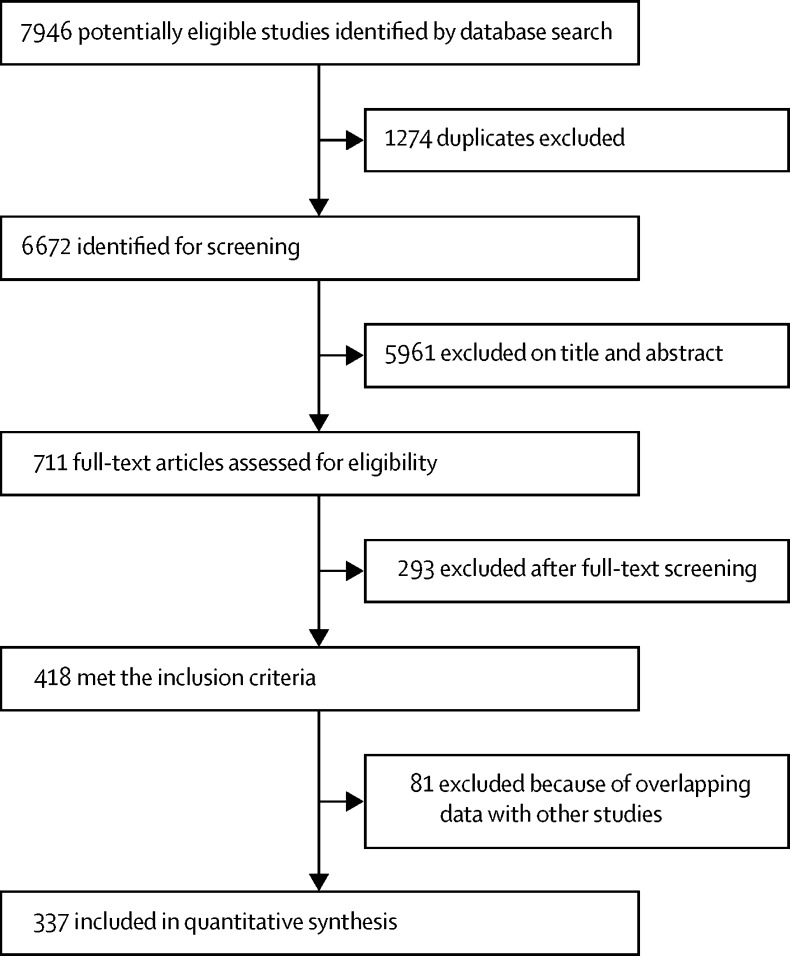
- The review included 337 studies from 38 countries out of 7,946 articles identified; after duplicate removal, the analysis included 2,835 datapoints.
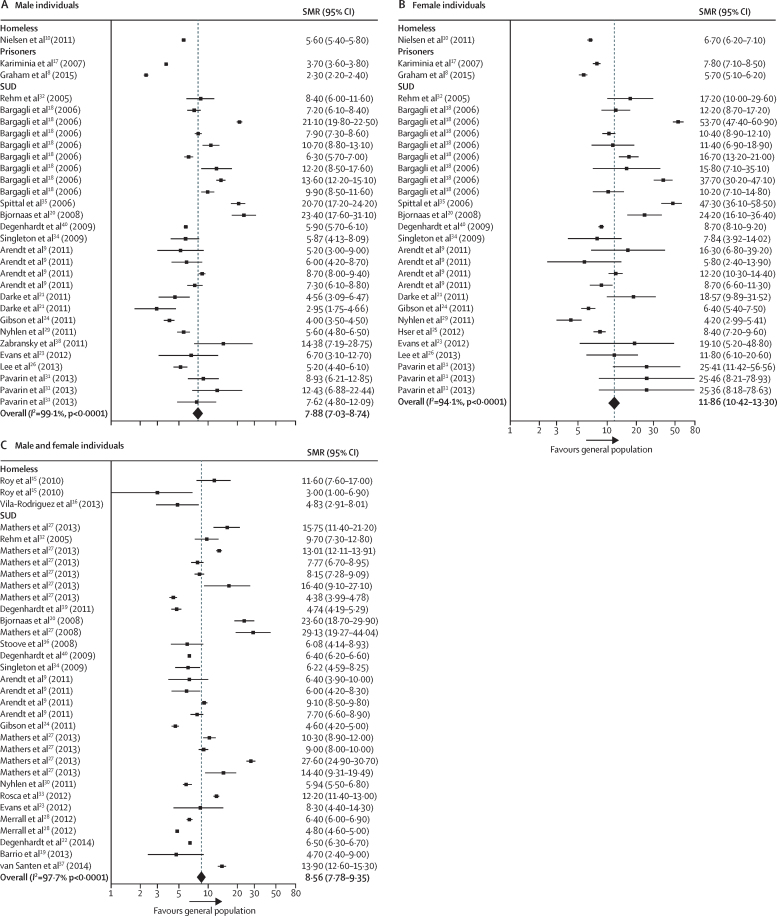
- All-cause mortality was elevated in 91 of 92 datapoints (99%); pooled all-cause SMRs were 11.86 (95% CI 10.42–13.30) in women and 7.88 (7.03–8.74) in men.
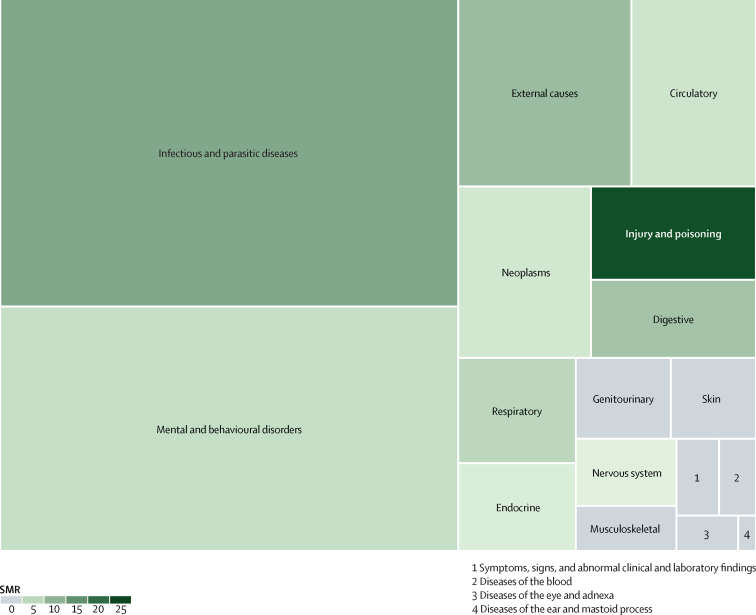
- The highest pooled SMRs were for injury, poisoning, and other external causes: 18.72 (13.73–23.71) in women and 7.89 (6.40–9.37) in men.
- Morbidity was consistently raised across multiple conditions, including infections (e.g., hepatitis C up to 90%, hepatitis B 67/103 [65%], latent tuberculosis infection 133/263 [51%]), mental health, cardiovascular, and respiratory conditions.
Methods
- Systematic review and meta-analysis of systematic reviews, meta-analyses, interventional studies, and observational studies published in English from Jan 1, 2005 to Oct 1, 2015 in high-income countries.
- Populations studied were people with a history of homelessness, imprisonment, sex work, or substance use disorder (excluding cannabis and alcohol use), with morbidity and mortality outcomes.
- Searches used MEDLINE, Embase, and the Cochrane Library; data were extracted from published reports, duplicates were removed, and random-effects models were used with I² to assess heterogeneity.
Limitations
- The paper states that heterogeneity was high across studies, so summary estimates should be interpreted with caution.
- The paper states that comparison groups varied and studies differed in definitions of inclusion health groups and in adjustment for deprivation and other risk factors.
- The paper states it searched only studies from 2005 onward, so it did not examine longer-term trends; it also could not assess other inclusion health groups.
- Evident from the text: sex workers were the least well investigated, and some outcomes had very sparse data (for example, only 44 studies reported cardiovascular outcomes; mental and behavioural disorder SMRs for some sex/sex-combined strata came from very few studies).
Model-written summary. Check it against the paper before relying on it.
Integrity signals
Registry
Cites
Statistics
Figures
Verification
Claims the paper makes
5 Valid · 0 Not valid · 17 Not checked · 74 Own results and interpretations
Every source the paper cites for this claim was checked and supports it.
In the paper
“highest reported was 32 [13%] of 247 individuals for coronary heart disease”
- Also stated in: § Results · plain
“The prevalence of coronary artery disease was 13% (32 of 247 individuals).53”
§ Morbidity and mortality in homeless individuals, prisoners, sex workers, and individuals with substance use disorders in high-income countries: a systematic review and meta-analysis > Abstract > Findings
What the sources say
- Supportedcites [53] Brown RT Kiely DK Bharel M Mitchell SL Geriatric syndromes in older homeless adults J Gen Intern Med 27 2012 16 22 21879368 PMC3250555 source
Table 1 (listed under Discussion; page not provided) reports coronary artery disease in 32 (13.1%) of the 247 homeless participants. The claim rounds this to 13%. Whether it was the highest prevalence across studies is the citing paper’s comparison, not a finding attributed to this source. (LLM, conf=0.92)
plainn = 247- Asserted: passes — The authors put it forward as true.
- Checkable: passes — It can be checked against evidence.
- Load-bearing: unclear — It is unclear whether the paper’s conclusions depend on it.
- Based: passes — The paper gives a reason why it holds.
- Also stated in: § Results · plain
Every source the paper cites for this claim was checked and supports it.
In the paper
“133 [51%] of 263 individuals for latent tuberculosis infection”
- Also stated in: § Results · plain
“51% (133 of 263)47 for latent tuberculosis infection”
§ Morbidity and mortality in homeless individuals, prisoners, sex workers, and individuals with substance use disorders in high-income countries: a systematic review and meta-analysis > Abstract > Findings
What the sources say
- Supportedcites [47] Tabuchi T Takatorige T Hirayama Y Tuberculosis infection among homeless persons and caregivers in a high-tuberculosis-prevalence area in Japan: a cross-sectional study BMC Infect Dis 11 2011 22 21255421 PMC3037881 source
Table 1 in the Results reports 133 positive QFT results among 263 homeless persons (50.6%, rounded to 51%). The Discussion treats QFT positivity as a measure of latent TB infection prevalence. (LLM, conf=0.93)
plainn = 263- Asserted: passes — The authors put it forward as true.
- Checkable: passes — It can be checked against evidence.
- Load-bearing: unclear — It is unclear whether the paper’s conclusions depend on it.
- Based: passes — The paper gives a reason why it holds.
- Also stated in: § Results · plain
Every source the paper cites for this claim was checked and supports it.
In the paper
“The prevalence of coronary artery disease was 13% (32 of 247 individuals).53”
§ Morbidity and mortality in homeless individuals, prisoners, sex workers, and individuals with substance use disorders in high-income countries: a systematic review and meta-analysis > Results
What the sources say
- Supportedcites [53] Brown RT Kiely DK Bharel M Mitchell SL Geriatric syndromes in older homeless adults J Gen Intern Med 27 2012 16 22 21879368 PMC3250555 source
Table 1 (shown under Discussion) reports coronary artery disease in 32 homeless subjects (13.1%), and its header gives the homeless sample as n=247. The citing sentence rounds 13.1% to 13%. (LLM, conf=0.95)
plainn = 247- Asserted: passes — The authors put it forward as true.
- Checkable: passes — It can be checked against evidence.
- Load-bearing: unclear — It is unclear whether the paper’s conclusions depend on it.
- Based: passes — The paper gives a reason why it holds.
- Supported
The cited sources support only part of this claim — read each source’s verdict below.
In the paper
“from 1% (one of 82)46 to 51% (133 of 263)47 for latent tuberculosis infection”
§ Morbidity and mortality in homeless individuals, prisoners, sex workers, and individuals with substance use disorders in high-income countries: a systematic review and meta-analysis > Results
What the sources say
- Partly supportedcites [46] Carbonara S Babudieri S Longo B Correlates of Mycobacterium tuberculosis infection in a prison population Eur Respir J 25 2005 1070 1076 15929964 sourceExperimental — accuracy not yet measured
Our copy of Carbonara et al. (2005) does contain the exact figure the citation is attached to: Table 1 (RESULTS/DISCUSSION section) reports tuberculin skin-test positivity of 1/82 (1.2%) among female inmates, i.e. the '1% (one of 82)' endpoint. However, that is a subgroup (female prisoners) rate, not the study's prevalence of latent TB infection: the paper states overall TST positivity of 80/448 (17.9%, 95% CI 14.3-21.4) in the RESULTS, and a range of 0-36.11% across the nine participating prisons in the DISCUSSION. So presenting 1/82 as this study's LTBI prevalence in a pooled range overstates the level at which the source reports it; the upper bound '51% (133 of 263)' carries a separate citation and appears nowhere in our copy (searched: '133 of 263', 'one of 82', prevalence ranges). (LLM, conf=0.78)
- Supportedcites [47] Tabuchi T Takatorige T Hirayama Y Tuberculosis infection among homeless persons and caregivers in a high-tuberculosis-prevalence area in Japan: a cross-sectional study BMC Infect Dis 11 2011 22 21255421 PMC3037881 source
The Results report 263 homeless participants and 50.6% QFT positivity, equivalent to 133 of 263 and rounded to 51%. The 1% figure is followed by a different citation (46), so it is not attributed to this paper. (LLM, conf=0.92)
plain- Asserted: passes — The authors put it forward as true.
- Checkable: passes — It can be checked against evidence.
- Load-bearing: unclear — It is unclear whether the paper’s conclusions depend on it.
- Based: passes — The paper gives a reason why it holds.
- Partly supported
A result the paper reports from its own data — it cites no other source for it, so there is none to check. The quote shows it is in the paper.
In the paper
“were 11·86 (95% CI 10·42–13·30; I2=94·1%) in female individuals”
- Also stated in: § Results · plain
“summary all-cause SMRs were higher in female individuals (11·86 [95% CI 10·42–13·30]; I2=94·1%; figure 3)”
§ Morbidity and mortality in homeless individuals, prisoners, sex workers, and individuals with substance use disorders in high-income countries: a systematic review and meta-analysis > Abstract > Findings
plain- Asserted: passes — The authors put it forward as true.
- Checkable: passes — It can be checked against evidence.
- Load-bearing: unclear — It is unclear whether the paper’s conclusions depend on it.
- Based: passes — The paper gives a reason why it holds.
- Also stated in: § Results · plain
53 more claims
Create a free account to see all 96 claims and to verify the 10 references still open.
- Probably not a substantial claim. 31
- The quote only partly states this claim. 1
- It may state two separate claims as one. 14
Claims other papers make about this one
Each is checked against this paper’s own text: does it say what the citing paper says it does?
The check wasn’t confident either way, so it gives no verdict — never disputed.
In the citing paper
“Risk of asthma is also increased in autism.18”
From The Lancet Psychiatry Commission: a blueprint for protecting physical health in people with mental illness (2019) · cites this paper as [18]
Experimental — accuracy not yet measuredThe check wasn’t confident either way, so it gives no verdict — never disputed.
In the citing paper
“Homeless people living in high-income countries have more untreated dental caries, more severe tooth loss, and are more likely to experience toothache compared to the general population.[45][46][47][48][49]”
From Oral diseases: a global public health challenge (2019) · cites this paper as [47]
Experimental — accuracy not yet measuredIn the citing paper
“Homelessness is associated with some of the highest levels of cross-sectoral inequities, including health care outcomes, in high-income countries.”
From Hospital Readmissions Among Patients Experiencing Homelessness: An Electronic Health Record Data Study (2024) · cites this paper as [1]
In the citing paper
“The theme Unmet human needs contributes to the mounting evidence of the extent to which social and economic disadvantages lead to huge health inequities (Aldridge et al., 2018;van Dongen et al., 2019;Fazel et al., 2014).”
From Homeless persons' experiences of health‐ and social care: A systematic integrative review (2020) · cites this paper as Aldridge et al., 2018
In the citing paper
“The Sustainable Development Agenda emphasises partnership to reach the Agenda 2030 goals, and in line with the findings of this review and previous research (Aldridge et al., 2018;Fazel et al., 2014;Slockers et al., 2018), partnership is crucial to adequately address the existing inequalities in health and well-being for individuals experiencing homelessness.”
From Homeless persons' experiences of health‐ and social care: A systematic integrative review (2020) · cites this paper as Aldridge et al., 2018
Citations
Cites
Quantifying heterogeneity in a meta‐analysis
Higgins, J. P. T., & Thompson, S. G. (2002) · Statistics in Medicine · doi:10.1002/sim.1186 · Cited by 36,763
Barnett, K., Mercer, S. W., Norbury, M., Watt, G., Wyke, S., & Guthrie, B. (2012) · The Lancet · doi:10.1016/s0140-6736(12)60240-2 · Cited by 6,972
Marmot, M. G., Allen, J., Goldblatt, P., Boyce, T., McNeish, D., Grady, M., & Geddes, I. (2010) · Europe PMC (PubMed Central) · Cited by 1,404
Substance abuse and dependence in prisoners: a systematic review
Fazel, S., Bains, P., & Doll, H. (2006) · Addiction · doi:10.1111/j.1360-0443.2006.01316.x · Cited by 839
Mortality among people who inject drugs: a systematic review and meta-analysis
Mathers, B. M., Degenhardt, L., Bucello, C., Lemon, J., Wiessing, L., & Hickman, M. (2013) · Bulletin of the World Health Organization · doi:10.2471/blt.12.108282 · Cited by 476
Reasons or excuses for avoiding meta-analysis in forest plots
Ioannidis, J. P. A., Patsopoulos, N. A., & Rothstein, H. R. (2008) · BMJ · doi:10.1136/bmj.a117 · Cited by 457
Luchenski, S., Maguire, N., Aldridge, R. W., Hayward, A., Story, A., Perri, P., Withers, J., Clint, S., Fitzpatrick, S., & Hewett, N. (2018) · The Lancet · doi:10.1016/s0140-6736(17)31959-1 · Cited by 430 · cited 2×
“In preparation for this Review, we searched the Cochrane Library, MEDLINE, and Embase databases for articles published between Jan 1, 2005, and Sept 30, 2013.”
BackgroundSelf-citationDegenhardt, L., Randall, D., Hall, W., Law, M., Butler, T., & Burns, L. (2009) · Drug and Alcohol Dependence · doi:10.1016/j.drugalcdep.2009.05.021 · Cited by 338
Social Exclusion: A Concept in Need of Definition?
Peace, R. (2001) · Social policy journal of New Zealand · Cited by 299
Pathways into Multiple Exclusion Homelessness in Seven UK Cities
Fitzpatrick, S., Bramley, G., & Johnsen, S. (2013) · Urban Studies · doi:10.1177/0042098012452329 · Cited by 265
Cited by
Items 301–400 of 878
Rates and causes of mortality among the homeless in Sydney
Woodman, L., Staples, L., Karin, E., Solterbeck, K., Burns, N., Mitchell, R. J., & Nielssen, O. B. (2023) · Australasian Psychiatry · doi:10.1177/10398562231176734 · Cited by 8
“The findings are consistent with the poor physical health identified in studies of homeless populations worldwide.(1,4) However, there were a higher Table 1.”
BackgroundResultZhang, C. X., Lewer, D., Aldridge, R. W., et al. (2023) · Journal of Epidemiology & Community Health · doi:10.1136/jech-2023-220849 · Cited by 9
“…prisoners and people who use illicit drugs but not including Gypsy, Roma and Traveller populations or migrants in vulnerable circum-stances), 5 followed by an illustrative example of cause-specific PAFs using data from a recent longitudinal study of mortality in people who use illicit…”
MethodSelf-citationHomelessness, psychiatric disorders, and violence in Denmark: a population-based cohort study
Nilsson, S. F., Laursen, T. M., Andersen, L. H., Nordentoft, M., & Fazel, S. (2024) · The Lancet Public Health · doi:10.1016/s2468-2667(24)00096-3 · Cited by 9
Self-citationTannerah, A., Hazel, O., Desson, S., Farah, R., Kamil-Thomas, Z., Iqbal, H., Eames, C., Saini, P., & Bifarin, O. O. (2024) · Health Expectations · doi:10.1111/hex.14132 · Cited by 12
Demakakos, P., Lewer, D., Jackson, S. E., & Hayward, A. C. (2020) · Public Health · doi:10.1016/j.puhe.2019.12.017 · Cited by 11
“We measured the following ten ACE variables: (1) unfavourable childhood circumstances (this included multiple mutually exclusive categories such as having spent most of childhood in single-parent family or living with foster parents or in residential care (children's homes or other institutions), (2) separation from m…”
MethodSelf-citationMabhala, M. A., Esealuka, W. A., Nwufo, A. N., Enyinna, C., Mabhala, C. N., Udechukwu, T., Reid, J., & Yohannes, A. (2021) · International Journal of Environmental Research and Public Health · doi:10.3390/ijerph18063066 · Cited by 22
Discharging the complex patient - changing our focus to patients’ networks of care providers
Perrault‐Sequeira, L., Torti, J. M. I., Appleton, A., Mathews, M., & Goldszmidt, M. A. (2021) · BMC Health Services Research · doi:10.1186/s12913-021-06841-2 · Cited by 10
Racial and ethnic disparities in mental health care
(2021) · Pharmaceutical journal/The pharmaceutical journal · doi:10.1211/pj.2021.1.107434 · Cited by 9
Trends and age-related characteristics of substance use in the hospitalized homeless population
Chun, S.-Y., Yoo, J. W., Park, H., Hwang, J., Kim, P. C., Park, S., & Shen, J. J. (2022) · Medicine · doi:10.1097/md.0000000000028917 · Cited by 10
“Furthermore, the high prevalence of substance use disorders in homeless populations is well recognized.([3,8]) Substance use remains primary drivers of hospitalization among the homeless population.”
BackgroundResultOf not passing: homelessness, addiction, mental health and care during COVID-19
Lenhard, J., Margetts, M., & Meng, E. (2022) · Medical Humanities · doi:10.1136/medhum-2021-012367 · Cited by 13
“Unsurprisingly, numerous studies have highlighted disproportionate levels of cardiac problems, long- standing tuberculosis, hepatitis C compared with agematched housed individuals (Aldridge et al. 2018).”
BackgroundBarriers adult refugees face to community health and patient engagement: a systematic review
Selvan, K., Leekha, A., Abdelmeguid, H., & Malvankar‐Mehta, M. S. (2022) · Global Public Health · doi:10.1080/17441692.2022.2121846 · Cited by 11
“In contrast to community engagement, traditional health care services are typically aimed at treating the insured population (Aldridge et al., 2018).”
BackgroundPalis, H., Zhao, B., Young, P., Korchinski, M., Greiner, L. E., Nicholls, T. L., & Slaunwhite, A. (2022) · Substance Abuse Treatment Prevention and Policy · doi:10.1186/s13011-022-00504-z · Cited by 10
Gray, A. T., Surey, J., Esmail, H., Story, A., & Harris, M. (2022) · BMC Health Services Research · doi:10.1186/s12913-022-08855-w · Cited by 21
Self-citationWohnungslosigkeit und Gesundheit
Steiger, I. (2023) · Springer eBooks · doi:10.1007/978-3-658-35279-0_27-1 · Cited by 10
Identifying the public health needs of a UK probation cohort: a cross-sectional analysis
Williams, O., Gray, B. J., & Perrett, S. E. (2023) · Journal of Public Health · doi:10.1093/pubmed/fdad183 · Cited by 9
Heston, T. F. (2023) · Cureus · doi:10.7759/cureus.46975 · Cited by 10
“Homeless individuals have higher rates of chronic health issues, mental health disorders, and substance abuse [7,8].”
BackgroundRosenblad, A., Klarare, A., Rapaport, P., Mattsson, E., & Gaber, S. N. (2024) · Health Promotion International · doi:10.1093/heapro/daae019 · Cited by 14
“While excess mortality and morbidity among people experiencing homelessness are widely reported (Fazel et al ., 2014; Aldridge et al ., 2018), there is a knowledge gap regarding other aspects of well-being in this population.”
BackgroundHealthcare for people experiencing homelessness
Bax, A., & Middleton, J. (2019) · BMJ · doi:10.1136/bmj.l1022 · Cited by 9
Young, J. T., Borschmann, R., Preen, D. B., Spittal, M. J., Brophy, L. M., Wang, E. A., Heffernan, E., & Kinner, S. A. (2019) · Injury Prevention · doi:10.1136/injuryprev-2018-043092 · Cited by 11
Pavarin, R. M., Sanchini, S., Marani, S., Turino, E., Tadonio, L., & Cantarelli, B. (2019) · Journal of Psychoactive Drugs · doi:10.1080/02791072.2019.1706014 · Cited by 10
“Individuals with substance use disorders experience extreme health inequalities across a wide range of health conditions, and excess mortality is high (Aldridge et al. 2018), but studies in Italy and Europe on mortality risk among migrants, in particular related to heroin use, are lacking.”
BackgroundFelipetto, L. G., Teider-Junior, P. I., da Silva, F. F. V., Yamakawa, A. C., Kmetiuk, L. B., do Couto, A. C., Martins, C. M., Vaz, E. S., Ullmann, L. S., Langoni, H., et al. (2020) · Frontiers in Public Health · doi:10.3389/fpubh.2020.580637 · Cited by 10
“Homeless persons have been described as one of the three most vulnerable populations, along with refugees and incarcerated persons [1].”
BackgroundWei, Y., Zhao, J., Wong, I. C. K., Wan, E. Y. F., Taylor, D. M., Blais, J. E., Castle, D. J., Knott, J. C., Tse, M. L., Chow, A. T., et al. (2021) · Drug and Alcohol Dependence · doi:10.1016/j.drugalcdep.2021.109119 · Cited by 14
“The high prevalence of opioid misuse has made it the most widely studied substance in both Western and Asian populations (Aldridge et al., 2018; Chang et al., 2010; Chen et al., 2015; Gryczynski et al., 2016; Hedegaard et al., 2020; Lee et al., 2013; Lewer et al., 2020; Li et al., 2020; Nguyen et…”
Clifford, B., Wood, L. J., Vallesi, S., et al. (2022) · Integrated Healthcare Journal · doi:10.1136/ihj-2020-000065 · Cited by 9
McLoughlin, A., Feeney, A., & Cooney, J. M. (2020) · Irish Journal of Medical Science (1971 -) · doi:10.1007/s11845-020-02392-3 · Cited by 10
Klarare, A., Wikman, A., Söderlund, M., McGreevy, J., Mattsson, E., & Rosenblad, A. (2020) · Worldviews on Evidence-Based Nursing · doi:10.1111/wvn.12477 · Cited by 13
Health Patterns Reveal Interdependent Needs of Dutch Homeless Service Users
van Everdingen, C., Peerenboom, P. B., van der Velden, K., & Delespaul, P. (2021) · Frontiers in Psychiatry · doi:10.3389/fpsyt.2021.614526 · Cited by 15
Russolillo, A., Moniruzzaman, A., & Somers, J. M. (2019) · JAMA Network Open · doi:10.1001/jamanetworkopen.2019.0595 · Cited by 11
Western Journal of Emergency Medicine
Lam, J. (2022) · Western Journal of Emergency Medicine · doi:10.5811/westjem.2022.8.59370 · Cited by 9
Bereavement in the context of homelessness: A rapid review
Monk, J., Black, J. E., Carter, R. Z., & Hassan, E. (2023) · Death Studies · doi:10.1080/07481187.2023.2246134 · Cited by 11
“Research has highlighted an increased mortality rate for people experiencing homelessness (Aldridge et al., 2018; Cheung & Hwang, 2004; Thomas, 2012), but little attention has been given to what that means for individuals bereaved by these deaths.”
BackgroundPalis, H., Young, P., Korchinski, M., Wood, S., Xavier, J. C., Luk, N., Mahil, S., Bartlett, S. R., Brown, H., Salmon, A., et al. (2024) · BMC Public Health · doi:10.1186/s12889-023-17524-4 · Cited by 8
“…health and social service engagement, leaving people unsupported and at further risk of adverse outcomes following release, such as unmet housing and financial needs and limited opportunities for employment, return to incarceration, and significant pre-ventable morbidity and mortality [13–15].”
BackgroundTreatment of trauma-related conditions for people in homelessness: a scoping review
Klarare, A., Ekström, V., Godskesen, T., Westman, J., Mattsson, E., & Kneck, Å. (2024) · Journal of Social Distress and the Homeless · doi:10.1080/10530789.2024.2310948 · Cited by 9
Kelley, J. C., Ramirez, V., & Meisner, J. (2024) · CABI One Health · doi:10.1079/cabionehealth.2024.0004 · Cited by 10
Unlocking the door to mental wellness: exploring the impact of homeownership on mental health issues
Rahman, S., & Steeb, D. R. (2024) · BMC Public Health · doi:10.1186/s12889-024-20842-w · Cited by 15
Learning about Inclusion Health in undergraduate medical education: a scoping review
Ashwell, G., Russell, A. M., Williamson, A. E., & Pope, L. M. (2025) · BMJ Open · doi:10.1136/bmjopen-2024-092420 · Cited by 17
Outreach health-care services for people experiencing exclusion in high-income countries
Johnson, L., Gaber, S. N., Langella, R., Turner-Moss, E., Weleff, J., Brothers, T. D., Koay, A. C. C., Hayward, A. C., Luchenski, S. A., Perri, P., et al. (2025) · The Lancet Public Health · doi:10.1016/s2468-2667(25)00144-6 · Cited by 12
Self-citationDeveloping a tool for the measurement of social exclusion in healthcare settings
O’Donnell, P., Hannigan, A., Ibrahim, N., O’Donovan, D. T., & Elmusharaf, K. (2022) · International Journal for Equity in Health · doi:10.1186/s12939-022-01636-1 · Cited by 10
Moss, C., Anselmi, L., & Sutton, M. (2023) · European Journal of Public Health · doi:10.1093/eurpub/ckac191 · Cited by 11
Paudyal, V., Vohra, N., Price, M. J., Jalal, Z., & Saunders, K. (2023) · International Journal of Emergency Medicine · doi:10.1186/s12245-023-00526-9 · Cited by 8
“Persons experiencing homelessness have 12 times higher mortality rate compared with the general population, mainly owing to opioid overdose, psychoactive substance use and related heart failure [3, 4].”
BackgroundKennedy, F., Cheallaigh, C. N., Romero‐Ortuño, R., Doyle, S. L., & Broderick, J. M. (2024) · PLoS ONE · doi:10.1371/journal.pone.0301926 · Cited by 12
The Milwaukee Continuum: Older Veterans and Nonveterans Use Housing First to Exit Homelessness
Nelson, D. A., Morzinski, J., & Flower, M. (2019) · Journal of Humanistic Psychology · doi:10.1177/0022167819866523 · Cited by 9
“Homelessness has a direct adverse impact on health (Frankish, Hwang, & Quantz, 2005), and individuals experiencing homelessness struggle with greater morbidity and mortality than those living in stable housing (Aldridge et al., 2018).”
BackgroundGallaher, C., Herrmann, S., Hunter, L. J., et al. (2020) · BMJ Open Quality · doi:10.1136/bmjoq-2019-000820 · Cited by 8
Song, J., Grey, C. N. B., & Davies, A. R. (2021) · Journal of Public Health · doi:10.1093/pubmed/fdab180 · Cited by 8
Heerde, J. A., Bailey, J. A., Patton, G. C., & Toumbourou, J. W. (2022) · Australian Journal of Social Issues · doi:10.1002/ajs4.212 · Cited by 9
Flike, K., Hayman, L. L., Byrne, T. H., Song, Q., & Aronowitz, T. B. (2022) · Health & Social Care in the Community · doi:10.1111/hsc.14007 · Cited by 9
Association of Social Needs and Housing Status Among Urban Emergency Department Patients
Wormley, K., Dickson, D. C., Alter, H., Njoku, N., Imani, P., & Anderson, E. S. (2022) · Western Journal of Emergency Medicine · doi:10.5811/westjem.2022.8.55705 · Cited by 10
“Characteristic Housed N = 281 Unstably housed N = 213 Homeless N = 264 P value n % n % n % Health and healthcare usage characteristics - chart review ED visits in past 12 months, median (IQR) 2 (1-3) 2 (1-3) 2 (1-5) P=0.”
Trivedi, A. N., Jiang, L., Johnson, E., Lima, J. C., Flores, M., & O'Toole, T. (2018) · Health Services Research · doi:10.1111/1475-6773.13034 · Cited by 7
The GP role in improving outcomes for homeless inpatients
Khan, Z., Haine, P., & Dorney-Smith, S. (2018) · Housing Care and Support · doi:10.1108/hcs-07-2018-0017 · Cited by 8
Spatial analysis of cases of Tuberculosis with Mental Disorders in São Paulo
Arroyo, L. H., Arcoverde, M. A. M., Alves, J. D., Fuentealba-Torres, M., Cartagena-Ramos, D., Scholze, A. R., Ramos, A. C. V., & Arcêncio, R. A. (2019) · Revista Brasileira de Enfermagem · doi:10.1590/0034-7167-2017-0949 · Cited by 14
Hopkin, G., Chaplin, L., Slade, K., Craster, L., Valmaggia, L., Samele, C., & Forrester, A. (2020) · International Journal of Social Psychiatry · doi:10.1177/0020764020920904 · Cited by 7
Truong, A., Secrest, A. M., Zhang, M., et al. (2020) · Journal of the American Academy of Dermatology · doi:10.1016/j.jaad.2020.08.085 · Cited by 8
O’Donnell, P., Moran, L., van Geelen, S., O’Donovan, D. T., van den Muijsenbergh, M. E. T. C., & Elmusharaf, K. (2021) · PLoS ONE · doi:10.1371/journal.pone.0253575 · Cited by 15
“These characteristics were also noted to mark very poor morbidity and mortality outcomes for affected people [2].”
BackgroundInfluentialSocial Exclusion, Caste and Health Status of Women and Children in Jammu & Kashmir, IndiaPreprint
Katoch, O. R., & Nawaz, A. (2018) · SSRN Electronic Journal · doi:10.2139/ssrn.3234145 · Cited by 8
Western Journal of Emergency Medicine
Saucedo, C., & Do, N. (2022) · Western Journal of Emergency Medicine · doi:10.5811/westjem.2022.3.56639 · Cited by 8
Ebert, T., Hamuda, N., City-Elifaz, E., Kobo, O. M., & Roguin, A. (2023) · Frontiers in Psychiatry · doi:10.3389/fpsyt.2023.1255323 · Cited by 11
Lowrie, R., McPherson, A., Mair, F. S., Stock, K., Maguire, D., Paudyal, V., Duncan, C., Blair, R., Lombard, C., Ross, S., et al. (2024) · BMJ Public Health · doi:10.1136/bmjph-2023-000219 · Cited by 11
A stakeholder co-design approach to designing a dental service for adults experiencing homelessness
Cairns, D., & Rodriguez, A. (2024) · Frontiers in Oral Health · doi:10.3389/froh.2024.1355429 · Cited by 7
Adams, E. A., & Ramsay, S. E. (2024) · BMC Health Services Research · doi:10.1186/s12913-024-11897-x · Cited by 8
Palliative care access and use among homeless individuals: a scoping review
Rodericks-Schulwach, A., Gokani, R., & Martin, L. (2025) · BMC Palliative Care · doi:10.1186/s12904-025-01835-x · Cited by 7
“Homeless and vulnerably housed individuals experience severe health inequalities and premature mortality [5, 6].”
The impact of incarceration on health: A global systematic review
Pearce, L. A., Shuttleworth, R. R., Young, J. T., Borschmann, R., & Kinner, S. A. (2026) · Social Science & Medicine · doi:10.1016/j.socscimed.2026.118946 · Cited by 9
Reflections on health among women in homelessness: A qualitative study
Kneck, Å., Klarare, A., Mattsson, E., & Salzmann‐Erikson, M. (2022) · Journal of Psychiatric and Mental Health Nursing · doi:10.1111/jpm.12859 · Cited by 11
Lahiguera, D. R., de Fortuny, B. B., Gironella, T. C., Rodriguez, T. F., Ruiz, P. S., & Franch‐Nadal, J. (2022) · Atención Primaria · doi:10.1016/j.aprim.2022.102458 · Cited by 20
Gibbs, D., Stockings, E., Larney, S., Bromberg, D. J., Shakeshaft, A. P., & Farnbach, S. (2023) · Harm Reduction Journal · doi:10.1186/s12954-023-00832-8 · Cited by 14
Vauhkonen, P. K., Oura, P., Kriikku, P., Mäyränpää, M. I., & Lindroos, K. M. (2024) · Forensic Science International · doi:10.1016/j.forsciint.2024.111947 · Cited by 10
Oral Findings in Male Prisoners: A Systematic Review
Korkosz, R., Trzcionka, A., Hildebrandt, T., Kiełbratowski, M., Kuśka-Kiełbratowska, A., Rahnama, M., & Tanasiewicz, M. (2024) · Journal of Clinical Medicine · doi:10.3390/jcm13061736 · Cited by 14
“Another study described self-harm, which is a leading cause of morbidity in prisoners [20].”
BackgroundBallard, A. M., Kesich, Z., Crane, H. M., Feinberg, J., Friedmann, P. D., Go, V. F.-L., Jenkins, W. D., Korthuis, P. T., Miller, W. C., Pho, M. T., et al. (2024) · Drug and Alcohol Dependence · doi:10.1016/j.drugalcdep.2024.112498 · Cited by 8
Perry, R. E., Adams, E. A., Harland, J., Broadbridge, A., Giles, E. L., McGeechan, G., O'Donnell, A. J., & Ramsay, S. E. (2021) · BMJ Open · doi:10.1136/bmjopen-2020-044634 · Cited by 11
A Comprehensive Assessment to Enable Recovery of the Homeless: The HOP-TR Study
van Everdingen, C., Peerenboom, P. B., van der Velden, K., & Delespaul, P. (2021) · Frontiers in Public Health · doi:10.3389/fpubh.2021.661517 · Cited by 13
“People are part of the SMI/EPA population if (1) they have pervasive mental illness symptoms giving rise to impairments in personal functioning and societal participation; (2) when interrelated symptoms and disabilities trigger each other (circularity); and (3) when integrated and coordinated professional care is requ…”
BackgroundBarker, S. L., Maguire, N., Gearing, R. E., Cheung, M., Price, D. M., Narendorf, S. C., & Buck, D. (2021) · SSM - Population Health · doi:10.1016/j.ssmph.2021.100905 · Cited by 16
“, medical care that is setup for the convenience of the providers rather than the patients or care targeting a single health condition rather than the intersecting healthcare issues (Aldridge et al., 2018).”
BackgroundBernardino, R. M. P., Silva, A. M., Costa, J. F., SILVA, M. V. B., dos Santos, I. T., Neta, N. B. D., Júnior, R. R. P., & Mendes, R. F. (2021) · Brazilian Oral Research · doi:10.1590/1807-3107bor-2021.vol35.0107 · Cited by 13
Smith, C. M., Feigal, J. P., Sloane, R. J., & Biederman, D. J. (2021) · Frontiers in Psychiatry · doi:10.3389/fpsyt.2021.780366 · Cited by 9
Ross-Houle, K., & Porcellato, L. A. (2021) · Drugs Education Prevention and Policy · doi:10.1080/09687637.2021.2014402 · Cited by 9
“…et al., 2014) such as poor nutrition (Sprake et al., 2014), unintentional injuries (Mackelprang et al., 2014; Topolovec-Vranic et al., 2012), communicable disease (Beijer et al., 2012; Aldridge et al., 2018) ; poor dental health (Paisi et al., 2019) and poor mental health (Fazel et al., 2008).”
BackgroundGaber, S. N., Klarare, A., Mattsson, E., & Rosenblad, A. (2022) · Scandinavian Journal of Caring Sciences · doi:10.1111/scs.13071 · Cited by 8
“The social gradient of health proposes that the lower the socio-economic status of an individual, the worse their health [14].”
Salvalaggio, G., Dong, K. A., Hyshka, E., McCabe, C. J., Nixon, L. L., Rosychuk, R. J., Dmitrienko, K., Krajnak, J., Mrklas, K., & Wild, T. C. (2022) · Substance Abuse Treatment Prevention and Policy · doi:10.1186/s13011-022-00445-7 · Cited by 10
Zufferey, C., Skovdal, M., Gjødsbøl, I. M., & Jervelund, S. S. (2022) · International Journal of Disaster Risk Reduction · doi:10.1016/j.ijdrr.2022.103157 · Cited by 12
Brostow, D. P., Smith, A. A., Bahraini, N. H., Besterman‐Dahan, K., Forster, J. E., & Brenner, L. A. (2022) · Journal of Hunger & Environmental Nutrition · doi:10.1080/19320248.2022.2118564 · Cited by 9
Evaluation of Mobile and Community Dental Service Use among People Experiencing Homelessness
Novák, B., Matajs, M., Sangalli, A. E., et al. (2023) · International Journal of Environmental Research and Public Health · doi:10.3390/ijerph20010845 · Cited by 7
van Everdingen, C., Peerenboom, P. B., van der Velden, K., & Delespaul, P. (2023) · International Journal of Environmental Research and Public Health · doi:10.3390/ijerph20032546 · Cited by 8
“A meta-analysis by Aldrigde and colleagues [20] identified a similar, extensive impact of health inequity on mortality and morbidity outcomes in homeless individuals, prisoners, sex workers, and substance users.”
BackgroundBrosnan, H. K., Yeh, K. W., Jones, P. S., Gokhale, S., Regos-Stewart, D., Tran, H., Poortinga, K., Danza, P. Y., Fisher, R., Finn, L. E., et al. (2023) · Emerging infectious diseases · doi:10.3201/eid2906.230021 · Cited by 7
“(%) Total interviewed* 101 (86) Reported exposure to monkeypox case Y 21 (21) N 45 (45) Don't know 34 (34 Did not answer 1 (1) Attended large public or private event Y 24 (24) N 75 (74) Did not answer 2 (2) Traveled Y 5 (5) N 94 (93) Did not answer 2 (2) Had sexual contact with >1 partners Y 74 (73) N 23 (23) Did not…”
BackgroundCurrie, J., McWilliams, L., Paisi, M., et al. (2023) · Collegian Journal of the Royal College of Nursing Australia · doi:10.1016/j.colegn.2023.02.002 · Cited by 7
“The evidence associating homelessness with morbidity and mortality is compelling (Aldridge, 2018; Marmot, 2015; Seastres, 2020).”
Masah, D. J., Schouler‐Ocak, M., Gutwinski, S., Gehrenbeck, K., Deutscher, K., Schindel, D., Lech, S., & Schreiter, S. (2023) · BJPsych Open · doi:10.1192/bjo.2023.501 · Cited by 13
van Hest, N., Brothers, T. D., Williamson, A. E., & Lewer, D. (2023) · Addiction · doi:10.1111/add.16401 · Cited by 8
“Although relative risks of viral infections and drug overdoses can be extremely high, non-communicable diseases may cause more excess deaths and illness [4 – 7].”
BackgroundSelf-citationRoy, L., Leclair, M., Crocker, A. G., Abdel‐Baki, A., Benedictis, L. D., Berubé, F.-A., Thibeault, E., Latimer, E. A., & Roy, M. (2024) · Early Intervention in Psychiatry · doi:10.1111/eip.13495 · Cited by 8
“The cumulative experiences of MI and homelessness or inadequate housing have been shown to lead to many adverse health and social outcomes, including excess mortality and morbidity (Aldridge et al., 2018; Zhang et al., 2018).”
Doughty, J., Johnson, A., Tatari, A., Kothari, C., Patel, R., Newman, A., Yazdi, M., O’Leary, F., & Shah, N. (2020) · BDJ · doi:10.1038/s41415-020-1253-z · Cited by 7
Differences in Utilization of Medical and Dental Services among Homeless People in South Korea
Lee, S., Ryu, J., & Jung, S.-H. (2020) · International Journal of Environmental Research and Public Health · doi:10.3390/ijerph17155304 · Cited by 10
““Social exclusion” separates them from mainstream society, stigmatizes with othering, and cuts them off from social systems [6,25].”
BackgroundRoy, L., Crocker, A. G., Hurtubise, R., Latimer, E. A., Côté, M., Billette, I., & Boissy, F. (2020) · Canadian Journal of Criminology and Criminal Justice/La Revue canadienne de criminologie et de justice pénale · doi:10.3138/cjccj.2019-0056 · Cited by 10
Chan, V., Estrella, M. J., Babineau, J., & Colantonio, A. (2021) · BMJ Open · doi:10.1136/bmjopen-2021-052942 · Cited by 11
Skow, M., Fossum, G. H., Høye, S., et al. (2023) · Journal of Antimicrobial Chemotherapy · doi:10.1093/jac/dkad227 · Cited by 6
Chilman, N., Schofield, P., McManus, S., Ronaldson, A., Stagg, A., & Das‐Munshi, J. (2024) · Epidemiology and Psychiatric Sciences · doi:10.1017/s2045796024000659 · Cited by 7
Gaber, S. N., Mattsson, E., Klarare, A., Dawes, J., Rapaport, P., & Women’s Advisory Board for Inclusion Health (2025) · The Gerontologist · doi:10.1093/geront/gnaf021 · Cited by 8
Warren, G., Kennedy, C. J., Gavas, N., Schmidt, J., Woodin, E. M., Biagioni, J. B., & García-Barrera, M. A. (2025) · Frontiers in Public Health · doi:10.3389/fpubh.2025.1643689 · Cited by 11
Stubbs, J. L., Jones, A. A., Wolfman, D., Chan, R. C. Y., Vila‐Rodriguez, F., Vertinsky, A. T., Heran, M. K. S., Su, W., Lang, D. J., Field, T. S., et al. (2023) · BMJ Neurology Open · doi:10.1136/bmjno-2022-000349 · Cited by 7
Requena, M.-B., Protopopescu, C., Stewart, A. C., van Santen, D. K., Klein, M. B., Jarrín, I., Berenguer, J., Wittkop, L., Salmon, D., Rauch, A., et al. (2024) · International Journal of Drug Policy · doi:10.1016/j.drugpo.2023.104311 · Cited by 6
Khezri, M., McKnight, C. A., Weng, C. A., Kimball, S., & Jarlais, D. C. D. (2024) · PLoS ONE · doi:10.1371/journal.pone.0303394 · Cited by 5
Digital Interventions for Older People Experiencing Homelessness: Systematic Scoping Review
Adams, E. R., Donaghy, E., Sanders, C., Wolters, M. K., Ng, L., St-Jean, C., Galan, R., & Mercer, S. W. (2024) · Journal of Medical Internet Research · doi:10.2196/63898 · Cited by 12
Cronin, T., Healy, D., McCarthy, N. D., Smith, S. M., & Travers, J. (2025) · The Journal of Frailty & Aging · doi:10.1016/j.tjfa.2025.100029 · Cited by 8
Lei, M., Rintoul, K., Stubbs, J. L., Kim, D. D., Jones, A. A., Hamzah, Y., Procyshyn, R. M., Gicas, K. M., Cho, L. L., Panenka, W. J., et al. (2021) · Substance Use & Misuse · doi:10.1080/10826084.2021.1958865 · Cited by 7
“The opioid epidemic is particularly devastating among homeless populations, where the leading cause of morbidity and mortality is related to substance use disorders (Aldridge et al., 2018).”
BackgroundVaiciurgis, V. T., Charlton, K. E., Clancy, A. K., & Beck, E. J. (2022) · Public Health Nutrition · doi:10.1017/s1368980022000969 · Cited by 10
“A recent systematic review andmeta-analysis found that individuals from high-income countries experiencing homelessness, substance abuse disorders and incarceration have a mortality rate around eight times higher for men, and twelve times higher for women, compared with the general population(6).”
BackgroundDeterminants of Hospital Use and Physician Services Among Adults With a History of Homelessness
Wiens, K., Rosella, L. C., Kurdyak, P. A., Chen, S. D. M., Aubry, T., Stergiopoulos, V., & Hwang, S. W. (2022) · Health Services Insights · doi:10.1177/11786329221127150 · Cited by 9
Self-citationPsychometric properties of the measure of achieved capabilities in homeless services
Greenwood, R. M., O’Shaughnessy, B. R., Manning, R. M., Vargas-Moniz, M., Sacchetto, B., Ornelas, J., Jorge-Monteiro, M. F., Almas, I., Duarte, T., Disperati, F., et al. (2023) · BMC Public Health · doi:10.1186/s12889-022-14755-9 · Cited by 8
Farmer, N., McPherson, A., Thomson, J., Reilly, F. K., Williamson, A. E., & Lowrie, R. (2023) · The British Journal of Social Work · doi:10.1093/bjsw/bcad160 · Cited by 10
Metadata
- Authors
- Aldridge, R. W., Story, A., Hwang, S. W., Nordentoft, M., Luchenski, S. A., Hartwell, G., Tweed, E. J., Lewer, D., Vittal Katikireddi, S., & Hayward, A. C.
- Affiliations
- Farr Institute (GB)
- University College London Hospitals NHS Foundation Trust (GB)
- St. Michael's Hospital (CA)
- University of Copenhagen (DK)
- London School of Hygiene & Tropical Medicine (GB)
- Chief Scientist Office (GB)
- Corresponding author
- Aldridge, Robert W
- ORCID
- Venue
- The Lancet
- Publisher
- Elsevier BV
- Published
- 2018-01
- Volume
- 391
- Issue
- 10117
- Pages
- 241-250
- ISSN
- 0099-5355 (ISSN-L)
- 0140-6736
- PMC
- PMC5803132
- OpenAlex
- W2767478650
- Semantic Scholar
- 539f6280f7c6141ef52a95f9ca66923feacd517c
- Cited by
- 905
- References
- 66
- Citations by year
- 2026: 92 · 2025: 122 · 2024: 126 · 2023: 127 · 2022: 110 · 2021: 121 · 2020: 99 · 2019: 68 · 2018: 35
- FWCI
- 9.87
- Type
- journal article
- Language
- en
- Open access
- hybrid
- doi.org
- Licence
- cc-by
- www.elsevier.com/tdm/userlicense/1.0/ (tdm)
- creativecommons.org/licenses/by/4.0/ (vor)
- Locations
- The Lancet (publishedVersion, cc-by)
- Europe PMC (PubMed Central) (publishedVersion, cc-by)
- PubMed Central (publishedVersion, cc-by)
- PubMed (publishedVersion)
- Research at the University of Copenhagen (University of Copenhagen) (publishedVersion, cc-by)
- ENLIGHTEN (Jurnal Bimbingan dan Konseling Islam) (acceptedVersion, cc-by-sa)
- LSHTM Research Online (London School of Hygiene and Tropical Medicine) (acceptedVersion)
- UCL Discovery (University College London) (submittedVersion)
- HRB National Drugs Library (Health Research Board) (submittedVersion)
- Funders
- Wellcome Trust (Z/17/Z, 206602, 206602/Z/17/Z)
- National Institute for Health and Care Research (ICA-CDRF-2015-01-017, 206602/Z/17/Z, CL-2015-18-011)
- University College London
- Lundbeckfonden (R155-2014-1724, R248‐2017‐2003)
- University College London Hospitals NHS Foundation Trust
- National Institutes of Health
- Medical Research Council (MC_UU_12017/13, MC_UU_12017/15)
- Topics
- Social Sciences › Sociology and Political Science › Homelessness and Social Issues
- Health Sciences › Medicine › Epidemiology › HIV, Drug Use, Sexual Risk
- Social Sciences › Sociology and Political Science › Criminal Justice and Corrections Analysis
- Keywords
- homelessness, incarceration, sex workers, substance use disorders, morbidity, mortality, standardized mortality ratio, hepatitis C, hepatitis B, HIV, tuberculosis, sexually transmitted infections, social exclusion, poverty, marginalization, multimorbidity, inclusion health, high-income countries, sex differences in mortality, hepatitis B screening, tuberculosis screening, HIV screening, STI screening
- MeSH terms
- Ill-Housed Persons, Humans, Morbidity, Mortality, Prisoners, Socioeconomic Factors, Developed Countries, Substance-Related Disorders, Health Status Disparities, Sex Workers, Social Marginalization
About these checks
Registry, retraction, Cites and statistics results are computed, not judged, with one exception: a printed reference that no index lists is read once by a model before it counts as a citation error. Claims are extracted by a model and kept only when their quote appears verbatim in the text; each cited source is then checked, with a model’s help, for whether it says what the claim relies on. Those verdicts can be wrong — read the claim’s quote and the cited source before relying on one.
The claim verdicts this report counts are experimental: their accuracy is not yet measured.
A language model drew the claims from the paper on 2026-10-10, under version 3 of the claim definition (model deepseek-v4.1-flash, prompt extract-v3).
A second model labelled each claim on 2026-10-10 (model jev-1.13-20260917, definition revision gold-guideline-v0.2).
Cited sources are checked with a language model’s help (gpt-6-sol and qwen3.8-omni-flash).
Statistics and arithmetic are recomputed, not judged.
Confidence bands are shown only for fields calibrated on our annotated test set. None is calibrated yet, so no band is shown.
What counts as a claim ›How we measure confidence ›How we check this ›
Are you an author, or do you see a problem with this page? Request a review
Data sources
Bibliographic data: Semantic Scholar, OpenAlex, Crossref.
Contains information from the Semantic Scholar Academic Graph Datasets, made available under the ODC Attribution License (ODC-BY 1.0).
Semantic Scholar’s data is described in: Kinney, R., et al. (2023). The Semantic Scholar Open Data Platform. arXiv:2301.10140.
