

Effects of the Learning Together intervention on bullying and aggression in English secondary schools (INCLUSIVE): a cluster randomised controlled trial
Open accessThe DOI matches its Crossref record; 41 of the 44 references it cites were found in a registry or an index.
Abstract
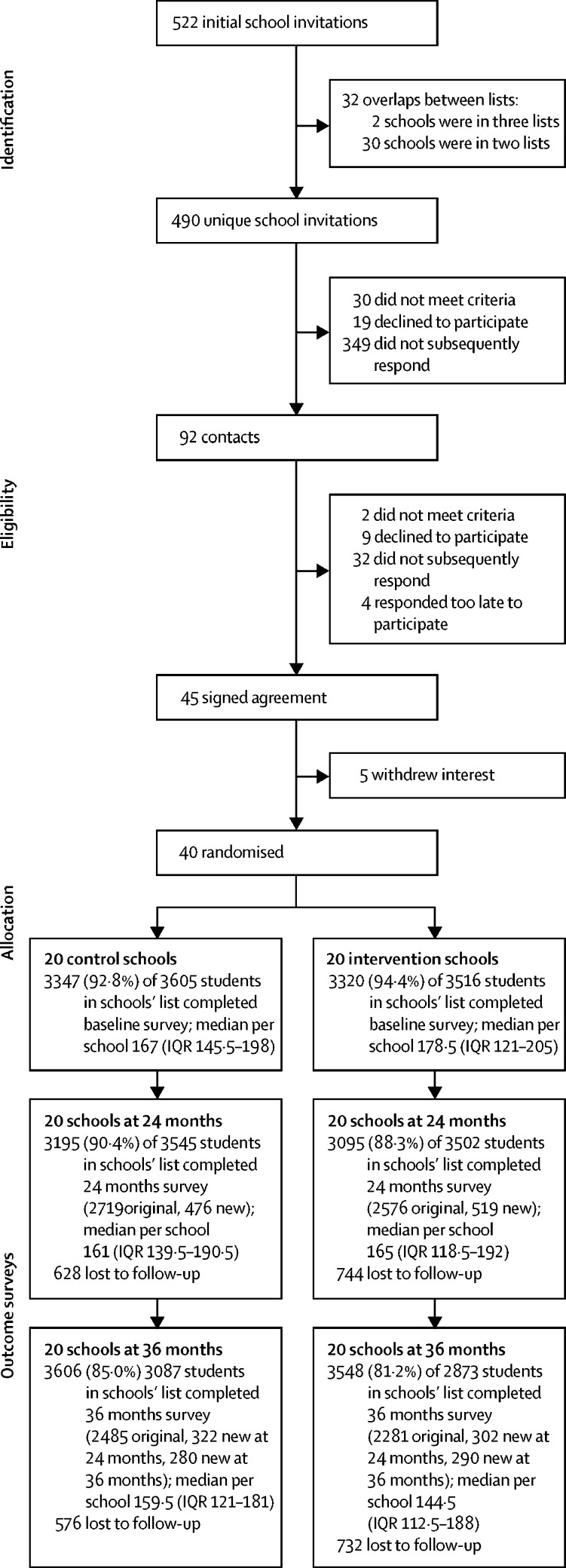
BACKGROUND: Bullying, aggression, and violence among children and young people are some of the most consequential public mental health problems. We tested the Learning Together intervention, which involved students in efforts to modify their school environment using restorative practice and by developing social and emotional skills. METHODS: We did a cluster randomised trial, with economic and process evaluations, of the Learning Together intervention compared with standard practice (controls) over 3 years in secondary schools in south-east England. Learning Together consisted of staff training in restorative practice; convening and facilitating a school action group; and a student social and emotional skills curriculum. Primary outcomes were self-reported experience of bullying victimisation (Gatehouse Bullying Scale; GBS) and perpetration of aggression (Edinburgh Study of Youth Transitions and Crime (ESYTC) school misbehaviour subscale) measured at 36 months. We analysed data using intention-to-treat longitudinal mixed-effects models. This trial was registered with the ISRCTN registry (10751359). FINDINGS: We included 40 schools (20 in each group); no schools withdrew. 6667 (93·6%) of 7121 students participated at baseline and 5960 (83·3%) of 7154 at 36 months. Mean GBS bullying score at 36 months was 0·34 (SE 0·02) in the control group versus 0·29 (SE 0·02) in the intervention group, with a significant adjusted mean difference (-0·03, 95% CI -0·06 to -0·001; adjusted effect size -0·08). Mean ESYTC score at 36 months was 4·33 (SE 0·20) in the control group versus 4·04 (0·21) in the intervention group, with no evidence of a difference between groups (adjusted difference -0·13, 95% CI -0·43 to 0·18; adjusted effect size -0·03). Costs were an additional £58 per pupil in intervention schools than in control schools. INTERPRETATION: Learning Together had small but significant effects on bullying, which could be important for public health, but no effect on aggression. Interventions to promote student health by modifying the whole-school environment are likely to be one of the most feasible and efficient ways of addressing closely related risk and health outcomes in children and young people. FUNDING: National Institute for Health Research, Educational Endowment Foundation.
Overview
The claims and statistics of this paper haven’t been checked yet.
Free: it reads the open-access text and checks the first 5 claims that cite a source we can check. Create a free account to check every claim.
Integrity signals
Registry
Cites
Statistics
Figures
Verification
Claims the paper makes
The claims and statistics of this paper haven’t been checked yet.
Free: it reads the open-access text and checks the first 5 claims that cite a source we can check. Create a free account to check every claim.
Claims other papers make about this one
Each is checked against this paper’s own text: does it say what the citing paper says it does?
The source backs part of the claim, not all of it — or backs it for a different population, condition or comparison.
In the citing paper
“In a 2-year CRCT with 40 middle schools (20 intervention and 20 control) in England (students = 5960), Bonell et al. (2018) found that schools assigned to an RP and a social-emotional learning (SEL) intervention had students who experienced less bullying victimization, less substance abuse (e.g., smoking, alcohol), and better psychological well-being.”
From The Impact of Restorative Practices on the Use of Out-of-School Suspensions: Results from a Cluster Randomized Controlled Trial (2023) · cites this paper as Bonell et al. (2018)
Experimental — accuracy not yet measuredThe source backs part of the claim, not all of it — or backs it for a different population, condition or comparison.
In the citing paper
“Evidence from both high-resource and low-resource settings suggests that low-cost interventions that target the whole school environment are effective in lowering rates of bullying victimisation, improving wellbeing, 335 and reducing the severity of depressive symptoms, particularly when delivered by lay counsellors.”
From The Lancet Psychiatry Commission on youth mental health (2024) · cites this paper as [335]
Experimental — accuracy not yet measuredThe cited source says what the claim attributes to it.
In the citing paper
“Effects were characterized as small (d = 0.08) and no statistically significant differences in terms of aggression were found.”
From The Impact of Restorative Practices on the Use of Out-of-School Suspensions: Results from a Cluster Randomized Controlled Trial (2023) · cites this paper as Bonell et al. (2018)
Self-check
Percentages, sums and reported differences re-computed from the paper’s own numbers.
The self-check needs the paper’s full text.
Citations
Cites
Durlak, J. A., Weissberg, R. P., Dymnicki, A. B., Taylor, R. D., & Schellinger, K. B. (2011) · Child Development · doi:10.1111/j.1467-8624.2010.01564.x · Cited by 10,854
The world report on violence and health
Krug, E. G., Mercy, J. A., Dahlberg, L. L., & Zwi, A. B. (2002) · The Lancet · doi:10.1016/s0140-6736(02)11133-0 · Cited by 9,110
Process evaluation of complex interventions: Medical Research Council guidance
Moore, G. F., Audrey, S., Barker, M., Bond, L., Bonell, C., Hardeman, W., Moore, L., O'Cathain, A., Tinati, T., Wight, D., et al. (2015) · BMJ · doi:10.1136/bmj.h1258 · Cited by 6,204
Self-citationQualitative methods for health research
(2009) · Choice Reviews Online · doi:10.5860/choice.47-0901 · Cited by 4,596
Goodman, R., Ford, T., Simmons, H., Gatward, R., & Meltzer, H. (2000) · British Journal of Psychiatry · doi:10.1192/bjp.177.6.534 · Cited by 1,818
Currie, C., Molcho, M., Boyce, W., Holstein, B., Torsheim, T., & Richter, M. (2008) · Social Science & Medicine · doi:10.1016/j.socscimed.2007.11.024 · Cited by 1,634
Adult psychiatric outcomes of bullying and being bullied by peers in childhood and adolescence
Copeland, W. E., Wolke, D., Angold, A., & Costello, E. J. (2013) · JAMA Psychiatry · doi:10.1001/jamapsychiatry.2013.504 · Cited by 1,247
Complex interventions: how “out of control” can a randomised controlled trial be?
Hawe, P., Shiell, A., & Riley, T. (2004) · BMJ · doi:10.1136/bmj.328.7455.1561 · Cited by 1,244
Global status report on violence prevention 2014
Butchart, A., Mikton, C., Dahlberg, L. L., & Krug, E. G. (2015) · Injury Prevention · doi:10.1136/injuryprev-2015-041640 · Cited by 825
Langford, R., Bonell, C. P., Jones, H. E., Pouliou, T., Murphy, S. M., Waters, E., Komro, K. A., Gibbs, L. F., Magnus, D., & Campbell, R. (2014) · Cochrane Database of Systematic Reviews · doi:10.1002/14651858.cd008958.pub2 · Cited by 768
Self-citation
Research works printed but not linked: 1
- NICE Methods for the development of NICE public health guidance 3rd edition 2012 National Institute for Health and Care Excellence 27905711
Cited by
Thapar, A., Eyre, O., Patel, V., & Brent, D. (2022) · The Lancet · doi:10.1016/s0140-6736(22)01012-1 · Cited by 869
“Another school-based intervention in the UK that targeted the social environment showed improvements in some outcomes but not depression 111 .”
The Lancet Psychiatry Commission on youth mental health
McGorry, P. D., Mei, C., Dalal, N., Alvarez-Jimenez, M., Blakemore, S.-J., Browne, V., Dooley, B., Hickie, I. B., Jones, P. B., McDaid, D., et al. (2024) · The Lancet Psychiatry · doi:10.1016/s2215-0366(24)00163-9 · Cited by 663
Skivington, K., Matthews, L., Simpson, S. A., Craig, P., Baird, J., Blazeby, J. M., Boyd, K. A., Craig, N., French, D. P., McIntosh, E., et al. (2021) · Health Technology Assessment · doi:10.3310/hta25570 · Cited by 522
The Handbook of Behavior Change
(2020) · Cambridge University Press eBooks · doi:10.1017/9781108677318 · Cited by 407
The association between academic pressure and adolescent mental health problems: a systematic review
Steare, T., Gutiérrez Muñoz, C., Sullivan, A., & Lewis, G. (2023) · Journal of Affective Disorders · doi:10.1016/j.jad.2023.07.028 · Cited by 372
Changing Behavior Using the Theory of Planned Behavior
Ajzen, I., & Schmidt, P. (2020) · The Handbook of Behavior Change · doi:10.1017/9781108677318.002 · Cited by 266
Assessment of School Anti-Bullying Interventions: A Meta-analysis of Randomized Clinical Trials
Fraguas, D., Díaz-Caneja, C. M., Ayora, M., Durán-Cutilla, M., Abregú-Crespo, R., Ezquiaga-Bravo, I., Martín-Babarro, J., & Arango, C. (2021) · JAMA Pediatrics · doi:10.1001/jamapediatrics.2020.3541 · Cited by 195
Use of Restorative Justice and Restorative Practices at School: A Systematic Literature Review
Lodi, E., Perrella, L., Lepri, G. L., Scarpa, M. L., & Patrizi, P. (2021) · International Journal of Environmental Research and Public Health · doi:10.3390/ijerph19010096 · Cited by 185
“[26] Randomized controlled trial (RCT) students, school teachers and teaching assistants from 40 English secondary schools Whole-school restorative approach to address bullying and aggression, involving school action group formation and external facilitation; staff training in restorative practices; a new social and e…”
BackgroundRaniti, M., Rakesh, D., Patton, G. C., & Sawyer, S. M. (2022) · BMC Public Health · doi:10.1186/s12889-022-14364-6 · Cited by 184
A call to action: the second Lancet Commission on adolescent health and wellbeing
Baird, S., Choonara, S., Azzopardi, P. S., Banati, P., Bessant, J., Biermann, O., Capon, A. G., Claeson, M., Collins, P. Y., Wet, N. D., et al. (2025) · The Lancet · doi:10.1016/s0140-6736(25)00503-3 · Cited by 245
Self-citationChanging Behavior Using the Model of Action Phases
Keller, L., Gollwitzer, P. M., & Sheeran, P. (2020) · The Handbook of Behavior Change · doi:10.1017/9781108677318.006 · Cited by 147
Mitić, M., Woodcock, K. A., Amering, M., Krammer, I., Stiehl, K. A. M., Zehetmayer, S., & Schrank, B. (2021) · Frontiers in Psychology · doi:10.3389/fpsyg.2021.589403 · Cited by 211
Richter, A., Sjunnestrand, M., Strandh, M. R., & Hasson, H. (2022) · International Journal of Environmental Research and Public Health · doi:10.3390/ijerph19063489 · Cited by 198
The longitudinal relationship of school climate with adolescent social and emotional health
Wong, M. D., Dosanjh, K. K., JACKSON, N. J., Rünger, D., & Dudovitz, R. (2021) · BMC Public Health · doi:10.1186/s12889-021-10245-6 · Cited by 189
Changing Behavior Using the Health Action Process Approach
Schwarzer, R., & Hamilton, K. (2020) · The Handbook of Behavior Change · doi:10.1017/9781108677318.007 · Cited by 102
Good Intentions Are Not Enough: Centering Equity in School Discipline Reform
Gregory, A., Osher, D., Bear, G. G., Jagers, R. J., & Sprague, J. R. (2021) · School Psychology Review · doi:10.1080/2372966x.2020.1861911 · Cited by 89
Luo, X., Zheng, R., Xiao, P., Xie, X., Liu, Q., Zhu, K., Wu, X., Xiang, Z., & Song, R. (2022) · Asian Journal of Psychiatry · doi:10.1016/j.ajp.2022.103043 · Cited by 115
Reed, H., Couturiaux, D., Davis, M., Edwards, A., Janes, E. H., Kim, H. S., Meléndez‐Torres, G. J., Murphy, S., Rotevatn, T. A., Smith, J. L., et al. (2020) · Prevention Science · doi:10.1007/s11121-020-01182-8 · Cited by 100
Mind the Gap: A Systematic Review of Research on Restorative Practices in Schools
Zakszeski, B., & Rutherford, L. (2021) · School Psychology Review · doi:10.1080/2372966x.2020.1852056 · Cited by 86
School-based mental health promotion: A global policy review
Margaretha, M., Azzopardi, P. S., Fisher, J., & Sawyer, S. M. (2023) · Frontiers in Psychiatry · doi:10.3389/fpsyt.2023.1126767 · Cited by 118
Gardner, B., Rebar, A. L., & Lally, P. J. (2020) · Cambridge University Press eBooks · doi:10.1017/9781108677318.041 · Cited by 82
Changing Behavior Using Social Cognitive Theory
Łuszczyńska, A., & Schwarzer, R. (2020) · Cambridge University Press eBooks · doi:10.1017/9781108677318.003 · Cited by 105
Reducing conflicts in school environments using restorative practices: A systematic review
Weber, C., & Vereenooghe, L. (2020) · International Journal of Educational Research Open · doi:10.1016/j.ijedro.2020.100009 · Cited by 103
Leurent, B., Dodd, M., Allen, E., Viner, R., Scott, S., & Bonell, C. P. (2021) · SSM - Mental Health · doi:10.1016/j.ssmmh.2021.100033 · Cited by 90
Self-citationYosep, I., Hikmat, R., & Mardhiyah, A. (2023) · International Journal of Environmental Research and Public Health · doi:10.3390/ijerph20021577 · Cited by 99
Yosep, I., Hikmat, R., Mardhiyah, A., Hazmi, H., & Hernawaty, T. (2022) · Healthcare · doi:10.3390/healthcare10101835 · Cited by 88
Lekamge, R. B., Jain, R., Sheen, J., Solanki, P., Zhou, Y., Romero, L., Barry, M. M., Chen, L., Karim, M. N., & Ilić, D. (2025) · Journal of Youth and Adolescence · doi:10.1007/s10964-025-02135-6 · Cited by 93
Warner, L. M., & French, D. (2020) · Cambridge University Press eBooks · doi:10.1017/9781108677318.032 · Cited by 79
Personality traits and self-esteem in traditional bullying and cyberbullying
Pascual-Sánchez, A., Hickey, N., Mateu, A., Martínez-Hervés, M., Kramer, T., & Nicholls, D. (2021) · Personality and Individual Differences · doi:10.1016/j.paid.2021.110809 · Cited by 67
Moore, G. F., Anthony, R., Hawkins, J. L., Godwin, J. V., Murphy, S., Hewitt, G., & Meléndez‐Torres, G. J. (2020) · British Educational Research Journal · doi:10.1002/berj.3616 · Cited by 58
Changing Behavior Using Ecological Models
Salmon, J., Hesketh, K. D., Arundell, L., Downing, K. L., & Biddle, S. (2020) · Cambridge University Press eBooks · doi:10.1017/9781108677318.017 · Cited by 90
Role theory of schools and adolescent health
Bonell, C. P., Blakemore, S., Fletcher, A., & Patton, G. C. (2019) · The Lancet Child & Adolescent Health · doi:10.1016/s2352-4642(19)30183-x · Cited by 62
Self-citationGuzman‐Holst, C., Zaneva, M., Chessell, C., Creswell, C., & Bowes, L. (2022) · Journal of Child Psychology and Psychiatry · doi:10.1111/jcpp.13620 · Cited by 44
Changing Behavior Using Self-Determination Theory
Hagger, M. S., Hankonen, N. E., Chatzisarantis, N. L. D., & Ryan, R. M. (2020) · Cambridge University Press eBooks · doi:10.1017/9781108677318.008 · Cited by 87
Bonell, C. P., Warren, E. A., & Meléndez‐Torres, G. J. (2022) · Evaluation · doi:10.1177/13563890221086309 · Cited by 58
Self-citationSiddiqui, S., & Schultze‐Krumbholz, A. (2023) · Societies · doi:10.3390/soc13090212 · Cited by 71
Parker, K., Nunns, M., Xiao, Z., Ford, T., & Ukoumunne, O. C. (2021) · BMC Medical Research Methodology · doi:10.1186/s12874-021-01348-0 · Cited by 41
An evidence-based theory of change for reducing SARS-CoV-2 transmission in reopened schools
Bonell, C. P., Meléndez‐Torres, G. J., Viner, R., Rogers, M. B., Whitworth, M., Rutter, H., Rubin, G. J., & Patton, G. C. (2020) · Health & Place · doi:10.1016/j.healthplace.2020.102398 · Cited by 44
Self-citationTroy, D. M., Anderson, J., Jessiman, P., Albers, P. N., Williams, J. G., Sheard, S., Geijer‐Simpson, E., Spencer, L. P., Kaner, E., Limmer, M., et al. (2022) · BMC Public Health · doi:10.1186/s12889-022-12894-7 · Cited by 74
Self-citationShang, W.-L. (2022) · Computational Intelligence and Neuroscience · doi:10.1155/2022/7643006 · Cited by 53
How can adolescent aggression be reduced? A multi-level meta-analysis
Castillo-Eito, L., Armitage, C. J., Norman, P. E., Day, M. R., Doğru, O. C., & Rowe, R. (2020) · Clinical Psychology Review · doi:10.1016/j.cpr.2020.101853 · Cited by 66
Planning and Implementation Intention Interventions
Rhodes, R. E., Grant, S. J., & de Bruijn, G. (2020) · Cambridge University Press eBooks · doi:10.1017/9781108677318.039 · Cited by 49
Attitudes and Persuasive Communication Interventions
Hamilton, K., & Johnson, B. T. (2020) · Cambridge University Press eBooks · doi:10.1017/9781108677318.031 · Cited by 61
Changing Behavior Using Habit Theory
Orbell, S., & Verplanken, B. (2020) · Cambridge University Press eBooks · doi:10.1017/9781108677318.013 · Cited by 66
Changing Behavior: A Theory- and Evidence-Based Approach
Hagger, M. S., Cameron, L. D., Hamilton, K., Hankonen, N. E., & Lintunen, T. (2020) · Cambridge University Press eBooks · doi:10.1017/9781108677318.001 · Cited by 63
Tarrant, M., Haslam, C., Carter, M., Calitri, R., & Haslam, S. A. (2020) · Cambridge University Press eBooks · doi:10.1017/9781108677318.044 · Cited by 43
Mertens, E. C. A., Deković, M., Leijten, P. H. O., van Londen, M., & Reitz, E. (2020) · Clinical Child and Family Psychology Review · doi:10.1007/s10567-020-00328-y · Cited by 56
Barker, R., Hartwell, G., Egan, M., & Lock, K. (2023) · British Educational Research Journal · doi:10.1002/berj.3853 · Cited by 67
Kidger, J., Turner, N. L., Hollingworth, W., Evans, R., Bell, S. L., Brockman, R., Copeland, L., Fisher, H., Harding, S., Powell, J., et al. (2021) · PLoS Medicine · doi:10.1371/journal.pmed.1003847 · Cited by 55
Suicide prevention: Putting the person at the center
Patel, V., & Gonsalves, P. P. (2019) · PLoS Medicine · doi:10.1371/journal.pmed.1002938 · Cited by 38
Meiksin, R., Crichton, J., Dodd, M., Morgan, G. S., Williams, P., Willmott, M., Allen, E., Tilouche, N., Sturgess, J., Morris, S., et al. (2020) · Public Health Research · doi:10.3310/phr08050 · Cited by 45
Self-citationChanging Behavior Using Integrated Theories
Hagger, M. S., & Hamilton, K. (2020) · Cambridge University Press eBooks · doi:10.1017/9781108677318.015 · Cited by 51
Tiiri, E., Luntamo, T., Mishina, K. E., Sillanmäki, L. H., Klomek, A. B., & Sourander, A. (2019) · Journal of the American Academy of Child & Adolescent Psychiatry · doi:10.1016/j.jaac.2019.03.023 · Cited by 43
Bonell, C. P., Beaumont, E., Dodd, M., Elbourne, D. R., Bevilacqua, L., Mathiot, A., McGowan, J., Sturgess, J., Warren, E. A., Viner, R., et al. (2019) · Journal of Epidemiology & Community Health · doi:10.1136/jech-2018-211866 · Cited by 43
Self-citationVarela, J. J., Savahl, S., Adams, S., & Reyes, F. (2019) · Child Indicators Research · doi:10.1007/s12187-019-09648-0 · Cited by 43
Sharpe, H., Fink, E., Duffy, F., & Patalay, P. (2021) · European Child & Adolescent Psychiatry · doi:10.1007/s00787-020-01708-z · Cited by 49
Warren, E., Melendez-Torres, G. J., Viner, R., & Bonell, C. (2020) · Trials · doi:10.1186/s13063-020-04688-2 · Cited by 32
Self-citationGregory, A., Huang, F., & Ward-Seidel, A. R. (2022) · Journal of School Psychology · doi:10.1016/j.jsp.2022.09.003 · Cited by 47
Changing Behavior Using the Transtheoretical Model
DiClemente, C. C., & Graydon, M. M. (2020) · Cambridge University Press eBooks · doi:10.1017/9781108677318.010 · Cited by 38
Warren, E. A., Bevilacqua, L., Opondo, C., Allen, E., Mathiot, A., West, G., Jamal, F., Viner, R., & Bonell, C. P. (2019) · British Educational Research Journal · doi:10.1002/berj.3547 · Cited by 35
Self-citationOrr, N., Chollet, A., Rizzo, A. J., Shaw, N., Farmer, C., Young, H., Rigby, E., Berry, V., Bonell, C. P., & Meléndez‐Torres, G. J. (2022) · Review of Education · doi:10.1002/rev3.3382 · Cited by 53
Self-citationBonell, C. P., Dodd, M., Allen, E., Bevilacqua, L., McGowan, J., Opondo, C., Sturgess, J., Elbourne, D. R., Warren, E. A., & Viner, R. (2020) · BMJ Open · doi:10.1136/bmjopen-2019-031589 · Cited by 37
Self-citationChanging Behavior Using the Health Belief Model and Protection Motivation Theory
Orbell, S., Zahid, H., & Henderson, C. J. (2020) · Cambridge University Press eBooks · doi:10.1017/9781108677318.004 · Cited by 40
Song, S. Y., Eddy, J., Thompson, H., Adams, B. C., & Beskow, J. (2020) · Journal of Educational and Psychological Consultation · doi:10.1080/10474412.2020.1819298 · Cited by 40
Rice, F. J., Ng‐Knight, T., Riglin, L., Powell, V. E., Moore, G. F., McManus, I. C., Shelton, K. H., & Frederickson, N. L. (2021) · School Mental Health · doi:10.1007/s12310-021-09415-z · Cited by 43
Statistical analyses of ordinal outcomes in randomised controlled trials: a scoping review
Selman, C. J., Lee, K. J., Ferguson, K. N., Whitehead, C. L., Manley, B. J., & Mahar, R. K. (2024) · Trials · doi:10.1186/s13063-024-08072-2 · Cited by 39
Changing Behavior by Changing Environments
Marteau, T. M., Fletcher, P. C., Hollands, G. J., & Munafo, M. R. (2020) · Cambridge University Press eBooks · doi:10.1017/9781108677318.014 · Cited by 35
Forte, A. M., Orri, M., Turecki, G., Galéra, C., Pompili, M., Boivin, M., Tremblay, R. E., Côté, S. M., & Geoffroy, M. (2021) · Journal of Child Psychology and Psychiatry · doi:10.1111/jcpp.13411 · Cited by 33
Bonell, C. P., Allen, E., Warren, E. A., McGowan, J., Bevilacqua, L., Jamal, F., Sadique, Z., Legood, R., Wiggins, M., Opondo, C., et al. (2019) · Public Health Research · doi:10.3310/phr07180 · Cited by 39
Self-citationDesign, Implementation, and Evaluation of Behavior Change Interventions: A Ten-Task Guide
Abraham, C., & Denford, S. (2020) · Cambridge University Press eBooks · doi:10.1017/9781108677318.019 · Cited by 36
Changing Behavior Using the Reflective-Impulsive Model
Deutsch, R., & Strack, F. (2020) · Cambridge University Press eBooks · doi:10.1017/9781108677318.012 · Cited by 37
Tsomokos, D. I., & Slavich, G. M. (2024) · Nature Mental Health · doi:10.1038/s44220-024-00203-7 · Cited by 29
Mahon, D. (2022) · Trauma Care · doi:10.3390/traumacare2010005 · Cited by 26
Roshan, R., Hamid, S., Kumar, R., Hamdani, U., Naqvi, S., Huma, Z., & Adeel, U. (2024) · Social Psychiatry and Psychiatric Epidemiology · doi:10.1007/s00127-024-02762-7 · Cited by 33
Dyadic Behavior Change Interventions
Scholz, U., Berli, C., Lüscher, J., & Knoll, N. (2020) · Cambridge University Press eBooks · doi:10.1017/9781108677318.043 · Cited by 29
Developing Behavior Change Interventions
Hankonen, N. E., & Hardeman, W. (2020) · Cambridge University Press eBooks · doi:10.1017/9781108677318.021 · Cited by 38
Madfis, E., Hirschfield, P., & Addington, L. A. (2021) · School Psychology Review · doi:10.1080/2372966x.2020.1855063 · Cited by 27
Applying Emotional Literacy in Comprehensive Sex Education for Young People
Seiler-Ramadas, R., Grabovac, I., Winkler, R., & Dorner, T. E. (2021) · American Journal of Sexuality Education · doi:10.1080/15546128.2021.1932657 · Cited by 35
Mas-Expósito, L., Krieger, V., Amador, J. A., Casañas, R., Cortés, M. A., & Lalucat-Jo, L. (2022) · Education Sciences · doi:10.3390/educsci12030187 · Cited by 40
Rothman, A. J., Klein, W. M. P., & Sheeran, P. (2020) · Cambridge University Press eBooks · doi:10.1017/9781108677318.020 · Cited by 30
Research priorities for mental health in schools in the wake of COVID-19
Barker, R., Hartwell, G., Bonell, C. P., Egan, M., Lock, K., & Viner, R. (2021) · Journal of Epidemiology & Community Health · doi:10.1136/jech-2021-217902 · Cited by 26
Self-citationAI4PCR: Artificial intelligence for practicing conflict resolution
Hsu, A., & Chaudhary, D. (2023) · Computers in Human Behavior Artificial Humans · doi:10.1016/j.chbah.2023.100002 · Cited by 33
Berti, S., Grazia, V., & Molinari, L. (2023) · Educational Psychology Review · doi:10.1007/s10648-023-09773-x · Cited by 79
Laurenzi, C. A., Toit, S. D., Mawoyo, T. L., Luitel, N. P., Jordans, M. J. D., Pradhan, I., van der Westhuizen, C., Meléndez‐Torres, G. J., Hawkins, J. L., Moore, G. F., et al. (2023) · SSM - Mental Health · doi:10.1016/j.ssmmh.2023.100289 · Cited by 37
Imagery, Visualization, and Mental Simulation Interventions
Hagger, M. S., & Conroy, D. (2020) · Cambridge University Press eBooks · doi:10.1017/9781108677318.033 · Cited by 25
Changing Behavior Using the Common-Sense Model of Self-Regulation
Cameron, L. D., Fleszar‐Pavlović, S. E., & Khachikian, T. (2020) · Cambridge University Press eBooks · doi:10.1017/9781108677318.005 · Cited by 32
Huang, F. L., Gregory, A., & Ward-Seidel, A. R. (2023) · Prevention Science · doi:10.1007/s11121-023-01507-3 · Cited by 21
Engagement of Stakeholders in the Design, Evaluation, and Implementation of Complex Interventions
Hudson, J. L., Moon, Z., Hughes, L. D., & Moss-Morris, R. E. (2020) · Cambridge University Press eBooks · doi:10.1017/9781108677318.024 · Cited by 29
Gneezy, U., Kajackaite, A., & Meier, S. (2020) · Cambridge University Press eBooks · doi:10.1017/9781108677318.036 · Cited by 28
Restorative Justice, Youth Violence, and Policing: A Review of the Evidence
Hobson, J., Twyman-Ghoshal, A. A., Banwell-Moore, R., & Ash, D. P. (2022) · Laws · doi:10.3390/laws11040062 · Cited by 51
Zhang, Q., & Deng, W. (2024) · BMC Public Health · doi:10.1186/s12889-024-20012-y · Cited by 21
Meléndez‐Torres, G. J., Warren, E. A., Viner, R., Allen, E., & Bonell, C. P. (2021) · Social Science & Medicine · doi:10.1016/j.socscimed.2021.113984 · Cited by 24
Self-citationMoore, G. F., Anthony, R., Angel, L., Hawkins, J. L., Morgan, K., Copeland, L., Murphy, S., Godwin, J. V., & Shenderovich, Y. (2022) · BMC Public Health · doi:10.1186/s12889-022-12752-6 · Cited by 28
Williams, I. R., Vaisey, A., Patton, G. C., & Sanci, L. A. (2020) · Current Opinion in Psychiatry · doi:10.1097/yco.0000000000000619 · Cited by 28
Liu, T., Wang, P., Yang, Y., Shyi, G. C. ‐., & Yen, C. (2019) · International Journal of Environmental Research and Public Health · doi:10.3390/ijerph16245125 · Cited by 23
Ruiter, R. A. C., Crutzen, R., de Leeuw, E., & Kok, G. (2020) · Cambridge University Press eBooks · doi:10.1017/9781108677318.018 · Cited by 22
How are parenting practices associated with bullying in adolescents? A cross‐sectional study
Pascual-Sánchez, A., Mateu, A., Martínez-Hervés, M., Hickey, N., Kramer, T., & Nicholls, D. (2021) · Child and Adolescent Mental Health · doi:10.1111/camh.12475 · Cited by 27
Azzopardi, P. S., Hijazi, Z., Wulan, N. R., Requejo, J. H., Lai, J., Carvajal-Vélez, L., & Patton, G. C. (2021) · Journal of Adolescent Health · doi:10.1016/j.jadohealth.2021.03.021 · Cited by 17
Meiksin, R., Campbell, R. M., Crichton, J., Morgan, G. S., Williams, P., Willmott, M., Tilouche, N., Ponsford, R., Barter, C., Sweeting, H. N., et al. (2020) · Sex Education · doi:10.1080/14681811.2020.1729718 · Cited by 27
Self-citationGobat, N., Littlecott, H., Williams, A., McEwan, K., Stanton, H., Robling, M. R., Rollnick, S., Murphy, S., & Evans, R. (2021) · BMC Public Health · doi:10.1186/s12889-020-10124-6 · Cited by 24
Metadata
- Authors
- Bonell, C., Allen, E., Warren, E., McGowan, J., Bevilacqua, L., Jamal, F., Legood, R., Wiggins, M., Opondo, C., Mathiot, A., Sturgess, J., Fletcher, A., Sadique, Z., Elbourne, D., Christie, D., Bond, L., Scott, S., & Viner, R. M.
- Affiliations
- London School of Hygiene & Tropical Medicine (GB)
- University College London (GB)
- Cardiff University (GB)
- University College London Hospitals NHS Foundation Trust (GB)
- Victoria University (AU)
- Corresponding author
- Bonell, Chris
- Viner, Russell M
- ORCID
- Venue
- The Lancet
- Publisher
- Elsevier BV
- Published
- 2018-12
- Volume
- 392
- Issue
- 10163
- Pages
- 2452-2464
- ISSN
- 0099-5355 (ISSN-L)
- 0140-6736
- PMC
- PMC6286420
- OpenAlex
- W2901066280
- Semantic Scholar
- 12c03bf21805f347a2f3d928a10f9984ddce2b6b
- Cited by
- 302
- References
- 44
- Citations by year
- 2026: 31 · 2025: 40 · 2024: 32 · 2023: 34 · 2022: 35 · 2021: 44 · 2020: 71 · 2019: 14 · 2018: 1
- FWCI
- 44.00
- Type
- journal article
- Language
- en
- Open access
- hybrid
- doi.org
- Licence
- cc-by-nc-nd
- www.elsevier.com/tdm/userlicense/1.0/ (tdm)
- www.elsevier.com/legal/tdmrep-license (tdm)
- creativecommons.org/licenses/by-nc-nd/4.0/ (vor)
- Locations
- The Lancet (publishedVersion, cc-by-nc-nd)
- Europe PMC (PubMed Central) (publishedVersion, cc-by-nc-nd)
- PubMed Central (publishedVersion, cc-by-nc-nd)
- PubMed (publishedVersion)
- Research Portal (King's College London) (publishedVersion, other-oa)
- LSHTM Research Online (London School of Hygiene and Tropical Medicine) (acceptedVersion)
- Victoria University Research Repository (Victoria University) (submittedVersion, cc-by-nc-nd)
- UCL Discovery (University College London) (submittedVersion)
- Funders
- Education Endowment Foundation
- National Institute for Health and Care Research (12/153/60)
- Topics
- Social Sciences › Psychology › Social Psychology › Bullying, Victimization, and Aggression
- Health Sciences › Medicine › Public Health, Environmental and Occupational Health › School Health and Nursing Education
- Social Sciences › Business, Management and Accounting › Organizational Behavior and Human Resource Management › Workplace Violence and Bullying
- Keywords
- bullying victimization, bullying perpetration, aggression, restorative practices, socioemotional skills, school-based intervention, high school students, school staff training, cost-effectiveness, economic evaluation, public health interventions, violence prevention, social inclusion, England, South East England
- MeSH terms
- Social Learning, Adolescent, Adolescent Behavior, Aggression, Child, Curriculum, Emotions, England, Female, Humans, Male, Schools, Social Support, Students, Violence, Bullying, Social Skills
About these checks
Registry, retraction, Cites and statistics results are computed, not judged, with one exception: a printed reference that no index lists is read once by a model before it counts as a citation error. Claims are extracted by a model and kept only when their quote appears verbatim in the text; each cited source is then checked, with a model’s help, for whether it says what the claim relies on. Those verdicts can be wrong — read the claim’s quote and the cited source before relying on one.
Statistics and arithmetic are recomputed, not judged.
Confidence bands are shown only for fields calibrated on our annotated test set. None is calibrated yet, so no band is shown.
What counts as a claim ›How we measure confidence ›How we check this ›
Are you an author, or do you see a problem with this page? Request a review
Data sources
Bibliographic data: Semantic Scholar, OpenAlex, Crossref.
Contains information from the Semantic Scholar Academic Graph Datasets, made available under the ODC Attribution License (ODC-BY 1.0).
Semantic Scholar’s data is described in: Kinney, R., et al. (2023). The Semantic Scholar Open Data Platform. arXiv:2301.10140.
