

Fenfluramine hydrochloride for the treatment of seizures in Dravet syndrome: a randomised, double-blind, placebo-controlled trial
Open accessThe DOI matches its Crossref record; 39 of the 39 references it cites were found in a registry or an index.
Abstract
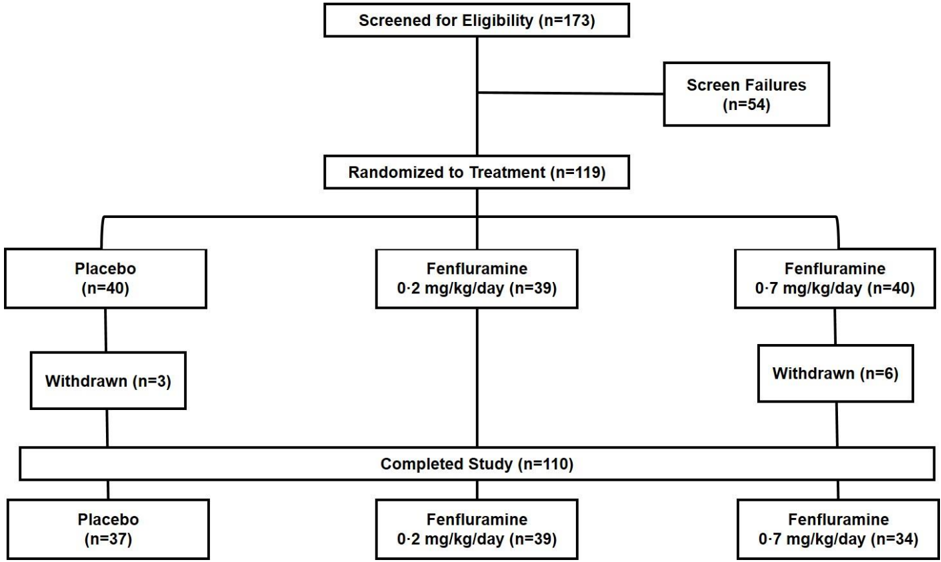
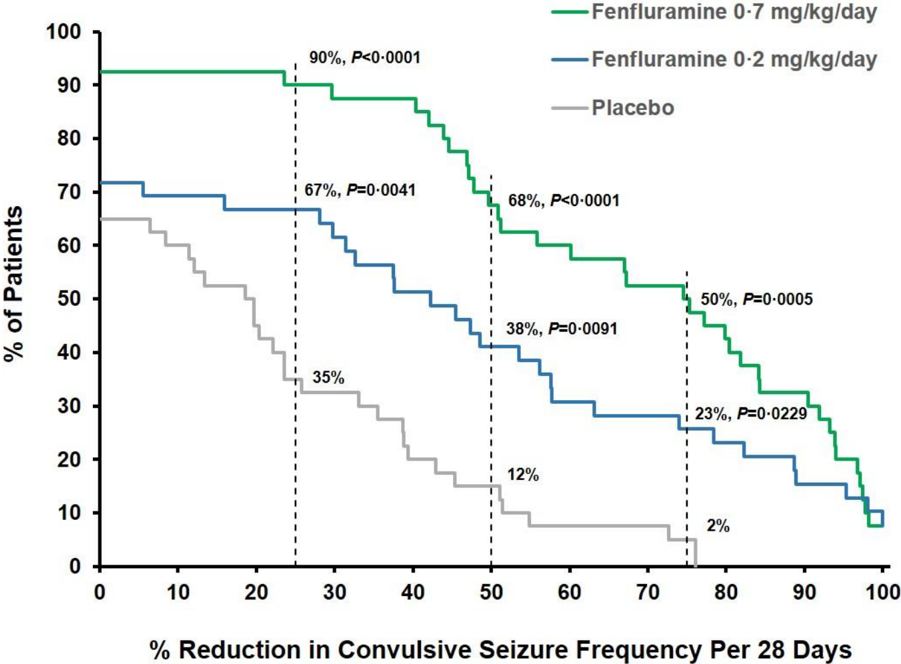
Background Dravet syndrome is a rare, treatment-resistant developmental epileptic encephalopathy characterised by multiple types of frequent, disabling seizures. Fenfluramine has been reported to have antiseizure activity in observational studies of photosensitive epilepsy and Dravet syndrome. The aim of the present study was to assess the efficacy and safety of fenfluramine in patients with Dravet syndrome.Methods In this randomised, double-blind, placebo-controlled clinical trial, we enrolled children and young adults with Dravet syndrome. After a 6-week observation period to establish baseline monthly convulsive seizure frequency (MCSF; convulsive seizures were defined as hemiclonic, tonic, clonic, tonic-atonic, generalised tonic-clonic, and focal with clearly observable motor signs), patients were randomly assigned through an interactive web response system in a 1:1:1 ratio to placebo, fenfluramine 0·2 mg/kg per day, or fenfluramine 0·7 mg/kg per day, added to existing antiepileptic agents for 14 weeks. The primary outcome was the change in mean monthly frequency of convulsive seizures during the treatment period compared with baseline in the 0·7 mg/kg per day group versus placebo; 0·2 mg/kg per day versus placebo was assessed as a key secondary outcome. Analysis was by modified intention to treat. Safety analyses included all participants who received at least one dose of study medication. This trial is registered with ClinicalTrials.gov with two identical protocols NCT02682927 and NCT02826863.Findings Between Jan 15, 2016, and Aug 14, 2017, we assessed 173 patients, of whom 119 patients (mean age 9·0 years, 64 [54%] male) were randomly assigned to receive either fenfluramine 0·2 mg/kg per day (39), fenfluramine 0·7 mg/kg per day (40) or placebo (40). During treatment, the median reduction in seizure frequency was 74·9% in the fenfluramine 0·7 mg/kg group (from median 20·7 seizures per 28 days to 4·7 seizures per 28 days), 42·3% in the fenfluramine 0·2 mg/kg group (from median 17·5 seizures per 28 days to 12·6 per 28 days), and 19·2% in the placebo group (from median 27·3 per 28 days to 22·0 per 28 days). The study met its primary efficacy endpoint, with fenfluramine 0·7 mg/kg per day showing a 62·3% greater reduction in mean MCSF compared with placebo (95% CI 47·7-72·8, p<0·0001); fenfluramine 0·2 mg/kg per day showed a 32·4% reduction in mean MCSF compared with placebo (95% CI 6·2-52·3, p=0·0209). The most common adverse events (occurring in at least 10% of patients and more frequently in the fenfluramine groups) were decreased appetite, diarrhoea, fatigue, lethargy, somnolence, and decreased weight. Echocardiographic examinations revealed valve function within the normal physiological range in all patients during the trial and no signs of pulmonary arterial hypertension.Interpretation In Dravet syndrome, fenfluramine provided significantly greater reduction in convulsive seizure frequency compared with placebo and was generally well tolerated, with no observed valvular heart disease or pulmonary arterial hypertension. Fenfluramine could be an important new treatment option for patients with Dravet syndrome.Funding Zogenix.
Overview
The claims and statistics of this paper haven’t been checked yet.
Free: it reads the open-access text and checks the first 5 claims that cite a source we can check. Create a free account to check every claim.
Integrity signals
Registry
Cites
Statistics
Figures
Verification
Claims the paper makes
The claims and statistics of this paper haven’t been checked yet.
Free: it reads the open-access text and checks the first 5 claims that cite a source we can check. Create a free account to check every claim.
Claims other papers make about this one
Each is checked against this paper’s own text: does it say what the citing paper says it does?
The cited source says what the claim attributes to it.
In the citing paper
“In the first of two RCTs, fenfluramine in two different doses was added to antiseizure regimens without stiripentol 197 .”
From Developmental and epileptic encephalopathies (2024) · cites this paper as [197]
The cited source says what the claim attributes to it.
In the citing paper
“The higher dose of fenfluramine was associated with a significantly greater likelihood of achieving a >50% (68% versus 12% placebo) and a >75% reduction (50% versus 2% placebo) in convulsive seizure frequency.”
From Developmental and epileptic encephalopathies (2024) · cites this paper as [197]
The cited source says what the claim attributes to it.
In the citing paper
“This randomised controlled trial showed that fenfluramine is highly efficacious in Dravet syndrome, highlighting that trials targeting a repurposed drug in specific epilepsy syndrome can offer major improvements to clinical care.”
From Developmental and epileptic encephalopathies (2024) · cites this paper as [197]
Self-check
Percentages, sums and reported differences re-computed from the paper’s own numbers.
The self-check needs the paper’s full text.
Citations
Cites
Varni, J. W., Seid, M., & Kurtin, P. S. (2001) · Medical Care · doi:10.1097/00005650-200108000-00006 · Cited by 5,131
Recommendations for Noninvasive Evaluation of Native Valvular Regurgitation
Zoghbi, W. A., Adams, D., Bonow, R. O., Enriquez-Sarano, M., Foster, E., Grayburn, P. A., Hahn, R. T., Han, Y., Hung, J., Lang, R. M., et al. (2017) · Journal of the American Society of Echocardiography · doi:10.1016/j.echo.2017.01.007 · Cited by 3,556
Trial of Cannabidiol for Drug-Resistant Seizures in the Dravet Syndrome
Devinsky, O., Cross, J. H., Laux, L., Marsh, E., Miller, I., Nabbout, R., Scheffer, I. E., Thiele, E. A., & Wright, S. (2017) · New England Journal of Medicine · doi:10.1056/nejmoa1611618 · Cited by 1,711
Self-citationValvular heart disease associated with fenfluramine-phentermine
Connolly, H. M., Crary, J. L., McGoon, M. D., Hensrud, D. D., Edwards, B. S., Edwards, W. D., & Schaff, H. V. (1997) · New England Journal of Medicine · doi:10.1056/nejm199708283370901 · Cited by 1,632
Lancellotti, P., Moura, L., Pierard, L. A., Agricola, E., Popescu, B. A., Tribouilloy, C., Hagendorff, A., Monin, J. L., Badano, L., Zamorano, J. L., et al. (2010) · European Journal of Echocardiography · doi:10.1093/ejechocard/jeq031 · Cited by 1,545
Appetite-suppressant drugs and the risk of primary pulmonary hypertension
Abenhaim, L., Moride, Y., Brenot, F., Rich, S., Benichou, J., Kurz, X., Higenbottam, T., Oakley, C., Wouters, E., Aubier, M., et al. (1996) · New England Journal of Medicine · doi:10.1056/nejm199608293350901 · Cited by 1,162
The core Dravet syndrome phenotype
Dravet, C. (2011) · Epilepsia · doi:10.1111/j.1528-1167.2011.02994.x · Cited by 627 · cited 1×
“Introduction 90 Dravet syndrome is a rare, treatment-resistant, developmental epileptic encephalopathy 91 characterised by multiple types of frequent, disabling seizures and severe neurodevelopmental 92 and psychomotor delay.(1,2) Current therapies remain inadequate for most patients; approximately 93 45% of patients…”
BackgroundGioia, G. A., Isquith, P. K., Retzlaff, P. D., & Espy, K. A. (2002) · Child Neuropsychology · doi:10.1076/chin.8.4.249.13513 · Cited by 608
Harden, C., Tomson, T., Gloss, D., Buchhalter, J., Cross, J. H., Donner, E., French, J. A., Gil-Nagel, A., Hesdorffer, D. C., Smithson, W. H., et al. (2017) · Neurology · doi:10.1212/wnl.0000000000003685 · Cited by 578
Self-citationChiron, C., Marchand, M., Tran, A., Rey, E., d'Athis, P., Vincent, J., Dulac, O., & Pons, G. (2000) · The Lancet · doi:10.1016/s0140-6736(00)03157-3 · Cited by 568
Pediatric Pulmonary Hypertension
Ivy, D. D., Abman, S. H., Barst, R. J., Berger, R. M. F., Bonnet, D., Fleming, T. R., Haworth, S. G., Raj, J. U., Rosenzweig, E. B., Schulze Neick, I., et al. (2013) · Journal of the American College of Cardiology · doi:10.1016/j.jacc.2013.10.028 · Cited by 536 · cited 1×
“Pulmonary hypertension 214 was considered to be present when pulmonary arterial systolic pressure (PASP) exceeded 35 215 mmHg.(18) 216 217”
BackgroundLancellotti, P., Tribouilloy, C., Hagendorff, A., Moura, L., Popescu, B. A., Agricola, E., Monin, J. L., Pierard, L. A., Badano, L., Zamorano, J. L., et al. (2010) · European Journal of Echocardiography · doi:10.1093/ejechocard/jeq030 · Cited by 501
Cooper, M. S., Mcintosh, A., Crompton, D. E., McMahon, J. M., Schneider, A., Farrell, K., Ganesan, V., Gill, D., Kivity, S., Lerman-Sagie, T., et al. (2016) · Epilepsy Research · doi:10.1016/j.eplepsyres.2016.10.006 · Cited by 316 · cited 1×
“epilepsy.(5) A Dravet-specific SUDEP rate of 9·32 per 1000 person-years has been reported,(5) 432 which is substantially higher than that reported in the general population of patients with 433 epilepsy.”
ResultCognitive Effects of Antiepileptic Drugs
Park, S.-P., & Kwon, S.-H. (2008) · Journal of Clinical Neurology · doi:10.3988/jcn.2008.4.3.99 · Cited by 271 · cited 1×
“The BRIEF assesses executive function, a 460 construct of cognition, and was included as a safety measure to assess if treatment resulted in any 461 negative effects on cognitive function, as this outcome has previously been reported with other 462 antiepileptic medications.(27) The results showed this was not the cas…”
ResultA Population-Based Study of Appetite-Suppressant Drugs and the Risk of Cardiac-Valve Regurgitation
Jick, H., Vasilakis, C., Weinrauch, L. A., Meier, C. R., Jick, S. S., & Derby, L. E. (1998) · New England Journal of Medicine · doi:10.1056/nejm199809103391102 · Cited by 263
Dravet syndrome as epileptic encephalopathy: evidence from long-term course and neuropathology
Catarino, C. B., Liu, J. Y. W., Liagkouras, I., Gibbons, V. S., Labrum, R. W., Ellis, R., Woodward, C., Davis, M. B., Smith, S. J., Cross, J. H., et al. (2011) · Brain · doi:10.1093/brain/awr129 · Cited by 227
Self-citationSuccessful use of fenfluramine as an add‐on treatment for Dravet syndrome
Ceulemans, B., Boel, M., Leyssens, K., Van Rossem, C., Neels, P., Jorens, P. G., & Lagae, L. (2012) · Epilepsia · doi:10.1111/j.1528-1167.2012.03495.x · Cited by 210
Self-citationTrial of Cannabidiol for Drug-Resistant Seizures in the Dravet Syndrome
(2017) · New England Journal of Medicine · doi:10.1056/nejmc1708349 · Cited by 206
Lagae, L., Brambilla, I., Mingorance, A., Gibson, E., & Battersby, A. (2018) · Developmental Medicine & Child Neurology · doi:10.1111/dmcn.13591 · Cited by 197
Self-citationAnorexigens and Pulmonary Hypertension in the United States
Rich, S., Rubin, L., Walker, A. M., Schneeweiss, S., & Abenhaim, L. (2000) · Chest · doi:10.1378/chest.117.3.870 · Cited by 189
Skluzacek, J. V., Watts, K. P., Parsy, O., Wical, B., & Camfield, P. (2011) · Epilepsia · doi:10.1111/j.1528-1167.2011.03012.x · Cited by 170
Dravet syndrome—From epileptic encephalopathy to channelopathy
Brunklaus, A., & Zuberi, S. M. (2014) · Epilepsia · doi:10.1111/epi.12652 · Cited by 161
Validation of the Quality of Life in Childhood Epilepsy Questionnaire in American epilepsy patients
Sabaz, M., Lawson, J. A., Cairns, D. R., Duchowny, M. S., Resnick, T. J., Dean, P. M., & Bye, A. M. E. (2003) · Epilepsy & Behavior · doi:10.1016/j.yebeh.2003.08.012 · Cited by 136
Onakpoya, I. J., Heneghan, C. J., & Aronson, J. K. (2016) · Critical Reviews in Toxicology · doi:10.3109/10408444.2016.1149452 · Cited by 119
(1997) · JAMA: The Journal of the American Medical Association · doi:10.1001/jama.1997.03550210025016 · Cited by 116
Five‐year extended follow‐up status of 10 patients with Dravet syndrome treated with fenfluramine
Ceulemans, B., Schoonjans, A., Marchau, F., Paelinck, B. P., & Lagae, L. (2016) · Epilepsia · doi:10.1111/epi.13407 · Cited by 114
Self-citationSchoonjans, A., Paelinck, B. P., Marchau, F., Gunning, B., Gammaitoni, A., Galer, B. S., Lagae, L., & Ceulemans, B. (2017) · European Journal of Neurology · doi:10.1111/ene.13195 · Cited by 104
Self-citationLow-dose fenfluramine in the treatment of neurologic disorders: experience in Dravet syndrome
Schoonjans, A., Lagae, L. G., & Ceulemans, B. (2015) · Therapeutic Advances in Neurological Disorders · doi:10.1177/1756285615607726 · Cited by 83
Self-citationAras, L. M., Isla, J., & Mingorance-Le Meur, A. (2015) · Epilepsy & Behavior · doi:10.1016/j.yebeh.2014.12.028 · Cited by 80
Valvular regurgitation and surgery associated with fenfluramine use: an analysis of 5743 individuals
Dahl, C. F., Allen, M. R., Urie, P. M., & Hopkins, P. N. (2008) · BMC Medicine · doi:10.1186/1741-7015-6-34 · Cited by 73
Assessing the impact of caring for a child with Dravet syndrome: Results of a caregiver survey
Campbell, J. D., Whittington, M. D., Kim, C., VanderVeen, G. R., Knupp, K. G., & Gammaitoni, A. R. (2018) · Epilepsy & Behavior · doi:10.1016/j.yebeh.2018.01.003 · Cited by 71
Self-citationSchoonjans, A.-S., Marchau, F., Paelinck, B. P., Lagae, L., Gammaitoni, A., Pringsheim, M., Keane, M. G., & Ceulemans, B. (2017) · Current Medical Research and Opinion · doi:10.1080/03007995.2017.1355781 · Cited by 46
Self-citationThe direct and indirect costs of Dravet Syndrome
Whittington, M. D., Knupp, K. G., VanderVeen, G. R., Kim, C., Gammaitoni, A. R., & Campbell, J. D. (2018) · Epilepsy & Behavior · doi:10.1016/j.yebeh.2017.12.034 · Cited by 46
Self-citationWebb, R., Gentles, T. L., Stirling, J. W., Lee, M., O’Donnell, C. P., & Wilson, N. J. (2015) · Journal of the American Society of Echocardiography · doi:10.1016/j.echo.2015.03.012 · Cited by 44
Li, R., Serdula, M., Williamson, D. F., Bowman, B., Graham, D., & Green, L. (1999) · International Journal of Obesity · doi:10.1038/sj.ijo.0801020 · Cited by 41
Risk of valvular heart disease associated with use of fenfluramine
Hopkins, P. N., & Polukoff, G. I. (2003) · BMC Cardiovascular Disorders · doi:10.1186/1471-2261-3-5 · Cited by 41
Multiple Testing Problems in Pharmaceutical Statistics
Pacheco, G. D., & Roche, F. H.-L. (2011) · Journal of the Royal Statistical Society Series A (Statistics in Society) · doi:10.1111/j.1467-985x.2011.00725_3.x · Cited by 26
Gatekeeping Procedures in Clinical Trials
Dmitrienko, A. A., & Tamhane, A. C. (2009) · Chapman & Hall/CRC eBooks · doi:10.1201/9781584889854-10 · Cited by 21
Is epilepsy the cause of comorbidities in Dravet syndrome?
Gataullina, S., & Dulac, O. (2017) · Developmental Medicine & Child Neurology · doi:10.1111/dmcn.13613 · Cited by 18
Cited by
Löscher, W., & Klein, P. (2021) · CNS Drugs · doi:10.1007/s40263-021-00827-8 · Cited by 367
“In children with Dravet syndrome, treatment with the serendipitously discovered weight-loss medication fenfluramine similarly resulted in an 8% seizure freedom during the entire 14-week treatment period, which was also sustained long term [50].”
BackgroundEarly childhood epilepsies: epidemiology, classification, aetiology, and socio-economic determinants
Symonds, J. D., Elliott, K. S., Shetty, J., Armstrong, M., Brunklaus, A., Cutcutache, I., Diver, L. A., Dorris, L., Gardiner, S., Jollands, A., et al. (2021) · Brain · doi:10.1093/brain/awab162 · Cited by 269
“the recently repurposed drug fenfluramine is highly encouraging in this condition.(7) For parents of children affected by severe epi-”
BackgroundThe Pharmacoresistant Epilepsy: An Overview on Existent and New Emerging Therapies
Fattorusso, A., Matricardi, S., Mencaroni, E., Dell'Isola, G. B., Di Cara, G., Striano, P., & Verrotti, A. (2021) · Frontiers in Neurology · doi:10.3389/fneur.2021.674483 · Cited by 269
International consensus on diagnosis and management of Dravet syndrome
Wirrell, E. C., Hood, V., Knupp, K. G., Meskis, M. A., Nabbout, R., Scheffer, I. E., Wilmshurst, J., & Sullivan, J. (2022) · Epilepsia · doi:10.1111/epi.17274 · Cited by 249
“Five focus areas were identified: (1) clinical presentation (including seizure semiology, electroencephalography [EEG], magnetic resonance imaging [MRI], and genetic studies), (2) comorbidities (cognition, behavior, autism, gait, sleep, other medical concerns, sudden unexpected death in epilepsy [SUDEP] and mortality,…”
Self-citationDevelopmental and epileptic encephalopathies: from genetic heterogeneity to phenotypic continuum
Guerrini, R., Conti, V., Mantegazza, M., Balestrini, S., Galanopoulou, A. S., & Benfenati, F. (2023) · Physiological Reviews · doi:10.1152/physrev.00063.2021 · Cited by 196
Self-citation
Metadata
- Authors
- Lagae, L., Sullivan, J., Knupp, K., Laux, L., Polster, T., Nikanorova, M., Devinsky, O., Cross, J. H., Guerrini, R., Talwar, D., Miller, I., Farfel, G., Galer, B. S., Gammaitoni, A., Mistry, A., Morrison, G., Lock, M., Agarwal, A., Lai, W. W., & Ceulemans, B.
- Affiliations
- KU Leuven (BE)
- University of California, San Francisco (US)
- Children's Hospital Colorado (US)
- Northwestern University (US)
- Krankenhaus Mara (DE)
- The Danish Epilepsy Association (DK)
- NYU Langone Health (US)
- University College London (GB)
- University of Florence (IT)
- University of Arizona (US)
- Miami Children's Hospital (US)
- Zogenix (United States) (US)
- Children's Hospital of Orange County (US)
- University of Antwerp (BE)
- Corresponding author
- Gammaitoni, Arnold
- ORCID
- Venue
- The Lancet
- Publisher
- Elsevier BV
- Published
- 2019-12
- Volume
- 394
- Issue
- 10216
- Pages
- 2243-2254
- ISSN
- 0099-5355 (ISSN-L)
- 0140-6736
- OpenAlex
- W2996672198
- Cited by
- 384
- References
- 39
- Citations by year
- 2026: 41 · 2025: 56 · 2024: 59 · 2023: 49 · 2022: 72 · 2021: 70 · 2020: 32 · 2019: 3
- FWCI
- 35.25
- Type
- journal article
- Language
- en
- Open access
- Licence
- cc-by-nc-nd
- www.elsevier.com/tdm/userlicense/1.0/ (tdm)
- www.elsevier.com/legal/tdmrep-license (tdm)
- Locations
- The Lancet (publishedVersion)
- PubMed (publishedVersion)
- University of Southern Denmark Research Portal (University of Southern Denmark) (submittedVersion, cc-by-nc-nd)
- UCL Discovery (University College London) (submittedVersion)
- Florence Research (University of Florence) (submittedVersion)
- CINECA IRIS Institutial Research Information System (University of Genoa) (submittedVersion)
- Lirias (submittedVersion)
- Funders
- Zogenix
- National Institute for Health and Care Research (NF-SI-0515-10073)
- Topics
- Health Sciences › Medicine › Clinical Neurology › Epilepsy research and treatment
- Health Sciences › Medicine › Pediatrics, Perinatology and Child Health › Pharmacological Effects and Toxicity Studies
- Health Sciences › Medicine › Physiology (medical) › Diet and metabolism studies
- Keywords
- Dravet syndrome, fenfluramine, developmental and epileptic encephalopathy, photosensitive epilepsy, drug safety, children and young adults, dose comparison, adjunctive antiepileptic therapy, adverse events, drug interactions, drug-resistant epilepsy, 5-HT2A receptor antagonist
- MeSH terms
- Administration, Oral, Adolescent, Anticonvulsants, Child, Child, Preschool, Double-Blind Method, Epilepsies, Myoclonic, Female, Fenfluramine, Humans, Male, Placebos, Seizures, Treatment Outcome, Selective Serotonin Reuptake Inhibitors, Observational Studies as Topic
About these checks
Registry, retraction, Cites and statistics results are computed, not judged, with one exception: a printed reference that no index lists is read once by a model before it counts as a citation error. Claims are extracted by a model and kept only when their quote appears verbatim in the text; each cited source is then checked, with a model’s help, for whether it says what the claim relies on. Those verdicts can be wrong — read the claim’s quote and the cited source before relying on one.
Statistics and arithmetic are recomputed, not judged.
Confidence bands are shown only for fields calibrated on our annotated test set. None is calibrated yet, so no band is shown.
What counts as a claim ›How we measure confidence ›How we check this ›
Are you an author, or do you see a problem with this page? Request a review
Data sources
Bibliographic data: Semantic Scholar, OpenAlex, Crossref.
Contains information from the Semantic Scholar Academic Graph Datasets, made available under the ODC Attribution License (ODC-BY 1.0).
Semantic Scholar’s data is described in: Kinney, R., et al. (2023). The Semantic Scholar Open Data Platform. arXiv:2301.10140.
