

Physical distancing, face masks, and eye protection to prevent person-to-person transmission of SARS-CoV-2 and COVID-19: a systematic review and meta-analysis
Open accessThe DOI matches its Crossref record; 92 of the 104 references it cites were found in a registry or an index; 6 of the 17 sources its claims cite were checked for support.
Abstract
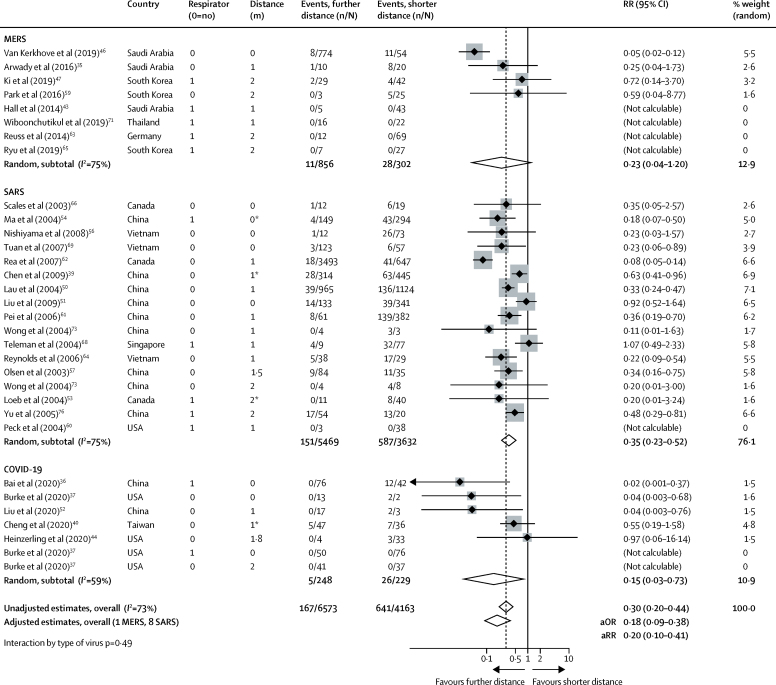
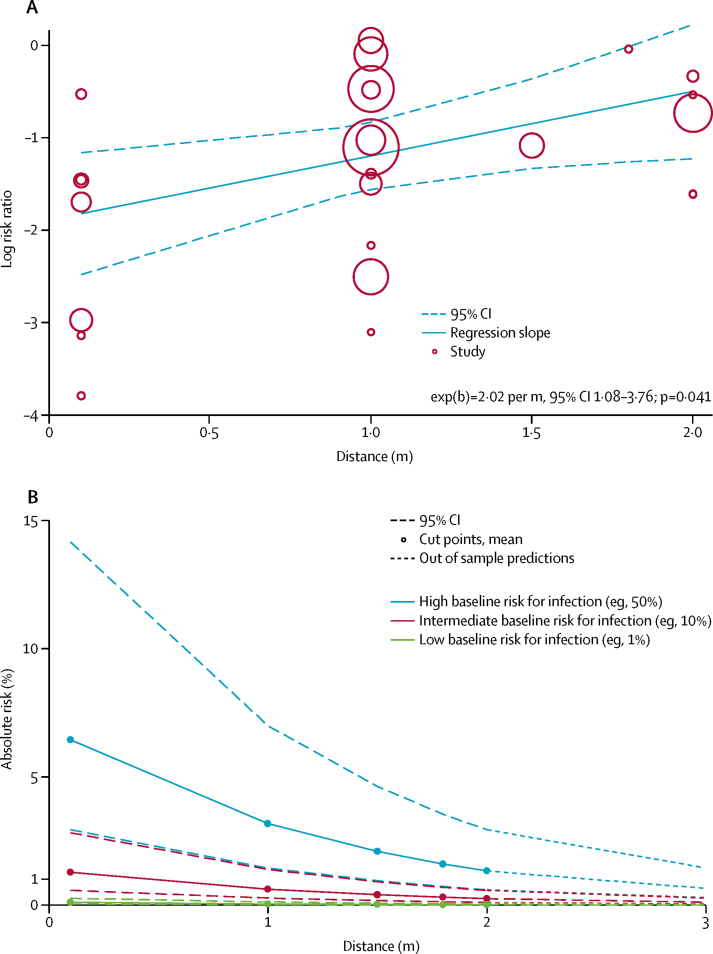
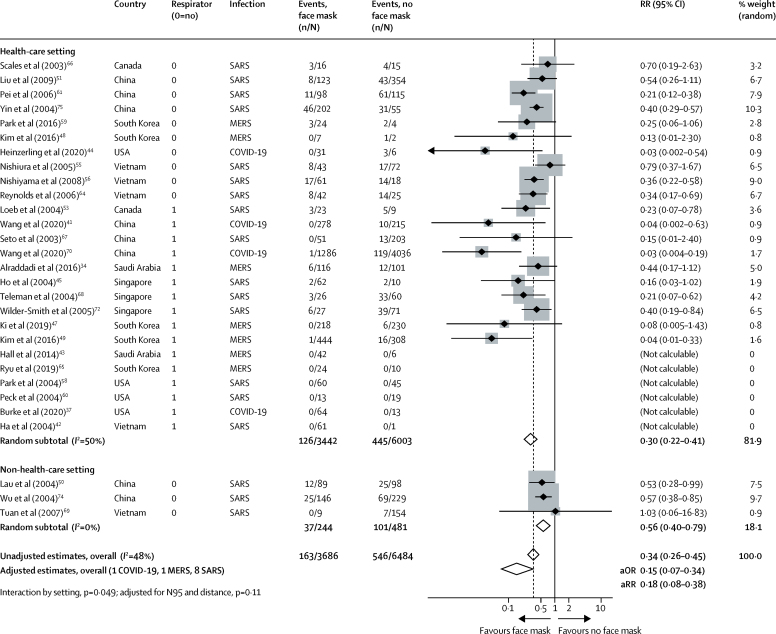
Background Severe acute respiratory syndrome coronavirus 2 (SARS-CoV-2) causes COVID-19 and is spread personto-person through close contact.We aimed to investigate the effects of physical distance, face masks, and eye protection on virus transmission in health-care and non-health-care (eg, community) settings. MethodsWe did a systematic review and meta-analysis to investigate the optimum distance for avoiding person-toperson virus transmission and to assess the use of face masks and eye protection to prevent transmission of viruses.We obtained data for SARS-CoV-2 and the betacoronaviruses that cause severe acute respiratory syndrome, and Middle East respiratory syndrome from 21 standard WHO-specific and COVID-19-specific sources.We searched these data sources from database inception to May 3, 2020, with no restriction by language, for comparative studies and for contextual factors of acceptability, feasibility, resource use, and equity.We screened records, extracted data, and assessed risk of bias in duplicate.We did frequentist and Bayesian meta-analyses and random-effects metaregressions.We rated the certainty of evidence according to Cochrane methods and the GRADE approach.This study is registered with PROSPERO, CRD42020177047.Findings Our search identified 172 observational studies across 16 countries and six continents, with no randomised controlled trials and 44 relevant comparative studies in health-care and non-health-care settings (n=25 697 patients).Transmission of viruses was lower with physical distancing of 1 m or more, compared with a distance of less than 1 m (n=10 736, pooled adjusted odds ratio [aOR] 0•18, 95% CI 0•09 to 0•38; risk difference [RD] -10•2%, 95% CI -11•5 to -7•5; moderate certainty); protection was increased as distance was lengthened (change in relative risk [RR] 2•02 per m; p interaction =0•041; moderate certainty).Face mask use could result in a large reduction in risk of infection (n=2647; aOR 0•15, 95% CI 0•07 to 0•34, RD -14•3%, -15•9 to -10•7; low certainty), with stronger associations with N95 or similar respirators compared with disposable surgical masks or similar (eg, reusable 12-16-layer cotton masks; p interaction =0•090; posterior probability >95%, low certainty).Eye protection also was associated with less infection (n=3713; aOR 0•22, 95% CI 0•12 to 0•39, RD -10•6%, 95% CI -12•5 to -7•7; low certainty).Unadjusted studies and subgroup and sensitivity analyses showed similar findings.Interpretation The findings of this systematic review and meta-analysis support physical distancing of 1 m or more and provide quantitative estimates for models and contact tracing to inform policy.Optimum use of face masks, respirators, and eye protection in public and health-care settings should be informed by these findings and contextual factors.Robust randomised trials are needed to better inform the evidence for these interventions, but this systematic appraisal of currently best available evidence might inform interim guidance.
Overview
CoChat Summary
TL;DR
This systematic review and meta-analysis of 172 observational studies found that physical distancing of at least 1 m, face masks, and eye protection were each associated with lower risk of SARS-CoV-2, SARS-CoV, or MERS-CoV infection. No randomised trials were identified, and certainty ranged from moderate for distancing to low for face masks and eye protection.
Key findings
- Among 44 comparative studies (n=25,697), physical distancing of ≥1 m versus <1 m was associated with lower infection risk (unadjusted n=10,736, RR 0·30, 95% CI 0·20–0·44; adjusted n=7782, aOR 0·18, 95% CI 0·09–0·38; RD −10·2%, 95% CI −11·5 to −7·5; moderate certainty), with protection increasing as distance lengthened (change in RR 2·02 per m; pinteraction=0·041).
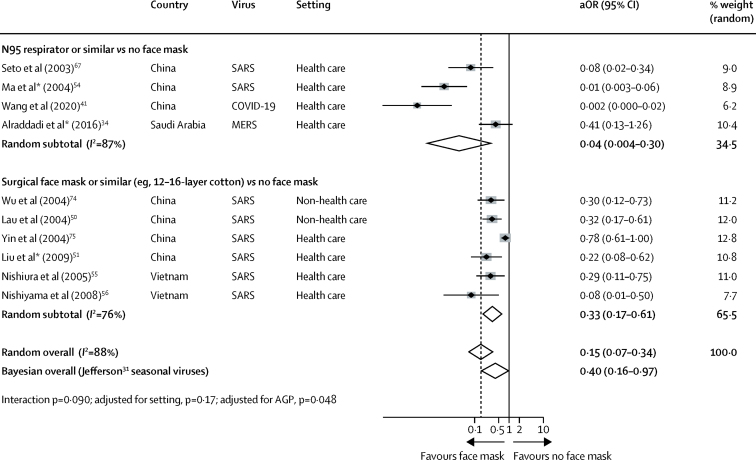
- Face mask use was associated with a large reduction in infection risk (adjusted n=2647, aOR 0·15, 95% CI 0·07–0·34; RD −14·3%, 95% CI −15·9 to −10·7; low certainty), with stronger associations for N95 or similar respirators than disposable surgical masks or similar (pinteraction=0·090; posterior probability >95%, low certainty).
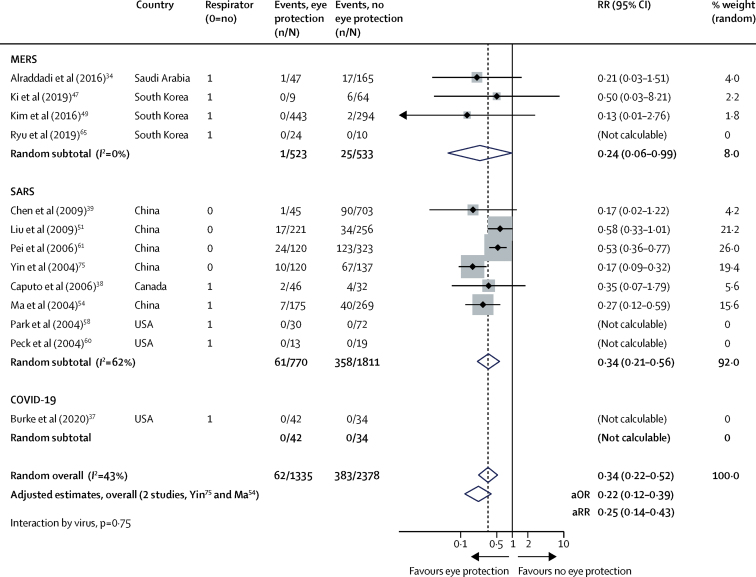
- Eye protection was associated with less infection (unadjusted n=3713, RR 0·34, 95% CI 0·22–0·52; adjusted n=701, aOR 0·22, 95% CI 0·12–0·39; RD −10·6%, 95% CI −12·5 to −7·7; low certainty).
- Across 24 contextual-factor studies, most stakeholders found these strategies acceptable, feasible, and reassuring, but reported discomfort, resource use and equity concerns, communication difficulty, and perceived reduced empathy.
Methods
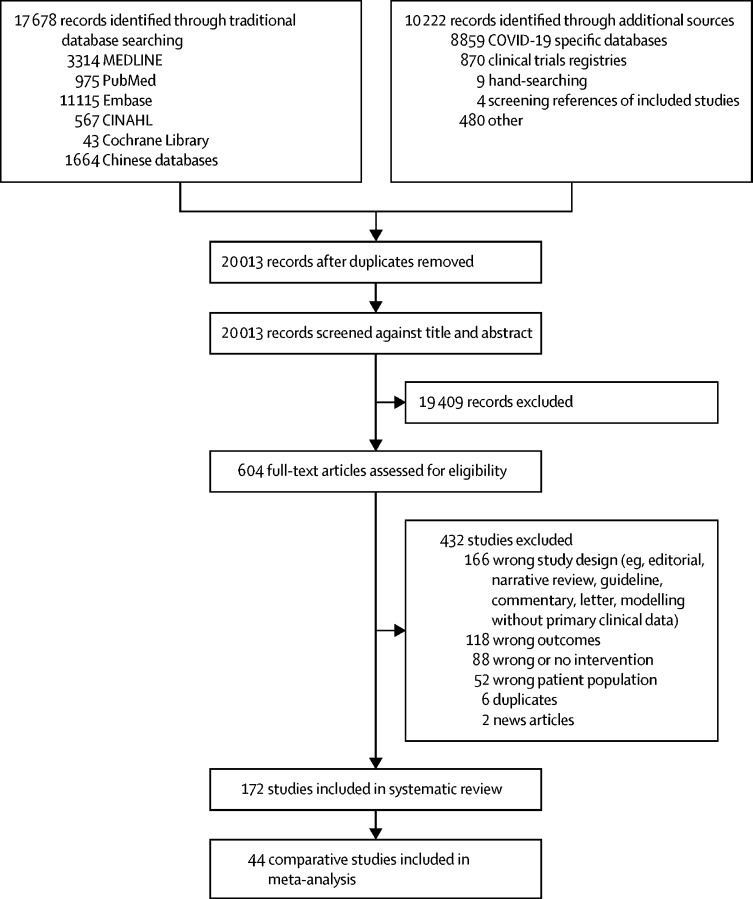
- Systematic review and meta-analysis searching 21 WHO-specific and COVID-19-specific sources from database inception to May 3, 2020, with no language restriction, for studies of confirmed or probable COVID-19, SARS, or MERS and close contacts.
- Duplicate screening, data extraction, and risk-of-bias assessment; frequentist and Bayesian meta-analyses and random-effects meta-regressions; certainty rated with Cochrane methods and GRADE; registered with PROSPERO, CRD42020177047.
- Outcomes included transmission and contextual factors; no randomised controlled trials were identified, so the meta-analysis included 44 comparative observational studies.
Limitations
- The paper states that all included studies were non-randomised, not always fully adjusted, and might suffer recall and measurement bias; many studies lacked precise distances, direct contact was equated to 0 m, and no eligible study quantitatively evaluated whether distances >2 m were more effective.
- The paper also states that few studies assessed non-health-care settings, most evidence came from SARS and MERS (n=6674 patients with COVID-19 of 25,697 total), duration of exposure was not specifically assessed, and reporting was inconsistent for aerosol-generating procedures and masks worn by infected patients.
- Evident from the text: observational designs preclude causal inference, and certainty was low for face masks and eye protection, with residual heterogeneity and imprecision noted.
Model-written summary. Check it against the paper before relying on it.
Integrity signals
Registry
Cites
Statistics
Figures
Verification
Claims the paper makes
3 Valid · 0 Not valid · 7 Not checked · 82 Own results and interpretations
The sources with a verdict support this claim; the rest weren’t checked yet, have no full text we could read, or their verdicts aren’t rated yet.
In the paper
“In 13 unadjusted studies and two adjusted studies,34, 37, 38, 39, 47, 49, 51, 54, 58, 60, 61, 65, 75 eye protection was associated with lower risk of infection (unadjusted n=3713, RR 0·34, 95% CI 0·22 to 0·52; AR 5·5% with eye protection vs 16·0% with no eye protection, RD −10·6%, 95% CI −12·5 to −7·7; adjusted n=701, aOR 0·22, 95% CI 0·12 to 0·39; low certainty; figure 6; table 2; appendix pp 16–”
§ Physical distancing, face masks, and eye protection to prevent person-to-person transmission of SARS-CoV-2 and COVID-19: a systematic review and meta-analysis > Results
What the sources say
- Supportedcites [34] Alraddadi BM Al-Salmi HS Jacobs-Slifka K Risk factors for Middle East respiratory syndrome coronavirus infection among healthcare personnel Emerg Infect Dis 22 2016 1915 1920 27767011 PMC5088034 source
Split into 2 atoms — 2 confirmed, 0 partially supported, 0 disputed, 0 misattributed, 0 unverifiable. Expand the claim to see per-atom verdicts.
- Not checked yetcites [37] Burke RM Balter S Barnes E Enhanced contact investigations for nine early travel-related cases of SARS-CoV-2 in the United States medRxiv 2020 published online May 3. 10.1101/2020.04.27.20081901 (preprint). PMC7467265 32877446
- Supportedcites [38] Caputo KM Byrick R Chapman MG Orser BJ Orser BA Intubation of SARS patients: infection and perspectives of healthcare workers Can J Anaesth 53 2006 122 129 16434750 source
Split into 2 atoms — 2 confirmed, 0 partially supported, 0 disputed, 0 misattributed, 0 unverifiable. Expand the claim to see per-atom verdicts.
plainstates an associationn = 3,713- Asserted: passes — The authors put it forward as true.
- Checkable: passes — It can be checked against evidence.
- Load-bearing: passes — The paper’s conclusions depend on it.
- Based: passes — The paper gives a reason why it holds.
- Supported
Every source the paper cites for this claim was checked and supports it.
In the paper
“This finding is inconsistent with conclusions of a review of four randomised trials,13 in which low certainty of evidence for no larger effect was suggested.”
§ Physical distancing, face masks, and eye protection to prevent person-to-person transmission of SARS-CoV-2 and COVID-19: a systematic review and meta-analysis > Discussion
What the sources say
- Supportedcites [13] Bartoszko JJ Farooqi MAM Alhazzani W Loeb M Medical masks vs N95 respirators for preventing COVID-19 in healthcare workers: a systematic review and meta-analysis of randomized trials Influenza Other Respir Viruses 2020 published online April 4. 10.1111/irv.12745 PMC7298295 32246890 source
The Abstract Conclusions (Bartoszko et al. 2020) state verbatim that 'Low certainty evidence suggests that medical masks and N95 respirators offer similar protection against viral respiratory infection including coronavirus in healthcare workers during non–aerosol–generating care' — i.e., no larger effect of one mask type, hedged at low certainty. The Abstract Data Synthesis and Results (Search results and study characteristics; Effect on outcomes) confirm the review/meta-analysis pooled exactly four RCTs (OR 1.06, 95% CI 0.90–1.25, I² = 0%, low certainty for laboratory-confirmed viral respiratory infection), and the Quality assessment section attributes the 'low' GRADE rating to that four-trial outcome. The citing sentence's paraphrase ('review of four randomised trials', 'low certainty of evidence for no larger effect') therefore matches what this source says. (LLM, conf=0.85)
plain- Asserted: passes — The authors put it forward as true.
- Checkable: passes — It can be checked against evidence.
- Load-bearing: unclear — It is unclear whether the paper’s conclusions depend on it.
- Based: passes — The paper gives a reason why it holds.
- Supported
A result the paper reports from its own data — it cites no other source for it, so there is none to check. The quote shows it is in the paper.
In the paper
“Transmission of viruses was lower with physical distancing of 1 m or more, compared with a distance of less than 1 m (n=10 736, pooled adjusted odds ratio [aOR] 0·18, 95% CI 0·09 to 0·38; risk difference [RD] −10·2%, 95% CI −11·5 to −7·5; moderate certainty)”
- Also stated in: § Results · boosted
“a strong association was found of proximity of the exposed individual with the risk of infection (unadjusted n=10 736, RR 0·30, 95% CI 0·20 to 0·44; adjusted n=7782, aOR 0·18, 95% CI 0·09 to 0·38; absolute risk [AR] 12·8% with shorter distance vs 2·6% with further distance, risk difference [RD] −10·2%, 95% CI −11·5 to −7·5; moderate certainty; figure 2; table 2; appendix p 16).”
§ Physical distancing, face masks, and eye protection to prevent person-to-person transmission of SARS-CoV-2 and COVID-19: a systematic review and meta-analysis > Abstract > Findings
boostedstates a causen = 10- Asserted: passes — The authors put it forward as true.
- Checkable: passes — It can be checked against evidence.
- Load-bearing: passes — The paper’s conclusions depend on it.
- Based: passes — The paper gives a reason why it holds.
- Rests on an assumption not shown here.
- Also stated in: § Results · boosted
A result the paper reports from its own data — it cites no other source for it, so there is none to check. The quote shows it is in the paper.
In the paper
“When differential N95 or similar respirator use, which was more frequent in health-care settings than in non-health-care settings, was adjusted for the possibility that face masks were less effective in non-health-care settings, the subgroup effect was slightly less credible (pinteraction=0·11, adjusted for differential respirator use; figure 4).”
§ Physical distancing, face masks, and eye protection to prevent person-to-person transmission of SARS-CoV-2 and COVID-19: a systematic review and meta-analysis > Results
plain- Asserted: passes — The authors put it forward as true.
- Checkable: passes — It can be checked against evidence.
- Load-bearing: unclear — It is unclear whether the paper’s conclusions depend on it.
- Based: passes — The paper gives a reason why it holds.
A result the paper reports from its own data — it cites no other source for it, so there is none to check. The quote shows it is in the paper.
In the paper
“Our search did not identify any randomised trials of COVID-19, SARS, or MERS.”
- Also stated in: § Results · plain
“Studies were all observational in nature; no randomised trials were identified of any interventions that directly addressed the included study populations.”
§ Physical distancing, face masks, and eye protection to prevent person-to-person transmission of SARS-CoV-2 and COVID-19: a systematic review and meta-analysis > Methods > Data analysis
plain- Asserted: passes — The authors put it forward as true.
- Checkable: passes — It can be checked against evidence.
- Load-bearing: passes — The paper’s conclusions depend on it.
- Based: passes — The paper gives a reason why it holds.
- Also stated in: § Results · plain
30 more claims
Create a free account to see all 92 claims and to verify the 11 references still open.
- It may state two separate claims as one. 40
- The quote only partly states this claim. 1
- Probably not a substantial claim. 23
Claims other papers make about this one
Each is checked against this paper’s own text: does it say what the citing paper says it does?
The source backs part of the claim, not all of it — or backs it for a different population, condition or comparison.
In the citing paper
“The review by Chu 2020 did not consider RCTs of influenza transmission, but only the observational studies examining impact on SARS, MERS, or SARS‐CoV‐2.”
From Physical interventions to interrupt or reduce the spread of respiratory viruses (2023) · cites this paper as Chu 2020
Experimental — accuracy not yet measuredThe source backs part of the claim, not all of it — or backs it for a different population, condition or comparison.
In the citing paper
“For N95 masks versus no mask in HCWs, there was a large protective effective with an OR of 0.04 (95% CI 0.004 to 0.30); for surgical masks versus no masks, there was an OR of 0.33 (0.17 to 0.61) overall, but four of these studies were in healthcare settings.”
From Physical interventions to interrupt or reduce the spread of respiratory viruses (2023) · cites this paper as Chu 2020
Experimental — accuracy not yet measuredThe source backs part of the claim, not all of it — or backs it for a different population, condition or comparison.
In the citing paper
“Chu 2020 has been criticised for several reasons: use of an outdated 'Risk of bias' tool; inaccuracy of distance measures; and not adequately addressing multiple sources of bias, including recall and classification bias and in particular confounding.”
From Physical interventions to interrupt or reduce the spread of respiratory viruses (2023) · cites this paper as Chu 2020
Experimental — accuracy not yet measuredThe cited source says what the claim attributes to it.
In the citing paper
“Social distancing has been shown to be an important component of measures designed to reduce the spread and impact of COVID-19.”
From Facilitators and barriers to social distancing for young people during the COVID-19 pandemic (2022) · cites this paper as [5]
The cited source says what the claim attributes to it.
In the citing paper
“A systematic review of early efforts to control the spread of COVID-19 additionally estimated that physical distancing of over one meter was important in reducing transmission (pooled adjusted OR 0.18, 95% CI 0·09 to 0·38) [5].”
From Facilitators and barriers to social distancing for young people during the COVID-19 pandemic (2022) · cites this paper as [5]
1 more claim about this paper
Create a free account to see every claim other papers make about this one.
Self-check
Percentages, sums and reported differences re-computed from the paper’s own numbers.
Each contradiction between two passages listed here was confirmed by an independent check.
Rated minor: it would not touch a result — a value no result rests on, a p-value that stays on the same side of the significance level, or a conflict that is clerical, resolved elsewhere in the paper, or outside its own findings.
In the paper
§ Physical distancing, face masks, and eye protection to prevent person-to-person transmission of SARS-CoV-2 and COVID-19: a systematic review and meta-analysis > Abstract > Findings
“Transmission of viruses was lower with physical distancing of 1 m or more, compared with a distance of less than 1 m (n=10 736, pooled adjusted odds ratio [aOR] 0·18”
§ Physical distancing, face masks, and eye protection to prevent person-to-person transmission of SARS-CoV-2 and COVID-19: a systematic review and meta-analysis > Results
“unadjusted n=10 736, RR 0·30, 95% CI 0·20 to 0·44; adjusted n=7782, aOR 0·18, 95% CI 0·09 to 0·38”
Citations
Cites
Preferred Reporting Items for Systematic Reviews and Meta-Analyses: the PRISMA statement
Moher, D., Liberati, A., Tetzlaff, J., Altman, D. G., & for the PRISMA Group (2009) · BMJ · doi:10.1136/bmj.b2535 · Cited by 83,823
Preferred reporting items for systematic reviews and meta-analyses: the PRISMA Statement.
(2009) · PubMed Central · Cited by 44,859
RoB 2: a revised tool for assessing risk of bias in randomised trials
Sterne, J. A. C., Savović, J., Page, M. J., Elbers, R. G., Blencowe, N. S., Boutron, I., Cates, C. J., Cheng, H.-Y., Corbett, M. S., Eldridge, S. M., et al. (2019) · BMJ · doi:10.1136/bmj.l4898 · Cited by 34,787
Dermyshi, E., Wang, Y., Yan, C., Hong, W., Qiu, G., Gong, X., & Zhang, T. (2017) · Neonatology · doi:10.1159/000454668 · Cited by 24,451
GRADE: an emerging consensus on rating quality of evidence and strength of recommendations
Guyatt, G. H., Oxman, A. D., Vist, G. E., Kunz, R., Falck-Ytter, Y., Alonso-Coello, P., & Schünemann, H. J. (2008) · BMJ · doi:10.1136/bmj.39489.470347.ad · Cited by 23,305
Self-citationMeta-analysis of Observational Studies in Epidemiology<SUBTITLE>A Proposal for Reporting</SUBTITLE>
Stroup, D. F. (2000) · JAMA · doi:10.1001/jama.283.15.2008 · Cited by 20,623
Preferred Reporting Items for Systematic Reviews and Meta-Analyses: The PRISMA Statement
Moher, D., Liberati, A., Tetzlaff, J., & Altman, D. G. (2009) · Journal of Clinical Epidemiology · doi:10.1016/j.jclinepi.2009.06.005 · Cited by 19,575
(2014) · Medical Entomology and Zoology · Cited by 17,633
GRADE guidelines: 1. Introduction—GRADE evidence profiles and summary of findings tables
Guyatt, G., Oxman, A. D., Akl, E. A., Kunz, R., Vist, G., Brozek, J., Norris, S., Falck-Ytter, Y., Glasziou, P., & deBeer, H. (2011) · Journal of Clinical Epidemiology · doi:10.1016/j.jclinepi.2010.04.026 · Cited by 10,681
Self-citationCumpston, M., Li, T., Page, M. J., Chandler, J., Welch, V. A., Higgins, J. P., & Thomas, J. (2019) · Cochrane Database of Systematic Reviews · doi:10.1002/14651858.ed000142 · Cited by 7,218
Research works printed but not linked: 3
- Liu ZQ Ye Y Zhang H Guohong X Yang J Wang JL Analysis of the spatio-temporal characteristics and transmission path of COVID-19 cluster cases in Zhuhai Trop Geogr 2020 published online March 12. 10.13284/j.cnki.rddl.003228 · doi:10.13284/j.cnki.rddl.003228
- Park JY Kim BJ Chung KH Hwang YI Factors associated with transmission of Middle East respiratory syndrome among Korean healthcare workers: infection control via extended healthcare contact management in a secondary outbreak hospital Respirology 21 suppl 3 2016 89 (abstr APSR6-0642).
- Campbell A Chapter eight: it's not about the mask: SARS Commission final report, volume 3 http://www.archives.gov.on.ca/en/e_records/sars/report/v3-pdf/Vol3Chp8.pdf December, 2006
Cited by
Items 3,601–3,700 of 4,035
Bajinka, O., Kebbeh, A., Ceesay, S. B. F., Jaiteh, L., Panneh, M., Mendy, S., Minteh, W., Bah, M. A., Sanyang, B., Jeng, C., et al. (2026) · International Journal of Infectious Diseases · doi:10.1016/j.ijid.2026.108709
Antwi-Agyei, P., Monney, I., Gyamfi, C., Yeboah, S. I. I. K., Adjei, K. A., Drabble, S., & Kettey, F. (2026) · Crisis and Risk Communication · doi:10.1080/29986907.2026.2709345
Global Picture of COVID-19 Pandemic with Emphasis on European Subcontinent
Majumder, A., Adak, D., Bala, T. K., & Bairagi, N. (2022) · Springer eBooks · doi:10.1007/978-981-16-9336-6_11
Cooper, D. K., Sobolik, J. S., Kovačević, J. J., Rock, C. M., Sajewski, E. T., Guest, J. L., Lopman, B. A., Jaykus, L., & León, J. S. (2022) · medRxiv · doi:10.1101/2022.04.06.22273125
Risk, Impact, and Disadvantage
Bennett, B., Freckelton, I. R., & Wolf, G. (2023) · Oxford University Press eBooks · doi:10.1093/oso/9780192896742.003.0007
Isolation Precautions for Visitors to Healthcare Settings
Cohen, A., Simon, M. S., & Banach, D. B. (2022) · Springer eBooks · doi:10.1007/978-3-030-98427-4_4
Gökmen, O., Özgür, G., Havuz, E., & Beyazyıldız, Ö. (2021) · Turkiye Klinikleri Journal of Ophthalmology · doi:10.5336/ophthal.2020-79888
Zhang, L., Gu, W.-C., Li, L., & Jian, C. (2022) · medRxiv · doi:10.1101/2022.04.05.22273473
Auswirkungen vermehrten Tragens von Mund-Nase-Schutz auf Kognition und Psyche von Klinikmitarbeitern
König, M., Eraslan, D., Aschenbrenner, S., Biela, C., & Weisbrod, M. (2021) · Nervenheilkunde · doi:10.1055/a-1467-7194
Rúška počas pandémie COVID-19 – áno, ale aké?(„Diabol je v detailoch“)
Hatala, R. (2021) · Cardiology letters · doi:10.4149/cardiol_2020_5_6_10
Pan, Y., Kalume, A., Hua, G., Heinson, Y. W., Beresnev, L. A., Videen, G. W., Wang, C., Lucero, G., & Santarpia, J. L. (2026) · Applied Optics · doi:10.1364/ao.576502
ECONOMIC ACTIVITY AND POLLUTION. A STUDY ON EUROPEAN COUNTRIES BEFORE AND AFTER COVID-19 OUTBREAK
Nerişanu, R. A., Cristescu, M. P., & Stoyanova, M. (2021) · Bulletin of Taras Shevchenko National University of Kyiv. Economics · doi:10.17721/1728-2667.2021/216-3/5
The Effect of Eye Protection on SARS-CoV-2 Transmission: A Systematic ReviewPreprint
Byambasuren, O., Beller, E., Clark, J. M., et al. (2021) · SSRN Electronic Journal · doi:10.2139/ssrn.3899111
Anaam, M. S. (2023) · Diseases · doi:10.3390/diseases11010017 · Cited by 2
Litigation and Legal Challenges to Emergency Orders
Bennett, B., Freckelton, I. R., & Wolf, G. (2023) · Oxford University Press eBooks · doi:10.1093/oso/9780192896742.003.0006
Yamamoto, N. (2023) · Elsevier eBooks · doi:10.1016/b978-0-12-824411-1.00001-6
Sodré, R. L. R., da Serra, J. R., Tipple, A. F. V., de Oliveira, K. C. S., & Pereira, L. V. (2022) · Texto & Contexto - Enfermagem · doi:10.1590/1980-265x-tce-2021-0359pt · Cited by 2
Zheng, Q., Meng, Q., & Bao, C. (2025) · Risk Analysis · doi:10.1111/risa.70118
Bennett, B., Freckelton, I. R., & Wolf, G. (2023) · Oxford University Press eBooks · doi:10.1093/oso/9780192896742.002.0011
Developing and validating an individual-level risk calculator for COVID-19 in the United StatesPreprint
Hu, X. C., Starling, J. E., Lipman, E., & Pendl-Robinson, E. L. (2021) · Research Square · doi:10.21203/rs.3.rs-456971/v1
Gomes, W. E. (2024) · Proceedings of the Indian National Science Academy · doi:10.1007/s43538-024-00265-2
Healthcare personnel masking: current practices and gaps in standardized thresholds
Gibas, K. M., Head, T., Broadley, M., & Mermel, L. A. (2026) · Infection Control and Hospital Epidemiology · doi:10.1017/ice.2026.10469
Use of Tracheostomy in COVID-19 Patients and it’s Effects on Healthcare Workers
Dixit, K., & Singh, C. V. (2021) · Journal of Pharmaceutical Research International · doi:10.9734/jpri/2021/v33i60b34845
Bansal, A., Trieu, M.-C., Eriksson, E. M., Zhou, F., McVernon, J., Brokstad, K. A., & Cox, R. J. (2024) · Research Square · doi:10.21203/rs.3.rs-4602421/v2
E.Hawdon, J., & Sedgwick, D. (2024) · Emerald Group Publishing Limited eBooks · doi:10.1108/978-1-83608-624-620241009
Why Face Masks Should not be Imposed on the Public Again: A Review Article
Alrasheedi, A. (2023) · Journal of Medical and Health Studies · doi:10.32996/jmhs.2023.4.6.14
Kisielinski, K., Hirsch, O., Wagner, S., Wojtasik, B., Funken, S., Klosterhalfen, B., Manna, S. K., Prescher, A., Sukul, P., & Sönnichsen, A. C. (2022) · Research Square · doi:10.21203/rs.3.rs-2364417/v1
RetractedKlophaus, N., Wehmeier, U. F., Forstner, J., Jansen, A., Probst, H., Grüter, S., & Hilberg, T. (2024) · Journal of Clinical Medicine · doi:10.3390/jcm13041086 · Cited by 1
Les effets du port du masque sanitaire sur les jeunes enfants en lieux d’accueil collectif
Tcherkassof, A., Busquet, M., Hurtig, M. H., & Thollon-Behar, M.-P. (2022) · Psychologie Française · doi:10.1016/j.psfr.2022.04.003 · Cited by 1
Molner, B., Spencer-Cavaliere, N., Storey, K., & Nykiforuk, C. I. J. (2026) · Journal of Adventure Education & Outdoor Learning · doi:10.1080/14729679.2026.2716032
Kaiser, T., Lück, I., Feldmann, M., Hamm, A. O., & Brakemeier, E. (2020) · doi:10.2196/preprints.24847
GRADE: A Transparent Approach for Evidence-Based Recommendations and Decisions in Health
Schünemann, H. J., & Reinap, M. (2023) · Sustainable development goals series · doi:10.1007/978-3-031-33851-9_84
Self-citationCorte, P. Q., Cano, J., Ayra, E. S., Joshi, C., & Comendador, V. F. G. (2024) · Mathematics · doi:10.3390/math12081241 · Cited by 1
Lopes, T. L., Pinheiro, A. F. D. C., Silva, C. G., Mocelin, P. C., & Zanin, G. D. (2021) · Research Society and Development · doi:10.33448/rsd-v10i12.20016
Hayashi, H., Okada, Y., Kayano, T., Hayashi, K., Kobayashi, T., & Nishiura, H. (2026) · Journal of Infection and Public Health · doi:10.1016/j.jiph.2026.103140
Fichtner, U. A., Piotrowsky-Fichtner, M., Fichtner, M., Goßmann, A., Weis, F., Weiß, M., & Steinmann, D. (2022) · Zentralblatt für Arbeitsmedizin Arbeitsschutz und Ergonomie · doi:10.1007/s40664-022-00480-y · Cited by 1
Reduced Diffusion of Exhaled Air Using Partition Wall With Aerosol Diffusion Prevention Unit
HORIE, M., FURUKAWA, R., & Yamanaka, Y. (2026) · Indoor Air · doi:10.1155/ina/1780792
Sindhu, B. S., Sujatha, S., Alex, S. M., & Rajendran, G. L. (2021) · Journal of Evidence Based Medicine and Healthcare · doi:10.18410/jebmh/2021/9
Mask mandates in light of DANMASK-19
Matthews, S. (2021) · Infection Control and Hospital Epidemiology · doi:10.1017/ice.2021.35
Sánchez-Migallón, V., Calvo‐Lobo, C., Sánchez-Jorge, S., et al. (2022) · Respiration · doi:10.1159/000524490
Mamun, M. M., & Vejerano, E. P. (2021) · SSRN Electronic Journal · doi:10.2139/ssrn.3955742
Direct Simulation of the CoVid-19 epidemicPreprint
Cabrera-Becerril, A., Miramóntes, P., & Peralta, R. (2021) · medRxiv · doi:10.1101/2021.01.14.21249829
Utilisation of Benime Application to Improve Video-Based Student Achievement
Miftachurohmah, N., Guilin, X., Jahara, J., Fusfitasari, Y., & Ikmah, A. D. (2024) · Al-Hijr Journal of Adulearn World · doi:10.55849/alhijr.v3i1.614
Mohsen, F., Bakkar, B., Kikhia, J., et al. (2021) · Research Square · doi:10.21203/rs.3.rs-528706/v1
Determinan Protokol Jaga Jarak pada Usia Dewasa berdasarkan Reasoned Action Approach
Rahmadianti, S., & Kurniawan, A. (2022) · Buletin Riset Psikologi dan Kesehatan Mental (BRPKM) · doi:10.20473/brpkm.v2i1.34535
Zimmerman, T., Sharma, N., Bulu, H., Burrowes, V. J., Beymer, D., & Mukherjee, V. V. (2024) · International Journal of Environmental Research and Public Health · doi:10.3390/ijerph21111413
Shan, S., Zhao, F., Sun, M., Li, Y., & Yang, Y. (2022) · International Journal of Environmental Research and Public Health · doi:10.3390/ijerph192316222
Civil Liability, Regulation, and Accountability
Bennett, B., Freckelton, I. R., & Wolf, G. (2023) · Oxford University Press eBooks · doi:10.1093/oso/9780192896742.003.0009
N95 Respirators for Dermatologic Surgery and Laser Procedures During COVID-19 and Beyond
Kashlan, R., Lyons, A. B., Hivnor, C. M., & Ozog, D. (2020) · Dermatologic Surgery · doi:10.1097/dss.0000000000002749
COOPERATIVE LANGUAGE LEARNING IN SPEAKING CLASS
Umaroh, L. (2022) · Jurnal Inovasi Penelitian · doi:10.47492/jip.v2i9.1302
Intervention effectiveness of health behaviors during COVID-19: A network meta-analysisPreprint
Zhou, R., Shi, K., Li, S., & Zhou, W. (2023) · Research Square · doi:10.21203/rs.3.rs-3190890/v1
Dong, Y., Peng, Z., Fan, H., Niu, X., Sun, J., Liu, Y., Xu, H., Cao, J., & Shen, Z. (2024) · Aerosol Science and Technology · doi:10.1080/02786826.2024.2359561
Fitri, W., Lapau, B., Gustina, T., Yunita, J., & Rizaldi, Z. (2022) · Warta Dharmawangsa · doi:10.46576/wdw.v16i4.2423
Formative Evaluation of a Student Symptom Decision Tree for COVID-19
Campo, M. S., Miovsky, N., Schnieder, M., Woodworth, A., DeHaven, M., Kahn, P., Weiss, M., & Cooper, D. M. (2023) · Health Behavior and Policy Review · doi:10.14485/hbpr.10.1.1 · Cited by 1
Ribaric, N. L., O'Neill-Byrne, Z., Hellinger, A., Pan, D., Wilson, N. M., Viola, I. M., Walsh, T., Lawton, T., Afanasjevs, S., Calabria, C., et al. (2026) · BMJ Open · doi:10.1136/bmjopen-2025-113205
Existence of Traveling Waves in a Spatially Diffusive SIR Model Considering Mask Wearing Behavior
Demir, E., & Vural, C. (2026) · Differential Equations and Dynamical Systems · doi:10.1007/s12591-026-00790-0 · Cited by 1
Gabrić, P. (2021) · OSF Preprints (OSF Preprints) · doi:10.31219/osf.io/sjhra
On the regularity of human mobility patterns at times of a pandemicPreprint
Vanni, F., & Lambert, D. (2021) · RePEc: Research Papers in Economics · doi:10.48550/arxiv.2104.08975 · Cited by 8
Psychological Warfare in the Digital Age: Using Health Misinformation as a Cyber Weapon
Etli, D., & True, N. (2025) · Communications in computer and information science · doi:10.1007/978-3-031-94956-2_15
The Role of Biocomposites in Health Issues During COVID-19 Pandemic
Sapuan, S. M., Ilyas, R. A., & Asyraf, M. R. M. (2021) · Composites science and technology · doi:10.1007/978-981-16-6136-5_12 · Cited by 1
Nagy, H., Hameed, M., Khan, F., Co, E. L., & Rauf, U. (2023) · Avicenna Journal of Medicine · doi:10.1055/s-0042-1760338
Getting the Country Back to Work, Safely
Honary, M., Martinez, V., Wlazlowski, T., Helal, S., Oertzen, H.-H. V., & Honary, S. (2020) · Digital Government Research and Practice · doi:10.1145/3416090
Metadata
- Authors
- Chu, D. K., Akl, E. A., Duda, S., Solo, K., Yaacoub, S., Schünemann, H. J., Chu, D. K., Akl, E. A., El-harakeh, A., Bognanni, A., Lotfi, T., Loeb, M., Hajizadeh, A., Bak, A., Izcovich, A., Cuello-Garcia, C. A., Chen, C., Harris, D. J., Borowiack, E., Chamseddine, F., Schünemann, F., Morgano, G. P., Muti Schünemann, G. E. U., Chen, G., Zhao, H., Neumann, I., Chan, J., Khabsa, J., Hneiny, L., Harrison, L., Smith, M., Rizk, N., Giorgi Rossi, P., AbiHanna, P., El-khoury, R., Stalteri, R., Baldeh, T., Piggott, T., Zhang, Y., Saad, Z., Khamis, A., Reinap, M., Duda, S., Solo, K., Yaacoub, S., & Schünemann, H. J.
- Affiliations
- McMaster University (CA)
- Samsung (China) (CN)
- Cochrane Canada (CA)
- ORCID
- Bognanni, Antonio
- Lotfi, Tamara
- Loeb, Mark
- Hajizadeh, Anisa
- Izcovich, Ariel
- Chen, Chen
- Harris, David J
- Borowiack, Ewa
- Chamseddine, Fatimah
- Morgano, Gian Paolo
- Chen, Guang
- Zhao, Hong
- Neumann, Ignacio
- Chan, Jeffrey
- Khabsa, Joanne
- Hneiny, Layal
- Harrison, Leila
- Smith, Maureen
- Rizk, Nesrine
- El-khoury, Rayane
- Baldeh, Tejan
- Piggott, Thomas
- Zhang, Yuan
- Khamis, Assem
- Reinap, Marge
- Venue
- The Lancet
- Publisher
- Elsevier BV
- Published
- 2020-06
- Volume
- 395
- Issue
- 10242
- Pages
- 1973-1987
- ISSN
- 0099-5355 (ISSN-L)
- 0140-6736
- PMC
- PMC7263814
- OpenAlex
- W3032742287
- Semantic Scholar
- 5af6b87d035e64d44ff43c277f06e1a2f21e23df
- Cited by
- 3,843
- References
- 104
- Citations by year
- 2026: 82 · 2025: 151 · 2024: 259 · 2023: 483 · 2022: 765 · 2021: 1366 · 2020: 729
- FWCI
- 117.07
- Type
- journal article
- Language
- en
- Open access
- hybrid
- doi.org
- Licence
- cc-by
- www.elsevier.com/tdm/userlicense/1.0/ (tdm)
- www.elsevier.com/legal/tdmrep-license (tdm)
- creativecommons.org/licenses/by/3.0/igo/ (vor)
- Locations
- The Lancet (publishedVersion, cc-by)
- PubMed Central (publishedVersion, cc-by)
- PubMed (publishedVersion)
- HAL (submittedVersion)
- Funders
- Canadian Allergy, Asthma and Immunology Foundation
- Lanzhou University
- Topics
- Health Sciences › Medicine › Pulmonary and Respiratory Medicine › Infection Control and Ventilation
- Physical Sciences › Mathematics › Modeling and Simulation › COVID-19 epidemiological studies
- Social Sciences › Sociology and Political Science › COVID-19 Prevention and Impact
- Keywords
- social distancing, face masks, eye protection, SARS-CoV-2, COVID-19 pandemic, human-to-human transmission, betacoronaviruses, SARS, MERS, respiratory virus transmission, N95 respirators, healthcare settings, community settings, infection control, droplet transmission, airborne transmission, acceptability
- MeSH terms
- Betacoronavirus, Physical Distancing, COVID-19, SARS-CoV-2, Communicable Disease Control, Eye Protective Devices, Humans, Masks, Pneumonia, Viral, Social Isolation, Coronavirus Infections, Pandemics
About these checks
Registry, retraction, Cites and statistics results are computed, not judged, with one exception: a printed reference that no index lists is read once by a model before it counts as a citation error. Claims are extracted by a model and kept only when their quote appears verbatim in the text; each cited source is then checked, with a model’s help, for whether it says what the claim relies on. Those verdicts can be wrong — read the claim’s quote and the cited source before relying on one.
The claim verdicts this report counts are experimental: their accuracy is not yet measured.
A language model drew the claims from the paper on 2026-10-06, under version 3 of the claim definition (model deepseek-v4.1-flash, prompt extract-v3).
A second model labelled each claim on 2026-10-06 (model jev-1.13-20260917, definition revision gold-guideline-v0.2).
Cited sources are checked with a language model’s help (gpt-6-sol and qwen3.8-omni-flash).
Statistics and arithmetic are recomputed, not judged.
Confidence bands are shown only for fields calibrated on our annotated test set. None is calibrated yet, so no band is shown.
What counts as a claim ›How we measure confidence ›How we check this ›
Are you an author, or do you see a problem with this page? Request a review
Data sources
Bibliographic data: Semantic Scholar, OpenAlex, Crossref.
Contains information from the Semantic Scholar Academic Graph Datasets, made available under the ODC Attribution License (ODC-BY 1.0).
Semantic Scholar’s data is described in: Kinney, R., et al. (2023). The Semantic Scholar Open Data Platform. arXiv:2301.10140.
