

Global minimum estimates of children affected by COVID-19-associated orphanhood and deaths of caregivers: a modelling study
Open accessThe DOI matches its Crossref record; 28 of the 28 references it cites were found in a registry or an index; 10 of the 46 sources its claims cite were checked for support.
Abstract
BACKGROUND: The COVID-19 pandemic priorities have focused on prevention, detection, and response. Beyond morbidity and mortality, pandemics carry secondary impacts, such as children orphaned or bereft of their caregivers. Such children often face adverse consequences, including poverty, abuse, and institutionalisation. We provide estimates for the magnitude of this problem resulting from COVID-19 and describe the need for resource allocation. METHODS: We used mortality and fertility data to model minimum estimates and rates of COVID-19-associated deaths of primary or secondary caregivers for children younger than 18 years in 21 countries. We considered parents and custodial grandparents as primary caregivers, and co-residing grandparents or older kin (aged 60-84 years) as secondary caregivers. To avoid overcounting, we adjusted for possible clustering of deaths using an estimated secondary attack rate and age-specific infection-fatality ratios for SARS-CoV-2. We used these estimates to model global extrapolations for the number of children who have experienced COVID-19-associated deaths of primary and secondary caregivers. FINDINGS: Globally, from March 1, 2020, to April 30, 2021, we estimate 1 134 000 children (95% credible interval 884 000-1 185 000) experienced the death of primary caregivers, including at least one parent or custodial grandparent. 1 562 000 children (1 299 000-1 683 000) experienced the death of at least one primary or secondary caregiver. Countries in our study set with primary caregiver death rates of at least one per 1000 children included Peru (10·2 per 1000 children), South Africa (5·1), Mexico (3·5), Brazil (2·4), Colombia (2·3), Iran (1·7), the USA (1·5), Argentina (1·1), and Russia (1·0). Numbers of children orphaned exceeded numbers of deaths among those aged 15-50 years. Between two and five times more children had deceased fathers than deceased mothers. INTERPRETATION: Orphanhood and caregiver deaths are a hidden pandemic resulting from COVID-19-associated deaths. Accelerating equitable vaccine delivery is key to prevention. Psychosocial and economic support can help families to nurture children bereft of caregivers and help to ensure that institutionalisation is avoided. These data show the need for an additional pillar of our response: prevent, detect, respond, and care for children. FUNDING: UK Research and Innovation (Global Challenges Research Fund, Engineering and Physical Sciences Research Council, Medical Research Council), UK National Institute for Health Research, US National Institutes of Health, and Imperial College London.
Overview
CoChat Summary
TL;DR
This modelling study estimates that from March 1, 2020, to April 30, 2021, at least 1,134,000 children globally experienced the death of a primary caregiver and 1,562,000 experienced the death of a primary or secondary caregiver due to COVID-19-associated deaths. The authors argue that COVID-19-associated orphanhood and caregiver death is an overlooked consequence requiring equitable vaccines, family-based care, and psychosocial and economic support.
Key findings
- Globally, an estimated 1,134,000 children (95% CrI 884,000–1,185,000) experienced death of primary caregivers, including at least one parent or custodial grandparent; 1,562,000 children (1,299,000–1,683,000) experienced death of at least one primary or secondary caregiver; and 1,042,000 children (806,000–1,083,000) experienced orphanhood.
- In the 21 included countries, 862,365 children lost primary caregivers, and 1,217,648 children were orphaned or bereft of custodial grandparents or other co-residing grandparents.
- Countries with primary caregiver death rates of at least one per 1000 children included Peru (10·2), South Africa (5·1), Mexico (3·5), Brazil (2·4), Colombia (2·3), Iran (1·7), the USA (1·5), Argentina (1·1), and Russia (1·0).
- Between two and five times more children had deceased fathers than deceased mothers; across the 21 countries, paternal versus maternal orphan ratios ranged from 1·6-times to 5·9-times higher.
Methods
- Modelling study using mortality and fertility data for 21 countries that accounted for 76·4% of global COVID-19 deaths up to April 30, 2021, with global extrapolations.
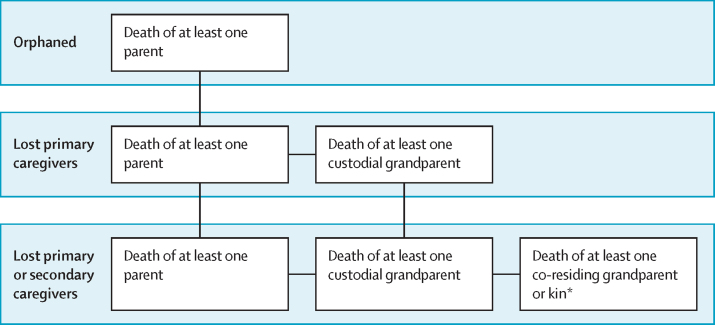
- Primary caregivers were parents and custodial grandparents; secondary caregivers were co-residing grandparents or older kin aged 60–84 years. The authors used excess deaths and COVID-19 deaths, adjusted for possible clustering of deaths using an estimated secondary attack rate and age-specific infection–fatality ratios.
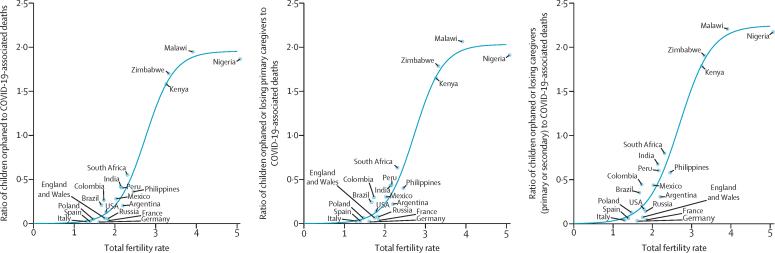
- Global extrapolation used a logistic model based on the correlation between total fertility rate and the ratio of orphans to deaths (Pearson r²=0·93), sampling TFRs 1000 times for uncertainty; analyses were done in R version 4.0.2.
Limitations
- The authors state that they underestimated total numbers of children affected because some countries’ estimates were based on COVID-19 mortality, which is under-reported due to variable testing and reporting.
- They state that age-and-sex-stratified COVID-19 death data were not available for every country, but a stable infection–fatality ratio makes substantial bias unlikely; fertility-rate variations were also unlikely to bias global extrapolations based on leave-one-out analyses.
- They state that lack of data on pre-existing single orphans limited double-orphan estimates to children whose parents both died during the pandemic; they also note limited global household composition data, truncation of grandparent deaths at age 85 years, and a maximum of two grandparents or older kin per child. Evident from the text: these are modelled minimum estimates, not direct counts, and global figures are extrapolated from 21 countries.
Model-written summary. Check it against the paper before relying on it.
Integrity signals
Registry
Cites
Statistics
Figures
Verification
Claims the paper makes
7 Valid · 1 Not valid · 31 Not checked · 48 Own results and interpretations
The cited sources support only part of this claim — read each source’s verdict below.
In the paper
“Evidence from previous epidemics shows that ineffective responses to the death of a parent or caregiver, even when there is a surviving parent or caregiver, can lead to deleterious psychosocial, neurocognitive, socioeconomic, and biomedical outcomes for children.31”
§ Global minimum estimates of children affected by COVID-19-associated orphanhood and deaths of caregivers: a modelling study > Discussion
What the sources say
- Partly supportedcites [31] Barenbaum E Smith T Social support as a protective factor for children impacted by HIV/AIDS across varying living environments in southern Africa AIDS Care 28 suppl 2 2016 92 99 PMC4991218 27392004 sourceExperimental — accuracy not yet measured
The Bereavement section (page unavailable) links parental death, disrupted caregiving, and inadequate support to children’s psychosocial difficulties, and mentions financial hardship even when a parent survives. The Attachment and caregiving section (page unavailable) also describes developmental consequences of inconsistent care. Our copy does not establish the claimed neurocognitive or biomedical outcomes, so the full range of outcomes attributed to this paper is not supported. (LLM, conf=0.86)
plainstates a cause- Asserted: passes — The authors put it forward as true.
- Checkable: passes — It can be checked against evidence.
- Load-bearing: passes — The paper’s conclusions depend on it.
- Based: passes — The paper gives a reason why it holds.
- Partly supported
A result the paper reports from its own data — it cites no other source for it, so there is none to check. The quote shows it is in the paper.
In the paper
“Of these, 788 704 children were orphaned of a mother, father, or both, with most losing one parent;”
§ Global minimum estimates of children affected by COVID-19-associated orphanhood and deaths of caregivers: a modelling study > Results
plainn = 862,365- Asserted: passes — The authors put it forward as true.
- Checkable: passes — It can be checked against evidence.
- Load-bearing: passes — The paper’s conclusions depend on it.
- Based: passes — The paper gives a reason why it holds.
A result the paper reports from its own data — it cites no other source for it, so there is none to check. The quote shows it is in the paper.
In the paper
“73 661 lost at least one custodial grandparent;”
§ Global minimum estimates of children affected by COVID-19-associated orphanhood and deaths of caregivers: a modelling study > Results
plainn = 73,661- Asserted: passes — The authors put it forward as true.
- Checkable: passes — It can be checked against evidence.
- Load-bearing: unclear — It is unclear whether the paper’s conclusions depend on it.
- Based: passes — The paper gives a reason why it holds.
A result the paper reports from its own data — it cites no other source for it, so there is none to check. The quote shows it is in the paper.
In the paper
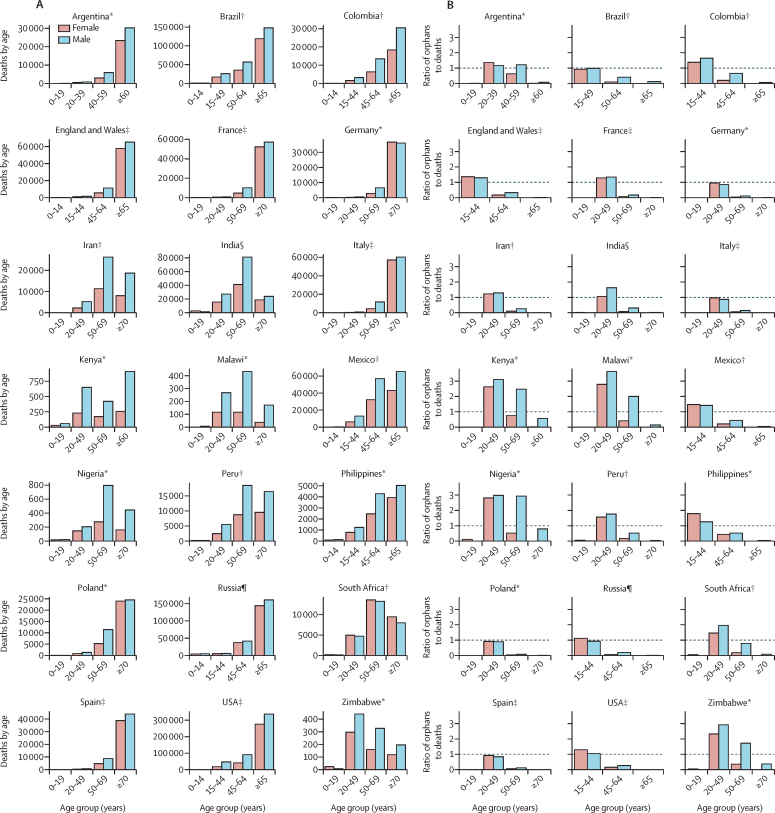
“In England and Wales, France, the USA, India, and Latin American and African countries, the number of children whose parents died before middle age (ie, between around 15 and 50 years of age) was greater than the number of COVID-19-associated adult deaths before middle age (figure 2B).”
§ Global minimum estimates of children affected by COVID-19-associated orphanhood and deaths of caregivers: a modelling study > Results
plain- Asserted: passes — The authors put it forward as true.
- Checkable: passes — It can be checked against evidence.
- Load-bearing: passes — The paper’s conclusions depend on it.
- Based: passes — The paper gives a reason why it holds.
A result the paper reports from its own data — it cites no other source for it, so there is none to check. The quote shows it is in the paper.
In the paper
“355 283 lost at least one co-residing grandparent or older kin (Table 1, Table 2).”
§ Global minimum estimates of children affected by COVID-19-associated orphanhood and deaths of caregivers: a modelling study > Results
plainn = 355,283- Asserted: passes — The authors put it forward as true.
- Checkable: passes — It can be checked against evidence.
- Load-bearing: passes — The paper’s conclusions depend on it.
- Based: passes — The paper gives a reason why it holds.
- Rests on an assumption not shown here.
31 more claims
Create a free account to see all 87 claims and to verify the 7 references still open.
- Probably not a substantial claim. 38
- It may state two separate claims as one. 26
- The quote only partly states this claim. 1
Claims other papers make about this one
Each is checked against this paper’s own text: does it say what the citing paper says it does?
The cited source says what the claim attributes to it.
In the citing paper
“High coronavirus disease 2019 (COVID-19) mortality rates may have severe unrecognized consequences: large-scale death of parents and caregivers for children.1,2”
From COVID-19–Associated Orphanhood and Caregiver Death in the United States (2021) · cites this paper as [2]
The cited source says what the claim attributes to it.
In the citing paper
“To date, little attention has focused on children who suffer COVID-19–associated death of parents and coresiding grandparents serving as caregivers and the attendant loss of salient nurturing, financial support, and care.1,2,5”
From COVID-19–Associated Orphanhood and Caregiver Death in the United States (2021) · cites this paper as [2]
Self-check
Percentages, sums and reported differences re-computed from the paper’s own numbers.
Each contradiction between two passages listed here was confirmed by an independent check.
Rated minor: it would not touch a result — a value no result rests on, a p-value that stays on the same side of the significance level, or a conflict that is clerical, resolved elsewhere in the paper, or outside its own findings.
In the paper
§ Global minimum estimates of children affected by COVID-19-associated orphanhood and deaths of caregivers: a modelling study > Abstract > Findings
“Between two and five times more children had deceased fathers than deceased mothers.”
§ Global minimum estimates of children affected by COVID-19-associated orphanhood and deaths of caregivers: a modelling study > Results
“the greater number of paternal versus maternal orphans, which ranged from 1·6-times to 5·9-times higher across the 21 countries (table 1).”
Citations
Cites
Assessing differential impacts of COVID-19 on black communities
Millett, G. A., Jones, A. T., Benkeser, D., Baral, S., Mercer, L., Beyrer, C., Honermann, B., Lankiewicz, E., Mena, L., Crowley, J. S., et al. (2020) · Annals of Epidemiology · doi:10.1016/j.annepidem.2020.05.003 · Cited by 1,217 · cited 1×
“40 Due to lack of data on country-specific prevalence of pre-existing single orphans from other causes, our estimates of double orphans are limited to deaths of both parents during the pandemic.”
Detecting hidden diversification shifts in models of trait-dependent speciation and extinction
Beaulieu, J. M., & O’Meara, B. C. (2016) · Systematic Biology · doi:10.1093/sysbio/syw022 · Cited by 579
A kinetic model of Phanerozoic taxonomic diversity I. Analysis of marine orders
Sepkoski, J. J. (1978) · Paleobiology · doi:10.1017/s0094837300005972 · Cited by 548
The Shifting Balance of Diversity Among Major Marine Animal Groups
Alroy, J. (2010) · Science · doi:10.1126/science.1189910 · Cited by 467
The million-year wait for macroevolutionary bursts
Uyeda, J. C., Hansen, T. F., Arnold, S. J., & Pienaar, J. (2011) · Proceedings of the National Academy of Sciences · doi:10.1073/pnas.1014503108 · Cited by 358
van IJzendoorn, M. H., Bakermans-Kranenburg, M. J., Duschinsky, R., Fox, N. A., Goldman, P. S., Gunnar, M. R., Johnson, D. E., Nelson, C. A., Reijman, S., Skinner, G. C. M., et al. (2020) · The Lancet Psychiatry · doi:10.1016/s2215-0366(19)30399-2 · Cited by 306
Self-citationHow do grandparents influence child health and development? A systematic review
Sadruddin, A. F. A., Ponguta, L. A., Zonderman, A. L., Wiley, K. S., Grimshaw, A., & Panter-Brick, C. (2019) · Social Science & Medicine · doi:10.1016/j.socscimed.2019.112476 · Cited by 228 · cited 4×
“16 Because the death of a parent or abrupt death of a close family member is the most frequently cited type of trauma exposure experienced by children, we considered the abrupt death of either co-residing grandparents or other co-residing extended family aged 60 years or older to represent a…”
InfluentialSocial Protection and Jobs Responses to COVID-19: A Real-Time Review of Country Measures
Gentilini, U., Almenfi, M. B. A., Iyengar, T., Okamura, Y., Downes, J. A., Dale, P., Weber, M., Newhouse, D. L., Rodriguez Alas, C. P., Kamran, M., et al. (2022) · World Bank, Washington, DC eBooks · doi:10.1596/37186 · Cited by 184
Goldman, P. S., Bakermans-Kranenburg, M. J., Bradford, B., Christopoulos, A., Ken, P. L. A., Cuthbert, C., Duchinsky, R., Fox, N. A., Grigoras, S., Gunnar, M. R., et al. (2020) · The Lancet Child & Adolescent Health · doi:10.1016/s2352-4642(20)30060-2 · Cited by 140 · cited 2×
“28 Negative socioeconomic impacts are strongly associated with adult deaths.”
Self-citationDolbin-MacNab, M. L., & Yancura, L. A. (2018) · The International Journal of Aging and Human Development · doi:10.1177/0091415016689565 · Cited by 99 · cited 1×
“29 Childcare by grandparents is associated with increased parental labour-force participation, school attendance, educational attainment, and communication skills.”
Research works printed but not linked: 1
- Lotka AJ Théorie analytique des associations biologiques. Deuxième Partie. Analyse démographique avec application particulière à l'espèce humaine Actualités Sci Industr 780 1939 1 149
Cited by
Items 101–200 of 299
COVID-19 and Religion: Pandemic Lessons and Legacies
Marshall, K. (2022) · The Review of Faith & International Affairs · doi:10.1080/15570274.2022.2139523 · Cited by 6
“During the COVID-19 pandemic, many millions of children have lost caregivers—a recent Lancet article (Hillis et al. 2021) estimates the number at up to two million children; more recent data suggest far higher numbers.”
BackgroundZani, B., Luckett, B., & Thurman, T. R. (2024) · AIDS Care · doi:10.1080/09540121.2024.2308025 · Cited by 10
“Estimates in South Africa from April 2021 indicate that 5.1 per 1000 children had lost a primary caregiver due to COVID-19-related complications (Hillis et al., 2021).”
InfluentialGlobal Pediatric Pulmonology Alliance (GPPA) proposal for COVID-19 vaccination in children
Rodewald, L. E., Shen, K., Yang, Y., et al. (2021) · World Journal of Pediatrics · doi:10.1007/s12519-021-00459-4 · Cited by 6
Relative Pandemic Severity in Canada and Four Peer Nations During the SARS-CoV-2 PandemicPreprint
Peng, A., Simmons, A. E., Amoako, A., et al. (2021) · medRxiv · doi:10.1101/2021.03.23.21253873 · Cited by 5
Snyder, M., Alburez‐Gutierrez, D., Williams, I., & Zagheni, E. (2022) · doi:10.4054/mpidr-wp-2022-010 · Cited by 7
Imperative to accelerate research aligning real-time clinical demand with mental health supply
Zima, B. T., Devaskar, S. U., on behalf of the Pediatric Policy COUNCIL, Shah, S., Patel, M., Raphael, J., Pursley, D., Keller, D., Cheng, T., Javier, J., et al. (2022) · Pediatric Research · doi:10.1038/s41390-022-02246-x · Cited by 5
Wijaya, B. H., & Hanifuddin, I. (2021) · Invest Journal of Sharia & Economic Law · doi:10.21154/invest.v1i2.3510 · Cited by 13
Lee, N., Self‐Brown, S., Bachman, G. L., Howard, A. L., Gilbert, L. K., Hegle, J., Perry, E. W., Saul, J. R., Behl, I., & Massetti, G. M. (2023) · Psychology Health & Medicine · doi:10.1080/13548506.2023.2235280 · Cited by 6
“The COVID-19 pandemic continues to impact families globally and has further increased the number of orphans due to caregiver deaths (Hillis et al., 2021; Unwin et al., 2022).”
BackgroundSelf-citationRothenberg, W. A., Skinner, A. T., Lansford, J. E., Bacchini, D., Bornstein, M. H., Chang, L., Deater-Deckard, K. D., Giunta, L. D., Dodge, K. A., Gurdal, S., et al. (2024) · Development and Psychopathology · doi:10.1017/s0954579423001621 · Cited by 5
“Moreover, the trauma of losing someone they knew due to COVID-19 has been linked to tremendous disruption in adolescents ’ lives (Hillis et al., 2021; Slomski, 2021), whereas hope and optimism about a COVID-free future has been associated with enhanced adolescent quality of life during the pandemic…”
Alblehai, F., Mahmoud, M. H., Akhtar, M. S., Shaker, A., & Mohamed, A. A. (2022) · Expert Systems · doi:10.1111/exsy.13027 · Cited by 6
“Spanish flu killed almost 20 to 40 million people (Qiu et al., 2017), HIV/AIDS affected 33 million people in 2019, and 3 million died in April 2021 (Cunningham Jr et al., 2020; Hillis et al., 2021) because of the coronavirus pandemic.”
BackgroundCOVID-19 orphans—Global patterns associated with the hidden pandemic
Lowe, C., Rachmawati, L., Richardson, A., & Kelly, M. (2022) · PLOS Global Public Health · doi:10.1371/journal.pgph.0000317 · Cited by 6
“A modelling study by Hillis et al (2021) was the first to quantify the burden of orphans due to the COVID-19 pandemic [4].”
BackgroundMethodInfluentialCovid-19: 1.5 million children have been orphaned by pandemic, study estimates
Taylor, L. (2021) · BMJ · doi:10.1136/bmj.n1871 · Cited by 5
Brasil, A. A. G. D. M., da Silva, K. V. C. C., Júnior, J. G., Alves, R. N. P., Lima, N. N. R., Sampaio, M. L., Cassiano, C. J. D. M., & Neto, M. L. R. (2021) · The Lancet Regional Health - Americas · doi:10.1016/j.lana.2021.100103 · Cited by 8
SARS-COV-2 δ variant drives the pandemic in India and Europe via two subvariantsPreprint
Yang, X. (2021) · medRxiv · doi:10.1101/2021.10.16.21265096 · Cited by 9
“Moreover, many of the deceased were adult caregivers, thereby leaving behind thousands of orphans around the world [1,2].”
BackgroundDemombynes, G., de Walque, D., Gubbins, P., Urdinola, B. P., & Veillard, J. H. M. (2021) · World Bank policy research working paper · doi:10.1596/1813-9450-9807 · Cited by 5
Child and adolescent mental health during the COVID-19 pandemic
De, E. F., Delvecchio, E., Salmi, L. P., Garofalo, C., Orgilés, M., & Mazzeschi, C. (2025) · Journal of Applied Developmental Psychology · doi:10.1016/j.appdev.2025.101811 · Cited by 5
Nearchou, F. (2022) · Journal of Child & Adolescent Trauma · doi:10.1007/s40653-022-00511-z · Cited by 8
“…events such as the death of a parent or a caregiver from COVID-19 (Ahmann, 2021) with estimates showing that as many as 1.5 million young people worldwide between March 2020 and April 2021 may have experienced the death of a primary or secondary caregiver from COVID-19 (Hillis et al., 2021).”
BackgroundInfluentialRothenberg, W. A., Lansford, J. E., Skinner, A. T., Chang, L., Deater-Deckard, K. D., Giunta, L. D., Dodge, K. A., Gurdal, S., Junla, D., Liu, Q., et al. (2024) · Prevention Science · doi:10.1007/s11121-024-01726-2 · Cited by 4
Accounts of home isolation during the COVID-19 pandemic: Case of Peruvian indigenous students
Fergusson, L. C., Ortíz, J., & Bonshek, A. (2022) · Revista Innova Educación · doi:10.35622/j.rie.2023.05.007 · Cited by 6
Children Who Lose a Parent in the COVID-19 Era: Considerations on Grief and Mourning
Rice, T. (2022) · The Psychoanalytic Study of the Child · doi:10.1080/00797308.2022.2120336 · Cited by 6
Orphans, Displaced, and Institutionalized Children
Allen, R. J., & Nakonechnyi, A. (2022) · Springer eBooks · doi:10.1007/978-3-030-68127-2_284-1 · Cited by 4
Blackburn, J., Waring, G., Turner, M., Currell, K., & Caress, A. (2023) · Comprehensive Child and Adolescent Nursing · doi:10.1080/24694193.2023.2292503 · Cited by 6
Demombynes, G., de Walque, D., Gubbins, P., Urdinola, B. P., & Veillard, J. H. M. (2021) · SSRN Electronic Journal · doi:10.2139/ssrn.3963789 · Cited by 4
Vaccinating adolescents in England: a risk-benefit analysisPreprint
Gurdasani, D. (2021) · OSF Preprints (OSF Preprints) · doi:10.31219/osf.io/grzma · Cited by 4
Año y medio de pandemia: años de vida perdidos debido al COVID-19 en México
Novak, B., & Castillo, P. V. (2022) · Notas de población · doi:10.18356/16810333-48-113-8 · Cited by 9
Tamirisa, K., & Maringanti, H. B. (2024) · Cureus · doi:10.7759/cureus.66781 · Cited by 7
“For instance, Peru had 10 times the rate of parental loss compared to the United States [17].”
BackgroundHoward, A. R. H., Forber-Pratt, I. A., & Wilke, N. G. (2022) · Developmental Child Welfare · doi:10.1177/25161032221118379 · Cited by 3
Asravor, R. K. (2023) · The International Journal of Health Planning and Management · doi:10.1002/hpm.3675 · Cited by 3
Fu, C., Xu, H., Stjernswärd, S., & Glasdam, S. (2025) · OMEGA - Journal of Death and Dying · doi:10.1177/00302228251313671 · Cited by 6
Bennett, B., Freckelton, I. R., & Wolf, G. (2023) · Oxford University Press eBooks · doi:10.1093/oso/9780192896742.003.0004 · Cited by 3
de Matos, A. A. G., da Silva, K. V. C. C., Júnior, J. G., Alves, R. N. P., Lima, N. N. R., Sampaio, M. L., Cassiano, C. J. D. M., & Neto, M. L. R. (2021) · Journal of the Royal Society of Medicine · doi:10.1177/01410768211061357 · Cited by 5
“COVID-19 continues to tear families apart, leaving the children of deceased parents with even fewer options than before the pandemic.(2) In Brazil, one child is orphaned by COVID-19 every 5min.”
BackgroundChild Mortality in England During the First Year of the COVID-19 PandemicPreprint
Odd, D., Stoianova, S., Williams, T. G. S., et al. (2021) · medRxiv · doi:10.1101/2021.08.23.21262114 · Cited by 3
Hillis, S. D., N’konzi, J.-P. N., Msemburi, W., et al. (2022) · medRxiv · doi:10.1101/2022.05.08.22274788 · Cited by 3
“From the Global Reference Group on Children Affected by COVID-19, University of Oxford, UK (1); African Institute for Mathematical Sciences, Rwanda (2); World Health Organization Division of Data, Analytics, and Delivery for Impact (3); Department of Social Policy and Intervention, Oxford and Department of Psychiatry…”
BackgroundSelf-citationAccelerating achievement for Africa’s adolescents - an innovative initiative
Sherr, L., Cluver, L. D., Desmond, C., Dhaliwal, M., Webb, D., & Aber, J. L. (2022) · Psychology Health & Medicine · doi:10.1080/13548506.2022.2147962 · Cited by 3
“We have strengthened our partnerships in conceptual development and analysis with UNICEF, WHO, UNDP, the World Food Programme, UNAIDS, the Global Partnership to End Violence Against Children, and the UNODC, and are working closely with CDC, USAID-PEPFAR, and the World Bank on COVID-associated orphanhood.”
MethodSelf-citationIgualdad de género en el Perú: Hacia una mejor distribución del trabajo remunerado y no remunerado
OECD (2022) · Gender equality at work · doi:10.1787/34a988b3-es · Cited by 5
Nguyen, Q. N., & Pham, L. N. (2022) · Advances in educational technologies and instructional design book series · doi:10.4018/978-1-6684-5083-3.ch015 · Cited by 2
Huang, H., Tao, J., Lei, Y., Chen, R., & Fang, H. (2024) · Frontiers in Psychology · doi:10.3389/fpsyg.2024.1433391 · Cited by 4
The COVID-19 Pandemic and Mental Health
Mittal, S., Sinha, S., & Bhat, S. (2022) · IntechOpen eBooks · doi:10.5772/intechopen.102947 · Cited by 2
Farozin, M., Purnama, D. S., Astuti, B., Prasetya, A. B., & Nurbaiti, A. T. (2022) · Jurnal Kajian Bimbingan dan Konseling · doi:10.17977/um001v7i12022p20-28 · Cited by 10
“On socioeconomic sector, 1.5 million children lost their guardians or parents to Covid-19 (Hillis et al., 2021), and in economic sector as many as 55% of men and 57% of women reported losing their jobs due to the pandemic (Hanna & Olken, 2020), which creates prolonged income insecurity for families…”
BackgroundInfluentialBlack, S., Filgueira, R., McAra, L., Miles, B., Parsons, M., & Terras, M. (2024) · Creative Industries Journal · doi:10.1080/17510694.2024.2311883 · Cited by 2
“Existing work on the effect of the pandemic on children and young people focuses on direct consequences like bereavement (Hillis et al. 2021) but also on the repercussions of mitigation efforts like home schooling (Deeker 2022).”
BackgroundGiang, C. W., Alvis, L. M., Oosterhoff, B. J., & Kaplow, J. B. (2024) · OMEGA - Journal of Death and Dying · doi:10.1177/00302228241246919 · Cited by 4
“More recently, it has been estimated that more than 350,000 children in the United States have lost a caregiver due to COVID-19, with disparities existing among communities of color (Cox & Bridgeland, 2023; Hillis et al., 2021).”
Demi, S. M., Sicchia, S. R., Dei, G. J. S., Gebremikael, L., & Shaw, T. (2024) · Agriculture & Food Security · doi:10.1186/s40066-024-00474-4 · Cited by 4
“Similarly, the level of food insecurity in the United States remained unchanged at the national level [16] but increased for the racialized population [26].”
BackgroundZavaleta-Ramírez, P., Rosetti, M., Albores‐Gallo, L., & Sarmiento-Hernández, E. I. (2025) · BJPsych Open · doi:10.1192/bjo.2025.4 · Cited by 4
Accelerating achievement for Africa’s adolescents
Sherr, L., Cluver, L. D., Desmond, C., Orkin, M. M., Rudgard, W. E., Toska, E., Omigbodun, O. O., Casale, M. A. J., Orkin, K., Falajiki, C., et al. (2025) · Contemporary Social Science · doi:10.1080/21582041.2025.2561650 · Cited by 2
“This allowed the identification of more than 12 million children orphaned by COVID-19, two thirds of them adolescents (Hillis, Blenkinsop, et al., 2021, Hillis, Unwin, Chen, et al., 2021; Hillis et al., 2022; Unwin et al., 2022).”
Self-citationAdams, S., & Savahl, S. (2022) · Evidence-Based Approaches to Peace and Conflict Studies · doi:10.1007/978-981-19-5045-2_4 · Cited by 2
COVID-19 and resource families: an examination of ongoing impact and disparities
Ruderman, M. A., Whitman, K. L., Perez, V., Waterman, J., Franke, T. M., & Langley, A. K. (2023) · Journal of Public Child Welfare · doi:10.1080/15548732.2023.2182399 · Cited by 2
“Exacerbated by the pandemic, more children are entering foster care than families who are willing to care for them, and every day, hundreds of youth who are unable to reunify are waiting for permanent placements (Casey Family Programs, 2014; Hillis et al., 2021).”
BackgroundChildcare workers: Challenges faced during Covid-19
Pitsoane, E. M., & Makahane, F. (2023) · Cogent Social Sciences · doi:10.1080/23311886.2023.2225826 · Cited by 2
Tripathy, P., Behera, S., Mohapatra, B., et al. (2023) · International Journal of Advance Research in Nursing · doi:10.33545/nursing.2023.v6.i2.b.351 · Cited by 2
Vieira, A. E. S. F., & Siqueira, D. P. (2024) · Revista Brasileira de Políticas Públicas · doi:10.5102/rbpp.v13i3.8034 · Cited by 2
Egharevba, M. E., Olubunmi, A. G., Olonade, O. Y., Oke, U., & Kasa, A. G. (2022) · Advances in Social Sciences Research Journal · doi:10.14738/assrj.97.12759 · Cited by 1
RIG-I-induced innate antiviral immunity protects mice from lethal SARS-CoV-2 infectionPreprint
Marx, S., Kümmerer, B. M., Grützner, C., et al. (2021) · bioRxiv (Cold Spring Harbor Laboratory) · doi:10.1101/2021.08.06.455405 · Cited by 2
Breen, L. J., Greene, D., Rees, C. S., Black, A., Cawthorne, M., & Egan, S. J. (2022) · doi:10.31234/osf.io/gy9wv · Cited by 2
Ndlovu, P., Mabaso, M., Naidoo, I., et al. (2023) · Research Square · doi:10.21203/rs.3.rs-2840448/v1 · Cited by 2
“Vaccinate every child against COVID-19”
Agrawal, S., Dayama, S., & Galhotra, A. (2022) · Journal of Family Medicine and Primary Care · doi:10.4103/jfmpc.jfmpc_1808_21 · Cited by 1
“[28] Of these, 788,704 children were orphaned of a mother, father, or both, with most losing one parent; 73,661 lost at least one custodial grandparent and 355,283 lost at least one coresiding grandparent or older kin.[29]”
BackgroundPiroddi, C. (2022) · Asian Bioethics Review · doi:10.1007/s41649-022-00212-7 · Cited by 2
“These losses can increase the risk of mental health problems; physical, emotional, and sexual violence; and family economic hardship (Hillis et al. 2021).”
BackgroundPHYSICAL ACTIVITY, EATING AND SLEEP IN ATHLETES ONE YEAR AFTER THE COVID-19 PANDEMIC
Brito, L. M. S., de Lima, V. A., Carli, M. E. C., Mota, J. A. P. S., Leite, N., & Boguszewski, M. C. D. S. (2023) · Revista Brasileira de Medicina do Esporte · doi:10.1590/1517-8692202430022022_0128i · Cited by 3
Harrison, J. N., & Leppert, M. L. O. (2024) · Journal of Technology in Behavioral Science · doi:10.1007/s41347-024-00383-0 · Cited by 1
Mass Trauma in Children: Expanding the Concept of Exposure in the Context of the COVID-19 Pandemic
Pfefferbaum, B. J. (2025) · Current Psychiatry Reports · doi:10.1007/s11920-025-01635-3 · Cited by 1
“An unprecedented number of children have lost parents, grandparents, and/or other caregivers to COVID-19 [ 17, 18 ].”
Orbach, L., Silva, E. D. O., & de Salles, J. F. (2025) · Review of Education · doi:10.1002/rev3.70106 · Cited by 1
Knight, D. S., Min, S., Almasi, P., et al. (2025) · Educational Evaluation and Policy Analysis · doi:10.3102/01623737251367056 · Cited by 1
“At least one quarter million U.S. children lost a caregiver during the pandemic, creating enduring trauma for students (Hillis et al., 2021; Hills et al., 2022).”
Kassa, E. E., Maree, W., Guez, J., & Frei-Landau, R. (2026) · European Journal of Psychotraumatology · doi:10.1080/20008066.2026.2683322 · Cited by 1
“Similarly, Hillis et al. (2021a, 2021b) demonstrated that children from minority and low-income backgrounds suffered disproportionately higher rates of caregiver loss during the COVID-19 pandemic, underscoring how structural inequalities heighten bereavement burden.”
Стоянова, И. Я., Гуткевич, Е. В., Лебедева, В. Ф., Иванова, А. А., & Bokhan, N. A. (2022) · Сибирский вестник психиатрии и наркологии · doi:10.26617/1810-3111-2022-1(114)-46-56 · Cited by 1
Deshpande, S. J., Velonjara, J., Lujan, S., Petroni, G. J., Wang, J., Patel, K. V., Boyle, L. N., Bell, M. J., Vavilala, M. S., & for the PEGASUS Argentina Study Group (2022) · PLoS ONE · doi:10.1371/journal.pone.0275255 · Cited by 2
“The COVID-19 pandemic especially stressed the pre-hospital medical system, necessitating stringent patient severity triage, restricting availability of hospitals to receive patients [25], and creating longer response times [33].”
BackgroundRousseau, C., Quach, C., Dubé, È., Vanier-Clément, A., Santavicca, T., & Monnais, L. (2022) · Canada Communicable Disease Report · doi:10.14745/ccdr.v48i10a01 · Cited by 3
Hassan, S. M. (2022) · Ilomata International Journal of Social Science · doi:10.52728/ijss.v3i4.566 · Cited by 1
Parents and Parenting in the COVID-19 Pandemic: A Review of the COVID-19 Literature
Roman, N. V. (2022) · Science across cultures · doi:10.1007/978-3-031-15359-4_23 · Cited by 3
Tuberculosis in the time of COVID-19: The successful results of treatment in Peru
Accinelli, R. A. (2023) · Enfermedades infecciosas y microbiologia clinica (English ed ) · doi:10.1016/j.eimce.2022.03.019 · Cited by 1
Beresin, A., & Bishop, J. (2023) · Open Book Publishers · doi:10.11647/obp.0326.22 · Cited by 1
Jones, M., & Jetelina, K. K. (2023) · American Journal of Epidemiology · doi:10.1093/aje/kwad161 · Cited by 1
Cárdenas, S., Ruelas, I., & Sánchez, E. (2023) · Springer eBooks · doi:10.1007/978-3-031-42671-1_6 · Cited by 2
Children's Grief: Theoretical Conceptualization of the Problem
Bakanova, A. A. (2023) · Counseling Psychology and Psychotherapy · doi:10.17759/cpp.2023310302 · Cited by 2
Bienestar emocional, percepciones y actitudes frente a la COVID-19 en adolescentes
Torralbo, A. M., Noguerola, S. R., Martin, V., Bielsa-Pascual, J., Alcazo, M. T. L., Domínguez, M. J. M., & Urgell, C. V. (2023) · Medicina de Familia SEMERGEN · doi:10.1016/j.semerg.2023.102158 · Cited by 6
Emerging Social Waqf Model for the Welfare of Pandemic Orphans
Busari, S. A. (2024) · IIUM Journal of Religion and Civilisational Studies · doi:10.31436/ijrcs.v6i2.296 · Cited by 4
“Pandemic orphans are children who have lost either one or both parents due to the COVID-19 virus attack (Hillis et al., 2021).”
BackgroundLegal Compliance of Islamic Philanthropic Institutions in Fulfilment of Children's Needs
Abdullah, M. R., Osman, Z., Fasiha, F., et al. (2023) · Diktum Jurnal Syariah dan Hukum · doi:10.35905/diktum.v21i2.6490 · Cited by 1
“The Orphanage is a place to live for orphans, neglected and abandoned by their parents due to personal and family problems (Uasheva et al., 2014), as well as the COVID-19 pandemic, which has secondary impacts, such as orphans losing their caregivers and coaching (Hillis et al., 2021).”
BackgroundNjokanma, A. R., Aborisade, A., Ojo, O. O., Adeyemi, A. C., Njokanma, A. H., & Adumah, C. C. (2024) · International Journal of Community Medicine and Public Health · doi:10.18203/2394-6040.ijcmph20240294 · Cited by 1
Chua, K., Conti, R. M., & Becker, N. V. (2025) · BMC Public Health · doi:10.1186/s12889-025-21528-7 · Cited by 1
Protective behaviours among orphaned learners in a district of Gauteng province, South Africa
Simbeni, T. V., & Mokgatle, M. M. (2025) · Health SA Gesondheid · doi:10.4102/hsag.v30i0.2812 · Cited by 3
“This is approximately one-third of the 3 322 107 fatalities as of April 30 2021 because of COVID-19, showing this enormous challenge of orphanhood (Hillis et al. 2021).”
Benefit with adjuvant metronomic capecitabine in NPC
Romero, D. (2021) · Nature Reviews Clinical Oncology · doi:10.1038/s41571-021-00536-7 · Cited by 1
Mental Health of Children and Young People During COVID-19: A Call for a Preventive Approach
Steinmetz, C. H. D. (2021) · Humanities and Social Sciences · doi:10.11648/j.hss.20210904.15 · Cited by 1
The COVID-19 Pandemic: Early Ripple Effects in Pediatric Palliative Care
Bustamante, L. M., Okhuysen‐Cawley, R., Downing, J. D., Connor, S. R., Muckaden, M. A., Phillips, M. B., Icaza-Freire, A. P., Garzon, N., Nakashima, Y., Morgan, K., et al. (2022) · Children · doi:10.3390/children9050642 · Cited by 2
Tendriana, G., & Yuliani, V. P. (2022) · KnE Social Sciences · doi:10.18502/kss.v7i9.10984 · Cited by 1
“(3) providing social assistance to children from poor families, and (4) providing protection and assistance in every judicial process.”
BackgroundMcKune, S. L., Acosta, D., Fujii, Y., Joyce‐Beaulieu, D., Sayeed, M. A., Cato, E. T., Flaherty, K. E., Creasy-Marrazzo, A., Pu, R., Kariyawasam, S., et al. (2023) · Frontiers in Public Health · doi:10.3389/fpubh.2023.1003923 · Cited by 3
COVID-19 in Children and Adolescents
Banerjee, R. (2023) · Elsevier eBooks · doi:10.1016/b978-0-323-87539-4.00014-2 · Cited by 1
Leong, F. T. L. (2008) · Sage eBooks · doi:10.4135/9781412963978.n131 · Cited by 1
Unwin, H. J. T., Hillis, S. D., Cluver, L. D., Flaxman, S. R., Goldman, P., Butchart, A., Bachman, G. L., Rawlings, L. B., Donnelly, C. A., Ratmann, O., et al. (2021) · SSRN Electronic Journal · doi:10.2139/ssrn.3971556 · Cited by 1
Self-citationBosco, S., Peng, A., Tuite, A. R., et al. (2023) · medRxiv · doi:10.1101/2023.08.01.23293449 · Cited by 1
Villaveces, A., Chen, Y., Tucker, S., et al. (2024) · Research Square · doi:10.21203/rs.3.rs-4208475/v1 · Cited by 1
Self-citationSteyn, N., Unwin, H. J. T., Ponmattam, J., Villaveces, A., Martins, L., Sherr, L., Blenkinsop, A., Semenova, E., Stuart-Brown, A., Amaral, A. V. R., et al. (2025) · medRxiv · doi:10.1101/2025.01.31.25321479 · Cited by 1
Self-citationVentura, A. (2020) · Medico e Bambino · doi:10.53126/meb39417
¿Volver a la normalidad? Impacto del cierre de los colegios.
Uscher, D. M. I. (2021) · Pediatría
Kishanrao, S. (2021) · Open Journal of Pediatrics and Child Health · doi:10.17352/ojpch.000037
“5 % of children aged 12 to 16, had symptoms fi ve weeks after their fi rst infection [20].”
BackgroundChandra, K. (2021) · Current Medicine Research and Practice · doi:10.4103/cmrp.cmrp_92_21
Horvat, C. M., Pelletier, J. H., & Ramgopal, S. (2021) · The Lancet Regional Health - Western Pacific · doi:10.1016/j.lanwpc.2021.100324
The ‘Moral’ Pandemic and Social Impact on Children in Malaysia following COVID-19 Pandemic
Hamid, I. J. A., Taib, F., Ilias, M. I., et al. (2021) · Malaysian Journal of Paediatrics and Child Health · doi:10.51407/mjpch.v27i2.191
“Orphanhood and caregiver deaths are hidden consequences of a pandemic resulting from COVID-19 associated deaths [6].”
BackgroundLa pandemia silenziosa: i bambini rimasti orfani
Troisi, A., & Marchetti, F. (2021) · Medico e Bambino · doi:10.53126/meb40629
Blume, A. W. (2022) · International and cultural psychology/International and cultural psychology series · doi:10.1007/978-3-030-92825-4_4
The Impact of SARS CoV-2 on Children and Adolescents
Clark, A. (2021) · Neonatology Today · doi:10.51362/neonatology.today/2021161237
On Women’s Times in a Pandemic
Griner, A., & Diniz, D. (2022) · International Journal of Feminist Approaches to Bioethics · doi:10.3138/ijfab-15.1.19
Shaligram, D., & Baweja, R. K. (2022) · Journal of the American Academy of Child & Adolescent Psychiatry · doi:10.1016/j.jaac.2022.01.011
Metadata
- Authors
- Hillis, S. D., Unwin, H. J. T., Chen, Y., Cluver, L., Sherr, L., Goldman, P. S., Ratmann, O., Donnelly, C. A., Bhatt, S., Villaveces, A., Butchart, A., Bachman, G., Rawlings, L., Green, P., Nelson, C. A., & Flaxman, S.
- Affiliations
- Centers for Disease Control and Prevention (US)
- Imperial College London (GB)
- University of Cape Town (ZA)
- University College London (GB)
- University of Oxford (GB)
- University of Copenhagen (DK)
- World Health Organization (CH)
- United States Agency for International Development (US)
- World Bank Group (US)
- Boston Children's Hospital (US)
- Corresponding author
- Hillis, Susan D
- ORCID
- Venue
- The Lancet
- Publisher
- Elsevier BV
- Published
- 2021-07
- Volume
- 398
- Issue
- 10298
- Pages
- 391-402
- ISSN
- 0099-5355 (ISSN-L)
- 0140-6736
- PMC
- PMC8293949
- OpenAlex
- W3186829581
- Cited by
- 317
- References
- 25
- Citations by year
- 2026: 23 · 2025: 29 · 2024: 38 · 2023: 75 · 2022: 110 · 2021: 40
- FWCI
- 90.50
- Type
- journal article
- Language
- en
- Open access
- hybrid
- doi.org
- Licence
- cc-by-nc-nd
- www.elsevier.com/tdm/userlicense/1.0/ (tdm)
- www.elsevier.com/legal/tdmrep-license (tdm)
- creativecommons.org/licenses/by-nc-nd/3.0/igo/ (vor)
- Locations
- The Lancet (publishedVersion, cc-by-nc-nd)
- PubMed Central (publishedVersion, cc-by-nc-nd)
- PubMed (publishedVersion)
- Edinburgh Research Explorer (University of Edinburgh) (publishedVersion, other-oa)
- Explore Bristol Research (publishedVersion, cc-by-nc-nd)
- Oxford University Research Archive (ORA) (University of Oxford) (submittedVersion, cc-by-nc-nd)
- UCL Discovery (University College London) (submittedVersion)
- Bristol Research (University of Bristol) (submittedVersion, cc-by-nc-nd)
- Spiral (Imperial College London) (submittedVersion, other-oa)
- Funders
- Government of South Australia
- World Health Organization
- National Institutes of Health
- National Institute for Health Research (HPRU200907)
- Engineering and Physical Sciences Research Council (EP/V002910/1)
- UK Research and Innovation
- Medical Research Council
- Imperial College London
- Inyuvesi Yakwazulu-Natali
- United States Agency for International Development
- Centers for Disease Control and Prevention
- Topics
- Social Sciences › Development › Poverty, Education, and Child Welfare
- Physical Sciences › Mathematics › Modeling and Simulation › COVID-19 epidemiological studies
- Social Sciences › Psychology › Clinical Psychology › Grief, Bereavement, and Mental Health
- Keywords
- COVID-19 pandemic, child mortality, SARS-CoV-2, primary caregivers, secondary caregivers, grandparent caregivers, global estimates, secondary attack rate, infection fatality rate, vaccine equity, psychosocial support, resource allocation, Latin America, South Africa, Peru, Brazil, Mexico, Colombia, Iran, United States
- MeSH terms
- COVID-19, Adolescent, Adult, Aged, Child, Female, Humans, Male, Middle Aged, Global Health, Models, Statistical, Caregivers, Child, Orphaned, Young Adult
About these checks
Registry, retraction, Cites and statistics results are computed, not judged, with one exception: a printed reference that no index lists is read once by a model before it counts as a citation error. Claims are extracted by a model and kept only when their quote appears verbatim in the text; each cited source is then checked, with a model’s help, for whether it says what the claim relies on. Those verdicts can be wrong — read the claim’s quote and the cited source before relying on one.
The claim verdicts this report counts are experimental: their accuracy is not yet measured.
A language model drew the claims from the paper on 2026-10-10, under version 3 of the claim definition (model deepseek-v4.1-flash, prompt extract-v3).
A second model labelled each claim on 2026-10-10 (model jev-1.13-20260917, definition revision gold-guideline-v0.2).
Cited sources are checked with a language model’s help (gpt-6-sol).
Statistics and arithmetic are recomputed, not judged.
Confidence bands are shown only for fields calibrated on our annotated test set. None is calibrated yet, so no band is shown.
What counts as a claim ›How we measure confidence ›How we check this ›
Are you an author, or do you see a problem with this page? Request a review
Data sources
Bibliographic data: Semantic Scholar, OpenAlex, Crossref.
Contains information from the Semantic Scholar Academic Graph Datasets, made available under the ODC Attribution License (ODC-BY 1.0).
Semantic Scholar’s data is described in: Kinney, R., et al. (2023). The Semantic Scholar Open Data Platform. arXiv:2301.10140.
