

Global minimum estimates of children affected by COVID-19-associated orphanhood and deaths of caregivers: a modelling study
Open accessThe DOI matches its Crossref record; 28 of the 28 references it cites were found in a registry or an index; 10 of the 46 sources its claims cite were checked for support.
Abstract
BACKGROUND: The COVID-19 pandemic priorities have focused on prevention, detection, and response. Beyond morbidity and mortality, pandemics carry secondary impacts, such as children orphaned or bereft of their caregivers. Such children often face adverse consequences, including poverty, abuse, and institutionalisation. We provide estimates for the magnitude of this problem resulting from COVID-19 and describe the need for resource allocation. METHODS: We used mortality and fertility data to model minimum estimates and rates of COVID-19-associated deaths of primary or secondary caregivers for children younger than 18 years in 21 countries. We considered parents and custodial grandparents as primary caregivers, and co-residing grandparents or older kin (aged 60-84 years) as secondary caregivers. To avoid overcounting, we adjusted for possible clustering of deaths using an estimated secondary attack rate and age-specific infection-fatality ratios for SARS-CoV-2. We used these estimates to model global extrapolations for the number of children who have experienced COVID-19-associated deaths of primary and secondary caregivers. FINDINGS: Globally, from March 1, 2020, to April 30, 2021, we estimate 1 134 000 children (95% credible interval 884 000-1 185 000) experienced the death of primary caregivers, including at least one parent or custodial grandparent. 1 562 000 children (1 299 000-1 683 000) experienced the death of at least one primary or secondary caregiver. Countries in our study set with primary caregiver death rates of at least one per 1000 children included Peru (10·2 per 1000 children), South Africa (5·1), Mexico (3·5), Brazil (2·4), Colombia (2·3), Iran (1·7), the USA (1·5), Argentina (1·1), and Russia (1·0). Numbers of children orphaned exceeded numbers of deaths among those aged 15-50 years. Between two and five times more children had deceased fathers than deceased mothers. INTERPRETATION: Orphanhood and caregiver deaths are a hidden pandemic resulting from COVID-19-associated deaths. Accelerating equitable vaccine delivery is key to prevention. Psychosocial and economic support can help families to nurture children bereft of caregivers and help to ensure that institutionalisation is avoided. These data show the need for an additional pillar of our response: prevent, detect, respond, and care for children. FUNDING: UK Research and Innovation (Global Challenges Research Fund, Engineering and Physical Sciences Research Council, Medical Research Council), UK National Institute for Health Research, US National Institutes of Health, and Imperial College London.
Overview
CoChat Summary
TL;DR
This modelling study estimates that from March 1, 2020, to April 30, 2021, at least 1,134,000 children globally experienced the death of a primary caregiver and 1,562,000 experienced the death of a primary or secondary caregiver due to COVID-19-associated deaths. The authors argue that COVID-19-associated orphanhood and caregiver death is an overlooked consequence requiring equitable vaccines, family-based care, and psychosocial and economic support.
Key findings
- Globally, an estimated 1,134,000 children (95% CrI 884,000–1,185,000) experienced death of primary caregivers, including at least one parent or custodial grandparent; 1,562,000 children (1,299,000–1,683,000) experienced death of at least one primary or secondary caregiver; and 1,042,000 children (806,000–1,083,000) experienced orphanhood.
- In the 21 included countries, 862,365 children lost primary caregivers, and 1,217,648 children were orphaned or bereft of custodial grandparents or other co-residing grandparents.
- Countries with primary caregiver death rates of at least one per 1000 children included Peru (10·2), South Africa (5·1), Mexico (3·5), Brazil (2·4), Colombia (2·3), Iran (1·7), the USA (1·5), Argentina (1·1), and Russia (1·0).
- Between two and five times more children had deceased fathers than deceased mothers; across the 21 countries, paternal versus maternal orphan ratios ranged from 1·6-times to 5·9-times higher.
Methods
- Modelling study using mortality and fertility data for 21 countries that accounted for 76·4% of global COVID-19 deaths up to April 30, 2021, with global extrapolations.
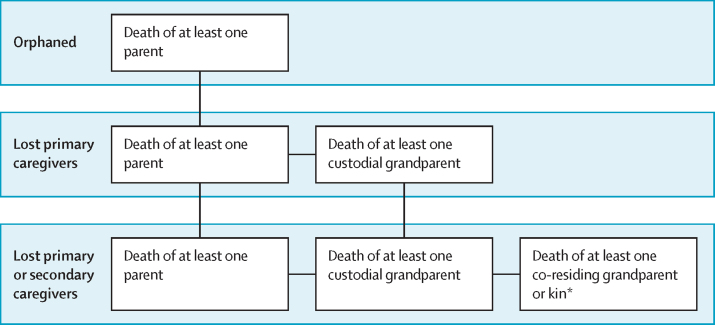
- Primary caregivers were parents and custodial grandparents; secondary caregivers were co-residing grandparents or older kin aged 60–84 years. The authors used excess deaths and COVID-19 deaths, adjusted for possible clustering of deaths using an estimated secondary attack rate and age-specific infection–fatality ratios.
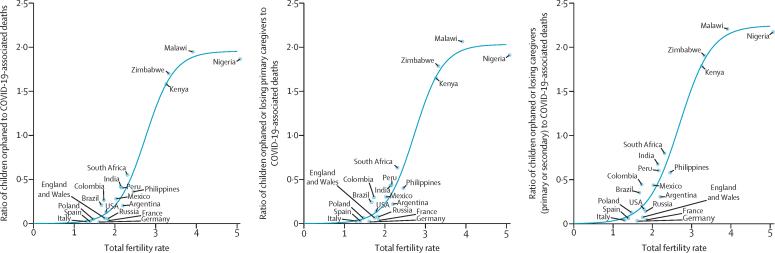
- Global extrapolation used a logistic model based on the correlation between total fertility rate and the ratio of orphans to deaths (Pearson r²=0·93), sampling TFRs 1000 times for uncertainty; analyses were done in R version 4.0.2.
Limitations
- The authors state that they underestimated total numbers of children affected because some countries’ estimates were based on COVID-19 mortality, which is under-reported due to variable testing and reporting.
- They state that age-and-sex-stratified COVID-19 death data were not available for every country, but a stable infection–fatality ratio makes substantial bias unlikely; fertility-rate variations were also unlikely to bias global extrapolations based on leave-one-out analyses.
- They state that lack of data on pre-existing single orphans limited double-orphan estimates to children whose parents both died during the pandemic; they also note limited global household composition data, truncation of grandparent deaths at age 85 years, and a maximum of two grandparents or older kin per child. Evident from the text: these are modelled minimum estimates, not direct counts, and global figures are extrapolated from 21 countries.
Model-written summary. Check it against the paper before relying on it.
Integrity signals
Registry
Cites
Statistics
Figures
Verification
Claims the paper makes
7 Valid · 1 Not valid · 31 Not checked · 48 Own results and interpretations
The cited sources support only part of this claim — read each source’s verdict below.
In the paper
“Evidence from previous epidemics shows that ineffective responses to the death of a parent or caregiver, even when there is a surviving parent or caregiver, can lead to deleterious psychosocial, neurocognitive, socioeconomic, and biomedical outcomes for children.31”
§ Global minimum estimates of children affected by COVID-19-associated orphanhood and deaths of caregivers: a modelling study > Discussion
What the sources say
- Partly supportedcites [31] Barenbaum E Smith T Social support as a protective factor for children impacted by HIV/AIDS across varying living environments in southern Africa AIDS Care 28 suppl 2 2016 92 99 PMC4991218 27392004 sourceExperimental — accuracy not yet measured
The Bereavement section (page unavailable) links parental death, disrupted caregiving, and inadequate support to children’s psychosocial difficulties, and mentions financial hardship even when a parent survives. The Attachment and caregiving section (page unavailable) also describes developmental consequences of inconsistent care. Our copy does not establish the claimed neurocognitive or biomedical outcomes, so the full range of outcomes attributed to this paper is not supported. (LLM, conf=0.86)
plainstates a cause- Asserted: passes — The authors put it forward as true.
- Checkable: passes — It can be checked against evidence.
- Load-bearing: passes — The paper’s conclusions depend on it.
- Based: passes — The paper gives a reason why it holds.
- Partly supported
A result the paper reports from its own data — it cites no other source for it, so there is none to check. The quote shows it is in the paper.
In the paper
“Of these, 788 704 children were orphaned of a mother, father, or both, with most losing one parent;”
§ Global minimum estimates of children affected by COVID-19-associated orphanhood and deaths of caregivers: a modelling study > Results
plainn = 862,365- Asserted: passes — The authors put it forward as true.
- Checkable: passes — It can be checked against evidence.
- Load-bearing: passes — The paper’s conclusions depend on it.
- Based: passes — The paper gives a reason why it holds.
A result the paper reports from its own data — it cites no other source for it, so there is none to check. The quote shows it is in the paper.
In the paper
“73 661 lost at least one custodial grandparent;”
§ Global minimum estimates of children affected by COVID-19-associated orphanhood and deaths of caregivers: a modelling study > Results
plainn = 73,661- Asserted: passes — The authors put it forward as true.
- Checkable: passes — It can be checked against evidence.
- Load-bearing: unclear — It is unclear whether the paper’s conclusions depend on it.
- Based: passes — The paper gives a reason why it holds.
A result the paper reports from its own data — it cites no other source for it, so there is none to check. The quote shows it is in the paper.
In the paper
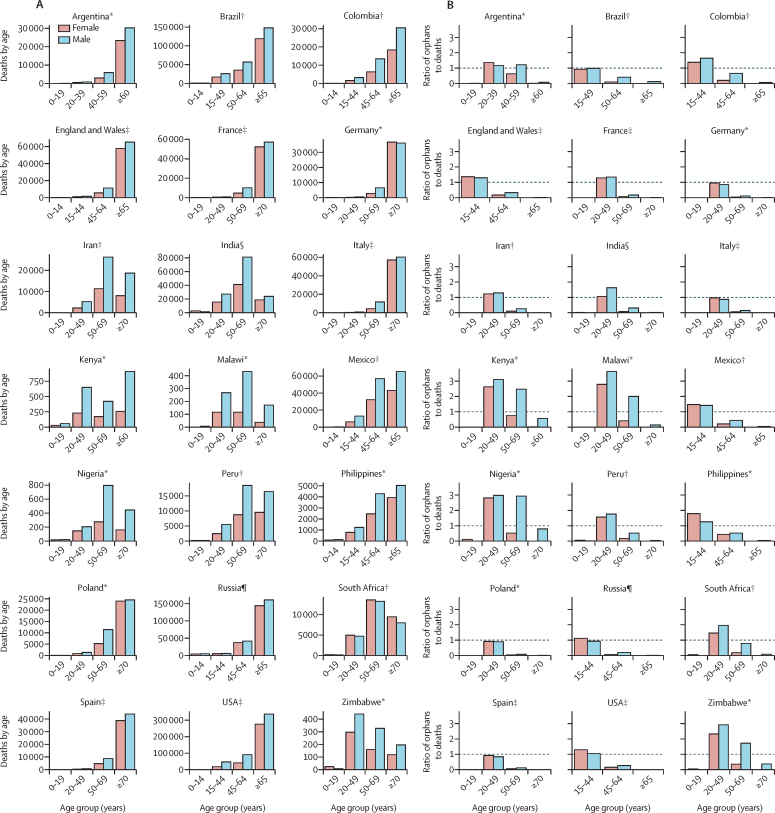
“In England and Wales, France, the USA, India, and Latin American and African countries, the number of children whose parents died before middle age (ie, between around 15 and 50 years of age) was greater than the number of COVID-19-associated adult deaths before middle age (figure 2B).”
§ Global minimum estimates of children affected by COVID-19-associated orphanhood and deaths of caregivers: a modelling study > Results
plain- Asserted: passes — The authors put it forward as true.
- Checkable: passes — It can be checked against evidence.
- Load-bearing: passes — The paper’s conclusions depend on it.
- Based: passes — The paper gives a reason why it holds.
A result the paper reports from its own data — it cites no other source for it, so there is none to check. The quote shows it is in the paper.
In the paper
“355 283 lost at least one co-residing grandparent or older kin (Table 1, Table 2).”
§ Global minimum estimates of children affected by COVID-19-associated orphanhood and deaths of caregivers: a modelling study > Results
plainn = 355,283- Asserted: passes — The authors put it forward as true.
- Checkable: passes — It can be checked against evidence.
- Load-bearing: passes — The paper’s conclusions depend on it.
- Based: passes — The paper gives a reason why it holds.
- Rests on an assumption not shown here.
31 more claims
Create a free account to see all 87 claims and to verify the 7 references still open.
- Probably not a substantial claim. 38
- It may state two separate claims as one. 26
- The quote only partly states this claim. 1
Claims other papers make about this one
Each is checked against this paper’s own text: does it say what the citing paper says it does?
The cited source says what the claim attributes to it.
In the citing paper
“High coronavirus disease 2019 (COVID-19) mortality rates may have severe unrecognized consequences: large-scale death of parents and caregivers for children.1,2”
From COVID-19–Associated Orphanhood and Caregiver Death in the United States (2021) · cites this paper as [2]
The cited source says what the claim attributes to it.
In the citing paper
“To date, little attention has focused on children who suffer COVID-19–associated death of parents and coresiding grandparents serving as caregivers and the attendant loss of salient nurturing, financial support, and care.1,2,5”
From COVID-19–Associated Orphanhood and Caregiver Death in the United States (2021) · cites this paper as [2]
Self-check
Percentages, sums and reported differences re-computed from the paper’s own numbers.
Each contradiction between two passages listed here was confirmed by an independent check.
Rated minor: it would not touch a result — a value no result rests on, a p-value that stays on the same side of the significance level, or a conflict that is clerical, resolved elsewhere in the paper, or outside its own findings.
In the paper
§ Global minimum estimates of children affected by COVID-19-associated orphanhood and deaths of caregivers: a modelling study > Abstract > Findings
“Between two and five times more children had deceased fathers than deceased mothers.”
§ Global minimum estimates of children affected by COVID-19-associated orphanhood and deaths of caregivers: a modelling study > Results
“the greater number of paternal versus maternal orphans, which ranged from 1·6-times to 5·9-times higher across the 21 countries (table 1).”
Citations
Cites
Assessing differential impacts of COVID-19 on black communities
Millett, G. A., Jones, A. T., Benkeser, D., Baral, S., Mercer, L., Beyrer, C., Honermann, B., Lankiewicz, E., Mena, L., Crowley, J. S., et al. (2020) · Annals of Epidemiology · doi:10.1016/j.annepidem.2020.05.003 · Cited by 1,217 · cited 1×
“40 Due to lack of data on country-specific prevalence of pre-existing single orphans from other causes, our estimates of double orphans are limited to deaths of both parents during the pandemic.”
Detecting hidden diversification shifts in models of trait-dependent speciation and extinction
Beaulieu, J. M., & O’Meara, B. C. (2016) · Systematic Biology · doi:10.1093/sysbio/syw022 · Cited by 579
A kinetic model of Phanerozoic taxonomic diversity I. Analysis of marine orders
Sepkoski, J. J. (1978) · Paleobiology · doi:10.1017/s0094837300005972 · Cited by 548
The Shifting Balance of Diversity Among Major Marine Animal Groups
Alroy, J. (2010) · Science · doi:10.1126/science.1189910 · Cited by 467
The million-year wait for macroevolutionary bursts
Uyeda, J. C., Hansen, T. F., Arnold, S. J., & Pienaar, J. (2011) · Proceedings of the National Academy of Sciences · doi:10.1073/pnas.1014503108 · Cited by 358
van IJzendoorn, M. H., Bakermans-Kranenburg, M. J., Duschinsky, R., Fox, N. A., Goldman, P. S., Gunnar, M. R., Johnson, D. E., Nelson, C. A., Reijman, S., Skinner, G. C. M., et al. (2020) · The Lancet Psychiatry · doi:10.1016/s2215-0366(19)30399-2 · Cited by 306
Self-citationHow do grandparents influence child health and development? A systematic review
Sadruddin, A. F. A., Ponguta, L. A., Zonderman, A. L., Wiley, K. S., Grimshaw, A., & Panter-Brick, C. (2019) · Social Science & Medicine · doi:10.1016/j.socscimed.2019.112476 · Cited by 228 · cited 4×
“16 Because the death of a parent or abrupt death of a close family member is the most frequently cited type of trauma exposure experienced by children, we considered the abrupt death of either co-residing grandparents or other co-residing extended family aged 60 years or older to represent a…”
InfluentialSocial Protection and Jobs Responses to COVID-19: A Real-Time Review of Country Measures
Gentilini, U., Almenfi, M. B. A., Iyengar, T., Okamura, Y., Downes, J. A., Dale, P., Weber, M., Newhouse, D. L., Rodriguez Alas, C. P., Kamran, M., et al. (2022) · World Bank, Washington, DC eBooks · doi:10.1596/37186 · Cited by 184
Goldman, P. S., Bakermans-Kranenburg, M. J., Bradford, B., Christopoulos, A., Ken, P. L. A., Cuthbert, C., Duchinsky, R., Fox, N. A., Grigoras, S., Gunnar, M. R., et al. (2020) · The Lancet Child & Adolescent Health · doi:10.1016/s2352-4642(20)30060-2 · Cited by 140 · cited 2×
“28 Negative socioeconomic impacts are strongly associated with adult deaths.”
Self-citationDolbin-MacNab, M. L., & Yancura, L. A. (2018) · The International Journal of Aging and Human Development · doi:10.1177/0091415016689565 · Cited by 99 · cited 1×
“29 Childcare by grandparents is associated with increased parental labour-force participation, school attendance, educational attainment, and communication skills.”
Orphanhood and human capital destruction: Is there persistence into adulthood?
Beegle, K., De Weerdt, J., & Dercon, S. (2010) · Demography · doi:10.1353/dem.0.0094 · Cited by 96 · cited 1×
“39 Evidence from the HIV/AIDS epidemic shows that cash transfers and social protection reduce poverty and its associated effects.”
Kidman, R., & Palermo, T. (2016) · Child Abuse & Neglect · doi:10.1016/j.chiabu.2015.10.018 · Cited by 83 · cited 2×
“8–10 These adverse experiences raise risks of suicide, adolescent pregnancy, infectious diseases including HIV/AIDS, and chronic diseases.”
Pynoos, R. S., Steinberg, A. M., Layne, C. M., Liang, L.-J., Vivrette, R. L., Briggs, E. C., Kisiel, C., Habib, M., Belin, T. R., & Fairbank, J. A. (2014) · Psychological Trauma Theory Research Practice and Policy · doi:10.1037/a0037767 · Cited by 76 · cited 2×
“25 From a public health perspective, the inclusion of these older adult family members is crucially important, as their prioritisation for vaccines renders their premature deaths highly preventable.”
Kentor, R. A., & Kaplow, J. B. (2020) · The Lancet Child & Adolescent Health · doi:10.1016/s2352-4642(20)30184-x · Cited by 72 · cited 1×
“30 These consequences can be compounded by mitigation-related isolation, school closures, and inability to participate in bereavement practices.”
Transmission dynamics of COVID-19 in household and community settings in the United Kingdom
Bernal, J. L., Panagiotopoulos, N., Byers, C., Garcia Vilaplana, T., Boddington, N., Zhang, X.-S., Charlett, A., Elgohari, S., Coughlan, L., Whillock, R., et al. (2020) · doi:10.1101/2020.08.19.20177188 · Cited by 65
Lopez Bernal, J., Panagiotopoulos, N., Byers, C., Garcia Vilaplana, T., Boddington, N., Zhang, X.-S., Charlett, A., Elgohari, S., Coughlan, L., Whillock, R., et al. (2022) · Eurosurveillance · doi:10.2807/1560-7917.es.2022.27.15.2001551 · Cited by 63
Os dependentes da renda dos idosos e o coronavírus: órfãos ou novos pobres?
Camarano, A. A. (2020) · Ciência & Saúde Coletiva · doi:10.1590/1413-812320202510.2.30042020 · Cited by 60 · cited 1×
“16 In Brazil, 70% of children receive such financial support, 17 yet Brazil ranks second globally for COVID-19 deaths, reducing options for kinship care.”
Debate: Recognising and responding to the mental health needs of young people in the era of COVID-19
Danese, A., & Smith, P. (2020) · Child and Adolescent Mental Health · doi:10.1111/camh.12414 · Cited by 50 · cited 1×
“32 By contrast, evidence-based responses can inspire hope by addressing these challenges in the context of COVID-19.”
Thomas, T., Tan, M., Ahmed, Y., & Grigorenko, E. L. (2020) · Annals of Behavioral Medicine · doi:10.1093/abm/kaaa022 · Cited by 39
Barenbaum, E., & Smith, T. (2016) · AIDS Care · doi:10.1080/09540121.2016.1176683 · Cited by 35 · cited 1×
“31 Psychosocial threats for children and adolescents bereft of parents or caregivers include increased risk of post-traumatic stress disorder, depression, and suicidal attempts.”
Methods to Estimate the Number of Orphans as a Result of AIDS and Other Causes in Sub-Saharan Africa
Grassly, N. C., & Timæus, I. M. (2005) · JAIDS Journal of Acquired Immune Deficiency Syndromes · doi:10.1097/01.qai.0000156393.80809.fd · Cited by 29 · cited 1×
“We used methods similar to Lotka and colleagues 22 and those used by the UNAIDS Reference Group for estimating AIDS orphans 5,23 to estimate COVID-19-associated orphanhood among children younger than 18 years (appendix pp 2–5).”
Phillips, S. P., & Carver, L. (2015) · PLOS ONE · doi:10.1371/journal.pone.0120762 · Cited by 20 · cited 1×
“11,12 Because of such findings, 10% of bilateral funding is invested to support orphans and vulnerable children within the multi-billion-dollar President’s Emergency Plan for AIDS Relief (PEPFAR).”
Albert, L. M., Edwards, J., Pence, B., Speizer, I. S., Hillis, S., Kahn, K., Gómez-Olivé, F. X., Wagner, R. G., Twine, R., & Pettifor, A. (2021) · AIDS and Behavior · doi:10.1007/s10461-020-03147-y · Cited by 8 · cited 1×
“8,26 Up to 23% of children in countries considered in this analysis are raised by single parents, whose death can have extreme consequences for children.”
Self-citationDepending on the income of older adults and the coronavirus: orphans or newly poor?
Camarano, A. A. (2021) · Figshare · doi:10.6084/m9.figshare.14284504 · Cited by 7
Taking Action to Prevent Violence Against Adolescents in the Time of COVID-19
Chiang, L. F., Howard, A. L., & Butchart, A. (2020) · Journal of Adolescent Health · doi:10.1016/j.jadohealth.2020.10.011 · Cited by 6 · cited 1×
“33 It is essential to support effective bereavement approaches, including psychosocial support .”
Self-citationJournals, I., Saboula, N. E.-S., Hussien, A. A., et al. (2015) · Figshare · doi:10.6084/m9.figshare.1453307.v1 · Cited by 5
Journals, I., Saboula, N. E.-S., Hussien, A. A., & El-Refaee, E. M. (2015) · Figshare · doi:10.6084/m9.figshare.1453307 · Cited by 5
Phillips, S. P., & Carver, L. (2015) · PLoS ONE · doi:10.1371/journal.pone.0128168
Research works printed but not linked: 1
- Lotka AJ Théorie analytique des associations biologiques. Deuxième Partie. Analyse démographique avec application particulière à l'espèce humaine Actualités Sci Industr 780 1939 1 149
Cited by
COVID-19–Associated Orphanhood and Caregiver Death in the United States
Hillis, S. D., Blenkinsop, A., Villaveces, A., Annor, F. B., Liburd, L., Massetti, G. M., Demissie, Z., Mercy, J. A., Nelson III, C. A., Cluver, L., et al. (2021) · Pediatrics · doi:10.1542/peds.2021-053760 · Cited by 235
“Nationally, COVID-19–associated deaths were distributed across racial and ethnic groups in proportions similar to racial and ethnic distributions of the population (Fig 3A).”
Self-citationGlobal and regional estimates of orphans attributed to maternal cancer mortality in 2020
Guida, F., Kidman, R., Ferlay, J., Schüz, J., Soerjomataram, I., Kithaka, B., Ginsburg, O., Mailhot Vega, R. B., Galukande, M., Parham, G., et al. (2022) · Nature Medicine · doi:10.1038/s41591-022-02109-2 · Cited by 186
Is the cure really worse than the disease? The health impacts of lockdowns during COVID-19
Meyerowitz‐Katz, G., Bhatt, S., Ratmann, O., Brauner, J., Flaxman, S. R., Mishra, S., Sharma, M., Mindermann, S., Bradley, V. C., Vollmer, M., et al. (2021) · BMJ Global Health · doi:10.1136/bmjgh-2021-006653 · Cited by 118
Self-citationFink, E. L., Robertson, C., Wainwright, M. S., Roa, J. D., Lovett, M. E., Stulce, C., Yacoub, M., Potera, R. M., Zivick, E. E., Holloway, A., et al. (2021) · Pediatric Neurology · doi:10.1016/j.pediatrneurol.2021.12.010 · Cited by 115
Mental health and wellbeing of children and adolescents during the covid-19 pandemic
Rider, E. A., Ansari, E., Varrin, P., & Sparrow, J. (2021) · BMJ · doi:10.1136/bmj.n1730 · Cited by 136
Metadata
- Authors
- Hillis, S. D., Unwin, H. J. T., Chen, Y., Cluver, L., Sherr, L., Goldman, P. S., Ratmann, O., Donnelly, C. A., Bhatt, S., Villaveces, A., Butchart, A., Bachman, G., Rawlings, L., Green, P., Nelson, C. A., & Flaxman, S.
- Affiliations
- Centers for Disease Control and Prevention (US)
- Imperial College London (GB)
- University of Cape Town (ZA)
- University College London (GB)
- University of Oxford (GB)
- University of Copenhagen (DK)
- World Health Organization (CH)
- United States Agency for International Development (US)
- World Bank Group (US)
- Boston Children's Hospital (US)
- Corresponding author
- Hillis, Susan D
- ORCID
- Venue
- The Lancet
- Publisher
- Elsevier BV
- Published
- 2021-07
- Volume
- 398
- Issue
- 10298
- Pages
- 391-402
- ISSN
- 0099-5355 (ISSN-L)
- 0140-6736
- PMC
- PMC8293949
- OpenAlex
- W3186829581
- Cited by
- 317
- References
- 25
- Citations by year
- 2026: 23 · 2025: 29 · 2024: 38 · 2023: 75 · 2022: 110 · 2021: 40
- FWCI
- 90.50
- Type
- journal article
- Language
- en
- Open access
- hybrid
- doi.org
- Licence
- cc-by-nc-nd
- www.elsevier.com/tdm/userlicense/1.0/ (tdm)
- www.elsevier.com/legal/tdmrep-license (tdm)
- creativecommons.org/licenses/by-nc-nd/3.0/igo/ (vor)
- Locations
- The Lancet (publishedVersion, cc-by-nc-nd)
- PubMed Central (publishedVersion, cc-by-nc-nd)
- PubMed (publishedVersion)
- Edinburgh Research Explorer (University of Edinburgh) (publishedVersion, other-oa)
- Explore Bristol Research (publishedVersion, cc-by-nc-nd)
- Oxford University Research Archive (ORA) (University of Oxford) (submittedVersion, cc-by-nc-nd)
- UCL Discovery (University College London) (submittedVersion)
- Bristol Research (University of Bristol) (submittedVersion, cc-by-nc-nd)
- Spiral (Imperial College London) (submittedVersion, other-oa)
- Funders
- Government of South Australia
- World Health Organization
- National Institutes of Health
- National Institute for Health Research (HPRU200907)
- Engineering and Physical Sciences Research Council (EP/V002910/1)
- UK Research and Innovation
- Medical Research Council
- Imperial College London
- Inyuvesi Yakwazulu-Natali
- United States Agency for International Development
- Centers for Disease Control and Prevention
- Topics
- Social Sciences › Development › Poverty, Education, and Child Welfare
- Physical Sciences › Mathematics › Modeling and Simulation › COVID-19 epidemiological studies
- Social Sciences › Psychology › Clinical Psychology › Grief, Bereavement, and Mental Health
- Keywords
- COVID-19 pandemic, child mortality, SARS-CoV-2, primary caregivers, secondary caregivers, grandparent caregivers, global estimates, secondary attack rate, infection fatality rate, vaccine equity, psychosocial support, resource allocation, Latin America, South Africa, Peru, Brazil, Mexico, Colombia, Iran, United States
- MeSH terms
- COVID-19, Adolescent, Adult, Aged, Child, Female, Humans, Male, Middle Aged, Global Health, Models, Statistical, Caregivers, Child, Orphaned, Young Adult
About these checks
Registry, retraction, Cites and statistics results are computed, not judged, with one exception: a printed reference that no index lists is read once by a model before it counts as a citation error. Claims are extracted by a model and kept only when their quote appears verbatim in the text; each cited source is then checked, with a model’s help, for whether it says what the claim relies on. Those verdicts can be wrong — read the claim’s quote and the cited source before relying on one.
The claim verdicts this report counts are experimental: their accuracy is not yet measured.
A language model drew the claims from the paper on 2026-10-10, under version 3 of the claim definition (model deepseek-v4.1-flash, prompt extract-v3).
A second model labelled each claim on 2026-10-10 (model jev-1.13-20260917, definition revision gold-guideline-v0.2).
Cited sources are checked with a language model’s help (gpt-6-sol).
Statistics and arithmetic are recomputed, not judged.
Confidence bands are shown only for fields calibrated on our annotated test set. None is calibrated yet, so no band is shown.
What counts as a claim ›How we measure confidence ›How we check this ›
Are you an author, or do you see a problem with this page? Request a review
Data sources
Bibliographic data: Semantic Scholar, OpenAlex, Crossref.
Contains information from the Semantic Scholar Academic Graph Datasets, made available under the ODC Attribution License (ODC-BY 1.0).
Semantic Scholar’s data is described in: Kinney, R., et al. (2023). The Semantic Scholar Open Data Platform. arXiv:2301.10140.
