

Estimating global and regional disruptions to routine childhood vaccine coverage during the COVID-19 pandemic in 2020: a modelling study
Open accessThe DOI matches its Crossref record; 36 of the 39 references it cites were found in a registry or an index.
Abstract
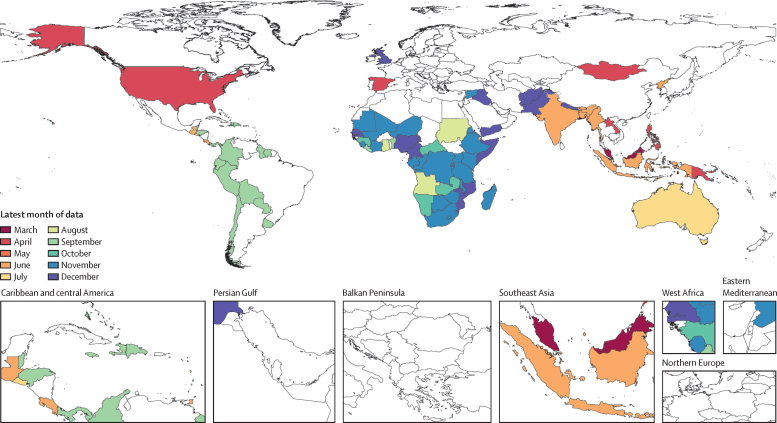
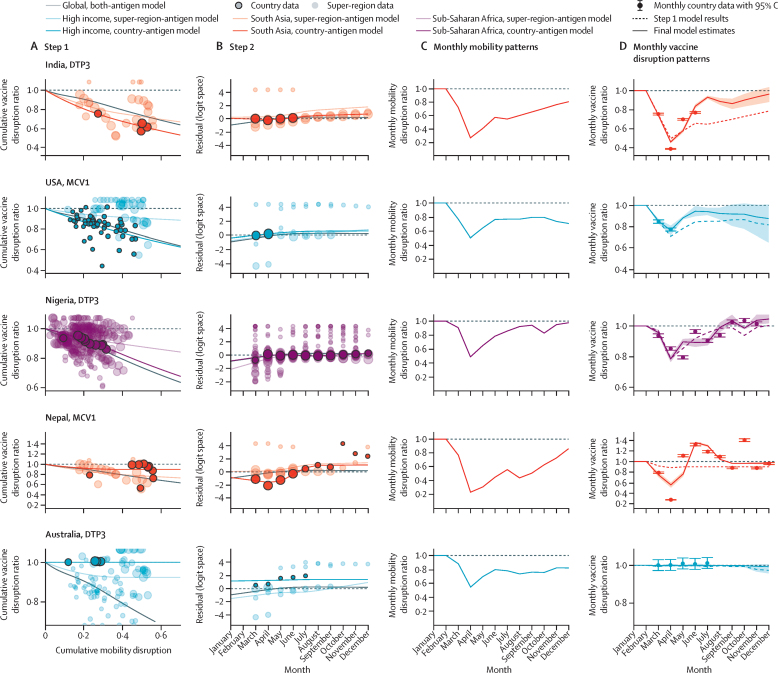
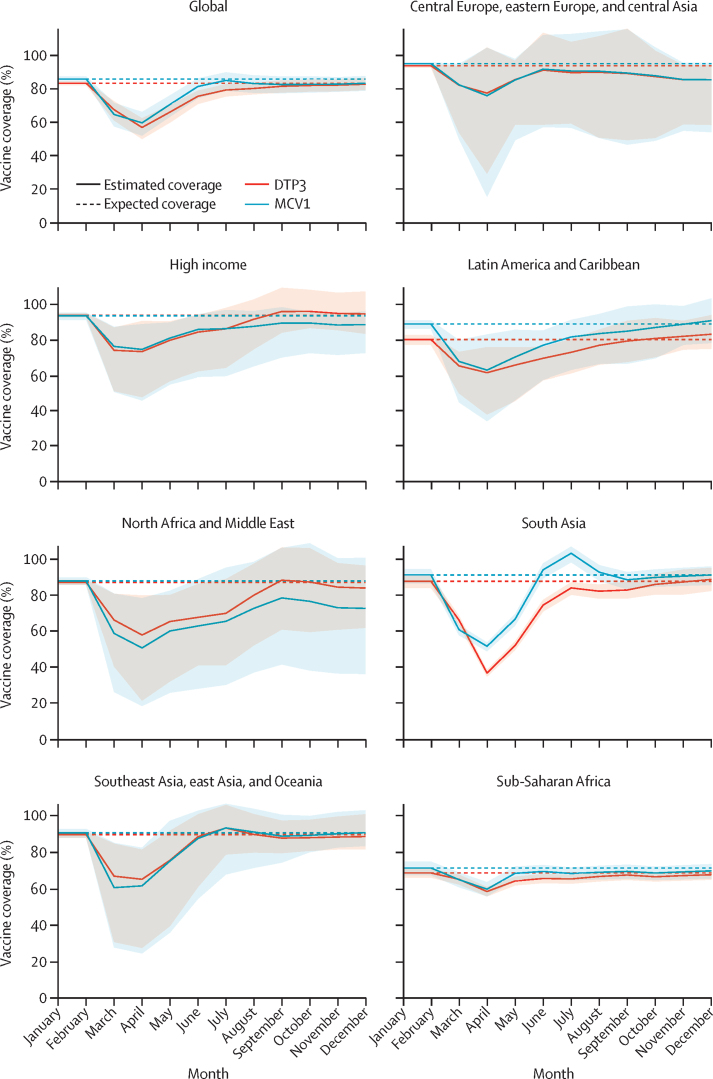
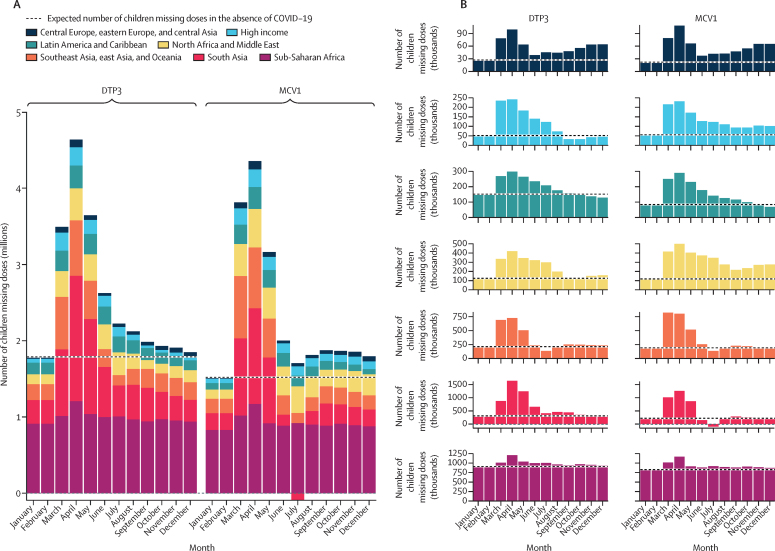
BACKGROUND: The COVID-19 pandemic and efforts to reduce SARS-CoV-2 transmission substantially affected health services worldwide. To better understand the impact of the pandemic on childhood routine immunisation, we estimated disruptions in vaccine coverage associated with the pandemic in 2020, globally and by Global Burden of Disease (GBD) super-region. METHODS: For this analysis we used a two-step hierarchical random spline modelling approach to estimate global and regional disruptions to routine immunisation using administrative data and reports from electronic immunisation systems, with mobility data as a model input. Paired with estimates of vaccine coverage expected in the absence of COVID-19, which were derived from vaccine coverage models from GBD 2020, Release 1 (GBD 2020 R1), we estimated the number of children who missed routinely delivered doses of the third-dose diphtheria-tetanus-pertussis (DTP3) vaccine and first-dose measles-containing vaccine (MCV1) in 2020. FINDINGS: Globally, in 2020, estimated vaccine coverage was 76·7% (95% uncertainty interval 74·3-78·6) for DTP3 and 78·9% (74·8-81·9) for MCV1, representing relative reductions of 7·7% (6·0-10·1) for DTP3 and 7·9% (5·2-11·7) for MCV1, compared to expected doses delivered in the absence of the COVID-19 pandemic. From January to December, 2020, we estimated that 30·0 million (27·6-33·1) children missed doses of DTP3 and 27·2 million (23·4-32·5) children missed MCV1 doses. Compared to expected gaps in coverage for eligible children in 2020, these estimates represented an additional 8·5 million (6·5-11·6) children not routinely vaccinated with DTP3 and an additional 8·9 million (5·7-13·7) children not routinely vaccinated with MCV1 attributable to the COVID-19 pandemic. Globally, monthly disruptions were highest in April, 2020, across all GBD super-regions, with 4·6 million (4·0-5·4) children missing doses of DTP3 and 4·4 million (3·7-5·2) children missing doses of MCV1. Every GBD super-region saw reductions in vaccine coverage in March and April, with the most severe annual impacts in north Africa and the Middle East, south Asia, and Latin America and the Caribbean. We estimated the lowest annual reductions in vaccine delivery in sub-Saharan Africa, where disruptions remained minimal throughout the year. For some super-regions, including southeast Asia, east Asia, and Oceania for both DTP3 and MCV1, the high-income super-region for DTP3, and south Asia for MCV1, estimates suggest that monthly doses were delivered at or above expected levels during the second half of 2020. INTERPRETATION: Routine immunisation services faced stark challenges in 2020, with the COVID-19 pandemic causing the most widespread and largest global disruption in recent history. Although the latest coverage trajectories point towards recovery in some regions, a combination of lagging catch-up immunisation services, continued SARS-CoV-2 transmission, and persistent gaps in vaccine coverage before the pandemic still left millions of children under-vaccinated or unvaccinated against preventable diseases at the end of 2020, and these gaps are likely to extend throughout 2021. Strengthening routine immunisation data systems and efforts to target resources and outreach will be essential to minimise the risk of vaccine-preventable disease outbreaks, reach children who missed routine vaccine doses during the pandemic, and accelerate progress towards higher and more equitable vaccination coverage over the next decade. FUNDING: Bill & Melinda Gates Foundation.
Overview
The claims and statistics of this paper haven’t been checked yet.
Free: it reads the open-access text and checks the first 5 claims that cite a source we can check. Create a free account to check every claim.
Integrity signals
Registry
Cites
Statistics
Figures
Verification
Claims the paper makes
The claims and statistics of this paper haven’t been checked yet.
Free: it reads the open-access text and checks the first 5 claims that cite a source we can check. Create a free account to check every claim.
Claims other papers make about this one
Each is checked against this paper’s own text: does it say what the citing paper says it does?
In the citing paper
“In a previous analysis using partial-year data from the first months of the pandemic, Causey and colleagues estimated 2020 global DTP3 coverage at approximately 76.7%, which is 7.7 pp lower than was expected in the absence of the pandemic.18”
In the citing paper
“The COVID-19 pandemic has disrupted routine health services globally, resulting in decreased vaccination rates affecting millions of children [8]”
Self-check
Percentages, sums and reported differences re-computed from the paper’s own numbers.
The self-check needs the paper’s full text.
Citations
Cites
Wang, H., Abbas, K. M., Abbasifard, M., Abbasi-Kangevari, M., Abbastabar, H., Abd-Allah, F., Abdelalim, A., Abolhassani, H., Abreu, L. G., Abrigo, M. R. M., et al. (2020) · The Lancet · doi:10.1016/s0140-6736(20)30977-6 · Cited by 1,971 · cited 2×
“…C , and the estimated monthly number of eligible children calculated from GBD 2020 R1 annual target population estimates (updated from GBD 2019 36 as part of the GBD continuous update cycle), pop m : 1000 draws of N were calculated from draws of MDR and C to incorporate uncertainty in both…”
Self-citationGuidelines for accurate and transparent health estimates reporting: the GATHER statement
Stevens, G. A., Alkema, L., Black, R. E., Boerma, J. T., Collins, G. S., Ezzati, M., Grove, J. T., Hogan, D. R., Hogan, M. C., Horton, R., et al. (2016) · The Lancet · doi:10.1016/s0140-6736(16)30388-9 · Cited by 1,798 · cited 1×
“This analysis complies with the Guidelines for Accurate and Transparent Health Estimates Reporting (GATHER) statement, 17 with further information provided in the appendix (section 1); all source codes used to generate estimates and corres ponding data will be made accessible upon publication, on…”
Fullman, N., Yearwood, J., Abay, S. M., Abbafati, C., Abd-Allah, F., Abdela, J., Abdelalim, A., Abebe, Z., Abebo, T. A., Aboyans, V., et al. (2018) · The Lancet · doi:10.1016/s0140-6736(18)30994-2 · Cited by 1,013 · cited 1×
“Other covariates were considered in addition to our mobility measure (eg, total COVID-19 deaths and cases to date, indices of development, 36 and health-system performance 37 ), but they provided no meaningful associations with disruptions to vaccine coverage.”
Self-citationMobile phone data for informing public health actions across the COVID-19 pandemic life cycle
Oliver, N., Lepri, B., Sterly, H., Lambiotte, R., Deletaille, S., De Nadai, M., Letouzé, E., Salah, A. A., Benjamins, R., Cattuto, C., et al. (2020) · Science Advances · doi:10.1126/sciadv.abc0764 · Cited by 631 · cited 1×
“30 Full methodological details about generating mobility estimates have been published elsewhere, 31 but in brief, we synthesised daily human movement data obtained from mobile phones from Descartes Labs, 32 Facebook, 33 Google, 34 and SafeGraph 35 in 134 countries and territories into cohesive…”
Modeling COVID-19 scenarios for the United States
IHME COVID-19 Forecasting Team, Reiner, R. C., Barber, R. M., Collins, J. K., Zheng, P., Adolph, C., Albright, J., Antony, C. M., Aravkin, A. Y., Bachmeier, S. D., et al. (2021) · Nature Medicine · doi:10.1038/s41591-020-1132-9 · Cited by 556
Self-citationStatistical Meta‐Analysis with Applications
Hartung, J., Knapp, G., & Sinha, B. K. (2008) · Wiley Series in Probability and Statistics · doi:10.1002/9780470386347 · Cited by 418 · cited 1×
“27 We used qualitative data collected by WHO and partners, including two sets of Pulse poll results, 4,28 essential health services polls, 7 and additional data from WHO regional offices, to evaluate estimated CDRs.”
Abbas, K., Procter, S. R., van Zandvoort, K., Clark, A., Funk, S., Mengistu, T., Hogan, D., Dansereau, E., Jit, M., Flasche, S., et al. (2020) · The Lancet Global Health · doi:10.1016/s2214-109x(20)30308-9 · Cited by 362 · cited 1×
“As evidenced by past epidemics and modelling exercises, 45,46 substantive gaps in vaccine coverage increase the risk of vaccine-preventable disease outbreaks once COVID-19 prevention measures subside and individuals resume pre-pandemic social contact patterns.”
McDonald, H. I., Tessier, E., White, J. M., Woodruff, M., Knowles, C., Bates, C., Parry, J., Walker, J. L., Scott, J. A., Smeeth, L., et al. (2020) · Eurosurveillance · doi:10.2807/1560-7917.es.2020.25.19.2000848 · Cited by 337
Statistical meta-analysis with applications
(2009) · Choice Reviews Online · doi:10.5860/choice.46-4497 · Cited by 311
Turner, N. (2009) · PubMed · Cited by 306
Research works printed but not linked: 1
- The DHS Program COVID-19 update: some DHS surveys return to the field; others postponed until 2021. Press release https://www.dhsprogram.com/Who-We-Are/News-Room/COVID-19-Update-Some-DHS-surveys-return-to-the-field-others-postponed-until-2021.cfm Sept 2, 2020
Cited by
Items 401–470 of 470
Vahabi, M. M., Ketentzi, S., Kahraman, Ü., Erdem, H. A., Pullukçu, H., & Tasbakan, M. I. (2025) · Vaccine · doi:10.1016/j.vaccine.2025.128023
Lorenzo, J. C., Islam, M. I., Ante-Orozco, C., & Mathieu, E. (2025) · medRxiv · doi:10.64898/2025.12.01.25341428
Gómez-Pérez, G. P., de Graaff, A. E., Dekker, J. T., Agyei, B. B., Dada, I., Milimo, E., Ommeh, M. S., Risha, P., de Wit, T. F. R., & Spieker, N. (2024) · Figshare · doi:10.6084/m9.figshare.25302879
Nie, Y., Zhang, Y., Yang, Z., Wang, N., Wang, S., Liu, Y., Jiang, H., & Wu, L. (2024) · Figshare · doi:10.6084/m9.figshare.26727793
Fu, H. J., Abbas, K., Klepac, P., van Zandvoort, K., Tanvir, H., Portnoy, A., & Jit, M. (2021) · Figshare · doi:10.6084/m9.figshare.17030630
Nie, Y., Zhang, Y., Yang, Z., Wang, N., Wang, S., Liu, Y., Jiang, H., & Wu, L. (2024) · Figshare · doi:10.6084/m9.figshare.26727790
Nie, Y., Zhang, Y., Yang, Z., Wang, N., Wang, S., Liu, Y., Jiang, H., & Wu, L. (2024) · Figshare · doi:10.6084/m9.figshare.26727796
Gilder, M. E., Pateekhum, C., Hashmi, A., Aramrat, C., Aung, K. K., Miket, W., Chu, C. S., Win, D., Bierhoff, M., Wiwattanacharoen, W., et al. (2023) · Figshare · doi:10.6084/m9.figshare.22616914
Nie, Y., Zhang, Y., Yang, Z., Wang, N., Wang, S., Liu, Y., Jiang, H., & Wu, L. (2024) · Figshare · doi:10.6084/m9.figshare.26727787
Cooper, S., Bicaba, F., Tiendrebeogo, C. O., Bila, A., Bicaba, A., & Druetz, T. (2023) · Figshare · doi:10.6084/m9.figshare.24180782
Gómez-Pérez, G. P., de Graaff, A. E., Dekker, J. T., Agyei, B. B., Dada, I., Milimo, E., Ommeh, M. S., Risha, P., de Wit, T. F. R., & Spieker, N. (2024) · Figshare · doi:10.6084/m9.figshare.25303198
Nie, Y., Zhang, Y., Yang, Z., Wang, N., Wang, S., Liu, Y., Jiang, H., & Wu, L. (2024) · Figshare · doi:10.6084/m9.figshare.26727799
Fu, H. J., Abbas, K., Klepac, P., van Zandvoort, K., Tanvir, H., Portnoy, A., & Jit, M. (2021) · Figshare · doi:10.6084/m9.figshare.17030633
Routine Childhood Immunizations in Iceland in an Emerging COVID-19 pandemic
Skarphéðinsdóttir, Þ. (2024) · Skemman
Tangney, S. (2023) · eScholarship (California Digital Library)
Li, L. (2024) · UCL Discovery (University College London)
Anzà, D., Restivo, V., Cirillo, F., Sasso, B. L., Martínez‐Jarreta, B., Senia, P., & Vitale, E. (2025) · IJID Regions · doi:10.1016/j.ijregi.2025.100833
“The COVID-19 pandemic has disrupted immunization programs, ex-acerbating immunity gaps and delaying routine vaccinations, which, together with the easing of containment measures, has contributed to a global resurgence of measles [ 6 , 11 , 12 ].”
Vaccine delay in routine childhood vaccines in the post-COVID-19 era in Jiangning, Nanjing, China
Guo, D., Dai, J., & Zhang, T. (2026) · Preventive Medicine Reports · doi:10.1016/j.pmedr.2025.103368
“Specifically, there was a relative decrease of 7.7% in the vaccine coverage of DTP3 and a relative decrease of 7.9% in the vaccine coverage of MCV1 (Causey et al., 2021).”
InfluentialDisruption and recovery of notifiable infectious diseases after COVID-19 in Australia, 2015–2025Preprint
Farquhar, H. L. (2026) · medRxiv · doi:10.64898/2026.02.13.26346301
AlSaihati, A., Chaudhary, M., & Olarte, L. (2026) · Journal of the Pediatric Infectious Diseases Society · doi:10.1093/jpids/piag018
Vacunación, política sanitaria y el desafío de recuperar coberturas en Argentina
Yedlin, P. (2026) · Revista del Hospital Italiano de Buenos Aires · doi:10.51987/rev.hosp.ital.b.aires.v46i1.1323
Awaluddin, S. M., Wahab, N. A., Shamsuddin, N., Rosslan, N. H., Adnan, M. A. A., Chong, C. T., Zain, S. H., & Ahmad, N. A. (2026) · Asia Pacific Journal of Public Health · doi:10.1177/10105395261433222
“10 Tribal affiliation also highlights significant disparities, with children from the Negrito tribe having three times the odds of incomplete vaccination compared with those from the Senoi tribe.”
Impact of the COVID-19 pandemic on primary health care reform in Pakistan
Hannay, E., Zia, N., Kennedy, C., Ghaffar, A. A., & Peters, D. H. (2026) · Eastern Mediterranean Health Journal · doi:10.26719/2026.32.4.212
Coronel, G. F. C., & Ledesma, K. G. V. (2026) · La Universidad · doi:10.66778/lu.e02v07n02.04
Vaccine Response Assessment in Children Using Dried Blood Spots: The DRIVE Study
Rodríguez-Molino, P., Rodríguez-Galet, A., Falces‐Romero, I., Alcolea, S., Méndez-Echevarría, A. M., del Rosal, T., Cámara, C., Grasa, C. D., Calvo, C., Balaguer, M. M., et al. (2026) · The Journal of Infectious Diseases · doi:10.1093/infdis/jiag274
Stojisavljević, S., Palo, M., & Dizdar, F. (2026) · Vaccines · doi:10.3390/vaccines14060483
Setiawati, A., Huang, D., Rajagukguk, V. C. A., & Tirtasari, S. (2026) · Community Medicine and Education Journal · doi:10.37275/cmej.v7i2.900
Song, Q., Wang, M., Shen, Z., Jing, Z., Fan, Y., Zhang, X., Huang, L., Li, W., Shi, Y., & Yang, D. (2026) · Immunity Inflammation and Disease · doi:10.1002/iid3.70473
“The higher burden among males may reflect multifactorial interactions involving immune regulation, hormonal influences, genetic susceptibility, and differences in environmental exposure [37].”
Nwadiuto, I., & Briggs, N. C. T. (2026) · World Journal of Advanced Research and Reviews · doi:10.30574/wjarr.2026.30.3.1703
VACINAÇÃO E SAÚDE COLETIVA: A IMPORTÂNCIA DA ATUAÇÃO MULTIDISCIPLINAR NA PREVENÇÃO DE DOENÇAS
Borba, F. D. L., FRAGOSO, A. F. D. S., de Andrade, T. P., da Silva, D. M., Rodrigues, G. M., Martins, F. R., Martins, V. M., Lobo, C. H., Almeida, C. C., de Moraes, I. G., et al. (2026) · Revista Tópicos. · doi:10.70773/revistatopicos/781836536
Hidayattullah, M., Putri, R. R. N. A. A. P. A., Amanda, M. F., Maysura, F., & Kurniati, K. (2026) · Jurnal Ners · doi:10.31004/jn.v10i3.58045
Effect of COVID-19 Pandemic on Immunisation Programmes in Ibadan Metropolis, Southwest Nigeria
Ogunbosi, B. O., Alao, M. A., Alejoh, J. N., Adebayo, B. E., & Lagunju, I. A. (2026) · Nigerian Journal of Paediatrics · doi:10.63270/njp.v53i2.2000063
Stavniichuk, S. S. (2026) · DSpace BSMU
Amberbir, A., Sayinzoga, F., Uwimana, A., VanderZanden, A., Ntawukuriryayo, J. T., Tambo, E., Krishna, A. K. I., Hirschhorn, L. R., & Binagwaho, A. (2026) · Advances in Global Health · doi:10.1525/agh.2026.2124975
Jabbar, F., Kadhim, K. A., Alhilfi, R. A., Lami, F., Chitheer, A., Rawaf, S., Tabche, C., Kuroiwa, M., Davies, H., & Rahi, A. (2026) · Journal of Public Health Research · doi:10.1177/22799036261470482
“34 These financial and human-resource considerations underscore the need to adopt context-appropriate and cost-effective RR strategies that balance potential coverage gains with system capacity and long-term sustainability.”
Ho, N. H., Hoang, T., Le, C. M., & Nguyen, T. T. H. (2026) · PLOS Global Public Health · doi:10.1371/journal.pgph.0006886
“However, the issue gained much greater attention and urgency during the COVID-19 pandemic, which caused widespread disruptions including prolonged lockdowns, increased misinformation, and significant interruptions to routine immunization services worldwide [13].”
Impacts of the One Big Beautiful Bill Act on African Public Health Systems
Edward, M. M., Musa, J., Stephen, M., Bundu, S. S., Alex, C. N., Owoicho, A. W., & Mbwana, N. (2026) · Public Health Challenges · doi:10.1002/puh2.70309
“Historical evidence shows that declines in immunization coverage are often followed by disease resurgence, disproportionately affecting rural and marginalized populations [ 18 ].”
AlWaraqy, S., Gharaibeh, M. K., & Allari, R. S. (2026) · Al-Rafidain Journal of Medical Sciences · doi:10.54133/ajms.v11i1.3013
Age-appropriate Completion and Coverage of Key Childhood Vaccines in Greater Accra, Ghana, 2014–2023Preprint
Addotei, D., Boateng, G., Noora, C. L., Dankoli, R. S., Laryea, J. N. L., Alhassan, I. K., Apuri, E., & Kenu, E. (2026) · Research Square · doi:10.21203/rs.3.rs-10020107/v1
Global Immunization: Progress, Challenges, and Future Directions in Vaccine Access and Equity
Safi, N., & Ehiri, J. E. (2026) · Springer eBooks · doi:10.1007/978-1-0716-5436-1_3
Akingbola, A., Adegbesan, A., Benson, E., Ozioko, M., Abdullah, K.-U.-R., Boakye, M., Adewole, O. A., & Mariaria, P. K. (2026) · Human Vaccines & Immunotherapeutics · doi:10.1080/21645515.2026.2709267
“12,13 Global averages provide a good comparison; however, there is significant spatial heterogeneity and temporal variation in vaccination coverage across and within countries.”
MEASUREMENT INVARIANCE OF TRANSTHEORETICAL MODEL-BASED MEASURES FOR COVID-19 VACCINATION READINESS
Opiela, A. (2026) · Digital Commons - URI (University of Rhode Island) · doi:10.23860/diss-4537
Alves, N. V. (2026) · Revista Multidisciplinar Epistemología de las Ciencias · doi:10.71112/9qzep621
Acomo, G., Okema, J. N., Obal, R., Foscah, F. A., Lourdes, I. M., Sesay, M. J., Bangura, F., Bulitya, J., & Elioba, J. L. R. (2026) · BMC Public Health · doi:10.1186/s12889-026-29002-8
Woromogo, S. H., Diallo, H., Mouhembe, M. W. N., M'boutiki, G., Bwaka, A. M., & Dadjo, C. H. (2026) · Pan African Medical Journal · doi:10.11604/pamj.2026.53.163.49196
“…(restrictions on movement, confinement, etc.), has destabilized countries' health systems, leading to a worrying decline in the vaccination coverage of the Expanded Programme on Immunization (EPI) [1-4] and an explosion in the number of unvaccinated and under-vaccinated children worldwide.”
Yuliarsih, L., Maesaroh, M., Iksan, R. R., & Susanti, Y. (2026) · Jurnal Persatuan Perawat Nasional Indonesia (JPPNI) · doi:10.32419/jppni.v11i2.856
“This interpretation is consistent with evidence showing that inadequate vaccine coverage remains a major public health challenge in low-and middle-income countries (Causey et al., 2021).”
Irikefe, O. B., Anthony, B. O., Uleyo, P. S., & Oniore, J. O. (2026) · F1000Research · doi:10.12688/f1000research.188906.1
Maternal Education and Behavioral Factors as Determinants of Immunization Completeness
Fataruba, R., Asri, Y., & Maharani, A. S. (2026) · Buletin Ilmu Kebidanan dan Keperawatan · doi:10.56741/bikk.v5i02.2129
“Such coverage gaps compromise herd immunity, increase the likelihood of outbreaks of vaccine-preventable diseases, and hinder progress toward achieving the Sustainable Development Goals (SDGs) related to child survival and well-being [6], [7], [8].”
Oladejo, A. J., Adewuyi, A. O., & Mundi, R. (2026) · AFRICAN JOURNAL OF GEOGRAPHICAL SCIENCES · doi:10.5281/zenodo.22157805
Hidayatullah, M., Nurmakiah, N., Putri, R., & Zahara, H. (2026) · Public Health Journal · doi:10.62710/wz317879
Nosa-Ihaza, E. A., Ogidi, M. C., Odeke, S., & Nosa-Ihaza, U. N. (2026) · medRxiv · doi:10.64898/2026.09.05.26362351
Progress and Barriers Define the Journey to Measles Elimination in Africa
Mwanyika, G., & Rugumisa, B. T. (2026) · MUST Journal of Research and Development. · doi:10.62277/mjrd2026v7i30010
Voeten, H. A. C. M., Colizzi, C., & Trompenaars, M. E. (2026) · Vaccine X · doi:10.1016/j.jvacx.2026.100905
Zhou, D., Zhang, J., Ma, K., Sun, T., Deng, F., Wu, S., Hu, H., Duan, H., Zhang, T., Yu, A., et al. (2026) · One Health · doi:10.1016/j.onehlt.2026.101590
“In addition, disruptions to routine immunization during the COVID-19 pandemic further highlighted the vulnerability of vaccination systems and the need for resilient immunization services [22,23].”
Cammarota, D., Coutinho, R. M., & Kraenkel, R. A. (2026) · Transactions of the Royal Society of Tropical Medicine and Hygiene · doi:10.1093/trstmh/trag116
Qyli, Z. (2026) · Romanian Journal of Pediatrics · doi:10.37897/rjp.2026.3.8
Adityarie, L. G., Rahayu, D. E., Kundarti, F. I., & Indriani, R. (2026) · Indonesian Journal of Nutritional Epidemiology and Reproductive · doi:10.30994/ijner.v9i3.388
“…including those that occurred during the COVID-19 pandemic, have also been reported to have reduced global routine child immunization coverage (Causey et al., 2021), confirming that factors beyond parental characteristics also affect immunization timeliness, so that support from the service…”
Sarhan, Y. T. (2026) · Journal of Education and Health Promotion · doi:10.4103/jehp.jehp_60_26
“[8] Parental forgetfulness may have an important role in a child not being fully immunized with the recommended vaccines.”
Improving Vaccine Accessibility After The Covid Pandemic
Vaanmathi, D. A. S., Krishnamoorthy, V., N, D. S. K. M., Dr. Balakrishnan, T., & Dr. Hamritha, A. (2024) · Educational Administration Theory and Practice journal
“The opportunity to catch up”: from emergency response to immunization sustainability in Cameroon
Fotso, J. C., Tchetchia, A., Ngong, F., Ngako, V., & Olaïtan, E. A. (2026) · Health Policy and Planning · doi:10.1093/heapol/czag116 · Cited by 1
Asri, H. I. S., Husada, D., & Djuari, L. (2024) · Community Development Journal Jurnal Pengabdian Masyarakat
Yolusever, A. (2026) · Frontiers in Public Health · doi:10.3389/fpubh.2026.1965676
“This is a sharper statement than the familiar observation that coverage dipped during the pandemic (23, 24): the estimates imply that the dip is not a transitory deviation from an unchanged attractor but a displacement of the attractor itself.”
Zhang, L., Li, Y., Dong, E., Zhang, M., Tian, Y., Zhou, S., Ni, R., An, Y., Qin, X., Gao, B., et al. (2026) · Med Research · doi:10.1002/mdr2.70095
Shea, B., & Shaman, J. (2026) · Vaccine · doi:10.1016/j.vaccine.2026.129277
Ezenwa-Ahanene, S. A., Madaki, P. D., Sabo, R. M., Oweh, O. T., Tauna, K. H., Dalhatu, Z. Z., Abiola, M. S., Nwadiuto, I., Gadanya, M., & Imam, A. Y. (2026) · PLoS ONE · doi:10.1371/journal.pone.0359837
“The stark finding that 68.9% of cases occurred in individuals with no history of vaccination points directly to a large and enduring pool of zero-dose children, which is the primary driver of measles outbreaks globally [13,25].”
InfluentialDamian, M., Freeman, M. A. R., Rao, S., Wightman, A. G., & Blydt‐Hansen, T. D. (2026) · Pediatric Transplantation · doi:10.1111/petr.70488
Saleem, M. M., Mian, M., Kanjoo, M. S., Bhatti, M., & Ahmed, J. (2026) · Vaccine X · doi:10.1016/j.jvacx.2026.100937
Гришаева, А. А., Тагирова, З. Г., Понежева, Ж. Б., Мелехина, Е. В., & Усенко, Д. В. (2026) · doi:10.26159/z5965-2517-6297-i
Alcalá, P. A., Faria, L. B., Elias, V. P., & Donalísio, M. R. (2026) · Revista Paulista de Pediatria · doi:10.1590/1984-0462/2026/44/2026054
Badacho, A. S., Maduna, N., & Nyasulu, J. C. Y. (2026) · Health Science Reports · doi:10.1002/hsr2.73470
Metadata
- Authors
- Causey, K., Fullman, N., Sorensen, R. J. D., Galles, N. C., Zheng, P., Aravkin, A., Danovaro-Holliday, M. C., Martinez-Piedra, R., Sodha, S. V., Velandia-González, M. P., Gacic-Dobo, M., Castro, E., He, J., Schipp, M., Deen, A., Hay, S. I., Lim, S. S., & Mosser, J. F.
- Affiliations
- University of Washington (US)
- World Health Organization Regional Office for the Americas (US)
- Seattle Children's Hospital (US)
- Corresponding author
- Mosser, Jonathan F
- ORCID
- Venue
- The Lancet
- Publisher
- Elsevier BV
- Published
- 2021-08
- Volume
- 398
- Issue
- 10299
- Pages
- 522-534
- ISSN
- 0099-5355 (ISSN-L)
- 0140-6736
- PMC
- PMC8285122
- OpenAlex
- W3183723118
- Cited by
- 450
- References
- 39
- Citations by year
- 2026: 58 · 2025: 61 · 2024: 79 · 2023: 123 · 2022: 103 · 2021: 25
- FWCI
- 45.58
- Type
- journal article
- Language
- en
- Open access
- hybrid
- doi.org
- Licence
- cc-by
- www.elsevier.com/tdm/userlicense/1.0/ (tdm)
- www.elsevier.com/legal/tdmrep-license (tdm)
- creativecommons.org/licenses/by/3.0/igo/ (vor)
- Locations
- The Lancet (publishedVersion, cc-by)
- PubMed Central (publishedVersion, cc-by)
- PubMed (publishedVersion)
- Funders
- Bill and Melinda Gates Foundation
- World Health Organization
- Topics
- Social Sciences › Health › Vaccine Coverage and Hesitancy
- Physical Sciences › Mathematics › Modeling and Simulation › COVID-19 epidemiological studies
- Health Sciences › Medicine › Oncology › COVID-19 and healthcare impacts
- Keywords
- COVID-19 pandemic, childhood immunization, measles-containing vaccine, missed vaccine doses, mobility data, vaccine hesitancy, healthcare disruption, child health outcomes
- MeSH terms
- Vaccination Coverage, COVID-19, Child, Humans, Measles Vaccine, Global Health, Models, Statistical, Diphtheria-Tetanus-Pertussis Vaccine
About these checks
Registry, retraction, Cites and statistics results are computed, not judged, with one exception: a printed reference that no index lists is read once by a model before it counts as a citation error. Claims are extracted by a model and kept only when their quote appears verbatim in the text; each cited source is then checked, with a model’s help, for whether it says what the claim relies on. Those verdicts can be wrong — read the claim’s quote and the cited source before relying on one.
Statistics and arithmetic are recomputed, not judged.
Confidence bands are shown only for fields calibrated on our annotated test set. None is calibrated yet, so no band is shown.
What counts as a claim ›How we measure confidence ›How we check this ›
Are you an author, or do you see a problem with this page? Request a review
Data sources
Bibliographic data: Semantic Scholar, OpenAlex, Crossref.
Contains information from the Semantic Scholar Academic Graph Datasets, made available under the ODC Attribution License (ODC-BY 1.0).
Semantic Scholar’s data is described in: Kinney, R., et al. (2023). The Semantic Scholar Open Data Platform. arXiv:2301.10140.
