

Two-dose ChAdOx1 nCoV-19 vaccine protection against COVID-19 hospital admissions and deaths over time: a retrospective, population-based cohort study in Scotland and Brazil
Open accessThe DOI matches its Crossref record; 33 of the 33 references it cites were found in a registry or an index.
Abstract
BACKGROUND: Reports suggest that COVID-19 vaccine effectiveness is decreasing, but whether this reflects waning or new SARS-CoV-2 variants-especially delta (B.1.617.2)-is unclear. We investigated the association between time since two doses of ChAdOx1 nCoV-19 vaccine and risk of severe COVID-19 outcomes in Scotland (where delta was dominant), with comparative analyses in Brazil (where delta was uncommon). METHODS: In this retrospective, population-based cohort study in Brazil and Scotland, we linked national databases from the EAVE II study in Scotland; and the COVID-19 Vaccination Campaign, Acute Respiratory Infection Suspected Cases, and Severe Acute Respiratory Infection/Illness datasets in Brazil) for vaccination, laboratory testing, clinical, and mortality data. We defined cohorts of adults (aged ≥18 years) who received two doses of ChAdOx1 nCoV-19 and compared rates of severe COVID-19 outcomes (ie, COVID-19 hospital admission or death) across fortnightly periods, relative to 2-3 weeks after the second dose. Entry to the Scotland cohort started from May 19, 2021, and entry to the Brazil cohort started from Jan 18, 2021. Follow-up in both cohorts was until Oct 25, 2021. Poisson regression was used to estimate rate ratios (RRs) and vaccine effectiveness, with 95% CIs. FINDINGS: 1 972 454 adults received two doses of ChAdOx1 nCoV-19 in Scotland and 42 558 839 in Brazil, with longer follow-up in Scotland because two-dose vaccination began earlier in Scotland than in Brazil. In Scotland, RRs for severe COVID-19 increased to 2·01 (95% CI 1·54-2·62) at 10-11 weeks, 3·01 (2·26-3·99) at 14-15 weeks, and 5·43 (4·00-7·38) at 18-19 weeks after the second dose. The pattern of results was similar in Brazil, with RRs of 2·29 (2·01-2·61) at 10-11 weeks, 3·10 (2·63-3·64) at 14-15 weeks, and 4·71 (3·83-5·78) at 18-19 weeks after the second dose. In Scotland, vaccine effectiveness decreased from 83·7% (95% CI 79·7-87·0) at 2-3 weeks, to 75·9% (72·9-78·6) at 14-15 weeks, and 63·7% (59·6-67·4) at 18-19 weeks after the second dose. In Brazil, vaccine effectiveness decreased from 86·4% (85·4-87·3) at 2-3 weeks, to 59·7% (54·6-64·2) at 14-15 weeks, and 42·2% (32·4-50·6) at 18-19 weeks. INTERPRETATION: We found waning vaccine protection of ChAdOx1 nCoV-19 against COVID-19 hospital admissions and deaths in both Scotland and Brazil, this becoming evident within three months of the second vaccine dose. Consideration needs to be given to providing booster vaccine doses for people who have received ChAdOx1 nCoV-19. FUNDING: UK Research and Innovation (Medical Research Council), Scottish Government, Research and Innovation Industrial Strategy Challenge Fund, Health Data Research UK, Fiocruz, Fazer o Bem Faz Bem Programme; Conselho Nacional de Desenvolvimento Científico e Tecnológico, Fundação Carlos Chagas Filho de Amparo à Pesquisa do Estado do Rio de Janeiro. TRANSLATION: For the Portuguese translation of the abstract see Supplementary Materials section.
Overview
The claims and statistics of this paper haven’t been checked yet.
Free: it reads the open-access text and checks the first 5 claims that cite a source we can check. Create a free account to check every claim.
Integrity signals
Registry
Cites
Statistics
Figures
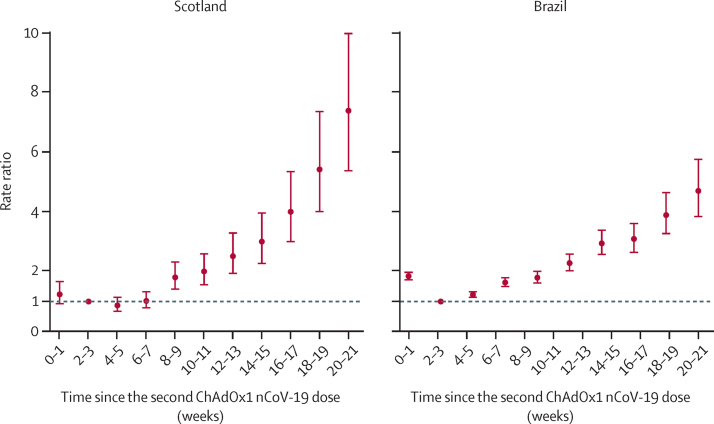
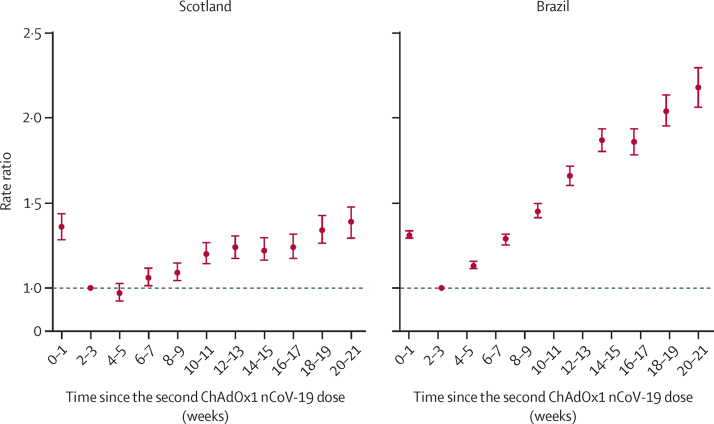
Verification
Claims the paper makes
The claims and statistics of this paper haven’t been checked yet.
Free: it reads the open-access text and checks the first 5 claims that cite a source we can check. Create a free account to check every claim.
Claims other papers make about this one
Each is checked against this paper’s own text: does it say what the citing paper says it does?
The source backs part of the claim, not all of it — or backs it for a different population, condition or comparison.
In the citing paper
“Effectiveness of ChAdOx1 against Delta variant-associated severe disease has been estimated at ≥80% in multiple postlicensure studies63,64, including in India65.”
From Attributed causes of excess mortality during the COVID-19 pandemic in a south Indian city (2023) · cites this paper as [63]
Experimental — accuracy not yet measured
Self-check
Percentages, sums and reported differences re-computed from the paper’s own numbers.
The self-check needs the paper’s full text.
Citations
Cites
von Elm, E., Altman, D. G., Egger, M., Pocock, S. J., Gøtzsche, P. C., & Vandenbroucke, J. P. (2007) · The Lancet · doi:10.1016/s0140-6736(07)61602-x · Cited by 21,320
Safety and Efficacy of the BNT162b2 mRNA Covid-19 Vaccine
Polack, F. P., Thomas, S. J., Kitchin, N., Absalon, J., Gurtman, A., Lockhart, S., Perez, J. L., Pérez Marc, G., Moreira, E. D., Zerbini, C., et al. (2020) · New England Journal of Medicine · doi:10.1056/nejmoa2034577 · Cited by 14,592 · cited 1×
“Randomised trials for ChAdOx1 nCoV-19 have shown short-term effective protection against severe COVID-19 disease; 1,30 however, research on potential vaccine waning has mainly focused on BNT162b2.”
No adjustments are needed for multiple comparisons.
Rothman, K. J. (1990) · Epidemiology · doi:10.1097/00001648-199001000-00010 · Cited by 5,965 · cited 1×
“Fifth, following our prespecified analysis plan and on the basis of published guidance, 41 we did not correct p values for multiple testing.”
Benchimol, E. I., Smeeth, L., Guttmann, A., Harron, K., Moher, D., Petersen, I., Sørensen, H. T., von Elm, E., Langan, S. M., & RECORD Working Committee (2015) · PLOS Medicine · doi:10.1371/journal.pmed.1001885 · Cited by 5,749
Voysey, M., Clemens, S. A. C., Madhi, S. A., Weckx, L. Y., Folegatti, P. M., Aley, P. K., Angus, B., Baillie, V. L., Barnabas, S. L., Bhorat, Q. E., et al. (2021) · The Lancet · doi:10.1016/s0140-6736(20)32661-1 · Cited by 4,616 · cited 1×
“Randomised trials for ChAdOx1 nCoV-19 have shown short-term effective protection against severe COVID-19 disease; 1,30 however, research on potential vaccine waning has mainly focused on BNT162b2.”
Effectiveness of Covid-19 Vaccines against the B.1.617.2 (Delta) Variant
Lopez Bernal, J., Andrews, N., Gower, C., Gallagher, E., Simmons, R., Thelwall, S., Stowe, J., Tessier, E., Groves, N., Dabrera, G., et al. (2021) · New England Journal of Medicine · doi:10.1056/nejmoa2108891 · Cited by 2,889
BNT162b2 mRNA Covid-19 Vaccine in a Nationwide Mass Vaccination Setting
Dagan, N., Barda, N., Kepten, E., Miron, O., Perchik, S., Katz, M. A., Hernán, M. A., Lipsitch, M., Reis, B., & Balicer, R. D. (2021) · New England Journal of Medicine · doi:10.1056/nejmoa2101765 · Cited by 2,527
Folegatti, P. M., Ewer, K. J., Aley, P. K., Angus, B., Becker, S., Belij-Rammerstorfer, S., Bellamy, D., Bibi, S., Bittaye, M., Clutterbuck, E. A., et al. (2020) · The Lancet · doi:10.1016/s0140-6736(20)31604-4 · Cited by 2,419
Reduced sensitivity of SARS-CoV-2 variant Delta to antibody neutralization
Planas, D., Veyer, D., Baidaliuk, A., Staropoli, I., Guivel-Benhassine, F., Rajah, M. M., Planchais, C., Porrot, F., Robillard, N., Puech, J., et al. (2021) · Nature · doi:10.1038/s41586-021-03777-9 · Cited by 1,992
Safety and Efficacy of the BNT162b2 mRNA Covid-19 Vaccine through 6 Months
Thomas, S. J., Moreira, E. D., Kitchin, N., Absalon, J., Gurtman, A., Lockhart, S., Perez, J. L., Pérez Marc, G., Polack, F. P., Zerbini, C., et al. (2021) · New England Journal of Medicine · doi:10.1056/nejmoa2110345 · Cited by 1,640 · cited 2×
“In combination with the emerging immunological and trials data suggesting that vaccine effectiveness declines over time following two-dose vaccination, 12,42 our findings highlight the need to consider providing booster doses.”
Research works printed but not linked: 1
- Skowronski DM Setayeshgar S Zou M Single-dose mRNA vaccine effectiveness against SARS-CoV-2, including alpha and gamma variants: a test-negative design in adults 70 years and older in British Columbia, Canada Clin Infect Dis 2021 published online July 9. 10.1093/cid/cia616 PMC8406884 34244723 · doi:10.1093/cid/cia616
Cited by
Items 101–141 of 141
Mixing mRNA, adenoviral, and spike-adjuvant vaccines for protection against COVID-19
Richardson, C. D. (2021) · The Lancet · doi:10.1016/s0140-6736(21)02757-4 · Cited by 3
Florentino, P. T. V., Alves, F. J. O., Silva, T. C., Oliveira, V. D. A., Bertoldo, J., Penna, G. O., Boaventura, V. S., Werneck, G. L., Pearce, N. E., Rodrigues, L. C., et al. (2022) · The Lancet Infectious Diseases · doi:10.1016/s1473-3099(22)00728-9 · Cited by 3
Self-citationShi, T., Gu, X., Meza-Torres, B., Agrawal, U., Anand, S., Ordonez-Mena, J., Robertson, C., Sheikh, A., & Lusignan, S. D. (2024) · Oxford University Research Archive (ORA) (University of Oxford) · Cited by 3
Self-citationRanade, D. S., Jena, R., Patil, K. D., Dogar, V., Sancheti, S., Deore, V., Ashtagi, S., & Gairola, S. (2023) · Vaccine · doi:10.1016/j.vaccine.2023.02.039 · Cited by 2
Oladejo, A. O. (2023) · Journal of Law Society and Development · doi:10.25159/2520-9515/12640 · Cited by 2
Developing the EAVE III platform for future health crises
Simpson, C. R., Robertson, C., McMenamin, J., Ritchie, L. D., & Sheikh, A. (2023) · The Lancet Infectious Diseases · doi:10.1016/s1473-3099(23)00626-6 · Cited by 2
Self-citationExplain Again: Why Are We Vaccinating Young Children against COVID-19?
Iles, R. K., & Makhzoumi, T. S. (2022) · COVID · doi:10.3390/covid2040036 · Cited by 2
Lim, S. Y., Jung, J., Kim, J. Y., Park, S., Kwon, J., Park, S. Y., Kim, S., Kim, S., Kim, S., Bae, S., et al. (2022) · Clinical and Translational Medicine · doi:10.1002/ctm2.804 · Cited by 2
Reynolds, J. A., Faustini, S. E., Tosounidou, S., Plant, T. D., Ubhi, M., Gilman, R., Richter, A. G., & Gordon, C. (2023) · Lupus · doi:10.1177/09612033231151603 · Cited by 2
“the general population, the BNT162b2 (Pfizer/BioNTech) and ChAdOx1 nCoV-19 vaccines reduced the risk of severe infection (requiring hospitalisation) in the early postvaccination period by around 90% and 84%, respectively.(3,4) The efficacy of such vaccines in patients with SLE is likely to depend at least in part on t…”
BackgroundSilva, T. C., Boaventura, V. S., Pearce, N. E., & Barral‐Netto, M. (2024) · International Journal of Infectious Diseases · doi:10.1016/j.ijid.2024.107241 · Cited by 1
Self-citationHaider, F., Silva, T. C., Hainey, K., Millington, T., Shah, S. A., de Oliveira, V. M., Pearce, N. E., Barreto, M. L., Boaventura, V. S., Katikireddi, S. V., et al. (2025) · BMJ Open · doi:10.1136/bmjopen-2025-104057 · Cited by 1
“…real-world data, vaccine effectiveness studies have demonstrated a waning of protection against both severe COVID-19 disease outcomes (ie, hospitalisation or death) and symptomatic infection within months of vaccination, 7–9 prompting the provision of booster vaccination doses in many countries.”
Self-citationWebster‐Kerr, K., Grant, A. S., Harris, A., Campbell, E., Henningham, D., Brown, M., Rowe, D., Lord, C., Thorpe, R., Mullings, T., et al. (2025) · Vaccines · doi:10.3390/vaccines13121250 · Cited by 1
“The observation of greater survival in vaccinated versus unvaccinated cases is consistent with studies conducted in high-income countries [11,37].”
Das, A., Khan, S., Vidyarthi, A. J., Gupta, R., Mondal, S., Singh, S., Wundavalli, L., Bhatnagar, S., Singh, U. B., & Chaudhry, R. (2023) · Journal of Family Medicine and Primary Care · doi:10.4103/jfmpc.jfmpc_529_23 · Cited by 1
“[11,12] Subsequently, VBI brought the next level of challenges in the COVID‑19 pandemic management especially in the setting of growing SARS‑CoV‑2 variants.”
BackgroundFairall, L. R., Yende‐Zuma, N., Reddy, T., Garrett, N., Goga, A. E., Bennet, S., Folb, N., Seocharan, I., Mametja, S., Semenya, M., et al. (2025) · South African Medical Journal · doi:10.7196/samj.2025.v115i7.2532 · Cited by 1
“[10,11] The ENSEMBLE2 study results had also been released, confirming additional protection and an acceptable safety profile of a second dose of Ad26.”
Nguyen, V. G., Yavlinsky, A., Beale, S., Hoskins, S., Lampos, V., Braithwaite, I., Byrne, T., Fong, W. L. E., Fragaszy, E., Geismar, C., et al. (2021) · medRxiv · doi:10.1101/2021.12.21.21268214 · Cited by 1
Brazilian COVID-19 data streamingPreprint
da Silva, N. B., Valencia, L. I. O., Filho, F. M. H. S., Ferreira, A. C. S., Pereira, F. A., de Oliveira, G. L., Oliveira, P. F., Rodrigues, M. M. D. S., Ramos, P. I. P., & de Oliveira, J. F. (2022) · arXiv (Cornell University) · doi:10.48550/arxiv.2205.05032 · Cited by 1
Chow, J. Y., Goh, Z. J., Li, R., Lim, D. Z. Y., Wee, L. E., Lye, D. C., Tan, K. B., & Lim, J. T. (2025) · medRxiv · doi:10.1101/2025.09.29.25336864 · Cited by 1
A IMPORTÂNCIA DA GESTÃO DA INFORMAÇÃO PARA OBTENÇÃO DA VANTAGEM COMPETITIVA
de Mello, F. A. M., Mello, R. B. D., & Piurcosky, F. P. (2019) · Interação - Revista de Ensino Pesquisa e Extensão · doi:10.33836/interacao.v17i17.73
Evaluation of the effects of vaccination regimes on the transmission dynamics of COVID-19 pandemicPreprint
Nakamoto, I., Zhang, J., Zhuang, W., & Guo, Y. (2022) · Research Square · doi:10.21203/rs.3.rs-1279130/v1
Kozak, A., & Nienhaus, A. (2022) · ASU Arbeitsmedizin Sozialmedizin Umweltmedizin · doi:10.17147/asu-1-174363
Modeling vaccine allocation and equity implications of COVID-19 containment strategiesPreprint
Nakamoto, I., & Zhang, J. (2022) · medRxiv · doi:10.1101/2022.09.05.22279623
Subramanian, R. (2022) · Research Square · doi:10.21203/rs.3.rs-2073308/v1
Nakamoto, I. (2023) · medRxiv · doi:10.1101/2023.04.16.23288641
Souza, A. L. C. R., Cruz, B. C. P., & de Almeida, K. C. (2023) · Research Society and Development · doi:10.33448/rsd-v12i7.42721
COVID-19 vaccine hesitancy, safety and effectiveness
(2024) · Frontiers research topics · doi:10.3389/978-2-8325-4812-7
Estadilla, C. D. S., Mar, J., Ibarrondo, O., Stollenwerk, N., & Aguiar, M. (2024) · Journal of Epidemiology and Global Health · doi:10.1007/s44197-024-00286-6
“Additionally, immunity wanes over time and offers lower resistance for the elderly [ 9 –11].”
BackgroundRiaba, O. V., Golubovska, O. A., & Chalyy, K. A. (2024) · Medical Science of Ukraine (MSU) · doi:10.32345/2664-4738.3.2024.07
ACCREDIT: Validation of clinical score for progression of COVID-19 while hospitalized
Melo, V. L. C. O., & do Brasil, P. E. A. A. (2024) · Global Epidemiology · doi:10.1016/j.gloepi.2024.100181
“Many prediction models for COVID-19 progression to critically ill were published even after the pandemic was considered no longer a global threat [12 – 16 , 31 – 35 ].”
Sarooni, S. S., Mohammadi, M., & Riahi, S. M. (2024) · European Journal of Translational and Clinical Medicine · doi:10.31373/ejtcm/196493
COVID-19 Vaccine and Mortality: Scoping Review with ☸️SAIMSARA
SAIMSARA (2025) · SAIMSARA Journal · doi:10.62487/saimsara047981e6
Jing, X., Han, M., Wang, X., & Zhou, L. (2023) · Figshare · doi:10.6084/m9.figshare.24089183
Willem, L., Abrams, S., Franco, N., Coletti, P., Libin, P., Wambua, J., Couvreur, S., André, E., Wenseleers, T., Mao, Z., et al. (2024) · Figshare · doi:10.6084/m9.figshare.25706094
Azzopardi, J., Xerri, T. D., Cassar, P., Aquilina, N., Pullicino, S. G., & Mallia Azzopardi, C. (2025) · Malta Medical Journal
Thakur, A., Meza-Torres, B., Fan, X., Byford, R. C., Joy, M., Meeraus, W. H., Venkatesan, S., Taylor, S., de Lusignan, S., & Clifton, D. A. (2026) · PLoS ONE · doi:10.1371/journal.pone.0336449
Dahl, A. M., & Brown, E. R. (2026) · arXiv (Cornell University) · doi:10.48550/arxiv.2602.18677
Mahdavi, S., Enayatrad, M., Goli, S., & Zare, F. (2026) · European journal of medical research · doi:10.1186/s40001-026-04748-4
“This finding is consistent with results from a study on the AZD1222 vaccine in Scotland and Brazil [34], which also reported an increased incidence after the second dose.”
Destiani, D. P., Rahmawati, N. A. S. L., & Ng, H. (2026) · Jurnal Sains Farmasi & Klinis · doi:10.25077/jsfk.13.02.194-202.2026
“Several studies have proven the effectiveness of vaccines against infections, including preventing complications, intensive hospitalization, and death [5], [6], [7], [8], [9].”
Ou, S., Huang, Z., Lan, M., Ye, J., Chen, J., Guo, H., Xiao, J., Zhuang, S., Wu, J., Yang, C., et al. (2022) · doi:10.3389/fimmu.2022.1027924.s001
Feikin, D. R., Higdon, M. M., Abu-Raddad, L. J., Andrews, N., & Araos, R. (2023) · The Lancet Respiratory Medicine · doi:10.1016/s2213-2600(23)00015-6
Metadata
- Authors
- Katikireddi, S. V., Cerqueira-Silva, T., Vasileiou, E., Robertson, C., Amele, S., Pan, J., Taylor, B., Boaventura, V., Werneck, G. L., Flores-Ortiz, R., Agrawal, U., Docherty, A. B., McCowan, C., McMenamin, J., Moore, E., Ritchie, L. D., Rudan, I., Shah, S. A., Shi, T., Simpson, C. R., Barreto, M. L., Oliveira, V. D. A., Barral-Netto, M., & Sheikh, A.
- Affiliations
- MRC/CSO Social and Public Health Sciences Unit (GB)
- University of Edinburgh (GB)
- University of Strathclyde (GB)
- Public Health Scotland (GB)
- Universidade Federal da Bahia (BR)
- Universidade do Estado do Rio de Janeiro (BR)
- Instituto Gonçalo Moniz (BR)
- University of St Andrews (GB)
- University of Aberdeen (GB)
- Victoria University of Wellington (NZ)
- Corresponding author
- Sheikh, Aziz
- ORCID
- Venue
- The Lancet
- Publisher
- Elsevier BV
- Published
- 2022-01
- Volume
- 399
- Issue
- 10319
- Pages
- 25-35
- ISSN
- 0099-5355 (ISSN-L)
- 0140-6736
- PMC
- PMC8687670
- OpenAlex
- W4200405047
- Semantic Scholar
- 04b46fbc9effb932d4bdb443766968721feef6dc
- Cited by
- 124
- References
- 32
- Citations by year
- 2026: 2 · 2025: 9 · 2024: 15 · 2023: 38 · 2022: 58
- FWCI
- 8.94
- Type
- journal article
- Language
- en
- Open access
- hybrid
- doi.org
- Licence
- cc-by
- www.elsevier.com/tdm/userlicense/1.0/ (tdm)
- www.elsevier.com/legal/tdmrep-license (tdm)
- creativecommons.org/licenses/by/4.0/ (vor)
- Locations
- The Lancet (publishedVersion, cc-by)
- PubMed Central (publishedVersion, cc-by)
- PubMed (publishedVersion)
- ENLIGHTEN (Jurnal Bimbingan dan Konseling Islam) (acceptedVersion, cc-by-sa)
- Strathprints: The University of Strathclyde institutional repository (University of Strathclyde) (acceptedVersion)
- Edinburgh Research Explorer (University of Edinburgh) (submittedVersion, cc-by)
- Arca - Repositório Institucional da Fiocruz (submittedVersion, other-oa)
- Aberdeen University Research Archive (Aberdeen University) (submittedVersion)
- St Andrews Research Repository (St Andrews Research Repository) (submittedVersion, cc-by)
- LA Referencia (Red Federada de Repositorios Institucionales de Publicaciones Científicas) (submittedVersion, other-oa)
- Funders
- UK Research and Innovation (MC_PC_20058)
- Medical Research Council (MC_PC_19075, MC_PC_19004)
- Fundação Carlos Chagas Filho de Amparo à Pesquisa do Estado do Rio de Janeiro (E-26/210.180/2020)
- Health Technology Assessment Programme (MC_UU_00022/2, 11/46/23, SCAF/15/02)
- National Institute for Health Research
- Conselho Nacional de Desenvolvimento Científico e Tecnológico
- Topics
- Health Sciences › Medicine › Infectious Diseases › SARS-CoV-2 and COVID-19 Research
- Social Sciences › Health › Vaccine Coverage and Hesitancy
- Health Sciences › Medicine › Infectious Diseases › COVID-19 Clinical Research Studies
- Keywords
- ChAdOx1 nCoV-19 vaccine, COVID-19 vaccine effectiveness, waning vaccine effectiveness, Delta variant, severe COVID-19 outcomes, COVID-19 hospitalization, COVID-19 mortality, vaccine protection duration, Scotland, Brazil
- MeSH terms
- COVID-19, SARS-CoV-2, COVID-19 Vaccines, Vaccine Efficacy, ChAdOx1 nCoV-19, Adolescent, Adult, Aged, Aged, 80 and over, Brazil, Female, Hospitalization, Humans, Immunization, Secondary, Male, Middle Aged, Retrospective Studies, Scotland, Time Factors, Vaccination
About these checks
Registry, retraction, Cites and statistics results are computed, not judged, with one exception: a printed reference that no index lists is read once by a model before it counts as a citation error. Claims are extracted by a model and kept only when their quote appears verbatim in the text; each cited source is then checked, with a model’s help, for whether it says what the claim relies on. Those verdicts can be wrong — read the claim’s quote and the cited source before relying on one.
Statistics and arithmetic are recomputed, not judged.
Confidence bands are shown only for fields calibrated on our annotated test set. None is calibrated yet, so no band is shown.
What counts as a claim ›How we measure confidence ›How we check this ›
Are you an author, or do you see a problem with this page? Request a review
Data sources
Bibliographic data: Semantic Scholar, OpenAlex, Crossref.
Contains information from the Semantic Scholar Academic Graph Datasets, made available under the ODC Attribution License (ODC-BY 1.0).
Semantic Scholar’s data is described in: Kinney, R., et al. (2023). The Semantic Scholar Open Data Platform. arXiv:2301.10140.
