

Impact of diabetes on the effects of sodium glucose co-transporter-2 inhibitors on kidney outcomes: collaborative meta-analysis of large placebo-controlled trials
Open accessThe DOI matches its Crossref record; 56 of the 59 references it cites were found in a registry or an index; 30 of the 47 sources its claims cite were checked for support.
Abstract
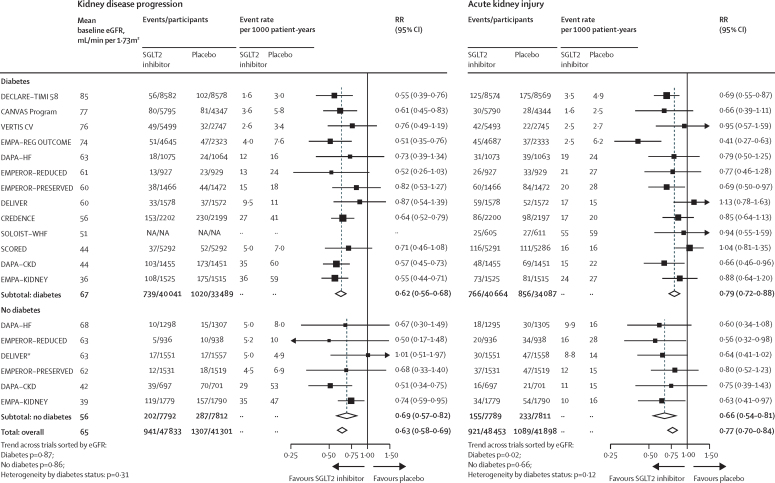
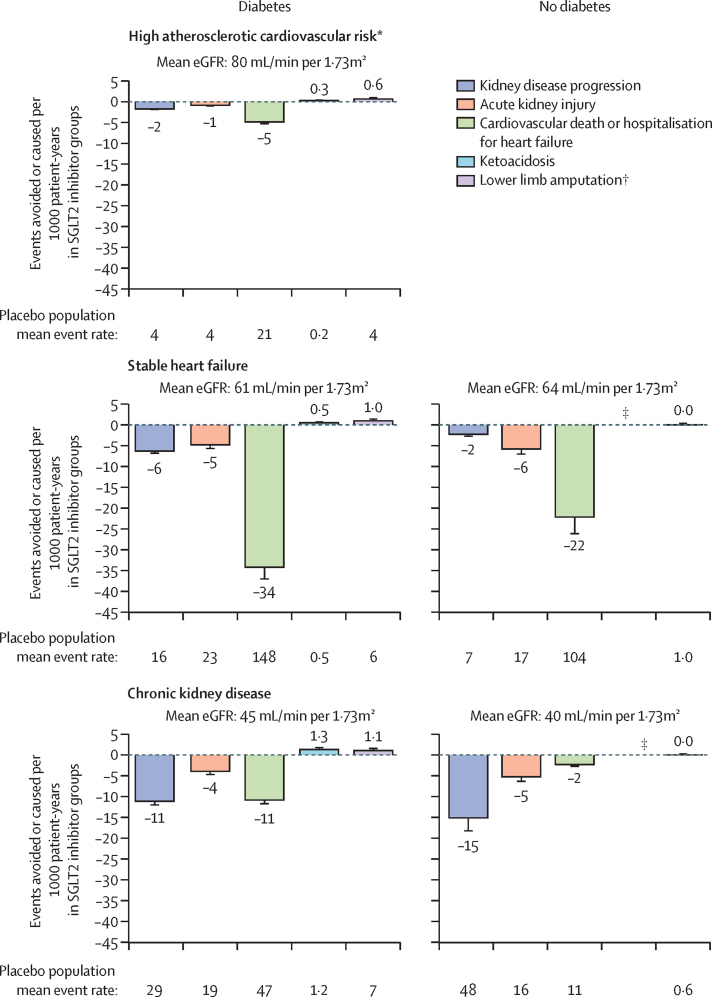
BACKGROUND: Large trials have shown that sodium glucose co-transporter-2 (SGLT2) inhibitors reduce the risk of adverse kidney and cardiovascular outcomes in patients with heart failure or chronic kidney disease, or with type 2 diabetes and high risk of atherosclerotic cardiovascular disease. None of the trials recruiting patients with and without diabetes were designed to assess outcomes separately in patients without diabetes. METHODS: We did a systematic review and meta-analysis of SGLT2 inhibitor trials. We searched the MEDLINE and Embase databases for trials published from database inception to Sept 5, 2022. SGLT2 inhibitor trials that were double-blind, placebo-controlled, performed in adults (age ≥18 years), large (≥500 participants per group), and at least 6 months in duration were included. Summary-level data used for analysis were extracted from published reports or provided by trial investigators, and inverse-variance-weighted meta-analyses were conducted to estimate treatment effects. The main efficacy outcomes were kidney disease progression (standardised to a definition of a sustained ≥50% decrease in estimated glomerular filtration rate [eGFR] from randomisation, a sustained low eGFR, end-stage kidney disease, or death from kidney failure), acute kidney injury, and a composite of cardiovascular death or hospitalisation for heart failure. Other outcomes were death from cardiovascular and non-cardiovascular disease considered separately, and the main safety outcomes were ketoacidosis and lower limb amputation. This study is registered with PROSPERO, CRD42022351618. FINDINGS: ). Compared with placebo, allocation to an SGLT2 inhibitor reduced the risk of kidney disease progression by 37% (relative risk [RR] 0·63, 95% CI 0·58-0·69) with similar RRs in patients with and without diabetes. In the four chronic kidney disease trials, RRs were similar irrespective of primary kidney diagnosis. SGLT2 inhibitors reduced the risk of acute kidney injury by 23% (0·77, 0·70-0·84) and the risk of cardiovascular death or hospitalisation for heart failure by 23% (0·77, 0·74-0·81), again with similar effects in those with and without diabetes. SGLT2 inhibitors also reduced the risk of cardiovascular death (0·86, 0·81-0·92) but did not significantly reduce the risk of non-cardiovascular death (0·94, 0·88-1·02). For these mortality outcomes, RRs were similar in patients with and without diabetes. For all outcomes, results were broadly similar irrespective of trial mean baseline eGFR. Based on estimates of absolute effects, the absolute benefits of SGLT2 inhibition outweighed any serious hazards of ketoacidosis or amputation. INTERPRETATION: In addition to the established cardiovascular benefits of SGLT2 inhibitors, the randomised data support their use for modifying risk of kidney disease progression and acute kidney injury, not only in patients with type 2 diabetes at high cardiovascular risk, but also in patients with chronic kidney disease or heart failure irrespective of diabetes status, primary kidney disease, or kidney function. FUNDING: UK Medical Research Council and Kidney Research UK.
Overview
CoChat Summary
TL;DR
In a collaborative meta-analysis of 13 large placebo-controlled SGLT2 inhibitor trials including 90,409 participants, SGLT2 inhibitors reduced kidney disease progression by 37% and acute kidney injury by 23%, with similar relative effects in patients with and without diabetes. Cardiovascular death or heart failure hospitalisation was reduced by 23%, and absolute benefits outweighed serious hazards of ketoacidosis or amputation in the studied populations.
Key findings
- Among 90,409 analysed participants (74,804 [82.7%] with diabetes, >99% type 2; 15,605 [17.3%] without diabetes), SGLT2 inhibitors reduced kidney disease progression by 37% overall (RR 0.63, 95% CI 0.58–0.69), with similar RRs in patients with diabetes (0.62, 0.56–0.68) and without diabetes (0.69, 0.57–0.82; heterogeneity p=0.31).
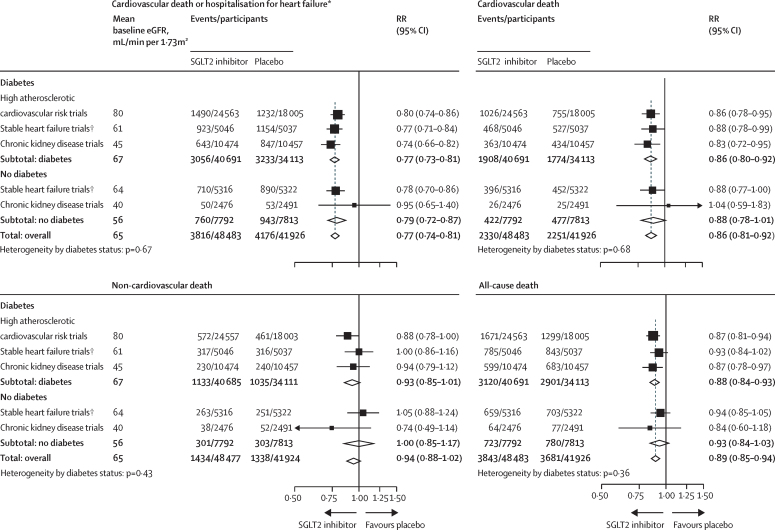
- SGLT2 inhibitors reduced acute kidney injury by 23% overall (RR 0.77, 95% CI 0.70–0.84), with similar effects in patients with diabetes (0.79, 0.72–0.88) and without diabetes (0.66, 0.54–0.81; heterogeneity p=0.12), and reduced cardiovascular death or hospitalisation for heart failure by 23% (0.77, 0.74–0.81), again similar by diabetes status.
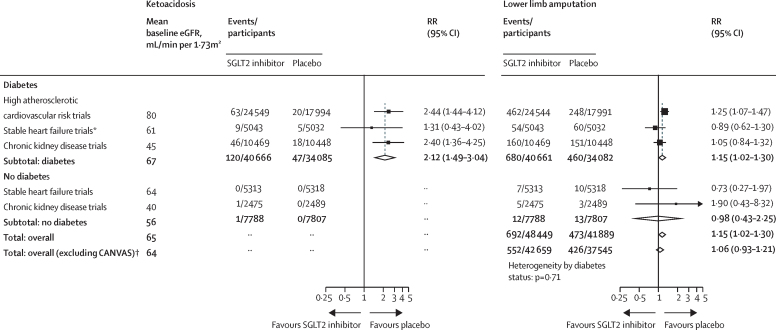
- Cardiovascular death was reduced by 14% (RR 0.86, 95% CI 0.81–0.92), while non-cardiovascular death was not significantly reduced (0.94, 0.88–1.02); ketoacidosis RR in patients with diabetes was 2.12 (1.49–3.04), and lower limb amputation overall was 1.15 (1.02–1.30), driven by CANVAS, with no significant association in the other 12 trials (1.06, 0.93–1.21).
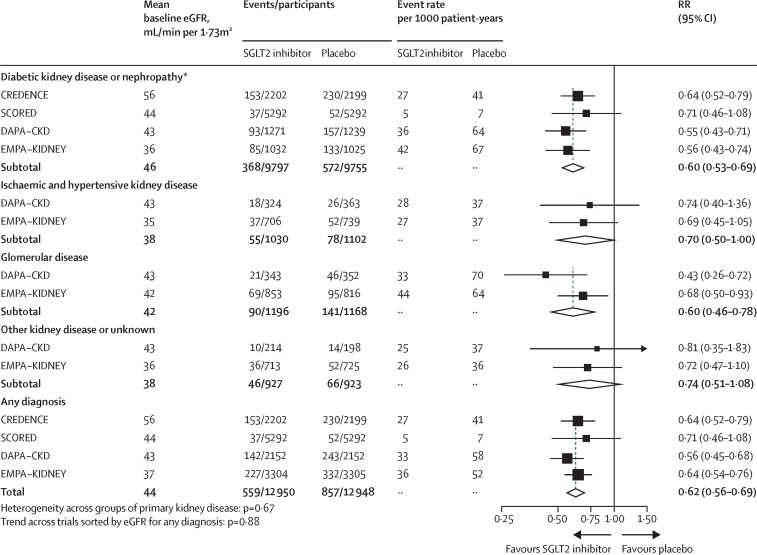
- In chronic kidney disease trials, kidney disease progression RRs were similar by primary kidney diagnosis: diabetic kidney disease 0.60 (0.53–0.69), ischaemic/hypertensive kidney disease 0.70 (0.50–1.00), glomerular disease 0.60 (0.46–0.78), and other/unknown 0.74 (0.51–1.08).
Methods
- Systematic review and meta-analysis; MEDLINE and Embase were searched from database inception to Sept 5, 2022, for double-blind, placebo-controlled SGLT2 inhibitor trials in adults (age ≥18 years), with ≥500 participants per group and ≥6 months duration; 13 trials were included.
- Summary-level data were extracted from published reports or provided by trial investigators; kidney disease progression was standardised to a sustained ≥50% eGFR decrease from randomisation, sustained low eGFR, end-stage kidney disease, or death from kidney failure, and inverse-variance-weighted meta-analyses estimated treatment effects.
- Main outcomes were kidney disease progression, acute kidney injury, and cardiovascular death or hospitalisation for heart failure; other outcomes included cardiovascular and non-cardiovascular death, with safety outcomes of ketoacidosis and lower limb amputation; analyses were by diabetes status, primary kidney diagnosis, and trial mean baseline eGFR. PROSPERO registration CRD42022351618.
Limitations
- Stated in the paper: there were low numbers of cardiovascular deaths and heart failure hospitalisations in patients with chronic kidney disease without diabetes; acute kidney injury adjudication was not performed in most trials; individual participant-level data were not available, precluding detailed eGFR slope analyses; efficacy and safety in dialysis or transplant patients, other kidney diagnoses (e.g., polycystic kidney disease), and type 1 diabetes remain unevaluated; absolute effect estimates are specific to the recruited trial populations.
- Stated in the paper: some subgroup data were limited, with wide confidence intervals for non-diabetic kidney diagnoses, and ketoacidosis events in patients without diabetes were too few to estimate absolute effects.
- Evident from the text: the meta-analysis relies on summary-level trial data rather than individual participant data; diabetes status is baseline-defined and >99% of participants with diabetes had type 2 diabetes; outcome definitions varied across trials despite standardisation, and several analyses (e.g., by primary kidney diagnosis, eGFR trend) were exploratory with multiple testing.
Model-written summary. Check it against the paper before relying on it.
Integrity signals
Registry
Cites
Statistics
Figures
Verification
Claims the paper makes
11 Valid · 1 Not valid · 11 Not checked · 64 Own results and interpretations
The cited sources support only part of this claim — read each source’s verdict below.
In the paper
“There is good evidence to support the use of SGLT2 inhibitors as a foundational therapy to prevent cardiovascular death or hospitalisation for heart failure in patients with heart failure, irrespective of ejection fraction or history of previous diabetes.1, 2, 3, 4, 5”
§ Impact of diabetes on the effects of sodium glucose co-transporter-2 inhibitors on kidney outcomes: collaborative meta-analysis of large placebo-controlled trials > Introduction
What the sources say
- Supportedcites [1] Staplin N Roddick AJ Emberson J Net effects of sodium-glucose co-transporter-2 inhibition in different patient groups: a meta-analysis of large placebo-controlled randomized trials EClinicalMedicine 41 2021 101163 PMC8571171 34765951 source
The Results (Relative effects of SGLT-2 inhibitors) report a 23% reduction in hospitalization for heart failure or cardiovascular death. The Results (Estimates of absolute effects) estimate benefits in heart failure with both reduced and preserved ejection fraction, including in people without diabetes; the paper also describes strong evidence of net benefit for people with heart failure. Page numbers were not available in our copy. (LLM, conf=0.91)
- Partly supportedcites [2] Zannad F Ferreira JP Pocock SJ SGLT2 inhibitors in patients with heart failure with reduced ejection fraction: a meta-analysis of the EMPEROR-Reduced and DAPA-HF trials Lancet 396 2020 819 829 32877652 sourceExperimental — accuracy not yet measured
The Conclusion reports that empagliflozin and dapagliflozin reduce heart-failure hospitalisations in patients with reduced ejection fraction (HFrEF), whether or not they have diabetes, and suggests a reduction in cardiovascular mortality. The paper does not establish benefit irrespective of ejection fraction: its meta-analysis covers HFrEF, not all patients with heart failure. (LLM, conf=0.90)
- Partly supportedcites [3] Anker SD Butler J Filippatos G Empagliflozin in heart failure with a preserved ejection fraction N Engl J Med 385 2021 1451 1461 34449189 sourceExperimental — accuracy not yet measured
Split into 2 atoms — 0 confirmed, 2 partially supported, 0 disputed, 0 misattributed, 0 unverifiable. Expand the claim to see per-atom verdicts.
- Supportedcites [4] Solomon SD McMurray JJV Claggett B Dapagliflozin in heart failure with mildly reduced or preserved ejection fraction N Engl J Med 387 2022 1089 1098 36027570 source
The Discussion describes SGLT2 inhibition as essential therapy for heart failure regardless of ejection fraction or type 2 diabetes status. The Results report a lower risk of the composite outcome of worsening heart failure or cardiovascular death with dapagliflozin; worsening heart failure included hospitalization or an urgent heart-failure visit. (LLM, conf=0.92)
- Supportedcites [5] Vaduganathan M Docherty KF Claggett BL SGLT-2 inhibitors in patients with heart failure: a comprehensive meta-analysis of five randomised controlled trials Lancet 400 2022 757 767 36041474 source
The Abstract reports a reduced risk of cardiovascular death or hospitalisation for heart failure across five trials and explicitly supports SGLT2 inhibitors as a foundational therapy irrespective of ejection fraction. The Outcomes and subgroups section includes history of diabetes in the primary-endpoint analysis; the Results report consistent effects across the examined subgroups except NYHA class, and the diabetes subgroup data show no evidence of a treatment-by-diabetes interaction (p=0.93). (LLM, conf=0.92)
boostedstates a cause- Asserted: passes — The authors put it forward as true.
- Checkable: passes — It can be checked against evidence.
- Load-bearing: unclear — It is unclear whether the paper’s conclusions depend on it.
- Based: passes — The paper gives a reason why it holds.
- Supported
The cited sources support only part of this claim — read each source’s verdict below.
In the paper
“Since 2021, two placebo-controlled SGLT2 inhibitor trials (EMPA-KIDNEY and DELIVER) have studied a large number of people without diabetes.”
§ Impact of diabetes on the effects of sodium glucose co-transporter-2 inhibitors on kidney outcomes: collaborative meta-analysis of large placebo-controlled trials > Introduction
What the sources say
- Partly supportedcites [4] Solomon SD McMurray JJV Claggett B Dapagliflozin in heart failure with mildly reduced or preserved ejection fraction N Engl J Med 387 2022 1089 1098 36027570 sourceExperimental — accuracy not yet measured
Our copy of DELIVER supports half of the attribution: the Trial Design and Oversight section describes a phase 3, double-blind, randomized trial of dapagliflozin versus matching placebo, the Trial Patients section states eligibility 'with or without type 2 diabetes mellitus', and Table 1 shows 6263 patients randomised with type 2 diabetes in only ~45% of each arm (i.e. a large number of people without diabetes). However, no passage of our copy mentions EMPA-KIDNEY at all (searches for 'EMPA-KIDNEY', 'empagliflozin chronic kidney disease trial' returned nothing); the only other SGLT2-inhibitor trial our copy names is EMPEROR-Preserved (empagliflozin in heart failure with LVEF >40%, Discussion). The EMPA-KIDNEY half of the claim therefore rests on another source. (LLM, conf=0.72)
- Partly supportedcites [12] Herrington WG Wanner C Green JB Design, recruitment, and baseline characteristics of the EMPA-KIDNEY trial Nephrol Dial Transplant 37 2022 1317 1329 35238940 PMC9217655 sourceExperimental — accuracy not yet measured
Our copy supports the EMPA-KIDNEY half of the sentence: the Abstract > Methods describes it as an 'international randomized, double-blind, placebo-controlled trial' of empagliflozin, and the Abstract > Results / Results > Recruitment (p. Recruitment) give 6609 randomized between 15 May 2019 and 16 April 2021, of whom 3570 (54%) had no prior history of DM, with the Discussion noting 'The larger number of people without DM in EMPA-KIDNEY will provide valuable additional information...'. However, nothing in our copy mentions DELIVER (or dapagliflozin in heart failure with mildly reduced/preserved EF): searches for DELIVER returned only references to DAPA-HF, EMPEROR-Preserved, DAPA-CKD and CREDENCE. The attribution of a second, large placebo-controlled SGLT2-inhibitor trial without diabetes since 2021 to this source is therefore unsupported. (LLM, conf=0.80)
- Not checked yetcites [13] The EMPA-KIDNEY Collaborative Group. Empagliflozin in patients with chronic kidney disease. N Engl J Med (in press).
plainn = 3,569- Asserted: passes — The authors put it forward as true.
- Checkable: passes — It can be checked against evidence.
- Load-bearing: passes — The paper’s conclusions depend on it.
- Based: passes — The paper gives a reason why it holds.
- Partly supported
The cited sources support only part of this claim — read each source’s verdict below.
In the paper
“a previous meta-analysis had limited power as only 98 kidney disease progression outcomes were reported in participants without diabetes in such trials.1, 11”
§ Impact of diabetes on the effects of sodium glucose co-transporter-2 inhibitors on kidney outcomes: collaborative meta-analysis of large placebo-controlled trials > Introduction
What the sources say
- Partly supportedcites [1] Staplin N Roddick AJ Emberson J Net effects of sodium-glucose co-transporter-2 inhibition in different patient groups: a meta-analysis of large placebo-controlled randomized trials EClinicalMedicine 41 2021 101163 PMC8571171 34765951 sourceExperimental — accuracy not yet measured
Our copy of Staplin et al. (2021) is the meta-analysis the citing sentence describes, and it does report kidney disease progression analysed by diabetes status in participants without DM from three HF trials (n=7529) plus one CKD trial (n=1398), with 'nearly 9000 participants without DM' (Results > Relative effects; Discussion). It also concedes limited evidence in people without DM — 'further data on in HFpEF and certain CKD patient groups are awaited ... these ongoing trials will provide more information in people without DM' (Discussion, limitations). But no passage states the figure of 98 kidney disease progression outcomes, nor characterises the renal analyses as underpowered; the only 'too few events' statements in our copy concern ketoacidosis and amputations in people without DM, and the reported HF heterogeneity test by DM status for kidney progression (p=0.53) is presented without a power caveat. The specific number and the 'limited power' conclusion attributed here are therefore not supported by our copy. (LLM, conf=0.62)
- Could not verifycites [11] Packer M Butler J Zannad F Empagliflozin and major renal outcomes in heart failure N Engl J Med 385 2021 1531 1533 34449179 sourceExperimental — accuracy not yet measured
Our copy of Packer et al. (2021, NEJM correspondence) is a prospective patient-level pooled analysis of EMPEROR-Reduced and EMPEROR-Preserved; its opening (Introduction) only states that SGLT2 inhibitors reduce adverse renal outcomes in type 2 diabetes but that 'the renal effects of these drugs in patients with heart failure remain uncertain'. No passage in our copy refers to a previous meta-analysis, to its statistical power, or to a count of 98 kidney disease progression outcomes in participants without diabetes — the only event numbers given are the pooled analysis's own 138 vs. 170 major adverse renal outcomes (Results). Searches for '98 kidney disease progression outcomes', 'limited power', 'meta-analysis', and 'underpowered' returned nothing on point, so the attributed detail cannot be checked against this source. (LLM, conf=0.70)
plain- Asserted: passes — The authors put it forward as true.
- Checkable: passes — It can be checked against evidence.
- Load-bearing: passes — The paper’s conclusions depend on it.
- Based: passes — The paper gives a reason why it holds.
- Partly supported
Every source the paper cites for this claim was checked and supports it.
In the paper
“Large trials have also shown that SGLT2 inhibitors reduce the risk of kidney disease progression in patients with type 2 diabetes and proteinuric chronic kidney disease,1, 6, 7, 8”
§ Impact of diabetes on the effects of sodium glucose co-transporter-2 inhibitors on kidney outcomes: collaborative meta-analysis of large placebo-controlled trials > Introduction
What the sources say
- Supportedcites [1] Staplin N Roddick AJ Emberson J Net effects of sodium-glucose co-transporter-2 inhibition in different patient groups: a meta-analysis of large placebo-controlled randomized trials EClinicalMedicine 41 2021 101163 PMC8571171 34765951 source
The Introduction states that trials found SGLT-2 inhibitors slow CKD progression and substantially reduce end-stage kidney disease risk in people with albuminuric diabetic nephropathy. The Results report a reduced risk of kidney disease progression compared with placebo. These passages support the claim about patients with type 2 diabetes and proteinuric CKD. (LLM, conf=0.93)
- Supportedcites [6] Neuen BL Young T Heerspink HJL SGLT2 inhibitors for the prevention of kidney failure in patients with type 2 diabetes: a systematic review and meta-analysis Lancet Diabetes Endocrinol 7 2019 845 854 31495651 source
The Results report that SGLT2 inhibitors reduced substantial loss of kidney function, end-stage kidney disease, or death due to kidney disease. They also identify CREDENCE as a trial requiring substantial albuminuria, and the Overall section reports no evidence that the treatment effect differed across albuminuria subgroups. Together, these passages support the claim for patients with type 2 diabetes and proteinuric chronic kidney disease. (LLM, conf=0.92)
- Supportedcites [7] Perkovic V Jardine MJ Neal B Canagliflozin and renal outcomes in type 2 diabetes and nephropathy N Engl J Med 380 2019 2295 2306 30990260 source
The Methods describe a randomized trial of the SGLT2 inhibitor canagliflozin in patients with type 2 diabetes and albuminuric chronic kidney disease. The Discussion reports a lower risk of end-stage kidney disease with canagliflozin than with placebo. This paper supports the claim as one of the trials cited; page numbers are not available in the supplied copy. (LLM, conf=0.92)
- Supportedcites [8] Heerspink HJL Stefánsson BV Correa-Rotter R Dapagliflozin in patients with chronic kidney disease N Engl J Med 383 2020 1436 1446 32970396 source
The Abstract (p. 1437) reports that this large trial enrolled patients with chronic kidney disease and elevated urinary albumin, and that dapagliflozin reduced the risk of the kidney-related composite outcome versus placebo. It also states that effects were similar in participants with and without type 2 diabetes; the Discussion describes these as kidney-protective effects of an SGLT2 inhibitor. (LLM, conf=0.91)
plainstates a cause- Asserted: passes — The authors put it forward as true.
- Checkable: passes — It can be checked against evidence.
- Load-bearing: passes — The paper’s conclusions depend on it.
- Based: passes — The paper gives a reason why it holds.
- Supported
The cited sources support only part of this claim — read each source’s verdict below.
In the paper
“the DAPA-CKD trial in patients with proteinuric chronic kidney disease reported just 109 kidney disease progression outcomes in patients without diabetes.1, 8, 10”
§ Impact of diabetes on the effects of sodium glucose co-transporter-2 inhibitors on kidney outcomes: collaborative meta-analysis of large placebo-controlled trials > Introduction
What the sources say
- Partly supportedcites [1] Staplin N Roddick AJ Emberson J Net effects of sodium-glucose co-transporter-2 inhibition in different patient groups: a meta-analysis of large placebo-controlled randomized trials EClinicalMedicine 41 2021 101163 PMC8571171 34765951 sourceExperimental — accuracy not yet measured
The Results (Eligible trial characteristics; page unavailable) identify DAPA-CKD as a trial involving 1,398 participants without diabetes and list albuminuria among its eligibility criteria. The Results (Relative effects of SGLT-2 inhibitors; page unavailable) discuss kidney disease progression in that subgroup, but our copy does not report the claimed total of 109 outcomes (searched: “109” and DAPA-CKD progression events without diabetes). (LLM, conf=0.85)
- Partly supportedcites [8] Heerspink HJL Stefánsson BV Correa-Rotter R Dapagliflozin in patients with chronic kidney disease N Engl J Med 383 2020 1436 1446 32970396 sourceExperimental — accuracy not yet measured
The Participants section confirms that DAPA-CKD enrolled people with albuminuric chronic kidney disease, including people without diabetes. Table 2 in Efficacy Outcomes reports 109 end-stage kidney disease events in the dapagliflozin group overall, not 109 kidney disease progression outcomes specifically among participants without diabetes. The claimed subgroup count is therefore not supported by this paper's reported figures. (LLM, conf=0.86)
- Not checked yetcites [10] Wheeler DC Stefánsson BV Jongs N Effects of dapagliflozin on major adverse kidney and cardiovascular events in patients with diabetic and non-diabetic chronic kidney disease: a prespecified analysis from the DAPA-CKD trial Lancet Diabetes Endocrinol 9 2021 22 31 33338413 source
plain- Asserted: passes — The authors put it forward as true.
- Checkable: passes — It can be checked against evidence.
- Load-bearing: passes — The paper’s conclusions depend on it.
- Based: passes — The paper gives a reason why it holds.
- Partly supported
55 more claims · 4 with their cited sources checked
Create a free account to see all 87 claims and to verify the 17 references still open.
- It may state two separate claims as one. 18
- Probably not a substantial claim. 10
Claims other papers make about this one
Each is checked against this paper’s own text: does it say what the citing paper says it does?
The source backs part of the claim, not all of it — or backs it for a different population, condition or comparison.
In the citing paper
“whilst in the non‐operative setting, is greater in patients with diabetes mellitus than those without (1 in 339 vs. 1 in 15,592) [96, 97].”
Experimental — accuracy not yet measuredThe source backs part of the claim, not all of it — or backs it for a different population, condition or comparison.
In the citing paper
“Outcomes trials confirmed that SGLT2i effectively prevented kidney failure as well as heart failure events, with more modest effects on atherosclerotic CV outcomes3.”
From Effects of semaglutide with and without concomitant SGLT2 inhibitor use in participants with type 2 diabetes and chronic kidney disease in the FLOW trial (2024) · cites this paper as [3]
Experimental — accuracy not yet measuredThe cited source says what the claim attributes to it.
In the citing paper
“Glucagon-like peptide-1 receptor agonists and sodium-glucose cotransporter-2 inhibitors (SGLT2i) independently reduce CV and kidney events.”
In the citing paper
“In patients with T1DM and CKD, the absence of large trials with sufficient follow-up means it is unclear whether the absolute benefits of SGLT2 inhibitors on kidney failure and CVD outcomes are outweighed by the high absolute risk of ketoacidosis with SGLT2 inhibitors.715,716”
From 2023 ESC guidelines for the management of cardiovascular disease in patients with diabetes. (2023) · cites this paper as [716]
Self-check
Percentages, sums and reported differences re-computed from the paper’s own numbers.
Each contradiction between two passages listed here was confirmed by an independent check.
Rated minor: it would not touch a result — a value no result rests on, a p-value that stays on the same side of the significance level, or a conflict that is clerical, resolved elsewhere in the paper, or outside its own findings.
In the paper
§ Impact of diabetes on the effects of sodium glucose co-transporter-2 inhibitors on kidney outcomes: collaborative meta-analysis of large placebo-controlled trials > Results
“shortest for the heart failure trials (0·8–2·2 years).”
§ Impact of diabetes on the effects of sodium glucose co-transporter-2 inhibitors on kidney outcomes: collaborative meta-analysis of large placebo-controlled trials > Results
“| DELIVER4 (dapagliflozin 10 mg) | 6263 | 2·3 |”
Citations
Cites
RoB 2: a revised tool for assessing risk of bias in randomised trials
Sterne, J. A. C., Savović, J., Page, M. J., Elbers, R. G., Blencowe, N. S., Boutron, I., Cates, C. J., Cheng, H.-Y., Corbett, M. S., Eldridge, S. M., et al. (2019) · BMJ · doi:10.1136/bmj.l4898 · Cited by 34,787
Self-citationEmpagliflozin, Cardiovascular Outcomes, and Mortality in Type 2 Diabetes
Zinman, B., Wanner, C., Lachin, J. M., Fitchett, D., Bluhmki, E., Hantel, S., Mattheus, M., Devins, T., Johansen, O. E., Woerle, H. J., et al. (2015) · New England Journal of Medicine · doi:10.1056/nejmoa1504720 · Cited by 12,315
Self-citationWan, X., Wang, W., Liu, J., & Tong, T. (2014) · BMC Medical Research Methodology · doi:10.1186/1471-2288-14-135 · Cited by 11,735
Canagliflozin and Cardiovascular and Renal Events in Type 2 Diabetes
Neal, B., Perkovic, V., Mahaffey, K. W., de Zeeuw, D., Fulcher, G., Erondu, N., Shaw, W., Law, G., Desai, M., & Matthews, D. R. (2017) · New England Journal of Medicine · doi:10.1056/nejmoa1611925 · Cited by 7,830 · cited 1×
“(20) Additional information on urinary tract infections (all and restricted to the subset which are serious), mycotic genital infections, severe hypoglycaemia and bone fractures are included for completeness (Webtable 2 provides details of derivation of each outcome by trial).”
Self-citationDapagliflozin in Patients with Heart Failure and Reduced Ejection Fraction
McMurray, J. J. V., Solomon, S. D., Inzucchi, S. E., Køber, L., Kosiborod, M. N., Martinez, F. A., Ponikowski, P., Sabatine, M. S., Anand, I. S., Bělohlávek, J., et al. (2019) · New England Journal of Medicine · doi:10.1056/nejmoa1911303 · Cited by 7,140
Self-citationDapagliflozin and Cardiovascular Outcomes in Type 2 Diabetes
Wiviott, S. D., Raz, I., Bonaca, M. P., Mosenzon, O., Kato, E. T., Cahn, A., Silverman, M. G., Zelniker, T. A., Kuder, J. F., Murphy, S. A., et al. (2019) · New England Journal of Medicine · doi:10.1056/nejmoa1812389 · Cited by 6,382 · cited 1×
“…so individual trial investigators provided a re-analysis of eGFR data to derive this meta-analysis’ pre-selected composite kidney disease progression outcome as well as any other unavailable outcomes of interest (3, 4, 7, 8, 12, 17, 21, 41) (excluding the short duration SOLOIST-WHF trial (18)).”
Self-citationCanagliflozin and Renal Outcomes in Type 2 Diabetes and Nephropathy
Perkovic, V., Jardine, M. J., Neal, B., Bompoint, S., Heerspink, H. J. L., Charytan, D. M., Edwards, R., Agarwal, R., Bakris, G., Bull, S., et al. (2019) · New England Journal of Medicine · doi:10.1056/nejmoa1811744 · Cited by 6,189 · cited 3×
“…so individual trial investigators provided a re-analysis of eGFR data to derive this meta-analysis’ pre-selected composite kidney disease progression outcome as well as any other unavailable outcomes of interest (3, 4, 7, 8, 12, 17, 21, 41) (excluding the short duration SOLOIST-WHF trial (18)).”
Self-citationDapagliflozin in Patients with Chronic Kidney Disease
Heerspink, H. J. L., Stefánsson, B. V., Correa-Rotter, R., Chertow, G. M., Greene, T., Hou, F.-F., Mann, J. F. E., McMurray, J. J. V., Lindberg, M., Rossing, P., et al. (2020) · New England Journal of Medicine · doi:10.1056/nejmoa2024816 · Cited by 5,618
Self-citationCardiovascular and renal outcomes with empagliflozin in heart failure
Packer, M., Anker, S. D., Butler, J., Filippatos, G., Pocock, S. J., Carson, P., Januzzi, J., Verma, S., Tsutsui, H., Brueckmann, M., et al. (2020) · New England Journal of Medicine · doi:10.1056/nejmoa2022190 · Cited by 5,206 · cited 1×
“…so individual trial investigators provided a re-analysis of eGFR data to derive this meta-analysis’ pre-selected composite kidney disease progression outcome as well as any other unavailable outcomes of interest (3, 4, 7, 8, 12, 17, 21, 41) (excluding the short duration SOLOIST-WHF trial (18)).”
Self-citationEmpagliflozin in heart failure with a preserved ejection fraction
Anker, S. D., Butler, J., Filippatos, G., Ferreira, J. P., Bocchi, E., Böhm, M., Brunner–La Rocca, H.-P., Choi, D.-J., Chopra, V., Chuquiure-Valenzuela, E., et al. (2021) · New England Journal of Medicine · doi:10.1056/nejmoa2107038 · Cited by 4,874 · cited 2×
“…so individual trial investigators provided a re-analysis of eGFR data to derive this meta-analysis’ pre-selected composite kidney disease progression outcome as well as any other unavailable outcomes of interest (3, 4, 7, 8, 12, 17, 21, 41) (excluding the short duration SOLOIST-WHF trial (18)).”
Self-citation
Research works printed but not linked: 4
- The EMPA-KIDNEY Collaborative Group. Empagliflozin in patients with chronic kidney disease. N Engl J Med (in press).
- Early Breast Cancer Trialists' Collaborative Group Treatment of early breast cancer. Vol 1. Worldwide evidence 1985–1990 vol 1 1990 Oxford University Press Oxford
- Deeks JJ Higgins JPT Altman DG on behalf of the Cochrane Statistical Methods Group Chapter 10: Analysing data and undertaking meta-analyses Higgins JPT Thomas J Chandler J Cumpston M Li T Page MJ Welch VA Cochrane Handbook for Systematic Reviews of Interventions version 6.1 2019 John Wiley & Sons Chichester
- National Institute for Health and Care Excellence Dapagliflozin for treating chronic kidney disease. Technology appraisal guidance [TA775] www.nice.org.uk/guidance/ta775 March 9, 2022 40455906
Cited by
Items 701–800 of 999
Oshima, M., Toyama, T., Nakade, Y., Sakurai, G., Yuasa, T., Koshino, A., Horikoshi, K., Minami, T., Sako, K., Nakagawa, S., et al. (2025) · Chemistry and Biodiversity · doi:10.1002/cbdv.202500746 · Cited by 1
Retracted: Are Your Kidneys Ok? Detect Early to Protect Kidney Health
Vassalotti, J. A., Francis, A., dos Santos, A. C. S., Correa‐Rotter, R., Abdellatif, D. A., Hsiao, L., Roumeliotis, S. K., Haris, A., Kumaraswami, L. A., Lui, S., et al. (2025) · Asian Medical Journal and Alternative Medicine · doi:10.70933/2773-9465.1026 · Cited by 1
RetractedTo Hold or Not to Hold, that is the Newest Sodium-Glucose Cotransporter-2 Inhibitor Question
Murphy, D. P. (2025) · Kidney360 · doi:10.34067/kid.0000000810 · Cited by 1
CHENG, A. Y. Y., Mottl, A. K., & MAGWIRE, M. L. (2025) · Diabetes Therapy · doi:10.1007/s13300-025-01796-7 · Cited by 5
Neuen, B. L., Heerspink, H. J. L., & Vaduganathan, M. (2025) · European Heart Journal · doi:10.1093/eurheartj/ehaf769 · Cited by 1
Self-citationRusso, G. T., Nicolucci, A., Cuttone, A., Ceriello, A., Manicardi, V., Rocca, A., Prattichizzo, F., Lucisano, G., Corrao, S., Cosmo, S. D., et al. (2025) · Acta Diabetologica · doi:10.1007/s00592-025-02599-9 · Cited by 1
How should we best manage the consequences of nephron loss in IgAN?
Kim, J., Kamal, F., Yeung, B., & Lafayette, R. A. (2025) · Nephrology Dialysis Transplantation · doi:10.1093/ndt/gfaf225 · Cited by 1
Hu, Z., Jin, W., Lou, S., & Zhang, L. (2025) · Renal Failure · doi:10.1080/0886022x.2025.2578413 · Cited by 1
“SGLt2i demonstrate robust reductions in cardiovascular events, cKD progression, and all-cause mortality among patients with t2D [10], while finerenone mitigates cardiovascular morbidity and renal function decline in t2D patients with albuminuria [11]. mechanistic distinctions between these drug…”
Comparison of three types of drugs for cardiovascular and renal benefits in type 2 diabetes mellitus
An, X., Li, X., Zhang, H., Jia, Q.-Y., Zhang, Y., & Yang, G.-G. (2025) · World Journal of Diabetes · doi:10.4239/wjd.v16.i11.111280 · Cited by 1
The influence of dapagliflozin on diabetic ocular complications: An observational cohort study
Chen, J.-H., Hung, F.-H., Wang, Y., Chen, J., Liao, S.-F., Hsueh, C.-M., Yeh, J., & Lip, G. Y. H. (2025) · European Journal of Pharmaceutical Sciences · doi:10.1016/j.ejps.2025.107382 · Cited by 1
What to do with key cardiovascular drugs when kidney function worsens?
Bergen, K., & Spaak, J. (2025) · Clinical Kidney Journal · doi:10.1093/ckj/sfaf354 · Cited by 1
“Contrary to RASi and MRA, SGLT2i decrease the risk of both AKI [123 ,124 ] and hyperkalemia [125 ,126 ], potentially facilitating maintenance of RAS inhibition and MRA treatment.”
Practice Variation in Prescribing SGLT2-Inhibitors: A Population-Based Analysis from Alberta, Canada
Kanji, R., Chew, D. S., Au, F., Campbell, D. J., Lau, D., Beall, R. F., Ronksley, P. E., Manns, B., & Quinn, A. E. (2025) · CJC Open · doi:10.1016/j.cjco.2025.11.015 · Cited by 1
Hertel, M., Jaoulak, H., Heiland, M., Nahles, S., Preißner, R., & Preißner, S. (2025) · Frontiers in Pharmacology · doi:10.3389/fphar.2025.1643866 · Cited by 2
Sanyal, D., & RoyChaudhuri, S. (2025) · Cureus · doi:10.7759/cureus.100108 · Cited by 2
Dapagliflozin modulates plasma lipidomic profile and urinary metabolite excretion in type 2 diabetes
Pezzica, S., Pratesi, F., Sabatini, S., Carli, F., Mengozzi, A., Solini, A., & Gastaldelli, A. (2025) · Cardiovascular Diabetology · doi:10.1186/s12933-025-03018-7 · Cited by 3
“Sodium-glucose co‐transporter‐2 inhibitors (SGLT2i) are a class of anti-hyperglycemic agents that inhibit glucose reabsorption in the proximal tubules of the kidney, with established metabolic, cardiovascular and renal benefits [2].”
Tang, J., Jing, B., Karunungan, K. L., Badathala, A., Wallace, A. W., & Legrand, M. M. (2026) · Annals of Intensive Care · doi:10.1016/j.aicoj.2025.100021 · Cited by 5
Kunitsu, Y., Koide, H., Ikuta, K., Hira, D., Nakagawa, S., Tsuda, M., Morita, S., & Terada, T. (2026) · BMC Nephrology · doi:10.1186/s12882-026-04753-z · Cited by 1
Berenyiová, A., & Šimko, F. (2026) · Biomedicine & Pharmacotherapy · doi:10.1016/j.biopha.2026.119012 · Cited by 1
Lamb, E. J., Barratt, J., Brettell, E. A., Cockwell, P., Dalton, R. N., Deeks, J. J., Eaglestone, G., Kalra, P. A., Khunti, K., Loud, F. C., et al. (2026) · BMJ Medicine · doi:10.1136/bmjmed-2025-001827 · Cited by 3
Bashier, A. M., Rukhaimi, M. A., Alhadari, A. K., Hussein, D., Hassanein, M. M., Abdelgadir, E., Rashid, F., Alhelfi, M., Kumar, D. N., Alalawi, F. J. A., et al. (2026) · Journal of Diabetes and Endocrine Practice · doi:10.1055/s-0045-1814429 · Cited by 1
Chronic Kidney Disease and Risk of Diabetic Ketoacidosis in Type 1 Diabetes
BAKHSH, A. M. K., Saleemi, A., Budhram, D., Zhang, Y., Bapat, P., Abuabat, M. I., Verhoeff, N. J., Mumford, D., Orszag, A., Fralick, M., et al. (2026) · Diabetes Care · doi:10.2337/dc25-1955 · Cited by 1
Self-citationJavier, R. M., Faizin, I., Andiani, Samudra, D., Puspitasari, R. A., Dharma, A. S., Nurpradika, B. Y., Amalia, F., Danny, S. S., Kuncoro, B. A. S., et al. (2026) · International Journal of Cardiology Cardiovascular Risk and Prevention · doi:10.1016/j.ijcrp.2026.200585 · Cited by 1
Gao, F. M., Kishore, K., Pandey, D., Jahanabadi, H., Stevens, M., Lecamwasam, A., Churilov, L. P., & Ekinci, E. I. (2026) · Diabetes Obesity and Metabolism · doi:10.1111/dom.70509 · Cited by 4
Abusnana, S., Sabbour, H. M., Afandi, B. O., Farghaly, M., Farooqi, M. H., Hafidh, K., Hassanein, M. M., Jabbar, A., Shehab, A., Kalimat, R., et al. (2026) · Vascular Health and Risk Management · doi:10.2147/vhrm.s579970 · Cited by 1
Taal, M. W. (2026) · Seminars in Nephrology · doi:10.1016/j.semnephrol.2026.151692 · Cited by 1
Zhang, Z., Xie, Q., Ye, Z., Zhang, F., Li, J., Zhang, Y., Lv, Q., Shen, S., & Tong, N. (2026) · Frontiers in Endocrinology · doi:10.3389/fendo.2026.1761317 · Cited by 1
Gut dysbiosis in kidney injury: therapeutic potential of fecal microbiota transplantation
Liu, J., Ning, X., Yuan, J., Yu, Z., Qin, Y., Xing, Y., Zhao, J., & Sun, S. (2026) · European journal of medical research · doi:10.1186/s40001-026-04100-w · Cited by 4
CKD and Cerebral Microbleeds: Pathophysiologic Insights and Implications for Nephrology
Lee, S.-H., Ryu, J., Minasyan, M., Lau, W. L., & Fisher, M. (2026) · Clinical Journal of the American Society of Nephrology · doi:10.2215/cjn.0000001067 · Cited by 1
Xiao, J., Wu, J., Deng, F., Liu, C., Chen, Y., Shen, K., Wang, C., Lin, W., Liu, W., Ning, Z., et al. (2026) · Clinical and Translational Medicine · doi:10.1002/ctm2.70657 · Cited by 1
Self-citationEndocrinology: What You May Have Missed in 2025
Escudero, C., Havranek, K., Cruz, M. M., & Batch, B. C. (2026) · Annals of Internal Medicine · doi:10.7326/annals-26-00925 · Cited by 1
Ljungberg, C., Nørgaard, M., Vandenbroucke‐Grauls, C. M. J. E., Dalager‐Pedersen, M., Sørensen, H. T., & Thomsen, R. W. (2026) · Diabetes Obesity and Metabolism · doi:10.1111/dom.70771 · Cited by 3
“Meta-analyses of randomised controlled trials have reported a modestly elevated risk of UTIs [17, 18], and large population-based studies have found no association [14, 19, 20], leading to removal of UTI as an adverse effect in treatment guidelines [21, 22].”
Klein, M., Roberts, V., & Javaid, M. M. (2026) · Journal of Nephrology · doi:10.1093/joneph/aajaf056 · Cited by 1
Jansz, T. T., McGovern, A. P., Young, K., Dinsdale, M. M., Cardoso, P., Shields, B. M., Hattersley, A. T., Jones, A. G., Pearson, E. R., Bingham, C., et al. (2026) · The Lancet Primary Care · doi:10.1016/j.lanprc.2026.100139 · Cited by 5
Novel Therapeutic Strategies for Patients With CKD and Diabetes Mellitus
Kugathasan, L., Katz, A., Muskiet, M. H. A., Sridhar, V. S., Scott, J., Yi, T. W., & Cherney, D. Z. I. (2026) · Kidney International Reports · doi:10.1016/j.ekir.2026.106547 · Cited by 2
“These findings have since been complemented by data supporting the use of nonsteroidal mineralocorticoid receptor antagonists (nsMRA) 27,28 and glucagon-like peptide-1 receptor agonists (GLP-1RA), 29,30 which further contribute to risk reduction through distinct and largely nonoverlapping…”
Self-citationTănăsescu, M., Rosu, A.-M., Mincă, A., Grigorie, M.-M., Timofte, D., & Ionescu, D. (2026) · Life · doi:10.3390/life16050756 · Cited by 1
“…which found a 23% reduction in the composite of CV death or hospitalization for HF, a 37% reduction in kidney disease progression, a 23% reduction in acute kidney injury, and a modest but significant reduction in CV death, with broadly similar effects in people with and without diabetes [55].”
Liu, Z.-Y., & Zhou, X.-J. (2026) · Genes & Diseases · doi:10.1016/j.gendis.2026.102226 · Cited by 1
“168 Conventional management of CKD has historically focused on slowing disease progression through blood pressure control, proteinuria reduction, and supportive care measures.”
Hadjadj, S., Ragot, S., Durocher, L., Bigot‐Corbel, E., Kessler, L., Tauveron, I., Vidal-Trécan, T., Saulnier, P., Gourdy, P., Moret, M., et al. (2026) · Diabetes & Metabolism · doi:10.1016/j.diabet.2026.101772 · Cited by 1
Fish oil supplements in patients with chronic kidney disease
Ferro, C. J., Thomas, M. R., Khattak, S., Chanouzas, D., & Townend, J. (2026) · Clinical Kidney Journal · doi:10.1093/ckj/sfag168 · Cited by 1
“Over the last few years there have been very significant advances in the treatment of CKD. Agents such as SGLT2-inhibitors [ 36 , 37 ], GLP-1 agonists [ 38 ], and finerenone [ 39 , 40 ], a non-steroidal mineralocorticoid receptor antagonist, have been shown to significantly reduce both the…”
Uncoupling Erythropoiesis from Cardiorenal Effects: SGLT2 Inhibition in Non-Diabetic Heart Failure
Măgureanu, D. C., Bocșan, I. C., Pop, R. M., Neag, M. A., Cozma, A., & Buzoianu, A. D. (2026) · Medicina · doi:10.3390/medicina62050993 · Cited by 1
“However, direct clinical evidence linking renal microvascular changes to erythropoietin stimulation in non-diabetic patients is lacking, representing another important knowledge gap [26,35,37,47–53].”
Malik, A. F., Kashish, F., Shivani, F., Kumar, S., Kumari, V., Haseeb, A., Bhutto, A. M., Raheem, A., Ali, S. M. S., Saleh, U., et al. (2026) · Medicine · doi:10.1097/md.0000000000049050 · Cited by 1
“[28] Standards recommend metformin initially, with SGLT-2 inhibitors and/or GLP-1 agonists added for cardiorenal protections.”
Ljungberg, C., Bonnesen, K., Schmidt, M. S., Vandenbroucke‐Grauls, C. M. J. E., Dalager‐Pedersen, M., Sørensen, H. T., Nørgaard, M., & Thomsen, R. W. (2026) · Diabetes Obesity and Metabolism · doi:10.1111/dom.70937 · Cited by 1
Finerenone: kidney protection beyond type 2 diabetes
Ortiz, A., & Fernández‐Fernández, B. (2026) · The Lancet · doi:10.1016/s0140-6736(26)01091-3 · Cited by 1
Garcia, B., Dixit, A. A., & Legrand, M. M. (2026) · British Journal of Anaesthesia · doi:10.1016/j.bja.2026.05.005 · Cited by 2
Cokro, F., Sauriasari, R., Tahapary, D. L., Setiawan, H., Tricaesario, C., Hidayati, N., Djauhari, W., Tandradynata, J., & Soegondo, S. (2026) · PLoS ONE · doi:10.1371/journal.pone.0353564 · Cited by 1
Kajiwara‐Morita, A., Kugimoto, S., Oniki, K., Yoshida, A., Kurinami, N., Suzuki, T., MIYAMOTO, F., Hieshima, K., Sugiyama, S., Kajiwara, K., et al. (2026) · Therapeutic Advances in Drug Safety · doi:10.1177/20420986261462669 · Cited by 3
“1,9,10 Genital infections can be caused by a variety of pathogens, and SGLT2 inhibitors have been reported to do not fully understand the specific risk factors for each sex.”
Type 2 Diabetes Mellitus: Molecular Pathogenesis and Therapeutic Interventions
Fei, S., Xiong, X., Zhang, L., Zhang, J., Chan, L. W. C., Jiang, H., Xiong, Q., Changtao, H., Chen, J., & Yang, S. (2026) · MedComm · doi:10.1002/mco2.70895 · Cited by 1
Sodium–glucose cotransporter-2 inhibitors in patients without diabetes
Fryml, E. M., & Lanktree, M. B. (2023) · Canadian Medical Association Journal · doi:10.1503/cmaj.221691 · Cited by 1
Treatment of Nondiabetic Kidney Diseases with Sodium-Glucose Cotransporter-2 Inhibitors
Brosius, F. C. (2023) · Clinical Journal of the American Society of Nephrology · doi:10.2215/cjn.0000000000000194 · Cited by 2
Khodabandeh, H., Bakhshizade, Z., Taklif, M. H., Fakhrabadi, H. Z., Alivand, S., Alivand, N., Rashidizadeh, G., Jampour, L., & Shirani, M. (2023) · Journal of Nephropathology · doi:10.34172/jnp.2023.21477 · Cited by 5
“This discrepancy may be due to the fact that the number of articles, the number of samples, and the evaluation criteria used in the present meta-analysis differed from those used by Baigent et al (24).”
BackgroundMethodInfluentialLinhares, M. R., Souza, A. V. A. D., Araujo, P. D. P., Silva, R. S. E., Lima, B. W. V., Pinho, P. H. B. C. D. A., Tavares, T. D. S. F., Franklin, T. F. S., Rafael, K. Y. A., Machado, M. D. M., et al. (2023) · STUDIES IN HEALTH SCIENCES · doi:10.54022/shsv4n4-016 · Cited by 1
Inserra, F., Forte, E. H., Elbert, A. E., Waisman, G. D., & Castellaro, C. (2023) · Revista de la Sociedad Argentina de Diabetes · doi:10.47196/diab.v57i3.728 · Cited by 1
Xiao, Y., & Liu, C. (2023) · European Journal of Preventive Cardiology · doi:10.1093/eurjpc/zwad408 · Cited by 1
Self-citationLamprea-Montealegre, J. A. (2024) · The Lancet Regional Health - Western Pacific · doi:10.1016/j.lanwpc.2023.101004 · Cited by 2
Landgraf, R., Aberle, J., Birkenfeld, A. L., Gallwitz, B., Kellerer, M., Klein, H. H., Müller‐Wieland, D., Nauck, M. A., Wiesner, T., & Siegel, E. G. (2024) · Die Diabetologie · doi:10.1007/s11428-023-01144-y · Cited by 1
Tatami, Y., Tanaka, A., Ohashi, T., Kubota, R., Kaneko, S., Shinoda, M., Uemura, Y., Takagi, K., Tanaka, M., Umemoto, N., et al. (2024) · Heart and Vessels · doi:10.1007/s00380-024-02369-7 · Cited by 2
Fletcher, R. A., Herrington, W. G., Agarwal, R., Mayne, K. J., Arnott, C. G., Jardine, M., Mahaffey, K. W., Perkovic, V., Staplin, N., Wheeler, D. C., et al. (2024) · Clinical Journal of the American Society of Nephrology · doi:10.2215/cjn.0000000000000470 · Cited by 1
Self-citationStachteas, P., Patoulias, D., Popovic, D. S., Athanasiadou, P., & Fragakis, N. (2024) · touchREVIEWS in Endocrinology · doi:10.17925/ee.2024.20.1.6 · Cited by 3
“18 In January 2023, bexagliflozin became the fifth orally administered SGLT-2 inhibitor to be approved by the US Food and Drug Administration (FDA) for the treatment of T2D as an adjunct therapy to diet and exercise in the USA, following approval of dapagliflozin, canagliflozin, empagliflozin and…”
BackgroundMind the gap in kidney care: translating what we know into what we do
Luyckx, V. A., Tuttle, K. R., Abdellatif, D. A., Correa‐Rotter, R., Fung, W. W., Haris, A., Hsiao, L., Khalife, M., Kumaraswami, L. A., Loud, F. C., et al. (2024) · Clinical and Experimental Nephrology · doi:10.1007/s10157-024-02518-2 · Cited by 1
Zhang, J., Kanchi, R., Conderino, S. E., Levy, N., Adhikari, S., Blecker, S., Davis, N. J., Divers, J., Rabin, C. C., Weiner, M. G., et al. (2024) · Journal of the American Geriatrics Society · doi:10.1111/jgs.19060 · Cited by 2
“22,23 Second, and in parallel, professional society advocacy has raised awareness among clinicians about the risks of aggressively using insulin or insulin secreta-gogues in older adults with diabetes.”
Wang, T., Ji, D., Stürmer, T., Ismail, S., Dong, S., Shen, P., Lin, H., Shi, L., Guan, X., & Xu, Y. (2024) · Pharmacoepidemiology and Drug Safety · doi:10.1002/pds.5876 · Cited by 2
“Together with previous studies [11– 16], our findings bolster confidence in the positive impact of SGLT2i on AKI in diabetic patients.”
InfluentialRangel, É. B. (2024) · Brazilian Journal of Nephrology · doi:10.1590/2175-8239-jbn-2024-0074pt · Cited by 2
Evaluation and management of aortic stenosis in chronic kidney disease
Mallick, S., Ogugua, F., Chedid, M., Mathew, R. O., & Shroff, G. R. (2024) · Journal of the Heart Valve Society · doi:10.1177/30494826241296668 · Cited by 1
“48 49 – 52 ACEI/ARB are of particular interest as initial concern of potential detrimental hemodynamic effects in the presence of AS were raised.”
Restrição proteica na DRC: uma estratégia obsoleta na era moderna
Bawazir, A., Topf, J. M., & Hiremath, S. S. (2025) · Brazilian Journal of Nephrology · doi:10.1590/2175-8239-jbn-2024-po03pt · Cited by 2
“Meta-análises demonstraram uma redução de 15% (p 0,0001) na mortalidade por todas as causas e uma redução de 16% (p = 0,0006) na mortalidade cardiovascular, com uma diminuição significativa na necessidade de diálise e hospitalizações por insuficiência cardíaca 29 .”
Extending Kidney Protective Therapy to Type 1 Diabetes
Neumiller, J. J., & Tuttle, K. R. (2025) · Clinical Journal of the American Society of Nephrology · doi:10.2215/cjn.0000000685 · Cited by 1
Late Allograft Loss and Contemporary Cardiorenal Metabolic Therapies
Vinson, A. J., & Matas, A. J. (2025) · Journal of the American Society of Nephrology · doi:10.1681/asn.0000000726 · Cited by 2
The ‘nephrotoxins’ were stopped: what is in a name and its impact on kidney and cardiac health?
Mao, C., & Chacko, B. (2025) · Internal Medicine Journal · doi:10.1111/imj.70060 · Cited by 1
“12 SGLT2 inhibitors increase sodium and glucose excretion through inhibiting their coupled reabsorption from the proximal tubule.”
Kuehn, B. M. (2025) · Kidney News · doi:10.62716/kn.000752025 · Cited by 1
Agarwal, S., Basit, M. A., Bowen, M. E., Heitjan, D. F., Mai, C., MARBLE, K., Pak, J., Xiang, Z., & Lingvay, I. (2025) · Frontiers in Cardiovascular Medicine · doi:10.3389/fcvm.2025.1606198 · Cited by 1
Montejo-Hernández, J. D., Lopera, J. M., Martín, C. R. S., Ronderos, I., Daza-Arnedo, R., Yama-Mosquera, E., López, J. A. F., Guerrero, R., Contreras, K., Miranda, E. M., et al. (2025) · Revista Colombiana de Nefrología · doi:10.22265/acnef.12.2.938 · Cited by 2
Costa, J. D. O., Lin, J., Milder, T. Y., Havard, A., Greenfield, J. R., Day, R. O., Neuen, B. L., Gibson, A. A., Morton, J. I., Sacre, J. W., et al. (2025) · European Journal of Clinical Pharmacology · doi:10.1007/s00228-025-03870-2 · Cited by 2
Self-citationSodium-Glucose Cotransporter 2 Inhibition and Hospitalizations in Patients with CKD
Oshima, M., Buizen, L., Jongs, N., Levin, A., Chertow, G. M., Wheeler, D. C., Heerspink, H. J. L., Arnott, C. G., Jardine, M., Mahaffey, K. W., et al. (2025) · Clinical Journal of the American Society of Nephrology · doi:10.2215/cjn.0000000771 · Cited by 1
Self-citationAre your kidneys ok? Detect early to protect kidney health
Vassalotti, J. A., Francis, A., dos Santos, A. C. S., Correa‐Rotter, R., Abdellatif, D. A., Hsiao, L., Roumeliotis, S. K., Haris, A., Kumaraswami, L. A., Lui, S., et al. (2025) · Clinical and Experimental Nephrology · doi:10.1007/s10157-025-02683-y · Cited by 1
“SGLT2i alone are estimated to decrease the risk of CKD progression by 37% in people with and without diabetes [40].”
Idakwoji, P. A., Oniemola, J. M., Zakari, D. A., Sule, F. A., Tukur, U., Madu, E. A., Ogbonnaya, O. C., Mannir, A. R., & Onoyima, S. C. (2025) · Tropical Journal of Natural Product Research · doi:10.26538/tjnpr/v9i8.31 · Cited by 1
Before you start: the safety of SGLT2 inhibitors for anti-obesity treatment
Meslamani, A. Z. A. (2025) · Expert Opinion on Drug Safety · doi:10.1080/14740338.2025.2573368 · Cited by 2
“The mean baseline eGFR did not seem to have an impact on the relative risks for amputations [87].”
Ojaimi, R. E., Cheisson, G., Jacqueminet, S., Ouattara, A., Tauveron, I., Benhamou, D., Ichaï, C., Cosson, E., Catargi, B., & Valensi, P.-E. (2023) · Anesthésie & Réanimation · doi:10.1016/j.anrea.2023.06.003 · Cited by 1
Evolution-informed therapy for kidney disease
Chevalier, R. L. (2023) · Evolution Medicine and Public Health · doi:10.1093/emph/eoad027 · Cited by 1
Sztanek, F., Tóth, L., & Pető, A. (2023) · Diabetologia Hungarica · doi:10.24121/dh.2023.15
Neuen, B. L., Jun, M., Wick, J., Kotwal, S. S., Badve, S. V., Jardine, M., Gallagher, M., Chalmers, J. P., Nallaiah, K., Perkovic, V., et al. (2023) · medRxiv · doi:10.1101/2023.06.26.23291881 · Cited by 1
Self-citationSaito, Y., Tanaka, A., Imai, T., Nakamura, I., Kanda, J., Matsuhisa, M., Uehara, H., Kario, K., Kobayashi, Y., & Node, K. (2023) · Research Square · doi:10.21203/rs.3.rs-3236592/v1 · Cited by 1
Is clinical trial data showing positive progress for the treatment of diabetic kidney disease?
Tan, S. K., & Cooper, M. E. (2023) · Expert Opinion on Emerging Drugs · doi:10.1080/14728214.2023.2277762 · Cited by 1
Vanhentenrijk, S., & Tang, W. H. W. (2024) · European Journal of Heart Failure · doi:10.1002/ejhf.3205 · Cited by 1
Cheng, X. Y., Yu, S., Gou, W., Xu, Y., Yang, L., & Dai, B. (2025) · Kidney Diseases · doi:10.1159/000544998 · Cited by 1
Are your kidneys ok? Detect early to protect kidney health
Vassalotti, J. A., Francis, A., dos Santos, A. C. S., Correa‐Rotter, R., Abdellatif, D. A., Hsiao, L., Roumeliotis, S. K., Haris, A., Kumaraswami, L. A., Lui, S., et al. (2025) · Renal Failure · doi:10.1080/0886022x.2025.2503514 · Cited by 3
“SGlt2i alone are estimated to decrease the risk of CKd progression by 37% in people with and without diabetes [40].”
Taal, M. W., Eldehni, M. T., & Selby, N. M. (2025) · American Journal of Kidney Diseases · doi:10.1053/j.ajkd.2025.05.005 · Cited by 1
Stachteas, P., Nasoufidou, A., Karakasis, P., Fragakis, N., & Patoulias, D. (2025) · Expert Opinion on Pharmacotherapy · doi:10.1080/14656566.2025.2547803 · Cited by 2
“More recently, sodium-glucose co-transporter-2 (SGLT-2) inhibitors have transformed the therapeutic landscape, demonstrating robust kidney and CV protection across a wide range of patients’ populations [3].”
Optimal strategies to prevent disease progression and clinical events in MASLD
Rowe, I. A. C. (2025) · Journal of Hepatology · doi:10.1016/j.jhep.2025.11.013 · Cited by 2
Hiperparatireoidismo secundário à hipovitaminose D depende dos níveis séricos de magnésio
Schuch, T. F. (2010) · Lume (Universidade Federal do Rio Grande do Sul)
Empagliflozin reduces risk of kidney disease progression and CV events in patients with CKD
van den Heuvel, R. (2023) · doi:10.55788/37627dd9
Die EMPA-KIDNEY-Studie: Neue Erkenntnisse oder Me-too?
Weyrich, P. (2023) · Info Diabetologie · doi:10.1007/s15034-022-4461-6
SGLT2-Inhibitoren schützen auch Patienten ohne Diabetes
Krome, S. (2023) · DMW - Deutsche Medizinische Wochenschrift · doi:10.1055/a-1988-9219
Relative and Absolute Risks of Adverse Events with Real-World Use of SGLT2 Inhibitors in CKD
Odutayo, A., & Levin, A. (2023) · Clinical Journal of the American Society of Nephrology · doi:10.2215/cjn.0000000000000148
Lanthier, L., Viau-Trudel, A., Plourde, M.-É., & Cauchon, M. (2023) · La Revue de Médecine Interne · doi:10.1016/j.revmed.2023.03.002
Carriazo, S. M., Ortíz, A., & Fernández‐Fernández, B. (2023) · Annals of Internal Medicine · doi:10.7326/l23-0005
Diabetes und Nephropathie gemeinsam anpacken
Schürfeld, R., & Ebert, T. (2023) · MMW - Fortschritte der Medizin · doi:10.1007/s15006-023-2446-6
Evidence regarding SGLT-2 inhibitors for the management of diabetic dyslipidemia
Duell, P. B., Puri, R., Mehta, V., & Wong, N. D. (2023) · Journal of clinical lipidology · doi:10.1016/j.jacl.2023.04.006
Fusco, S. A. D., Spinelli, A., Aquilani, S., Borrelli, N., Iannopollo, G., Gulizia, M. M., Gabrielli, D., Oliva, F. G., & Colivicchi, F. (2023) · European Heart Journal Supplements · doi:10.1093/eurheartjsupp/suad107
Nasri, H., Ghanbari-nejad, S., Dehghani, M., & Dieti, A. (2023) · Journal of Renal Endocrinology · doi:10.34172/jre.2023.25084
“…show that the use of SGLT2i prevents the progression of chronic kidney failure and provides a therapeutic key approach in managing diabetic and non-diabetic patients with IgA nephropathy, focal segmental glomerulosclerosis, and heart failure (4), and reducing the risk of hospitalization (5).”
Chapman, D., Judge, P. K., Arnold, T., Staplin, N., Clark, S., Haynes, R., Moffat, S., Herrington, W. G., & Hill, M. (2023) · Kidney International · doi:10.1016/j.kint.2023.03.032
Self-citation
Metadata
- Authors
- Baigent, C., Emberson, J., Haynes, R., Herrington, W. G., Judge, P., Landray, M. J., Mayne, K. J., Ng, S. Y. A., Preiss, D., Roddick, A. J., Staplin, N., Zhu, D., Anker, S. D., Bhatt, D. L., Brueckmann, M., Butler, J., Cherney, D. Z. I., Green, J. B., Hauske, S. J., Haynes, R., Heerspink, H. J. L., Herrington, W. G., Inzucchi, S. E., Jardine, M. J., Liu, C.-C., Mahaffey, K. W., McCausland, F. R., McGuire, D. K., McMurray, J. J. V., Neal, B., Neuen, B. L., Packer, M., Perkovic, V., Sabatine, M. S., Solomon, S. D., Vaduganathan, M., Wanner, C., Wheeler, D. C., Wiviott, S. D., & Zannad, F.
- ORCID
- Baigent, Colin
- Judge, Parminder
- Landray, Martin J.
- Mayne, Kaitlin J.
- Preiss, David
- Roddick, Alistair J.
- Staplin, Natalie
- Zhu, Doreen
- Anker, Stefan D.
- Bhatt, Deepak L.
- Brueckmann, Martina
- Butler, Javed
- Cherney, David Z.I.
- Green, Jennifer B.
- Hauske, Sibylle J.
- Heerspink, Hiddo J.L.
- Inzucchi, Silvio E.
- Jardine, Meg J.
- Mahaffey, Kenneth W.
- McGuire, Darren K.
- McMurray, John J.V.
- Neal, Bruce
- Neuen, Brendon L.
- Packer, Milton
- Perkovic, Vlado
- Sabatine, Marc S.
- Solomon, Scott D.
- Vaduganathan, Muthiah
- Wanner, Christoph
- Wheeler, David C.
- Wiviott, Stephen D.
- Zannad, Faiez
- Venue
- The Lancet
- Publisher
- Elsevier BV
- Published
- 2022-11
- Volume
- 400
- Issue
- 10365
- Pages
- 1788-1801
- ISSN
- 0099-5355 (ISSN-L)
- 0140-6736
- PMC
- PMC7613836
- OpenAlex
- W4308291843
- Semantic Scholar
- b97ac03e9adeca21574ed90408bfc59aceceabf2
- Cited by
- 1,020
- References
- 59
- Citations by year
- 2026: 157 · 2025: 293 · 2024: 319 · 2023: 242 · 2022: 8
- FWCI
- 30.86
- Type
- journal article
- Language
- en
- Open access
- hybrid
- doi.org
- Licence
- cc-by
- www.elsevier.com/tdm/userlicense/1.0/ (tdm)
- www.elsevier.com/legal/tdmrep-license (tdm)
- creativecommons.org/licenses/by/4.0/ (vor)
- Locations
- The Lancet (publishedVersion, cc-by)
- PubMed Central (publishedVersion, cc-by)
- PubMed (publishedVersion)
- ENLIGHTEN (Jurnal Bimbingan dan Konseling Islam) (acceptedVersion, cc-by-sa)
- UNSWorks (University of New South Wales, Sydney, Australia) (submittedVersion, cc-by-nc-nd)
- Funders
- Medical Research Council (MR/R007764/1, MC_UU_00017/3, MC_UU_00017/4)
- Kidney Research UK
- Topics
- Health Sciences › Medicine › Endocrinology, Diabetes and Metabolism › Diabetes Treatment and Management
- Health Sciences › Medicine › Nephrology › Chronic Kidney Disease and Diabetes
- Health Sciences › Medicine › Cardiology and Cardiovascular Medicine › Heart Failure Treatment and Management
- Keywords
- SGLT2 inhibitors, diabetes mellitus, renal outcomes, chronic kidney disease, acute kidney injury, cardiovascular outcomes, heart failure, estimated glomerular filtration rate decline, end-stage renal disease, cardiovascular mortality, heart failure hospitalization, ketoacidosis, lower limb amputation, non-diabetic patients, drug safety and efficacy
- MeSH terms
- Sodium-Glucose Transporter 2 Inhibitors, Adolescent, Adult, Diabetes Mellitus, Type 2, Glucose, Heart Failure, Humans, Ketosis, Kidney, Sodium, Randomized Controlled Trials as Topic, Disease Progression, Sodium-Glucose Transporter 2, Renal Insufficiency, Chronic, Acute Kidney Injury
About these checks
Registry, retraction, Cites and statistics results are computed, not judged, with one exception: a printed reference that no index lists is read once by a model before it counts as a citation error. Claims are extracted by a model and kept only when their quote appears verbatim in the text; each cited source is then checked, with a model’s help, for whether it says what the claim relies on. Those verdicts can be wrong — read the claim’s quote and the cited source before relying on one.
The claim verdicts this report counts are experimental: their accuracy is not yet measured.
A language model drew the claims from the paper on 2026-10-04, under version 3 of the claim definition (model deepseek-v4.1-flash, prompt extract-v3).
A second model labelled each claim on 2026-10-04 (model jev-1.13-20260917, definition revision gold-guideline-v0.2).
Cited sources are checked with a language model’s help (gpt-6-sol and qwen3.8-omni-flash).
Statistics and arithmetic are recomputed, not judged.
Confidence bands are shown only for fields calibrated on our annotated test set. None is calibrated yet, so no band is shown.
What counts as a claim ›How we measure confidence ›How we check this ›
Are you an author, or do you see a problem with this page? Request a review
Data sources
Bibliographic data: Semantic Scholar, OpenAlex, Crossref.
Contains information from the Semantic Scholar Academic Graph Datasets, made available under the ODC Attribution License (ODC-BY 1.0).
Semantic Scholar’s data is described in: Kinney, R., et al. (2023). The Semantic Scholar Open Data Platform. arXiv:2301.10140.
