

Differential alterations in antioxidant capacity in cells from Alzheimer patients
Open accessThe DOI matches its Crossref record; 51 of the 52 references it cites were found in a registry or an index.
Abstract
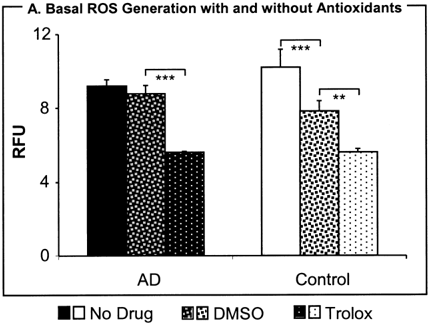
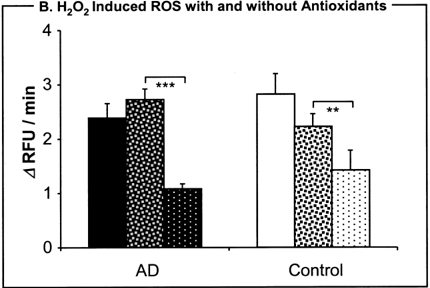
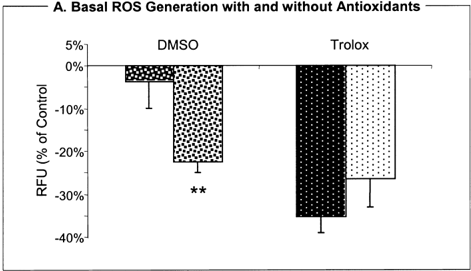
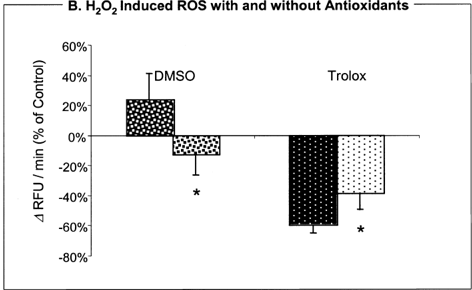
Oxidative stress occurs in brains of Alzheimer's disease (AD) patients. A major question in AD research is whether the oxidative stress is just secondary to neurodegeneration. To test whether oxidative stress is an inherent property of AD tissues, the ability of cultured fibroblasts bearing the AD Presenilin-1 246 Ala-->Glu mutation to handle reactive oxygen species (ROS) was compared to controls. Although ROS in cells from AD subjects were only slightly less than cells from controls under basal conditions (-10%) or after exposure to H(2)O(2) (-16%), treatment with antioxidants revealed clear differences. Pretreatment with DMSO, a hydroxyl radical scavenger, reduced basal and H(2)O(2)-induced ROS levels significantly more in cells from controls (-22%, -22%) than in those from AD subjects (-4%, +14%). On the other hand, pretreatment with Trolox diminished H(2)O(2)-induced ROS significantly more in cells from AD (-60%) than control subjects (-39%). In summary, cells from AD patients have greater Trolox sensitive ROS and less DMSO sensitive ROS than controls. The results demonstrate that fibroblasts bearing this PS-1 mutation have altered means of handling oxidative stress and appear useful for determining the mechanism underlying the altered redox metabolism.
Overview
The claims and statistics of this paper haven’t been checked yet.
Free: it reads the open-access text and checks the first 5 claims that cite a source we can check. Create a free account to check every claim.
Integrity signals
Registry
Cites
Statistics
Figures

Verification
Claims the paper makes
The claims and statistics of this paper haven’t been checked yet.
Free: it reads the open-access text and checks the first 5 claims that cite a source we can check. Create a free account to check every claim.
Claims other papers make about this one
Each is checked against this paper’s own text: does it say what the citing paper says it does?
The source backs part of the claim, not all of it — or backs it for a different population, condition or comparison.
In the citing paper
“the increased generation of Aβ by cells from Alzheimer’s patients with mutant PSEN1 was accompanied by a reduction of ROS levels.422”
From Amyloid β-based therapy for Alzheimer’s disease: Challenges, successes and future (2023) · cites this paper as [422]
Experimental — accuracy not yet measured
Self-check
Percentages, sums and reported differences re-computed from the paper’s own numbers.
The self-check needs the paper’s full text.
Citations
Cites
Cloning of a gene bearing missense mutations in early-onset familial Alzheimer's disease
Sherrington, R., Rogaev, E. I., Liang, Y., Rogaeva, E. A., Levesque, G., Ikeda, M., Chi, H., Lin, C., Li, G., Holman, K., et al. (1995) · Nature · doi:10.1038/375754a0 · Cited by 4,051
Oxidative stress hypothesis in Alzheimer’s disease
Markesbery, W. R. (1997) · Free Radical Biology and Medicine · doi:10.1016/s0891-5849(96)00629-6 · Cited by 2,383
Copper, iron and zinc in Alzheimer's disease senile plaques
Lovell, M. A., Robertson, J. D., Teesdale, W. J., Campbell, J. L., & Markesbery, W. R. (1998) · Journal of the Neurological Sciences · doi:10.1016/s0022-510x(98)00092-6 · Cited by 2,120
Iron accumulation in Alzheimer disease is a source of redox-generated free radicals
Smith, M. A., Harris, P. L. R., Sayre, L. M., & Perry, G. (1997) · Proceedings of the National Academy of Sciences · doi:10.1073/pnas.94.18.9866 · Cited by 1,355
Sayre, L. M., Zelasko, D. A., Harris, P. L. R., Perry, G., Salomon, R. G., & Smith, M. A. (1997) · Journal of Neurochemistry · doi:10.1046/j.1471-4159.1997.68052092.x · Cited by 1,007
Oxidative Alterations in Alzheimer's Disease
Markesbery, W. R., & Carney, J. M. (1999) · Brain Pathology · doi:10.1111/j.1750-3639.1999.tb00215.x · Cited by 784
Markesbery, W. R., & Lovell, M. A. (1998) · Neurobiology of Aging · doi:10.1016/s0197-4580(98)00009-8 · Cited by 680
Presenilin-1 mutations downregulate the signalling pathway of the unfolded-protein response
Katayama, T., Imaizumi, K., Sato, N., Miyoshi, K., Kudo, T., Hitomi, J., Morihara, T., Yoneda, T., Gomi, F., Mori, Y., et al. (1999) · Nature Cell Biology · doi:10.1038/70265 · Cited by 524
Hensley, K., Maidt, M. L., Yu, Z., Sang, H., Markesbery, W. R., & Floyd, R. A. (1998) · The Journal of Neuroscience · doi:10.1523/jneurosci.18-20-08126.1998 · Cited by 507
Guo, Q., Sopher, B. L., Furukawa, K., Pham, D. G., Robinson, N., Martin, G. M., & Mattson, M. P. (1997) · The Journal of Neuroscience · doi:10.1523/jneurosci.17-11-04212.1997 · Cited by 481
Vowells, S. J., Sekhsaria, S., Malech, H. L., Shalit, M., & Fleisher, T. A. (1995) · Journal of Immunological Methods · doi:10.1016/0022-1759(94)00247-t · Cited by 425
Regoli, F., & Winston, G. W. (1999) · Toxicology and Applied Pharmacology · doi:10.1006/taap.1999.8637 · Cited by 403
Protein‐Bound Acrolein: A Novel Marker of Oxidative Stress in Alzheimer's Disease
Calingasan, N. Y., Uchida, K., & Gibson, G. E. (1999) · Journal of Neurochemistry · doi:10.1046/j.1471-4159.1999.0720751.x · Cited by 400
Self-citationGabuzda, D., Busciglio, J., Chen, L. B., Matsudaira, P., & Yankner, B. A. (1994) · Journal of Biological Chemistry · doi:10.1016/s0021-9258(17)36875-8 · Cited by 373
Vitamin E: beyond antioxidant function
Traber, M., & Packer, L. (1995) · The American Journal of Clinical Nutrition · doi:10.1093/ajcn/62.6.1501s · Cited by 365
Internal Ca2+ mobilization is altered in fibroblasts from patients with Alzheimer disease.
Ito, E., Oka, K., Etcheberrigaray, R., Nelson, T. J., McPhie, D. L., Tofel-Grehl, B., Gibson, G. E., & Alkon, D. L. (1994) · Proceedings of the National Academy of Sciences · doi:10.1073/pnas.91.2.534 · Cited by 321
Self-citationLi, P.-F., Dietz, R., & von Harsdorf, R. (1997) · Circulation · doi:10.1161/01.cir.96.10.3602 · Cited by 288
Niwa, M., Sidrauski, C., Kaufman, R. J., & Walter, P. (1999) · Cell · doi:10.1016/s0092-8674(00)81667-0 · Cited by 276
Sheehan, J. P., Swerdlow, R. H., Miller, S. W., Davis, R. E., Parks, J. K., Parker, W. D., & Tuttle, J. B. (1997) · The Journal of Neuroscience · doi:10.1523/jneurosci.17-12-04612.1997 · Cited by 249
Presenilins, the Endoplasmic Reticulum, and Neuronal Apoptosis in Alzheimer's Disease
Mattson, M. P., Guo, Q., Furukawa, K., & Pedersen, W. A. (1998) · Journal of Neurochemistry · doi:10.1046/j.1471-4159.1998.70010001.x · Cited by 247
Inflammation of the brain in Alzheimer's disease: implications for therapy
McGeer, P. L., & McGeer, E. G. (1999) · Journal of Leukocyte Biology · doi:10.1002/jlb.65.4.409 · Cited by 220
Keller, J. N., Guo, Q., Holtsberg, F. W., Bruce-Keller, A. J., & Mattson, M. P. (1998) · The Journal of Neuroscience · doi:10.1523/jneurosci.18-12-04439.1998 · Cited by 215
Peripheral markers in testing pathophysiological hypotheses and diagnosing Alzheimer's disease
Gasparini, L., Racchi, M., Binetti, G., Trabucchi, M., Solerte, S. B., Alkon, D., Etcheberrigaray, R., Gibson, G., Blass, J., Paoletti, R., et al. (1998) · The FASEB Journal · doi:10.1096/fasebj.12.1.17 · Cited by 175
Self-citationJackson, V. N., & Halestrap, A. P. (1996) · Journal of Biological Chemistry · doi:10.1074/jbc.271.2.861 · Cited by 173
Oxidative damage to DNA in lymphocytes from AD patients
Mecocci, P., Polidori, M. C., Ingegni, T., Cherubini, A., Chionne, F., Cecchetti, R., & Senin, U. (1998) · Neurology · doi:10.1212/wnl.51.4.1014 · Cited by 166
Marchesi, E., Rota, C., Fann, Y. C., Chignell, C. F., & Mason, R. P. (1999) · Free Radical Biology and Medicine · doi:10.1016/s0891-5849(98)00174-9 · Cited by 162
Quantitation of the hydroxyl radical by reaction with dimethyl sulfoxide
Steiner, M. G., & Babbs, C. F. (1990) · Archives of Biochemistry and Biophysics · doi:10.1016/0003-9861(90)90288-a · Cited by 161
[11] Detection and quantitation of hydroxyl radical using dimethyl sulfoxide as molecular probe
Babbs, C. F., & Steiner, M. G. (1990) · Methods in enzymology on CD-ROM/Methods in enzymology · doi:10.1016/0076-6879(90)86103-3 · Cited by 138
Microglia and Alzheimer’s disease
Kalaria, R. N. (1999) · Current Opinion in Hematology · doi:10.1097/00062752-199901000-00004 · Cited by 133
Impaired Antioxidant Defense System in the Kidney Tissues from Rabbits Treated with Cyclosporine
Durak, İ., Karabacak, H. İ., Büyükkoçak, S., Çimen, M., Kaçmaz, M., Ömeroğlu, E., & Öztürk, S. (1998) · The Nephron journals/Nephron journals · doi:10.1159/000044912 · Cited by 105
Parkinson's disease and Alzheimer's disease: hypersensitivity to X rays in cultured cell lines.
Robbins, J. H., Otsuka, F., Tarone, R. E., Polinsky, R. J., Brumback, R. A., & Nee, L. E. (1985) · Journal of Neurology, Neurosurgery & Psychiatry · doi:10.1136/jnnp.48.9.916 · Cited by 102
Bursztajn, S., DeSouza, R., McPhie, D. L., Berman, S. A., Shioi, J., Robakis, N. K., & Neve, R. L. (1998) · The Journal of Neuroscience · doi:10.1523/jneurosci.18-23-09790.1998 · Cited by 102
Wei, H., Cai, Q., Rahn, R. O., & Zhang, X. (1997) · Free Radical Biology and Medicine · doi:10.1016/s0891-5849(96)00526-6 · Cited by 101
Oxygen radicals induce stress proteins and tolerance to oxidative stress in human lymphocytes
MARINI, M. (1996) · International Journal of Radiation Biology · doi:10.1080/095530096145076 · Cited by 93
Butterfield, D. A., Martin, L., Carney, J. M., & Hensley, K. (1995) · Life Sciences · doi:10.1016/0024-3205(95)02279-1 · Cited by 71
Kumar, U., Dunlop, D. M., & Richardson, J. S. (1994) · Life Sciences · doi:10.1016/0024-3205(94)90142-2 · Cited by 68
Prolyl Hydroxylase, Protein Disulfide Isomerase and Other Structurally Related Proteins
Guzman, N. A. (1997) · M. Dekker eBooks · Cited by 62
Use of Cultured Fibroblasts in Elucidating the Pathophysiology and Diagnosis of Alzheimer's Diseasea
Huang, H., Martins, R. N., Gandy, S., Etcheberrigaray, R., Ito, E., Alkon, D. L., Blass, J. P., & Gibson, G. E. (1994) · Annals of the New York Academy of Sciences · doi:10.1111/j.1749-6632.1994.tb44412.x · Cited by 56
Self-citationRojas, C., Cadenas, S., Lopez‐Torres, M., Pérez‐Campo, R., & Barja, G. (1996) · Free Radical Biology and Medicine · doi:10.1016/s0891-5849(96)00223-7 · Cited by 51
Lii, C., Ko, Y., Chiang, M., Sung, W., & Chen, H. (1998) · Nutrition and Cancer · doi:10.1080/01635589809514725 · Cited by 47
Hardman, W. E., Barnes, C. J., Knight, C., & Cameron, I. (1997) · British Journal of Cancer · doi:10.1038/bjc.1997.389 · Cited by 45
What are the facts and artifacts of the pathogenensis and etiology of Alzheimer disease?
Smith, M. A., & Perry, G. L. (1998) · Journal of Chemical Neuroanatomy · doi:10.1016/s0891-0618(98)00061-1 · Cited by 39
Nonneural Markers in Alzheimer Disease
Blass, J. P., & Gibson, G. E. (1992) · Alzheimer Disease & Associated Disorders · doi:10.1097/00002093-199206040-00003 · Cited by 37
Self-citationKalinich, J. F., Ramakrishnan, N., & McClain, D. E. (1997) · Free Radical Research · doi:10.3109/10715769709097782 · Cited by 35
Park, L. C. H., Calingasan, N. Y., Uchida, K., Zhang, H., & Gibson, G. E. (2000) · Journal of Neurochemistry · doi:10.1046/j.1471-4159.2000.0740114.x · Cited by 33
Self-citationVitamin E analogues reduce the incidence of ventricular fibrillations and scavenge free radicals
Walker, M., Vergely, C., Lecour, S., Abadie, C., Maupoil, V., & Rochette, L. (1998) · Fundamental and Clinical Pharmacology · doi:10.1111/j.1472-8206.1998.tb00937.x · Cited by 30
Free Radical Injury in Skin Cultured Fibroblasts from Alzheimer's Disease Patients
Tesco, G., Latorraca, S., Piersanti, P., Sorbi, S., Piacentini, S., & Amaducci, L. A. (1992) · Annals of the New York Academy of Sciences · doi:10.1111/j.1749-6632.1992.tb27446.x · Cited by 18
Alzheimer skin fibroblasts show increased susceptibility to free radicals
Tesco, G., Latorraca, S., Piersanti, P., Piacentini, S., Amaducci, L. A., & Sorbi, S. (1992) · Mechanisms of Ageing and Development · doi:10.1016/0047-6374(92)90129-2 · Cited by 17
Gibson, G. E., Tofel-Grehl, B., Scheffold, K., Cristofalo, V. J., & Blass, J. P. (1998) · AGE · doi:10.1007/s11357-998-0002-z · Cited by 16
Self-citationEffects of alpha-tocopherol on antioxidant enzyme activity in human fibroblast cultures.
Conti, M., Couturier, M., Lemonnier, A., & Lemonnier, F. (1993) · PubMed · Cited by 14
Mitotic index and Alzheimerʼs disease
Jenkins, E. C., Ye, L., Gu, H., & Wísniewski, H. M. (1998) · Neuroreport · doi:10.1097/00001756-199812010-00017 · Cited by 7
Research works printed but not linked: 7
- J. Sambrook, E.F. Fritsch, T. Maniatis, Molecular Cloning, Cold Spring Harbor Laboratory Press, Cold Spring Harbor, NY, 1989, pp. 9.16^9.19.
- H. Zhang, L.C.H. Park, H. Xu, G.E. Gibson, Soc. Neurosci. Abstr. 30, in press.
- M.A. Leissring, I. Parker, F.M. Laferla, Soc. Neurosci. Abst. 29 (1999) 641.7.
- R.P. Evstigneeva, I.M. Volkov, V.V. Chudinova, Membr. Cell Biol. 12 (1998) 151^172.
- W.I. Rosenblum, G.H. Nelson, R.A. Bei, R.B. Brandt, W. Chan, Am. J. Physiol. 271 (1996) H637^H642.
- K. Fukuchi, E.M. Bryan, C.E. Ogburn, A.C. Smith, M.G. Muna, T.D. Bird, G.M. Martin, Neurodegeneration 1 (1991) 193^200.
- M. Conti, M. Couturier, A. Lemonnier, F. Lemonnier, Int. J. Vit. Nutr. Res. 63 (1993) 71^76.
Cited by
Amyloid β-based therapy for Alzheimer’s disease: Challenges, successes and future
Zhang, Y., Chen, H., Li, R., Sterling, K., & Song, W. (2023) · Signal Transduction and Targeted Therapy · doi:10.1038/s41392-023-01484-7 · Cited by 988
“In addition, the increased generation of Aβ by cells from Alzheimer’s patients with mutant PSEN1 was accompanied by a reduction of ROS levels.(422) Conversely, application of Aβ to primary hippocampal neurons from PSEN1 mutant knock-in mice significantly increased superoxide production.”
BackgroundMitochondrial dysfunction, apoptotic cell death, and Alzheimer’s disease
Eckert, A., Keil, U., Marques, C. A., Bonert, A., Frey, C., Schüssel, K., & Müller, W. E. (2003) · Biochemical Pharmacology · doi:10.1016/s0006-2952(03)00534-3 · Cited by 309
Atwood, C. S., Obrenovich, M. E., Liu, T., Chan, H., Perry, G., Smith, M. A., & Martins, R. N. (2003) · Brain Research Reviews · doi:10.1016/s0165-0173(03)00174-7 · Cited by 293
Are mitochondria critical in the pathogenesis of Alzheimer's disease?
Reddy, P. H., & Beal, M. F. (2005) · Brain Research Reviews · doi:10.1016/j.brainresrev.2005.03.004 · Cited by 289
Oxidative DNA damage in peripheral leukocytes of mild cognitive impairment and AD patients
Migliore, L., Fontana, I., Trippi, F., Colognato, R., Coppedè, F., Tognoni, G., Nucciarone, B., & Siciliano, G. (2005) · Neurobiology of Aging · doi:10.1016/j.neurobiolaging.2004.07.016 · Cited by 263
Metadata
- Authors
- Gibson, G. E., Zhang, H., Sheu, K.-F. R., & Park, L. C. H.
- Affiliations
- Cornell University (US)
- Corresponding author
- Gibson, G.E.
- Venue
- Biochimica et Biophysica Acta (BBA) - Molecular Basis of Disease
- Publisher
- Elsevier BV
- Published
- 2000-11
- Volume
- 1502
- Issue
- 3
- Pages
- 319-329
- ISSN
- 0925-4439 (ISSN-L)
- OpenAlex
- W2071535287
- Cited by
- 44
- References
- 52
- Citations by year
- 2023: 2 · 2019: 1 · 2018: 2 · 2017: 1 · 2015: 1 · 2014: 1 · 2013: 3 · 2012: 3
- FWCI
- 1.83
- Type
- journal article
- Language
- en
- Open access
- hybrid
- doi.org
- Licence
- cc-by-nc-nd
- www.elsevier.com/tdm/userlicense/1.0/ (tdm)
- www.elsevier.com/legal/tdmrep-license (tdm)
- creativecommons.org/licenses/by-nc-nd/4.0/ (vor, 366 d)
- Locations
- Biochimica et Biophysica Acta (BBA) - Molecular Basis of Disease (publishedVersion, cc-by-nc-nd)
- PubMed (publishedVersion)
- Funders
- National Institutes of Health
- National Institute on Aging (P01AG014930, R01AG011921, AG011921, AG14930)
- Topics
- Life Sciences › Neuroscience › Cellular and Molecular Neuroscience › Alzheimer's disease research and treatments
- Life Sciences › Biochemistry, Genetics and Molecular Biology › Molecular Biology › Redox biology and oxidative stress
- Health Sciences › Medicine › Biochemistry (medical) › Antioxidant Activity and Oxidative Stress
- Keywords
- Alzheimer's disease, oxidative stress, antioxidant capacity, reactive oxygen species, presenilin 1 mutations, fibroblasts, hydrogen peroxide, hydroxyl radical scavenging, dimethyl sulfoxide, Trolox, redox metabolism
- MeSH terms
- Adult, Aged, Alzheimer Disease, Antioxidants, Cells, Cultured, Chromans, Dimethyl Sulfoxide, Female, Fibroblasts, Fluoresceins, Fluorescent Dyes, Humans, Hydrogen Peroxide, Hydrogen-Ion Concentration, Male, Membrane Proteins, Middle Aged, Mutation, Free Radical Scavengers, Reactive Oxygen Species, Oxidative Stress, Presenilin-1
About these checks
Registry, retraction, Cites and statistics results are computed, not judged, with one exception: a printed reference that no index lists is read once by a model before it counts as a citation error. Claims are extracted by a model and kept only when their quote appears verbatim in the text; each cited source is then checked, with a model’s help, for whether it says what the claim relies on. Those verdicts can be wrong — read the claim’s quote and the cited source before relying on one.
Statistics and arithmetic are recomputed, not judged.
Confidence bands are shown only for fields calibrated on our annotated test set. None is calibrated yet, so no band is shown.
What counts as a claim ›How we measure confidence ›How we check this ›
Are you an author, or do you see a problem with this page? Request a review
Data sources
Bibliographic data: Semantic Scholar, OpenAlex, Crossref.
Contains information from the Semantic Scholar Academic Graph Datasets, made available under the ODC Attribution License (ODC-BY 1.0).
Semantic Scholar’s data is described in: Kinney, R., et al. (2023). The Semantic Scholar Open Data Platform. arXiv:2301.10140.
