

Cognitive behavioural treatment for women who have menopausal symptoms after breast cancer treatment (MENOS 1): a randomised controlled trial
Open accessThe DOI matches its Crossref record; 35 of the 35 references it cites were found in a registry or an index.
Abstract
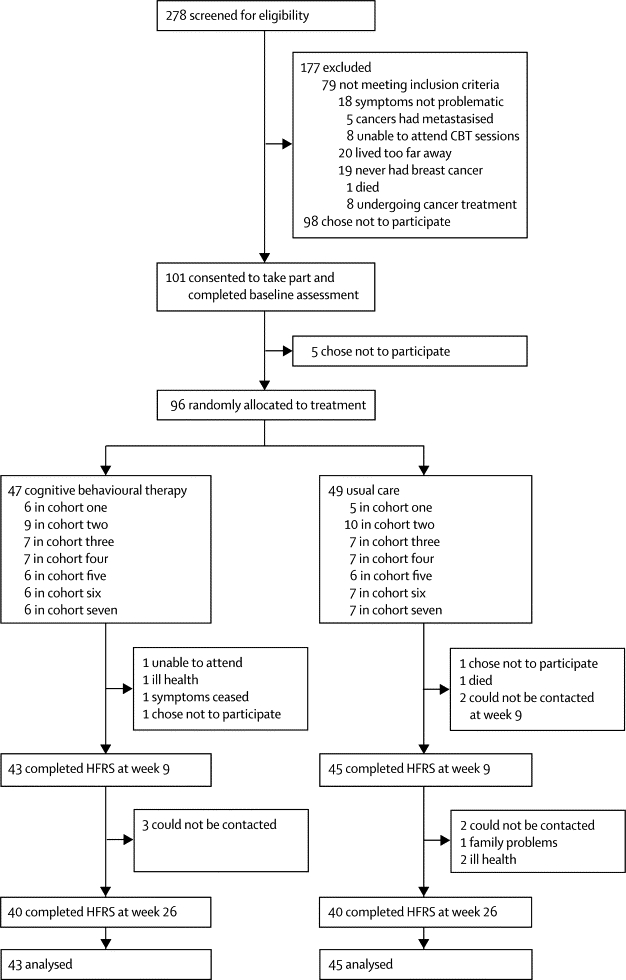
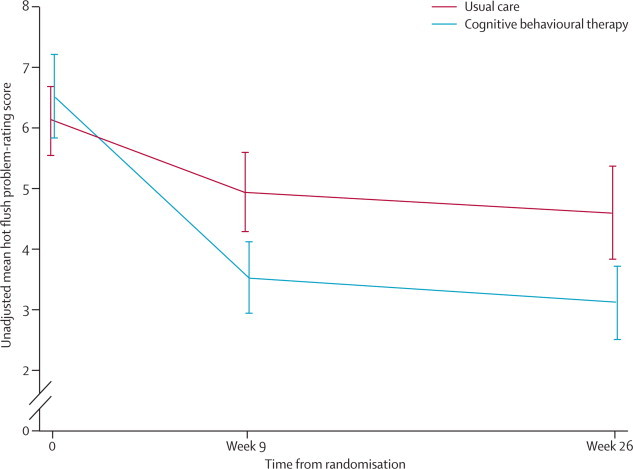
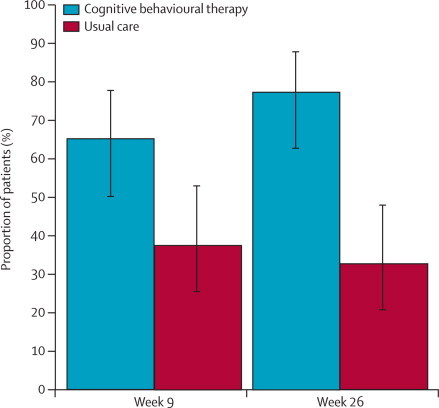
BACKGROUND: Hot flushes and night sweats (HFNS) affect 65-85% of women after breast cancer treatment; they are distressing, causing sleep problems and decreased quality of life. Hormone replacement therapy is often either undesirable or contraindicated. Safe, effective non-hormonal treatments are needed. We investigated whether cognitive behavioural therapy (CBT) can help breast cancer survivors to effectively manage HFNS. METHODS: In this randomised controlled trial, we recruited women from breast clinics in London, UK, who had problematic HFNS (minimum ten problematic episodes a week) after breast-cancer treatment. Participants were randomly allocated to receive either usual care or usual care plus group CBT (1:1). Randomisation was done in blocks of 12-20 participants, stratifying by age (younger than 50 years, 50 years or older), and was done with a computer-generated sequence. The trial statistician and researchers collecting outcome measures were masked to group allocation. Group CBT comprised one 90 min session a week for 6 weeks, and included psycho-education, paced breathing, and cognitive and behavioural strategies to manage HFNS. Assessments were done at baseline, 9 weeks, and 26 weeks after randomisation. The primary outcome was the adjusted mean difference in HFNS problem rating (1-10) between CBT and usual care groups at 9 weeks after randomisation. Analysis of the primary endpoint was done by modified intention to treat. The trial is registered, ISRCTN13771934, and was closed March 15, 2011. FINDINGS: Between May 5, 2009, and Aug 27, 2010, 96 women were randomly allocated to group CBT (n=47) or usual care (n=49). Group CBT significantly reduced HFNS problem rating at 9 weeks after randomisation compared with usual care (mean difference -1·67, 95% CI -2·43 to -0·91; p<0·0001) and improvements were maintained at 26 weeks (mean difference -1·76, -2·54 to -0·99; p<0·0001). We recorded no CBT-related adverse events. INTERPRETATION: Group CBT seems to be a safe and effective treatment for women who have problematic HFNS after breast cancer treatment with additional benefits to mood, sleep, and quality of life. The treatment could be incorporated into breast cancer survivorship programmes and delivered by trained breast cancer nurses. FUNDING: Cancer Research UK.
Overview
The claims and statistics of this paper haven’t been checked yet.
Free: it reads the open-access text and checks the first 5 claims that cite a source we can check. Create a free account to check every claim.
Integrity signals
Registry
Cites
Statistics
Figures
Verification
Claims the paper makes
The claims and statistics of this paper haven’t been checked yet.
Free: it reads the open-access text and checks the first 5 claims that cite a source we can check. Create a free account to check every claim.
Claims other papers make about this one
Each is checked against this paper’s own text: does it say what the citing paper says it does?
The source backs part of the claim, not all of it — or backs it for a different population, condition or comparison.
In the citing paper
“For menopausal symptoms in general, mind-body interventions, physical training and cognitive behavioural therapy should be recommended as effective non-pharmacological treatment options.113, 114, 115, 116, 117”
From 5th ESO-ESMO international consensus guidelines for advanced breast cancer (ABC 5) (2020) · cites this paper as [114]
Experimental — accuracy not yet measuredThe cited source says what the claim attributes to it.
In the citing paper
“Three studies (Ayers et al., 2012; Kalmbach et al., 2019; Mann et al., 2012) found evidence for the effectiveness of CBT on the outcomes of the 36 Item Short Form Health Survey (SF-36, Ware & Sherbourne, 1992).”
From The effectiveness of psychosocial interventions on non-physiological symptoms of menopause: A systematic review and meta-analysis (2024) · cites this paper as Mann et al., 2012
Self-check
Percentages, sums and reported differences re-computed from the paper’s own numbers.
The self-check needs the paper’s full text.
Citations
Cites
SF-36 health survey: Manual and interpretation guide
Ware, J. (2003) · Medical Entomology and Zoology · Cited by 11,424
The ATAC (Arimidex, T. A. O. I. C. T. G. (2003) · Cancer · doi:10.1002/cncr.11745 · Cited by 861
Loprinzi, C. L., Kugler, J. W., Sloan, J. A., Mailliard, J. A., LaVasseur, B. I., Barton, D. L., Novotny, P. J., Dakhil, S. R., Rodger, K., Rummans, T. A., et al. (2000) · The Lancet · doi:10.1016/s0140-6736(00)03403-6 · Cited by 737
Pradhan, A. D., Manson, J. E., Rossouw, J. E., Siscovick, D. S., Mouton, C. P., Rifai, N., Wallace, R. B., Jackson, R. D., Pettinger, M. B., & Ridker, P. M. (2002) · JAMA · doi:10.1001/jama.288.8.980 · Cited by 680
Wampold, B. E., & Brown, G. S. (. (2005) · Journal of Consulting and Clinical Psychology · doi:10.1037/0022-006x.73.5.914 · Cited by 476
Adherence to tamoxifen over the five-year course
Lash, T. L., Fox, M. P., Westrup, J. L., Fink, A. K., & Silliman, R. A. (2006) · Breast Cancer Research and Treatment · doi:10.1007/s10549-006-9193-0 · Cited by 320
Cella, D., & Fallowfield, L. J. (2008) · Breast Cancer Research and Treatment · doi:10.1007/s10549-007-9548-1 · Cited by 286
Gupta, P., Sturdee, D. W., Palin, S. L., Majumder, K., Fear, R., Marshall, T., & Paterson, I. (2006) · Climacteric · doi:10.1080/13697130500487224 · Cited by 217
Ayers, B., Smith, M., Hellier, J., Mann, E., & Hunter, M. S. (2012) · Menopause · doi:10.1097/gme.0b013e31823fe835 · Cited by 207
Self-citationHot Flashes and Related Outcomes in Breast Cancer Survivors and Matched Comparison Women
Carpenter, J. S., Johnson, D. H., Wagner, L. J., & Andrykowski, M. A. (2002) · Oncology Nursing Forum · doi:10.1188/02.onf.e16-e25 · Cited by 193
A psychological analysis of menopausal hot flushes
Hunter, M. S., & Liao, K. L. (1995) · British Journal of Clinical Psychology · doi:10.1111/j.2044-8260.1995.tb01493.x · Cited by 187
Self-citationNon-hormonal interventions for hot flushes in women with a history of breast cancer
Rada, G., Capurro, D., Pantoja, T., Corbalán, J., Moreno, G., Letelier, L. M., & Vera, C. (2010) · Cochrane Database of Systematic Reviews · doi:10.1002/14651858.cd004923.pub2 · Cited by 160
A cognitive model of menopausal hot flushes and night sweats
Hunter, M. S., & Mann, E. (2010) · Journal of Psychosomatic Research · doi:10.1016/j.jpsychores.2010.04.005 · Cited by 148
Self-citationThe Women's Health Questionnaire (WHQ): Frequently Asked Questions (FAQ).
Hunter, M. S. (2003) · Health and Quality of Life Outcomes · doi:10.1186/1477-7525-1-41 · Cited by 121
Self-citationGabapentin for the treatment of menopausal hot flashes: a randomized controlled trial
Butt, D. A., Lock, M., Lewis, J. E., Ross, S., & Moineddin, R. (2008) · Menopause · doi:10.1097/gme.0b013e3180dca175 · Cited by 119
Evaluation of a four‐session cognitive–behavioural intervention for menopausal hot flushes
Hunter, M. S., & Liao, K. L. (1996) · British Journal of Health Psychology · doi:10.1111/j.2044-8287.1996.tb00496.x · Cited by 116
Self-citationBehavioral treatment of menopausal hot flashes: Evaluation by objective methods.
Germaine, L. M., & Freedman, R. R. (1984) · Journal of Consulting and Clinical Psychology · doi:10.1037//0022-006x.52.6.1072 · Cited by 113
Hunter, M. (2000) · Quality of Life Research · doi:10.1023/a:1008973822876 · Cited by 109
Self-citationMenopausal symptoms in women with breast cancer: Prevalence and treatment preferences
Hunter, M. S., Grunfeld, E. A., Mittal, S., Sikka, P., Ramirez, A., Fentiman, I., & Hamed, H. (2004) · Psycho-Oncology · doi:10.1002/pon.793 · Cited by 105
Self-citationBuijs, C., Mom, C. H., Willemse, P. H. B., Boezen, H. M., Maurer, J. M., Wymenga, A. N. M., de Jong, R. S., Nieboer, P., de Vries, E. G. E., & Mourits, M. J. E. (2008) · Breast Cancer Research and Treatment · doi:10.1007/s10549-008-0138-7 · Cited by 102
Hunter, M. S., Coventry, S., Hamed, H., Fentiman, I., & Grunfeld, E. A. (2009) · Psycho-Oncology · doi:10.1002/pon.1414 · Cited by 95
Self-citationManagement of menopausal symptoms in breast cancer patients
Loibl, S., Lintermans, A., Dieudonné, A. S., & Neven, P. (2010) · Maturitas · doi:10.1016/j.maturitas.2010.11.013 · Cited by 64
Mann, E., & Hunter, M. S. (2011) · Menopause · doi:10.1097/gme.0b013e318204a1fb · Cited by 57
Self-citationNon-hormonal treatment of hot flushes in breast cancer survivors: gabapentin vs. vitamin E
Biglia, N., Sgandurra, P., Peano, E., Marenco, D., Moggio, G., Bounous, V., Tomasi Cont, N., Ponzone, R., & Sismondi, P. (2009) · Climacteric · doi:10.1080/13697130902736921 · Cited by 56
Modeling hot flushes and quality of life in breast cancer survivors
Rand, K. L., Otte, J. L., Flockhart, D., Hayes, D., Storniolo, A. M., Stearns, V., Henry, N. L., Nguyen, A., Lemler, S., Hayden, J., et al. (2011) · Climacteric · doi:10.3109/13697131003717070 · Cited by 53
Mann, E., Smith, M., Hellier, J., & Hunter, M. S. (2011) · BMC Cancer · doi:10.1186/1471-2407-11-44 · Cited by 43
Self-citationModeling the hot flash experience in breast cancer survivors
Carpenter, J. S., & Rand, K. L. (2008) · Menopause · doi:10.1097/gme.0b013e3181591db7 · Cited by 38
Duijts, S. F., Oldenburg, H. S., van Beurden, M., & Aaronson, N. K. (2009) · BMC Women's Health · doi:10.1186/1472-6874-9-15 · Cited by 36
Damirchi, A., Mehdizade, R., Ansar, M. M., Tehrani, B. S., & Babaei, P. (2009) · Climacteric · doi:10.3109/13697130903360234 · Cited by 33
Cognitive-Behavioral Intervention for Hot Flashes
Carpenter, J. S., Neal, J. G., Payne, J. K., Kimmick, G. G., & Storniolo, A. M. (2007) · Oncology nursing forum · doi:10.1188/07.onf.e1-e8 · Cited by 32
Savard, M., Savard, J., Trudel‐Fitzgerald, C., Ivers, H., & Quesnel, C. (2011) · Menopause The Journal of The North American Menopause Society · doi:10.1097/gme.0b013e31820db6a1 · Cited by 32
Kaplan, M., Mahon, S., Cope, D., Keating, E., Hill, S., & Jacobson, M. (2011) · Clinical Journal of Oncology Nursing · doi:10.1188/11.cjon.149-157 · Cited by 26
Maki, P. M. (2011) · Menopause The Journal of The North American Menopause Society · doi:10.1097/gme.0b013e31821ace67 · Cited by 6
Duijts, S. F. A., Oldenburg, H. S. A., van Beurden, M., & Aaronson, N. K. (2010) · European Journal of Cancer Supplements · doi:10.1016/s1359-6349(10)70536-x · Cited by 2
Cited by
3rd ESO–ESMO International Consensus Guidelines for Advanced Breast Cancer (ABC 3)
Cardoso, F., Costa, A., Senkus, E., Aapro, M., André, F., Barrios, C. H., Bergh, J., Bhattacharyya, G., Biganzoli, L., Cardoso, M. J., et al. (2017) · Annals of Oncology · doi:10.1093/annonc/mdw544 · Cited by 2,033
Breast Cancer, Version 4.2017, NCCN Clinical Practice Guidelines in Oncology
Gradishar, W. J., Anderson, B. O., Balassanian, R., Blair, S. L., Burstein, H. J., Cyr, A., Elias, A. D., Farrar, W. B., Forero, A., Giordano, S. H., et al. (2018) · Journal of the National Comprehensive Cancer Network · doi:10.6004/jnccn.2018.0012 · Cited by 1,609
Self-citationESHRE Guideline: management of women with premature ovarian insufficiency
(2016) · Human Reproduction · doi:10.1093/humrep/dew027 · Cited by 1,555
“Psychological and lifestyle interventions should be accessible to women with POI (Boivin, 2003; Duijts et al., 2012; Mann et al., 2012a,b) B What are the consequences of POI for sexuality?”
Background5th ESO-ESMO international consensus guidelines for advanced breast cancer (ABC 5)
Cardoso, F., Paluch-Shimon, S., Senkus, E., Curigliano, G., Aapro, M. S., André, F., Barrios, C. H., Bergh, J., Bhattacharyya, G. S., Biganzoli, L., et al. (2020) · Annals of Oncology · doi:10.1016/j.annonc.2020.09.010 · Cited by 1,369
“For menopausal symptoms in general, mind-body interventions, physical training and cognitive behavioural therapy should be recommended as effective non-pharmacological treatment options.(113-117) To control hot flushes, valid alternatives are venlafaxine, oxybutynin, gabapentin and clonidine.”
BackgroundMurphy, C. C., Bartholomew, L. K., Carpentier, M. Y., Bluethmann, S. M., & Vernon, S. W. (2012) · Breast Cancer Research and Treatment · doi:10.1007/s10549-012-2114-5 · Cited by 708
Metadata
- Authors
- Mann, E., Smith, M. J., Hellier, J., Balabanovic, J. A., Hamed, H., Grunfeld, E. A., & Hunter, M. S.
- Affiliations
- King's College London (GB)
- Guy's and St Thomas' NHS Foundation Trust (GB)
- University of Birmingham (GB)
- Corresponding author
- Hunter, Myra S
- ORCID
- Venue
- The Lancet Oncology
- Publisher
- Elsevier BV
- Published
- 2012-03
- Volume
- 13
- Issue
- 3
- Pages
- 309-318
- ISSN
- 1470-2045 (ISSN-L)
- PMC
- PMC3314999
- OpenAlex
- W2122368260
- Cited by
- 307
- References
- 35
- Citations by year
- 2026: 19 · 2025: 27 · 2024: 15 · 2023: 14 · 2022: 13 · 2021: 45 · 2020: 30 · 2019: 16 · 2018: 19 · 2017: 16 · 2016: 21 · 2015: 15 · 2014: 19 · 2013: 21 · 2012: 16
- FWCI
- 11.23
- Type
- journal article
- Language
- en
- Open access
- hybrid
- doi.org
- Licence
- cc-by
- www.elsevier.com/tdm/userlicense/1.0/ (tdm)
- www.elsevier.com/legal/tdmrep-license (tdm)
- creativecommons.org/licenses/by/4.0/ (vor, 649 d)
- Locations
- The Lancet Oncology (publishedVersion, cc-by)
- PubMed Central (publishedVersion, cc-by)
- PubMed (publishedVersion)
- BIROn (Birkbeck, University of London) (acceptedVersion)
- Research Portal (King's College London) (submittedVersion, other-oa)
- University of Birmingham Research Portal (University of Birmingham) (submittedVersion)
- Funders
- Cancer Research UK (grant C8303/A6130)
- Topics
- Health Sciences › Medicine › Oncology › Cancer survivorship and care
- Health Sciences › Medicine › Endocrinology, Diabetes and Metabolism › Menopause: Health Impacts and Treatments
- Health Sciences › Medicine › Psychiatry and Mental health › Sexual function and dysfunction studies
- Keywords
- cognitive behavioral therapy, hot flashes, night sweats, menopausal symptoms, breast cancer survivors, non-hormonal therapy, group therapy, mood, quality of life, sleep disorders, psychoeducation, paced breathing, long-term follow-up
- MeSH terms
- Affect, Antineoplastic Agents, Breast Neoplasms, Female, Humans, London, Mastectomy, Menopause, Middle Aged, Quality of Life, Surveys and Questionnaires, Sleep, Sweating, Time Factors, Cognitive Behavioral Therapy, Linear Models, Treatment Outcome, Chemotherapy, Adjuvant, Radiotherapy, Adjuvant, Hot Flashes
About these checks
Registry, retraction, Cites and statistics results are computed, not judged, with one exception: a printed reference that no index lists is read once by a model before it counts as a citation error. Claims are extracted by a model and kept only when their quote appears verbatim in the text; each cited source is then checked, with a model’s help, for whether it says what the claim relies on. Those verdicts can be wrong — read the claim’s quote and the cited source before relying on one.
Statistics and arithmetic are recomputed, not judged.
Confidence bands are shown only for fields calibrated on our annotated test set. None is calibrated yet, so no band is shown.
What counts as a claim ›How we measure confidence ›How we check this ›
Are you an author, or do you see a problem with this page? Request a review
Data sources
Bibliographic data: Semantic Scholar, OpenAlex, Crossref.
Contains information from the Semantic Scholar Academic Graph Datasets, made available under the ODC Attribution License (ODC-BY 1.0).
Semantic Scholar’s data is described in: Kinney, R., et al. (2023). The Semantic Scholar Open Data Platform. arXiv:2301.10140.
