

Cognitive behavioural treatment for women who have menopausal symptoms after breast cancer treatment (MENOS 1): a randomised controlled trial
Open accessThe DOI matches its Crossref record; 35 of the 35 references it cites were found in a registry or an index.
Abstract
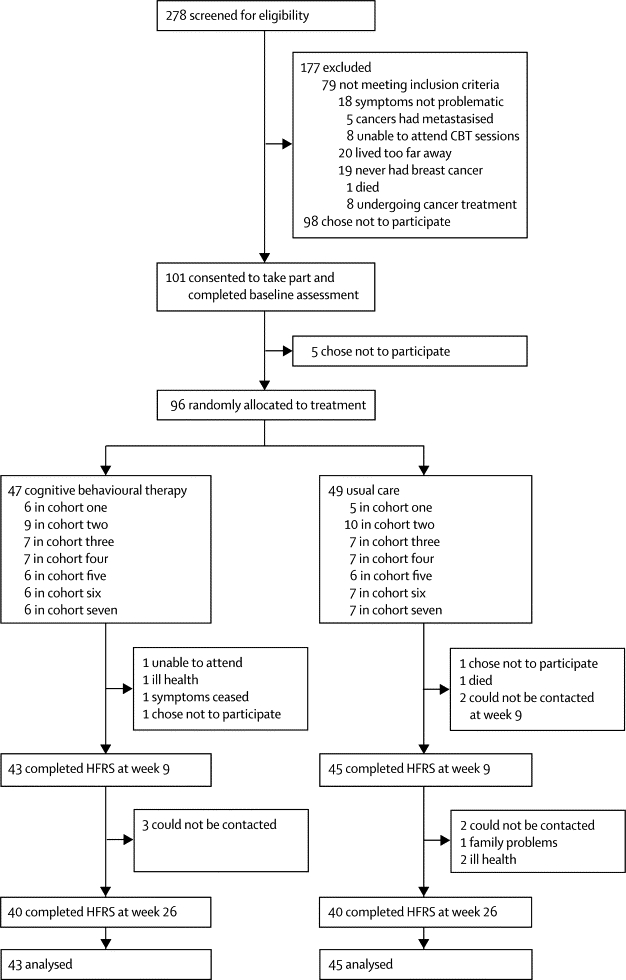
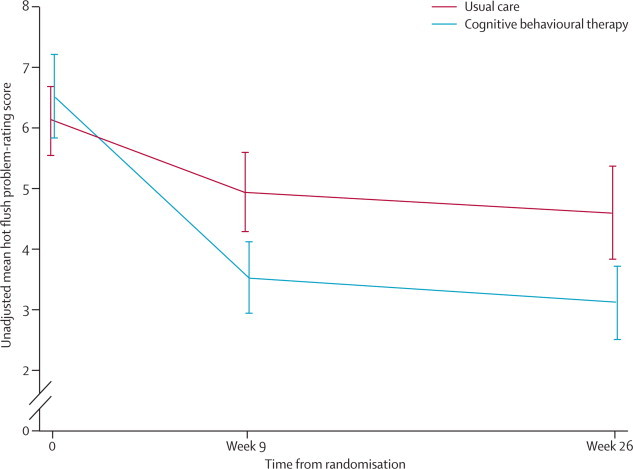
BACKGROUND: Hot flushes and night sweats (HFNS) affect 65-85% of women after breast cancer treatment; they are distressing, causing sleep problems and decreased quality of life. Hormone replacement therapy is often either undesirable or contraindicated. Safe, effective non-hormonal treatments are needed. We investigated whether cognitive behavioural therapy (CBT) can help breast cancer survivors to effectively manage HFNS. METHODS: In this randomised controlled trial, we recruited women from breast clinics in London, UK, who had problematic HFNS (minimum ten problematic episodes a week) after breast-cancer treatment. Participants were randomly allocated to receive either usual care or usual care plus group CBT (1:1). Randomisation was done in blocks of 12-20 participants, stratifying by age (younger than 50 years, 50 years or older), and was done with a computer-generated sequence. The trial statistician and researchers collecting outcome measures were masked to group allocation. Group CBT comprised one 90 min session a week for 6 weeks, and included psycho-education, paced breathing, and cognitive and behavioural strategies to manage HFNS. Assessments were done at baseline, 9 weeks, and 26 weeks after randomisation. The primary outcome was the adjusted mean difference in HFNS problem rating (1-10) between CBT and usual care groups at 9 weeks after randomisation. Analysis of the primary endpoint was done by modified intention to treat. The trial is registered, ISRCTN13771934, and was closed March 15, 2011. FINDINGS: Between May 5, 2009, and Aug 27, 2010, 96 women were randomly allocated to group CBT (n=47) or usual care (n=49). Group CBT significantly reduced HFNS problem rating at 9 weeks after randomisation compared with usual care (mean difference -1·67, 95% CI -2·43 to -0·91; p<0·0001) and improvements were maintained at 26 weeks (mean difference -1·76, -2·54 to -0·99; p<0·0001). We recorded no CBT-related adverse events. INTERPRETATION: Group CBT seems to be a safe and effective treatment for women who have problematic HFNS after breast cancer treatment with additional benefits to mood, sleep, and quality of life. The treatment could be incorporated into breast cancer survivorship programmes and delivered by trained breast cancer nurses. FUNDING: Cancer Research UK.
Overview
The claims and statistics of this paper haven’t been checked yet.
Free: it reads the open-access text and checks the first 5 claims that cite a source we can check. Create a free account to check every claim.
Integrity signals
Registry
Cites
Statistics
Figures
Verification
Claims the paper makes
The claims and statistics of this paper haven’t been checked yet.
Free: it reads the open-access text and checks the first 5 claims that cite a source we can check. Create a free account to check every claim.
Claims other papers make about this one
Each is checked against this paper’s own text: does it say what the citing paper says it does?
The source backs part of the claim, not all of it — or backs it for a different population, condition or comparison.
In the citing paper
“For menopausal symptoms in general, mind-body interventions, physical training and cognitive behavioural therapy should be recommended as effective non-pharmacological treatment options.113, 114, 115, 116, 117”
From 5th ESO-ESMO international consensus guidelines for advanced breast cancer (ABC 5) (2020) · cites this paper as [114]
Experimental — accuracy not yet measuredThe cited source says what the claim attributes to it.
In the citing paper
“Three studies (Ayers et al., 2012; Kalmbach et al., 2019; Mann et al., 2012) found evidence for the effectiveness of CBT on the outcomes of the 36 Item Short Form Health Survey (SF-36, Ware & Sherbourne, 1992).”
From The effectiveness of psychosocial interventions on non-physiological symptoms of menopause: A systematic review and meta-analysis (2024) · cites this paper as Mann et al., 2012
Self-check
Percentages, sums and reported differences re-computed from the paper’s own numbers.
The self-check needs the paper’s full text.
Citations
Cites
SF-36 health survey: Manual and interpretation guide
Ware, J. (2003) · Medical Entomology and Zoology · Cited by 11,424
The ATAC (Arimidex, T. A. O. I. C. T. G. (2003) · Cancer · doi:10.1002/cncr.11745 · Cited by 861
Loprinzi, C. L., Kugler, J. W., Sloan, J. A., Mailliard, J. A., LaVasseur, B. I., Barton, D. L., Novotny, P. J., Dakhil, S. R., Rodger, K., Rummans, T. A., et al. (2000) · The Lancet · doi:10.1016/s0140-6736(00)03403-6 · Cited by 737
Pradhan, A. D., Manson, J. E., Rossouw, J. E., Siscovick, D. S., Mouton, C. P., Rifai, N., Wallace, R. B., Jackson, R. D., Pettinger, M. B., & Ridker, P. M. (2002) · JAMA · doi:10.1001/jama.288.8.980 · Cited by 680
Wampold, B. E., & Brown, G. S. (. (2005) · Journal of Consulting and Clinical Psychology · doi:10.1037/0022-006x.73.5.914 · Cited by 476
Adherence to tamoxifen over the five-year course
Lash, T. L., Fox, M. P., Westrup, J. L., Fink, A. K., & Silliman, R. A. (2006) · Breast Cancer Research and Treatment · doi:10.1007/s10549-006-9193-0 · Cited by 320
Cella, D., & Fallowfield, L. J. (2008) · Breast Cancer Research and Treatment · doi:10.1007/s10549-007-9548-1 · Cited by 286
Gupta, P., Sturdee, D. W., Palin, S. L., Majumder, K., Fear, R., Marshall, T., & Paterson, I. (2006) · Climacteric · doi:10.1080/13697130500487224 · Cited by 217
Ayers, B., Smith, M., Hellier, J., Mann, E., & Hunter, M. S. (2012) · Menopause · doi:10.1097/gme.0b013e31823fe835 · Cited by 207
Self-citation
Cited by
3rd ESO–ESMO International Consensus Guidelines for Advanced Breast Cancer (ABC 3)
Cardoso, F., Costa, A., Senkus, E., Aapro, M., André, F., Barrios, C. H., Bergh, J., Bhattacharyya, G., Biganzoli, L., Cardoso, M. J., et al. (2017) · Annals of Oncology · doi:10.1093/annonc/mdw544 · Cited by 2,033
Breast Cancer, Version 4.2017, NCCN Clinical Practice Guidelines in Oncology
Gradishar, W. J., Anderson, B. O., Balassanian, R., Blair, S. L., Burstein, H. J., Cyr, A., Elias, A. D., Farrar, W. B., Forero, A., Giordano, S. H., et al. (2018) · Journal of the National Comprehensive Cancer Network · doi:10.6004/jnccn.2018.0012 · Cited by 1,609
Self-citationESHRE Guideline: management of women with premature ovarian insufficiency
(2016) · Human Reproduction · doi:10.1093/humrep/dew027 · Cited by 1,555
“Psychological and lifestyle interventions should be accessible to women with POI (Boivin, 2003; Duijts et al., 2012; Mann et al., 2012a,b) B What are the consequences of POI for sexuality?”
Background5th ESO-ESMO international consensus guidelines for advanced breast cancer (ABC 5)
Cardoso, F., Paluch-Shimon, S., Senkus, E., Curigliano, G., Aapro, M. S., André, F., Barrios, C. H., Bergh, J., Bhattacharyya, G. S., Biganzoli, L., et al. (2020) · Annals of Oncology · doi:10.1016/j.annonc.2020.09.010 · Cited by 1,369
“For menopausal symptoms in general, mind-body interventions, physical training and cognitive behavioural therapy should be recommended as effective non-pharmacological treatment options.(113-117) To control hot flushes, valid alternatives are venlafaxine, oxybutynin, gabapentin and clonidine.”
BackgroundMurphy, C. C., Bartholomew, L. K., Carpentier, M. Y., Bluethmann, S. M., & Vernon, S. W. (2012) · Breast Cancer Research and Treatment · doi:10.1007/s10549-012-2114-5 · Cited by 708
Eccles, S. A., Aboagye, E. O., Ali, S., Anderson, A. S., Armes, J., Berditchevski, F., Blaydes, J. P., Brennan, K., Brown, N. J., Bryant, H. E., et al. (2013) · Breast Cancer Research · doi:10.1186/bcr3493 · Cited by 421
“Effective means are required to support women to manage impaired sexuality/ sexual function, altered body image, lymphoedema, weight gain [354], fear of recurrence, hormone therapy-related symptoms [341,343,355,356], cognitive problems [357] [358] and post-surgical problems [359,360].”
Self-citationThe 2023 nonhormone therapy position statement of The North American Menopause Society
(2023) · Menopause · doi:10.1097/gme.0000000000002200 · Cited by 309
Franzoi, M. A., Agostinetto, E., Perachino, M., Del Mastro, L., de Azambuja, E., Vaz-Luis, I., Partridge, A. H., & Lambertini, M. (2021) · The Lancet Oncology · doi:10.1016/s1470-2045(20)30666-5 · Cited by 290
Complementary and Alternative Medicine for Menopause
Johnson, A., Roberts, L., & Elkins, G. (2019) · Journal of Evidence-Based Integrative Medicine · doi:10.1177/2515690x19829380 · Cited by 256
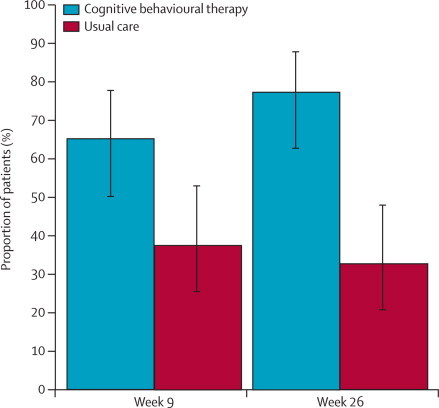
“Hot flash frequency was reduced by 38% in both groups, 38% indicating CBT was no better than usual care for reducing the frequency of hot flashes.(26) In a second RCT, 65% of women receiving a 4-week CBT intervention and 21% of a no-treatment control group, reported clinically significant improvements (eg, 2-point cha…”
BackgroundMethodDuijts, S. F. A., van Beurden, M., Oldenburg, H. S. A., Hunter, M. S., Kieffer, J. M., Stuiver, M. M., Gerritsma, M. A., Menke-Pluymers, M. B. E., Plaisier, P. W., Rijna, H., et al. (2012) · Journal of Clinical Oncology · doi:10.1200/jco.2012.41.8525 · Cited by 220
Self-citationHamoda, H., Panay, N., Pedder, H., Arya, R., & Savvas, M. (2020) · Post Reproductive Health · doi:10.1177/2053369120957514 · Cited by 192
Survivorship, Version 2.2017, NCCN Clinical Practice Guidelines in Oncology
Denlinger, C. S., Sanft, T., Baker, K. S., Baxi, S., Broderick, G., Demark-Wahnefried, W., Friedman, D. L., Goldman, M., Hudson, M., Khakpour, N., et al. (2017) · Journal of the National Comprehensive Cancer Network · doi:10.6004/jnccn.2017.0146 · Cited by 152
Treating menopause — MHT and beyond
Davis, S. R., & Baber, R. J. (2022) · Nature Reviews Endocrinology · doi:10.1038/s41574-022-00685-4 · Cited by 172
Otte, J. L., Carpenter, J. S., Manchanda, S., Rand, K. L., Skaar, T. C., Weaver, M., Chernyak, Y., Zhong, X., Igega, C., & Landis, C. (2015) · Cancer Medicine · doi:10.1002/cam4.356 · Cited by 153
Psychosocial/Survivorship Issues in Breast Cancer: Are We Doing Better?
Fallowfield, L., & Jenkins, V. (2014) · JNCI Journal of the National Cancer Institute · doi:10.1093/jnci/dju335 · Cited by 135
Managing side effects in adjuvant endocrine therapy for breast cancer
Condorelli, R., & Vaz-Luís, I. (2018) · Expert Review of Anticancer Therapy · doi:10.1080/14737140.2018.1520096 · Cited by 148
Kalter, J., Verdonck‐de Leeuw, I. M., Sweegers, M. G., Aaronson, N. K., Jacobsen, P. B., Newton, R. U., Courneya, K. S., Aitken, J. F., Armes, J., Arving, C., et al. (2018) · Psycho-Oncology · doi:10.1002/pon.4648 · Cited by 115
Self-citationMenopause, wellbeing and health: A care pathway from the European Menopause and Andropause Society
Lambrinoudaki, I. V., Armeni, E., Goulis, D. G., Bretz, S., Ceauşu, I., Durmuşoğlu, F., Erkkola, R., Fistonić, I., Gambacciani, M., Geukes, M., et al. (2022) · Maturitas · doi:10.1016/j.maturitas.2022.04.008 · Cited by 118
“The CBT protocols MENOS 1 and MENOS 2 have been recommended for the treatment of depression and anxiety during the menopausal transition and postmenopause [156,157].”
BackgroundHome-based multidimensional survivorship programmes for breast cancer survivors
Cheng, K. K. F., Lim, Y. T. E., Koh, Z. M., & Tam, W. W. S. (2017) · Cochrane Database of Systematic Reviews · doi:10.1002/14651858.cd011152.pub2 · Cited by 114
Premature menopause in young breast cancer: effects on quality of life and treatment interventions.
Rosenberg, S. M., & Partridge, A. H. (2013) · Europe PMC (PubMed Central) · doi:10.3978/j.issn.2072-1439.2013.06.20 · Cited by 114
Atema, V., van Leeuwen, M., Kieffer, J. M., Oldenburg, H. S. A., van Beurden, M., Gerritsma, M. A., Kuenen, M. A., Plaisier, P. W., Lopes Cardozo, A. M. F., van Riet, Y. E. A., et al. (2019) · Journal of Clinical Oncology · doi:10.1200/jco.18.00655 · Cited by 105
Self-citationSexual Health Issues in Women with Cancer
Krychman, M., & Millheiser, L. S. (2013) · The Journal of Sexual Medicine · doi:10.1111/jsm.12034 · Cited by 104
Cognitive behavior therapy for menopausal symptoms (CBT-Meno): a randomized controlled trial
Green, S. M., Donegan, E., Frey, B. N., Fedorkow, D. M., Key, B. L., Streiner, D. L., & McCabe, R. E. (2019) · Menopause · doi:10.1097/gme.0000000000001363 · Cited by 86
Cognitive behavioral therapy for menopausal symptoms
Hunter, M. S. (2020) · Climacteric · doi:10.1080/13697137.2020.1777965 · Cited by 104
Self-citationA Practitioner's Toolkit for Managing the Menopause
Jane, F., & Davis, S. R. (2014) · Climacteric · doi:10.3109/13697137.2014.929651 · Cited by 99
Lumsden, M. A., Dekkers, O. M., Faubion, S. S., Hirschberg, A. L., Jayasena, C. N., Lambrinoudaki, I. V., Louwers, Y. V., Pinkerton, J. V., Šojat, A. S., & van Hulsteijn, L. T. (2025) · European Journal of Endocrinology · doi:10.1093/ejendo/lvaf206 · Cited by 99
The menopausal hot flush: a review
Sturdee, D. W., Hunter, M. S., Maki, P. M., Gupta, P., Sassarini, J., Stevenson, J. C., & Lumsden, M. A. (2017) · Climacteric · doi:10.1080/13697137.2017.1306507 · Cited by 90
Self-citationElinzanetant for Vasomotor Symptoms from Endocrine Therapy for Breast Cancer
Cardoso, F., Parke, S., Brennan, D. J., Briggs, P., Donders, G. G. G., Panay, N., Mashhadi, N. H., Block, M. S., Caetano, C., Francuski, M., et al. (2025) · New England Journal of Medicine · doi:10.1056/nejmoa2415566 · Cited by 90
Hardy, C., Griffiths, A., Norton, S., & Hunter, M. S. (2018) · Menopause · doi:10.1097/gme.0000000000001048 · Cited by 86
Self-citationvan Driel, C. M. G., Stuursma, A., Schroevers, M. J., Mourits, M., & de Bock, G. H. (2018) · BJOG An International Journal of Obstetrics & Gynaecology · doi:10.1111/1471-0528.15153 · Cited by 89
Testing a cognitive model of menopausal hot flushes and night sweats
Hunter, M. S., & Chilcot, J. (2013) · Journal of Psychosomatic Research · doi:10.1016/j.jpsychores.2012.12.005 · Cited by 83
Self-citationCognitive Behavioral Therapy for Insomnia in Breast Cancer Survivors: A Review of the Literature
Aricò, D., Raggi, A., & Ferri, R. (2016) · Frontiers in Psychology · doi:10.3389/fpsyg.2016.01162 · Cited by 71
“…the studies (Quesnel et al., 2003; Savard et al., 2005a,b; Dirksen and Epstein, 2008; Tremblay et al., 2009; Mann et al., 2011; Savard et al., 2011; Mann et al., 2012; Roscoe et al., 2015; Savard et al., 2005a,b), in agreement withMorin et al. (Morin and Benca, 2012) who reported that CBT-I in…”
BackgroundMethodManchanda, R., Gaba, F., Talaulikar, V. S., Pundir, J., Gessler, S., Davies, M. C., & Menon, U. (2021) · BJOG An International Journal of Obstetrics & Gynaecology · doi:10.1111/1471-0528.16896 · Cited by 79
“66 CBT delivered as group therapy 70 or self-administered are equally effective, 69 with data supporting an internet-based approach.”
Savard, J., & Savard, M. (2013) · Sleep Medicine Clinics · doi:10.1016/j.jsmc.2013.04.006 · Cited by 74
Psychological Adjustment in Breast Cancer Survivors
Stanton, A. L., & Bower, J. E. (2015) · Advances in experimental medicine and biology · doi:10.1007/978-3-319-16366-6_15 · Cited by 73
von Blanckenburg, P., Schuricht, F., Albert, U.-S., Rief, W., & Nestoriuc, Y. (2013) · BMC Cancer · doi:10.1186/1471-2407-13-426 · Cited by 66
“Recent studies showed that cognitive behavioral therapy helps breast cancer patients in the management of menopausal side effects and can lead to decreased levels of reported symptoms [34,35].”
BackgroundPeate, M., Saunders, C. M., Cohen, P. A., & Hickey, M. (2021) · Breast Cancer Research and Treatment · doi:10.1007/s10549-021-06117-7 · Cited by 69
“In addition, emerging evidence supports the efficacy of non-pharmacological interventions such as Cognitive Behaviour Therapy for vasomotor symptoms [14, 27], sleep disturbance [14, 28, 29], and sexual dysfunction [13, 14] after breast cancer with additional benefits for sleep and depressed mood [14].”
BackgroundPsychosocial interventions in breast cancer survivorship care
Gudenkauf, L. M., & Ehlers, S. L. (2018) · The Breast · doi:10.1016/j.breast.2017.11.005 · Cited by 67
Psychological treatments to improve quality of life in cancer contexts: a meta-analysis
de la Torre-Luque, A., Gambara, H., López, E., & Cruzado, J. A. (2016) · International Journal of Clinical and Health Psychology · doi:10.1016/j.ijchp.2015.07.005 · Cited by 67
“These events aken together impact well-being and QoL and can be coped ith more effectively by the aid of psychological treatments Mann et al., 2012; Osborn et al., 2006).”
BackgroundSymptoms and Symptom Attribution Among Women on Endocrine Therapy for Breast Cancer
Rosenberg, S. M., Stanton, A. L., Petrie, K. J., & Partridge, A. H. (2015) · The Oncologist · doi:10.1634/theoncologist.2015-0007 · Cited by 67
Non-hormonal strategies for managing menopausal symptoms in cancer survivors: an update
Biglia, N., Bounous, V. E., Seta, F. D., Nappi, R. E., & Paoletti, A. M. (2019) · ecancermedicalscience · doi:10.3332/ecancer.2019.909 · Cited by 67
“The improvement was maintained at 26 weeks from randomisation and additional benefits to mood, sleep and quality of life were observed [66].”
BackgroundFactors related to the experience of menopausal symptoms in women prescribed tamoxifen
Moon, Z., Hunter, M. S., Moss-Morris, R., & Hughes, L. D. (2017) · Journal of Psychosomatic Obstetrics & Gynecology · doi:10.1080/0167482x.2016.1216963 · Cited by 59
Self-citationNorton, S., Chilcot, J., & Hunter, M. S. (2014) · Menopause · doi:10.1097/gme.0000000000000095 · Cited by 52
Self-citationFenlon, D., Maishman, T., Day, L., Nuttall, J., May, C. R., Ellis, M., Raftery, J. P., Turner, L., Fields, J., Griffiths, G. O., et al. (2020) · Psycho-Oncology · doi:10.1002/pon.5432 · Cited by 64
Self-citationOpen-label placebos for menopausal hot flushes: a randomized controlled trial
Pan, Y., Meister, R., Löwe, B., Kaptchuk, T. J., Bühling, K. J., & Nestoriuc, Y. (2020) · Scientific Reports · doi:10.1038/s41598-020-77255-z · Cited by 63
Sopfe, J., Pettigrew, J., Afghahi, A., Appiah, L. A., & Coons, H. L. (2021) · Cancers · doi:10.3390/cancers13133153 · Cited by 61
“A similarly designed RCT of a six-week, in-person, group CBT program for women with vasomotor symptoms after breast cancer treatment showed similarly promising results with a significant reduction in hot flashes and night sweats in the CBT arm [108].”
Maheu, C., Lebel, S., Courbasson, C., Lefebvre, M., Singh, M., Bernstein, L. J., Muraca, L., Benea, A., Jolicoeur, L., Harris, C., et al. (2016) · BMC Cancer · doi:10.1186/s12885-016-2326-x · Cited by 59
“coping skills, relaxation training, goal setting, problemsolving) [37–39].”
Risk factors, pathophysiology, and treatment of hot flashes in cancer
Fisher, W. I., Johnson, A. K., Elkins, G. R., Otte, J. L., Burns, D. S., Yu, M., & Carpenter, J. S. (2013) · CA A Cancer Journal for Clinicians · doi:10.3322/caac.21171 · Cited by 61
“In the other study, 96 patients with breast cancer were randomized to a group receiving a cognitive behavioral intervention or usual care.(270) The intervention protocol has been published and included education, paced respiration, and cognitive and behavioral strategies to help the women manage their hot flashes.”
BackgroundSpector, A., Li, Z., He, L., Badawy, Y., & Desai, R. (2024) · Journal of Affective Disorders · doi:10.1016/j.jad.2024.02.048 · Cited by 56
Tal, J. Z., Suh, S. A., Dowdle, C. L., & Nowakowski, S. (2014) · Current Psychiatry Reviews · doi:10.2174/1573400510666140929194848 · Cited by 58
“There were no significant reductions in hot flashes both post-treatment and at 20 weeks follow-up [78].”
BackgroundMethodInfluentialYe, M., Shou, M., Zhang, J., Hu, B., Liu, C., Bi, C., Lv, T., Luo, F., Zhang, Z., Liang, S., et al. (2022) · Psychological Medicine · doi:10.1017/s0033291721005407 · Cited by 56
Hamoda, H., Panay, N., Arya, R., Savvas, M., & on behalf of The British Menopause Society and Women’s Health Concern (2016) · Post Reproductive Health · doi:10.1177/2053369116680501 · Cited by 54
Living with persistent insomnia after cancer: A qualitative analysis of impact and management
Reynolds‐Cowie, P., & Fleming, L. (2021) · British Journal of Health Psychology · doi:10.1111/bjhp.12446 · Cited by 53
“…with a diversity of cancer types and also possibly adapting CBT-i for cancer patients, to include elements of cancer symptommanagement, similar to Mann et al. (2012), where they targeted hot flushes and night sweats, along with sleep disturbance in breast cancer survivors, may also be worthwhile.”
BackgroundSmith, S. G., Sestak, I., Howell, A., Forbes, J., & Cuzick, J. (2017) · Journal of Clinical Oncology · doi:10.1200/jco.2016.71.7439 · Cited by 51
Management of hot flashes in women with breast cancer receiving ovarian function suppression
Leon-Ferre, R. A., Majithia, N., & Loprinzi, C. L. (2016) · Cancer Treatment Reviews · doi:10.1016/j.ctrv.2016.11.012 · Cited by 51
Stefanopoulou, E., Yousaf, O., Grunfeld, E. A., & Hunter, M. S. (2015) · Psycho-Oncology · doi:10.1002/pon.3794 · Cited by 49
“The intervention: The guided self-help CBT treatment, based on interventions developed by Hunter and colleagues [12,13,22,23], is a 4-week intervention consisting of a booklet [20] containing:”
BackgroundMethodResultInfluentialSelf-citationMora, M. C. S., Pan, Y., Heisig, S. R., von Blanckenburg, P., Rief, W., Witzel, I., Albert, U., & Nestoriuc, Y. (2020) · Clinical Psychology in Europe · doi:10.32872/cpe.v2i1.2695 · Cited by 49
“While there are effective approaches to support patients in coping with cancer-associated stress, pain, and fatigue (Antoni et al., 2009), few directly address coping with side effects of cancer treatment (Mann et al., 2012) and target patients’ expectations as a relevant etiological factor.”
BackgroundVariation in menopausal vasomotor symptoms outcomes in clinical trials: a systematic review
Iliodromiti, S., Wang, W., Lumsden, M., Hunter, M. S., Bell, R. J., Mishra, G. D., & Hickey, M. (2019) · BJOG An International Journal of Obstetrics & Gynaecology · doi:10.1111/1471-0528.15990 · Cited by 47
Self-citationMatthews, E., Carter, P., Page, M., Dean, G., & Berger, A. (2018) · Clinical Journal of Oncology Nursing · doi:10.1188/18.cjon.37-52 · Cited by 40
“…1,202 patients Moderate effects of CBT on sleep disturbance across studies Data presented only graphically; no confidence interval data given Mann et al., 2012 CBT group sessions compared to usual care Triple-blind RCT; 88 patients with breast cancer Intervention group reported fewer sleep…”
BackgroundChan, C. W. H., Tai, D., Kwong, S., Chow, K. M., Chan, D. N. S., & Law, B. M. H. (2020) · International Journal of Environmental Research and Public Health · doi:10.3390/ijerph17082950 · Cited by 46
“, 2012 [30]; United Kingdom Not specified Breast cancer survivors (stage unknown), undergoing endocrine therapy”
BackgroundInfluentialChilcot, J., Norton, S., & Hunter, M. S. (2014) · Maturitas · doi:10.1016/j.maturitas.2014.01.007 · Cited by 45
Self-citationMewes, J. C., Steuten, L., Duijts, S. F. A., Oldenburg, H. S. A., van Beurden, M., Stuiver, M. M., Hunter, M. S., Kieffer, J. M., van Harten, W. H., & Aaronson, N. K. (2014) · Journal of Cancer Survivorship · doi:10.1007/s11764-014-0396-9 · Cited by 45
“This suggests that the current analyses might underestimate the cost-effectiveness of CBT [14], as compliance in the RCT underlying this cost-effectiveness analysis was relatively low.”
BackgroundMethodInfluentialSelf-citationManagement of Menopause Symptoms and Quality of Life during the Menopause Transition
Ye, L., Knox, B., & Hickey, M. (2022) · Endocrinology and Metabolism Clinics of North America · doi:10.1016/j.ecl.2022.04.006 · Cited by 45
Accortt, E. E., Bower, J. E., Stanton, A. L., & Ganz, P. A. (2015) · Archives of Women s Mental Health · doi:10.1007/s00737-015-0504-5 · Cited by 42
“For example, a randomized controlled trial of group CBT for hot flashes and night sweats in BCS found that CBTwas effective in reducing levels of all of these symptoms (Mann et al. 2012).”
BackgroundLambertini, M., Arecco, L., Woodard, T. L., Messelt, A., & Rojas, K. E. (2023) · American Society of Clinical Oncology Educational Book · doi:10.1200/edbk_390442 · Cited by 45
Ren, W., Qiu, H., Yang, Y., Zhu, X., Zhu, C., Mao, G., Mao, S., Lin, Y., Shen, S., Li, C., et al. (2019) · Psychiatry Research · doi:10.1016/j.psychres.2018.11.026 · Cited by 41
Atema, V., van Leeuwen, M., Oldenburg, H. S. A., van Beurden, M., Hunter, M. S., & Aaronson, N. K. (2017) · Menopause · doi:10.1097/gme.0000000000000836 · Cited by 39
“This is in line with findings of the previous studies of the in-person and telephone-based versions of the program.(13-16)”
BackgroundMethodResultInfluentialSelf-citationMcNamara, M., Batur, P., & DeSapri, K. T. (2015) · Annals of Internal Medicine · doi:10.7326/aitc201502030 · Cited by 41
Balabanovic, J., Ayers, B., & Hunter, M. S. (2012) · Behavioural and Cognitive Psychotherapy · doi:10.1017/s1352465812000677 · Cited by 39
Self-citationBagga, S. S., Tayade, S. A., Lohiya, N., Tyagi, A., & Chauhan, A. (2024) · Multidisciplinary Reviews · doi:10.31893/multirev.2025057 · Cited by 38
“By enabling individuals to recognize and change negative thought patterns, CBT empowers them to develop effective coping strategies, leading to improvements in mental well-being and overall quality of life (Mann et al., 2012).”
BackgroundMaking Evidence-Based Psychotherapy More Accessible in Canada
Gratzer, D., & Goldbloom, D. S. (2016) · The Canadian Journal of Psychiatry · doi:10.1177/0706743716642416 · Cited by 38
Menopausal symptoms in breast cancer survivors: management update
Cusack, L., Brennan, M. E., Baber, R., & Boyle, F. M. (2012) · British Journal of General Practice · doi:10.3399/bjgp13x660977 · Cited by 37
Sleep and endocrine therapy in breast cancer
Dyk, K. V., Joffe, H., & Carroll, J. (2021) · Current Opinion in Endocrine and Metabolic Research · doi:10.1016/j.coemr.2021.03.007 · Cited by 36
Stefanopoulou, E., & Grunfeld, E. A. (2017) · Journal of Psychosomatic Obstetrics & Gynecology · doi:10.1080/0167482x.2016.1235147 · Cited by 35
“Nevertheless, since RCTs often combined paced breathing or other relaxation exercises with other therapies, such as mental focusing [50] or CBT [71, 73], future studies need to delineate their efficacy as stand-alone treatments.”
BackgroundMethodInfluentialSelf-citationTelephone-guided Self-Help Cognitive Behavioural Therapy for menopausal symptoms
Stefanopoulou, E., & Hunter, M. S. (2013) · Maturitas · doi:10.1016/j.maturitas.2013.09.013 · Cited by 35
“In terms of clinical implications, it is possible that this Self-Help BT intervention might also help to alleviate cancer treatmentelated HF/NS which are prevalent and troublesome for breast ancer survivors [2], as well as for men experiencing problemtic HF/NS following hormone treatments for prostate cancer 23].”
BackgroundMethodInfluentialSelf-citationSymptoms: Menopause, Infertility, and Sexual Health
Barton, D. L., & Ganz, P. A. (2015) · Advances in experimental medicine and biology · doi:10.1007/978-3-319-16366-6_9 · Cited by 35
Consenso Mexicano sobre diagnóstico y tratamiento del cáncer mamario. Octava revisión. Colima 2019
Cárdenas-Sánchez, J., Erazo-Valle-Solís, A. A., Arce-Salinas, C., Bargalló‐Rocha, E., Piña, V. B., Cervantes-Sánchez, M. G., Flores-Balcázar, C. H., Lluch-Hernández, A., Maffuz‐Aziz, A., Pérez-Sánchez, V. M., et al. (2022) · Gaceta Mexicana de Oncología · doi:10.24875/j.gamo.m19000180 · Cited by 36
Hunter, M. S., & Chilcot, J. (2021) · British Journal of Health Psychology · doi:10.1111/bjhp.12543 · Cited by 33
“CBT significantly reduced the impact (problem rating) of VMS, compared with a wait control, in MENOS 1 and 2 trials (Ayers et al., 2012; Mann et al., 2012), including patients with breast cancer and well women, respectively, by an average of 50%, with improvements maintained at 26-week follow-up.”
BackgroundMethodSelf-citationTextbook of Women’s Reproductive Mental Health
(2021) · American Psychiatric Association Publishing eBooks · doi:10.1176/appi.books.9781615379545 · Cited by 33
Sleep difficulty mediates effects of vasomotor symptoms on mood in younger breast cancer survivors
Vincent, A. J., Ranasinha, S., Sayakhot, P., Mansfield, D. R., & Teede, H. J. (2014) · Climacteric · doi:10.3109/13697137.2014.900745 · Cited by 33
Shamsunder, M. G., Chu, J. J., Polanco, T. O., Yin, S., Costas-Muñíz, R., James, M. C., Mehrara, B. J., Pusic, A. L., Voineskos, S. H., & Nelson, J. A. (2022) · Annals of Surgery · doi:10.1097/sla.0000000000005478 · Cited by 31
“Data Source and Study Population An institutional review board–approved study (18-202) was performed to evaluate patient-reported outcomes in postmastectomy reconstruction patients (a component of routine clinical care).”
MethodHervik, J. B., & Stub, T. (2016) · Breast Cancer Research and Treatment · doi:10.1007/s10549-016-4002-x · Cited by 32
“Cognitive behavioural therapy trials [17, 18] and relaxation [19] have shown modest, short-term effect.”
BackgroundParish, S. J., Nappi, R. E., & Kingsberg, S. A. (2018) · Menopause The Journal of The North American Menopause Society · doi:10.1097/gme.0000000000001088 · Cited by 31
Managing vasomotor symptoms effectively without hormones
McCormick, C. A., Brennan, A., & Hickey, M. (2020) · Climacteric · doi:10.1080/13697137.2020.1789093 · Cited by 31
Guidelines for diagnosis and treatment of advanced breast cancer in China (2022 edition)
Xu, B., & Ma, F. (2023) · Journal of the National Cancer Center · doi:10.1016/j.jncc.2023.12.001 · Cited by 30
National consensus on the management of patients in menopause
Вільєрс, Т. Д., Татарчук, Т. Ф., Авраменко, Н. В., Булавенко, О. В., Габаль, В. А., Burlaka, O., Ганжий, І. Ю., Геник, Н. І., Грищенко, О. В., Громова, А. М., et al. (2016) · Reproductive Endocrinology · doi:10.18370/2309-4117.2016.27.8-25 · Cited by 34
The effect of couples education on marital satisfaction in menopausal women
Rouhbakhsh, M., Kermansaravi, F., Shakiba, M., & Navidian, A. (2018) · Journal of Women & Aging · doi:10.1080/08952841.2018.1510244 · Cited by 30
“In this regard, Mann et al. (2012) have observed that cognitive-behavioral therapy has a wide acceptance among patients.”
BackgroundAddison, S., Shirima, D., Aboagye-Mensah, E. B., Dunovan, S. G., Pascal, E. Y., Lustberg, M. B., Arthur, E. K., & Nolan, T. S. (2021) · Journal of Cancer Survivorship · doi:10.1007/s11764-021-01094-8 · Cited by 30
“In total, only eight of the 36 studies recorded 8% or greater black participants [53, 54, 57, 58, 61, 71, 76, 80].”
BackgroundBaker, B. S., & Hoffman, C. J. (2014) · European Journal of Integrative Medicine · doi:10.1016/j.eujim.2014.10.004 · Cited by 29
Current Obstetrics and Gynecology Reports
(2013) · Current Obstetrics and Gynecology Reports · doi:10.1007/13669.2161-3303 · Cited by 30
Tran, S., Hickey, M., Saunders, C. M., Ramage, L., & Cohen, P. A. (2020) · Supportive Care in Cancer · doi:10.1007/s00520-020-05754-w · Cited by 29
Exogenous reproductive hormone use in breast cancer survivors and previvors
Vaz-Luís, I., & Partridge, A. H. (2018) · Nature Reviews Clinical Oncology · doi:10.1038/nrclinonc.2017.207 · Cited by 28
Efficacy of a biobehavioral intervention for hot flashes: a randomized controlled pilot study
Barton, D. L., Schroeder, K. C. F., Banerjee, T., Wolf, S., Keith, T. Z., & Elkins, G. (2017) · Menopause · doi:10.1097/gme.0000000000000837 · Cited by 27
Balabanovic, J., Ayers, B., & Hunter, M. S. (2012) · Maturitas · doi:10.1016/j.maturitas.2012.03.013 · Cited by 28
Self-citationMoon, Z., Moss-Morris, R. E., Hunter, M. S., & Hughes, L. D. (2020) · Supportive Care in Cancer · doi:10.1007/s00520-020-05850-x · Cited by 25
Self-citationBai, P. (2023) · Journal of Cancer · doi:10.7150/jca.82632 · Cited by 25
Quality of life, menopause, and hormone therapy: an update and recommendations for future research
Woods, N. F., & Utian, W. H. (2018) · Menopause The Journal of The North American Menopause Society · doi:10.1097/gme.0000000000001114 · Cited by 25
Eziefula, C. U., Grunfeld, E. A., & Hunter, M. S. (2013) · Psycho-Oncology · doi:10.1002/pon.3355 · Cited by 25
“Furthermore, evidence from randomised controlled trials in healthy women [25] and breast cancer sufferers [26] suggests that cognitive–behavioural interventions are superior to treatment as usual in reducing flush problem ratings and improving psychosocial functioning.”
BackgroundSelf-citationIgwesi-Chidobe, C. N., Kitchen, S. S., Sorinola, I. O., & Godfrey, E. L. (2020) · BMC Public Health · doi:10.1186/s12889-020-8392-7 · Cited by 24
Management of menopause in women with breast cancer
Vincent, A. J. (2015) · Climacteric · doi:10.3109/13697137.2014.996749 · Cited by 25
Metadata
- Authors
- Mann, E., Smith, M. J., Hellier, J., Balabanovic, J. A., Hamed, H., Grunfeld, E. A., & Hunter, M. S.
- Affiliations
- King's College London (GB)
- Guy's and St Thomas' NHS Foundation Trust (GB)
- University of Birmingham (GB)
- Corresponding author
- Hunter, Myra S
- ORCID
- Venue
- The Lancet Oncology
- Publisher
- Elsevier BV
- Published
- 2012-03
- Volume
- 13
- Issue
- 3
- Pages
- 309-318
- ISSN
- 1470-2045 (ISSN-L)
- PMC
- PMC3314999
- OpenAlex
- W2122368260
- Semantic Scholar
- a302805f51bc3382e9ea9526fdce6b1d0381431d
- Cited by
- 307
- References
- 35
- Citations by year
- 2026: 19 · 2025: 27 · 2024: 15 · 2023: 14 · 2022: 13 · 2021: 45 · 2020: 30 · 2019: 16 · 2018: 19 · 2017: 16 · 2016: 21 · 2015: 15 · 2014: 19 · 2013: 21 · 2012: 16
- FWCI
- 11.23
- Type
- journal article
- Language
- en
- Open access
- hybrid
- doi.org
- Licence
- cc-by
- www.elsevier.com/tdm/userlicense/1.0/ (tdm)
- www.elsevier.com/legal/tdmrep-license (tdm)
- creativecommons.org/licenses/by/4.0/ (vor, 649 d)
- Locations
- The Lancet Oncology (publishedVersion, cc-by)
- PubMed Central (publishedVersion, cc-by)
- PubMed (publishedVersion)
- BIROn (Birkbeck, University of London) (acceptedVersion)
- Research Portal (King's College London) (submittedVersion, other-oa)
- University of Birmingham Research Portal (University of Birmingham) (submittedVersion)
- Funders
- Cancer Research UK (grant C8303/A6130)
- Topics
- Health Sciences › Medicine › Oncology › Cancer survivorship and care
- Health Sciences › Medicine › Endocrinology, Diabetes and Metabolism › Menopause: Health Impacts and Treatments
- Health Sciences › Medicine › Psychiatry and Mental health › Sexual function and dysfunction studies
- Keywords
- cognitive behavioral therapy, hot flashes, night sweats, menopausal symptoms, breast cancer survivors, non-hormonal therapy, group therapy, mood, quality of life, sleep disorders, psychoeducation, paced breathing, long-term follow-up
- MeSH terms
- Affect, Antineoplastic Agents, Breast Neoplasms, Female, Humans, London, Mastectomy, Menopause, Middle Aged, Quality of Life, Surveys and Questionnaires, Sleep, Sweating, Time Factors, Cognitive Behavioral Therapy, Linear Models, Treatment Outcome, Chemotherapy, Adjuvant, Radiotherapy, Adjuvant, Hot Flashes
About these checks
Registry, retraction, Cites and statistics results are computed, not judged, with one exception: a printed reference that no index lists is read once by a model before it counts as a citation error. Claims are extracted by a model and kept only when their quote appears verbatim in the text; each cited source is then checked, with a model’s help, for whether it says what the claim relies on. Those verdicts can be wrong — read the claim’s quote and the cited source before relying on one.
Statistics and arithmetic are recomputed, not judged.
Confidence bands are shown only for fields calibrated on our annotated test set. None is calibrated yet, so no band is shown.
What counts as a claim ›How we measure confidence ›How we check this ›
Are you an author, or do you see a problem with this page? Request a review
Data sources
Bibliographic data: Semantic Scholar, OpenAlex, Crossref.
Contains information from the Semantic Scholar Academic Graph Datasets, made available under the ODC Attribution License (ODC-BY 1.0).
Semantic Scholar’s data is described in: Kinney, R., et al. (2023). The Semantic Scholar Open Data Platform. arXiv:2301.10140.
