

The DOI matches its Crossref record; 27 of the 31 references it cites were found in a registry or an index; 4 of the 30 sources its claims cite were checked for support.
Vaccine side-effects and SARS-CoV-2 infection after vaccination in users of the COVID Symptom Study app in the UK: a prospective observational study
Open accessAbstract
Background The Pfizer-BioNTech (BNT162b2) and the Oxford-AstraZeneca (ChAdOx1 nCoV-19) COVID-19 vaccines have shown excellent safety and efficacy in phase 3 trials. We aimed to investigate the safety and effectiveness of these vaccines in a UK community setting. Methods In this prospective observational study, we examined the proportion and probability of self-reported systemic and local side-effects within 8 days of vaccination in individuals using the COVID Symptom Study app who received one or two doses of the BNT162b2 vaccine or one dose of the ChAdOx1 nCoV-19 vaccine. We also compared infection rates in a subset of vaccinated individuals subsequently tested for SARS-CoV-2 with PCR or lateral flow tests with infection rates in unvaccinated controls. All analyses were adjusted by age (≤55 years vs >55 years), sex, health-care worker status (binary variable), obesity (BMI <30 kg/m 2 vs ≥30 kg/m 2 ), and comorbidities (binary variable, with or without comorbidities). Findings Between Dec 8, and March 10, 2021, 627 383 individuals reported being vaccinated with 655 590 doses: 282 103 received one dose of BNT162b2, of whom 28 207 received a second dose, and 345 280 received one dose of ChAdOx1 nCoV-19. Systemic side-effects were reported by 13·5% (38 155 of 282 103) of individuals after the first dose of BNT162b2, by 22·0% (6216 of 28 207) after the second dose of BNT162b2, and by 33·7% (116 473 of 345 280) after the first dose of ChAdOx1 nCoV-19. Local side-effects were reported by 71·9% (150 023 of 208 767) of individuals after the first dose of BNT162b2, by 68·5% (9025 of 13 179) after the second dose of BNT162b2, and by 58·7% (104 282 of 177 655) after the first dose of ChAdOx1 nCoV-19. Systemic side-effects were more common (1·6 times after the first dose of ChAdOx1 nCoV-19 and 2·9 times after the first dose of BNT162b2) among individuals with previous SARS-CoV-2 infection than among those without known past infection. Local effects were similarly higher in individuals previously infected than in those without known past infection (1·4 times after the first dose of ChAdOx1 nCoV-19 and 1·2 times after the first dose of BNT162b2). 3106 of 103 622 vaccinated individuals and 50 340 of 464 356 unvaccinated controls tested positive for SARS-CoV-2 infection. Significant reductions in infection risk were seen starting at 12 days after the first dose, reaching 60% (95% CI 49–68) for ChAdOx1 nCoV-19 and 69% (66–72) for BNT162b2 at 21–44 days and 72% (63–79) for BNT162b2 after 45–59 days. Interpretation Systemic and local side-effects after BNT162b2 and ChAdOx1 nCoV-19 vaccination occur at frequencies lower than reported in phase 3 trials. Both vaccines decrease the risk of SARS-CoV-2 infection after 12 days. Funding ZOE Global, National Institute for Health Research, Chronic Disease Research Foundation, National Institutes of Health, UK Medical Research Council, Wellcome Trust, UK Research and Innovation, American Gastroenterological Association.
Overview
AI snapshot
Written from the paper’s full text.
TL;DR
In UK users of the COVID Symptom Study app, self-reported side-effects after BNT162b2 and ChAdOx1 nCoV-19 vaccination were less frequent than in phase 3 trials and were mostly mild and short-lived. Both vaccines were associated with reduced SARS-CoV-2 infection risk starting 12 days after the first dose.
Key findings
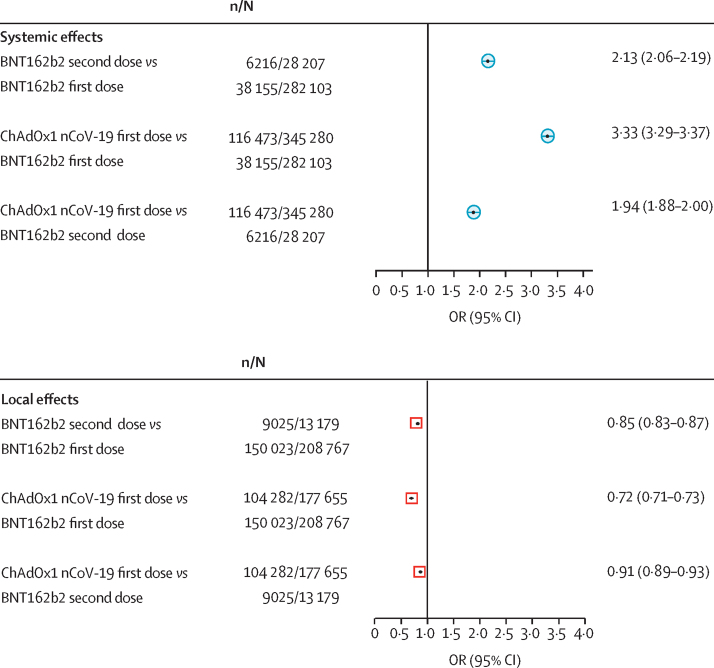
- Among 627,383 vaccinated individuals reporting 655,590 doses, systemic side-effects occurred in 13.5% after first-dose BNT162b2, 22.0% after second-dose BNT162b2, and 33.7% after first-dose ChAdOx1 nCoV-19; local side-effects occurred in 71.9%, 68.5%, and 58.7%, respectively.
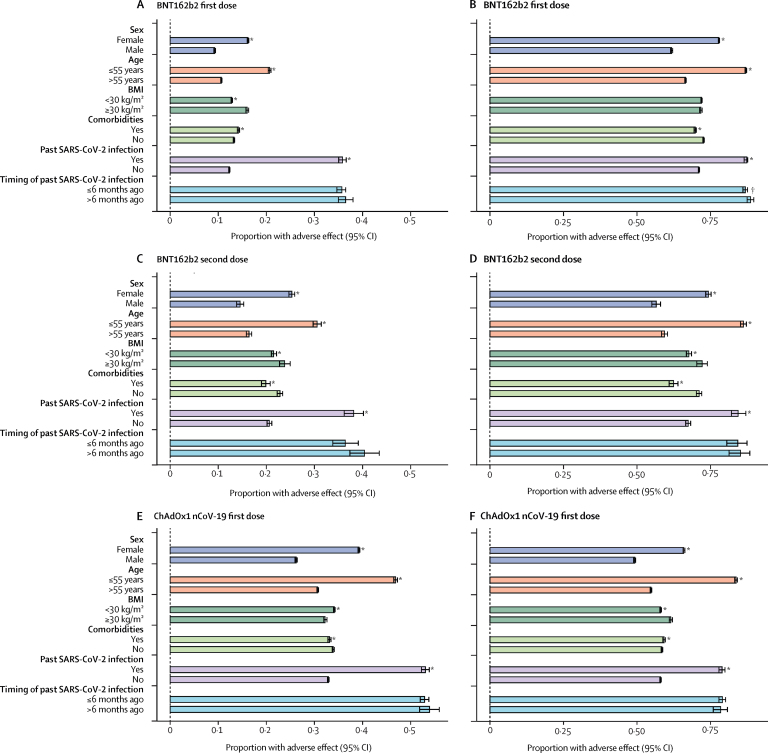
- Side-effects were more common in people with previous SARS-CoV-2 infection: systemic effects were 1.6 times higher after first-dose ChAdOx1 and 2.9 times higher after first-dose BNT162b2; local effects were 1.4 times and 1.2 times higher, respectively.
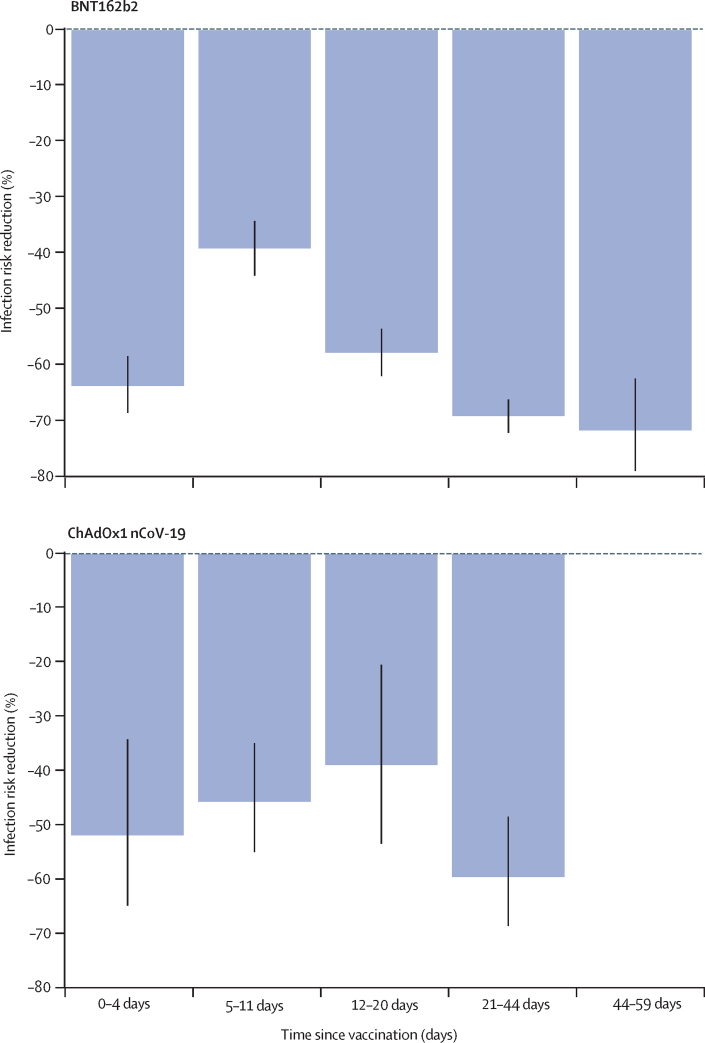
- Infection risk reductions versus unvaccinated controls began at 12 days: BNT162b2 reduced risk by 58% (95% CI 54–62) at 12–20 days, 69% (66–72) at 21–44 days, and 72% (63–79) at 45–59 days; ChAdOx1 reduced risk by 39% (21–53) at 12–20 days and 60% (49–68) at 21–44 days.
- Overall, 3106 of 103,622 vaccinated individuals and 50,340 of 464,356 unvaccinated controls tested positive for SARS-CoV-2.
Methods
- Prospective observational study using self-reported data from the UK COVID Symptom Study app between Dec 8, 2020, and March 10, 2021; participants reported vaccination and side-effects within 8 days, and a subset reported PCR or lateral flow test results after vaccination.
- Side-effect analyses adjusted for age (≤55 vs >55 years), sex, health-care worker status, obesity (BMI <30 vs ≥30 kg/m²), and comorbidities using Pearl’s back-door adjustment; infection analyses used Poisson regressions adjusted for testing and incidence.
- Infection rates in vaccinated individuals were compared with unvaccinated app users who reported a COVID-19 test in the same week as a vaccinated user.
Limitations
- The paper states that self-reported data can introduce information bias, misclassification, or exposure bias; app users were a self-selected group not representative of the general population; collider bias is possible; ChAdOx1 recipients had not received two doses at the time; reporting completeness was higher for systemic than local effects; severe side-effects might have been missed if users could not report them; testing selection bias is possible; the observational design does not allow causal inference; only short-term adverse effects were evaluated; side-effects within 1 week may not be vaccine related; and power was insufficient to assess differential rates by ethnic group.
- The text also makes evident that previous infection status and test results relied on self-report, and stratified infection models pooled vaccine types because some strata had relatively small sample sizes.
Model-written summary. Check it against the paper before relying on it.
Integrity signals
Registry
Cites
Statistics
Figures
Verification
Claims the paper makes
63 Own result · 20 Own method · 17 Not checked yet · 9 Own interpretation · 1 Supported so far · 1 Partly supported · 1 No basis given · accuracy not yet measured
The cited sources support only part of this claim — read each source’s verdict below.
In the paper
“However, our study population was considerably older than the study populations of the phase 3 trials.3, 6, 7”
§ Vaccine side-effects and SARS-CoV-2 infection after vaccination in users of the COVID Symptom Study app in the UK: a prospective observational study > Discussion
What the sources say
- Supportedcites [3] Polack FP Thomas SJ Kitchin N Safety and efficacy of the BNT162b2 mRNA COVID-19 vaccine N Engl J Med 383 2020 2603 2615 33301246 PMC7745181 source
The Results > Participants passage identifies this as a phase 2/3 trial and reports a median participant age of 52 years, with 42% older than 55. The citation supplies the age profile of one trial population used for the citing authors’ comparison; it does not need to describe the citing authors’ own population. (LLM, conf=0.90)
- Supportedcites [6] Voysey M Clemens SAC Madhi SA Safety and efficacy of the ChAdOx1 nCoV-19 vaccine (AZD1222) against SARS-CoV-2: an interim analysis of four randomised controlled trials in Brazil, South Africa, and the UK Lancet 397 2021 99 111 33306989 PMC7723445 source
The Results report that 86.7% of the UK participants and 89.9% of the Brazil participants in the primary efficacy analysis were aged 18–55. This supports the cited paper’s role in the comparison: its trial population was predominantly younger. The citing authors’ description of their own population is not a claim attributed to this source. (LLM, conf=0.90)
- Could not verifycites [7] Ramasamy MN Minassian AM Ewer KJ Safety and immunogenicity of ChAdOx1 nCoV-19 vaccine administered in a prime-boost regimen in young and old adults (COV002): a single-blind, randomised, controlled, phase 2/3 trial Lancet 396 2021 1979 1993 33220855 PMC7674972 sourceExperimental — accuracy not yet measured
The Methods (Study design and participants; page unavailable) state that this paper reports the phase 2 component and that data on phase 3 participants will be published elsewhere. The Results give ages for the phase 2 groups, but not the age distribution of the phase 3 trial population needed to assess the citing paper’s comparison. (LLM, conf=0.76)
plain- Asserted: passes — The authors put it forward as true.
- Checkable: passes — It can be checked against evidence.
- Load-bearing: unclear — It is unclear whether the paper’s conclusions depend on it.
- Based: passes — The paper gives a reason why it holds.
- Supported
The sources with a verdict support this claim; the rest weren’t checked yet, have no full text we could read, or their verdicts aren’t rated yet.
In the paper
“However, given that strong reductions in COVID hospitalisations after vaccination were observed in nationwide studies in Scotland12 and England,11 we believe that collider bias is unlikely to underlie the reduction in infections seen in our data.”
§ Vaccine side-effects and SARS-CoV-2 infection after vaccination in users of the COVID Symptom Study app in the UK: a prospective observational study > Discussion
What the sources say
- Not checked yetcites [12] Vasileiou E Simpson CR Shi T Interim findings from first-dose mass COVID-19 vaccination roll-out and COVID-19 hospital admissions in Scotland: a national prospective cohort study Lancet 2021 published online April 23. 10.1016/S0140-6736(21)00677-2 PMC8064669 33901420 source
- Supportedcites [11] Lopez Bernal J Andrews N Gower C Early effectiveness of COVID-19 vaccination with BNT162b2 mRNA vaccine and ChAdOx1 adenovirus vector vaccine on symptomatic disease, hospitalisations and mortality in older adults in England medRxiv 2021 published online March 2. 10.1101/2021.03.01.21252652 (preprint). source
The Results report that, among older adults in England, a single dose of either vaccine was approximately 80% effective at preventing hospitalisation. The sentence’s conclusion about collider bias is the citing authors’ own inference, not a claim attributed to this source; the Scotland finding has a separate citation. (LLM, conf=0.93)
hedged- Asserted: passes — The authors put it forward as true.
- Checkable: passes — It can be checked against evidence.
- Load-bearing: passes — The paper’s conclusions depend on it.
- Based: passes — The paper gives a reason why it holds.
A result the paper reports from its own data — it cites no other source for it, so there is none to check. The quote shows it is in the paper.
In the paper
“by 33·7% (116 473 of 345 280) after the first dose of ChAdOx1 nCoV-19”
§ Vaccine side-effects and SARS-CoV-2 infection after vaccination in users of the COVID Symptom Study app in the UK: a prospective observational study > Abstract > Findings
plain- Asserted: passes — The authors put it forward as true.
- Checkable: passes — It can be checked against evidence.
- Load-bearing: unclear — It is unclear whether the paper’s conclusions depend on it.
- Based: passes — The paper gives a reason why it holds.
A result the paper reports from its own data — it cites no other source for it, so there is none to check. The quote shows it is in the paper.
In the paper
“3106 of 103 622 vaccinated individuals and 50 340 of 464 356 unvaccinated controls tested positive for SARS-CoV-2 infection”
§ Vaccine side-effects and SARS-CoV-2 infection after vaccination in users of the COVID Symptom Study app in the UK: a prospective observational study > Abstract > Findings
plainn = 622- Asserted: passes — The authors put it forward as true.
- Checkable: passes — It can be checked against evidence.
- Load-bearing: passes — The paper’s conclusions depend on it.
- Based: passes — The paper gives a reason why it holds.
A result the paper reports from its own data — it cites no other source for it, so there is none to check. The quote shows it is in the paper.
In the paper
“Systemic side-effects were more common (1·6 times after the first dose of ChAdOx1 nCoV-19”
§ Vaccine side-effects and SARS-CoV-2 infection after vaccination in users of the COVID Symptom Study app in the UK: a prospective observational study > Abstract > Findings
plaincorrelational- Asserted: passes — The authors put it forward as true.
- Checkable: passes — It can be checked against evidence.
- Load-bearing: passes — The paper’s conclusions depend on it.
- Based: passes — The paper gives a reason why it holds.
A result the paper reports from its own data — it cites no other source for it, so there is none to check. The quote shows it is in the paper.
In the paper
“and 1·2 times after the first dose of BNT162b2)”
§ Vaccine side-effects and SARS-CoV-2 infection after vaccination in users of the COVID Symptom Study app in the UK: a prospective observational study > Abstract > Findings
plaincorrelational- Asserted: passes — The authors put it forward as true.
- Checkable: passes — It can be checked against evidence.
- Load-bearing: unclear — It is unclear whether the paper’s conclusions depend on it.
- Based: passes — The paper gives a reason why it holds.
A result the paper reports from its own data — it cites no other source for it, so there is none to check. The quote shows it is in the paper.
In the paper
“and 72% (63–79) after 45–59 days following BNT162b2”
§ Vaccine side-effects and SARS-CoV-2 infection after vaccination in users of the COVID Symptom Study app in the UK: a prospective observational study > Introduction
plaincorrelational- Asserted: passes — The authors put it forward as true.
- Checkable: passes — It can be checked against evidence.
- Load-bearing: passes — The paper’s conclusions depend on it.
- Based: passes — The paper gives a reason why it holds.
A result the paper reports from its own data — it cites no other source for it, so there is none to check. The quote shows it is in the paper.
In the paper
“Systemic side-effects were reported by 13·5% (38 155 of 282 103) of individuals after the first dose of BNT162b2”
§ Vaccine side-effects and SARS-CoV-2 infection after vaccination in users of the COVID Symptom Study app in the UK: a prospective observational study > Abstract > Findings
plain- Asserted: passes — The authors put it forward as true.
- Checkable: passes — It can be checked against evidence.
- Load-bearing: passes — The paper’s conclusions depend on it.
- Based: passes — The paper gives a reason why it holds.
A result the paper reports from its own data — it cites no other source for it, so there is none to check. The quote shows it is in the paper.
In the paper
“and 2·9 times after the first dose of BNT162b2) among individuals with previous SARS-CoV-2 infection than among those without known past infection”
§ Vaccine side-effects and SARS-CoV-2 infection after vaccination in users of the COVID Symptom Study app in the UK: a prospective observational study > Abstract > Findings
plaincorrelational- Asserted: passes — The authors put it forward as true.
- Checkable: passes — It can be checked against evidence.
- Load-bearing: passes — The paper’s conclusions depend on it.
- Based: passes — The paper gives a reason why it holds.
A result the paper reports from its own data — it cites no other source for it, so there is none to check. The quote shows it is in the paper.
In the paper
“Documented infection rates in our app after a single vaccine dose decreased by 58% (95% CI 54–62) at 12–20 days”
§ Vaccine side-effects and SARS-CoV-2 infection after vaccination in users of the COVID Symptom Study app in the UK: a prospective observational study > Introduction
plaincorrelational- Asserted: passes — The authors put it forward as true.
- Checkable: passes — It can be checked against evidence.
- Load-bearing: passes — The paper’s conclusions depend on it.
- Based: passes — The paper gives a reason why it holds.
- It may state two separate claims as one. 30
- Probably not a substantial claim. 15
A result the paper reports from its own data — it cites no other source for it, so there is none to check. The quote shows it is in the paper.
In the paper
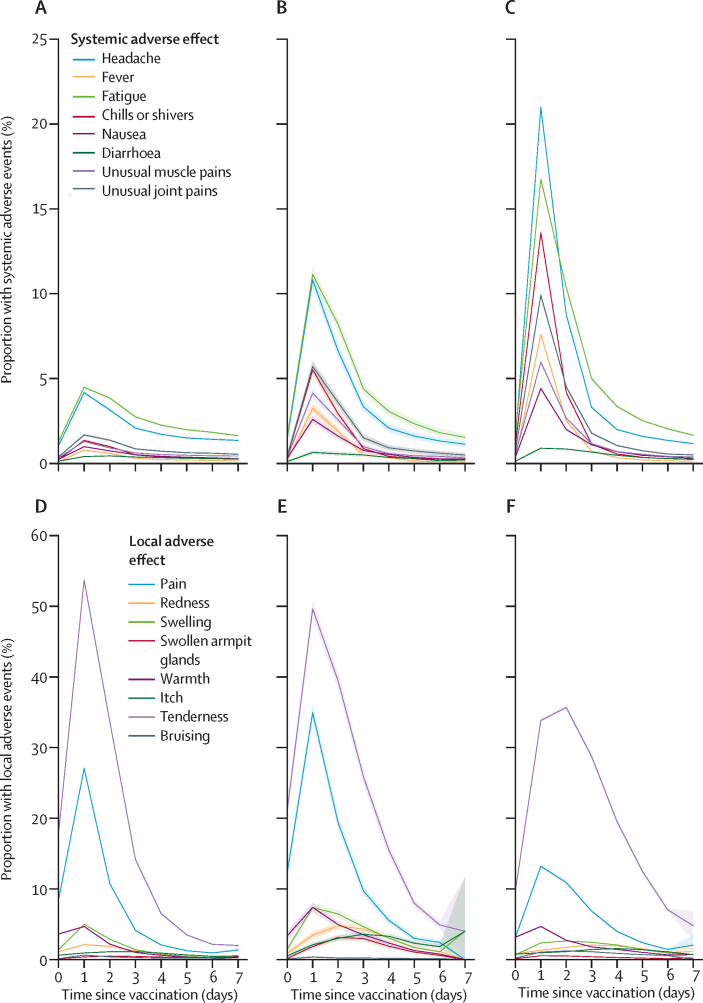
“These were most frequently reported within the first 24 h after vaccination and lasted a mean of 1·01 days (SD 0·1; figure 1).”
§ Vaccine side-effects and SARS-CoV-2 infection after vaccination in users of the COVID Symptom Study app in the UK: a prospective observational study > Results
plain- Asserted: passes — The authors put it forward as true.
- Checkable: passes — It can be checked against evidence.
- Load-bearing: unclear — It is unclear whether the paper’s conclusions depend on it.
- Based: passes — The paper gives a reason why it holds.
It may state two separate claims as one.
In the paper
“we found a modest association (r=0·021 [95% CI 0·019–0·025]), corresponding to 0·04% of the variance in symptoms reporting.”
§ Vaccine side-effects and SARS-CoV-2 infection after vaccination in users of the COVID Symptom Study app in the UK: a prospective observational study > Results
What the sources say
- Not checked yetcites [20] Ministry of Housing, Communities, and Local Government English indices of deprivation 2019 https://www.gov.uk/government/statistics/english-indices-of-deprivation-2019 Sept 26, 2019
plaincorrelational- Asserted: passes — The authors put it forward as true.
- Checkable: passes — It can be checked against evidence.
- Load-bearing: fails — The paper’s conclusions may not depend on it.
- Based: passes — The paper gives a reason why it holds.
Probably not a substantial claim. The paper’s conclusions may not depend on it.
A result the paper reports from its own data — it cites no other source for it, so there is none to check. The quote shows it is in the paper.
In the paper
“Users who reported receiving a BNT162b2 vaccine were slightly younger, had more comorbidities, and were more frequently female than users who reported receiving a ChAdOx1 nCoV-19 inoculation”
§ Vaccine side-effects and SARS-CoV-2 infection after vaccination in users of the COVID Symptom Study app in the UK: a prospective observational study > Results
plaincorrelational- Asserted: passes — The authors put it forward as true.
- Checkable: passes — It can be checked against evidence.
- Load-bearing: unclear — It is unclear whether the paper’s conclusions depend on it.
- Based: passes — The paper gives a reason why it holds.
It may state two separate claims as one.
A result the paper reports from its own data — it cites no other source for it, so there is none to check. The quote shows it is in the paper.
In the paper
“Reported side-effects were minor in severity and of short duration.”
§ Vaccine side-effects and SARS-CoV-2 infection after vaccination in users of the COVID Symptom Study app in the UK: a prospective observational study > Introduction
plain- Asserted: passes — The authors put it forward as true.
- Checkable: passes — It can be checked against evidence.
- Load-bearing: passes — The paper’s conclusions depend on it.
- Based: passes — The paper gives a reason why it holds.
It may state two separate claims as one.
A result the paper reports from its own data — it cites no other source for it, so there is none to check. The quote shows it is in the paper.
In the paper
“Tenderness and local pain around the injection site were the most frequently reported local effects (table), occurring most often on the day after injection and lasting a mean of 1·02 days (SD 0·15; figure 1).”
§ Vaccine side-effects and SARS-CoV-2 infection after vaccination in users of the COVID Symptom Study app in the UK: a prospective observational study > Results
plain- Asserted: passes — The authors put it forward as true.
- Checkable: passes — It can be checked against evidence.
- Load-bearing: unclear — It is unclear whether the paper’s conclusions depend on it.
- Based: passes — The paper gives a reason why it holds.
It may state two separate claims as one.
In the paper
“The phase 2–3 trial of the ChAdOx1 nCoV-19 vaccine7 reported systemic adverse effects in 88% of participants aged 18–55 years who received the first injection, whereas we found a lower rate of 33·7% after the first dose in the overall sample and 46·9% in individuals aged 18–55 years (data not shown).”
§ Vaccine side-effects and SARS-CoV-2 infection after vaccination in users of the COVID Symptom Study app in the UK: a prospective observational study > Discussion
What the sources say
- Not checked yetcites [7] Ramasamy MN Minassian AM Ewer KJ Safety and immunogenicity of ChAdOx1 nCoV-19 vaccine administered in a prime-boost regimen in young and old adults (COV002): a single-blind, randomised, controlled, phase 2/3 trial Lancet 396 2021 1979 1993 33220855 PMC7674972
plain- Asserted: passes — The authors put it forward as true.
- Checkable: passes — It can be checked against evidence.
- Load-bearing: passes — The paper’s conclusions depend on it.
- Based: passes — The paper gives a reason why it holds.
It may state two separate claims as one.
- Rests on an assumption: Self-reported adverse effects are accurate enough to estimate their prevalence and associations.
A result the paper reports from its own data — it cites no other source for it, so there is none to check. The quote shows it is in the paper.
In the paper
“Borderline differences were observed for BMI (RR for BMI <30 kg/m2 −69% [95% CI −71 to −67]; RR for BMI ≥30 kg/m2 −63% [−67 to −59]) and sex (RR for female −69% [95% CI −71 to −67]; RR for male −61% [–66 to −57]; appendix p 5).”
§ Vaccine side-effects and SARS-CoV-2 infection after vaccination in users of the COVID Symptom Study app in the UK: a prospective observational study > Results
plain- Asserted: passes — The authors put it forward as true.
- Checkable: passes — It can be checked against evidence.
- Load-bearing: unclear — It is unclear whether the paper’s conclusions depend on it.
- Based: passes — The paper gives a reason why it holds.
It may state two separate claims as one.
A result the paper reports from its own data — it cites no other source for it, so there is none to check. The quote shows it is in the paper.
In the paper
“However, in our community analysis, less than 30% of users complained of injection-site pain and less than 25% of fatigue and headache after the first dose.”
§ Vaccine side-effects and SARS-CoV-2 infection after vaccination in users of the COVID Symptom Study app in the UK: a prospective observational study > Discussion
plain- Asserted: passes — The authors put it forward as true.
- Checkable: passes — It can be checked against evidence.
- Load-bearing: passes — The paper’s conclusions depend on it.
- Based: passes — The paper gives a reason why it holds.
It may state two separate claims as one.
- Rests on an assumption: Self-reported adverse effects are accurate enough to estimate their prevalence and associations.
In the paper
“We found that systemic adverse effects, including headache and fatigue, affected fewer than one in four people and were less common in the community than expected from clinical trials.”
§ Vaccine side-effects and SARS-CoV-2 infection after vaccination in users of the COVID Symptom Study app in the UK: a prospective observational study > Discussion
What the sources say
- Not checked yetcites [3] Polack FP Thomas SJ Kitchin N Safety and efficacy of the BNT162b2 mRNA COVID-19 vaccine N Engl J Med 383 2020 2603 2615 33301246 PMC7745181
plain- Asserted: passes — The authors put it forward as true.
- Checkable: passes — It can be checked against evidence.
- Load-bearing: passes — The paper’s conclusions depend on it.
- Based: passes — The paper gives a reason why it holds.
It may state two separate claims as one.
- Rests on an assumption: Self-reported adverse effects are accurate enough to estimate their prevalence and associations.
None of the sources cited for this claim have been checked yet.
In the paper
“The overall mean age of the vaccinated app users was higher than that of the general population (40·3 years)24 yet was lower than those of the samples within other UK COVID-19 effectiveness studies,11, 12 largely because of the presence of a small proportion of health-care workers among the participants of this study.”
§ Vaccine side-effects and SARS-CoV-2 infection after vaccination in users of the COVID Symptom Study app in the UK: a prospective observational study > Discussion
What the sources say
- Not matchedcites [24] Office for National Statistics Population estimates for the UK, England and Wales, Scotland and Northern Ireland, provisional: mid-2019 https://www.ons.gov.uk/peoplepopulationandcommunity/populationandmigration/populationestimates/bulletins/annualmidyearpopulationestimates/mid2019 May 6, 2020
Couldn’t be matched to a paper in Crossref, so it can’t be checked.
- Not checked yetcites [11] Lopez Bernal J Andrews N Gower C Early effectiveness of COVID-19 vaccination with BNT162b2 mRNA vaccine and ChAdOx1 adenovirus vector vaccine on symptomatic disease, hospitalisations and mortality in older adults in England medRxiv 2021 published online March 2. 10.1101/2021.03.01.21252652 (preprint). source
- Not checked yetcites [12] Vasileiou E Simpson CR Shi T Interim findings from first-dose mass COVID-19 vaccination roll-out and COVID-19 hospital admissions in Scotland: a national prospective cohort study Lancet 2021 published online April 23. 10.1016/S0140-6736(21)00677-2 PMC8064669 33901420 source
plaincorrelational- Asserted: passes — The authors put it forward as true.
- Checkable: passes — It can be checked against evidence.
- Load-bearing: unclear — It is unclear whether the paper’s conclusions depend on it.
- Based: passes — The paper gives a reason why it holds.
It may state two separate claims as one.
- Not matched
A result the paper reports from its own data — it cites no other source for it, so there is none to check. The quote shows it is in the paper.
In the paper
“Although side-effects were significantly more prevalent in women than in men, in people aged 55 years or younger than in those older than 55 years, and after the second than after the first dose, they occurred at much lower frequencies than expected from the published literature.”
§ Vaccine side-effects and SARS-CoV-2 infection after vaccination in users of the COVID Symptom Study app in the UK: a prospective observational study > Discussion
plaincorrelational- Asserted: passes — The authors put it forward as true.
- Checkable: passes — It can be checked against evidence.
- Load-bearing: unclear — It is unclear whether the paper’s conclusions depend on it.
- Based: passes — The paper gives a reason why it holds.
It may state two separate claims as one.
- Rests on an assumption: Self-reported adverse effects are accurate enough to estimate their prevalence and associations.
In the paper
“For instance, whereas 51–59% of participants reported fatigue after the second BNT162b2 dose in the phase 3 trial of that vaccine,3 fatigue was reported by less than 15% of participants after the second dose in our study.”
§ Vaccine side-effects and SARS-CoV-2 infection after vaccination in users of the COVID Symptom Study app in the UK: a prospective observational study > Discussion
What the sources say
- Not checked yetcites [3] Polack FP Thomas SJ Kitchin N Safety and efficacy of the BNT162b2 mRNA COVID-19 vaccine N Engl J Med 383 2020 2603 2615 33301246 PMC7745181
plain- Asserted: passes — The authors put it forward as true.
- Checkable: passes — It can be checked against evidence.
- Load-bearing: passes — The paper’s conclusions depend on it.
- Based: passes — The paper gives a reason why it holds.
It may state two separate claims as one.
- Rests on an assumption: Self-reported adverse effects are accurate enough to estimate their prevalence and associations.
A result the paper reports from its own data — it cites no other source for it, so there is none to check. The quote shows it is in the paper.
In the paper
“We observed a further reduction in infection risk after one dose of the BNT162b2 vaccine when compared with unvaccinated controls at 21–44 days after vaccination (RR −69% [95% CI −72 to −66]) and at 45–59 days after vaccination (−72% [–79 to −63]; figure 4).”
§ Vaccine side-effects and SARS-CoV-2 infection after vaccination in users of the COVID Symptom Study app in the UK: a prospective observational study > Results
plaindirect- Asserted: passes — The authors put it forward as true.
- Checkable: passes — It can be checked against evidence.
- Load-bearing: passes — The paper’s conclusions depend on it.
- Based: passes — The paper gives a reason why it holds.
It may state two separate claims as one.
A result the paper reports from its own data — it cites no other source for it, so there is none to check. The quote shows it is in the paper.
In the paper
“but in our study 89% of respondents who logged at least one systemic effect after the ChAdOx1 nCoV-19 vaccine did not report any systemic effects after 3 days, and 98·3% did not report any after 1 week.”
§ Vaccine side-effects and SARS-CoV-2 infection after vaccination in users of the COVID Symptom Study app in the UK: a prospective observational study > Discussion
plain- Asserted: passes — The authors put it forward as true.
- Checkable: passes — It can be checked against evidence.
- Load-bearing: passes — The paper’s conclusions depend on it.
- Based: passes — The paper gives a reason why it holds.
It may state two separate claims as one.
- Rests on an assumption: Self-reported adverse effects are accurate enough to estimate their prevalence and associations.
In the paper
“Phase 3 trials reported the BNT162b2 vaccine to have an efficacy of 52% at 12 days after the first dose and of 95% after the second dose if administered 3–4 weeks apart in participants without previous SARS-CoV-2 infection.”
§ Vaccine side-effects and SARS-CoV-2 infection after vaccination in users of the COVID Symptom Study app in the UK: a prospective observational study > Introduction
What the sources say
- Not checked yetcites [3] Polack FP Thomas SJ Kitchin N Safety and efficacy of the BNT162b2 mRNA COVID-19 vaccine N Engl J Med 383 2020 2603 2615 33301246 PMC7745181
plaindirect- Asserted: passes — The authors put it forward as true.
- Checkable: passes — It can be checked against evidence.
- Load-bearing: fails — The paper’s conclusions may not depend on it.
- Based: passes — The paper gives a reason why it holds.
Probably not a substantial claim. The paper’s conclusions may not depend on it. It may state two separate claims as one.
What the paper did — it cites no source for this, so there is none to check. The quote shows it is in the paper.
In the paper
“We did not collect information on why individuals were tested, so not all tested individuals were necessarily experiencing COVID-19-associated symptoms at testing, and some individuals might have been routinely tested while being asymptomatic.”
§ Vaccine side-effects and SARS-CoV-2 infection after vaccination in users of the COVID Symptom Study app in the UK: a prospective observational study > Methods > Outcomes
hedged- Asserted: passes — The authors put it forward as true.
- Checkable: passes — It can be checked against evidence.
- Load-bearing: unclear — It is unclear whether the paper’s conclusions depend on it.
- Based: passes — The paper gives a reason why it holds.
It may state two separate claims as one.
What the paper did — it cites no source for this, so there is none to check. The quote shows it is in the paper.
In the paper
“This model allowed us to control for the number of follow-up days for each group.”
§ Vaccine side-effects and SARS-CoV-2 infection after vaccination in users of the COVID Symptom Study app in the UK: a prospective observational study > Methods > Statistical analysis
plaindirect- Asserted: passes — The authors put it forward as true.
- Checkable: passes — It can be checked against evidence.
- Load-bearing: passes — The paper’s conclusions depend on it.
- Based: passes — The paper gives a reason why it holds.
Probably not a substantial claim.
- Rests on an assumption: The Poisson regression model correctly specifies the relationship and the included covariates (including incidence) adequately control for temporal and other confounders.
In the paper
“Since the BNT162b2 phase 3 trial showed a decrease in infections from 12 days after vaccination”
§ Vaccine side-effects and SARS-CoV-2 infection after vaccination in users of the COVID Symptom Study app in the UK: a prospective observational study > Methods > Statistical analysis
What the sources say
- Not checked yetcites [3] Polack FP Thomas SJ Kitchin N Safety and efficacy of the BNT162b2 mRNA COVID-19 vaccine N Engl J Med 383 2020 2603 2615 33301246 PMC7745181
plaindirect- Asserted: passes — The authors put it forward as true.
- Checkable: passes — It can be checked against evidence.
- Load-bearing: passes — The paper’s conclusions depend on it.
- Based: passes — The paper gives a reason why it holds.
Probably not a substantial claim.
What the paper did — it cites no source for this, so there is none to check. The quote shows it is in the paper.
In the paper
“All analyses were adjusted by age (≤55 years vs >55 years), sex, health-care worker status (binary variable), obesity (BMI <30 kg/m2vs ≥30 kg/m2), and comorbidities (binary variable, with or without comorbidities).”
§ Vaccine side-effects and SARS-CoV-2 infection after vaccination in users of the COVID Symptom Study app in the UK: a prospective observational study > Abstract > Methods
plain- Asserted: passes — The authors put it forward as true.
- Checkable: passes — It can be checked against evidence.
- Load-bearing: passes — The paper’s conclusions depend on it.
- Based: passes — The paper gives a reason why it holds.
Probably not a substantial claim.
- Rests on an assumption: The adjustment set (age, sex, health-care worker status, obesity, and comorbidities) is sufficient to control for confounding in the observational comparisons.
What the paper did — it cites no source for this, so there is none to check. The quote shows it is in the paper.
In the paper
“we also included incidence as a covariate in the Poisson regression model”
§ Vaccine side-effects and SARS-CoV-2 infection after vaccination in users of the COVID Symptom Study app in the UK: a prospective observational study > Methods > Statistical analysis
plain- Asserted: passes — The authors put it forward as true.
- Checkable: passes — It can be checked against evidence.
- Load-bearing: passes — The paper’s conclusions depend on it.
- Based: passes — The paper gives a reason why it holds.
Probably not a substantial claim.
- Rests on an assumption: The Poisson regression model correctly specifies the relationship and the included covariates (including incidence) adequately control for temporal and other confounders.
What the paper did — it cites no source for this, so there is none to check. The quote shows it is in the paper.
In the paper
“Due to a relatively small sample size in some of the strata, we did not differentiate between vaccine types but pooled all vaccinated contributors.”
§ Vaccine side-effects and SARS-CoV-2 infection after vaccination in users of the COVID Symptom Study app in the UK: a prospective observational study > Methods > Statistical analysis
plain- Asserted: passes — The authors put it forward as true.
- Checkable: passes — It can be checked against evidence.
- Load-bearing: passes — The paper’s conclusions depend on it.
- Based: passes — The paper gives a reason why it holds.
Probably not a substantial claim.
None of the sources cited for this claim have been checked yet.
In the paper
“The ChAdOx1 nCoV-19 trial found efficacy against symptomatic disease of 76% at 22–90 days after at least one standard dose.”
§ Vaccine side-effects and SARS-CoV-2 infection after vaccination in users of the COVID Symptom Study app in the UK: a prospective observational study > Introduction
What the sources say
- Not checked yetcites [6] Voysey M Clemens SAC Madhi SA Safety and efficacy of the ChAdOx1 nCoV-19 vaccine (AZD1222) against SARS-CoV-2: an interim analysis of four randomised controlled trials in Brazil, South Africa, and the UK Lancet 397 2021 99 111 33306989 PMC7723445 source
- Not checked yetcites [7] Ramasamy MN Minassian AM Ewer KJ Safety and immunogenicity of ChAdOx1 nCoV-19 vaccine administered in a prime-boost regimen in young and old adults (COV002): a single-blind, randomised, controlled, phase 2/3 trial Lancet 396 2021 1979 1993 33220855 PMC7674972 source
- Not checked yetcites [8] Voysey M Clemens SAC Madhi SA Single-dose administration and the influence of the timing of the booster dose on immunogenicity and efficacy of ChAdOx1 nCoV-19 (AZD1222) vaccine: a pooled analysis of four randomised trials Lancet 397 2021 881 891 33617777 PMC7894131 source
plaindirect- Asserted: passes — The authors put it forward as true.
- Checkable: passes — It can be checked against evidence.
- Load-bearing: fails — The paper’s conclusions may not depend on it.
- Based: passes — The paper gives a reason why it holds.
Probably not a substantial claim. The paper’s conclusions may not depend on it.
A conclusion the paper draws from its own results — it cites no other source for it, so there is none to check. The quote shows it is in the paper.
In the paper
“Adverse effects are more frequently reported in younger individuals, women, and among those who previously had COVID-19.”
§ Vaccine side-effects and SARS-CoV-2 infection after vaccination in users of the COVID Symptom Study app in the UK: a prospective observational study > Discussion
plaincorrelational- Asserted: passes — The authors put it forward as true.
- Checkable: passes — It can be checked against evidence.
- Load-bearing: passes — The paper’s conclusions depend on it.
- Based: passes — The paper gives a reason why it holds.
It may state two separate claims as one.
- Rests on an assumption: Self-reported previous positive PCR or lateral flow result accurately identifies past SARS-CoV-2 infection.
- Rests on an assumption: Self-reported adverse effects are accurate enough to estimate their prevalence and associations.
What the paper did — it cites no source for this, so there is none to check. The quote shows it is in the paper.
In the paper
“Strengths of our study include its large sample size; capture of data on SARS-CoV-2 RT-PCR or lateral flow test results, regardless of symptoms; the prospective real-time capture of information on symptoms; and the availability of both BNT162b2 and ChAdOx1 nCoV-19 vaccines in the UK, which allowed cross-vaccine comparison.”
§ Vaccine side-effects and SARS-CoV-2 infection after vaccination in users of the COVID Symptom Study app in the UK: a prospective observational study > Discussion
plain- Asserted: passes — The authors put it forward as true.
- Checkable: passes — It can be checked against evidence.
- Load-bearing: passes — The paper’s conclusions depend on it.
- Based: passes — The paper gives a reason why it holds.
It may state two separate claims as one.
What the paper did — it cites no source for this, so there is none to check. The quote shows it is in the paper.
In the paper
“Recipients of the ChAdOx1 nCoV-19 vaccine might differ from recipients of the BNT162b2 vaccine by age or dependency.”
§ Vaccine side-effects and SARS-CoV-2 infection after vaccination in users of the COVID Symptom Study app in the UK: a prospective observational study > Discussion
hedgedcorrelational- Asserted: passes — The authors put it forward as true.
- Checkable: passes — It can be checked against evidence.
- Load-bearing: fails — The paper’s conclusions may not depend on it.
- Based: fails — The paper may give no reason why it holds.
Probably not a substantial claim. The paper’s conclusions may not depend on it. The paper may give no reason why it holds.
In the paper
“Although our data, due to their observational nature, does not allow us to comment directly on effectiveness, the observed decrease of infection over time seems to be in line with efficacy reported in the BNT162b2 phase 3 trial3 and supports the UK Government's decision to delay the timing of the second injection to 12 weeks to maximise the number of people receiving at least one dose.”
§ Vaccine side-effects and SARS-CoV-2 infection after vaccination in users of the COVID Symptom Study app in the UK: a prospective observational study > Discussion
What the sources say
- Not checked yetcites [3] Polack FP Thomas SJ Kitchin N Safety and efficacy of the BNT162b2 mRNA COVID-19 vaccine N Engl J Med 383 2020 2603 2615 33301246 PMC7745181
hedgedcorrelational- Asserted: passes — The authors put it forward as true.
- Checkable: passes — It can be checked against evidence.
- Load-bearing: passes — The paper’s conclusions depend on it.
- Based: passes — The paper gives a reason why it holds.
It may state two separate claims as one.
What the paper did — it cites no source for this, so there is none to check. The quote shows it is in the paper.
In the paper
“Furthermore, because the ChAdOx1 nCoV-19 vaccine started being rolled out in January, 2021, and the second dose is to be administered at 12 weeks, no app users had received two doses of ChAdOx1 nCoV-19 at the time of this report.”
§ Vaccine side-effects and SARS-CoV-2 infection after vaccination in users of the COVID Symptom Study app in the UK: a prospective observational study > Discussion
plain- Asserted: passes — The authors put it forward as true.
- Checkable: passes — It can be checked against evidence.
- Load-bearing: unclear — It is unclear whether the paper’s conclusions depend on it.
- Based: passes — The paper gives a reason why it holds.
It may state two separate claims as one.
What the paper did — it cites no source for this, so there is none to check. The quote shows it is in the paper.
In the paper
“Finally, the systemic side-effects were collected from daily reports within 1 week from the injection date, so we cannot rule out that these effects might not be vaccine related.”
§ Vaccine side-effects and SARS-CoV-2 infection after vaccination in users of the COVID Symptom Study app in the UK: a prospective observational study > Discussion
hedged- Asserted: passes — The authors put it forward as true.
- Checkable: passes — It can be checked against evidence.
- Load-bearing: unclear — It is unclear whether the paper’s conclusions depend on it.
- Based: passes — The paper gives a reason why it holds.
It may state two separate claims as one.
None of the sources cited for this claim have been checked yet.
In the paper
“Previous work has shown that data from our app is able to produce estimates of population-level disease prevalence that agree well with surveys with random, representative designs,18, 28 suggesting that behavioural issues are not substantially biasing our app population.”
§ Vaccine side-effects and SARS-CoV-2 infection after vaccination in users of the COVID Symptom Study app in the UK: a prospective observational study > Discussion
What the sources say
- Not matchedcites [18] Varsavsky T Graham MS Canas LS Detecting COVID-19 infection hotspots in England using large-scale self-reported data from a mobile application: a prospective, observational study Lancet Public Health 6 2021 e21 e29 33278917 PMC7785969
Couldn’t be matched to a paper in Crossref, so it can’t be checked.
- Not checked yetcites [28] Bowyer RCE Varsavsky T Thompson EJ Geo-social gradients in predicted COVID-19 prevalence in Great Britain: results from 1 960 242 users of the COVID-19 Symptoms Study app Thorax 2020 published online Dec 29. 10.1136/thoraxjnl-2020-215119 PMC8223682 33376145 source
hedged- Asserted: passes — The authors put it forward as true.
- Checkable: passes — It can be checked against evidence.
- Load-bearing: unclear — It is unclear whether the paper’s conclusions depend on it.
- Based: passes — The paper gives a reason why it holds.
It may state two separate claims as one.
- Not matched
In the paper
“Participants using the app were a self-selected group and not representative of the general population, as has been observed in other digital platform studies.27”
§ Vaccine side-effects and SARS-CoV-2 infection after vaccination in users of the COVID Symptom Study app in the UK: a prospective observational study > Discussion
What the sources say
- Not checked yetcites [27] Baltrusaitis K Santillana M Crawley AW Chunara R Smolinski M Brownstein JS Determinants of participants' follow-up and characterization of representativeness in flu near you, a participatory disease surveillance system JMIR Public Health Surveill 3 2017 e18 28389417 PMC5400887
plain- Asserted: passes — The authors put it forward as true.
- Checkable: passes — It can be checked against evidence.
- Load-bearing: unclear — It is unclear whether the paper’s conclusions depend on it.
- Based: passes — The paper gives a reason why it holds.
It may state two separate claims as one.
What the paper did — it cites no source for this, so there is none to check. The quote shows it is in the paper.
In the paper
“This is an observational study, with data captured during a specific timeframe, and our study design does not allow an inference of causality.”
§ Vaccine side-effects and SARS-CoV-2 infection after vaccination in users of the COVID Symptom Study app in the UK: a prospective observational study > Discussion
plain- Asserted: passes — The authors put it forward as true.
- Checkable: passes — It can be checked against evidence.
- Load-bearing: passes — The paper’s conclusions depend on it.
- Based: passes — The paper gives a reason why it holds.
It may state two separate claims as one.
A conclusion the paper draws from its own results — it cites no other source for it, so there is none to check. The quote shows it is in the paper.
In the paper
“Furthermore, our data support results from randomised controlled trials in a large community-based scenario showing evidence of reduction in infection after 12 days and substantial protection after 3 weeks.”
§ Vaccine side-effects and SARS-CoV-2 infection after vaccination in users of the COVID Symptom Study app in the UK: a prospective observational study > Discussion
plaindirect- Asserted: passes — The authors put it forward as true.
- Checkable: passes — It can be checked against evidence.
- Load-bearing: passes — The paper’s conclusions depend on it.
- Based: passes — The paper gives a reason why it holds.
It may state two separate claims as one.
What the paper did — it cites no source for this, so there is none to check. The quote shows it is in the paper.
In the paper
“The completeness of reporting was higher for systemic effects than for local effects, which might have introduced some bias (appendix p 12).”
§ Vaccine side-effects and SARS-CoV-2 infection after vaccination in users of the COVID Symptom Study app in the UK: a prospective observational study > Discussion
hedgedconditional- Asserted: passes — The authors put it forward as true.
- Checkable: passes — It can be checked against evidence.
- Load-bearing: unclear — It is unclear whether the paper’s conclusions depend on it.
- Based: passes — The paper gives a reason why it holds.
It may state two separate claims as one.
None of the sources cited for this claim have been checked yet.
In the paper
“It has been shown that vaccines have increased immunogenicity in individuals with past infection and these people have higher antibody titres than those without previous infection.22, 23, 25”
§ Vaccine side-effects and SARS-CoV-2 infection after vaccination in users of the COVID Symptom Study app in the UK: a prospective observational study > Discussion
What the sources say
- Not checked yetcites [22] Krammer F Srivastava K Simon V Robust spike antibody responses and increased reactogenicity in seropositive individuals after a single dose of SARS-CoV-2 mRNA vaccine medRxiv 2021 published online Feb 1. 10.1101/2021.01.29.21250653 (preprint). source
- Not checked yetcites [23] Wise J COVID-19: people who have had infection might only need one dose of mRNA vaccine BMJ 372 2021 n308 33531333 source
- Not checked yetcites [25] Manisty C Otter AD Treibel TA Antibody response to first BNT162b2 dose in previously SARS-CoV-2-infected individuals Lancet 397 2021 1057 1058 33640038 PMC7972310 source
plaindirect- Asserted: passes — The authors put it forward as true.
- Checkable: passes — It can be checked against evidence.
- Load-bearing: fails — The paper’s conclusions may not depend on it.
- Based: passes — The paper gives a reason why it holds.
Probably not a substantial claim. The paper’s conclusions may not depend on it. It may state two separate claims as one.
What the paper did — it cites no source for this, so there is none to check. The quote shows it is in the paper.
In the paper
“Also, we evaluated only short-term adverse effects, and long-term surveillance in the general population will be required to investigate possible future effects.”
§ Vaccine side-effects and SARS-CoV-2 infection after vaccination in users of the COVID Symptom Study app in the UK: a prospective observational study > Discussion
plain- Asserted: passes — The authors put it forward as true.
- Checkable: passes — It can be checked against evidence.
- Load-bearing: passes — The paper’s conclusions depend on it.
- Based: passes — The paper gives a reason why it holds.
Probably not a substantial claim. It may state two separate claims as one.
What the paper did — it cites no source for this, so there is none to check. The quote shows it is in the paper.
In the paper
“We used self-reported data, which can introduce information bias, including misclassification, or effect bias exposure.”
§ Vaccine side-effects and SARS-CoV-2 infection after vaccination in users of the COVID Symptom Study app in the UK: a prospective observational study > Discussion
plaindirect- Asserted: passes — The authors put it forward as true.
- Checkable: passes — It can be checked against evidence.
- Load-bearing: fails — The paper’s conclusions may not depend on it.
- Based: passes — The paper gives a reason why it holds.
Probably not a substantial claim. The paper’s conclusions may not depend on it.
What the paper did — it cites no source for this, so there is none to check. The quote shows it is in the paper.
In the paper
“Users of a participatory platform (as well as participants in all voluntary studies, including clinical trials) are likely to be more interested in health, and might behave differently to the general population as a result.”
§ Vaccine side-effects and SARS-CoV-2 infection after vaccination in users of the COVID Symptom Study app in the UK: a prospective observational study > Discussion
hedgedconditional- Asserted: passes — The authors put it forward as true.
- Checkable: passes — It can be checked against evidence.
- Load-bearing: fails — The paper’s conclusions may not depend on it.
- Based: fails — The paper may give no reason why it holds.
Probably not a substantial claim. The paper’s conclusions may not depend on it. The paper may give no reason why it holds. It may state two separate claims as one.
What the paper did — it cites no source for this, so there is none to check. The quote shows it is in the paper.
In the paper
“Some severe side-effects might have been missed if app users experiencing them were unable to use the app to report side-effects.”
§ Vaccine side-effects and SARS-CoV-2 infection after vaccination in users of the COVID Symptom Study app in the UK: a prospective observational study > Discussion
hedgedconditional- Asserted: passes — The authors put it forward as true.
- Checkable: passes — It can be checked against evidence.
- Load-bearing: fails — The paper’s conclusions may not depend on it.
- Based: passes — The paper gives a reason why it holds.
Probably not a substantial claim. The paper’s conclusions may not depend on it.
What the paper did — it cites no source for this, so there is none to check. The quote shows it is in the paper.
In the paper
“Also, some participants might be more likely to report symptoms than others, and there is the potential for users to drop out of reporting in the app.”
§ Vaccine side-effects and SARS-CoV-2 infection after vaccination in users of the COVID Symptom Study app in the UK: a prospective observational study > Discussion
hedgedcorrelational- Asserted: passes — The authors put it forward as true.
- Checkable: passes — It can be checked against evidence.
- Load-bearing: fails — The paper’s conclusions may not depend on it.
- Based: passes — The paper gives a reason why it holds.
Probably not a substantial claim. The paper’s conclusions may not depend on it. It may state two separate claims as one.
A conclusion the paper draws from its own results — it cites no other source for it, so there is none to check. The quote shows it is in the paper.
In the paper
“In conclusion, short-term adverse effects of both vaccines are moderate in frequency, mild in severity, and short-lived.”
§ Vaccine side-effects and SARS-CoV-2 infection after vaccination in users of the COVID Symptom Study app in the UK: a prospective observational study > Discussion
plain- Asserted: passes — The authors put it forward as true.
- Checkable: passes — It can be checked against evidence.
- Load-bearing: passes — The paper’s conclusions depend on it.
- Based: passes — The paper gives a reason why it holds.
It may state two separate claims as one.
- Rests on an assumption: Self-reported adverse effects are accurate enough to estimate their prevalence and associations.
The paper relies on this without support.
COVID Symptom Study app users are representative of the UK general population.
“The aim of this study was to investigate the adverse effects and infection rate of vaccinated people in a community (general population app users) scenario.”
The paper relies on this without support.
Self-reported vaccination status, side-effects, and SARS-CoV-2 test results are accurate.
“The app enables self-reported information related to SARS-CoV-2 infection to be captured.”
The paper relies on this without support.
The adjustment set (age, sex, health-care worker status, obesity, and comorbidities) is sufficient to control for confounding in the observational comparisons.
“we used Pearl's back-door adjustment16 to account for differences within the populations.”
The paper relies on this without support.
The phase 3 trial populations and side-effect definitions are comparable to the app population, so frequencies can be compared.
“Systemic and local side-effects after BNT162b2 and ChAdOx1 nCoV-19 vaccination occur at frequencies lower than reported in phase 3 trials.”
The paper relies on this without support.
The Poisson regression model correctly specifies the relationship and the included covariates (including incidence) adequately control for temporal and other confounders.
“we also included incidence as a covariate in the Poisson regression model”
The paper relies on this without support.
Self-reported previous positive PCR or lateral flow result accurately identifies past SARS-CoV-2 infection.
“previous SARS-CoV-2 infection (based on self-reported previous positive PCR or lateral flow result)”
The paper relies on this without support.
Self-reported adverse effects are accurate enough to estimate their prevalence and associations.
“We used self-reported data, which can introduce information bias, including misclassification, or effect bias exposure.”
Claims other papers make about this one
Each is checked against this paper’s own text: does it say what the citing paper says it does?
The cited source says what the claim attributes to it.
In the citing paper
“These findings are in line with the real-world evidence on COVID-19 mRNA vaccines (BNT162b2, mRNA-1273) which describe higher reactogenicity in females compared with males38,39.”
From An Omicron-specific, self-amplifying mRNA booster vaccine for COVID-19: a phase 2/3 randomized trial (2024) · cites this paper as [39]
In the citing paper
“but high-quality real-world safety data on the messenger RNA (mRNA)–based Covid-19 vaccines remain relatively sparse in the literature.”
From Safety of the BNT162b2 mRNA Covid-19 Vaccine in a Nationwide Setting (2021) · cites this paper as [12]
Self-check
Percentages, sums and reported differences re-computed from the paper’s own numbers.
Each contradiction between two passages listed here was confirmed by an independent check.
Rated minor: it would not touch a result — a value no result rests on, a p-value that stays on the same side of the significance level, or a conflict that is clerical, resolved elsewhere in the paper, or outside its own findings.
In the paper
§ Vaccine side-effects and SARS-CoV-2 infection after vaccination in users of the COVID Symptom Study app in the UK: a prospective observational study > Discussion
“We found that systemic adverse effects, including headache and fatigue, affected fewer than one in four people”
§ Vaccine side-effects and SARS-CoV-2 infection after vaccination in users of the COVID Symptom Study app in the UK: a prospective observational study > Results
“Among vaccinated app users, 159 101 (25·4%) of 627 383 indicated having one or more systemic adverse effect”
Citations
Cites
Safety and Efficacy of the BNT162b2 mRNA Covid-19 Vaccine
Polack, F. P., Thomas, S. J., Kitchin, N., Absalon, J., Gurtman, A., Lockhart, S., Perez, J. L., Pérez Marc, G., Moreira, E. D., Zerbini, C., et al. (2020) · New England Journal of Medicine · doi:10.1056/nejmoa2034577 · Cited by 14,592 · cited 2×
“3,7 Similarly, rates of side-effects following the ChAdOx1 nCoV-19 vaccine were lower than expected.”
Voysey, M., Clemens, S. A. C., Madhi, S. A., Weckx, L. Y., Folegatti, P. M., Aley, P. K., Angus, B., Baillie, V. L., Barnabas, S. L., Bhorat, Q. E., et al. (2021) · The Lancet · doi:10.1016/s0140-6736(20)32661-1 · Cited by 4,616
Self-citationBNT162b2 mRNA Covid-19 Vaccine in a Nationwide Mass Vaccination Setting
Dagan, N., Barda, N., Kepten, E., Miron, O., Perchik, S., Katz, M. A., Hernán, M. A., Lipsitch, M., Reis, B., & Balicer, R. D. (2021) · New England Journal of Medicine · doi:10.1056/nejmoa2101765 · Cited by 2,527
Real-time tracking of self-reported symptoms to predict potential COVID-19
Menni, C., Valdes, A. M., Freidin, M. B., Sudre, C. H., Nguyen, L. H., Drew, D. A., Ganesh, S., Varsavsky, T., Cardoso, M. J., El-Sayed Moustafa, J. S., et al. (2020) · Nature Medicine · doi:10.1038/s41591-020-0916-2 · Cited by 1,517
Self-citationThe English indices of deprivation 2004
Noble, M., Wright, G., Dibben, C., Smith, G., McLennan, D., Anttila, C., Barnes, H., Mokhtar, C., Noble, S., & Gardner, J. (2004) · Cited by 1,494
Bernal, J. L., Andrews, N., Gower, C., Stowe, J., Robertson, C., Tessier, E., Simmons, R., Cottrell, S., Roberts, R., O’Doherty, M., et al. (2021) · doi:10.1101/2021.03.01.21252652 · Cited by 1,389
Lopez Bernal, J., Andrews, N., Gower, C., Robertson, C., Stowe, J., Tessier, E., Simmons, R., Cottrell, S., Roberts, R., O’Doherty, M., et al. (2021) · BMJ · doi:10.1136/bmj.n1088 · Cited by 1,389
Ramasamy, M. N., Minassian, A. M., Ewer, K. J., Flaxman, A. L., Folegatti, P. M., Owens, D. R., Voysey, M., Aley, P. K., Angus, B., Babbage, G., et al. (2020) · The Lancet · doi:10.1016/s0140-6736(20)32466-1 · Cited by 1,324
Voysey, M., Costa Clemens, S. A., Madhi, S. A., Weckx, L. Y., Folegatti, P. M., Aley, P. K., Angus, B., Baillie, V. L., Barnabas, S. L., Bhorat, Q. E., et al. (2021) · The Lancet · doi:10.1016/s0140-6736(21)00432-3 · Cited by 1,119
Self-citationCollider bias undermines our understanding of COVID-19 disease risk and severity
Griffith, G. J., Morris, T. T., Tudball, M. J., Herbert, A., Mancano, G., Pike, L., Sharp, G. C., Sterne, J., Palmer, T. M., Davey Smith, G., et al. (2020) · Nature Communications · doi:10.1038/s41467-020-19478-2 · Cited by 826
Research works printed but not linked: 1
- MacKenna, 2021, Trends, regional variation, and clinical characteristics of COVID-19 vaccine recipients: a retrospective cohort study in 23·4 million patients using OpenSAFELY, medRxiv
Cited by
Sorted by citations
Items 901–1,000 of 1,000
Effectiveness of COVID-19 vaccines: A systematic review
Sony, P., Kannan, I., & Thenmozhivalli, P. R. (2023) · Asian Journal of Medical Sciences · doi:10.3126/ajms.v14i11.55746
Ferrazza, G., Nucera, A., Longo, S., Ferrari, C., Mazza, A., Magrini, A., Coppeta, L., & Rizza, S. (2023) · The Open Public Health Journal · doi:10.2174/0118749445268028230921100630
Loss of control of the pandemic during vaccination in Uruguay
Marqués, J. M. (2023) · Journal of Microbiology & Experimentation · doi:10.15406/jmen.2023.11.00396
Marques, M. C., Paul, S., Lake, C., Bergeron, L.-L., Sinha, R. R., Peixoto, L., Twilt, M., & Ombrello, M. J. (2023) · Pediatric Rheumatology · doi:10.1186/s12969-023-00911-x
Prevalence of hair loss in Egyptian people after covid -19 vaccination.
Ammar, A. M., Shahin, I. M. I., & Mohamed, A. N. (2023) · Al-Azhar International Medical Journal /Al-Azhar International Medical Journal · doi:10.58675/2682-339x.1928
COVID-19 Vaccines Side-Effects and Reaction Among Vaccinated Population in Saudi Arabia
Bakhuraysah, M. M., Bukhari, A. A., Gharib, A. F., & Alharbi, A. D. (2023) · Archives of Pharmacy Practice · doi:10.51847/khntseqjwk
Mahmoud, N., Eldegla, H., Shenouda, R., Elsaeed, A., Mahmoud, M., Alemam, D. S., Kheir, N. A. E., & El-Ashry, A. H. (2023) · The Egyptian Journal of Medical Microbiology · doi:10.21608/ejmm.2024.326771
A Survey of the Side Effects of Pfizer/BioNTech COVID-19 Vaccine among Vaccinated Adults in Iraq
Saleh, A. M., & Shabila, N. P. (2023) · Asia Pacific Journal of Health Management · doi:10.24083/apjhm.v18i3.2145
Ata, I., Rafique, A., Ameer, H., Fayyaz, A., Sidddiqui, A., & Anwar, A. (2023) · Pakistan Journal of Medical and Health Sciences · doi:10.53350/pjmhs2023175564
Research needs for optimising wastewater-based epidemiology monitoring for public health protection
Robins, K., Leonard, A. F. C., Farkas, K., Graham, D. W., Jones, D. L., Kasprzyk‐Hordern, B., Bunce, J. T., Grimsley, J. M. S., Wade, M. J., Zealand, A. M., et al. (2023) · IWA Publishing eBooks · doi:10.2166/9781789064780_ch11
Abu-Zaid, M. H., Aly, H. M., Moshrif, A., Noor, R. A. A., & El-Ghobashy, N. (2023) · Rheumatology (Bulgaria) · doi:10.35465/31.3.2023.pp30-37
Overview of COVID-19 Vaccine Adverse Events Following Immunization in Bali
Suri, S. A. P. D. L., Ernawati, D. K., & Satriyasa, B. K. (2023) · International Journal of Research and Review · doi:10.52403/ijrr.20231234
Luque-Ramos, L., Vilca, J. A., Pilco, Á. G. V., & Vargas, E. C. (2023) · NURTURE · doi:10.55951/nurture.v18i1.545
Neurological complications after covid-19 vaccination
Мухсиновна, Х. Х., Rashidova, N., & Salimjonov, J. (2023) · S S Korsakov Journal of Neurology and Psychiatry · doi:10.17116/jnevro202312312113
CHARACTERISTICS OF ADVERSE EVENTS OF CORONAVIRUS DISEASE 2019 VACCINES FIRST, SECOND AND BOOSTER
Probowati, W., Jayadi, T., & Rustam, B. M. (2023) · Berkala Ilmiah Kedokteran Duta Wacana · doi:10.21460/bikdw.v8i2.721
Demographical risk factors of adverse events following immunisation of CoronaVac in Jambi, Indonesia
Heriyanto, R. S., Yanto, T. A., Octavius, G. S., Nisa, H., Ienawi, C., & Pasai, E. (2023) · Public Health and Preventive Medicine Archive · doi:10.53638/phpma.2023.v11.i1.p05
Aslan, T. K., Cantekin, I., Burucu, R., & Akdoğan, Y. (2024) · Ageing International · doi:10.1007/s12126-023-09536-7
COVID-19 Vaccines: A Comprehensive Review of Development, Action Mechanisms, and Global Implications
Yadav, S. R., & Chougule, P. (2024) · Coronaviruses · doi:10.2174/0126667975268518240111113733
Safety and efficiency of COVID-19 vaccine in North Africa
Chelly, S., Jaziri, S., Ammar, A., Ezzi, O., douss, N., Saffar, S., Tritar, M., Njah, M., & Mahjoub, M. (2024) · Human Vaccines & Immunotherapeutics · doi:10.1080/21645515.2024.2306703
Sinaei, R., Najafzadeh, M. J., Ghafari, S., Hosseininasab, A., Pardakhty, A., Dalfardi, B., Yousefi, M., Sinaei, A., Pezeshki, S., Sinaei, R., et al. (2024) · Archives of Clinical Infectious Diseases · doi:10.5812/archcid-142157
Subaiea, G. M., Alkhateeb, N., Sahman, F., Alsudayri, A., Almudayni, A. M., Alrashidi, H., Alshammari, A. M., Alsolami, A. A., Alqarni, A. M., Alamri, A., et al. (2024) · Preprints.org · doi:10.20944/preprints202402.0749.v1
Mulianti, H., Zuhri, M. I., & Isasih, W. D. (2023) · Biocity Journal of Pharmacy Bioscience and Clinical Community · doi:10.30812/biocity.v2i1.3284
Nyambayo, P. P. M., Gold, M., & Mehta, U. C. (2023) · Journal of Clinical Cases & Reports · doi:10.46619/joccr.2023.6-s16-1086
Iwakawa, S., Azechi, T., Saigo, O., Imai, R., Nakai, A., Koshiba, S., Saito, U., Asakura, K., Sato, K., & Kimura, T. (2024) · Journal of Pharmaceutical Health Care and Sciences · doi:10.1186/s40780-024-00338-w
Kazaal, M. A., Abbas, G. A., & Al-Kurdy, M. J. J. (2024) · AIP conference proceedings · doi:10.1063/5.0199663 · Cited by 2
Batı, S., & Burucu, R. (2024) · Clinical and Experimental Health Sciences · doi:10.33808/clinexphealthsci.996248
Tumoral Calcinosis (TC) of iliac Crest in a 70 year-Old Female: A Case Report
Aggarwal, M. (2024) · Journal of Medical Science And clinical Research · doi:10.18535/jmscr/v12i02.08
Jeon, H. J., Lee, W. S., Park, J. E., Hwang, J. Y., & Kim, J. W. (2024) · Daehan saengsik uihak hoeji/Clinical and experimental reproductive medicine · doi:10.5653/cerm.2023.06107
Rule Based Mamdani Fuzzy Inference System to Analyze Efficacy of COVID19 Vaccines
Mittal, P. C., Abirami, S. P., Ramya, P., Balajee, J. M., & Muniyandy, E. (2024) · EAI Endorsed Transactions on Pervasive Health and Technology · doi:10.4108/eetpht.10.5571
Headache as the most prevalent post-vaccination adverse event after Covid-19 vaccination
Freitas, F. R. N., Júnior, E. J. F., Freitas, D. J. N., Caproni, S. M. P., de Barros, D. F., & Silva‐Néto, R. P. (2024) · Headache Medicine/Revista Headache Medicine · doi:10.48208/headachemed.2024.3
Mwangi, L. W., Omuse, G., Adam, R. D., Ong’ete, G., Matheka, C., Mugaine, P., Sayed, S., & Maina, D. (2024) · PLoS ONE · doi:10.1371/journal.pone.0299302
Short-term side effects of BNT162b2 vaccine in primary care settings in Qatar: a retrospective study
Abdeen, S., Alah, M. A., Zaidan, M., Ibrahim, M. I. M., Abdulmajeed, J., Al-Nuaimi, A. A., & Al‐Kuwari, M. G. (2024) · Frontiers in Public Health · doi:10.3389/fpubh.2024.1384327
COVID-19 vaccine hesitancy, safety and effectiveness
(2024) · Frontiers research topics · doi:10.3389/978-2-8325-4812-7
Димитрова, T., Paunov, T., & Chenkov, Y. (2024) · PROBLEMS of Infectious and Parasitic Diseases · doi:10.58395/hb45xe74
Fadhilah, D. R., Ermayanti, S., & Herman, D. (2024) · Syntax Literate Jurnal Ilmiah Indonesia · doi:10.36418/syntax-literate.v9i5.15722
Impact of Covid – 19 mRNA vaccine on Ovarian Reserve
Soliman, M., & Sadek, J. (2024) · Evidence Based Women s Health Journal · doi:10.21608/ebwhj.2024.275057.1311
Neurological Complications after COVID-19 Vaccination
Мухсиновна, Х. Х., Rashidova, N., & Salimjonov, J. (2024) · Neuroscience and Behavioral Physiology · doi:10.1007/s11055-024-01624-8
Lung, H., Chang, M.-C., & Lung, F. (2024) · SSRN Electronic Journal · doi:10.2139/ssrn.4859545
Vaccine Adverse Effects Following Covishield among Health-care Workers in Central India
Goldar, S., Neog, B. J., & Agrawal, S. K. (2024) · Indian Journal of Medical Specialities · doi:10.4103/injms.injms_182_23
Pseudoexfoliation Syndrome Post COVID Vaccination
Russell-Jones, G. J. (2024) · Journal of Medical - Clinical Research & Reviews · doi:10.33425/2639-944x.1374
Ribeiro, I. R. F., Santos, P. R. D. O., Diamante, A. C., Daher, L. A., & Cruz, L. H. (2024) · Brazilian Journal of Health Review · doi:10.34119/bjhrv7n4-050
Medical occurrence and safety of SARS-CoV-2 vaccination outside of the hospital setting
Ferrari, F., Sodi, F., Madotto, F., Carlesso, E., Florio, G., Pelliccia, M. R., Laquintana, D., Bisesti, A., Piatti, A., Letzgus, M., et al. (2024) · Internal and Emergency Medicine · doi:10.1007/s11739-024-03641-4
Evaluation of COVID-19 Patients Who Developed after COVID-19 Vaccination
Kaya, G., Oskay, P. Ö., Mert, N. K., TRABZON, Ş., Ergenç, Z., Ergenç, H., Karakus, O., & Karacaer, C. (2024) · JOURNAL OF BIOTECHNOLOGY AND STRATEGIC HEALTH RESEARCH · doi:10.34084/bshr.1510840
Afzal, A. B., & Baset, K. U. (2024) · doi:10.31237/osf.io/vmq7c
Bataille, V. A. (2024) · Updates in clinical dermatology · doi:10.1007/978-3-031-57836-6_7
Kridis, W. B., Boudawara, O., & Khanfir, A. (2024) · Journal of Oncology Pharmacy Practice · doi:10.1177/10781552241285034
ZoghAli, M., Hojjati, F., Mirenayat, M. S., & Rayegani, S. M. (2024) · Clinical Epidemiology and Global Health · doi:10.1016/j.cegh.2024.101691
Shafi, S., Mahajan, A., & Augustine, A. T. V. (2024) · Indian Journal of Public Health Research & Development · doi:10.37506/ctb0ex29
Panwar, P., Kumar, P. M., Tendulkar, P., Pathania, M., Navriya, S. C., Saxena, V., & Singh, M. (2024) · Journal of Family Medicine and Primary Care · doi:10.4103/jfmpc.jfmpc_310_24
Adverse reactions to mRNA COVID-19 vaccine in people with allergies in Japan
Shoji, N., Ito, S., Nojiri, S., Urasaki, W., Nara, T., Okuzawa, A., & Tobita, M. (2024) · Global Health & Medicine · doi:10.35772/ghm.2024.01053
Awad, T. A., & Mahmoud, T. (2024) · The Open COVID Journal · doi:10.2174/0126669587340687241016054629
Yousefi, M., Madih, A. N., Dalfardi, B., Shafieipour, M., Sajadi, S. M. K., & Behzadi, A. (2023) · Archives of Clinical Infectious Diseases · doi:10.5812/archcid-140132
Iftikhar, N., Khalid, M. O. R., Ahmed, A. E., & Ghori, U. (2024) · Infectious Diseases Journal of Pakistan · doi:10.61529/idjp.v33i4.267
Oliva‐Ariza, G., Criado, I., Fuentes‐Herrero, B., Carbonell, C., Sánchez-Gallego, J. I., López‐Bernús, A., Gutiérrez, M. L., Rolo-Ramírez, A., Bernal‐Ribes, M., Almenara-Morales, Y., et al. (2025) · International Journal of Molecular Sciences · doi:10.3390/ijms26020681 · Cited by 1
Даниловна, К. Е. (2024) · Pakistan Journal of Life and Social Sciences (PJLSS) · doi:10.57239/pjlss-2024-22.2.001710
Nader, J. A., Flores-Silva, F., Brutto, Ó. H. D., Gutiérrez, A., Pino-Peña, Y., Flores-Aldama, M. J., Soto-Ramírez, L., & Peniche-Echazarreta, A. (2023) · Revista Ecuatoriana de Neurologia · doi:10.46997/revecuatneurol32300030
Park, Y. H., Kim, M. H., Kim, H. J., Choi, M. G., & Chun, E. M. (2025) · Research Square · doi:10.21203/rs.3.rs-5955129/v1
Goldman, R. D., Hart, R., Bone, J. N., Seiler, M., Olson, P., Keitel, K., Manzano, S., Gualco, G., Krupnik, D., Schroter, S., et al. (2025) · SSRN Electronic Journal · doi:10.2139/ssrn.5117856
Adverse effect profile of COVID-19 vaccine in Northern Nigeria: a prospective observational study
Awang, S. K., Dunga, J. A., Stephen, R. I., Dika, J., Mohammad, A. S., Elijah, T. G., Vandi, Z. G., Onesimus, K. J., & Shehu, N. Y. (2025) · Annals of African Medical Research · doi:10.4081/aamr.2025.509
Qahtani, A. A. A., Korairi, H., Alzaedy, M. A., Nasher, M. A. A., Alshahrani, A. S., Mohamed, N. S., Alzahrani, O. M., Ahamed, K. M. A., Ali, J. H. A., Alqahtani, M. A., et al. (2025) · Clinical Epidemiology and Global Health · doi:10.1016/j.cegh.2025.101975
Diagnostic imaging of coronavirus disease 2019: A narrative review
Huang, S., Liu, J., Liao, M., Liu, J., & Li, H. (2024) · Radiology of Infectious Diseases · doi:10.4103/rid.rid-d-24-00008
Alrubayyi, A., Huang, H., & Gaiha, G. D. (2025) · Infectious Disease Clinics of North America · doi:10.1016/j.idc.2025.02.001
Panigrahi, S., Priyadarshani, N. S., Nadikrishnan, N., Henry, K., & Parida, S. (2025) · International Journal of Research in Medical Sciences · doi:10.18203/2320-6012.ijrms20250973
AbuBakr, N., Mubarak, R. T., Haggag, T., & Khaled, H. (2025) · Journal of Stomatology Oral and Maxillofacial Surgery · doi:10.1016/j.jormas.2025.102393
Effects of Taking COVID-19 Vaccine among Pregnant Women: A Prospective Cohort Study
George, A. A., & Suresh, D. (2025) · Journal of South Asian Federation of Obstetrics and Gynaecology · doi:10.5005/jp-journals-10006-2634
McLeod, D., Martins, I., Tinker, A. V., Selk, A., Brezden‐Masley, C., LeVasseur, N., & Altman, A. D. (2025) · Therapeutic Advances in Medical Oncology · doi:10.1177/17588359251339919
Bose, S., Bhriguvanshi, A., & Saxena, M. (2025) · Clinical Epidemiology and Global Health · doi:10.1016/j.cegh.2025.102082
Adverse events of COVID-19 vaccines: Insights from primary health care centers in Qatar
Zaidan, M., Isleem, N., Singh, R., Abdeen, S., Alah, M. A., Ibrahim, M. I. M., Abdulmajeed, J., Al-Nuaimi, A. A., & Al‐Kuwari, M. G. (2025) · Qatar journal of public health. · doi:10.5339/qjph.2025.4
Beller, N. S., Beller, M., Murmann, J. J., & Crisp, R. W. (2025) · Vaccine · doi:10.1016/j.vaccine.2025.127392
Association of Thrombocytopenia in Pregnant Women with COVID-19 Vaccination in the Post-COVID Era
Sultan, K., Khan, S., Tariq, S., Maaz, M., Shahmina, & Akhund, I. I. (2025) · Indus journal of bioscience research. · doi:10.70749/ijbr.v3i6.1659
Poulitsidou, M., Kuster, S. P., & Hungerbühler, V. (2025) · Bulletin of the National Research Centre/Bulletin of the National Research Center · doi:10.1186/s42269-025-01333-3
Aguilar, S. F. (2025) · Revista de Postgrados de Medicina · doi:10.62267/rev.post.med.v4i1.82
Belij‐Rammerstorfer, S., Sheehan, E., Li, G., Bibi, S., Wright, D., Voysey, M., Bissett, C., Barman, N., Camara, S., Yong, A., et al. (2025) · EBioMedicine · doi:10.1016/j.ebiom.2025.105847
Abiye, A. A., Endale, S., Negash, Z., Hussen, S. U., Gebregeorgise, D. T., Tamiru, M. T., Beyene, D. A., Amde, H. S., & Negash, A. Y. (2025) · Public Health Challenges · doi:10.1002/puh2.70078
Nsambu, M. N., Bolekola, L., Mengouo, M. N., Kinuani, L. M., & Likwela, J. L. (2025) · Journal of Biosciences and Medicines · doi:10.4236/jbm.2025.138023
Kazama, I. (2025) · Springer eBooks · doi:10.1007/978-3-031-40858-8_502-1
Self-reported side effects after vaccination against COVID-19 in Honduras
Avilez, P. E. F., Santos, S. M., Mencia, C. C., Caballero, M. R., Ávila, E. S., Elvir, D. R., Borjas, N. R., Santos, T. V., ñez, A. E. O., Baide, W. M., et al. (2022) · Open Science Journal · doi:10.23954/osj.v7i4.3226
Efectos de la vacuna COVID-19: evidencias y perspectivas - 2024
Perú, U. N. J. B. G. T., Luque-Ramos, L., Vargas, E. C., Cárdenas, M. A. V., & Pilco, Á. G. V. (2025) · doi:10.33326/9786125167118
Exploring the incidence and time to onset of side effects associated with the COVID-19 vaccine
Saroj, R. K., Bhutia, J. L., & Upreti, B. (2025) · Discover Social Science and Health · doi:10.1007/s44155-025-00292-4
Nouaji, R., Meskı, F. Z., Hermani, N., Razıne, R., Obtel, M., & Mechita, N. B. (2025) · Pan African Medical Journal · doi:10.11604/pamj.2025.52.63.48603
Pengalaman Hidup Penyintas Covid-19 yang Melakukan Vaksinasi di Kota Banda Aceh: Studi Fenomenologi
Phonna, R. M., Rizki, M. I., Daralina, M., & Nabella, N. (2025) · Journal of Language and Health · doi:10.37287/jlh.v6i3.442
BEKHTI, I. N. E. H., MATMOUR, D., YAKOUB, E. K. W., LARACHI, H., Merad, Y., & Toumi, H. (2025) · Vacunas · doi:10.1016/j.vacun.2025.500505
Madni, A. U. H., Hassan, N., Hameed, S. M., Satti, M. N., Ullah, R. H., Adnan, H., Mushtaq, M. F., & Faridi, T. A. (2025) · Pakistan BioMedical Journal · doi:10.54393/pbmj.v8i8.1299
Stachura, M., Biela, A., Puszczewicz, Z., Wypyszyńska, J., Zaboklicka, N., & Męcik-Kronenberg, T. (2025) · Annales Academiae Medicae Silesiensis · doi:10.18794/aams/211012
Daisley, H., Daisley, M., Joseph, H., Daisley, J., & Phagoo, K. (2025) · Brazilian Journal of Case Reports · doi:10.52600/2763-583x.bjcr.2026.6.1.bjcr130
Side Effects of COVID-19 Vaccination Among Medical Students in Bangladesh: A Cross-Sectional Study
Islam, A. S. M. S., Sanjana, S., Azad, S. U., Saify, S., Trisha, M. S., & Nahid, M. H. (2025) · Cureus · doi:10.7759/cureus.96937
EVENTOS ADVERSOS DAS VACINAS CONTRA COVID-19 EM UM ESTADO DO NORDESTE BRASILEIRO
Chaves, A. F. D. C. P., de Araújo, T. M. E., BEZERRA, G. S. S., de Araújo, O. D., Vieira, C. P. D. B., & Pereira, B. M. (2025) · Enfermagem em Foco · doi:10.21675/2357-707x.2025.v16.e-2025080
Houshmand, B., Keyhan, S. O., Fallahi, H. R., Ramezanzade, S., Sadeghi, E., & Yousefi, P. (2022) · Figshare · doi:10.6084/m9.figshare.18393080
Iwakawa, S., Azechi, T., Saigo, O., Imai, R., Nakai, A., Koshiba, S., Saito, U., Asakura, K., Sato, K., & Kimura, T. (2024) · Figshare · doi:10.6084/m9.figshare.25341419
Wei, J., Zhang, W., Doherty, M., Wallace, Z. S., Sparks, J. A., Lu, N., Li, X., Zeng, C., Lei, G., & Zhang, Y. (2023) · Figshare · doi:10.6084/m9.figshare.22616996
Joyce, M. C., Mountjoy, N. J., Johnson, J. A., Newman, J. T., Bandy, D. L., Atalla, N. A., Singh, A., & McElroy, D. (2024) · Figshare · doi:10.6084/m9.figshare.26554604
Additional file 1 of Ocular manifestations following COVID-19 vaccination
Mahendradas, P., Mishra, S. B., Sangoram, R., Srinivasan, S., Kawali, A., Patil, A., & Shetty, R. (2024) · Figshare · doi:10.6084/m9.figshare.26619265
Warkentin, L., Werner, F., Zeschick, N., Kühlein, T., Steininger, P., Überla, K., Kaiser, I., Sebastião, M., & Hueber, S. (2023) · Figshare · doi:10.6084/m9.figshare.23550293
Shapiro, J. R., Seddu, K., Park, H.-S., Lee, J. S., Creisher, P. S., Yin, A., Shea, P., Kuo, H., Li, H., Abrams, E., et al. (2023) · Figshare · doi:10.6084/m9.figshare.24054475
Castaldo, M., Waliszewska‐Prosół, M., Koutsokera, M., Robotti, M., Straburzyński, M., Apostolakopoulou, L., Capizzi, M., Çibuku, O., Ambat, F. D. F., Frattale, I., et al. (2022) · Figshare · doi:10.6084/m9.figshare.19498266
Werner, F., Zeschick, N., Kühlein, T., Steininger, P., Überla, K., Kaiser, I., Sebastião, M., Hueber, S., & Warkentin, L. (2023) · Figshare · doi:10.6084/m9.figshare.24165104
Warkentin, L., Werner, F., Zeschick, N., Kühlein, T., Steininger, P., Überla, K., Kaiser, I., Sebastião, M., & Hueber, S. (2023) · Figshare · doi:10.6084/m9.figshare.23550290
Warkentin, L., Werner, F., Zeschick, N., Kühlein, T., Steininger, P., Überla, K., Kaiser, I., Sebastião, M., & Hueber, S. (2023) · Figshare · doi:10.6084/m9.figshare.23550287
Metadata
- Authors
- Menni, C., Klaser, K., May, A., Polidori, L., Capdevila, J., Louca, P., Sudre, C. H., Nguyen, L. H., Drew, D. A., Merino, J., Hu, C., Selvachandran, S., Antonelli, M., Murray, B., Canas, L. S., Molteni, E., Graham, M. S., Modat, M., Joshi, A. D., Mangino, M., Hammers, A., Goodman, A. L., Chan, A. T., Wolf, J., Steves, C. J., Valdes, A. M., Ourselin, S., & Spector, T. D.
- Affiliations
- King's College London (GB)
- ZOE (United Kingdom) (GB)
- Harvard University (US)
- Broad Institute (US)
- St Thomas' Hospital (GB)
- University of Nottingham (GB)
- Corresponding author
- Menni, Cristina
- ORCID
- Menni, Cristina
- Louca, Panayiotis
- Sudre, Carole H
- Nguyen, Long H
- Drew, David A
- Merino, Jordi
- Hu, Christina
- Antonelli, Michela
- Murray, Benjamin
- Canas, Liane S
- Molteni, Erika
- Graham, Mark S
- Joshi, Amit D
- Mangino, Massimo
- Hammers, Alexander
- Goodman, Anna L
- Chan, Andrew T
- Wolf, Jonathan
- Steves, Claire J
- Valdes, Ana M
- Spector, Tim D
- Venue
- The Lancet Infectious Diseases
- Publisher
- Elsevier BV
- Published
- 2021-07
- Volume
- 21
- Issue
- 7
- Pages
- 939-949
- ISSN
- 1473-3099 (ISSN-L)
- PMC
- PMC8078878
- OpenAlex
- W3158373340
- Semantic Scholar
- 417264cadae077b05eac39e243c53085734f5548
- Cited by
- 1,031
- References
- 31
- Citations by year
- 2026: 18 · 2025: 62 · 2024: 115 · 2023: 243 · 2022: 391 · 2021: 198
- FWCI
- 74.92
- Type
- journal article
- Language
- en
- Open access
- hybrid
- doi.org
- Licence
- Locations
- The Lancet Infectious Diseases (publishedVersion, cc-by)
- PubMed Central (publishedVersion, cc-by)
- PubMed (publishedVersion)
- Research Portal (King's College London) (publishedVersion, cc-by)
- Repository@Nottingham (University of Nottingham) (publishedVersion, cc-by)
- Repository@Nottingham (University of Nottingham) (submittedVersion, cc-by)
- Archivio Istituzionale della Ricerca (Universita Degli Studi Di Milano) (submittedVersion, other-oa)
- UCL Discovery (University College London) (submittedVersion)
- IRIS eCampus Telematic University (Università degli Studi eCampus) (submittedVersion)
- Funders
- European Commission
- Crohn's and Colitis Foundation (AGA2021-5102)
- Newcastle upon Tyne Hospitals NHS Foundation Trust
- Chronic Disease Research Foundation
- British Heart Foundation (MR/M016560/1)
- American Gastroenterological Association
- Department of Health and Social Care
- Wellcome Trust (212904/Z/18/Z, WT203148/Z/16/Z, WT213038/Z/18/Z)
- Alzheimer's Society
- King's College London
- King's College Hospital NHS Foundation Trust
- American Diabetes Association (7-21-JDFM-005)
- Engineering and Physical Sciences Research Council
- National Institute of Diabetes and Digestive and Kidney Diseases (DK40561, K01DK120742)
- National Institute for Health Research
- Massachusetts General Hospital
- UK Research and Innovation
- NIHR Biomedical Research Centre, Royal Marsden NHS Foundation Trust/Institute of Cancer Research
- National Institutes of Health (K23DK125838)
- Medical Research Council (AS-JF-17-011, MR/V027883/1)
- Topics
- Health Sciences › Medicine › Infectious Diseases › SARS-CoV-2 and COVID-19 Research
- Social Sciences › Health › Vaccine Coverage and Hesitancy
- Health Sciences › Medicine › Infectious Diseases › COVID-19 Clinical Research Studies
- Keywords
- COVID-19 vaccines, BNT162b2, ChAdOx1 nCoV-19 vaccine, vaccine side effects, vaccine effectiveness, community settings, self-reported symptoms, injection site reactions, systemic side effects, comorbidities, obesity, healthcare workers, lateral flow tests
- MeSH terms
- COVID-19, SARS-CoV-2, COVID-19 Vaccines, Female, United Kingdom, Humans, Male, Middle Aged, Prospective Studies, Safety, Vaccination, Self Report, Drug-Related Side Effects and Adverse Reactions
About these checks
Registry, retraction, Cites and statistics results are computed, not judged, with one exception: a printed reference that no index lists is read once by a model before it counts as a citation error. Claims are extracted by a model and kept only when their quote appears verbatim in the text; each cited source is then checked, with a model’s help, for whether it says what the claim relies on. Those verdicts can be wrong — read the claim’s quote and the cited source before relying on one.
A language model drew the claims from the paper on 2026-10-10, under version 3 of the claim definition (model deepseek-v4.1-flash, prompt extract-v3).
A second model labelled each claim on 2026-10-10 (model jev-1.13-20260917, definition revision gold-guideline-v0.2).
Cited sources are checked with a language model’s help (gpt-6-sol).
Statistics and arithmetic are recomputed, not judged.
Confidence bands are shown only for fields calibrated on our annotated test set. None is calibrated yet, so no band is shown.
What counts as a claim ›How we measure confidence ›How we check this ›
Are you an author, or do you see a problem with this page? Request a review
