

In-vivo staging of pathology in REM sleep behaviour disorder: a multimodality imaging case-control study
Open accessThe DOI matches its Crossref record; 52 of the 52 references it cites were found in a registry or an index.
Abstract
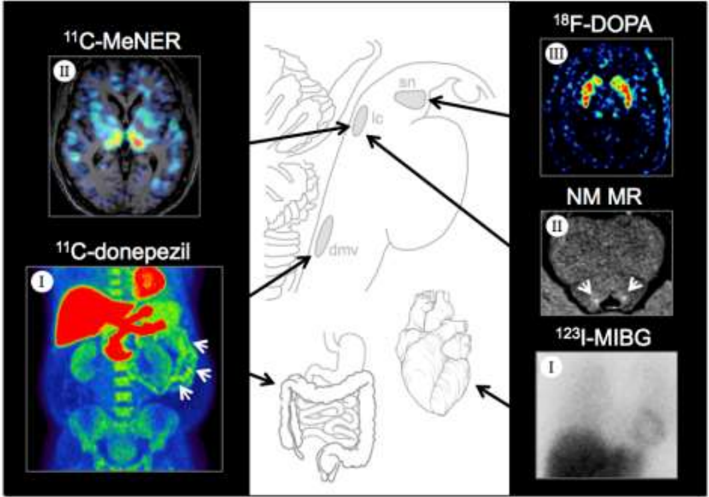
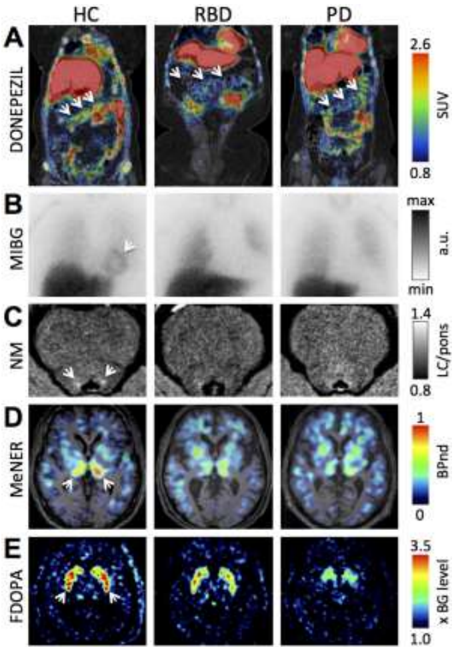
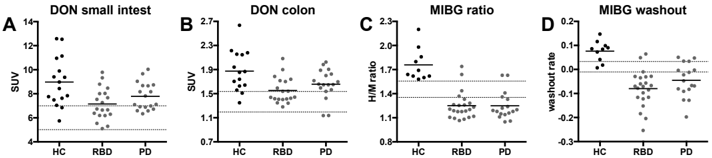
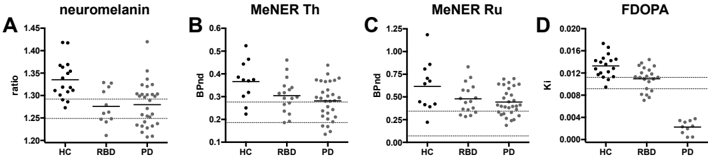
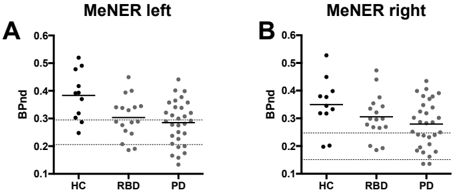
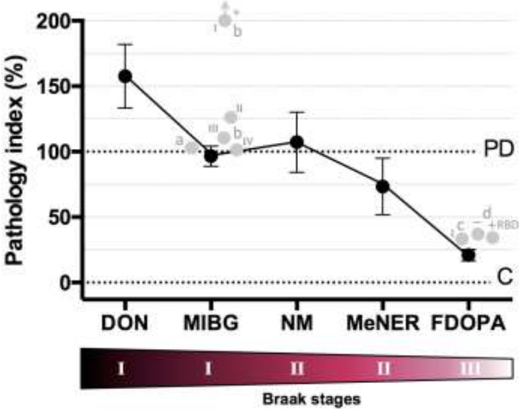
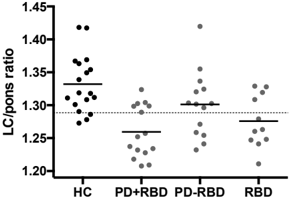
BACKGROUND Accumulating evidence suggests that α-synuclein aggregates-a defining pathology of Parkinson's disease-display cell-to-cell transmission. α-synuclein aggregation is hypothesised to start in autonomic nerve terminals years before the appearance of motor symptoms, and subsequently spread via autonomic nerves to the spinal cord and brainstem. To assess this hypothesis, we investigated sympathetic, parasympathetic, noradrenergic, and dopaminergic innervation in patients with idiopathic rapid eye movement (REM) sleep behaviour disorder, a prodromal phenotype of Parkinson's disease. METHODS In this prospective, case-control study, we recruited patients with idiopathic REM sleep behaviour disorder, confirmed by polysomnography, without clinical signs of parkinsonism or dementia, via advertisement and through sleep clinics in Denmark. We used 11C-donepezil PET and CT to assess cholinergic (parasympathetic) gut innervation, 123I-metaiodobenzylguanidine (MIBG) scintigraphy to measure cardiac sympathetic innervation, neuromelanin-sensitive MRI to measure integrity of pigmented neurons of the locus coeruleus, 11C-methylreboxetine (MeNER) PET to assess noradrenergic nerve terminals originating in the locus coeruleus, and 18F-dihydroxyphenylalanine (DOPA) PET to assess nigrostriatal dopamine storage capacity. For each imaging modality, we compared patients with idiopathic REM sleep behaviour disorder with previously published reference data of controls without neurological disorders or cognitive impairment and with symptomatic patients with Parkinson's disease. We assessed imaging data using one-way ANOVA corrected for multiple comparisons. FINDINGS Between June 3, 2016, and Dec 19, 2017, we recruited 22 consecutive patients with idiopathic REM sleep behaviour disorder to the study. Compared with controls, patients with idiopathic REM sleep behaviour disorder had decreased colonic 11C-donepezil uptake (-0·322, 95% CI -0·112 to -0·531; p=0·0020), 123I-MIBG heart:mediastinum ratio (-0·508, -0·353 to -0·664; p<0·0001), neuromelanin-sensitive MRI locus coeruleus:pons ratio (-0·059, -0·019 to -0·099; p=0·0028), and putaminal 18F-DOPA uptake (Ki; -0·0023, -0·0009 to -0·0037; p=0·0013). No between-group differences were detected between idiopathic REM sleep behaviour disorder and Parkinson's disease groups with respect to 11C-donepezil (p=0·39), 123I-MIBG (p>0·99), neuromelanin-sensitive MRI (p=0·96), and 11C-MeNER (p=0·56). By contrast, 15 (71%) of 21 patients with idiopathic REM sleep behaviour disorder had 18F-DOPA Ki values within normal limits, whereas all patients with Parkinson's disease had significantly decreased 18F-DOPA Ki values when compared with patients with idiopathic REM sleep behaviour disorder (p<0·0001). INTERPRETATION Patients with idiopathic REM sleep behaviour disorder had fully developed pathology in the peripheral autonomic nervous system and the locus coeruleus, equal to that in diagnosed Parkinson's disease. These patients also showed noradrenergic thalamic denervation, but most had normal putaminal dopaminergic storage capacity. This caudorostral gradient of dysfunction supports the hypothesis that α-synuclein pathology in Parkinson's disease initially targets peripheral autonomic nerves and then spreads rostrally to the brainstem. FUNDING Lundbeck Foundation, Jascha Foundation, and the Swiss National Foundation.
Overview
The claims and statistics of this paper haven’t been checked yet.
Free: it reads the open-access text and checks the first 5 claims that cite a source we can check. Create a free account to check every claim.
Integrity signals
Registry
Cites
Statistics
Figures
Verification
Claims the paper makes
The claims and statistics of this paper haven’t been checked yet.
Free: it reads the open-access text and checks the first 5 claims that cite a source we can check. Create a free account to check every claim.
Claims other papers make about this one
Each is checked against this paper’s own text: does it say what the citing paper says it does?
The cited source says what the claim attributes to it.
In the citing paper
“In Parkinson's disease, the vagus nerve seems to play a fundamental role in the gut-brain transmission of pathological asynuclein.141”
From The role of gut dysbiosis in Parkinson’s disease: mechanistic insights and therapeutic options (2021) · cites this paper as [141]
Self-check
Percentages, sums and reported differences re-computed from the paper’s own numbers.
The self-check needs the paper’s full text.
Citations
Cites
Folstein, M. F., Folstein, S. E., & McHugh, P. R. (1975) · Journal of Psychiatric Research · doi:10.1016/0022-3956(75)90026-6 · Cited by 88,282
The Montreal Cognitive Assessment, MoCA: a brief screening tool for mild cognitive impairment
Nasreddine, Z. S., Phillips, N. A., Bédirian, V., Charbonneau, S., Whitehead, V., Collin, I., Cummings, J. L., & Chertkow, H. (2005) · Journal of the American Geriatrics Society · doi:10.1111/j.1532-5415.2005.53221.x · Cited by 25,553
Staging of brain pathology related to sporadic Parkinson’s disease
Braak, H., Tredici, K. D., Rüb, U., de Vos, R. A. I., Jansen Steur, E. N. H., & Braak, E. (2003) · Neurobiology of Aging · doi:10.1016/s0197-4580(02)00065-9 · Cited by 10,777 · cited 6×
“PD 21/8 67±9 6·2±4·2 37 (11-51) 2/26/1/0 - 26 (23-30) 10/16 6 (2-14) 7 (1-19)”
InfluentialMDS clinical diagnostic criteria for Parkinson’s disease
Postuma, R. B., Berg, D., Stern, M., Poewe, W., Olanow, C. W., Oertel, W., Obeso, J., Marek, K., Litvan, I., Lang, A. E., et al. (2015) · Movement Disorders · doi:10.1002/mds.26424 · Cited by 7,653 · cited 9×
“PD 21/8 67±9 6·2±4·2 37 (11-51) 2/26/1/0 - 26 (23-30) 10/16 6 (2-14) 7 (1-19)”
InfluentialDiagnosis and management of dementia with Lewy bodies: Fourth consensus report of the DLB Consortium
McKeith, I. G., Boeve, B. F., Dickson, D. W., Halliday, G., Taylor, J.-P., Weintraub, D., Aarsland, D., Galvin, J., Attems, J., Ballard, C. G., et al. (2017) · Neurology · doi:10.1212/wnl.0000000000004058 · Cited by 4,476 · cited 8×
“PD 21/8 67±9 6·2±4·2 37 (11-51) 2/26/1/0 - 26 (23-30) 10/16 6 (2-14) 7 (1-19)”
InfluentialBraak, H., R�b, U., Gai, W. P., & Del Tredici, K. (2003) · Journal of Neural Transmission · doi:10.1007/s00702-002-0808-2 · Cited by 1,683 · cited 6×
“PD 21/8 67±9 6·2±4·2 37 (11-51) 2/26/1/0 - 26 (23-30) 10/16 6 (2-14) 7 (1-19)”
InfluentialHummel, T., Kobal, G., Gudziol, H., & Mackay-Sim, A. (2007) · European Archives of Oto-Rhino-Laryngology · doi:10.1007/s00405-006-0173-0 · Cited by 1,484
Goetz, C. G., Fahn, S., Martinez‐Martin, P., Poewe, W., Sampaio, C., Stebbins, G. T., Stern, M. B., Tilley, B. C., Dodel, R., Dubois, B., et al. (2007) · Movement Disorders · doi:10.1002/mds.21198 · Cited by 1,404
Chaudhuri, K. R., Martinez‐Martin, P., Schapira, A. H. V., Stocchi, F., Sethi, K., Odin, P., Brown, R. G., Koller, W., Barone, P., MacPhee, G., et al. (2006) · Movement Disorders · doi:10.1002/mds.20844 · Cited by 1,100
The REM sleep behavior disorder screening questionnaire—A new diagnostic instrument
Stiasny‐Kolster, K., Mayer, G., Schäfer, S., Möller, J. C., Heinzel‐Gutenbrunner, M., & Oertel, W. H. (2007) · Movement Disorders · doi:10.1002/mds.21740 · Cited by 1,060
Cited by
Items 301–317 of 317
Role of Molecular Imaging in Parkinson’s Disease
Su, D., & Stoessl, A. J. (2025) · Springer eBooks · doi:10.1007/978-3-031-95878-6_3
Valli, M. (2022) · TSpace (University of Toronto)
Apport de l'IRM multimodale pour le diagnostic différentiel des syndromes parkinsoniens
Chougar, L. (2022) · theses.fr (ABES) · doi:10.70675/eebdb441z4314z48f5zab1aze3d95f0d4e54
The Noradrenergic Brain in Parkinson’s Disease
Pasquini, J., Palermo, G., Pavese, N., & Ceravolo, R. (2026) · Current Neurology and Neuroscience Reports · doi:10.1007/s11910-026-01499-x
“Furthermore, in vivo cardiac denervation is a usual finding in PD, dementia with Lewy bodies and their prodromal manifestations [122–125].”
Self-citationInstantaneous-Frequency EEG Microstate Dynamics Stratify Motor Subtypes in Parkinson’s DiseasePreprint
Nobukawa, S., & Watanabe, H. (2026) · medRxiv · doi:10.64898/2026.06.09.26355312
Skjærbæk, C., Damgaard, A. T., Bertelsen, N. B., Lillethorup, T. P., Horsager, J., Lowe, V., Andersen, N. H., Terkelsen, A. J., Otto, M., Bertram, D., et al. (2026) · medRxiv · doi:10.64898/2026.08.14.26360475
Self-citationNigro-striatal deficits capture phenoconversion risk in isolated REM sleep behavior disorderPreprint
Johansson, M. E., Baron, A., Gaurav, R., Ruze, A., Dodet, P., Kas, A., Radhakrishnan, V., Valabrègue, R., Villain, N., Mangone, G., et al. (2026) · medRxiv · doi:10.64898/2026.08.26.26361210
Carli, G. (n.d.) · Archivio Istituzionale della Ricerca - Università Vita-Salute San Raffaele · Cited by 1
Boccalini, C. (n.d.) · Archivio Istituzionale della Ricerca - Università Vita-Salute San Raffaele
Scheperjans, F., Borghammer, P., Pfeiffer, R. F., Appel‐Cresswell, S., & Keshavarzian, A. (2026) · Movement Disorders · doi:10.1002/mds.70566
Self-citationZhou, Z., Elvira, R., Ng, J. H., Tamakoshi, D., Hiraga, K., Xiao, B., Katsuno, M., & Tan, E. (2026) · Parkinsonism & Related Disorders · doi:10.1016/j.parkreldis.2026.109023
Body-First and Brain-First Parkinson’s Disease
Borghammer, P. (2025) · doi:10.68739/ns6etjip
Self-citationByun, J. I., Song, H., Shin, J. H., Kim, H.-J., Shin, W. C., Sohn, C. H., & Jung, K. (2026) · Sleep And Breathing · doi:10.1007/s11325-026-03845-2
“Furthermore, mul - timodal imaging studies have shown that RBD is accompanied by alterations across multiple neurotransmitter systems, including cholinergic, noradrenergic, and dopaminergic circuits [ 5 ].”
Beyond dopamine: the role of non-dopaminergic systems in Parkinson’s disease
Li, L., & Zhang, B. (2026) · npj Parkinson s Disease · doi:10.1038/s41531-026-01604-4
Metadata
- Authors
- Knudsen, K., Fedorova, T. D., Hansen, A. K., Sommerauer, M., Otto, M., Svendsen, K. B., Nahimi, A., Stokholm, M. G., Pavese, N., Beier, C. P., Brooks, D. J., & Borghammer, P.
- Affiliations
- Aarhus University Hospital (DK)
- University of Southern Denmark (DK)
- Corresponding author
- Borghammer, Per
- ORCID
- Venue
- The Lancet Neurology
- Publisher
- Elsevier BV
- Published
- 2018-07
- Volume
- 17
- Issue
- 7
- Pages
- 618-628
- ISSN
- 1474-4422 (ISSN-L)
- OpenAlex
- W2803083570
- Semantic Scholar
- 4563f9a3953b8f84462ef0bec086f71c50049b54
- Cited by
- 309
- References
- 51
- Citations by year
- 2026: 16 · 2025: 25 · 2024: 47 · 2023: 37 · 2022: 50 · 2021: 57 · 2020: 29 · 2019: 33 · 2018: 15
- FWCI
- 22.75
- Type
- journal article
- Language
- en
- Open access
- Licence
- cc-by-nc-nd
- www.elsevier.com/tdm/userlicense/1.0/ (tdm)
- www.elsevier.com/legal/tdmrep-license (tdm)
- Locations
- The Lancet Neurology (publishedVersion)
- PubMed (publishedVersion)
- Kölner Universitäts PublikationsServer (Universität zu Köln) (publishedVersion)
- University of Southern Denmark Research Portal (University of Southern Denmark) (submittedVersion, cc-by-nc-nd)
- Newcastle University ePrints (Newcastle Univesity) (cc-by-nc-nd)
- Funders
- Jascha Fonden
- Lundbeckfonden
- Topics
- Health Sciences › Medicine › Clinical Neurology › Parkinson's Disease Mechanisms and Treatments
- Health Sciences › Medicine › Psychiatry and Mental health › Dementia and Cognitive Impairment Research
- Health Sciences › Medicine › Clinical Neurology › Deep Brain Stimulation and Movement Disorders
- Keywords
- REM sleep behavior disorder, alpha-synuclein aggregation, cell-to-cell transmission, cardiac sympathetic innervation, noradrenergic terminals, locus coeruleus, nigrostriatal dopamine, 123I-MIBG scintigraphy, neuromelanin-sensitive MRI
- MeSH terms
- Aged, Denmark, Female, Heart, Humans, Locus Coeruleus, Magnetic Resonance Imaging, Male, Middle Aged, Parkinson Disease, Prospective Studies, Sympathetic Nervous System, Case-Control Studies, Polysomnography, Presynaptic Terminals, REM Sleep Behavior Disorder, Positron-Emission Tomography, Multimodal Imaging
About these checks
Registry, retraction, Cites and statistics results are computed, not judged, with one exception: a printed reference that no index lists is read once by a model before it counts as a citation error. Claims are extracted by a model and kept only when their quote appears verbatim in the text; each cited source is then checked, with a model’s help, for whether it says what the claim relies on. Those verdicts can be wrong — read the claim’s quote and the cited source before relying on one.
Statistics and arithmetic are recomputed, not judged.
Confidence bands are shown only for fields calibrated on our annotated test set. None is calibrated yet, so no band is shown.
What counts as a claim ›How we measure confidence ›How we check this ›
Are you an author, or do you see a problem with this page? Request a review
Data sources
Bibliographic data: Semantic Scholar, OpenAlex, Crossref.
Contains information from the Semantic Scholar Academic Graph Datasets, made available under the ODC Attribution License (ODC-BY 1.0).
Semantic Scholar’s data is described in: Kinney, R., et al. (2023). The Semantic Scholar Open Data Platform. arXiv:2301.10140.
