

Association of BMI with overall and cause-specific mortality: a population-based cohort study of 3· 6 million adults in the UK
Open accessThe DOI matches its Crossref record; 27 of the 29 references it cites were found in a registry or an index.
Abstract
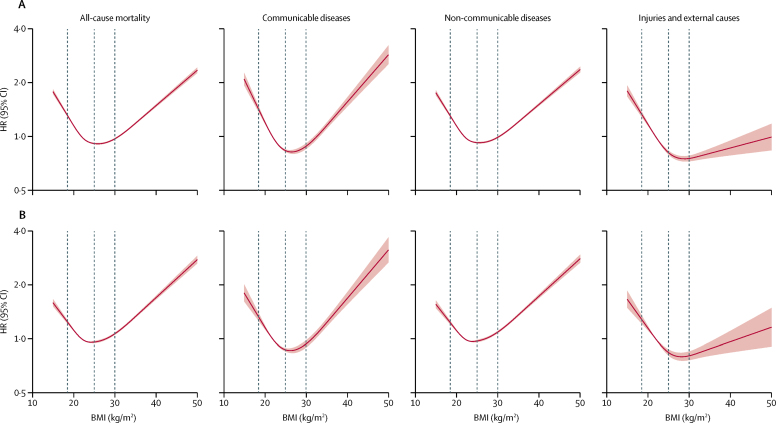
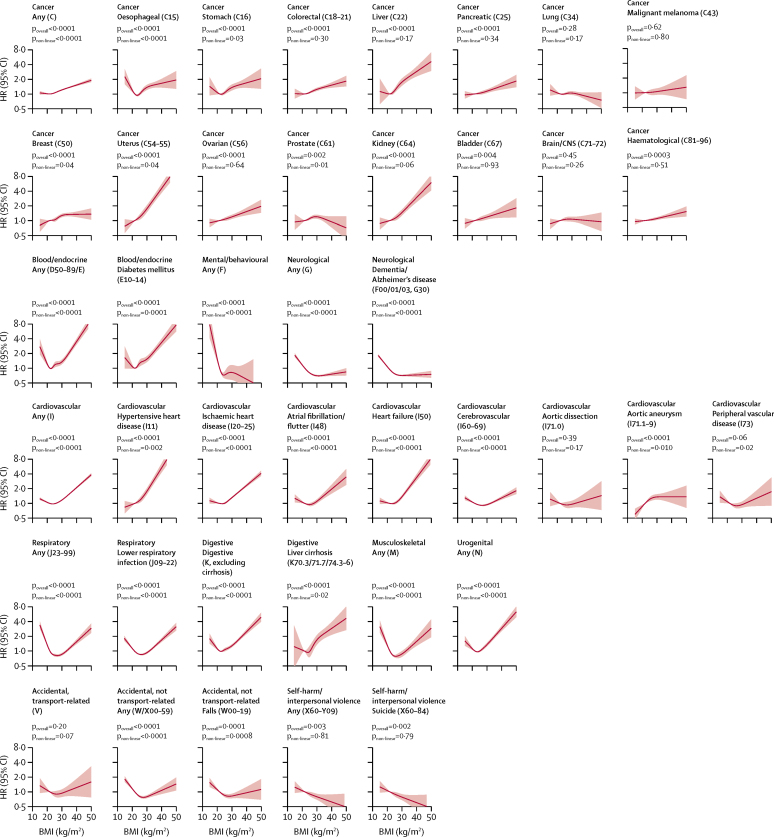
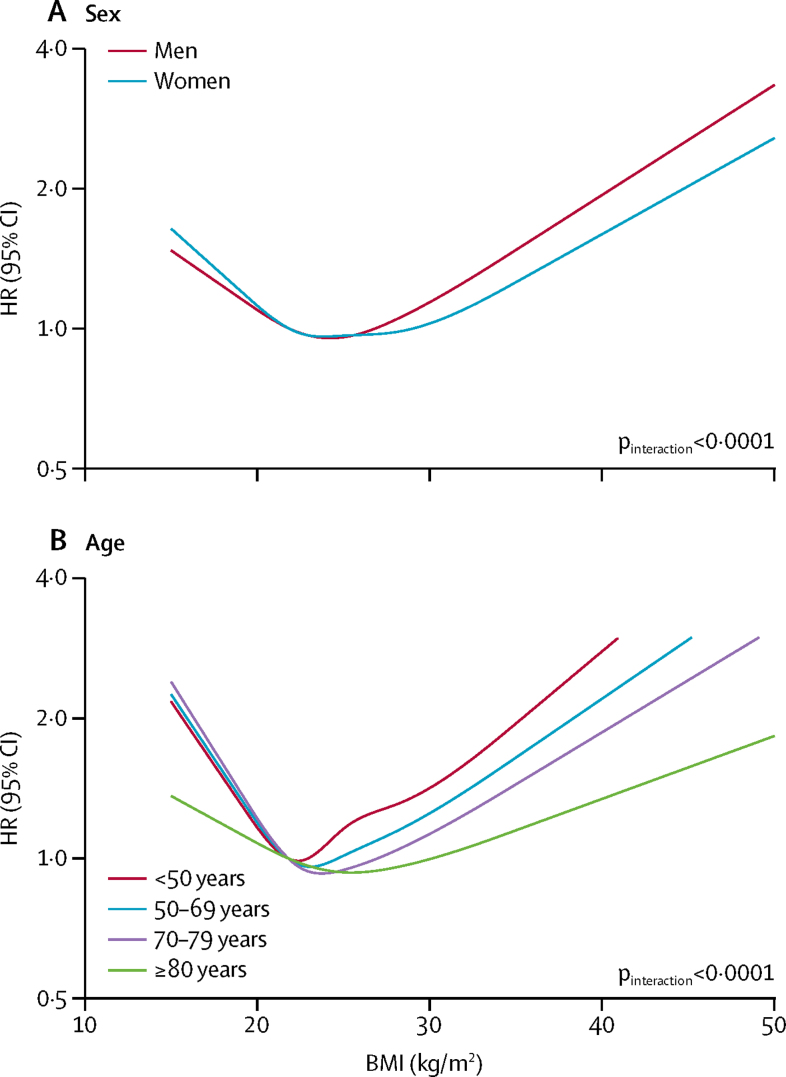
Background BMI is known to be strongly associated with all-cause mortality, but few studies have been large enough to reliably examine associations between BMI and a comprehensive range of cause-specific mortality outcomes. Methods In this population-based cohort study, we used UK primary care data from the Clinical Practice Research Datalink (CPRD) linked to national mortality registration data and fitted adjusted Cox regression models to examine associations between BMI and all-cause mortality, and between BMI and a comprehensive range of cause-specific mortality outcomes (recorded by International Classification of Diseases, 10th revision [ICD-10] codes). We included all individuals with BMI data collected at age 16 years and older and with subsequent follow-up time available. Follow-up began at whichever was the latest of: start of CPRD research-standard follow up, the 5-year anniversary of the first BMI record, or on Jan 1, 1998 (start date for death registration data); follow-up ended at death or on March 8, 2016. Fully adjusted models were stratified by sex and adjusted for baseline age, smoking, alcohol use, diabetes, index of multiple deprivation, and calendar period. Models were fitted in both never-smokers only and the full study population. We also did an extensive range of sensitivity analyses. The expected age of death for men and women aged 40 years at baseline, by BMI category, was estimated from a Poisson model including BMI, age, and sex. Findings 3 632 674 people were included in the full study population; the following results are from the analysis of never-smokers, which comprised 1 969 648 people and 188 057 deaths. BMI had a J-shaped association with overall mortality; the estimated hazard ratio per 5 kg/m 2 increase in BMI was 0·81 (95% CI 0·80–0·82) below 25 kg/m 2 and 1·21 (1·20–1·22) above this point. BMI was associated with all cause of death categories except for transport-related accidents, but the shape of the association varied. Most causes, including cancer, cardiovascular diseases, and respiratory diseases, had a J-shaped association with BMI, with lowest risk occurring in the range 21–25 kg/m 2 . For mental and behavioural, neurological, and accidental (non-transport-related) causes, BMI was inversely associated with mortality up to 24–27 kg/m 2 , with little association at higher BMIs; for deaths from self-harm or interpersonal violence, an inverse linear association was observed. Associations between BMI and mortality were stronger at younger ages than at older ages, and the BMI associated with lowest mortality risk was higher in older individuals than in younger individuals. Compared with individuals of healthy weight (BMI 18·5–24·9 kg/m 2 ), life expectancy from age 40 years was 4·2 years shorter in obese (BMI ≥30·0 kg/m 2 ) men and 3·5 years shorter in obese women, and 4·3 years shorter in underweight (BMI <18·5 kg/m 2 ) men and 4·5 years shorter in underweight women. When smokers were included in analyses, results for most causes of death were broadly similar, although marginally stronger associations were seen among people with lower BMI, suggesting slight residual confounding by smoking. Interpretation BMI had J-shaped associations with overall mortality and most specific causes of death; for mental and behavioural, neurological, and external causes, lower BMI was associated with increased mortality risk. Funding Wellcome Trust.
Overview
The claims and statistics of this paper haven’t been checked yet.
Free: it reads the open-access text and checks the first 5 claims that cite a source we can check. Create a free account to check every claim.
Integrity signals
Registry
Cites
Statistics
Figures
Verification
Claims the paper makes
The claims and statistics of this paper haven’t been checked yet.
Free: it reads the open-access text and checks the first 5 claims that cite a source we can check. Create a free account to check every claim.
Claims other papers make about this one
Each is checked against this paper’s own text: does it say what the citing paper says it does?
The cited source says what the claim attributes to it.
In the citing paper
“As a chronic disease, obesity increases cardiometabolic risk [1] and ultimately confers an increased risk of premature mortality [2,3].”
In the citing paper
“Furthermore, several prospective studies reported a J-shaped association between BMI and both all-cause and cardiovascular mortality (73, 74).”
From Health Consequences of Sarcopenic Obesity: A Narrative Review (2020) · cites this paper as [74]
Self-check
Percentages, sums and reported differences re-computed from the paper’s own numbers.
The self-check needs the paper’s full text.
Citations
Cites
(2000) · PubMed · Cited by 13,173
The metabolic phenotype in obesity: Fat mass, body fat distribution, and adipose tissue function
Goossens, G. H. (2017) · Obesity Facts · doi:10.1159/000471488 · Cited by 8,481
Health effects of overweight and obesity in 195 countries over 25 years
Collaborators, T. G. 2. O. (2017) · New England Journal of Medicine · doi:10.1056/nejmoa1614362 · Cited by 7,918
Prospective Studies Collaboration (2009) · The Lancet · doi:10.1016/s0140-6736(09)60318-4 · Cited by 4,807
Flegal, K. M., Kit, B. K., Orpana, H., & Graubard, B. I. (2013) · JAMA · doi:10.1001/jama.2012.113905 · Cited by 3,998
Di Angelantonio, E., Bhupathiraju, S. N., Wormser, D., Gao, P., Kaptoge, S., de Gonzalez, A. B., Cairns, B. J., Huxley, R., Jackson, C. L., Joshy, G., et al. (2016) · The Lancet · doi:10.1016/s0140-6736(16)30175-1 · Cited by 2,821
Data Resource Profile: Clinical Practice Research Datalink (CPRD)
Herrett, E., Gallagher, A. M., Bhaskaran, K., Forbes, H., Mathur, R., van Staa, T., & Smeeth, L. (2015) · International Journal of Epidemiology · doi:10.1093/ije/dyv098 · Cited by 2,667
Self-citationBody-mass index and mortality among 1.46 million white adults
Berrington de Gonzalez, A., Hartge, P., Cerhan, J. R., Flint, A. J., Hannan, L., MacInnis, R. J., Moore, S. C., Tobias, G. S., Anton-Culver, H., Freeman, L. B., et al. (2010) · New England Journal of Medicine · doi:10.1056/nejmoa1000367 · Cited by 2,317
The use of fractional polynomials to model continuous risk variables in epidemiology
Royston, P., Ambler, G., & Sauerbrei, W. (1999) · International Journal of Epidemiology · doi:10.1093/ije/28.5.964 · Cited by 1,066
Research works printed but not linked: 1
- Gallagher A Puri S Staa T Linkage of the General Practice Research Database (GPRD) with other data sources Pharmacoepidemiol Drug Saf 20 2011 S230 (abstr).
Cited by
Items 401–500 of 1,001
Ni, W., Liu, W., Zhao, Z., Yuan, X., Sun, Y., Zhang, H., Wang, L., Zhou, M., Yin, P., & Xu, J. (2022) · The journal of nutrition health & aging · doi:10.1007/s12603-022-1813-9 · Cited by 16
Golubnitschaja, O., Kubatka, P., Mazuráková, A., Samec, M., Alajati, A., Giordano, F. A., Costigliola, V., Ellinger, J., & Ritter, M. (2022) · Cancers · doi:10.3390/cancers14030675 · Cited by 16
“This interplay is extremely comprehensive as clearly illustrated by highly individual association between the Body Mass Index (BMI) and PCa-related mortality [4]: a disease specific association between BMI and corresponding mortality rates has been demonstrated in the UK population.”
BackgroundWang, W., Zhang, W., Li, L., Huang, J., Hu, D., Liu, S., Xu, J., Cui, L., Liu, J., Wu, S., et al. (2022) · Environmental Research · doi:10.1016/j.envres.2022.113888 · Cited by 16
Obesidad y coronavirus 2019nCoV: una relación de riesgo
Carretero‐Gómez, J., Arévalo‐Lorido, J. C., & Carrasco-Sánchez, F. J. (2020) · Revista Clínica Española · doi:10.1016/j.rce.2020.04.008 · Cited by 16
Ostrominski, J. W., & Powell‐Wiley, T. M. (2023) · Current Atherosclerosis Reports · doi:10.1007/s11883-023-01182-3 · Cited by 15
Clift, A. K., Lannou, E. L., Tighe, C. P., Shah, S. S., Beatty, M., Hyvärinen, A., Lane, S. J., Strauss, T., Dunn, D. D., Lu, J., et al. (2021) · JMIR mhealth and uhealth · doi:10.2196/25655 · Cited by 15
“BMI is often used as a quick means of estimating an individual’s relative adiposity and infer the relative likelihood of adverse adiposity-related outcomes [4,5].”
Obesity paradox as a new insight from postoperative complications in gastric cancer
Kamiya, H., Komatsu, S., Nishibeppu, K., Ohashi, T., Konishi, H., Shiozaki, A., Kubota, T., Fujiwara, H., & Otsuji, E. (2023) · Scientific Reports · doi:10.1038/s41598-023-36968-7 · Cited by 15
Gunsalus, K. T. W., Mixon, J. K., & House, E. M. (2024) · Medical Science Educator · doi:10.1007/s40670-024-02025-9 · Cited by 15
“In our experience, nutrition education provided to medical students typically emphasizes weight loss, ignoring the harms of weight cycling [81, 82] and the many studies demonstrating that a low BMI is associated with a higher mortality rate than a high BMI [76, 83].”
BackgroundBioletto, F., Ponzo, V., Goitre, I., Stella, B., Rahimi, F., Parasiliti‐Caprino, M., Broglio, F., Ghigo, E., & Bo, S. (2024) · Nutrients · doi:10.3390/nu16203433 · Cited by 15
“…with all-cause mortality remains controversial; several meta-analyses reported a positive association with BMI starting from values > 25 kg/m 2 [8–10], while others showed that patients with overweight or class I obesity may face similar or even diminished risks for all-cause mortality compared…”
BackgroundZhang, X., Wu, X., Ma, Y., Zhu, C., Cao, J., Liu, G., Li, F., & Cheng, A. S. K. (2021) · Risk Management and Healthcare Policy · doi:10.2147/rmhp.s311692 · Cited by 15
“As we all know, BMI is reported to have a “U” or “J” relationship with mortality in different populations.(36,37) In our study, BMI was a protective factor for mortality in an unadjusted model; however, after adjusting a variety of variables, this association was found not to exist, indicating that BMI is not a stable…”
BackgroundQuestionnaires for assessing self-perceived physical fitness: A systematic review
Sánchez-Lastra, M. A., Varela, S., Martínez-Aldao, D., & Ayán, C. (2021) · Experimental Gerontology · doi:10.1016/j.exger.2021.111463 · Cited by 15
Seo, D. H., Cho, Y., Seo, S., Ahn, S. H., Hong, S., Ha, K. H., Shim, J., Kim, H. C., Kim, D. J., & Kim, S. H. (2022) · Journal of Clinical Medicine · doi:10.3390/jcm11092440 · Cited by 15
Yu, X., & Ren, X. (2021) · Frontiers in Public Health · doi:10.3389/fpubh.2021.722629 · Cited by 15
Isacco, L., Ennequin, G., & Boisseau, N. (2021) · Archives of Physiology and Biochemistry · doi:10.1080/13813455.2021.1933045 · Cited by 16
“The Body Mass Index (BMI) is the most commonly used screening tool to detect individuals at health risk because high BMI is one of the most important health concerns worldwide and a major risk factor of various diseases (Bhaskaran et al. 2018).”
MethodSpaggiari, G., Santi, D., Budriesi, G., Dondi, P., Cavedoni, S., Leonardi, L., Delvecchio, C., Valentini, L., Bondi, M., Miloro, C., et al. (2020) · Obesity Surgery · doi:10.1007/s11695-020-04723-w · Cited by 15
Zhang, X., Li, X., Shi, H., Zhang, K., Zhang, Q., Tang, M., Li, W., Zhou, F., Liu, M. R., Cong, M., et al. (2021) · Nutrition · doi:10.1016/j.nut.2021.111508 · Cited by 15
Post-infectious and post-acute sequelae of critically ill adults with COVID-19
Ibrahim, H., Athar, S., Harhara, T., Elhag, S. A., MElnour, S., Sukkar, H. H., & Kamour, A. M. (2021) · PLoS ONE · doi:10.1371/journal.pone.0252763 · Cited by 15
Low CD4 counts predict excessive weight gains during first-line treatment for HIV
Hill, A. M., Sanchez, T. T., Delaporte, É., Sokhela, S. M., Simmons, B., Kouanfack, C., McCann, K., Levi, J., Fairhead, C., & Venter, F. (2024) · Journal of Antimicrobial Chemotherapy · doi:10.1093/jac/dkae238 · Cited by 15
Grob, S. R., Suter, F., Katzke, V. A., & Rohrmann, S. (2023) · Nutrients · doi:10.3390/nu15133063 · Cited by 15
“Low BMI is associated with poorer outcome, especially in the elderly, whose estimated BMI for lowest risk of all-cause mortality is higher than in younger patients [42].”
BackgroundObesity associates with increased all-cause and cardiovascular mortality in adults with asthma
Sturesson, A., Hedman, L., Stridsman, C., Lindberg, A., Rönmark, E., & Bäckman, H. (2023) · Respiratory Medicine · doi:10.1016/j.rmed.2023.107301 · Cited by 15
Additive effects of obesity and vitamin D insufficiency on all-cause and cause-specific mortality
Song, S., Yuan, Y., Wu, X., Zhang, D., Qi, Q., Wang, H., & Li, F. (2022) · Frontiers in Nutrition · doi:10.3389/fnut.2022.999489 · Cited by 16
Zha, B., Cai, A., & Wang, G. (2024) · Preventive Medicine Reports · doi:10.1016/j.pmedr.2024.102760 · Cited by 15
“This may be due to the complex relationship between obesity index and mortality (Bhaskaran et al., 2018).”
BackgroundShen, Z., Zhang, S., Zhang, M., Hu, L., Sun, Q., He, C., Yan, D., Ye, J., Zhang, H., Wang, L., et al. (2022) · Frontiers in Oncology · doi:10.3389/fonc.2021.823079 · Cited by 15
Pescari, D., Mihuţa, M. S., Bena, A., & Stoian, D. L. (2024) · Frontiers in Nutrition · doi:10.3389/fnut.2024.1493954 · Cited by 14
Experienced and internalized weight stigma among Spanish adolescents
Anastasiadou, D. T., Tárrega, S., Fornieles-Deu, A., Montcada-Ribera, A., Bach-Faig, A., & Sánchez‐Carracedo, D. (2024) · BMC Public Health · doi:10.1186/s12889-024-19246-7 · Cited by 14
“Obesity is one of the greatest public health concerns of the 21st century [1] that compromises health in its broader spectrum, including physical [2] and mental well-being [3].”
BackgroundNormal-Weight Abdominal Obesity: A Risk Factor for Hypertension and Cardiometabolic Dysregulation
Sun, J.-Y., Qu, Q., Yuan, Y., Sun, G., Kong, X., & Sun, W. (2021) · Cardiology Discovery · doi:10.1097/cd9.0000000000000034 · Cited by 14
“9 kg/m(2)) who underwent physical and laboratory examinations.([18,19]) In addition, we excluded the participants who had missing data on body measurements, blood pressure, cardiometabolic risk factors, dietary interview, standard biochemistry profile, or family poverty-income ratio (PIR).”
BackgroundHow much of the stalled mortality trends in Scotland and England can be attributed to obesity?
Walsh, D., Tod, E., McCartney, G., & Levin, K. A. (2022) · BMJ Open · doi:10.1136/bmjopen-2022-067310 · Cited by 14
Gray, L. A., Breeze, P. R., & Williams, E. A. (2022) · Obesity · doi:10.1002/oby.23510 · Cited by 14
“Being underweight or living with obesity has been associated with higher risk of all-cause mortality compared with having a “healthy” BMI [1].”
BackgroundSu, Y., Sun, J., Zhou, Y., & Sun, W. (2024) · Reviews in Cardiovascular Medicine · doi:10.31083/j.rcm2506212 · Cited by 15
“Obesity is commonly defined by the body mass index (BMI), a measurement that is insufficient to find out the association between regional body fat distribution and cardiovascular-specific morbidity [11].”
BackgroundGayan, S., Teli, A., Nair, A., Tomar, G. B., & Dey, T. (2021) · In vitro models · doi:10.1007/s44164-021-00006-5 · Cited by 14
Association of weight change with all-cause and cause-specific mortality: an age-stratified analysis
Huang, Q., Shen, D., Gao, J., Chen, H., Xie, J., Yan, H.-Y., Wu, B., Li, Z., Liu, G., & Mao, C. (2024) · BMC Medicine · doi:10.1186/s12916-024-03665-9 · Cited by 14
“Excessive weight gain may herald an impending epidemic of obesity-related chronic diseases, notably CVD, and associated health outcomes, especially mortality [2, 30].”
BackgroundDaouadji-Ghazouani, A., Aron‐Wisnewsky, J., Torcivia, A., Irigoin-Guichandut, M., Poitou, C., Faucher, P., Ciangura, C., Lassen, P. B., Clément, K., Vaillant, J., et al. (2023) · Obesity Surgery · doi:10.1007/s11695-023-06485-7 · Cited by 14
Jung, M., Yi, S., An, S. J., Balkau, B., Yi, J., & Kim, H. (2020) · Diabetologia · doi:10.1007/s00125-020-05160-1 · Cited by 14
“However, people with low BMI (lean/normal weight, particularly BMI <22–23 kg/m(2)) also had higher mortality than overweight people in the general population [8, 9].”
BackgroundJúnior, J. C. D. L., Virginio, V. W., Moura, F. A., Bertolami, A., Bertolami, M. C., Coelho‐Filho, O. R., Zanotti, I., Nadruz, W., de Faria, E. C., de Carvalho, L. S. F., et al. (2019) · Nutrition Metabolism and Cardiovascular Diseases · doi:10.1016/j.numecd.2019.09.017 · Cited by 14
Thielman, J., Copes, R., Rosella, L. C., Chiu, M., & Manson, H. E. (2019) · BMJ Open · doi:10.1136/bmjopen-2019-032475 · Cited by 14
Brown, C., Terrell, K., Goodwin, R. L., & Nathaniel, T. I. (2022) · Journal of Cardiovascular Development and Disease · doi:10.3390/jcdd9100345 · Cited by 14
“The description of obesity categories is based on BMI [43], and there is a U-shaped association between BMI and stroke [44,45].”
BackgroundHealthcare costs attributable to abnormal weight in China: evidence based on a longitudinal study
Zhao, S., Xu, X., You, H., Ge, J., & Wu, Q.-F. (2023) · BMC Public Health · doi:10.1186/s12889-023-16855-6 · Cited by 14
“Specifically, the risk of mortality linked to being underweight is attributed to neurological diseases and accidents [8].”
BackgroundBorda, M. G., Jaramillo-Jiménez, A., Giil, L. M., Tovar, D., Soennesyn, H., & Aarsland, D. (2022) · Health Science Reports · doi:10.1002/hsr2.590 · Cited by 14
“It has been shown that malnourished people with dementia have a higher risk of mortality and functional loss.(3,16) In addition, Cumming et al.”
BackgroundObesity Paradox of All-Cause Mortality in 4,133 Patients Treated with Coronary Revascularization
Li, C., Han, D., Xu, F., Zheng, S., Zhang, L., Wang, Z., Yang, R., Yin, H., & Lyu, J. (2021) · Journal of Interventional Cardiology · doi:10.1155/2021/3867735 · Cited by 14
“,e body mass index (BMI) is a prognostic factor for all-cause mortality in many diseases, with the prognosis being better in people with a normal BMI than in those who are overweight or obese [1, 2].”
BackgroundCalcaterra, V., Pelizzo, G., & Cena, H. (2019) · Frontiers in Pediatrics · doi:10.3389/fped.2019.00226 · Cited by 14
“(4) for mental and behavioral, neurological causes, only a lower BMI was associated with increased mortality risk.”
BackgroundSchinzari, F., Vizioli, G., Campia, U., Tesauro, M., & Cardillo, C. (2021) · Biomedicines · doi:10.3390/biomedicines9081037 · Cited by 13
“Obesity remains a leading cause of cardiovascular morbidity and mortality [1], especially when associated with lipid abnormalities, high blood pressure or T2D [2].”
BackgroundGe, Z., Li, C., Li, Y., Wang, N., & Hong, Z. (2024) · INQUIRY The Journal of Health Care Organization Provision and Financing · doi:10.1177/00469580241235755 · Cited by 13
Liu, S., Cao, W., Li, Z., Wang, S., Yang, S., Lu, M., Li, H., Song, Y., Chen, S., Li, X., et al. (2023) · Clinical Nutrition · doi:10.1016/j.clnu.2023.04.023 · Cited by 13
Han, K., Jia, W., Wang, S., Cao, W., Song, Y., Wang, J., Liu, M., Yang, S., & He, Y. (2021) · Frontiers in Endocrinology · doi:10.3389/fendo.2021.620261 · Cited by 14
Weight loss trend after bariatric surgery in a population of obese patients
Palumbo, P., Banchelli, F., Miloro, C., Toschi, P. F., Mécheri, F., Gabriele, S., Pantaleoni, M., D’Amico, R., & Menozzi, R. (2023) · Clinical Nutrition ESPEN · doi:10.1016/j.clnesp.2023.06.015 · Cited by 13
Dietary patterns modify the association between body mass index and mortality in older adults
Li, S., Lu, Z., Leung, J. C. S., Su, Y., Yu, B. W. M., & Kwok, T. C. Y. (2025) · Clinical Nutrition · doi:10.1016/j.clnu.2025.01.016 · Cited by 13
Lynch, D. H., Howard, A. G., Tien, H.-C., Du, S., Zhang, B., Wang, H., Gordon‐Larsen, P., & Batsis, J. A. (2023) · The Journals of Gerontology Series A · doi:10.1093/gerona/glad051 · Cited by 13
Edmonton Obesity Staging System: an improvement by cardiopulmonary exercise testing
Bettini, S., Quinto, G., Neunhäeuserer, D., Battista, F., Belligoli, A., Milan, G., Gasperetti, A., Vettor, R., Ermolao, A., & Busetto, L. (2021) · International Journal of Obesity · doi:10.1038/s41366-021-00856-9 · Cited by 13
“To classify obesity and assess cardiovascular risk, body mass index (BMI) and waist circumference are preferably used in clinical practice as surrogate measures of body and visceral fat, respectively [3].”
MethodLosciale, J. M., Truong, L. K., Ward, P., Collins, G. S., & Bullock, G. S. (2024) · International Journal of Sports Physical Therapy · doi:10.26603/001c.122644 · Cited by 13
Age-appropriate BMI cut-offs for malnutrition among older adults in India
Singh, A., & Chattopadhyay, A. (2024) · Scientific Reports · doi:10.1038/s41598-024-63421-0 · Cited by 13
Berger, M. B., Steinberg, D., Askew, S., Gallis, J. A., Treadway, C., Egger, J. R., Kay, M. C., Batch, B. C., Finkelstein, E. A., DeVries, A., et al. (2019) · BMC Public Health · doi:10.1186/s12889-019-6926-7 · Cited by 13
Mainous, A. G., Xie, Z., Dickmann, S. B., Medley, J. F., & Hong, Y. (2023) · The Journal of the American Board of Family Medicine · doi:10.3122/jabfm.2022.220297r1 · Cited by 13
“3,4 As our main analysis showed, it is possible for providers to prescribe the treatment without recording obesity.”
BackgroundPerpiñán, C., Bertran, L., Terra, X., Aguilar, C., López-Dupla, M., Alibalic, A., Riesco, D., Camaron, J., Perrone, F., Rull, A., et al. (2021) · Journal of Personalized Medicine · doi:10.3390/jpm11030227 · Cited by 13
“Obesity is a complex chronic metabolic and multifactorial disease that, associated with a chronic inflammatory state, has an essential role in the development of T2DM, dyslipidemia, hypertension, cardiovascular disease (CVD), or cancer [8].”
BackgroundWhelton, S. P., Marshall, C. H., Cainzos‐Achirica, M., Dzaye, O. D. A., Blumenthal, R. S., Nasir, K., McClelland, R. L., & Blaha, M. J. (2021) · American Journal of Preventive Cardiology · doi:10.1016/j.ajpc.2021.100212 · Cited by 13
Evsevyeva, M. E., Владимирович, Е. М., Ростовцева, М. В., Fursova, E., Rusidi, A., Galkova, I., & Kudryavtseva, V. D. (2021) · Arterial’naya Gipertenziya (Arterial Hypertension) · doi:10.18705/1607-419x-2021-27-2-188-205 · Cited by 13
Oral Superabsorbent Hydrogel (Plenity) for Weight Management
Pass, A., Bialonczyk, D., Chiquette, E., & Goldman, J. D. (2020) · Annals of Pharmacotherapy · doi:10.1177/1060028020983046 · Cited by 13
Long-term BMI trajectories and epigenetic age acceleration: the role of genetic risk for obesity
Wen, Y., Chen, Y., Ma, Y., Lu, C., Liu, Y., Zhang, R., Liao, J., Wu, D., & Li, C. (2025) · BMC Medicine · doi:10.1186/s12916-025-04410-6 · Cited by 13
“However, the relationship between body mass index (BMI) and both all-cause and disease-specific mortality follows a U-or J-shaped curve, with increased risks associated with both too high or too low BMI [2, 3].”
Verboeket, S. O., Boyd, A. C., Wit, F. W. N. M., Verheij, E., van der Loeff, M. F. S., Kootstra, N. A., van der Valk, M., Reiss, P., & on behalf of the AGEhIV Cohort Study Group (2021) · PLoS ONE · doi:10.1371/journal.pone.0251205 · Cited by 13
Zhou, L., Surapaneni, A., Rhee, E. P., Yu, B., Boerwinkle, E., Coresh, J., Grams, M. E., & Schlosser, P. (2022) · Human Genomics · doi:10.1186/s40246-022-00425-9 · Cited by 13
“Again, adjustment for total cholesterol and BMI used linear splines with knots at 200 mg/dL and 25 kg/m2, respectively [44, 45].”
MethodWouters, E. F. �. (2021) · Frontiers in Rehabilitation Sciences · doi:10.3389/fresc.2021.725534 · Cited by 12
Men, J., Zhao, C., Xiang, C., Zhu, G., Yu, Z., Wang, P., Wu, S., Zhang, Y., Li, Y., Wang, L., et al. (2025) · Frontiers in Endocrinology · doi:10.3389/fendo.2025.1526991 · Cited by 12
Thompson, M. D., Pirkle, C. M., Youkhana, F., & Wu, Y. Y. (2020) · International Journal of Obesity · doi:10.1038/s41366-020-0589-4 · Cited by 12
“Progress in Cardiovascular Diseases 2014; 56(4): 369–381.”
BackgroundInfluentialPatil, M., Casari, I., Warne, L. N., & Falasca, M. (2024) · Biomedicine & Pharmacotherapy · doi:10.1016/j.biopha.2024.116245 · Cited by 12
Mortality in relation to diabetes remission in Swedish Obese Subjects – a prospective cohort study
Carlsson, L. M. S., Carlsson, B., Jacobson, P., Karlsson, C., Andersson‐Assarsson, J. C., Kristensson, F. M., Ahlin, S., Svensson, P., Taube, M., Näslund, I., et al. (2024) · International Journal of Surgery · doi:10.1097/js9.0000000000001807 · Cited by 12
Center Stage: Putting Obesity Staging Systems Into the Spotlight
Zahid, S., Peng, A. W., Razavi, A. C., Yao, Z., Blumenthal, R. S., & Blaha, M. J. (2025) · Preventing Chronic Disease · doi:10.5888/pcd22.250222 · Cited by 12
Iona, A., Bragg, F., Fairhurst-Hunter, Z., Millwood, I. Y., Wright, N., Lin, K., Yang, L., Du, H., Chen, Y., Pei, P., et al. (2024) · International Journal of Epidemiology · doi:10.1093/ije/dyae125 · Cited by 12
van Hoorn, F., de Wit, L., van Rossem, L., Jambroes, M., Groenendaal, F., Kwee, A., Ruiter, M. L.-D., Franx, A., van Rijn, B. B., Koster, M. P. H., et al. (2021) · PLoS ONE · doi:10.1371/journal.pone.0257722 · Cited by 12
Deravi, N., Moazzeni, S. S., Hasheminia, M., Arani, R. H., Azizi, F., & Hadaegh, F. (2022) · BMC Public Health · doi:10.1186/s12889-022-14126-4 · Cited by 12
“A J- or U-shaped relation between BMI and mortality was already established that both underweight and obesity categories were at higher mortality risk [7, 8].”
BackgroundYang, Z., Shen, P., Qu, Y., Xu, L., Li, T., Zhu, Z., Wu, Y., Yu, L., Gao, K., Zhang, X., et al. (2023) · Diabetes & Metabolism · doi:10.1016/j.diabet.2023.101426 · Cited by 12
Impact of cancer on short-term in-hospital mortality after primary acute myocardial infarction
Zheng, R., Kusunose, K., Okushi, Y., Okayama, Y., Nakai, M., Sumita, Y., Ise, T., Yamaguchi, K., Yagi, S., Fukuda, D., et al. (2021) · Open Heart · doi:10.1136/openhrt-2021-001860 · Cited by 12
The association of high-sensitivity C-reactive protein with future weight gain in adults
Santa-Paavola, R., Lehtinen‐Jacks, S., Jääskeläinen, T., Männistö, S., & Lundqvist, A. (2022) · International Journal of Obesity · doi:10.1038/s41366-022-01101-7 · Cited by 12
Evsevyeva, M. E., Владимирович, Е. М., Ростовцева, М. В., Сергеева, О. В., Rusidi, A., Kudryavtseva, V. D., & Shchetinin, E. (2022) · Rational Pharmacotherapy in Cardiology · doi:10.20996/1819-6446-2022-02-14 · Cited by 12
Jackowska, B., Wiśniewski, P., Noiński, T., & Bandosz, P. (2024) · PLoS ONE · doi:10.1371/journal.pone.0298696 · Cited by 12
Palamim, C. V. C., Boschiero, M. N., & Marson, F. A. L. (2023) · Frontiers in Medicine · doi:10.3389/fmed.2023.1064120 · Cited by 12
“At the same time, a higher BMI might have a protective effect in older people (which might be associated with higher nutritional reserve) (35).”
BackgroundGERD after Roux-en-Y Gastric Bypass: Prevalence and Risk Factors Analysis
Pažūsis, M., Gerasimovič, G., Petereit, R., Gudaitytė, R., & Maleckas, A. (2024) · Medicina · doi:10.3390/medicina60081221 · Cited by 12
“A recent UK population-based cohort study of 2 million individuals has shown that the all-cause mortality rate among persons with BMI ≥ 25 kg/m 2 is higher and rises by 21% per each 5 kg/m 2 increase in BMI units [2].”
BackgroundOvercoming Increasing Morbid Obesity in Korea
Huh, Y., & Nam, G. E. (2021) · Journal of Obesity & Metabolic Syndrome · doi:10.7570/jomes21052 · Cited by 12
Gu, Y., Yarong, C. H. E. N., Yang, D., Zhao, X., & Pan, S. (2025) · Ecological Indicators · doi:10.1016/j.ecolind.2025.113493 · Cited by 12
“Additionally, restricted cubic splines imposes constraints on the spline functions, effectively preventing overfitting and ensuring model stability at extreme values (Bhaskaran et al., 2018; Dahlgren et al., 2011).”
Body weight regulation models in humans: insights for testing their validity
Fernández‐Verdejo, R., Ravussin, É., & Galgani, J. E. (2025) · Nature Reviews Endocrinology · doi:10.1038/s41574-025-01149-1 · Cited by 11
“This minimum value should be near the lowest BMI associated with the lowest mortality risk (approximately 20 kg/m 2 ) 140,141 .”
Testosterone Therapy for Prevention and Treatment of Obesity in Men
Caliber, M., & Saad, F. (2020) · Androgens Clinical Research and Therapeutics · doi:10.1089/andro.2020.0010 · Cited by 11
Zhu, L., Pan, Z., Shen, F., Yi, S., & Zhang, W. (2024) · Family Practice · doi:10.1093/fampra/cmae010 · Cited by 11
Lee, C.-L., Liu, W.-J., & Wang, J. (2020) · Clinical Nutrition · doi:10.1016/j.clnu.2020.12.019 · Cited by 11
Villani, A. M. (2022) · Healthcare · doi:10.3390/healthcare10102107 · Cited by 11
Age differences in preferences for body physique
Han, C., Lei, X., Yan, P., Li, X., & Morrison, E. R. (2021) · Personality and Individual Differences · doi:10.1016/j.paid.2021.111033 · Cited by 11
“In a systematic review, both obesity and underweight were associated with shorter life expectancy (Bhaskaran et al., 2018).”
Backgroundde Carvalho, F. G., Muñoz, V. R., Brandão, C., Simabuco, F. M., Pavan, I. C. B., Nakandakari, S. C. B. R., Pauli, J. R., de Moura, L. P., Ropelle, E. R., Marchini, J. S., et al. (2021) · Nutrition · doi:10.1016/j.nut.2021.111430 · Cited by 11
Chenchula, S., Sharma, S., Tripathi, M., Chavan, M., Misra, A. K., & Rangari, G. M. (2023) · Obesity Reviews · doi:10.1111/obr.13616 · Cited by 11
Diet Quality and Dietary Inflammatory Index Score among Women’s Cancer Survivors
Kranz, S., Hasan, F. O., Kennedy, E., Zoellner, J., Guertin, K. A., Shivappa, N., Hébert, J. R., Anderson, R. T., & Cohn, W. F. (2022) · International Journal of Environmental Research and Public Health · doi:10.3390/ijerph19041916 · Cited by 11
“Nonetheless, obesity in endometrial cancer survivors is also associated with poorer quality of life, particularly regarding physical and social functioning [46,47].”
BackgroundOnghena, L., Nieuwenhove, Y. V., Demeulenaere, L. H. F., Devisscher, L., Verhelst, X., Degroote, H., Raevens, S., Vlierberghe, H. V., Lefere, S., & Geerts, A. M. (2023) · Liver International · doi:10.1111/liv.15726 · Cited by 11
de Lima, A. P., Nunes, A. P. D. O. B., Nicoletti, C. F., & Benatti, F. B. (2024) · International Journal of Environmental Research and Public Health · doi:10.3390/ijerph21040502 · Cited by 11
Da, H., Yang, R., Liang, J., Wang, J., Yang, W., Dunk, M. M., Qi, X., & Xu, W. (2024) · Clinical Nutrition · doi:10.1016/j.clnu.2024.02.022 · Cited by 11
Obesity – A Matter of Motivation?
Hanßen, R., Thanarajah, S. E., Tittgemeyer, M., & Brüning, J. C. (2022) · Experimental and Clinical Endocrinology & Diabetes · doi:10.1055/a-1749-4852 · Cited by 11
Lammers, S. W. M., Thurisch, H., Vriens, I. J. H., Meegdes, M., Engelen, S. M. E., Erdkamp, F., Dercksen, M. W., Vriens, B. E. P. J., Aaldering, K. N. A., Pepels, M. J. A. E., et al. (2023) · Breast Cancer Research and Treatment · doi:10.1007/s10549-023-07108-6 · Cited by 11
“In the general population, for example, it was shown that the association between BMI and all-cause-mortality tends to differ by age [20].”
BackgroundThe prognostic and predictive effect of body mass index in hormone receptor-positive breast cancer
Lammers, S. W. M., Geurts, S. M. E., van Hellemond, I. E. G., Swinkels, A. C. P., Smorenburg, C. H., van der Sangen, M. J. C., Kroep, J. R., de Graaf, H., Honkoop, A. H., Erdkamp, F., et al. (2023) · JNCI Cancer Spectrum · doi:10.1093/jncics/pkad092 · Cited by 12
Traczyk, I., Kucharska, A., Sińska, B. I., Pańczyk, M., Wronka, L., Raciborski, F., Szostak-Węgierek, D. E., & Samolinski, B. K. (2023) · Annals of Agricultural and Environmental Medicine · doi:10.26444/aaem/165913 · Cited by 11
Lin, J., Yang, R., Zhang, S., Li, H., Li, S., Yang, H., Ma, Y., & Wang, Y. (2023) · Food & Function · doi:10.1039/d2fo03429h · Cited by 11
Jiang, H., Li, M., Yu, H., Huang, Y., Yang, B., Wu, B., & Yang, Y. (2024) · Frontiers in Endocrinology · doi:10.3389/fendo.2024.1419715 · Cited by 11
La carga del sobrepeso y la obesidad en México de 1990 a 2021
Arreola‐Ornelas, H., Merino-Juárez, G. A., Contreras-Loya, D., Méndez-Carniado, O., Morales‐Juárez, L., Bernal-Serrano, D., Arizmendi-Barrera, K. A., Vargas, C. G., Razo, C., Knaul, F. M., et al. (2023) · Gaceta Médica de México · doi:10.24875/gmm.23000397 · Cited by 11
Bradshaw, P. T., Olsson, L. T., Sánchez, A., Knežević, A., Akın, O., Scott, J. M., Hakimi, A. A., Russo, P., Caan, B. J., Mourtzakis, M., et al. (2024) · Cancer Epidemiology Biomarkers & Prevention · doi:10.1158/1055-9965.epi-24-0306 · Cited by 11
Wu, J., Wang, C., He, X., Zhou, C., & Wang, H. (2024) · Land · doi:10.3390/land13050612 · Cited by 11
Kirsch, F. W., Schramm, A., Kurz, C., Schwarzkopf, L., Lutter, J. I., Huber, M. B., & Leidl, R. (2020) · Respiratory Medicine · doi:10.1016/j.rmed.2020.106194 · Cited by 11
Liao, T., Wang, J., & Shih, J.-Y. (2022) · Journal of Microbiology Immunology and Infection · doi:10.1016/j.jmii.2022.11.003 · Cited by 11
Metadata
- Authors
- Bhaskaran, K., dos-Santos-Silva, I., Leon, D. A., Douglas, I. J., & Smeeth, L.
- Affiliations
- London School of Hygiene & Tropical Medicine (GB)
- Corresponding author
- Bhaskaran, Krishnan
- Venue
- The Lancet Diabetes & Endocrinology
- Publisher
- Elsevier BV
- Published
- 2018-12
- Volume
- 6
- Issue
- 12
- Pages
- 944-953
- ISSN
- 2213-8587 (ISSN-L)
- PMC
- PMC6249991
- OpenAlex
- W2898741363
- Semantic Scholar
- 2177d6543e914c435350504e6a3932ee247a32d0
- Cited by
- 1,228
- References
- 29
- Citations by year
- 2026: 104 · 2025: 231 · 2024: 208 · 2023: 159 · 2022: 179 · 2021: 170 · 2020: 119 · 2019: 52 · 2018: 6
- FWCI
- 82.58
- Type
- journal article
- Language
- en
- Open access
- hybrid
- doi.org
- Licence
- cc-by
- www.elsevier.com/tdm/userlicense/1.0/ (tdm)
- creativecommons.org/licenses/by/4.0/ (vor)
- Locations
- The Lancet Diabetes & Endocrinology (publishedVersion, cc-by)
- Europe PMC (PubMed Central) (publishedVersion, other-oa)
- PubMed Central (publishedVersion, cc-by)
- PubMed (publishedVersion)
- LSHTM Research Online (London School of Hygiene and Tropical Medicine) (acceptedVersion)
- NORA - Norwegian Open Research Archives (submittedVersion, other-oa)
- Funders
- Wellcome Trust and the Royal Society (grant number 107731/Z/15/Z)
- Topics
- Health Sciences › Medicine › Public Health, Environmental and Occupational Health › Obesity, Physical Activity, Diet
- Health Sciences › Medicine › Oncology › Cancer Risks and Factors
- Health Sciences › Medicine › Endocrinology, Diabetes and Metabolism › Diabetes, Cardiovascular Risks, and Lipoproteins
- Keywords
- body mass index, all-cause mortality, cause-specific mortality, J-shaped association, obesity paradox, underweight, cancer mortality, cardiovascular mortality, respiratory mortality, mental and behavioral disorders, accidental death, never smokers, sex differences, UK adults, Clinical Practice Research Datalink
- MeSH terms
- Adolescent, Adult, Aged, Aged, 80 and over, Cause of Death, Female, Follow-Up Studies, United Kingdom, Humans, Male, Middle Aged, Mortality, Obesity, Prognosis, Prospective Studies, Body Mass Index, Survival Rate, Overweight, Young Adult
About these checks
Registry, retraction, Cites and statistics results are computed, not judged, with one exception: a printed reference that no index lists is read once by a model before it counts as a citation error. Claims are extracted by a model and kept only when their quote appears verbatim in the text; each cited source is then checked, with a model’s help, for whether it says what the claim relies on. Those verdicts can be wrong — read the claim’s quote and the cited source before relying on one.
Statistics and arithmetic are recomputed, not judged.
Confidence bands are shown only for fields calibrated on our annotated test set. None is calibrated yet, so no band is shown.
What counts as a claim ›How we measure confidence ›How we check this ›
Are you an author, or do you see a problem with this page? Request a review
Data sources
Bibliographic data: Semantic Scholar, OpenAlex, Crossref.
Contains information from the Semantic Scholar Academic Graph Datasets, made available under the ODC Attribution License (ODC-BY 1.0).
Semantic Scholar’s data is described in: Kinney, R., et al. (2023). The Semantic Scholar Open Data Platform. arXiv:2301.10140.
