

Global and regional causes of maternal deaths 2009–20: a WHO systematic analysis
Open accessThe DOI matches its Crossref record; 16 of the 16 references it cites were found in a registry or an index.
Abstract
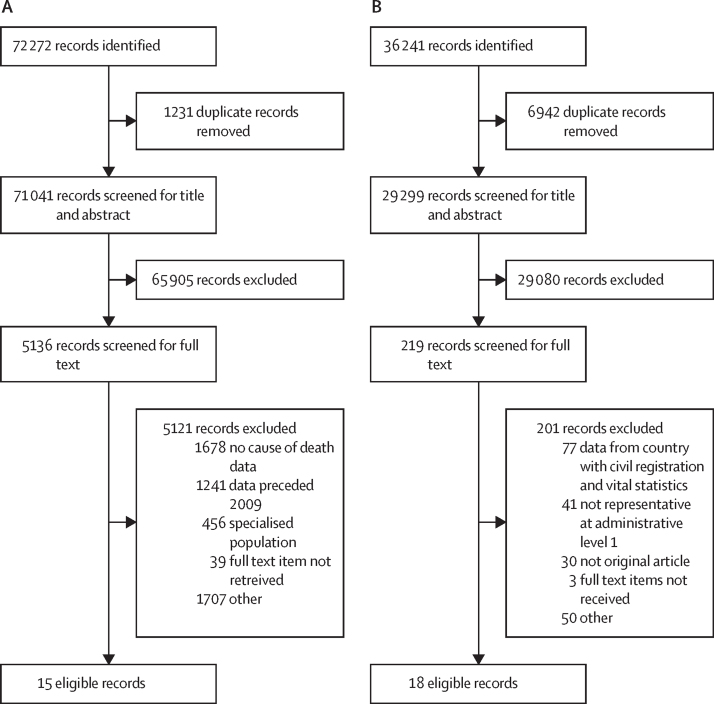
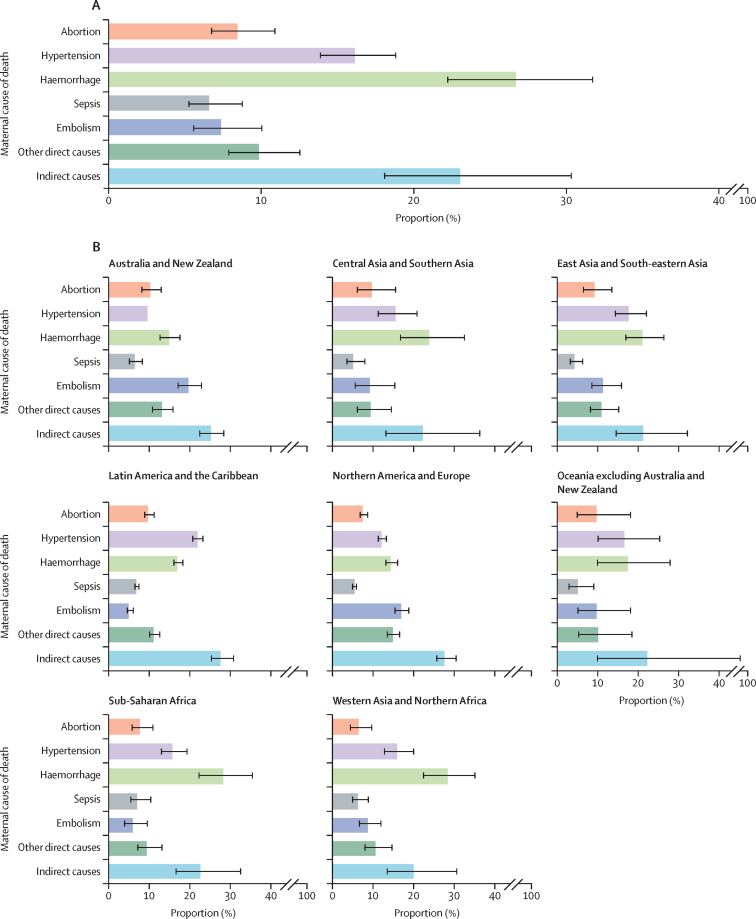
BACKGROUND: Maternal mortality is not on track to meet Sustainable Development Goal (SDG) target 3.1 of a global maternal mortality ratio below 70 per 100 000 livebirths by 2030. Updated evidence on causes of death is needed to accelerate progress. METHODS: We conducted a multi-strategy systematic review to identify causes of maternal deaths occurring in 2009-20. Data sources included civil registration and vital statistics systems data from the WHO Mortality Database, reports published by Member States, and national and subnational journal articles identified via bibliographic databases. We used a Bayesian hierarchical model to estimate the maternal cause of death distribution by SDG regions and worldwide. Given the paucity of data on maternal suicide and late maternal deaths occurring beyond 42 days postpartum, additional analyses were conducted to estimate the proportion of maternal deaths from suicide and the ratio of maternal to late maternal deaths (all cause). FINDINGS: Globally, the most common cause of maternal death was haemorrhage (27%; 80% uncertainty interval 22-32), followed by indirect obstetric deaths (23%, 18-30), and hypertensive disorders (16%, 14-19). The proportion of haemorrhage deaths varied substantially by region and was highest in sub-Saharan Africa and Western Asia and Northern Africa. The proportion of maternal deaths from hypertensive disorders was highest in Latin America and the Caribbean. Most maternal deaths from haemorrhage and sepsis occurred during the postpartum period. Only 12 countries recorded one or more maternal suicides; of those countries, the proportion of deaths from suicide ranged from below 1% to 26% of maternal deaths. For countries reporting at least one late maternal death (ie, deaths that occur more than 42 days but less than 1 year after the termination of pregnancy), the ratio of late maternal deaths to maternal deaths up to 42 days ranged from <0·01 to 0·07. INTERPRETATION: Haemorrhage remains the leading cause of death, despite the existence of effective clinical interventions, emphasising the need for improved access to quality health care. The timing of most deaths in the postpartum period demands renewed commitment to improving the provision of postpartum care in addition to intrapartum care. Indirect causes of death require health system approaches to integrate obstetric and non-obstetric care. FUNDING: USAID; US Fund for UNICEF via the Bill & Melinda Gates Foundation; and UNDP-UNFPA-UNICEF-WHO-World Bank Special Programme of Research, Development, and Research Training in Human Reproduction (HRP).
Overview
The claims and statistics of this paper haven’t been checked yet.
Free: it reads the open-access text and checks the first 5 claims that cite a source we can check. Create a free account to check every claim.
Integrity signals
Registry
Cites
Statistics
Figures
Verification
Claims the paper makes
The claims and statistics of this paper haven’t been checked yet.
Free: it reads the open-access text and checks the first 5 claims that cite a source we can check. Create a free account to check every claim.
Self-check
Percentages, sums and reported differences re-computed from the paper’s own numbers.
The self-check needs the paper’s full text.
Citations
Cites
Global causes of maternal death: a WHO systematic analysis
Say, L., Chou, D., Gemmill, A., Tunçalp, Ö., Moller, A.-B., Daniels, J., Gülmezoglu, A. M., Temmerman, M., & Alkema, L. (2014) · The Lancet Global Health · doi:10.1016/s2214-109x(14)70227-x · Cited by 6,582
Self-citationWHO analysis of causes of maternal death: a systematic review
Khan, K. S., Wojdyla, D., Say, L., Gülmezoglu, A. M., & Van Look, P. F. (2006) · The Lancet · doi:10.1016/s0140-6736(06)68397-9 · Cited by 3,978
Self-citationBennett, J. E., Stevens, G. A., Mathers, C. D., Bonita, R., Rehm, J., Kruk, M. E., Riley, L. M., Dain, K., Kengne, A. P., Chalkidou, K., et al. (2018) · The Lancet · doi:10.1016/s0140-6736(18)31992-5 · Cited by 1,336
Souza, J. P., Gülmezoglu, A. M., Vogel, J., Carroli, G., Lumbiganon, P., Qureshi, Z., Costa, M. J., Fawole, B., Mugerwa, Y., Nafiou, I., et al. (2013) · The Lancet · doi:10.1016/s0140-6736(13)60686-8 · Cited by 757
Self-citationBoerma, T., Requejo, J., Victora, C. G., Amouzou, A., George, A., Agyepong, I., Barroso, C., Barros, A. J. D., Bhutta, Z. A., Black, R. E., et al. (2018) · The Lancet · doi:10.1016/s0140-6736(18)30104-1 · Cited by 517
Self-citationA global analysis of the determinants of maternal health and transitions in maternal mortality
Souza, J. P., Day, L. T., Rezende-Gomes, A. C., Zhang, J., Mori, R., Baguiya, A., Jayaratne, K., Osoti, A., Vogel, J. P., Campbell, O., et al. (2024) · The Lancet Global Health · doi:10.1016/s2214-109x(23)00468-0 · Cited by 398
Self-citationThe scale, scope, coverage, and capability of childbirth care
Campbell, O. M. R., Calvert, C., Testa, A., Strehlow, M., Benova, L., Keyes, E., Donnay, F., Macleod, D., Gabrysch, S., Rong, L., et al. (2016) · The Lancet · doi:10.1016/s0140-6736(16)31528-8 · Cited by 307
Vogel, J. P., Jung, J., Lavin, T., Simpson, G., Kluwgant, D., Abalos, E. J., Díaz, V., Downe, S. M., Filippi, V., Gallos, I. D., et al. (2023) · The Lancet Global Health · doi:10.1016/s2214-109x(23)00454-0 · Cited by 161
A framework for healthcare interventions to address maternal morbidity
Firoz, T., McCaw‐Binns, A., Filippi, V., Magee, L. A., Costa, M. L., Cecatti, J. G., Barreix, M., Adanu, R., Chou, D., Say, L., et al. (2018) · International Journal of Gynecology & Obstetrics · doi:10.1002/ijgo.12469 · Cited by 127
Self-citationLate maternal deaths: a neglected responsibility
Sliwa, K. S., & Anthony, J. (2016) · The Lancet · doi:10.1016/s0140-6736(16)30391-9 · Cited by 67
Research works printed but not linked: 2
- Alexander M Chong MYC Pejcinovska M Estimating causes of maternal death in data-sparse contexts http://arxiv.org/abs/2101.05240 2021 39189680 · arXiv
- WHO WHO recommendations on maternal and newborn care for a positive postnatal experience https://www.who.int/publications/i/item/9789240045989 March 30, 2022 35467813
Cited by
Items 101–200 of 401
Global CVD Prevention: A Call to Action for Nursing: Multilevel Policies
Fitzsimons, D., Commodore-Mensah, Y. Y., Creighton, L., Thompson, G., & Ferranti, E. P. (2026) · European Journal of Cardiovascular Nursing · doi:10.1093/eurjcn/zvaf247 · Cited by 1
Rakale, G., Ntuli, S. T., Ramarumo, T., & Seeletse, S. M. (2026) · African Journal of Primary Health Care & Family Medicine · doi:10.4102/phcfm.v18i1.5287 · Cited by 1
Alhaj, D., Schmock, S., Gerhold, L.-L., Wallwiener, S., Zdanowicz, J. A., Hanson, C., Dudenhausen, J., & Königbauer, J. T. (2026) · Archives of Gynecology and Obstetrics · doi:10.1007/s00404-026-08424-0 · Cited by 1
“Globally, obstetric hemorrhage, hypertensive disorders of pregnancy, and indirect causes such as pre-existing medical conditions remain the leading contributors to maternal death although their relative importance varies considerably across regions [4].”
Wei, J.-B., Huang, H., Zhang, J., Li, X.-F., Xu, Y., Lv, M., & Fan, L. (2026) · International Journal of Women s Health · doi:10.2147/ijwh.s600634 · Cited by 1
Jasani, S., Demiray, A., Stevenson, J., & Krawiec, C. (2026) · PLoS ONE · doi:10.1371/journal.pone.0338586 · Cited by 1
Empowerment at the Core: Decoding the Determinants of Skilled Birth Attendance in Pakistan
Malik, M. I. (2026) · American Journal of Human Biology · doi:10.1002/ajhb.70272 · Cited by 1
Grovogui, F. M., Semaan, A. T., Manet, H., Kourouma, K., Delvaux, T., Macharia, P. M., Kpogomou, P., Souaré, H. F., Souaré, M. S., Camara, M. L. M., et al. (2026) · BMJ Global Health · doi:10.1136/bmjgh-2025-020317 · Cited by 2
“5 21 Furthermore, while data on maternal deaths are available, it remains incomplete, and obstetric complications, which are key predictors of maternal health outcomes, are under-reported.”
Advanced nanoformulations of NUAK1 regulate NLRP3 inflammasome for preeclampsia management in mice
Jiang, P., Ying, X., Li, Z., Fei, W., Yao, Y., Xu, J., Li, H., Chen, L., & Luo, Q. (2026) · Nature Communications · doi:10.1038/s41467-026-72775-0 · Cited by 1
Yalley, A. A., & Gumbi, K. S. (2026) · Frontiers in Global Women s Health · doi:10.3389/fgwh.2026.1720050 · Cited by 1
Visan, I. G., & Petca, A. T. (2026) · Applied Sciences · doi:10.3390/app16105085 · Cited by 2
Beardmore‐Gray, A., Rohwer, C., Turienzo, C. F., & Cluver, C. A. (2026) · Cochrane Database of Systematic Reviews · doi:10.1002/14651858.cd009273.pub3 · Cited by 3
World Pre-eclampsia Day: are we moving in the right direction?
Gosavi, A., Li, S., Biswas, A., & Choolani, M. (2026) · Singapore Medical Journal · doi:10.4103/singaporemedj.smj-2026-276 · Cited by 1
Global Maternal Mortality Attributed to Maternal Hemorrhage and Its Socioeconomic Disparities
Lin, J., Lin, X., Li, Z. K., Chacha, S., Wang, D., & Dang, S. (2026) · Women · doi:10.3390/women6020036 · Cited by 1
“These efforts have contributed to a 40% reduction in global maternal mortality between 2000 and 2023, which includes increased investment in midwife training, expanded access to antenatal care, and strengthened health systems [2,6].”
Angelo, T. E., Daoud, B. E., Factor, M., Khan, A., Stanley, S. L., Monanian, G., Garry, D. J., & Bennett‐Guerrero, E. (2026) · Anesthesia & Analgesia · doi:10.1213/ane.0000000000008107 · Cited by 1
Whitaker, K. M., Crisp, A. H., Gallagher, J. B., Jones, M., Kim, J., Wilhite, K. L., Smith, K., Rahman, S. M. A., Thrower, A., Catov, J. M., et al. (2026) · British Journal of Sports Medicine · doi:10.1136/bjsports-2025-111091 · Cited by 3
Vinogradov, R., Holden, E., Patel, M., Grigg, R., Errington, L., Husband, A., Rankin, J. M., & Araújo‐Soares, V. (2026) · Health Expectations · doi:10.1111/hex.70703 · Cited by 2
“Pre‐eclampsia (PE) is a pregnancy‐related syndrome affecting approximately 5% of pregnancies [1, 2] and the second most common direct cause of maternal death [3, 4], leading to approximately 60,000 deaths annually worldwide [5].”
High-Dose Oxytocin Protocol Implementation and Postpartum Hemorrhage
Triebwasser, J. E., Keil, E., Bailey, J. M., Arnolds, D. E., Feldkamp, D., Stout, M. J., & Campbell, E. J. (2026) · Obstetrics and Gynecology · doi:10.1097/aog.0000000000006351 · Cited by 1
Cha, Y., & Yang, E. (2026) · Journal of Emergency Nursing · doi:10.1016/j.jen.2026.05.004 · Cited by 1
Takahashi, Y., Obata, S., Nakanishi, S., Shindo, R., Aoki, S., & Miyagi, E. (2026) · Journal of obstetrics and gynaecology research · doi:10.1111/jog.70388 · Cited by 1
Lin, J., Chen, Y., & Poon, L. C. (2026) · American Journal of Obstetrics & Gynecology MFM · doi:10.1016/j.ajogmf.2026.102051 · Cited by 1
Kostov, S. G., Kornovski, Y. D., Slavchev, S. H., Ivanova, Y., Aleksandrova, E., Georgieva, S., Selçuk, İ., Wafa, M., Hasan, I., Yordanov, A. D., et al. (2026) · Journal of Clinical Medicine · doi:10.3390/jcm15145658 · Cited by 1
“Bleeding complications are among the most feared surgical complications and remain a leading cause of morbidity and mortality in gynecology and obstetrics (OB/GYN) [1–3].”
Aden, J. A., Hendrie, D. V., Daire, J., Belay, D. G., & Dunne, J. (2026) · Global Health Action · doi:10.1080/16549716.2026.2712181 · Cited by 2
“By 2023, the global maternal mortality ratio (MMR) was 197 deaths per 100 000 livebirths [2], indicating that the world is not on track to achieve SDG target 3.1, which aims to reduce the global MMR to less than 70 per 100 000 livebirths by 2030 [1].”
InfluentialBrazile, T. L., Conrad, N., Bergman, L., Paul, G. J., Mehta, L. S., Silversides, C. K., Sliwa, K. S., Sharma, G. V., Sharma, G. V., Brazile, T. L., et al. (2026) · The Lancet · doi:10.1016/s0140-6736(26)01234-1 · Cited by 1
Raifman, S., Murro, R., Boscardin, W. J., Puri, M. C., Foster, D. G., & Rocca, C. H. (2026) · The Lancet Regional Health - Southeast Asia · doi:10.1016/j.lansea.2026.100835 · Cited by 2
Jones, E. S. W., Ralapanawa, U., Wu, P., Brewster, L. M., Nuyt, A. M., Slater, K., Bertagnolli, M., Steckelings, U. M., Socrates, T., Magee, L. A., et al. (2026) · Journal of Hypertension · doi:10.1097/hjh.0000000000004389 · Cited by 1
Kojima, T., Obata, S., Hiiragi, K., Kamihara, Y., Nakanishi, S., Shindo, R., Miyagi, E., & Aoki, S. (2026) · The Journal of Maternal-Fetal & Neonatal Medicine · doi:10.1080/14767058.2026.2726056 · Cited by 1
Weighing up causes of and risk factors for postpartum haemorrhage to improve its prevention
Ducloy‐Bouthors, A. ‐., & Vidarte, M. F. E. (2025) · The Lancet · doi:10.1016/s0140-6736(25)00573-2 · Cited by 1
People, Rights, and Choices: Keeping the Promise of the ICPD Programme of Action Alive
RamaRao, S., Idele, P., & Wickremarathene, D. (2025) · Studies in Family Planning · doi:10.1111/sifp.70017 · Cited by 1
Xie, Y., Zhou, J., Xie, Y., & Zhu, Y. (2025) · Naunyn-Schmiedeberg s Archives of Pharmacology · doi:10.1007/s00210-025-04560-7 · Cited by 1
“The latest report of the WHO in 2020 showed that PPH remains the leading cause of maternal death worldwide, and this challenge is particularly prominent in most low-income countries (Cresswell et al. 2025; Say et al. 2014).”
Eunice, A. A., Yankyera, B. O., Mensah, R., Bismark, S., & Otupiri, E. (2025) · medRxiv · doi:10.1101/2025.05.27.25327765
Adewuyi, E. O., Auta, A., Omonaiye, O., Adewuyi, M. I., Olutuase, V. O., Adefemi, K., Odeyemi, O. A., Zhao, Y., Tessema, G. A., & Pereira, G. F. (2025) · medRxiv · doi:10.1101/2025.05.31.25328693 · Cited by 1
Maternal collapse in pregnancy: evolving aetiology and healthcare system response
Tucker, D., & Freestun, M. (2025) · Case Reports in Women s Health · doi:10.1016/j.crwh.2025.e00750 · Cited by 1
“Effective obstetric emergency capabilities are required across all healthcare settings [3].”
World Postpartum Haemorrhage Day: Renewing the Global Call to End Deaths From Postpartum Haemorrhage
PPH Roadmap Advocacy Working Group (2025) · BJOG An International Journal of Obstetrics & Gynaecology · doi:10.1111/1471-0528.70007 · Cited by 1
Fouogue, J. T., Sato, M., Day, L. T., Matsui, M., Kenne, W. C. D., Kenfack, B., Beňová, L., & Filippi, V. (2025) · medRxiv · doi:10.1101/2025.10.29.25339125 · Cited by 3
Disentangling Maternal and Fetal Genetic Contributions to PreeclampsiaPreprint
Leinonen, J. T., Tyrmi, J. S., Kaartokallio, T., Lokki, A. I., FINNPEC Study Group, FINNGEN, Laisk, T., Pouta, A. M., Kivinen, K., Kajantie, E., et al. (2025) · medRxiv · doi:10.64898/2025.12.03.25341531 · Cited by 1
Time Series Analysis and Forecasting of Maternal Mortality in SomaliaPreprint
Yousuf³, I. M. (2026) · Research Square · doi:10.21203/rs.3.rs-8944533/v1 · Cited by 1
Turigye, B., Beňová, L., Ngonzi, J. N. J., Mulogo, E. M., Kabakyenga, J. K., & Macharia, P. M. (2026) · medRxiv · doi:10.64898/2026.04.27.26351638 · Cited by 2
Xie, J., Zhu, L., Wu, T., & Li, G. (2026) · Infection and Drug Resistance · doi:10.2147/idr.s609224
Redonnet, C. S., Gold, M., Krolewiecki, A. J., Nhampossa, T., & Menéndez, C. (2025) · The Lancet Global Health · doi:10.1016/s2214-109x(25)00112-3
Muriithi, F. G., Makabong’o, P., Osoti, A. O., Qureshi, Z. P., Devall, A., Coomarasamy, A., & Ladur, A. N. (2025) · Research Square · doi:10.21203/rs.3.rs-6615286/v1
Building a sustainable model for global maternal health
Tunçalp, Ö., Vogel, J. P., Kouanda, S., & Liabsuetrakul, T. (2025) · BMJ · doi:10.1136/bmj.r1011
Self-citationMayrink, J., Costa, M. L., Souza, R. T., Sampaio, L. T. C., & Cecatti, J. G. (2025) · International Journal of Gynecology & Obstetrics · doi:10.1002/ijgo.70257
Kakama, C., Agaba, D. C., Byamukama, O., Kajabwangu, R., Kengonzi, E., Akol, M. A., Muhumuza, A., Businge, J., Turanzomwe, S., Ainomugisha, B., et al. (2025) · International Journal of Women s Health · doi:10.2147/ijwh.s515760
Policy Action for CVD Prevention: A Call to Action for Nurses Globally
Fitzsimons, D., Commodore-Mensah, Y. Y., Creighton, L., Thompson, G., & Ferranti, E. P. (2025) · The Journal of Cardiovascular Nursing · doi:10.1097/jcn.0000000000001224
Umbilical Artery Wall Shear Stress and Control of the Feto-placental Circulation
Hoskins, P. R., Reynolds, R. M., Hunt, K. F., & Townsend, R. (2025) · Ultrasound in Medicine & Biology · doi:10.1016/j.ultrasmedbio.2025.05.012
Yussuf, N. I.-H., Stekelenburg, J., Manongi, R. N., & Mahande, M. J. (2025) · Open Journal of Nursing · doi:10.4236/ojn.2025.156030
Andrade-Arita, B., López, S. H., Herrera-Ruíz, G., García‐Trejo, J. F., Aguirre-Becerra, H., Rojas-Molina, A., & Rodríguez‐Reséndiz, J. (2025) · Societies · doi:10.3390/soc15070173
Nwagha, T. U., Okoye, H. C., Nonyelu, C. E., Ejezie, C. S., Okafor, M. T., Ajah, L. O., & Nwagha, U. I. (2025) · Annals of African Medicine · doi:10.4103/aam.aam_148_25
“[3] The condition not only affects the mother’s health but also has profound implications for the fetus, including intrauterine growth restriction, preterm birth, and increased perinatal mortality.”
Morau, E., Paquin, S., Bouthors, A. S., Bouvet, L., Baptiste, A.-S., Benhamou, D., Bonnet, M., Bonnin, M., Bouthors, A. S., Bouvet, L., et al. (2025) · International Journal of Obstetric Anesthesia · doi:10.1016/j.ijoa.2025.104713
Listas de chequeo en obstetricia: Ayudas cognitivas que salvan vidas
de Venezuela., S. D. O. Y. G., Pérez-Wulf, J., Daniel Márquez, C., Carlos Lugo, L., Stefanía Robles, T., Víctor Ayala, H., Muro, J. D., Vita, S. D., Cortés, R., & Araujo, K. (2025) · Revista de Obstetricia y Ginecología de Venezuela · doi:10.51288/00850213
Walker, J., Jackson, N. A., Ramakrishnan, S., Perry, C. E., Gaur, A., Shaw, A., Pirzada, S., & Tran, Q. K. (2025) · Journal of Clinical Medicine · doi:10.3390/jcm14145113 · Cited by 1
“About 260,000 women died during and following pregnancy and childbirth in 2023 [36].”
Antenatal Maternal Hemoglobin Level and Severe Maternal Morbidity
Fabricant, S. P., Opara, K. N., Rau, A. R., Paul, J. V., Girma, A., White, J. D., Blissett, G., Sriprasert, I., Korst, L. M., & Chadwick, N. M. (2025) · Journal of Clinical Medicine · doi:10.3390/jcm14165823
“Yet an assessment of the relationship between anemia and SMM would be incomplete without considering transfusion: blood transfusion represents a surrogate for hemorrhage, a leading cause of maternal morbidity and mortality [18].”
Batoum, V. M., Um, E. J. M. N., Nsahlaï, C., Mpono, P., Madie, N. D., Nyuykighan, C. J., Nyada, S. R., Isidore, T., Kaze, F., & Nkwanong, E. (2025) · Open Journal of Obstetrics and Gynecology · doi:10.4236/ojog.2025.159113
Cost-effectiveness of diagnostic criteria for postpartum haemorrhage treatmentPreprint
Scott, N., Gallos, I. D., Walsh, T., Williams, C. R., Allotey, J., Borovac‐Pinheiro, A., Devall, A., Festin, M., Goudar, S. S., Haslinger, C., et al. (2025) · medRxiv · doi:10.1101/2025.09.02.25334895
Advances in detection and treatment of maternal sepsis
Fassett, M. J. (2025) · Case Reports in Women s Health · doi:10.1016/j.crwh.2025.e00751
“As a result, obstetric sepsis is now the second leading cause of preventable maternal morbidity and mortality in California and remains a leading cause worldwide [4].”
World postpartum haemorrhage day: Renewing the global call to end deaths from postpartum haemorrhage
PPH Roadmap Advocacy Working Group (2025) · Pregnancy · doi:10.1002/pmf2.70130
Li, J., Pan, M., Dai, Q., Deng, Y., Tang, S., & Tan, H. (2025) · Environmental Pollution · doi:10.1016/j.envpol.2025.127210
The use of IPD meta-analysis in maternal health prognostics
Otte, W. M. (2025) · The Lancet · doi:10.1016/s0140-6736(25)01909-9
Political Decisions, Personal Consequences: Abortion Bans Threaten the Health of All Pregnant People
Horvath, D. J. (2025) · American Journal of Public Health · doi:10.2105/ajph.2025.308275
Kidanemariam, R., Teka, H., Tadesse, H., Ebrahim, M. M., Berhe, E., Abera, B. T., Abrha, M., Abraha, H. E., Yemane, A., & Berhe, Y. (2025) · PLoS ONE · doi:10.1371/journal.pone.0332620 · Cited by 3
“Despite global declines, progress in sub‑Saharan Africa has stagnated, com‑ pounded by conflict and health‑system disruption [2].”
Afolabi, B. B., Makwe, C. C., Oluwole, E. O., Obi‐Jeff, C., Mitchell, E. J., Banke-Thomas, A. O., Adeyemo, T. A., Abioye, A. I., Eboreime, E., Saidu, A., et al. (2025) · doi:10.12688/verixiv.2100.1
Dyspnea in pregnancy. Can POCUS be the game changer?
Ghiringhelli, J. P., Arzola, C., & Zasso, F. B. (2025) · Colombian Journal of Anesthesiology · doi:10.5554/22562087.e1169
Severe preeclampsia: immediate action as a strategy to save lives
Braga, A., de Jesús, G. R., Costa, M. L., Oliveira, L. G., Ramos, J. G. L., Peraçoli, J. C., Filho, E. V. D. C., Filho, A. L. D. S., Wender, M. C. O., Mello, C., et al. (2025) · Revista Brasileira Ginecologia e Obstetrícia · doi:10.61622/rbgo/2025rbgoedt2
Braga, A., Ramos, J. G. L., Peraçoli, J. C., Oliveira, L. G., Costa, M. L., Costa, S. H. D. A. M., de Sousa, F. L. P., de Jesús, G. R., da Cunha, E. V., Sass, N., et al. (2025) · Femina · doi:10.61622/0100-7254538202504
Pai, M. V., Kharka, L. V., Singhal, B., & Naren, K. (2025) · International Journal of Reproduction Contraception Obstetrics and Gynecology · doi:10.18203/2320-1770.ijrcog20253539
The global preclinical research and development landscape for pre-eclampsia and eclampsia therapies
Postregna, J., Mills, K., Bruinsma, F., Goldstein, M., Tuttle, A., Keir, L. S., Ventola, C., Gülmezoglu, A. M., Ammerdorffer, A., Vogel, J. P., et al. (2026) · Communications Medicine · doi:10.1038/s43856-026-01784-3
Secondhand Smoke Exposure Timing Triggers Distinct Placental Responses in Mouse Pregnancy
Chou, A., Frank, E., Reall, M., Hiatt, O., Beck, L., Reynolds, P. R., Pickett, B. E., & Arroyo, J. A. (2025) · Cells · doi:10.3390/cells14211735
Parnell, L. A., Tierney, A. L., Cottrell, E. C., Krakowiak, K., Unwin, R. D., Pritchard, H. A. T., Gurney, A. M., Myers, J., Greenstein, A. S., & Worton, S. A. (2025) · medRxiv · doi:10.1101/2025.11.04.25339536
Reproductive medicine news. Digest of publications, issue 8
Бармина, И. И. (2025) · Bulletin of Reproductive Health · doi:10.14341/brh12776
Tounkara, F. K., Tegueté, I., Touré, O., Bagayoko, A., Coulibaly, B., Fomba, R., & Touré, C. (2025) · International Journal of Gynecology & Obstetrics · doi:10.1002/ijgo.70617
“…for 100 F CFA per pack of three at shops, market stalls, service stations, pharmacies, health facilities, and community health worker sites Message 26: The “Bangué Kolosi Konon” Cycle Necklace This is a natural contraceptive method for women with menstrual cycles lasting between 26 and 32 days.”
Panorama of Two Decades of Maternal Deaths in Brazil: Retrospective Ecological Time Series
dos Santos, G. G., Vidotti, G. A. G., Bonetti, T. C., Ichikawa, C. R. D. F., Lima, C. F., Dionízio, L. D. A., Maia, J. S., Zihlmann, K. F., Neto, J. G. D. O., Nascimento, W. S. M., et al. (2025) · Nursing Reports · doi:10.3390/nursrep15110396 · Cited by 5
“In addition to direct causes, such as hemorrhage, infections, and hypertensive syndromes, the proportion of deaths associated with indirect causes, such as cardiovascular disease and mental disorders, has been increasing, particularly in the late postpartum period [24,25].”
Kaura, D. K., Demissie, D. B., & Gebhardt, G. (2025) · Frontiers in Reproductive Health · doi:10.3389/frph.2025.1687886
The path to performance of public versus private healthcare supply chains: case study of Uganda
Kalangwa, A., Knoppen, D., & Bak, O. (2025) · Journal of Humanitarian Logistics and Supply Chain Management · doi:10.1108/jhlscm-10-2024-0133 · Cited by 1
Yang, J., Zhao, Z., Jia, M., Wang, Y., Peng, F., Wang, Y., & Liao, G. (2025) · Research Square · doi:10.21203/rs.3.rs-7935843/v1
Adelabu, Y. A., Saalu, T. T., Afolabi, B. B., Banke-Thomas, A. O., & Beňová, L. (2025) · doi:10.12688/verixiv.2010.1
Makama, M., Ferguson, A., Connolly, M., Boudová, S., Aziz, S., Romero, L., & Vogel, J. P. (2025) · BJOG An International Journal of Obstetrics & Gynaecology · doi:10.1111/1471-0528.70091 · Cited by 1
Khuanloy, P., Songthap, A., & Mekrungrongwong, S. (2025) · BMC Pregnancy and Childbirth · doi:10.1186/s12884-025-08470-7
Jasani, S., Demiray, A., Stevenson, J., & Krawiec, C. (2025) · medRxiv · doi:10.1101/2025.11.26.25341112
Khan, N. U., Asif, N., Miraj, M. A., Khalid, H., Awan, T. B., Khan, M. A., Khalid, N., Mon, P. T., & Shafi, A. (2025) · Cureus · doi:10.7759/cureus.98424
“Globally, severe bleeding, infections, hypertensive disorders, and other obstetric complications are responsible for roughly 75% of maternal deaths [8], and most deaths from hemorrhage and sepsis occur after delivery [9].”
The Value of Fine Tuning a Maternal Health AI Chatbot with Local Country Expertise
Chen, A., Zhang, C., Dahman, A., Barroco, L., Pickering, A., & Chen, M. (2025) · IEEE Global Humanitarian Technology Conference (GHTC) · doi:10.1109/ghtc66843.2025.11266775
“In 2023, an estimated 260,000 women worldwide died from pregnancy-related complications, which is equivalent to over 700 deaths per day [1].”
Bellizzi, A. L. D. M., Kale, P. L., Fonseca, S. C., & Cascão, Â. M. (2025) · Revista Brasileira de Saúde Materno Infantil · doi:10.1590/1806-9304202520250118
Bellizzi, A. L. D. M., Kale, P. L., Fonseca, S. C., & Cascão, Â. M. (2025) · Revista Brasileira de Saúde Materno Infantil · doi:10.1590/1806-9304202520250118-en
Reflexos da mortalidade materna em África: um olhar atento para Angola
Bernardo, B. C., & Souza, A. S. R. (2025) · Revista Brasileira de Saúde Materno Infantil · doi:10.1590/1806-9304202520250354
Reflections on maternal mortality in Africa: a closer look at Angola
Bernardo, B. C., & Souza, A. S. R. (2025) · Revista Brasileira de Saúde Materno Infantil · doi:10.1590/1806-9304202520250354-en
Akbar, M. I. A., Ernawati, E., Wardhana, M. P., Putri, R. W. R., Wiradyana, A. A. G. P., Santoso, D. P. J., Andonotopo, W., Dekker, G., & Aryananda, R. A. (2025) · AJOG Global Reports · doi:10.1016/j.xagr.2025.100596 · Cited by 8
Gazeley, U., Gargiulo, M., Eilerts-Spinelli, H., Hassan, A., Díaz-Juárez, I., & Palfreyman, A. (2026) · BMJ Public Health · doi:10.1136/bmjph-2025-004871
Self-citationRajan, S., Vijayasamundeeswari, C. K., Panicker, B. S., Srinivasan, S., Kumari, P. P., & Rangasamy, S. (2025) · Biomedical and Biotechnology Research Journal (BBRJ) · doi:10.4103/bbrj.bbrj_151_25
Gudu, W., Tefera, F. T., Tilahun, A., Getachew, A., Bekele, D., Birara, M., Wondafrash, M., Lemma, K., Teka, S., Mulugeta, Y., et al. (2025) · AJOG Global Reports · doi:10.1016/j.xagr.2025.100588
Sherif, A. K. E., Saleh, D. M., & Youssef, O. A. (2021) · Journal of Current Research in Oral Surgery · doi:10.51847/xvhtvvfmni
Logbo-Akey, K. E., Amewouho, K. M., Ketevi, T. A., Kambote, Y. P., Laré, S., Ajavon, D. R. D., Aboubakari, A., & Akpadza, K. (2025) · Open Journal of Obstetrics and Gynecology · doi:10.4236/ojog.2025.1512186
Maviso, M. K., Potjepat, G., Emori, R., Aines, P. Z., & Hastie, C. R. (2025) · PLoS ONE · doi:10.1371/journal.pone.0338606
Shrivastava, S. R., & Bobhate, P. S. (2025) · Journal of Cardiovascular Echography · doi:10.4103/jcecho.jcecho_108_25
“[1] Despite cardiovascular diseases being the major contributor to maternal deaths, it is quite alarming that most women with underlying cardiomyopathy or valvular heart diseases either remain asymptomatic or experience mild symptoms that mimic normal pregnancy, resulting in late diagnoses and poor…”
Medhi, R., Arsha, K., & Rabha, N. (2025) · International Journal of Reproduction Contraception Obstetrics and Gynecology · doi:10.18203/2320-1770.ijrcog20254294
da‐Costa‐Santos, J., Borges, G. F., Reis, V. L. V., Japecanga, R. R., Carvalho, M. A., Oliveira, A. J. G., Vinchi, L. C., Righi, A. B. P., Mayrink, J., Surita, F. G. D. C., et al. (2026) · International Journal of Gynecology & Obstetrics · doi:10.1002/ijgo.70772 · Cited by 1
“18 The administration of magnesium sulfate for women with severe PE is the main medical intervention for avoiding adverse outcomes.”
Implementation of safe abortion care policy in africa: a scoping review of readiness and outcomes
Tchèkpé, D.-D., Mpakaniye, P., Somassè, Y. E., Sambiéni, E. N., & Coppieters, Y. (2026) · BMC Public Health · doi:10.1186/s12889-025-26026-4 · Cited by 1
“Between 2009 and 20, abortion represented 8% of maternal deaths worldwide, and 7,7% in sub-Saharan Africa [3].”
InfluentialSemaan, A. T., Apers, L., Kikula, A. I., van den Akker, T., Pembe, A. B., Beňová, L., & Housseine, N. (2026) · BMC Health Services Research · doi:10.1186/s12913-026-14035-x
“Common causes of maternal deaths include haemorrhage, hypertensive disorders and sepsis, and most maternal deaths occur in the postpartum period [2].”
Vaz, C. T., Silva, U. M., Ortigoza, A. A. H., Perner, M. S., Alazraqui, M., Braverman‐Bronstein, A., Quistberg, D. A., Friche, A. A. D. L., & Caiaffa, W. T. (2026) · BMJ Public Health · doi:10.1136/bmjph-2024-002437
Brennan, M. M., O'Dowd, T., Brink, N. B., Travill, D., Dumbura, C., Pleiss, C. D.-D., Gazeley, U., Radebe, L., de Bont, J., Parnell, A. C., et al. (2026) · HRB Open Research · doi:10.12688/hrbopenres.14304.1
Self-citationZheng, S., Chen, D., & Gao, Y. (2026) · Frontiers in Medicine · doi:10.3389/fmed.2026.1747286
Metadata
- Authors
- Cresswell, J. A., Alexander, M., Chong, M. Y. C., Link, H. M., Pejchinovska, M., Gazeley, U., Ahmed, S. M. A., Chou, D., Moller, A.-B., Simpson, D., Alkema, L., Villanueva, G., Sguassero, Y., Tunçalp, Ö., Long, Q., Xiao, S., & Say, L.
- Affiliations
- World Health Organization (CH)
- University of Toronto (CA)
- London School of Hygiene & Tropical Medicine (GB)
- Monash University (AU)
- University of Massachusetts Amherst (US)
- Cochrane (GB)
- Duke Kunshan University (CN)
- Peking University (CN)
- Corresponding author
- Cresswell, Jenny A
- ORCID
- Venue
- The Lancet Global Health
- Publisher
- Elsevier BV
- Published
- 2025-04
- Volume
- 13
- Issue
- 4
- Pages
- e626-e634
- ISSN
- 2214-109X (ISSN-L)
- PMC
- PMC11946934
- OpenAlex
- W4408249334
- Semantic Scholar
- 3f0e3f4e6e8808ce4bba9d36a912981a01ea9c36
- Cited by
- 401
- References
- 16
- Citations by year
- 2026: 266 · 2025: 134
- FWCI
- 605.67
- Type
- journal article
- Language
- en
- Open access
- gold
- doi.org
- Licence
- cc-by
- www.elsevier.com/tdm/userlicense/1.0/ (tdm)
- www.elsevier.com/legal/tdmrep-license (tdm)
- creativecommons.org/licenses/by/3.0/igo/ (vor)
- Locations
- The Lancet Global Health (publishedVersion, cc-by)
- Europe PMC (PubMed Central) (publishedVersion, cc-by)
- PubMed Central (publishedVersion, cc-by)
- PubMed (publishedVersion)
- Funders
- USAID
- Topics
- Health Sciences › Medicine › Pediatrics, Perinatology and Child Health › Global Maternal and Child Health
- Health Sciences › Medicine › Pediatrics, Perinatology and Child Health › Maternal and fetal healthcare
- Health Sciences › Medicine › Pediatrics, Perinatology and Child Health › Maternal and Neonatal Healthcare
- Keywords
- maternal mortality, causes of maternal death, hemorrhage, hypertensive disorders of pregnancy, sepsis, postpartum period, maternal suicide, postpartum care, Sustainable Development Goal 3.1, maternal health policy, sub-Saharan Africa, West Asia
- MeSH terms
- Bayes Theorem, Cause of Death, Female, Humans, Maternal Mortality, Pregnancy, Global Health, World Health Organization, Maternal Death
About these checks
Registry, retraction, Cites and statistics results are computed, not judged, with one exception: a printed reference that no index lists is read once by a model before it counts as a citation error. Claims are extracted by a model and kept only when their quote appears verbatim in the text; each cited source is then checked, with a model’s help, for whether it says what the claim relies on. Those verdicts can be wrong — read the claim’s quote and the cited source before relying on one.
Statistics and arithmetic are recomputed, not judged.
Confidence bands are shown only for fields calibrated on our annotated test set. None is calibrated yet, so no band is shown.
What counts as a claim ›How we measure confidence ›How we check this ›
Are you an author, or do you see a problem with this page? Request a review
Data sources
Bibliographic data: Semantic Scholar, OpenAlex, Crossref.
Contains information from the Semantic Scholar Academic Graph Datasets, made available under the ODC Attribution License (ODC-BY 1.0).
Semantic Scholar’s data is described in: Kinney, R., et al. (2023). The Semantic Scholar Open Data Platform. arXiv:2301.10140.
