

The DOI matches its Crossref record; 43 of the 46 references it cites were found in a registry or an index.
Effects of cognitive behaviour therapy for worry on persecutory delusions in patients with psychosis (WIT): a parallel, single-blind, randomised controlled trial with a mediation analysis.
Open accessAbstract
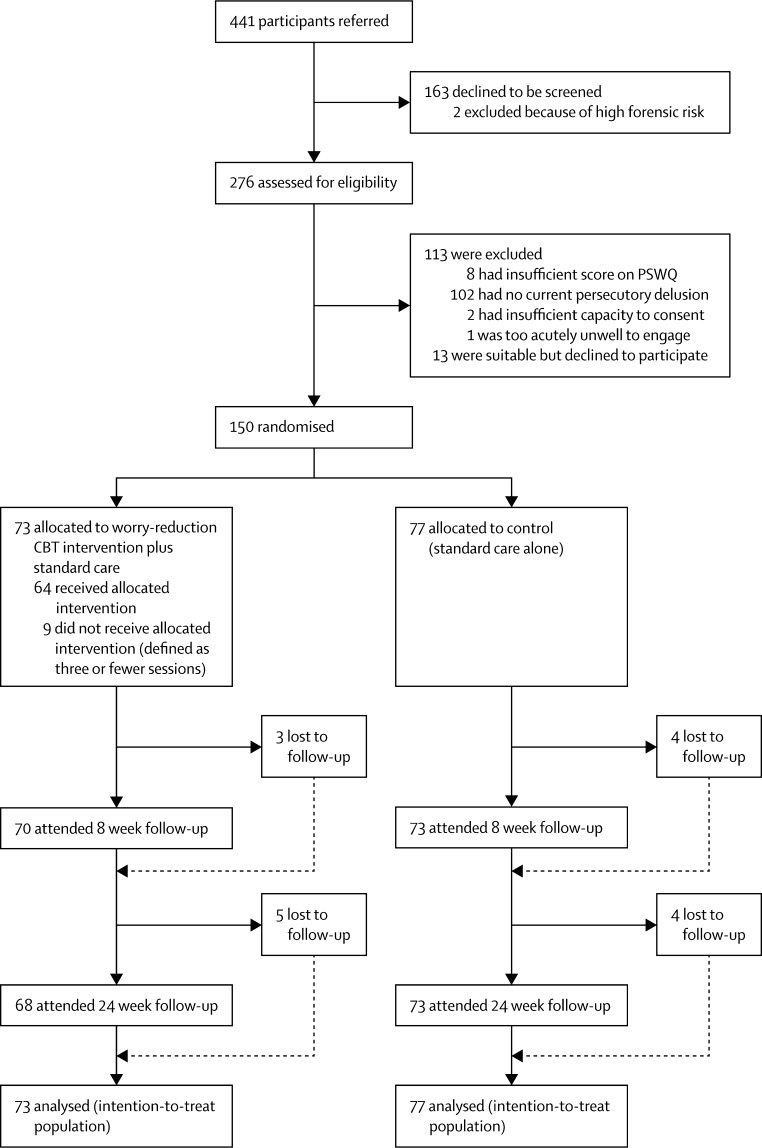
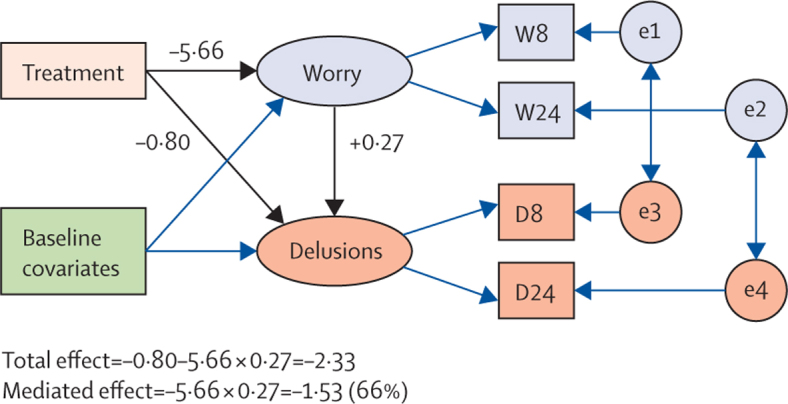
BACKGROUND: Worry might be a contributory causal factor in the occurrence of persecutory delusions in patients with psychotic disorders. Therefore we postulated that reducing worry with cognitive behaviour therapy (CBT) would reduce persecutory delusions. METHODS: For our two-arm, assessor-blinded, randomised controlled trial (Worry Intervention Trial [WIT]), we recruited patients aged 18-65 years with persistent persecutory delusions but non-affective psychosis from two centres: the Oxford Health National Health Service (NHS) Foundation Trust (Oxford, UK) and the Southern Health NHS Foundation Trust (Southampton, UK). The key inclusion criteria for participants were a score of at least 3 on the Psychotic Symptoms Rating Scale (PSYRATS) denoting a current persecutory delusion; that the delusion had persisted for at least 3 months; a clinical diagnosis of schizophrenia, schizoaffective disorder, or delusional disorder; and a clinically significant level of worry. We randomly assigned (1:1) eligible patients, using a randomly permuted block procedure with variable block sizes and division by four strata, to either six sessions of worry-reduction CBT intervention done over 8 weeks added to standard care (the CBT-intervention group), or to standard care alone (the control group). The assessors were masked to patient allocations and did their assessments at week 0 (baseline), 8 weeks (end of treatment), and 24 weeks, follow-up. The primary outcomes were worry measured by the Penn State Worry Questionnaire (PSWQ) and delusions measured by the PSYRATS-delusion scale; we did the analyses in the intention-to-treat population, and also did a planned mediation analysis. This trial is registered with the ISRCTN Registry (number ISRCTN23197625) and is closed to new participants. FINDINGS: From Nov 1, 2011, to Sept 9, 2013, we recruited 150 eligible participants and randomly assigned 73 to the CBT intervention group, and 77 to the control group. 143 patients (95%) provided primary outcome follow-up data. Compared with standard care alone, at 8 weeks the CBT intervention significantly reduced worry (mean difference 6·35 [SE 1·56] PSWQ units, 95% CI 3·30-9·40; p<0·001) and persecutory delusions (2·08 [SE 0·73] PSYRATS units, 95% CI 0·64-3·51; p=0·005). The reductions were maintained to 24 weeks follow-up. The mediation analysis suggested that the change in worry accounted for 66% of the change in delusion. No patients died or were admitted to secure units during our study. Six suicide attempts (two in the CBT intervention group, and four in the control group) and two serious violent incidents (one in each group) were noted, but no adverse events were deemed related to the treatments or the assessments. INTERPRETATION: To our knowledge, this is the first large trial focused on persecutory delusions. We have shown that long-standing delusions were significantly reduced by a brief intervention targeted on worry, although the limitations for our study include no determination of the key elements within the intervention. Our results suggest that worry might cause paranoia, and that worry intervention techniques might be a beneficial addition to the standard treatment of psychosis. FUNDING: Efficacy and Mechanism Evaluation programme, which is a UK Medical Research Council and National Institute of Health Research partnership.
Overview
The claims and statistics of this paper haven’t been checked yet.
Run the check — free, no account needed. It reads the open-access text and checks the sources it cites.
Integrity signals
Registry
Cites
Statistics
Figures
Verification
Claims the paper makes
The claims and statistics of this paper haven’t been checked yet.
Run the check — free, no account needed. It reads the open-access text and checks the sources it cites.
Claims other papers make about this one
Each is checked against this paper’s own text: does it say what the citing paper says it does?
The source backs part of the claim, not all of it — or backs it for a different population, condition or comparison.
In the citing paper
“A controlled trial also found that an intervention targeting rumination in patients with psychosis significantly reduced paranoid delusions relative to standard care over 8 weeks.18”
From Dispositional Mindfulness and Psychotic Symptoms in Schizophrenia Spectrum Disorders: The Mediating Roles of Rumination and Negative Emotion (2022) · cites this paper as [18]
Experimental — accuracy not yet measuredThe cited source says what the claim attributes to it.
In the citing paper
“A different working group could have created a different needs analysis and chosen a different treatment focus, change methods and practical applications (see for example the CRISIS-, the WIT- or the OASIS-study) (150–152).”
From Developing a mechanism-based therapy for acute psychiatric inpatients with psychotic symptoms: an Intervention Mapping approach (2023) · cites this paper as [151]
The cited source says what the claim attributes to it.
In the citing paper
“with some promising early results [12–15]”
Self-check
Percentages, sums and reported differences re-computed from the paper’s own numbers.
The self-check needs the paper’s full text.
Citations
Cites
Baron, R. M., & Kenny, D. A. (1986) · Journal of Personality and Social Psychology · doi:10.1037/0022-3514.51.6.1173 · Cited by 91,532
Statistical Analysis With Missing Data
Lahiff, M., Little, R. J. A., & Rubin, D. B. (1989) · Journal of the American Statistical Association · doi:10.2307/2289883 · Cited by 17,385
Wechsler Abbreviated Scale of Intelligence
Dumont, R., Willis, J. O., Veizel, K., & Zibulsky, J. (2014) · Wiley eBooks · doi:10.1002/9781118660584.ese2519 · Cited by 5,546
Development and validation of the Penn State Worry Questionnaire
Meyer, T. J., Miller, M. L., Metzger, R. L., & Borkovec, T. D. (1990) · Behaviour Research and Therapy · doi:10.1016/0005-7967(90)90135-6 · Cited by 5,099
The Warwick-Edinburgh Mental Well-being Scale (WEMWBS): development and UK validation
Tennant, R., Hiller, L., Fishwick, R., Platt, S., Joseph, S., Weich, S., Parkinson, J., Secker, J., & Stewart-Brown, S. (2007) · Health and Quality of Life Outcomes · doi:10.1186/1477-7525-5-63 · Cited by 5,031
Statistical Analysis With Missing Data
Lazar, N. A. (2003) · Technometrics · doi:10.1198/tech.2003.s167 · Cited by 2,477
Latent Variable Modeling of Differences and Changes with Longitudinal Data
McArdle, J. J. (2009) · Annual Review of Psychology · doi:10.1146/annurev.psych.60.110707.163612 · Cited by 1,952
Weinman, J. A., Petrie, K. J., Moss-Morris, R. E., & Horne, R. (1996) · Psychology and Health · doi:10.1080/08870449608400270 · Cited by 1,557
HADDOCK, G., McCARRON, J., TARRIER, N., & FARAGHER, E. B. (1999) · Psychological Medicine · doi:10.1017/s0033291799008661 · Cited by 1,461
Yes, but what’s the mechanism? (don’t expect an easy answer).
Bullock, J. G., Green, D. P., & Ha, S. E. (2010) · Journal of Personality and Social Psychology · doi:10.1037/a0018933 · Cited by 1,063
Cited by
Sorted by citations
Items 201–294 of 294
Arnfred, B. T., Lund, C. N., Ysbæk-Nielsen, A. T., Jeppesen, U. N., Clemmensen, L., Midtgaard, J., Johansen, J. F., Fuglsang, A. V., & Glenthøj, L. B. (2026) · Psychotherapy and Psychosomatics · doi:10.1159/000551732 · Cited by 2
Les thérapies cognitives et comportementales, une coconstruction des soins
Livet, A., & McCluskey, I. (2019) · Soins Psychiatrie · doi:10.1016/j.spsy.2019.07.001 · Cited by 2
Sired, R., Griffith, E., Jamalamadaka, T., & Salkovskis, P. M. (2021) · British Journal of Clinical Psychology · doi:10.1111/bjc.12299 · Cited by 2
Raffard, S., de Connor, A., Freeman, D. H., & Bortolon, C. (2023) · L Encéphale · doi:10.1016/j.encep.2023.08.004 · Cited by 2
Self-citationEmotion Focused and Schema Therapy for Anorexia Nervosa: The SPEAKS Approach
Oldershaw, A., & Startup, H. M. (2024) · Springer eBooks · doi:10.1007/978-3-030-97416-9_105-1 · Cited by 2
Self-citationPsychosocial Intervention Strategies for Patients with Schizophrenia
Ashwini, R., Prasad, B. V., & Kosgi, S. (2016) · Advances in psychology, mental health, and behavioral studies (APMHBS) book series · doi:10.4018/978-1-5225-0519-8.ch004 · Cited by 2
Okkenhaug, A., Tanem, T., Myklebust, T. Å., Gjervan, B., & Johansen, A. (2018) · Scandinavian Psychologist · doi:10.15714/scandpsychol.5.e8 · Cited by 2
Gussmann, E., Lindner, C., Lucae, S., Falkai, P., Padberg, F., Egli, S., & Kopf‐Beck, J. (2023) · European Archives of Psychiatry and Clinical Neuroscience · doi:10.1007/s00406-023-01690-y · Cited by 2
Worry intervention in an older adult with a persecutory delusion: A single case experimental design
Brown, P., & Crabtree, A. (2023) · Clinical Psychology in Europe · doi:10.32872/cpe.11173 · Cited by 2
Thought Insertion as a Persecutory Delusion
Langland‐Hassan, P. (2023) · Oxford University Press eBooks · doi:10.1093/med/9780192896162.003.0011 · Cited by 2
Courtney, H., White, L., Richardson, T. H., Dasyam, B., Tedbury, J., & Butt, J. (2019) · The Cognitive Behaviour Therapist · doi:10.1017/s1754470x1900014x · Cited by 2
Cognitive Behavioural Therapy and Its Role in the Outcome and Recovery from Schizophrenia
Lodha, P., & Sousa, A. D. (2020) · Springer eBooks · doi:10.1007/978-3-030-19847-3_26 · Cited by 2
Moreno-Calvete, M. C., Ruiz-Ibañez, I., & Uriarte-Uriarte, J. J. (2020) · BMJ Open · doi:10.1136/bmjopen-2020-037006 · Cited by 2
Barnby, J. M., Deeley, Q., Robinson, O. J., Raihani, N., Bell, V., & Mehta, M. A. (2019) · doi:10.31234/osf.io/2j7ms · Cited by 2
Wood, L., Williams, C., Pinfold, V., Nolan, F., Morrison, A. P., Morant, N., Lloyd-Evans, B., Lewis, G., Lay, B., Jones, R., et al. (2021) · doi:10.21203/rs.3.rs-270658/v1 · Cited by 1
New treatments for psychotic disorders
Nieman, D. H. (2015) · The Lancet Psychiatry · doi:10.1016/s2215-0366(15)00093-0 · Cited by 1
Amirpour, L., Mirzakhani, M., Gharaee, B., & Birashk, B. (2019) · Iranian Journal of Psychiatry and Behavioral Sciences · doi:10.5812/ijpbs.81855 · Cited by 1
Vallath, S., Narasimhan, L. S., Priyanka, M., Varadarajan, V., & Ravikanth, L. (2021) · Journal of Mental Health · doi:10.1080/09638237.2021.1922627 · Cited by 1
von Hardenberg, L., Leopold, K., Pfennig, A., Kuhn, C., Kallenbach, M., Aliakbari, N., Mehl, S., & Bechdolf, A. (2024) · Frontiers in Psychiatry · doi:10.3389/fpsyt.2024.1369629 · Cited by 1
Karageorgiou, V., Michopoulos, I., & Tsigkaropoulou, E. (2025) · Journal of Clinical Medicine · doi:10.3390/jcm14155521 · Cited by 2
Bagrowska, P., & Gawęda, Ł. (2025) · Schizophrenia Bulletin Open · doi:10.1093/schizbullopen/sgaf021 · Cited by 1
Metacognitive and Related Approaches in the Treatment of Schizophrenia-Spectrum Disorders
Fiszdon, J. M., Martin, A. M. S., & Kurtz, M. M. (2025) · Annual Review of Clinical Psychology · doi:10.1146/annurev-clinpsy-061724-085601 · Cited by 2
Mehl, S., Hautmann, C., Schlier, B., Dorn, L. M.-L., Ludwig, L., Teismann, T., Franz, M., Rief, W., Stark, R. M., & Lincoln, T. M. (2026) · Schizophrenia · doi:10.1038/s41537-026-00737-y · Cited by 1
Psychological therapies for psychosis: a view from the hills
Kuipers, E., Onwumere, J., & PETERS, E. R. (2016) · The Lancet Psychiatry · doi:10.1016/s2215-0366(15)00570-2 · Cited by 1
Better Sleep: Evidence-Based Interventions
Waite, F., & Sheaves, B. (2019) · Elsevier eBooks · doi:10.1016/b978-0-12-815012-2.00020-1 · Cited by 1
Cognitive Behavioural Therapy for Psychosis
Manser, R., & Johns, L. (2023) · Springer eBooks · doi:10.1007/978-3-031-27003-1_9 · Cited by 1
The impact of reduced worry on general functioning: A mediation analysis from a randomized trial
Andersson, E., Mataix‐Cols, D., Lauri, K. O., de Schipper, E. J., Ljótsson, B., Aspvall, K., & Wahlund, T. (2023) · Stress and Health · doi:10.1002/smi.3319 · Cited by 1
Mehl, S. (2023) · Springer eBooks · doi:10.1007/978-3-662-64465-2_32 · Cited by 1
Psychosocial Management of Psychosis
Kingdon, D. (2024) · Cambridge University Press eBooks · doi:10.1017/9781911623861.013 · Cited by 1
Self-citationMurakami, T., Morimoto, T., Nishiyama, K., & Ikeda, N. (2018) · The Japanese Journal of Personality · doi:10.2132/personality.27.1.8 · Cited by 1
Lamster, F., Kiener, J., Wagner, K., Rief, W., Görge, S. C., Iwaniuk, S., Leube, D., Falkenberg, I., Kluge, I., Kircher, T. T. J., et al. (2018) · Verhaltenstherapie · doi:10.1159/000486966 · Cited by 1
Update kognitive Verhaltenstherapie bei Psychosen
Pillny, M., & Lincoln, T. M. (2020) · Psychotherapie · doi:10.30820/2364-1517-2020-1-67 · Cited by 1
Arul, B., Lee, D. C., & Marzen, S. (2021) · Frontiers in Psychology · doi:10.3389/fpsyg.2021.674108 · Cited by 1
Intérêt de la restructuration cognitive des idées de référence dans la schizophrénie
Livet, A., & Estingoy, P. (2022) · Soins Psychiatrie · doi:10.1016/j.spsy.2022.01.009 · Cited by 1
Schizophrenien und andere psychotische Störungen
Leucht, S., Hasan, A., Jäger, M., & Vauth, R. (2019) · Elsevier eBooks · doi:10.1016/b978-3-437-22485-0.00010-5 · Cited by 1
Psychotherapy for Schizophrenia‐Spectrum Disorders
Ellenberg, S., Lynn, S. J., & Strauss, G. P. (2017) · Wiley eBooks · doi:10.1002/9781119462996.ch14 · Cited by 1
Personalised care in severe mental illness – there's no need to wait
Molodynski, A., & Bale, R. (2016) · Progress in Neurology and Psychiatry · doi:10.1002/pnp.447
Hamid, A. A. R. M. (2017) · Horizons in Humanities and Social Sciences An International Refereed Journal · doi:10.19089/hhss.v2i2.63
The cognitive and behavioural consequences of psychotic experiences
Tully, S. (2017) · Research Explorer (The University of Manchester)
Comment utiliser les thérapies cognitives et comportementales ?
Yazbek, H., Bortolon, C., de Connor, A., & Raffard, S. (2019) · Elsevier eBooks · doi:10.1016/b978-2-294-76179-9.00012-7
Persecutory delusions and personal goals
Vorontsova, N. (2015)
Аврамчук, О. С., & Shalak, K. (2020) · Hellenic Journal of Nursing Science · doi:10.24283/hjns.202014
Иванов, Д. Н., & Omelchenko, M. A. (2021) · Сибирский вестник психиатрии и наркологии · doi:10.26617/1810-3111-2021-1(110)-53-64
Psychosis and Schizophrenia: Case Conceptualization and Treatment
Kingdon, D., & Riggs, S. E. (2021) · Comprehensive Clinical Psychology · doi:10.1016/b978-0-12-818697-8.00230-2
Self-citationPsychosocial Intervention Strategies for Patients With Schizophrenia
Ashwini, R., Prasad, B. V., & Kosgi, S. (2018) · IGI Global eBooks · doi:10.4018/978-1-5225-7122-3.ch023
Doelgerichte CGT vermindert psychotische klachten
van Loghum, B. S. (2015) · GZ - Psychologie · doi:10.1007/s41480-015-0056-3
THEORY AND PRACTICE ANALYSIS OF PSYCHOTHERAPY FOR PATIENTS WITH SCHIZOPHRENIA
Ряховська, Т. (2022) · Věda a perspektivy · doi:10.52058/2695-1592-2022-5(12)-213-224
Versterking van de Gezonde volwassene bij eetstoornissen
Oldershaw, A., & Startup, H. M. (2022) · Bohn Stafleu van Loghum eBooks · doi:10.1007/978-90-368-2791-1_18
Self-citationKriminalprävention und Straftäterbehandlung – Was machen wir denn jetzt mit denen?
von Buch, J., Müller, R., & Köhler, D. (2022) · Springer eBooks · doi:10.1007/978-3-662-65520-7_8
Cukanovas, A., Kazlauskaitė, Ž., & Viliūnienė, R. (2023) · Health Sciences · doi:10.35988/sm-hs.2023.024
Rakitzi, S. (2023) · Springer eBooks · doi:10.1007/978-3-031-27837-2_20
Lim, C. Y. E., & Mankiewicz, P. D. (2024) · Journal of Cognitive Psychotherapy · doi:10.1891/jcp-2023-0034
Nofrion, N., Rahmanelli, R., Utomo, E. P., & Operma, S. (2024) · Advances in Social Science, Education and Humanities Research/Advances in social science, education and humanities research · doi:10.2991/978-2-38476-267-5_20
Emotion Focused and Schema Therapy for Anorexia Nervosa: The SPEAKS Approach
Oldershaw, A., & Startup, H. M. (2024) · Springer eBooks · doi:10.1007/978-3-031-46096-8_105
Self-citationCasteleijn-Osorno, R., & Duong, L. (2025) · Journal of Business Venturing Insights · doi:10.1016/j.jbvi.2025.e00515
Zahariichuk, O. (2024) · Wiadomości Lekarskie · doi:10.36740/wlek/195547
Translational Models for Psychosis
Corlett, P. R. (2025) · Oxford University Press eBooks · doi:10.1093/med/9780197640654.003.0017
Grundlagen der Diagnostik und Therapie
(2024) · Elsevier eBooks · doi:10.1016/b978-3-437-22487-4.16001-0
Bornheimer, L. A., Brdar, N. M., Lapidos, A., Kelter, A. N., Miner, C., & Grogan‐Kaylor, A. C. (2025) · Early Intervention in Psychiatry · doi:10.1111/eip.70013
Gomes, L. L., & Felício, L. R. (2025) · Revista Contemporânea · doi:10.56083/rcv5n3-070
Bighelli, I., Salanti, G., Huhn, M., Schneider‐Thoma, J., Krause, M., Reitmeir, C., Wallis, S., Schwermann, F., Pitschel‐Walz, G., Barbui, C., et al. (2025) · FOCUS The Journal of Lifelong Learning in Psychiatry · doi:10.1176/appi.focus.25023024
Insomnia and psychiatric disorders
Vargas, I., Garland, S. N., Kloss, J. D., & Perlis, M. L. (2025) · Elsevier eBooks · doi:10.1016/b978-0-443-13954-3.00044-9
Ruiz-Ibañez, I., Uriarte, J. J., & Moreno-Calvete, M. C. (2020) · OSF Preprints (OSF Preprints)
Jalali, A., Ghasemianrad, M., Khazaie, H., Jalali, R., Chavoshani, F., Khalili, M., & Kazeminia, M. (2026) · SN Comprehensive Clinical Medicine · doi:10.1007/s42399-025-02235-1 · Cited by 2
Gilly, T. (2026) · SSRN Electronic Journal · doi:10.2139/ssrn.7033079
Hubbard, L. A., Zhang, J. N., Moore, R. C., Depp, C. A., Ackerman, R. A., Pinkham, A. E., & Harvey, P. D. (2026) · Psychiatry Research · doi:10.1016/j.psychres.2026.117098
Gilly, T. (2026) · SSRN Electronic Journal · doi:10.2139/ssrn.7033139
Liu, X., Wang, H., Wang, S., Wang, R., Zhao, Q., Tian, S., Guo, X., & Cao, H. (2026) · Psychiatry Research · doi:10.1016/j.psychres.2026.117188
Treating General Anxiety Disorder in Psychosis
Jaya, E. S. (2026) · Springer eBooks · doi:10.1007/978-981-95-9203-6_14
Helping Patients With Persecutory Delusions Find Safety
Freeman, D. H. (2026) · Schizophrenia Bulletin · doi:10.1093/schbul/sbag034
Self-citationSheffield, J. M., Sloan, A. F., Liu, J., Beals, K., Hall, L. M., Gautier, T., Moussa‐Tooks, A. B., Torregrossa, L., Achee, M. C., Armstrong, K., et al. (2026) · Schizophrenia Bulletin Open · doi:10.1093/schizbullopen/sgag026
Self-citationWilliams, D. R., Wilkinson, S., & Miyazono, K. (2026) · Oxford University Press eBooks · doi:10.1093/9780191976360.003.0001
Williams, D. R., Wilkinson, S., & Miyazono, K. (2026) · Oxford University Press eBooks · doi:10.1093/9780191976360.003.0011
The Puzzle of Popular Delusions
Williams, D. R., Wilkinson, S., & Miyazono, K. (2026) · Oxford University Press eBooks · doi:10.1093/9780191976360.003.0004
The Social Roots of Popular Delusions
Williams, D. R., Wilkinson, S., & Miyazono, K. (2026) · Oxford University Press eBooks · doi:10.1093/9780191976360.003.0005
Williams, D., Wilkinson, S., & Miyazono, K. (2026) · doi:10.1093/9780191976360.001.0001
The Social Insensitivity of Clinical Delusions
Williams, D. R., Wilkinson, S., & Miyazono, K. (2026) · Oxford University Press eBooks · doi:10.1093/9780191976360.003.0010
Williams, D. R., Wilkinson, S., & Miyazono, K. (2026) · Oxford University Press eBooks · doi:10.1093/9780191976360.003.0002
Existing Social Accounts of Clinical Delusions
Williams, D. R., Wilkinson, S., & Miyazono, K. (2026) · Oxford University Press eBooks · doi:10.1093/9780191976360.003.0008
The Social Scaffolding of Popular Delusions
Williams, D. R., Wilkinson, S., & Miyazono, K. (2026) · Oxford University Press eBooks · doi:10.1093/9780191976360.003.0006
Individualistic Accounts of Clinical Delusions
Williams, D. R., Wilkinson, S., & Miyazono, K. (2026) · Oxford University Press eBooks · doi:10.1093/9780191976360.003.0007
Williams, D. R., Wilkinson, S., & Miyazono, K. (2026) · Oxford University Press eBooks · doi:10.1093/9780191976360.002.0005
Why Do We Call People Delusional?
Williams, D. R., Wilkinson, S., & Miyazono, K. (2026) · Oxford University Press eBooks · doi:10.1093/9780191976360.003.0003
The Social Determinants and Focus of Clinical Delusions
Williams, D. R., Wilkinson, S., & Miyazono, K. (2026) · Oxford University Press eBooks · doi:10.1093/9780191976360.003.0009
Bokhari, S. A., Osman, A. A., Elnoor, M., Alnor, M. A., & Javaid, S. F. (2026) · JMIR Mental Health · doi:10.2196/102927
Gupta, P. M., Hegde, G., & Pandurangi, S. A. (2026) · Annals of Indian Psychiatry · doi:10.4103/aip.aip_139_26
Cross-sectional and longitudinal associations between temperament and delusional ideation
Luo, J., Herms, E. N., & Wisner, K. (2026) · Schizophrenia Research · doi:10.1016/j.schres.2026.09.026
Misiak, B., Gawęda, Ł., & Samochowiec, J. (2026) · Journal of Affective Disorders · doi:10.1016/j.jad.2026.122641
Metadata
- Authors
- Freeman, D., Dunn, G., Startup, H., Pugh, K., Cordwell, J., Mander, H., Černis, E., Wingham, G., Shirvell, K., & Kingdon, D.
- Affiliations
- University of Oxford (GB)
- University of Liverpool (GB)
- Sussex Partnership NHS Foundation Trust (GB)
- University of Southampton (GB)
- Corresponding author
- Freeman, Daniel
- Venue
- The Lancet Psychiatry
- Publisher
- Elsevier BV
- Published
- 2015-04
- Volume
- 2
- Issue
- 4
- Pages
- 305-313
- ISSN
- 2215-0366 (ISSN-L)
- PMC
- PMC4698664
- OpenAlex
- W2135509506
- Cited by
- 295
- References
- 46
- Citations by year
- 2026: 27 · 2025: 20 · 2024: 19 · 2023: 17 · 2022: 19 · 2021: 27 · 2020: 27 · 2019: 31 · 2018: 36 · 2017: 32 · 2016: 24 · 2015: 13
- FWCI
- 28.38
- Type
- journal article
- Language
- en
- Open access
- hybrid
- doi.org
- Locations
- The Lancet Psychiatry (publishedVersion, cc-by)
- Europe PMC (PubMed Central) (publishedVersion, cc-by)
- PubMed Central (publishedVersion, cc-by)
- PubMed (publishedVersion)
- Research Explorer (The University of Manchester) (publishedVersion)
- ePrints Soton (University of Southampton) (acceptedVersion)
- University of Birmingham Research Portal (University of Birmingham) (submittedVersion)
- Funders
- UK MRC Senior Clinical Fellowship (G0902308)
- MRC (MR/K006185/1)
- Topics
- Health Sciences › Medicine › Psychiatry and Mental health › Schizophrenia research and treatment
- Social Sciences › Psychology › Experimental and Cognitive Psychology › Anxiety, Depression, Psychometrics, Treatment, Cognitive Processes
- Social Sciences › Psychology › Clinical Psychology › Psychological Treatments and Assessments
- Keywords
- cognitive behavioral therapy, worry reduction, persecutory delusions, psychosis, schizophrenia, schizoaffective disorder, delusional disorder, Penn State Worry Questionnaire, mediation analysis, medication adherence, relapse prevention, relapse prevention training
- MeSH terms
- Adolescent, Adult, Aged, Anxiety, Delusions, Female, Humans, Male, Middle Aged, Paranoid Disorders, Psychiatric Status Rating Scales, Psychotic Disorders, Schizophrenia, Schizophrenia, Paranoid, Cognitive Behavioral Therapy, Single-Blind Method
About these checks
Registry, retraction, Cites and statistics results are computed, not judged, with one exception: a printed reference that no index lists is read once by a model before it counts as a citation error. Claims are extracted by a model and kept only when their quote appears verbatim in the text; each cited source is then checked, with a model’s help, for whether it says what the claim relies on. Those verdicts can be wrong — read the claim’s quote and the cited source before relying on one.
Statistics and arithmetic are recomputed, not judged.
Confidence bands are shown only for fields calibrated on our annotated test set. None is calibrated yet, so no band is shown.
What counts as a claim ›How we measure confidence ›How we check this ›
Are you an author, or do you see a problem with this page? Request a review
