

The DOI matches its Crossref record; 43 of the 46 references it cites were found in a registry or an index.
Effects of cognitive behaviour therapy for worry on persecutory delusions in patients with psychosis (WIT): a parallel, single-blind, randomised controlled trial with a mediation analysis.
Open accessAbstract
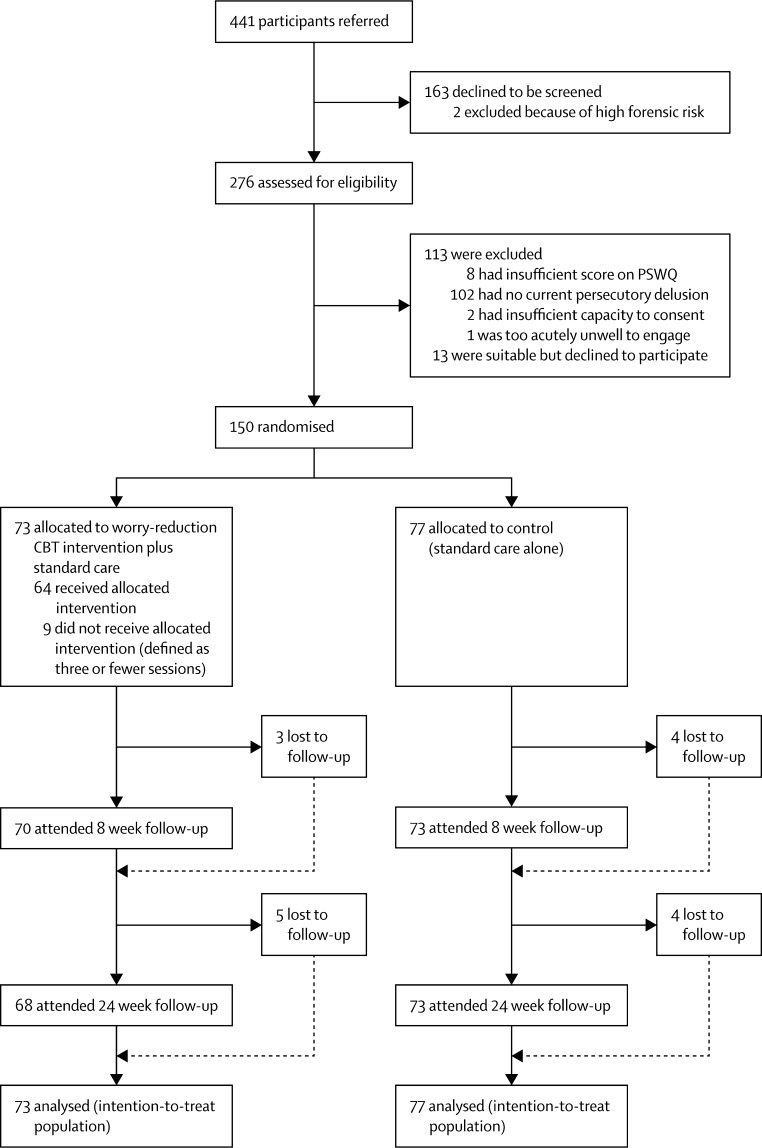
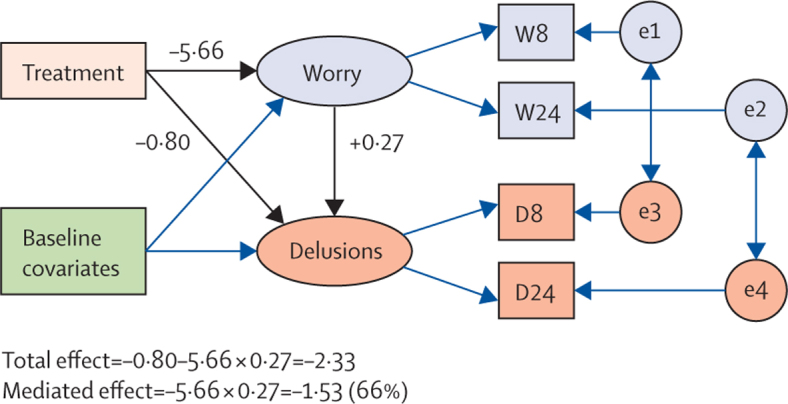
BACKGROUND: Worry might be a contributory causal factor in the occurrence of persecutory delusions in patients with psychotic disorders. Therefore we postulated that reducing worry with cognitive behaviour therapy (CBT) would reduce persecutory delusions. METHODS: For our two-arm, assessor-blinded, randomised controlled trial (Worry Intervention Trial [WIT]), we recruited patients aged 18-65 years with persistent persecutory delusions but non-affective psychosis from two centres: the Oxford Health National Health Service (NHS) Foundation Trust (Oxford, UK) and the Southern Health NHS Foundation Trust (Southampton, UK). The key inclusion criteria for participants were a score of at least 3 on the Psychotic Symptoms Rating Scale (PSYRATS) denoting a current persecutory delusion; that the delusion had persisted for at least 3 months; a clinical diagnosis of schizophrenia, schizoaffective disorder, or delusional disorder; and a clinically significant level of worry. We randomly assigned (1:1) eligible patients, using a randomly permuted block procedure with variable block sizes and division by four strata, to either six sessions of worry-reduction CBT intervention done over 8 weeks added to standard care (the CBT-intervention group), or to standard care alone (the control group). The assessors were masked to patient allocations and did their assessments at week 0 (baseline), 8 weeks (end of treatment), and 24 weeks, follow-up. The primary outcomes were worry measured by the Penn State Worry Questionnaire (PSWQ) and delusions measured by the PSYRATS-delusion scale; we did the analyses in the intention-to-treat population, and also did a planned mediation analysis. This trial is registered with the ISRCTN Registry (number ISRCTN23197625) and is closed to new participants. FINDINGS: From Nov 1, 2011, to Sept 9, 2013, we recruited 150 eligible participants and randomly assigned 73 to the CBT intervention group, and 77 to the control group. 143 patients (95%) provided primary outcome follow-up data. Compared with standard care alone, at 8 weeks the CBT intervention significantly reduced worry (mean difference 6·35 [SE 1·56] PSWQ units, 95% CI 3·30-9·40; p<0·001) and persecutory delusions (2·08 [SE 0·73] PSYRATS units, 95% CI 0·64-3·51; p=0·005). The reductions were maintained to 24 weeks follow-up. The mediation analysis suggested that the change in worry accounted for 66% of the change in delusion. No patients died or were admitted to secure units during our study. Six suicide attempts (two in the CBT intervention group, and four in the control group) and two serious violent incidents (one in each group) were noted, but no adverse events were deemed related to the treatments or the assessments. INTERPRETATION: To our knowledge, this is the first large trial focused on persecutory delusions. We have shown that long-standing delusions were significantly reduced by a brief intervention targeted on worry, although the limitations for our study include no determination of the key elements within the intervention. Our results suggest that worry might cause paranoia, and that worry intervention techniques might be a beneficial addition to the standard treatment of psychosis. FUNDING: Efficacy and Mechanism Evaluation programme, which is a UK Medical Research Council and National Institute of Health Research partnership.
Overview
The claims and statistics of this paper haven’t been checked yet.
Run the check — free, no account needed. It reads the open-access text and checks the sources it cites.
Integrity signals
Registry
Cites
Statistics
Figures
Verification
Claims the paper makes
The claims and statistics of this paper haven’t been checked yet.
Run the check — free, no account needed. It reads the open-access text and checks the sources it cites.
Claims other papers make about this one
Each is checked against this paper’s own text: does it say what the citing paper says it does?
The source backs part of the claim, not all of it — or backs it for a different population, condition or comparison.
In the citing paper
“A controlled trial also found that an intervention targeting rumination in patients with psychosis significantly reduced paranoid delusions relative to standard care over 8 weeks.18”
From Dispositional Mindfulness and Psychotic Symptoms in Schizophrenia Spectrum Disorders: The Mediating Roles of Rumination and Negative Emotion (2022) · cites this paper as [18]
Experimental — accuracy not yet measuredThe cited source says what the claim attributes to it.
In the citing paper
“A different working group could have created a different needs analysis and chosen a different treatment focus, change methods and practical applications (see for example the CRISIS-, the WIT- or the OASIS-study) (150–152).”
From Developing a mechanism-based therapy for acute psychiatric inpatients with psychotic symptoms: an Intervention Mapping approach (2023) · cites this paper as [151]
The cited source says what the claim attributes to it.
In the citing paper
“with some promising early results [12–15]”
Self-check
Percentages, sums and reported differences re-computed from the paper’s own numbers.
The self-check needs the paper’s full text.
Citations
Cites
Baron, R. M., & Kenny, D. A. (1986) · Journal of Personality and Social Psychology · doi:10.1037/0022-3514.51.6.1173 · Cited by 91,532
Statistical Analysis With Missing Data
Lahiff, M., Little, R. J. A., & Rubin, D. B. (1989) · Journal of the American Statistical Association · doi:10.2307/2289883 · Cited by 17,385
Wechsler Abbreviated Scale of Intelligence
Dumont, R., Willis, J. O., Veizel, K., & Zibulsky, J. (2014) · Wiley eBooks · doi:10.1002/9781118660584.ese2519 · Cited by 5,546
Development and validation of the Penn State Worry Questionnaire
Meyer, T. J., Miller, M. L., Metzger, R. L., & Borkovec, T. D. (1990) · Behaviour Research and Therapy · doi:10.1016/0005-7967(90)90135-6 · Cited by 5,099
The Warwick-Edinburgh Mental Well-being Scale (WEMWBS): development and UK validation
Tennant, R., Hiller, L., Fishwick, R., Platt, S., Joseph, S., Weich, S., Parkinson, J., Secker, J., & Stewart-Brown, S. (2007) · Health and Quality of Life Outcomes · doi:10.1186/1477-7525-5-63 · Cited by 5,031
Statistical Analysis With Missing Data
Lazar, N. A. (2003) · Technometrics · doi:10.1198/tech.2003.s167 · Cited by 2,477
Latent Variable Modeling of Differences and Changes with Longitudinal Data
McArdle, J. J. (2009) · Annual Review of Psychology · doi:10.1146/annurev.psych.60.110707.163612 · Cited by 1,952
Weinman, J. A., Petrie, K. J., Moss-Morris, R. E., & Horne, R. (1996) · Psychology and Health · doi:10.1080/08870449608400270 · Cited by 1,557
HADDOCK, G., McCARRON, J., TARRIER, N., & FARAGHER, E. B. (1999) · Psychological Medicine · doi:10.1017/s0033291799008661 · Cited by 1,461
Yes, but what’s the mechanism? (don’t expect an easy answer).
Bullock, J. G., Green, D. P., & Ha, S. E. (2010) · Journal of Personality and Social Psychology · doi:10.1037/a0018933 · Cited by 1,063
Cited by
Sorted by citations
Reflecting on rumination: Consequences, causes, mechanisms and treatment of rumination
Watkins, E. R., & Roberts, H. (2020) · Behaviour Research and Therapy · doi:10.1016/j.brat.2020.103573 · Cited by 862
Freeman, D., Sheaves, B., Goodwin, G. M., Yu, L.-M., Nickless, A., Harrison, P. J., Emsley, R., Luik, A. I., Foster, R. G., Wadekar, V., et al. (2017) · The Lancet Psychiatry · doi:10.1016/s2215-0366(17)30328-0 · Cited by 652
Self-citationThe Lancet Psychiatry Commission on psychological treatments research in tomorrow's science
Holmes, E. A., Ghaderi, A., Harmer, C. J., Ramchandani, P. G., Cuijpers, P., Morrison, A. P., Roiser, J. P., Bockting, C. L. H., O'Connor, R. C., Shafran, R., et al. (2018) · The Lancet Psychiatry · doi:10.1016/s2215-0366(17)30513-8 · Cited by 624
Persecutory delusions: a cognitive perspective on understanding and treatment.
Freeman, D. (2016) · The Lancet Psychiatry · doi:10.1016/s2215-0366(16)00066-3 · Cited by 356
Self-citationAdvances in understanding and treating persecutory delusions: a review
Freeman, D., & Garety, P. (2014) · Social Psychiatry and Psychiatric Epidemiology · doi:10.1007/s00127-014-0928-7 · Cited by 348
Self-citationFreeman, D. H., Loe, B. S., Kingdon, D., Startup, H. M., Molodynski, A., Rosebrock, L. E., Brown, P., Sheaves, B., Waite, F., & Bird, J. C. (2019) · Psychological Medicine · doi:10.1017/s0033291719003155 · Cited by 327
Self-citationLaws, K. R., Darlington, N., Kondel, T. K., McKenna, P. J., & Jauhar, S. (2018) · BMC Psychology · doi:10.1186/s40359-018-0243-2 · Cited by 244
The role of emotion regulation in the characterization, development and treatment of psychopathology
Lincoln, T. M., Schulze, L., & Renneberg, B. (2022) · Nature Reviews Psychology · doi:10.1038/s44159-022-00040-4 · Cited by 234
Freeman, D., Waite, F., Startup, H., Myers, E., Lister, R., McInerney, J., Harvey, A. G., Geddes, J., Zaiwalla, Z., Luengo-Fernandez, R., et al. (2015) · The Lancet Psychiatry · doi:10.1016/s2215-0366(15)00314-4 · Cited by 219
Self-citationBighelli, I., Salanti, G., Huhn, M., Schneider‐Thoma, J., Krause, M., Reitmeir, C., Wallis, S., Schwermann, F., Pitschel‐Walz, G., Barbui, C., et al. (2018) · World Psychiatry · doi:10.1002/wps.20577 · Cited by 199
Moffa, G., Catone, G., Kuipers, J., Kuipers, E., Freeman, D. H., Marwaha, S., Lennox, B., Broome, M. R., & Bebbington, P. (2017) · Schizophrenia Bulletin · doi:10.1093/schbul/sbx013 · Cited by 151
Self-citationMei, C., van der Gaag, M., Nelson, B., Smit, F., Yuen, H. P., Berger, M., Krcmar, M., French, P., Amminger, G. P., Bechdolf, A., et al. (2021) · Clinical Psychology Review · doi:10.1016/j.cpr.2021.102005 · Cited by 143
Ludwig, L., Werner, D., & Lincoln, T. M. (2019) · Clinical Psychology Review · doi:10.1016/j.cpr.2019.101746 · Cited by 147
Mehl, S., Werner, D., & Lincoln, T. M. (2015) · Frontiers in Psychology · doi:10.3389/fpsyg.2015.01450 · Cited by 129
Relating Therapy for distressing auditory hallucinations: A pilot randomized controlled trial
Hayward, M., Jones, A.-M., Bogen-Johnston, L., Thomas, N., & Strauss, C. (2017) · Schizophrenia Research · doi:10.1016/j.schres.2016.11.019 · Cited by 128
Freeman, D. H., Pugh, K., Dunn, G., Evans, N., Sheaves, B., Waite, F., Černis, E., Lister, R., & Fowler, D. G. (2014) · Schizophrenia Research · doi:10.1016/j.schres.2014.10.038 · Cited by 137
Self-citationFreeman, D., Emsley, R., Diamond, R., Collett, N., Bold, E., Chadwick, E., Isham, L., Bird, J. C., Edwards, D., Kingdon, D., et al. (2021) · The Lancet Psychiatry · doi:10.1016/s2215-0366(21)00158-9 · Cited by 127
Self-citationTreatable clinical intervention targets for patients with schizophrenia
Freeman, D., Taylor, K. M., Molodynski, A., & Waite, F. (2019) · Schizophrenia Research · doi:10.1016/j.schres.2019.07.016 · Cited by 125
Self-citationA systematic review and meta-analysis of low intensity CBT for psychosis
Hazell, C. M., Hayward, M., Cavanagh, K., & Strauss, C. (2016) · Clinical Psychology Review · doi:10.1016/j.cpr.2016.03.004 · Cited by 120
Lincoln, T. M., & PETERS, E. R. (2018) · Schizophrenia Research · doi:10.1016/j.schres.2017.12.014 · Cited by 124
Oldershaw, A., Startup, H. M., & Lavender, T. (2019) · Frontiers in Psychology · doi:10.3389/fpsyg.2019.00219 · Cited by 131
Self-citationTreating Sleep Problems in Patients with Schizophrenia
Waite, F., Myers, E., Harvey, A. G., Espie, C. A., Startup, H., Sheaves, B., & Freeman, D. H. (2015) · Behavioural and Cognitive Psychotherapy · doi:10.1017/s1352465815000430 · Cited by 103
Self-citationMoritz, S., Pfuhl, G., Lüdtke, T., Menon, M., Balzan, R. P., & Andreou, C. (2016) · Journal of Behavior Therapy and Experimental Psychiatry · doi:10.1016/j.jbtep.2016.07.004 · Cited by 99
Garety, P. A., Ward, T., Emsley, R., Greenwood, K., Freeman, D. H., Fowler, D. G., Kuipers, E., Bebbington, P., Rus‐Calafell, M., McGourty, A., et al. (2021) · JAMA Psychiatry · doi:10.1001/jamapsychiatry.2021.0326 · Cited by 105
Self-citationHarvey, A. G., Dong, L., Hein, K., Yu, S. H., Martinez, A. J., Gumport, N. B., Smith, F. L., Chapman, A., Lisman, M., Mirzadegan, I. A., et al. (2021) · Journal of Consulting and Clinical Psychology · doi:10.1037/ccp0000650 · Cited by 108
The paranoia as defence model of persecutory delusions: a systematic review and meta-analysis
Murphy, P., Bentall, R. P., Freeman, D. H., O’Rourke, S. J., & Hutton, P. (2018) · The Lancet Psychiatry · doi:10.1016/s2215-0366(18)30339-0 · Cited by 95
Self-citationNaeem, F., Khoury, B., Munshi, T., Ayub, M., Lecomte, T., Kingdon, D., & Farooq, S. (2016) · International Journal of Cognitive Therapy · doi:10.1521/ijct_2016_09_04 · Cited by 80
Self-citationTransdiagnostic Extension of Delusions: Schizophrenia and Beyond
Bebbington, P., & Freeman, D. H. (2017) · Schizophrenia Bulletin · doi:10.1093/schbul/sbw191 · Cited by 84
Self-citationGarety, P. A., Ward, T., Freeman, D. H., Fowler, D. G., Emsley, R., Dunn, G., Kuipers, E., Bebbington, P., Waller, H., Greenwood, K., et al. (2017) · Trials · doi:10.1186/s13063-017-2242-7 · Cited by 66
Self-citationMcDonagh, M. S., Dana, T., Kopelovich, S. L., Monroe‐DeVita, M., Blazina, I., Bougatsos, C., Grusing, S., & Selph, S. (2021) · Psychiatric Services · doi:10.1176/appi.ps.202000649 · Cited by 68
Nittel, C. M., Lincoln, T. M., Lamster, F., Leube, D., Rief, W., Kircher, T. T. J., & Mehl, S. (2018) · British Journal of Clinical Psychology · doi:10.1111/bjc.12174 · Cited by 62
Establishing how psychological therapies work: the importance of mediation analysis
Windgassen, S., Goldsmith, K., Moss-Morris, R. E., & Chalder, T. (2016) · Journal of Mental Health · doi:10.3109/09638237.2015.1124400 · Cited by 67
Understanding, treating, and renaming grandiose delusions: A qualitative study
Isham, L., Griffith, L., Boylan, A. R., Hicks, A., Wilson, N., Byrne, R. E., Sheaves, B., Bentall, R. P., & Freeman, D. H. (2019) · Psychology and Psychotherapy Theory Research and Practice · doi:10.1111/papt.12260 · Cited by 56
Self-citationLiu, J., Chua, J. J.-X., Chong, S. A., Subramaniam, M., & Mahendran, R. (2020) · Journal of Clinical Psychology · doi:10.1002/jclp.22915 · Cited by 60
Adapted CBT to stabilize sleep on psychiatric wards: a transdiagnostic treatment approach
Sheaves, B., Isham, L., Bradley, J., Espie, C., Barrera, A., Waite, F., Harvey, A. G., Attard, C., & Freeman, D. (2018) · Behavioural and Cognitive Psychotherapy · doi:10.1017/s1352465817000789 · Cited by 55
“The process of worry and the impact it had on sleep was targeted by integrating worry periods into the early evening routine, following a briefer form of the method used in Freeman et al. (2015a).”
BackgroundMethodSelf-citationSzymczyńska, P., Walsh, S., Greenberg, L., & Priebe, S. (2017) · Journal of Psychiatric Research · doi:10.1016/j.jpsychires.2017.02.009 · Cited by 62
Nightmares in the general population: identifying potential causal factors
Rek, S. V., Sheaves, B., & Freeman, D. H. (2017) · Social Psychiatry and Psychiatric Epidemiology · doi:10.1007/s00127-017-1408-7 · Cited by 55
Self-citationBelief Updating and Paranoia in Individuals With Schizophrenia
Sheffield, J. M., Suthaharan, P., Leptourgos, P., & Corlett, P. R. (2022) · Biological Psychiatry Cognitive Neuroscience and Neuroimaging · doi:10.1016/j.bpsc.2022.03.013 · Cited by 57
Jaya, E. S., Ascone, L., & Lincoln, T. M. (2017) · Psychological Medicine · doi:10.1017/s003329171700277x · Cited by 58
Understanding the mental health burden of COVID-19 in the United Kingdom.
Lopes, B., & Jaspal, R. (2020) · Psychological Trauma Theory Research Practice and Policy · doi:10.1037/tra0000632 · Cited by 60
CBT for schizophrenia: a critical viewpoint
Jauhar, S., Laws, K. R., & McKenna, P. J. (2019) · Psychological Medicine · doi:10.1017/s0033291718004166 · Cited by 52
Kuipers, J., Moffa, G., Kuipers, E., Freeman, D., & Bebbington, P. (2018) · Psychological Medicine · doi:10.1017/s0033291718000879 · Cited by 50
Self-citationFreeman, D., Bradley, J., Waite, F., Sheaves, B., DeWeever, N., Bourke, E., McInerney, J., Evans, N., Černis, E., Lister, R., et al. (2016) · Behavioural and Cognitive Psychotherapy · doi:10.1017/s1352465816000060 · Cited by 50
Self-citationDeveloping an automated VR cognitive treatment for psychosis: gameChange VR therapy
Lambe, S., Knight, I., Kabir, T., West, J., Patel, R., Lister, R., Rosebrock, L., Rovira, A., Garnish, B., Freeman, J., et al. (2020) · Journal of Behavioral and Cognitive Therapy · doi:10.1016/j.jbct.2019.12.001 · Cited by 48
Self-citationMoment-to-moment associations between negative affect, aberrant salience, and paranoia
So, S. H., Chau, A. K. C., PETERS, E. R., Swendsen, J. D., Garety, P. A., & Kapur, S. (2018) · Cognitive Neuropsychiatry · doi:10.1080/13546805.2018.1503080 · Cited by 48
Brief Coping Strategy Enhancement for Distressing Voices: an Evaluation in Routine Clinical Practice
Hayward, M., Edgecumbe, R., Bibby-Jones, A.-M., Berry, C., & Strauss, C. (2017) · Behavioural and Cognitive Psychotherapy · doi:10.1017/s1352465817000388 · Cited by 48
Bird, J. C., Waite, F., Rowsell, E., Fergusson, E. C., & Freeman, D. H. (2017) · Psychiatry Research · doi:10.1016/j.psychres.2017.07.023 · Cited by 48
Self-citationCognitive behavioural therapy plus standard care versus standard care for people with schizophrenia
Jones, C. R., Hacker, D., Xia, J., Meaden, A., Irving, C. B., Zhao, S., Chen, J., & Shi, C. (2018) · Cochrane Database of Systematic Reviews · doi:10.1002/14651858.cd007964.pub2 · Cited by 51
The Dunn Worry Questionnaire and the Paranoia Worries Questionnaire: new assessments of worry
Freeman, D. H., Bird, J. C., Loe, B. S., Kingdon, D., Startup, H. M., Clark, D. M., Ehlers, A., Černis, E., Wingham, G., Evans, N., et al. (2019) · Psychological Medicine · doi:10.1017/s0033291719000588 · Cited by 48
Self-citationWorry processes in patients with persecutory delusions.
Startup, H., Pugh, K., Dunn, G., Cordwell, J., Mander, H., Černis, E., Wingham, G., Shirvell, K., Kingdon, D., & Freeman, D. (2016) · British Journal of Clinical Psychology · doi:10.1111/bjc.12109 · Cited by 42
Self-citationLandau, S., Emsley, R., & Dunn, G. (2018) · Clinical Trials · doi:10.1177/1740774518760300 · Cited by 43
Self-citationTraumatic loss and psychosis – Reconceptualising the role of trauma in psychosis.
Vallath, S., Ravikanth, L., Regeer, B., Borba, P. C., Henderson, D. C., & Scholte, W. F. (2020) · European Journal of Psychotraumatology · doi:10.1080/20008198.2020.1725322 · Cited by 42
Individualized metacognitive therapy for delusions: A randomized controlled rater-blind study
Andreou, C., Wittekind, C. E., Fieker, M., Heitz, U., Veckenstedt, R., Bohn, F., & Moritz, S. (2016) · Journal of Behavior Therapy and Experimental Psychiatry · doi:10.1016/j.jbtep.2016.11.013 · Cited by 47
Visually Perceiving the Intentions of Others
Helton, G. (2017) · The Philosophical Quarterly · doi:10.1093/pq/pqx051 · Cited by 41
Blodgett, J. M., Birch, J. M., Musella, M., Harkness, F., & Kaushal, A. (2022) · International Journal of Environmental Research and Public Health · doi:10.3390/ijerph192315845 · Cited by 50
Developmental Aspects of Schizotypy and Suspiciousness: a Review
Wong, K. K., & Raine, A. (2018) · Current Behavioral Neuroscience Reports · doi:10.1007/s40473-018-0144-y · Cited by 43
Lewandowski, K. E., Öngür, D., & Keshavan, M. S. (2017) · Schizophrenia Research · doi:10.1016/j.schres.2017.06.010 · Cited by 40
Unravelling psychosis: psychosocial epidemiology, mechanism, and meaning.
Bebbington, P. (2015) · Europe PMC (PubMed Central) · doi:10.11919/j.issn.1002-0829.215027 · Cited by 38
Barnby, J. M., Deeley, Q., Robinson, O. J., Raihani, N., Bell, V., & Mehta, M. A. (2020) · Royal Society Open Science · doi:10.1098/rsos.191525 · Cited by 37
Awareness and rumination moderate the affective pathway to paranoia in daily life.
Ludwig, L., Mehl, S., Schlier, B., Krkovic, K., & Lincoln, T. (2019) · Schizophrenia Research · doi:10.1016/j.schres.2019.12.007 · Cited by 35
Freeman, D., Sheaves, B., Goodwin, G. M., Yu, L.-M., Harrison, P. J., Emsley, R., Bostock, S., Foster, R. G., Wadekar, V., Hinds, C., et al. (2015) · Trials · doi:10.1186/s13063-015-0756-4 · Cited by 35
Self-citationDelusional disorder and schizophrenia: a comparative study across multiple domains
Peralta, V., & Cuesta, M. J. (2016) · Psychological Medicine · doi:10.1017/s0033291716001501 · Cited by 35
Opoka, S. M., & Lincoln, T. M. (2017) · Psychiatric Clinics of North America · doi:10.1016/j.psc.2017.08.005 · Cited by 33
PETERS, E. R., Crombie, T., Agbedjro, D., Johns, L., Stahl, D. R., Greenwood, K., Keen, N., Onwumere, J., Hunter, E. C. M., Smith, L., et al. (2015) · Frontiers in Psychology · doi:10.3389/fpsyg.2015.01658 · Cited by 34
Capturing behavioral indicators of persecutory ideation using mobile technology
Buck, B., Hallgren, K. A., Scherer, E. A., Brian, R., Wang, R., Wang, W., Campbell, A. T., Choudhury, T., Hauser, M., Kane, J. M., et al. (2019) · Journal of Psychiatric Research · doi:10.1016/j.jpsychires.2019.06.002 · Cited by 32
Sellers, R., Wells, A., & Morrison, A. P. (2018) · Clinical Psychology & Psychotherapy · doi:10.1002/cpp.2132 · Cited by 32
Oh, H. Y., Singh, F., Koyanagi, A., Jameson, N. D., Schiffman, J. E., & DeVylder, J. (2016) · Schizophrenia Research · doi:10.1016/j.schres.2016.01.018 · Cited by 32
Do depressive symptoms predict paranoia or vice versa?
Moritz, S., Göritz, A. S., McLean, B., Westermann, S., & Brodbeck, J. (2017) · Journal of Behavior Therapy and Experimental Psychiatry · doi:10.1016/j.jbtep.2016.10.002 · Cited by 30
Kopelovich, S. L., Strachan, E. D., Sivec, H. J., & Kreider, V. A. L. (2019) · Community Mental Health Journal · doi:10.1007/s10597-018-00365-6 · Cited by 31
Freeman, D. H., Waite, F., Emsley, R., Kingdon, D., Davies, L. M., Fitzpatrick, R. M., & Dunn, G. (2016) · Trials · doi:10.1186/s13063-016-1245-0 · Cited by 29
Self-citationMorrison, A. P., Shryane, N. M., Fowler, D. G., Birchwood, M. J., Gumley, A. I., Taylor, H. E., French, P., Stewart, S., Jones, P. B., Lewis, S. W., et al. (2015) · Psychological Medicine · doi:10.1017/s0033291715000689 · Cited by 29
Motive-oriented therapeutic relationship building for patients diagnosed with schizophrenia
Westermann, S., Cavelti, M., Heibach, E., & Caspar, F. (2015) · Frontiers in Psychology · doi:10.3389/fpsyg.2015.01294 · Cited by 26
The Perseverative Thinking Questionnaire in Patients with Persecutory Delusions
Černis, E., Dunn, G., Startup, H. M., Kingdon, D., Wingham, G., Evans, N., Lister, R., Pugh, K., Cordwell, J., Mander, H., et al. (2015) · Behavioural and Cognitive Psychotherapy · doi:10.1017/s1352465815000533 · Cited by 26
Self-citationKonsztowicz, S., Schmitz, N., & Lepage, M. (2018) · Schizophrenia Research · doi:10.1016/j.schres.2018.02.055 · Cited by 26
Muñoz-Negro, J. E., Gómez-Sierra, F. J., Peralta, V., González-Rodríguez, A., & Cervilla, J. A. (2020) · International Clinical Psychopharmacology · doi:10.1097/yic.0000000000000306 · Cited by 26
Premature commitment to uncertain decisions during human NMDA receptor hypofunction
Salvador, A., Arnal, L. H., Vinckier, F., Domenech, P., Raphaël Gaillard, B., & Wyart, V. (2022) · Nature Communications · doi:10.1038/s41467-021-27876-3 · Cited by 24
Greenwood, K., Gurnani, M., Ward, T., Vogel, E., Vella, C., McGourty, A., Robertson, S., Sacadura, C., Hardy, A., Rus‐Calafell, M., et al. (2022) · Psychology and Psychotherapy Theory Research and Practice · doi:10.1111/papt.12393 · Cited by 22
Self-citationRunning acceptance and commitment therapy groups for psychosis in community settings
Butler, L., Johns, L., Byrne, M., Joseph, C., O’Donoghue, E., Jolley, S., Morris, E. M. J., & Oliver, J. E. (2015) · Journal of Contextual Behavioral Science · doi:10.1016/j.jcbs.2015.12.001 · Cited by 25
Hazell, C. M., Greenwood, K., Fielding-Smith, S. F., Rammou, A., Bogen‐Johnston, L., Berry, C., Bibby-Jones, A.-M., & Hayward, M. (2018) · Frontiers in Psychology · doi:10.3389/fpsyg.2018.00727 · Cited by 25
Guo, Z.-H., Li, Z.-J., Ma, Y., Sun, J., Guo, J.-H., Li, W.-X., Wang, Z.-Q., Xu, H.-L., Ng, R. M. K., Turkington, D., et al. (2017) · British Journal of Psychiatry · doi:10.1192/bjp.bp.116.183285 · Cited by 24
Self-citationRetractedSellers, R., Gawęda, Ł., Adrian Wells, A., & Morrison, A. P. (2016) · Psychiatry Research · doi:10.1016/j.psychres.2016.10.029 · Cited by 23
Hutton, P., Rienzo, F. D., Turkington, D., Spencer, H. M., & Taylor, P. J. (2018) · Schizophrenia Bulletin · doi:10.1093/schbul/sby153 · Cited by 22
Waller, H., Landau, S., Fornells-Ambrojo, M., Jolley, S., McCrone, P., Halkoree, R., Basit, N., Iredale, C., Tunnard, C., Zala, D., et al. (2018) · Journal of Behavior Therapy and Experimental Psychiatry · doi:10.1016/j.jbtep.2017.12.004 · Cited by 21
Conceptualising paranoia in ASD: A systematic review and development of a theoretical framework
Spain, D., Sin, J., & Freeman, D. H. (2016) · Research in Autism · doi:10.1016/j.rasd.2016.02.002 · Cited by 23
Self-citationSheffield, J. M., Brinen, A. P., & Freeman, D. H. (2021) · Frontiers in Psychiatry · doi:10.3389/fpsyt.2021.668152 · Cited by 22
Self-citationGawęda, Ł., Staszkiewicz, M., & Balzan, R. P. (2016) · Journal of Behavior Therapy and Experimental Psychiatry · doi:10.1016/j.jbtep.2016.08.003 · Cited by 25
Howells, F. M., Kingdon, D., & Baldwin, D. S. (2017) · Human Psychopharmacology Clinical and Experimental · doi:10.1002/hup.2628 · Cited by 22
Self-citationBrown, P., Waite, F., & Freeman, D. H. (2018) · Clinical Psychology Review · doi:10.1016/j.cpr.2018.12.003 · Cited by 20
Self-citationGarety, P. A., Ward, T., Emsley, R., Greenwood, K., Freeman, D. H., Fowler, D. G., Kuipers, E., Bebbington, P., Dunn, G., & Hardy, A. (2021) · Efficacy and Mechanism Evaluation · doi:10.3310/eme08110 · Cited by 19
Self-citationDifferent learning aberrations relate to delusion-like beliefs with different contents
Rossi-Goldthorpe, R. A., Silverstein, S. M., Gold, J. M., Schiffman, J. E., Waltz, J. A., Williams, T. F., Powers, A. R., Woods, S. W., Zinbarg, R. E., Mittal, V. A., et al. (2024) · Brain · doi:10.1093/brain/awae122 · Cited by 19
Taylor, C. D. J., Bee, P., KELLY, J. A., & Haddock, G. (2018) · Cognitive and Behavioral Practice · doi:10.1016/j.cbpra.2018.10.002 · Cited by 19
Cognitive Behavior Therapy for Psychosis
Kingdon, D., & Turkington, D. (2022) · Springer eBooks · doi:10.1007/978-3-031-10239-4_44 · Cited by 19
Self-citationRefining Suicide Prevention: a Narrative Review on Advances in Psychotherapeutic Tools
Calati, R., Courtet, P., & López‐Castromán, J. (2018) · Current Psychiatry Reports · doi:10.1007/s11920-018-0876-0 · Cited by 22
Steel, C., Korrelboom, K., Baksh, M. F., Kingdon, D., Simon, J., Wykes, T., Phiri, P., & van der Gaag, M. (2018) · Behaviour Research and Therapy · doi:10.1016/j.brat.2020.103734 · Cited by 17
Self-citationThe Pandemic Paranoia Scale (PPS): factor structure and measurement invariance across languages
Kingston, J. L., Schlier, B., Ellett, L., So, S. H., Gaudiano, B. A., Morris, E. M. J., & Lincoln, T. M. (2021) · Psychological Medicine · doi:10.1017/s0033291721004633 · Cited by 17
Cognitive therapy of psychosis: Research and implementation
Kingdon, D., & Turkington, D. (2017) · Schizophrenia Research · doi:10.1016/j.schres.2017.09.023 · Cited by 17
Self-citationFreeman, D. H., Morrison, A. P., Bird, J. C., Chadwick, E., Bold, E., Taylor, K. M., Diamond, R., Collett, N., Černis, E., Isham, L., et al. (2019) · BJPsych Open · doi:10.1192/bjo.2019.67 · Cited by 16
Self-citationCotter, J., Bucci, S., Drake, R., Yung, A. R., Carney, R., & Edge, D. (2018) · Early Intervention in Psychiatry · doi:10.1111/eip.12560 · Cited by 17
A Systematic Review of Trials Targeting Depression and Anxiety in Patients With Delusions
Opoka, S. M., Ludwig, L., & Lincoln, T. M. (2018) · Zeitschrift für Psychologie · doi:10.1027/2151-2604/a000331 · Cited by 16
Switzer, F., & Harper, S. F. (2019) · Psychosis · doi:10.1080/17522439.2019.1578400 · Cited by 16
Metadata
- Authors
- Freeman, D., Dunn, G., Startup, H., Pugh, K., Cordwell, J., Mander, H., Černis, E., Wingham, G., Shirvell, K., & Kingdon, D.
- Affiliations
- University of Oxford (GB)
- University of Liverpool (GB)
- Sussex Partnership NHS Foundation Trust (GB)
- University of Southampton (GB)
- Corresponding author
- Freeman, Daniel
- Venue
- The Lancet Psychiatry
- Publisher
- Elsevier BV
- Published
- 2015-04
- Volume
- 2
- Issue
- 4
- Pages
- 305-313
- ISSN
- 2215-0366 (ISSN-L)
- PMC
- PMC4698664
- OpenAlex
- W2135509506
- Cited by
- 295
- References
- 46
- Citations by year
- 2026: 27 · 2025: 20 · 2024: 19 · 2023: 17 · 2022: 19 · 2021: 27 · 2020: 27 · 2019: 31 · 2018: 36 · 2017: 32 · 2016: 24 · 2015: 13
- FWCI
- 28.38
- Type
- journal article
- Language
- en
- Open access
- hybrid
- doi.org
- Locations
- The Lancet Psychiatry (publishedVersion, cc-by)
- Europe PMC (PubMed Central) (publishedVersion, cc-by)
- PubMed Central (publishedVersion, cc-by)
- PubMed (publishedVersion)
- Research Explorer (The University of Manchester) (publishedVersion)
- ePrints Soton (University of Southampton) (acceptedVersion)
- University of Birmingham Research Portal (University of Birmingham) (submittedVersion)
- Funders
- UK MRC Senior Clinical Fellowship (G0902308)
- MRC (MR/K006185/1)
- Topics
- Health Sciences › Medicine › Psychiatry and Mental health › Schizophrenia research and treatment
- Social Sciences › Psychology › Experimental and Cognitive Psychology › Anxiety, Depression, Psychometrics, Treatment, Cognitive Processes
- Social Sciences › Psychology › Clinical Psychology › Psychological Treatments and Assessments
- Keywords
- cognitive behavioral therapy, worry reduction, persecutory delusions, psychosis, schizophrenia, schizoaffective disorder, delusional disorder, Penn State Worry Questionnaire, mediation analysis, medication adherence, relapse prevention, relapse prevention training
- MeSH terms
- Adolescent, Adult, Aged, Anxiety, Delusions, Female, Humans, Male, Middle Aged, Paranoid Disorders, Psychiatric Status Rating Scales, Psychotic Disorders, Schizophrenia, Schizophrenia, Paranoid, Cognitive Behavioral Therapy, Single-Blind Method
About these checks
Registry, retraction, Cites and statistics results are computed, not judged, with one exception: a printed reference that no index lists is read once by a model before it counts as a citation error. Claims are extracted by a model and kept only when their quote appears verbatim in the text; each cited source is then checked, with a model’s help, for whether it says what the claim relies on. Those verdicts can be wrong — read the claim’s quote and the cited source before relying on one.
Statistics and arithmetic are recomputed, not judged.
Confidence bands are shown only for fields calibrated on our annotated test set. None is calibrated yet, so no band is shown.
What counts as a claim ›How we measure confidence ›How we check this ›
Are you an author, or do you see a problem with this page? Request a review
