

The DOI matches its Crossref record; 43 of the 46 references it cites were found in a registry or an index.
Effects of cognitive behaviour therapy for worry on persecutory delusions in patients with psychosis (WIT): a parallel, single-blind, randomised controlled trial with a mediation analysis.
Open accessAbstract
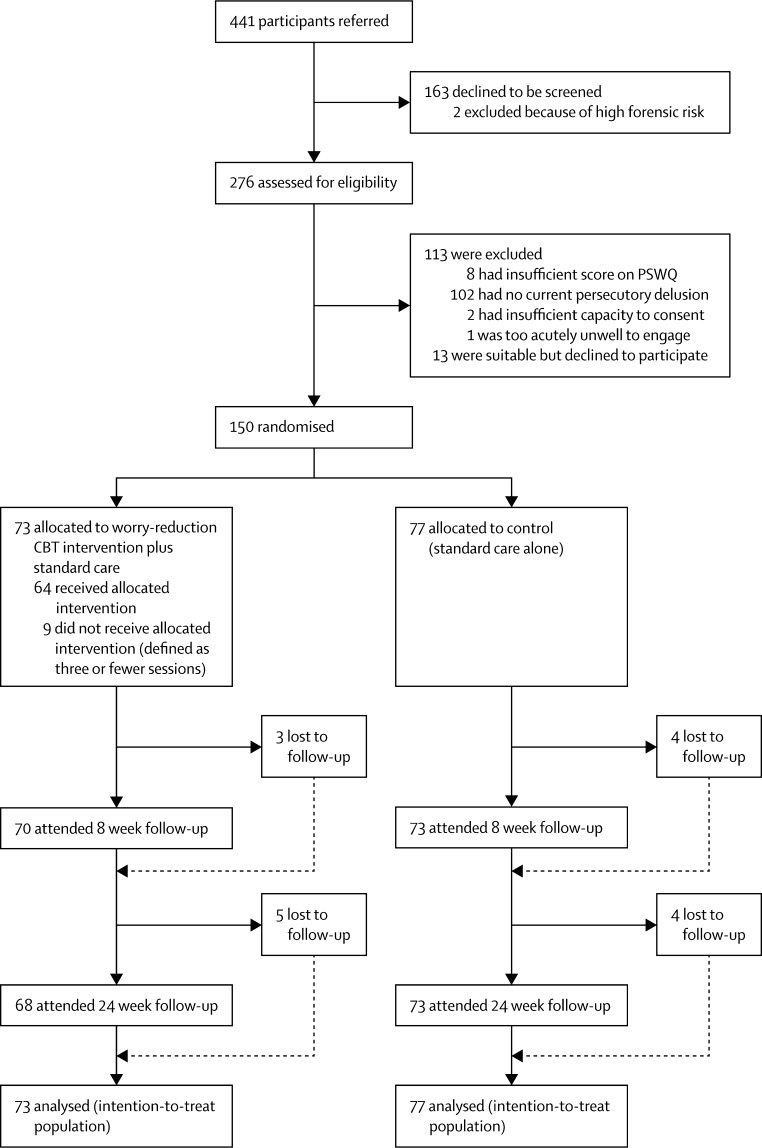
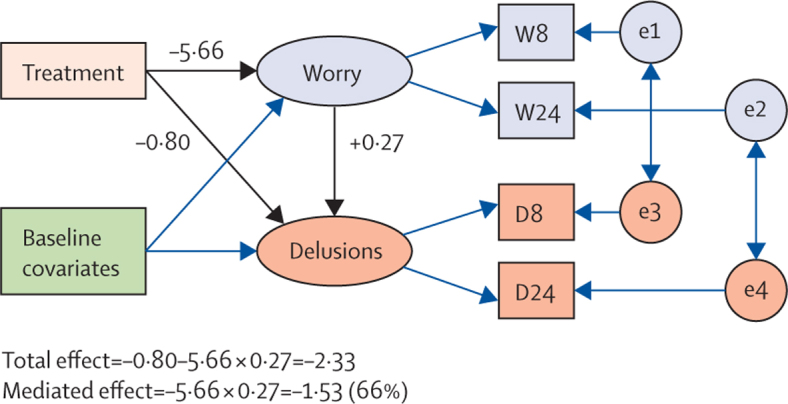
BACKGROUND: Worry might be a contributory causal factor in the occurrence of persecutory delusions in patients with psychotic disorders. Therefore we postulated that reducing worry with cognitive behaviour therapy (CBT) would reduce persecutory delusions. METHODS: For our two-arm, assessor-blinded, randomised controlled trial (Worry Intervention Trial [WIT]), we recruited patients aged 18-65 years with persistent persecutory delusions but non-affective psychosis from two centres: the Oxford Health National Health Service (NHS) Foundation Trust (Oxford, UK) and the Southern Health NHS Foundation Trust (Southampton, UK). The key inclusion criteria for participants were a score of at least 3 on the Psychotic Symptoms Rating Scale (PSYRATS) denoting a current persecutory delusion; that the delusion had persisted for at least 3 months; a clinical diagnosis of schizophrenia, schizoaffective disorder, or delusional disorder; and a clinically significant level of worry. We randomly assigned (1:1) eligible patients, using a randomly permuted block procedure with variable block sizes and division by four strata, to either six sessions of worry-reduction CBT intervention done over 8 weeks added to standard care (the CBT-intervention group), or to standard care alone (the control group). The assessors were masked to patient allocations and did their assessments at week 0 (baseline), 8 weeks (end of treatment), and 24 weeks, follow-up. The primary outcomes were worry measured by the Penn State Worry Questionnaire (PSWQ) and delusions measured by the PSYRATS-delusion scale; we did the analyses in the intention-to-treat population, and also did a planned mediation analysis. This trial is registered with the ISRCTN Registry (number ISRCTN23197625) and is closed to new participants. FINDINGS: From Nov 1, 2011, to Sept 9, 2013, we recruited 150 eligible participants and randomly assigned 73 to the CBT intervention group, and 77 to the control group. 143 patients (95%) provided primary outcome follow-up data. Compared with standard care alone, at 8 weeks the CBT intervention significantly reduced worry (mean difference 6·35 [SE 1·56] PSWQ units, 95% CI 3·30-9·40; p<0·001) and persecutory delusions (2·08 [SE 0·73] PSYRATS units, 95% CI 0·64-3·51; p=0·005). The reductions were maintained to 24 weeks follow-up. The mediation analysis suggested that the change in worry accounted for 66% of the change in delusion. No patients died or were admitted to secure units during our study. Six suicide attempts (two in the CBT intervention group, and four in the control group) and two serious violent incidents (one in each group) were noted, but no adverse events were deemed related to the treatments or the assessments. INTERPRETATION: To our knowledge, this is the first large trial focused on persecutory delusions. We have shown that long-standing delusions were significantly reduced by a brief intervention targeted on worry, although the limitations for our study include no determination of the key elements within the intervention. Our results suggest that worry might cause paranoia, and that worry intervention techniques might be a beneficial addition to the standard treatment of psychosis. FUNDING: Efficacy and Mechanism Evaluation programme, which is a UK Medical Research Council and National Institute of Health Research partnership.
Overview
The claims and statistics of this paper haven’t been checked yet.
Run the check — free, no account needed. It reads the open-access text and checks the sources it cites.
Integrity signals
Registry
Cites
Statistics
Figures
Verification
Claims the paper makes
The claims and statistics of this paper haven’t been checked yet.
Run the check — free, no account needed. It reads the open-access text and checks the sources it cites.
Claims other papers make about this one
Each is checked against this paper’s own text: does it say what the citing paper says it does?
The source backs part of the claim, not all of it — or backs it for a different population, condition or comparison.
In the citing paper
“A controlled trial also found that an intervention targeting rumination in patients with psychosis significantly reduced paranoid delusions relative to standard care over 8 weeks.18”
From Dispositional Mindfulness and Psychotic Symptoms in Schizophrenia Spectrum Disorders: The Mediating Roles of Rumination and Negative Emotion (2022) · cites this paper as [18]
Experimental — accuracy not yet measuredThe cited source says what the claim attributes to it.
In the citing paper
“A different working group could have created a different needs analysis and chosen a different treatment focus, change methods and practical applications (see for example the CRISIS-, the WIT- or the OASIS-study) (150–152).”
From Developing a mechanism-based therapy for acute psychiatric inpatients with psychotic symptoms: an Intervention Mapping approach (2023) · cites this paper as [151]
The cited source says what the claim attributes to it.
In the citing paper
“with some promising early results [12–15]”
Self-check
Percentages, sums and reported differences re-computed from the paper’s own numbers.
The self-check needs the paper’s full text.
Citations
Cites
Baron, R. M., & Kenny, D. A. (1986) · Journal of Personality and Social Psychology · doi:10.1037/0022-3514.51.6.1173 · Cited by 91,532
Statistical Analysis With Missing Data
Lahiff, M., Little, R. J. A., & Rubin, D. B. (1989) · Journal of the American Statistical Association · doi:10.2307/2289883 · Cited by 17,385
Wechsler Abbreviated Scale of Intelligence
Dumont, R., Willis, J. O., Veizel, K., & Zibulsky, J. (2014) · Wiley eBooks · doi:10.1002/9781118660584.ese2519 · Cited by 5,546
Development and validation of the Penn State Worry Questionnaire
Meyer, T. J., Miller, M. L., Metzger, R. L., & Borkovec, T. D. (1990) · Behaviour Research and Therapy · doi:10.1016/0005-7967(90)90135-6 · Cited by 5,099
The Warwick-Edinburgh Mental Well-being Scale (WEMWBS): development and UK validation
Tennant, R., Hiller, L., Fishwick, R., Platt, S., Joseph, S., Weich, S., Parkinson, J., Secker, J., & Stewart-Brown, S. (2007) · Health and Quality of Life Outcomes · doi:10.1186/1477-7525-5-63 · Cited by 5,031
Statistical Analysis With Missing Data
Lazar, N. A. (2003) · Technometrics · doi:10.1198/tech.2003.s167 · Cited by 2,477
Latent Variable Modeling of Differences and Changes with Longitudinal Data
McArdle, J. J. (2009) · Annual Review of Psychology · doi:10.1146/annurev.psych.60.110707.163612 · Cited by 1,952
Weinman, J. A., Petrie, K. J., Moss-Morris, R. E., & Horne, R. (1996) · Psychology and Health · doi:10.1080/08870449608400270 · Cited by 1,557
HADDOCK, G., McCARRON, J., TARRIER, N., & FARAGHER, E. B. (1999) · Psychological Medicine · doi:10.1017/s0033291799008661 · Cited by 1,461
Yes, but what’s the mechanism? (don’t expect an easy answer).
Bullock, J. G., Green, D. P., & Ha, S. E. (2010) · Journal of Personality and Social Psychology · doi:10.1037/a0018933 · Cited by 1,063
Ehring, T., Zetsche, U., Weidacker, K., Wahl, K., Schönfeld, S., & Ehlers, A. (2011) · Journal of Behavior Therapy and Experimental Psychiatry · doi:10.1016/j.jbtep.2010.12.003 · Cited by 888
Costing psychiatric interventions.
Beecham, J. K., & Knapp, M. R. J. (1992) · Kent Academic Repository (University of Kent) · Cited by 710
Slade, M., & Thornicroft, G. (2025) · doi:10.1093/med/9780198898818.003.0007 · Cited by 679
The Cement of the Universe: A Study of Causation.
Berofsky, B., & Mackie, J. L. (1977) · The Journal of Philosophy · doi:10.2307/2025574 · Cited by 637
The revised cognitive therapy scale (CTS-R): psychometric properties.
Blackburn, I.-M., James, I. A., Milne, D. L., Baker, C., Standart, S., Garland, A., & Reichelt, F. K. (2001) · Behavioural and Cognitive Psychotherapy · doi:10.1017/s1352465801004040 · Cited by 568
The Maudsley Addiction Profile (MAP): a brief instrument for assessing treatment outcome
Marsden, J., Gossop, M., Stewart, D., Best, D. W., Farrell, M., Lehmann, P., Edwards, C., & Strang, J. (1998) · Addiction · doi:10.1046/j.1360-0443.1998.9312185711.x · Cited by 487
Worry and its Psychological Disorders
Adrian Wells, A., & Davey, G. C. L. (2006) · Wiley eBooks · doi:10.1002/9780470713143 · Cited by 451
Reasoning, Emotions, and Delusional Conviction in Psychosis.
Garety, P. A., Freeman, D. H., Jolley, S., Dunn, G., Bebbington, P., Fowler, D. G., Kuipers, E., & Dudley, R. E. J. (2005) · Journal of Abnormal Psychology · doi:10.1037/0021-843x.114.3.373 · Cited by 438
Self-citationGreen, C. E. L., Freeman, D., Kuipers, E., Bebbington, P., Fowler, D., Dunn, G., & Garety, P. A. (2008) · Psychological Medicine · doi:10.1017/s0033291707001638 · Cited by 401
Self-citationvan der Gaag, M., Smit, F., Bechdolf, A., French, P., Linszen, D. H., Yung, A. R., McGorry, P., & Cuijpers, P. (2013) · Schizophrenia Research · doi:10.1016/j.schres.2013.07.004 · Cited by 384
Emsley, R., Dunn, G., & White, I. R. (2010) · Statistical Methods in Medical Research · doi:10.1177/0962280209105014 · Cited by 356
Self-citationAdvances in understanding and treating persecutory delusions: a review
Freeman, D., & Garety, P. (2014) · Social Psychiatry and Psychiatric Epidemiology · doi:10.1007/s00127-014-0928-7 · Cited by 348
Self-citationComments on the content of persecutory delusions: Does the definition need clarification?
Freeman, D. H., & Garety, P. A. (2000) · British Journal of Clinical Psychology · doi:10.1348/014466500163400 · Cited by 334
Self-citationVirtual reality study of paranoid thinking in the general population
Freeman, D. H., Pugh, K., Antley, A., Slater, M., Bebbington, P., Gittins, M., Dunn, G., Kuipers, E., Fowler, D. G., & Garety, P. A. (2008) · The British Journal of Psychiatry · doi:10.1192/bjp.bp.107.044677 · Cited by 315
Self-citationvan der Gaag, M., Valmaggia, L. R., & Smit, F. (2014) · Schizophrenia Research · doi:10.1016/j.schres.2014.03.016 · Cited by 271
Freeman, D., Stahl, D., McManus, S., Meltzer, H., Brugha, T., Wiles, N., & Bebbington, P. (2012) · Social Psychiatry and Psychiatric Epidemiology · doi:10.1007/s00127-011-0433-1 · Cited by 246
Self-citationFreeman, D. H., & Garety, P. A. (1999) · Behavioural and Cognitive Psychotherapy · doi:10.1017/s135246589927107x · Cited by 218
Self-citationStartup, H. M., Freeman, D. H., & Garety, P. A. (2006) · Behaviour Research and Therapy · doi:10.1016/j.brat.2006.04.006 · Cited by 205
Self-citationTesting the continuum of delusional beliefs: An experimental study using virtual reality.
Freeman, D. H., Pugh, K., Vorontsova, N., Antley, A., & Slater, M. (2010) · Journal of Abnormal Psychology · doi:10.1037/a0017514 · Cited by 198
Self-citationInterventionist causal models in psychiatry: repositioning the mind–body problem
Kendler, K. S., & Campbell, J. (2009) · Psychological Medicine · doi:10.1017/s0033291708004467 · Cited by 173
A meta-analysis of cognitive therapy for worry in generalized anxiety disorder
Hanrahan, F., Field, A. P., Jones, F. W., & Davey, G. C. L. (2013) · Clinical Psychology Review · doi:10.1016/j.cpr.2012.10.008 · Cited by 159
Foster, C., Startup, H. M., Potts, L. C., & Freeman, D. H. (2009) · Journal of Behavior Therapy and Experimental Psychiatry · doi:10.1016/j.jbtep.2009.09.001 · Cited by 139
Self-citationAn experience sampling study of worry and rumination in psychosis
Hartley, S., Haddock, G., Vasconcelos e Sa, D., Emsley, R., & Barrowclough, C. (2014) · Psychological Medicine · doi:10.1017/s0033291713002080 · Cited by 138
Greenwood, K., Sweeney, A., Williams, S., Garety, P. A., Kuipers, E., Scott, J. L., & PETERS, E. R. (2009) · Schizophrenia Bulletin · doi:10.1093/schbul/sbp117 · Cited by 136
The Penn State Worry Questionnaire (PSWQ)
Startup, H. M., & Erickson, T. M. (2006) · Worry and its Psychological Disorders · doi:10.1002/9780470713143.ch7 · Cited by 124
Self-citationStatistical Evaluation of Measurement Errors: Design and Analysis of Reliability Studies
Dunn, G. D. (2004) · Cited by 115
Self-citationCognitive factors maintaining persecutory delusions in psychosis: The contribution of depression.
Vorontsova, N., Garety, P., & Freeman, D. (2013) · Journal of Abnormal Psychology · doi:10.1037/a0034952 · Cited by 107
Self-citationMorrison, A., & Wells, A. (2007) · Behaviour Research and Therapy · doi:10.1016/j.brat.2006.11.010 · Cited by 90
Freeman, D., Thompson, C., Vorontsova, N., Dunn, G., Carter, L.-A., Garety, P., Kuipers, E., Slater, M., Antley, A., Glucksman, E., et al. (2013) · Psychological Medicine · doi:10.1017/s003329171300038x · Cited by 79
Self-citationFreeman, D. H., Startup, H. M., Dunn, G., Černis, E., Wingham, G., Pugh, K., Cordwell, J., Mander, H., & Kingdon, D. (2014) · Psychological Medicine · doi:10.1017/s0033291714000592 · Cited by 59
Self-citationPositive and negative syndromes in schizophrenia
Tandon, R., & Greden, J. F. (1989) · American Journal of Psychiatry · doi:10.1176/ajp.146.3.407 · Cited by 38
Freeman, D. H., Dunn, G., Startup, H. M., & Kingdon, D. (2012) · Trials · doi:10.1186/1745-6215-13-223 · Cited by 20
Self-citationFreeman, D. H., & Freeman, J. (2013) · CERN Document Server (European Organization for Nuclear Research) · Cited by 3
Self-citation
Cited by
Sorted by citations
Reflecting on rumination: Consequences, causes, mechanisms and treatment of rumination
Watkins, E. R., & Roberts, H. (2020) · Behaviour Research and Therapy · doi:10.1016/j.brat.2020.103573 · Cited by 862
Freeman, D., Sheaves, B., Goodwin, G. M., Yu, L.-M., Nickless, A., Harrison, P. J., Emsley, R., Luik, A. I., Foster, R. G., Wadekar, V., et al. (2017) · The Lancet Psychiatry · doi:10.1016/s2215-0366(17)30328-0 · Cited by 652
Self-citationThe Lancet Psychiatry Commission on psychological treatments research in tomorrow's science
Holmes, E. A., Ghaderi, A., Harmer, C. J., Ramchandani, P. G., Cuijpers, P., Morrison, A. P., Roiser, J. P., Bockting, C. L. H., O'Connor, R. C., Shafran, R., et al. (2018) · The Lancet Psychiatry · doi:10.1016/s2215-0366(17)30513-8 · Cited by 624
Persecutory delusions: a cognitive perspective on understanding and treatment.
Freeman, D. (2016) · The Lancet Psychiatry · doi:10.1016/s2215-0366(16)00066-3 · Cited by 356
Self-citationAdvances in understanding and treating persecutory delusions: a review
Freeman, D., & Garety, P. (2014) · Social Psychiatry and Psychiatric Epidemiology · doi:10.1007/s00127-014-0928-7 · Cited by 348
Self-citation
Metadata
- Authors
- Freeman, D., Dunn, G., Startup, H., Pugh, K., Cordwell, J., Mander, H., Černis, E., Wingham, G., Shirvell, K., & Kingdon, D.
- Affiliations
- University of Oxford (GB)
- University of Liverpool (GB)
- Sussex Partnership NHS Foundation Trust (GB)
- University of Southampton (GB)
- Corresponding author
- Freeman, Daniel
- Venue
- The Lancet Psychiatry
- Publisher
- Elsevier BV
- Published
- 2015-04
- Volume
- 2
- Issue
- 4
- Pages
- 305-313
- ISSN
- 2215-0366 (ISSN-L)
- PMC
- PMC4698664
- OpenAlex
- W2135509506
- Cited by
- 295
- References
- 46
- Citations by year
- 2026: 27 · 2025: 20 · 2024: 19 · 2023: 17 · 2022: 19 · 2021: 27 · 2020: 27 · 2019: 31 · 2018: 36 · 2017: 32 · 2016: 24 · 2015: 13
- FWCI
- 28.38
- Type
- journal article
- Language
- en
- Open access
- hybrid
- doi.org
- Locations
- The Lancet Psychiatry (publishedVersion, cc-by)
- Europe PMC (PubMed Central) (publishedVersion, cc-by)
- PubMed Central (publishedVersion, cc-by)
- PubMed (publishedVersion)
- Research Explorer (The University of Manchester) (publishedVersion)
- ePrints Soton (University of Southampton) (acceptedVersion)
- University of Birmingham Research Portal (University of Birmingham) (submittedVersion)
- Funders
- UK MRC Senior Clinical Fellowship (G0902308)
- MRC (MR/K006185/1)
- Topics
- Health Sciences › Medicine › Psychiatry and Mental health › Schizophrenia research and treatment
- Social Sciences › Psychology › Experimental and Cognitive Psychology › Anxiety, Depression, Psychometrics, Treatment, Cognitive Processes
- Social Sciences › Psychology › Clinical Psychology › Psychological Treatments and Assessments
- Keywords
- cognitive behavioral therapy, worry reduction, persecutory delusions, psychosis, schizophrenia, schizoaffective disorder, delusional disorder, Penn State Worry Questionnaire, mediation analysis, medication adherence, relapse prevention, relapse prevention training
- MeSH terms
- Adolescent, Adult, Aged, Anxiety, Delusions, Female, Humans, Male, Middle Aged, Paranoid Disorders, Psychiatric Status Rating Scales, Psychotic Disorders, Schizophrenia, Schizophrenia, Paranoid, Cognitive Behavioral Therapy, Single-Blind Method
About these checks
Registry, retraction, Cites and statistics results are computed, not judged, with one exception: a printed reference that no index lists is read once by a model before it counts as a citation error. Claims are extracted by a model and kept only when their quote appears verbatim in the text; each cited source is then checked, with a model’s help, for whether it says what the claim relies on. Those verdicts can be wrong — read the claim’s quote and the cited source before relying on one.
Statistics and arithmetic are recomputed, not judged.
Confidence bands are shown only for fields calibrated on our annotated test set. None is calibrated yet, so no band is shown.
What counts as a claim ›How we measure confidence ›How we check this ›
Are you an author, or do you see a problem with this page? Request a review
